
Do You Have a Talent for Creating Art?
This blog post is illustrated by students of the 4-week online workshop Inspirational Drawing. All the illustrations shown here are created at the class by these wonderful artists: Deb Weiers, Chrissie, CHB, Valerie Lima, Sandy Guderyon, Mary W, Gloria Schurman, Katia Maliantovich, Nea Wiseman, Gina Meadows, Joanne, Jacqueline Kriesels, Marie Jerred, Sue Rowlands and C in Ohio.
Let’s start the actual blog post with a personal question: Do you ever wonder whether you are talented enough?
I used to think that some day I will meet a person, both knowledgeable and prestigious, who would tell whether my art is good or bad. That thought made me both excited and worried. I became excited when I thought that someone saw more in my art than I did myself. And I became worried when thinking about the opposite result: that my art, that beautiful tower I had built, would just collapse. I would collapse.
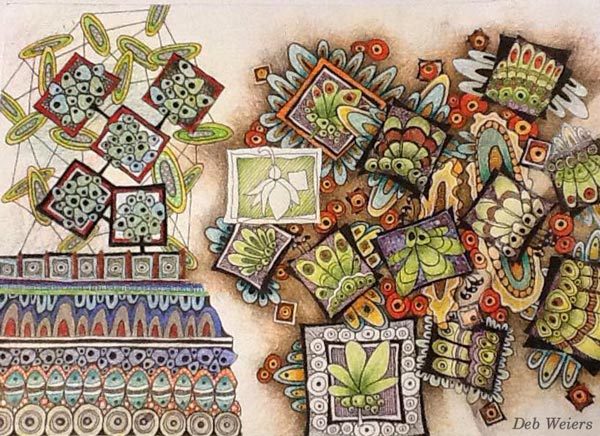
Years went by and I got tired of waiting for a specialist’s opinion. Maybe I could be my own critic? I went to study industrial design to find out how the quality of art and design would be set. While studying I realized that there are no right or wrong. People are different. Some may like art that somebody else does not, even if they both are art critics.
Somehow that made me even more puzzled. I didn’t know what kind of people would be my people, who would enjoy my art. And furthermore, if my art was bad, there wouldn’t be many of them.
However, I became convinced that somewhere in the world, there must be people that want to use their imagination and design whatever they like. They want to build houses …

… they want to travel …

… they feel drawn to beautiful patterns, and dream about enchanting gardens …

They want to learn from the history and use it to move forward in their own direction.
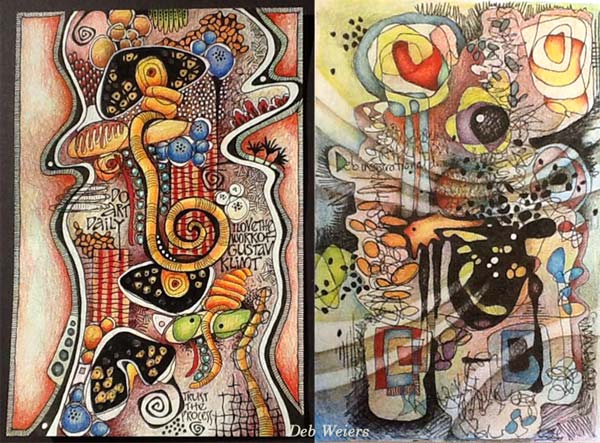
The more I examined whether I have the talent, I realized that art is not an absolute in any way. Art is a channel to express and communicate. If I look outside the window, and let my mind wonder on a path, the question is not how dimensional the window frames look like or how grey the stepping tones are. I find my people by sharing how uplifting the coolness feels like when walking barefoot on a hot summer day.

Even if there are theories about aesthetics, originality, playfulness etc. which determine good art, it is the experience that matters the most. If we feel connected to our art, there are much more chances that others will too.

By strengthening our connection, we will become more talented. We start creating more and seeing more. We will have more to express and more imagination to use. We can make people calm down in front of our art, or make them run and catch thoughts about their possibilities.

Nowadays, many ask me whether they have the talent. Even before they actually start.
Here’s the answer: Your talent cannot be determined by the grades you got while you were at school. Your talent cannot be determined by an opinion of a knowledgeable and prestigious specialist. Art is not about talent. It is about having something to say and work for saying it. It is about asking “what if” and finding the answer by using both your life experience and imagination. It is about looking out the window, seeing numerous possibilities for the perspective, and bravely picking your point of view.

So, do you have a talent for creating art? Always.
Subscribe to my weekly emails – Get a free mini-course!
A Natural Approach to Creating Art

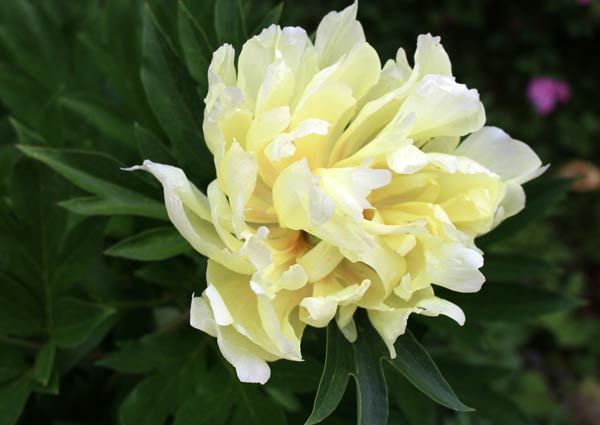
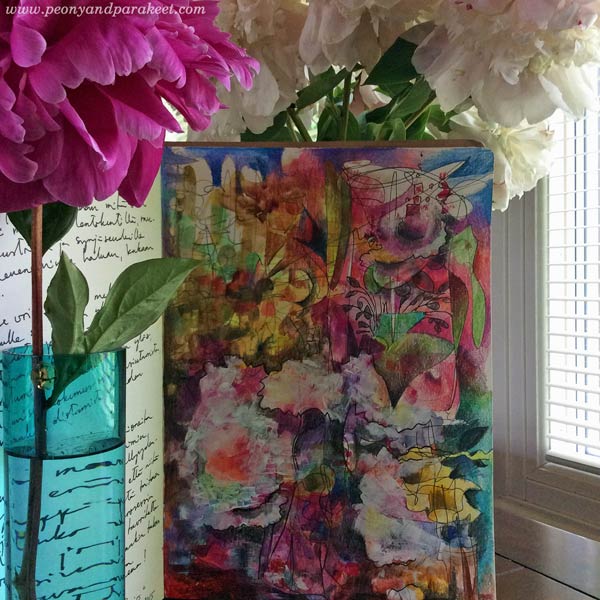
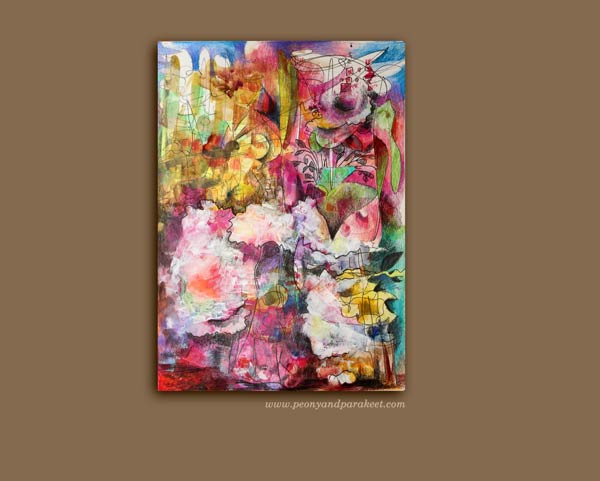
My latest art journal page is called “Withering Peonies.” What I love most about peonies is that they are always graceful and brave, whether they get ready for blooming or withering, whether it is late autumn or early spring. They are living in the middle of the continuous transformation, and it’s always enjoyable to watch them. They seem unique and individual; even every flower looks different from each other.
No Fixations, Just Painting and Doodling
When watching peonies, I think about the word “natural.” To be able to grow as artists, we need to learn to express ourselves naturally. Like peonies bend towards the light, we should bend towards our inner thoughts and feelings. So when I began to create the artwork, I did not think about anything particular, not even about peonies.

I started with acrylic paints and a palette knife creating thin spots of color using a restricted color palette. Then I changed to a drawing pen and let it move freely, without any fixated thought.

I believe that we suffocate our creativity when we have fixed images in our minds. We get disappointed if we cannot copy the images exactly on paper. But then, the fixed image is often imperfect, impossible to copy. It is more like a collection of visuals, a movie or an emotion that is not very detailed. If we fixate on that, we turn away from what is natural.
Moving forward is natural. It’s natural to let thoughts flow freely and add more colors and layers.
More Mixed Media
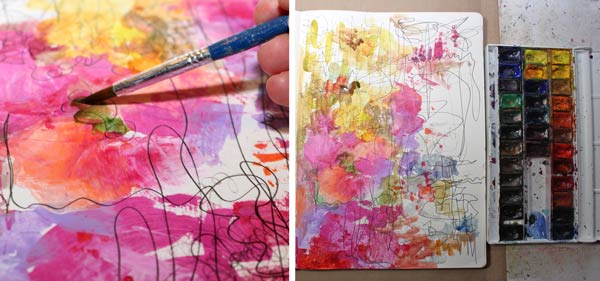
I used watercolors for some areas.
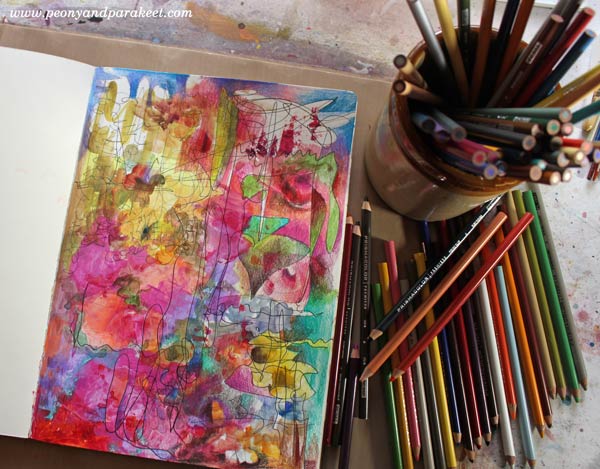
After watercolors, I worked with colored pencils.
A Theme Emerges
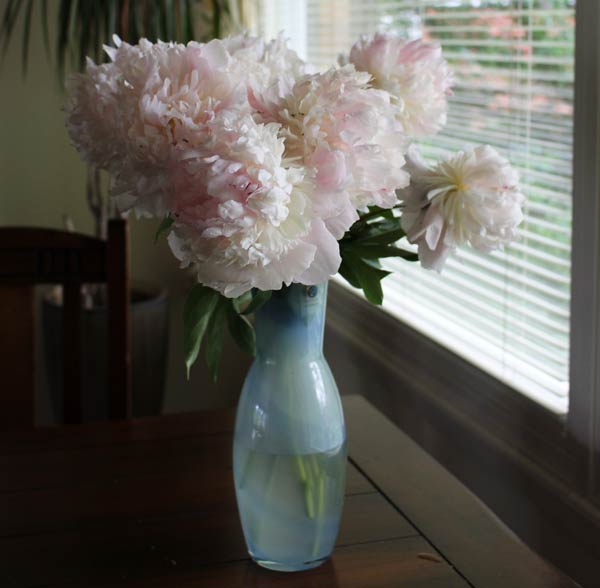
While coloring, I saw peonies emerging on the page and I remembered the peonies that were put in a vase to save them from the rain.
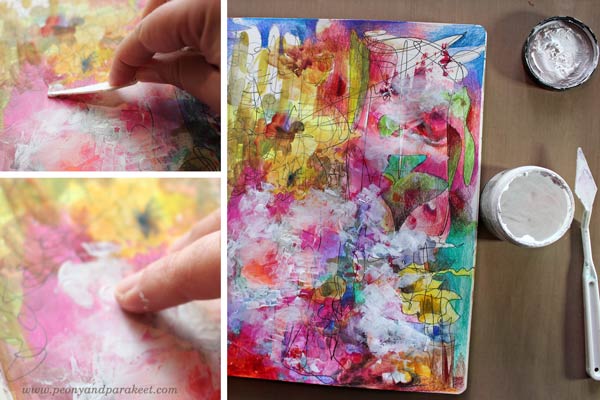
When peony flowers mature, they will lose their color. That gave me the idea to take some gesso and rub it on the surface of the piece. First with a palette knife but then with fingers, to soften parts of the edges.
Finally, I sharpened some details with a drawing pen and made some color areas clearer with colored pencils.
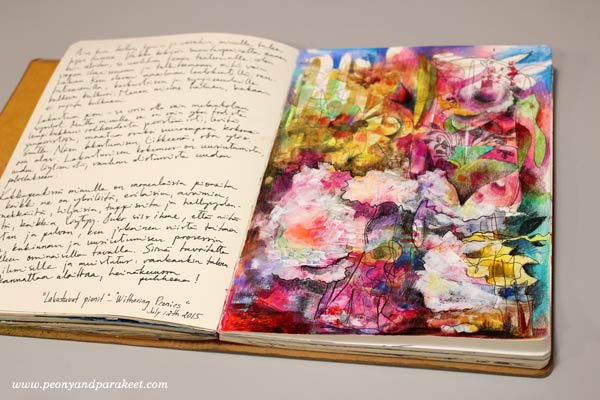
Journaling
Writing thoughts after creating an artwork feels natural too. Drawing or painting is not only a technical process, but it’s also a way to process thoughts.
The Natural Approach
Withering peonies can be a symbol of letting go. When you open yourself to art, something beautiful might disappear. But it is so exciting to see what else will appear – naturally!
Subscribe to my weekly emails – Get a free mini-course!
Art Journal about Love for Home!
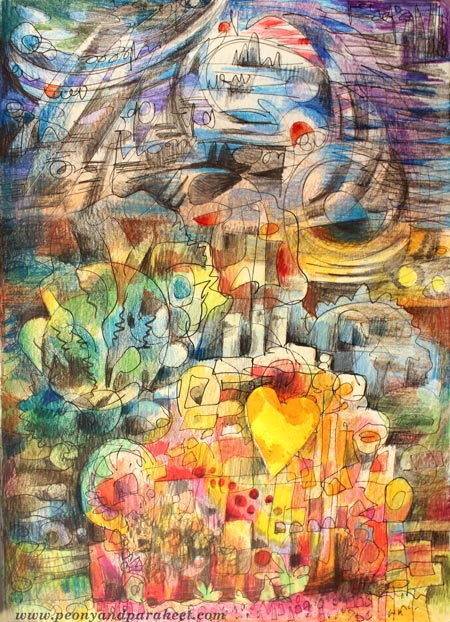
I am honored to be the featured artist in Documented Life Project this week! The theme is Hometown inspiration: “There is no place like home”. This, if any, is suitable for me and for my art journal! I had a stay-at-home mother and we did not travel much as a family. Probably because of that, I have always loved being at home. When I worked away from home, I missed it all the time. Nowadays, especially every morning when I wake up, I am extremely grateful to be able to work from home!
Let’s create an art journal page to celebrate home!
1) Background – Outside from Home
How do your surroundings look like when you are not at home?
Bring those things to the background of your page!
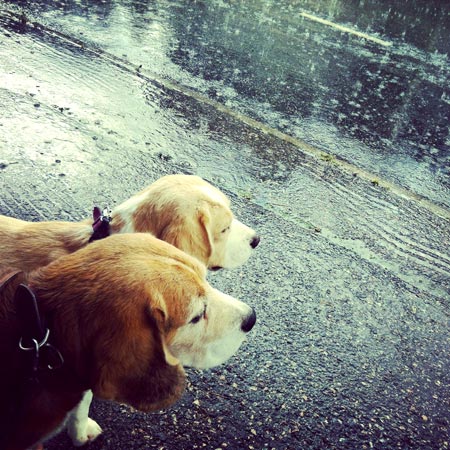
I thought about the situations when arriving home is most appealing. The house, and the living room couch, looks the most welcoming after walking the dogs on a bad weather.

Being a dog owner and living in Finland, I have been in the middle of snow storms, pouring rain and everything between.
2) Focal Point – Inside Your Home
Pick some of the items from your home which represent your love for home!
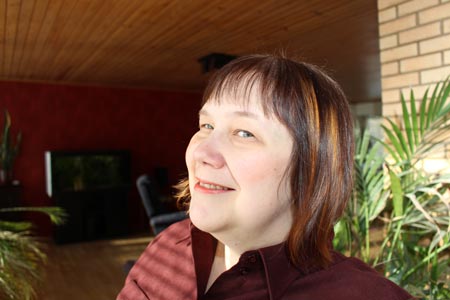
I wanted to express the experience of staying inside, feeling happy, warm and safe from the blowing winds. A couch and house plants are good symbols for that.
3) Location, Location!
Create the page where you feel most at home!
We, visual people, are often very easily affected by the environment where we create. To make sure that the page would express of a warm and comfortable place, I created the page by sitting on the living room couch.
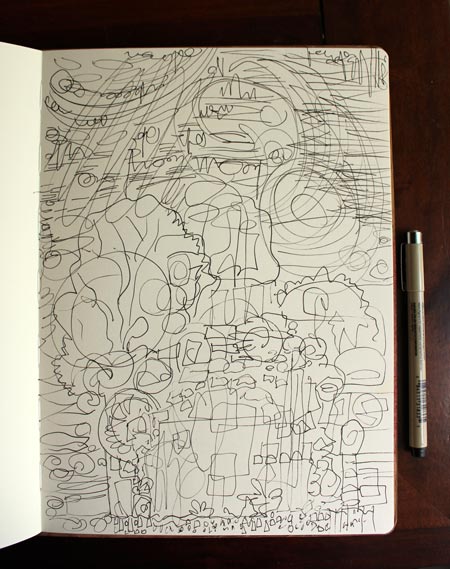
4) Start by Drawing Freely
Draw and doodle on the page. Don’t worry too much about the end result!
5) Add Color (+ 3 new ideas)
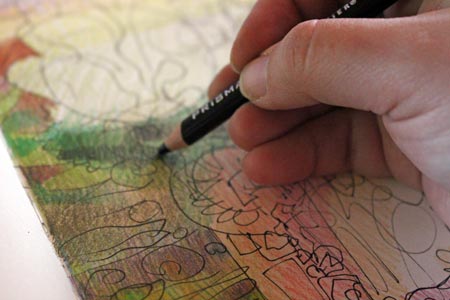
To make sure that your page expresses an experience and is not only a static illustration, add few new thoughts and ideas when coloring the page.
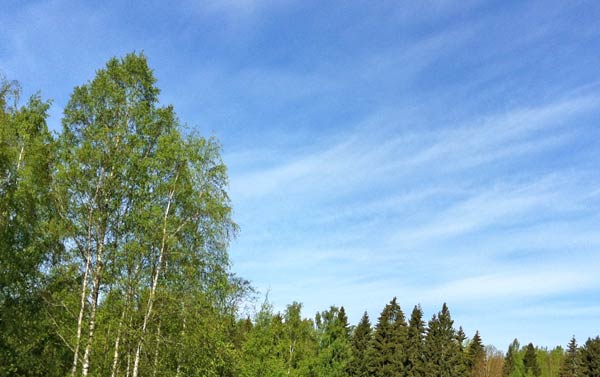
1st: For me, the first idea was the green color. Namely, living in Finland is not only enduring snow and rain. Now in summer, we have daylight almost through the night. Actually, if you read this on 20th June, we Finnish will be celebrating Midsummer, one of our biggest holidays.
This photo was taken just a week ago when walking the dogs 11 pm in the evening.
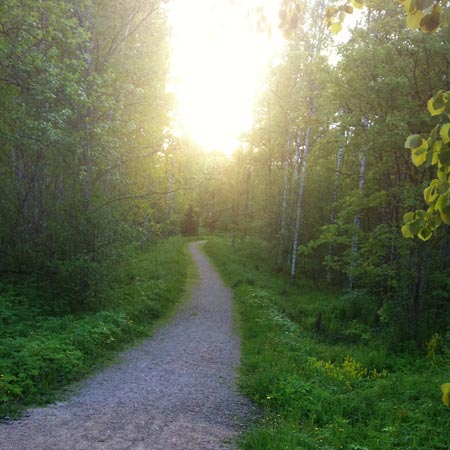
2nd: My second new idea was that home is not only a house or an apartment. It is a mental state. When I feel at home, my cup gets filled, I become peaceful and energetic at the same time.
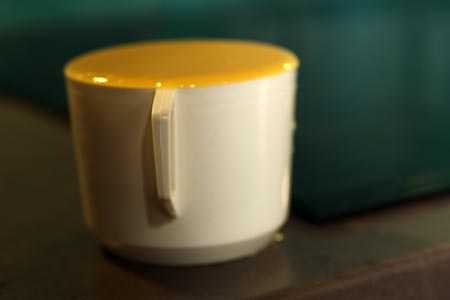
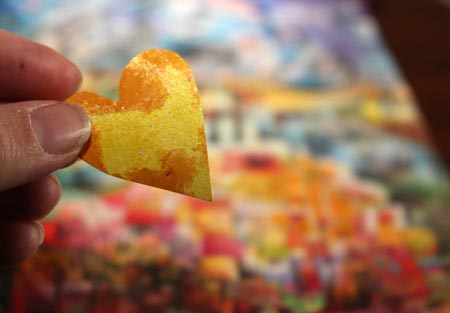
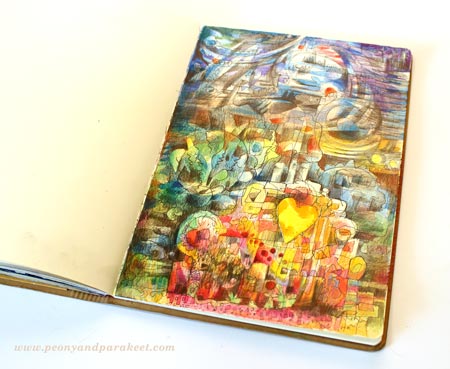
The combination of peace and energy looks yellow to me. So I made sure that the focal point has a lot of yellow. I also cut a yellow heart and glued it to the page with a gel medium.
3rd: Where ever we go, we always carry a piece of home with us. My third idea was to add some red spots to the background to express that.
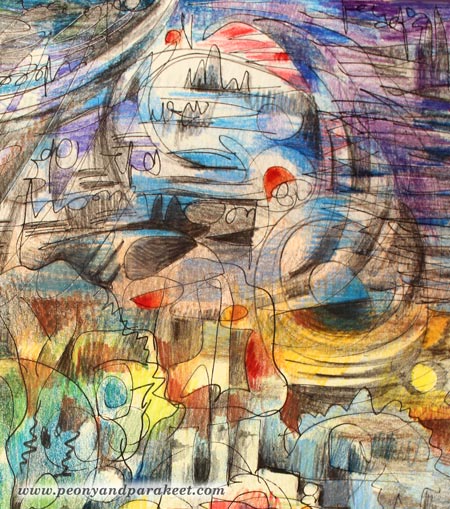
Boosted Expression
When you bring new ideas and thoughts on the theme while you are creating, you are not only making the page look more lively and expressive. You are also allowing your thoughts to move forward with creating.
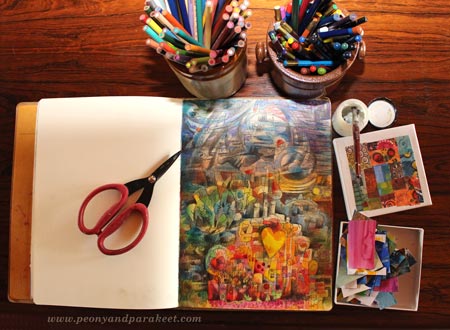
Supplies Used
A black drawing pen (Micron 0.8 mm), colored pencils, a piece of scrap paper and some gel medium were the only supplies used on this page.
Subscribe to my weekly emails – Get a free mini-course!
Art Quilts in a Modern Way

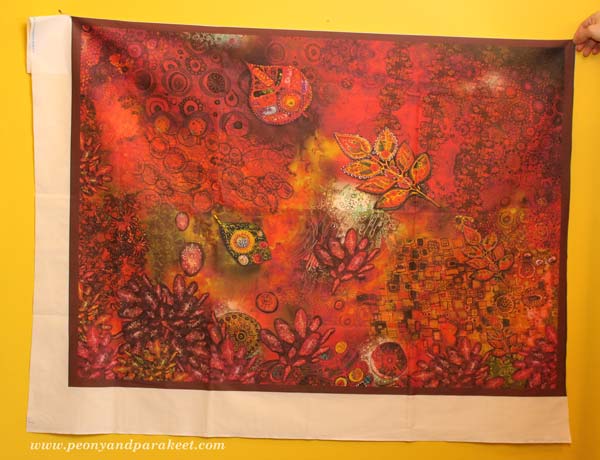
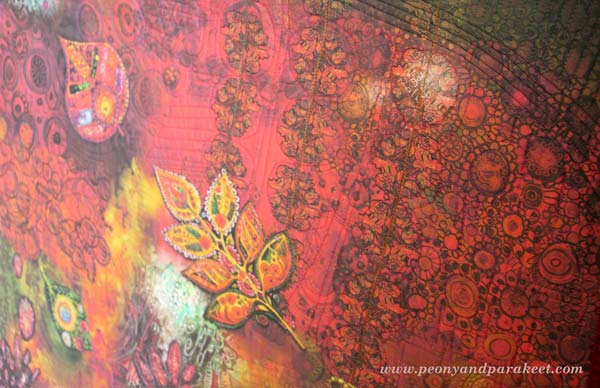
Here’s something that I have wanted to show you for a long time! I have been working with a custom order which made me think of a new idea: to create fabric prints and make quilted wall hangings from them. This idea is very versatile as you don’t have to be a quilter, you can print your art on fabric and use it for bags, purses, clothes – anything!
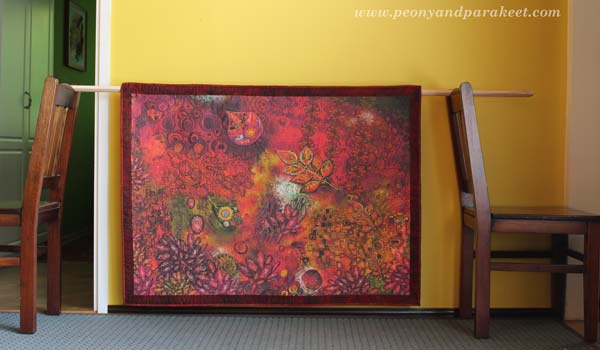
The artwork above has been composed digitally of various art pieces that I have made. The person who ordered the wall hanging is a fan of modern folk music and the color red. (If you have not listened to modern folk songs, try Hanneke Cassel for example!)

I created one new collage piece for the artwork. All the other details are picked from my archives.
It was pretty exciting to send the artwork to Spoonflower. When I received the fabric, the print quality was really sharp and detailed! I already knew from the previous experiences that big areas of black don’t print well, so I avoided those.
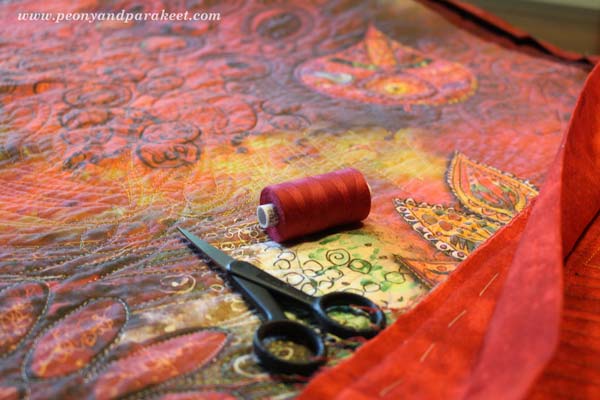
If you are a quilter, you know that the fabric will look so much better when quilted! I sandwiched cotton wadding, two layers of fusible interfacing and backing fabric and took out my sewing machine.
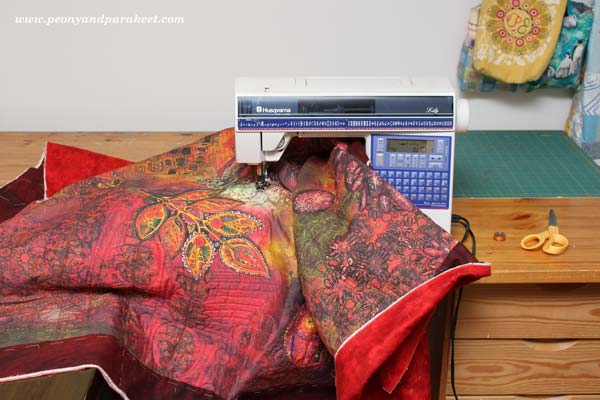
I am not very experienced with free-motion quilting using the free-motion foot, so I used even-feed foot instead. But with patience, I was able to create quilting that enhanced my brush strokes.
The finished quilt is about 45 x 39 inches.
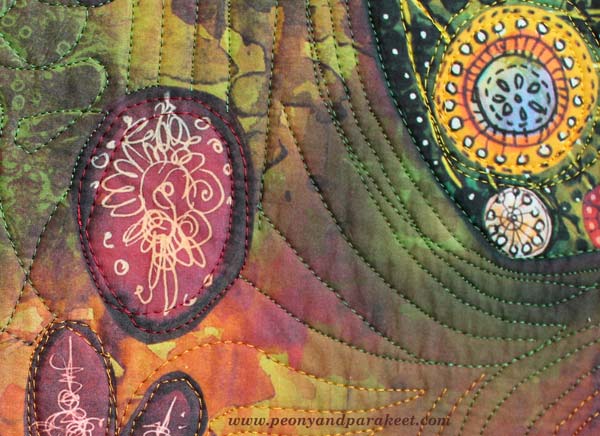
I used various colors of shiny embroidery threads for quilting. Using black thread brings the real black that was not produced by digital printing.
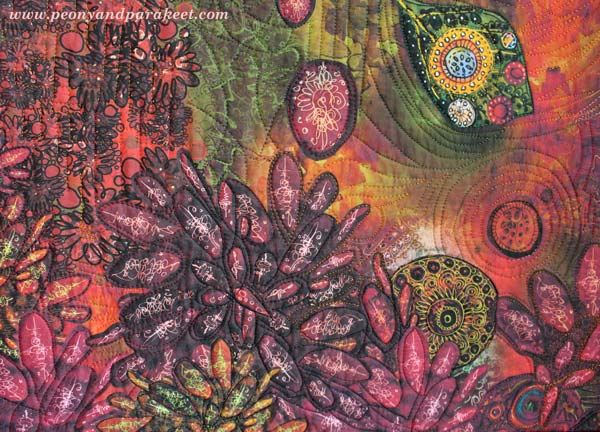
Quilting on watercolor!
Entering the flow state when playing modern folk was in the center of my inspiration.
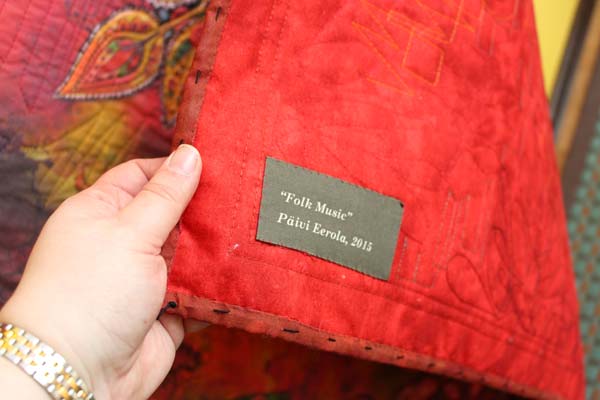
I added the label to the printing file too.
Here’s another project that I actually made earlier to test the idea. This one does not contain much digital processing, I only took a good photo of the original art and enhanced it a little bit.
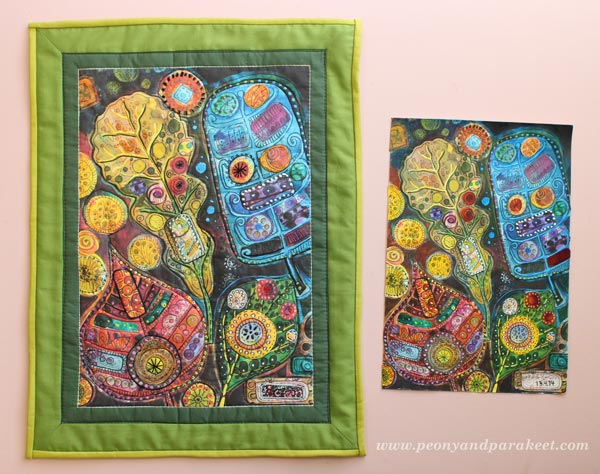
I think this artwork looks really good on fabric! The actual idea when creating the original was to mimic hand embroidery! Read about creating the original artwork: When Pens Replace Needles
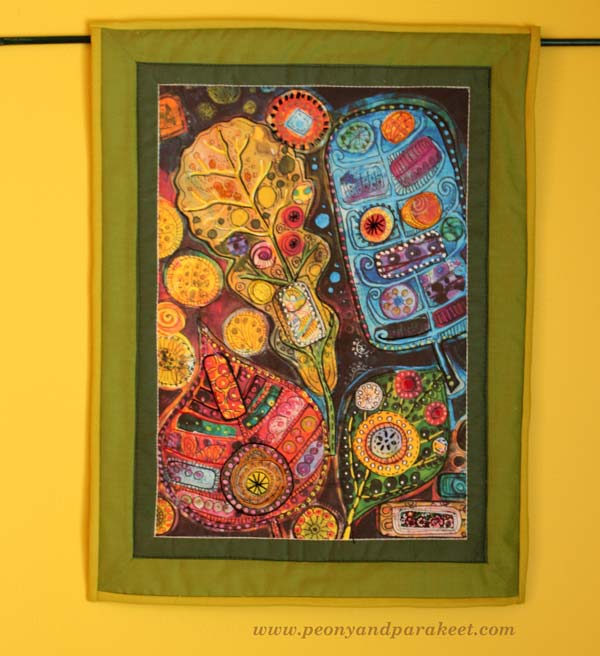
I added some embroidery before quilting but found out that quilting works well as decoration.
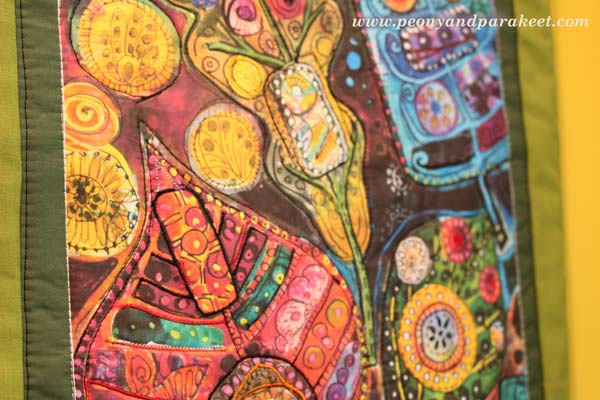
A printed fabric label can be found from here too.
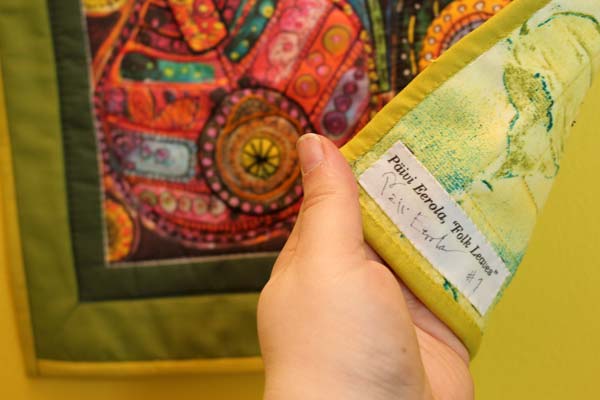
I also have more fabric prints waiting to be transferred into art quilts!

Paper prints news: New card sets have arrived at my Etsy shop.
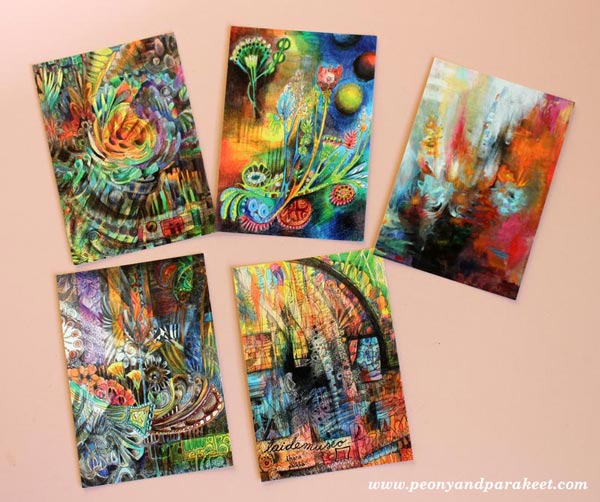
Life can never be too colorful!
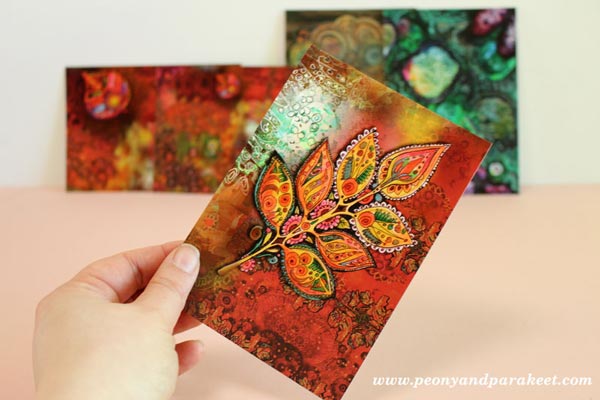
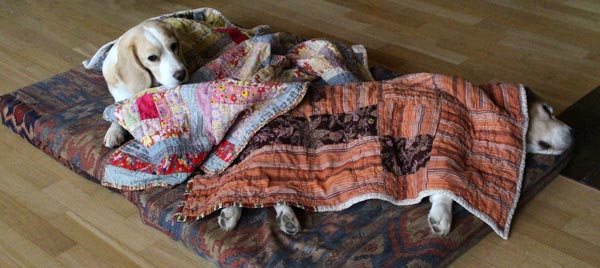
Stella and Cosmo send their greetings to all artists and quilters: Have a relaxing weekend!
Let me be your art teacher: Subscribe to my weekly emails!