
Now and Then – Development of Style
I started a grant project in October. The project lasts a year and covers half of my working time. I am making a digital artwork that can be experienced with virtual glasses. This will definitely give a boost for my artistic development, including the style as well.
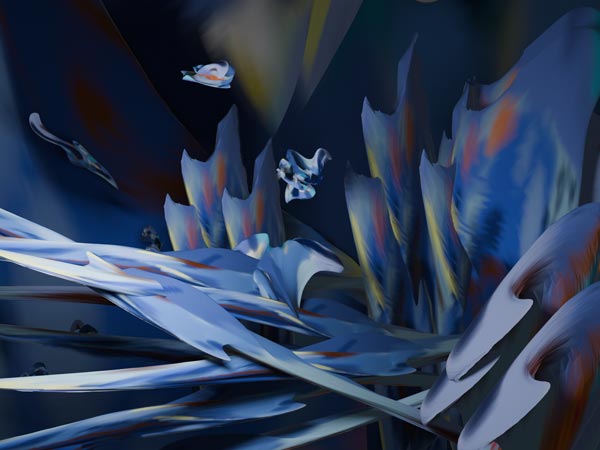
I used a fun sculpting app called Nomad and a 3D modeling software called Blender.
This image is based on replicating one shape only.
One of the recent practical changes is that I have given up using a Mac computer and bought a new Windows gaming laptop, which I call Turandot. I am now writing this blog post with her. She must have imagined that she would be owned by a young man, but no – she has a woman in her fifties. Turandot must have sounded like a great name to her, but after googling it, she might have been upset: Puccini’s opera! Well, she just has to adjust and learn my style.
Style Development – Looking Back
The new big project has made me think back and explain it all to Turandot. Ten years ago, I wanted to learn to paint so well that I would be satisfied with my paintings: “I could then die happy!” I thought that as an artist I had to abandon what I have been until then and build a new vision and a new world of my own.
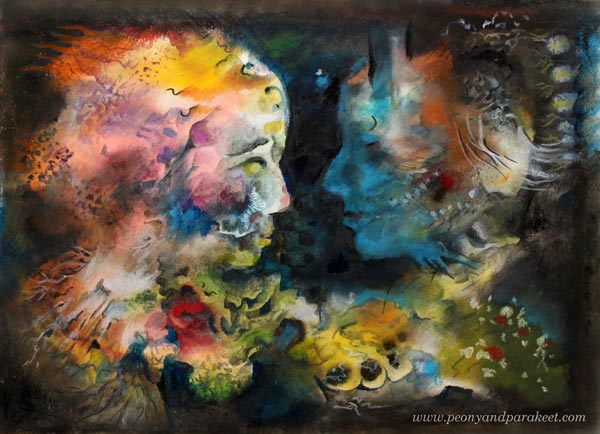
When my paintings started to reach the level I had hoped for, I felt first grateful and then empty. I couldn’t see forward anymore.
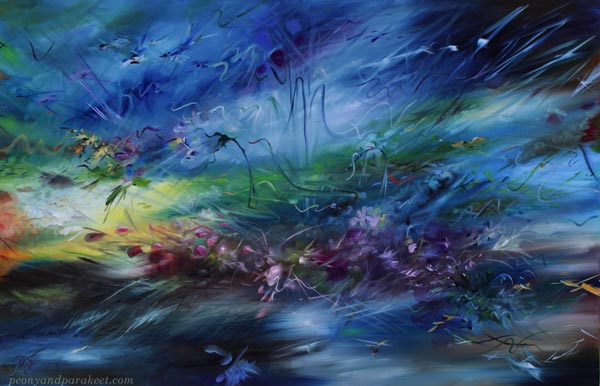
See the gallery of my oil paintings!
Now, however, I’m on the brink of something new again and the crises of the past seem strange: how was I so hopeless? Why didn’t I realize that everything meaningful that I’ve done in my life will tie into my art over time?
Always a Beginner
My artist friend said that I have developed quickly as an artist. However, it doesn’t always feel that way. I always have self-criticism and always notice things to improve. That’s why it feels frustrating now when I’m starting over again and building a three-dimensional digital expression. At the same time, I remind myself that the beginning of today is much further than the beginning 10 years ago – there is a lot that I already know and what I can already see, not only style-wise but in a more general level as well.
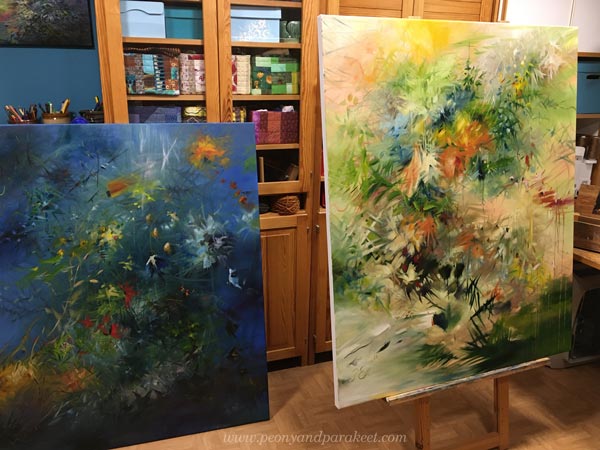
The balance between encouraging yourself and criticizing yourself is essential when making art. You have to be able to observe your pictures as if they were created by someone else and at the same time, you have to see forward – what all this could be and where it could lead when I will learn more skill and imagination.
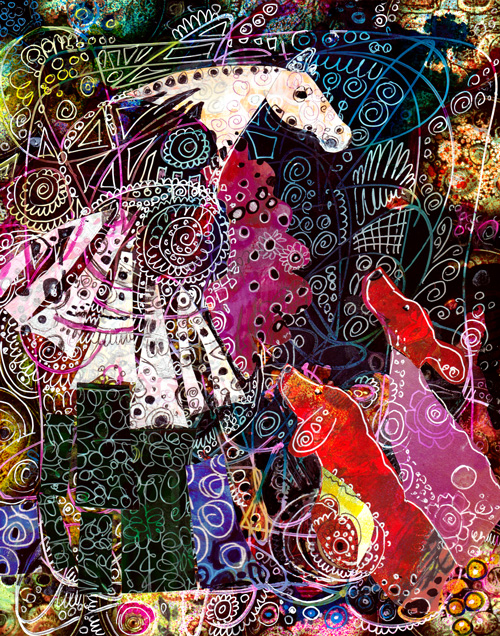
Fortunately, I haven’t listened to those who say that everything you do must be in the same style and form a unified experience. When you’re a beginner, forcing a certain style only leads to getting stuck at a level where you really don’t want to stay. When you’ve done enough, your own style pushes out naturally.
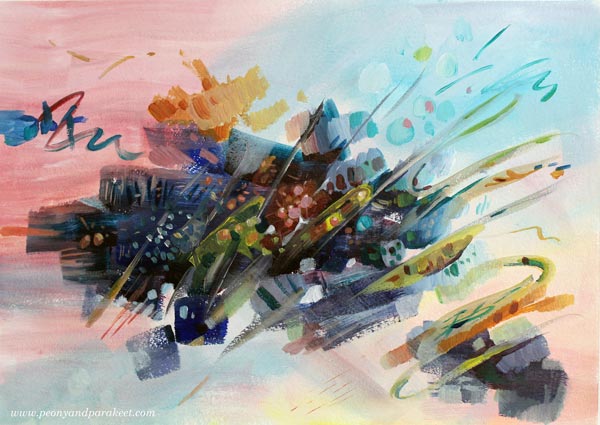
Yarn, Thread, Line, and a Telescope!
10 years ago, my line was clumsy and closed, while now it’s elegant and curious, like a telescope that lets me see beyond what I’m currently aware of.
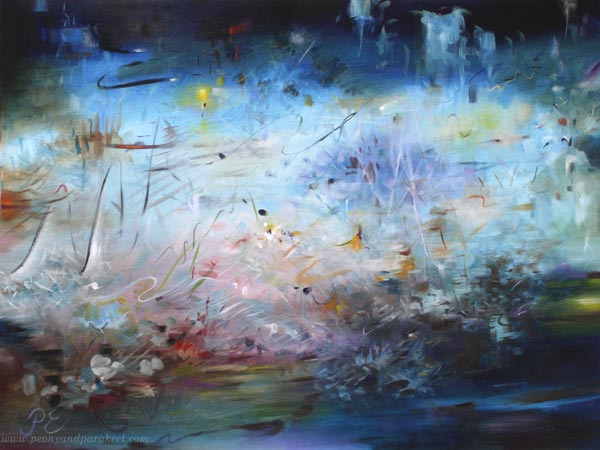
I’ve always liked knitting and embroidery. Thread and line have a lot in common. That’s where my style started.
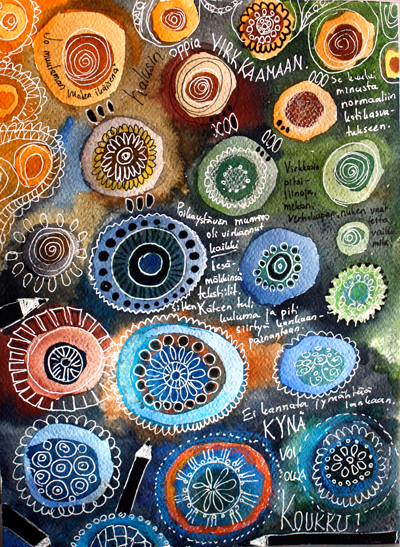
Collageland teaches this style!
Now my task is to continue developing my style and step into the world of digital art. However, I will still be drawing and painting next year, so there is no need to worry that this blog will change too much!
How to Create Comforting Art
This blog post is for you who want to spread more joy through your art, and make your art more comforting and captivating.

I am listening to an interesting course on writing. It’s Neil Gaiman Teaches the Art of Storytelling. Writing and making a picture have a lot in common. When you look at your piece, can you find a story – so, a conflict and a solution?
Conflict Creates More Comfort
Neil Gaiman says that beginning writers leave conflict out of their stories. And that it’s the conflict that makes the story interesting. The same goes for the picture. Beginner artists usually want to use only happy colors and draw or paint only beautiful and joyful things.
I too want to make comforting art – something that takes me to a softer world right in the beginning and that will lift the viewer’s mind when finished. But the conflict must still be allowed because first showing it, and then finding a solution for it, creates comfort and happiness.
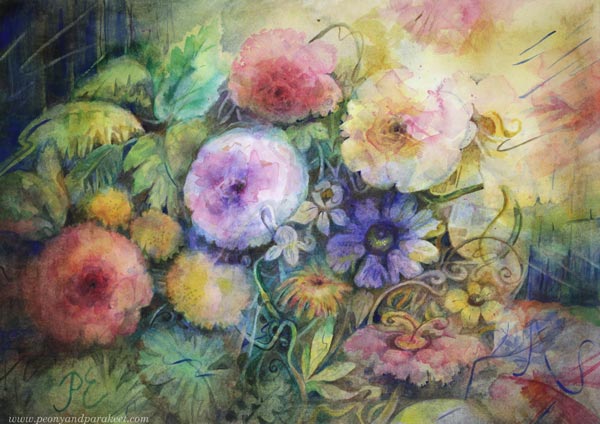
Purchase this painting via the Taiko art store!
For example, in this watercolor painting above, the flowers have run indoors because it has started to get windy and rain a little.
Imagine how they first evaluate the houses: “Where would we be welcomed the most?” And then they would push through the darkest window and settle on the windowsill close to each other.
Imagine stepping into that room and seeing shattered glass and feeling unpleasant coldness. But then the colorful flowers would bend towards you. What a pleasant surprise to receive in these windy times!

When I painted this, I wanted to protect myself from the winds of the world. I started with the flowers, but the painting only came true when the wind joined in.
Overcoming Difficulties Brings Comfort
For me, the most comforting art is the one where difficulties are overcome. For example, in this painting, the flowers have experienced loss, but are still ready to take risks again.

Build Different Characters
Neil Gaiman says that his stories are largely in the hands of the characters. Also in painting, you have to identify the main characters. Blots easily turn into flowers, but don’t leave it at that! Make small changes to the shapes so that the personality of each flower comes out. Often it’s a very small adjustment that a beginner easily ignores as insignificant. The skill of building an expression for a form no matter what it represents develops with making.
Strong characters and an understanding of the place where everything happens create a story in the picture. My main characters are strong-minded and independent and the conflict is often a fight against wild conditions.
For example, winter has arrived here, but the flowers stubbornly decide to turn the clock back to a warmer time. In this conflict, the flowers lose their color to stay alive.
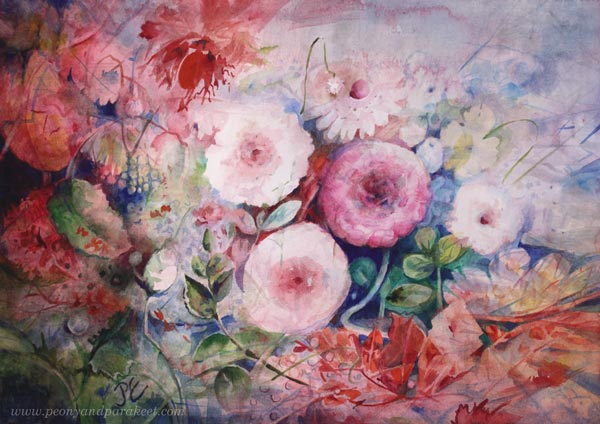
Sometimes what feels good at first can break down in the long run. Can a flower live only in light? Don’t we get a better understanding of our outlines and boundaries in the shadows?

On the other hand, when life has been nothing but darkness and the colors have faded, the power of light enables a fast recovery.

Observe the Surroundings with Empathy and Imagination
As a director of disaster films, I am inspired by the survivors around me. This autumn, I listened to the lily of our new pond, who described how boldly she would soon bloom. Fall progressed and my suspicion grew. But just before the big storm, the bud opened for one day.
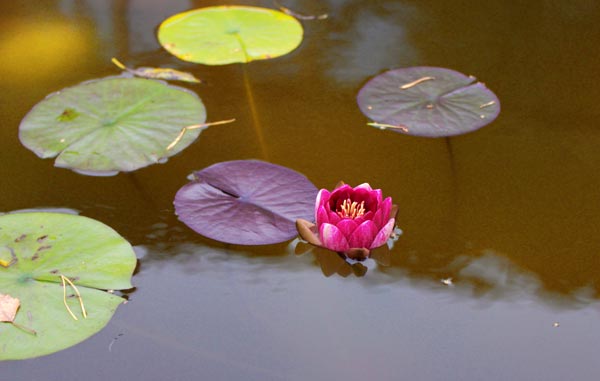
You can survive of the deep waters – even only for a moment!

The world of inanimate objects is also full of ideas when you use your imagination.
For example, wallpaper is one of the most pathetic things I know. The flowers are glued in place, but they still see and hear everything. If they were released, a lot of pent-up energy would be present. The silent and motionless wall flowers would party around the room. They had been thirsty for life for a long time.

Isn’t that what happens when a person starts creating art? The frenzy inside her finally gets out!
Flower Time – Watercolor Video
This week, I have a treat for you – a free video about painting flowers. In the video, I claim:
“When you create art, sometimes it’s adventurous “bird time,”
and sometimes driven by the need for beauty and comfort, so “flower time.”
I believe that we are not only inhabited by an inner bird but also by inner flowers. At the adventure, the flowers are only seen as passive decorations. But when you get friends with the flowers, you notice that they are active characters who like to get together. The inner bird is a hermit adventurer, but flowers tell the common story. This togetherness is also what we need as humans.
“Janonsa sammuttaneet” could be translated to “those who have quenched their thirst.” In this painting, I thought about wallpaper and how its flowers jump from the wall to quench their thirst.
Flower Time – Watch the Video!
Everytime I see a bird flying across a landscape, I feel the need to paint something big, dramatic, and immersive. Art invites us to fly high and see far – to live the adventurous life of a brave bird. Imagination is our inner bird that wants to experience new things and move forward … Watch the video!
More instructions for flowers in watercolor: Buy my newest course Freely Grown!
Flower Portraits
I used to think of flower paintings as still lifes, but now I look at them as portraits. The delicacy of flowers makes my inner bird rest and roots me in a comforting life. From the inner bird’s point of view, there are always new sceneries to travel, and the world is never enough. But from the flowers’ point of view, it’s always good to look close to one’s heart and express that we are enough.
“Valosta voimaantuneet” is Finnish and means “Empowered by Light.”
Think about birds and flowers as symbols for two kinds of art – the other is adventurous and escape-seeking, and the other is easier to digest and connection-seeking.
What do you think of this? Do you have more “bird time” or “flower time?” Leave a comment!
Expressive Flowers in Watercolor
This week, I share how I found the expressive idea for this floral watercolor painting. I go into more detail about this process in the course Freely Grown.
This week I am presenting a watercolor that is part of a small series I painted for the gallery Gumbostrand Konst & Form. The title of this piece is “Syvältä selviytyneet” in Finnish. The English translation could be “Survivors of the Deep” or “those who survived the deep.” The first of the series was “Talven voittaneet” – winners of winter.
Starting with Random Strokes and Splashes
When I start painting, I usually have no idea what the finished piece will express. That keeps my excitement up! The flowers grow gradually and the overall expression takes turns during the painting process.
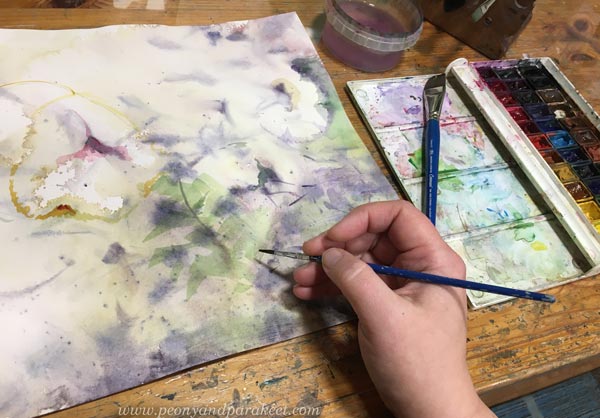
Even now, I only had an assignment to paint flower paintings with watercolors in the same style as what I had already painted earlier this fall. After the first random layers, I could see big flowers.
Wondering About the Expression
The large size and fearless look of the flowers reminded me of strong wild animals. But the further I painted, the more I began to think about the environment where the flowers had appeared.

In nature-themed paintings, it’s important to find the right atmosphere, and that’s where the location matters a lot. I got the feeling that these flowers can withstand even the harshest conditions. Would they live in the desert?

But the softness and roundness of the flowers told of something other than the desert.
Finding the Answer from the Flowers
I looked at the big rose at the bottom edge and asked myself where a flower could swell before decomposing. Then I realized that these have come from deep water and are on their way to the surface. After that, it was easy to add the references to water – like bubbles and water lines – and finish the painting. Painting expressive flowers in watercolor is not only about adjusting the flowers but also finding their back story.

I think it’s a wonderful idea that you can not only grow from difficulties but also soften. And that difficulties can be overcome by staying together. Surface water which seems cold and drowning to others, can be like a gentle sea of light to these survivors.
Every time I paint flowers, my mood rises!