
Colored Pencil Fantasy Art – From Sunnyland to Starryverse
This week, we go from happy and light to adventurous and dark. This is how adventurous colored pencil fantasy art is born!
Imagine walking in a sunnyland through sunshine meadows, seeing pinks, fresh greens, smiling yellows, and trotting happily along a path that feels pleasantly warm and soft. And then, suddenly, something dark hits you, and you no longer feel the ground. Should you fight back to the sunnyland? Or try to figure out what this new place is that feels like a deepwater or a starryverse? That’s what happened to me with colored pencils.
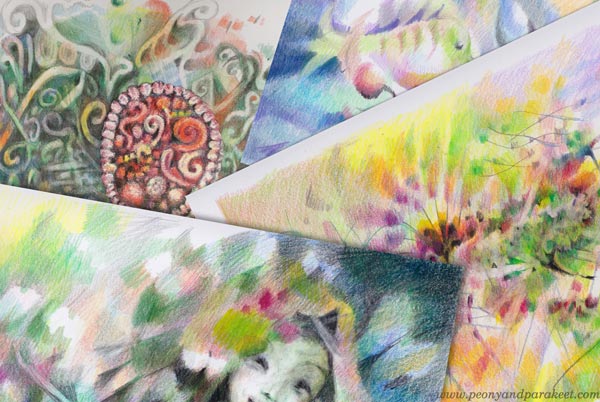
I have made drawings for the upcoming class Intuitive Coloring, and it’s been fun. Happy pictures have filled my studio, and bright colors have got shorter.
But then, boom! Somebody wanted to come out, and she was not a smiley face.
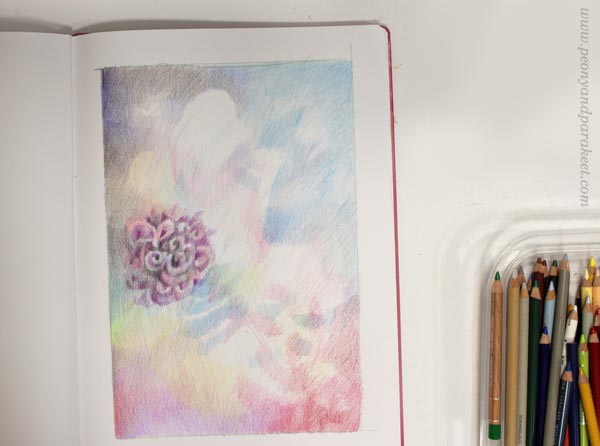
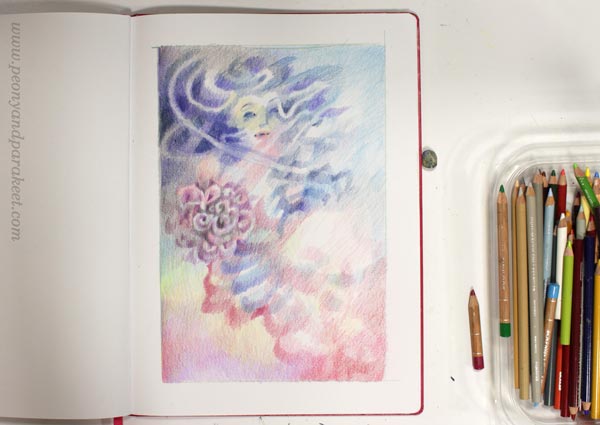
“Let’s make you smile,” I told her. “Let’s take away the darkness, and you will fit better with others. So, here’s a rose that will guide our path back to the sunnyland.” But she didn’t stay behind the flower, and her eyes refused to smile.
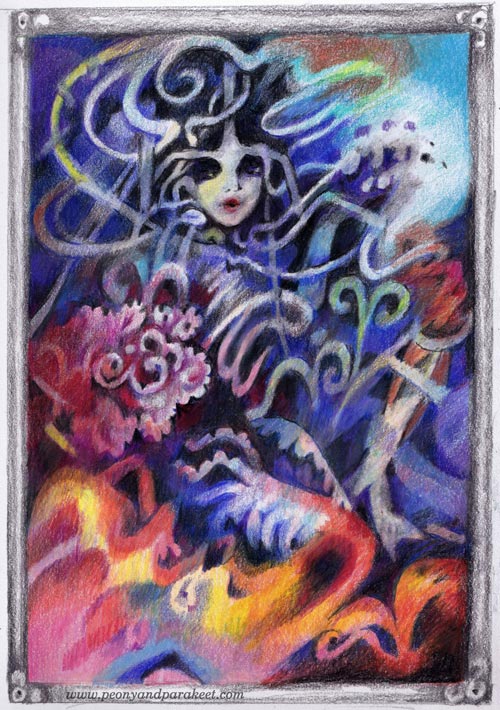
It’s easy to follow intuition when she plays with the butterflies promising good things and much harder when she takes you to a less defined zone. For example, can I let go of not drawing an arm or a leg? Not that I would specifically enjoy drawing them, but because humans do usually have hands and feet.
Colored Pencil Fantasy Art
I didn’t know what was what, but I let her appear anyway.
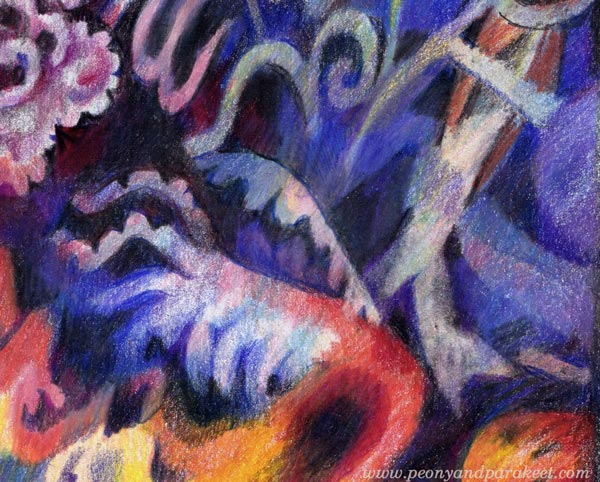
While spending time in this strange place, it started to feel exciting and inviting.
I found myself thinking: why do I give restrictions to my imagination when pens and paper don’t set them? When imagination hits our intuition – or is it vice versa – why not just let go and see who’s the little monster that wants to come out.
I want to fit and belong, and yet, it’s not always so.
My art and my expectations don’t always meet. But the dark starryverse feeds the bright sunnyland, and I need both to keep the sun shining and fairies moving forward.
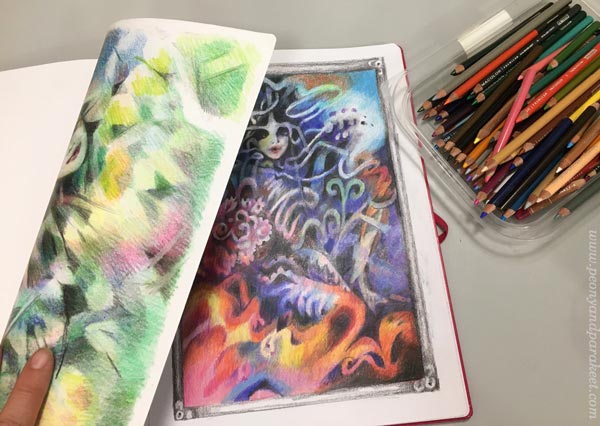
How’s this with your art?
Coloring with the Inner Child
This week, let’s get excited about colored pencils and embrace the inner child!

I used to play with colored pencils as a child. Not just use them for drawing and coloring, but also treat them as dolls. A brand was their surname. I had Caran d’Aches, Derwents, Lyras, … My sister was coloring while I played with the pencils. So, it often happened that someone precious got blunt and tired in my sister’s hands and needed some loving care after coming back to my play.
Colored Pencils – Do Yours Need Some TLC?
Some weeks ago, when taking the jars of colored pencils out of the cabinet, I sighed: “I want a new set; these are getting quite short.” But if I look at my diverse selection of pencils in child’s eyes, all they needed was some sharpening and close observation – what is the family name, who could this little pencil be?

I picked a tray for a smaller selection so that I can get to know them again: “Hello, Cretacolor! Let’s work together!” And then, I made some mixed selections and drew more, and it felt as much fun as a brand new set. I also found some small sheets of paper, and it felt as satisfying to fill them as it is to knit with leftover yarns.

Coloring with the Inner Child
The same difference in attitude goes for drawing and coloring. As adults, we may color some random shapes, feel disappointed in their composition, and try forcing the image out. Or we can change the rational to irrational. Then, like a child sees a person in a pencil, we see life in a simple shape. What could be its counterpart, and where could be its reflection? And could it remain blurry – breathe better without outlines?

Instead of controlling the big picture, we can reveal the personality behind each shape. The image will then grow slowly but naturally, and we get to release our inner child.
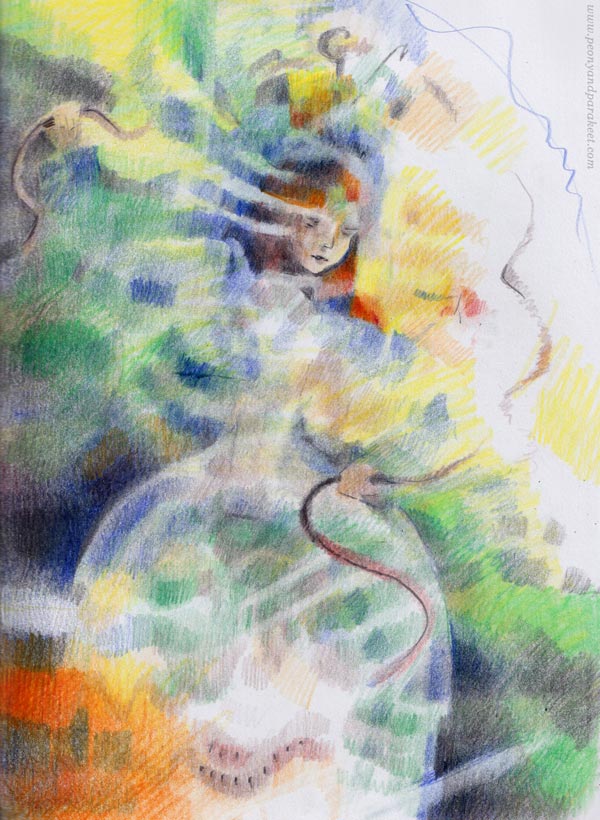
This post includes sneak peeks of my upcoming class Intuitive Coloring – Stay tuned!
Artistic Spirit between Abstract and Realistic
This week’s theme is the artistic spirit. I share a new painting, glimpses of my painting fever, and inspire you to explore the zone between abstract and realistic art.
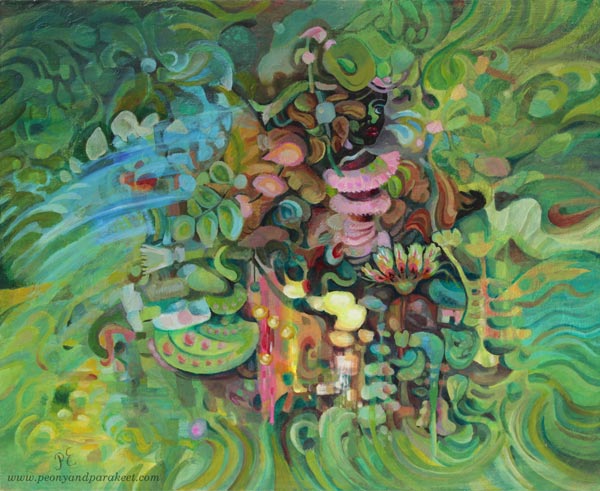
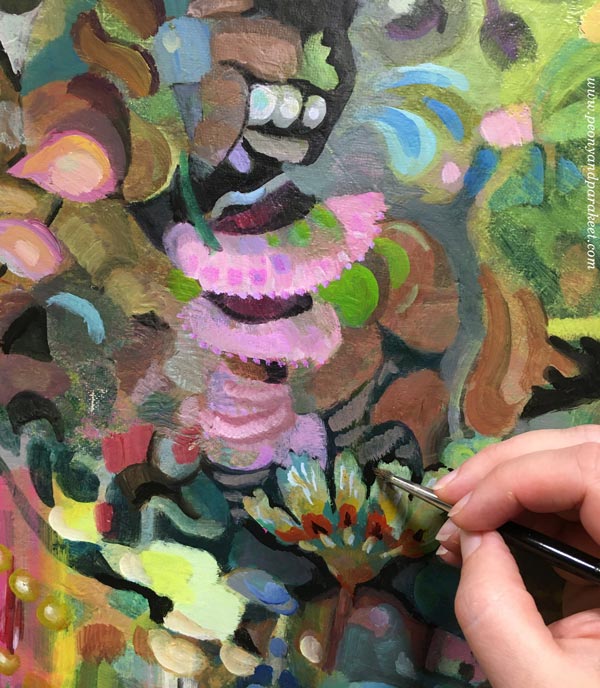
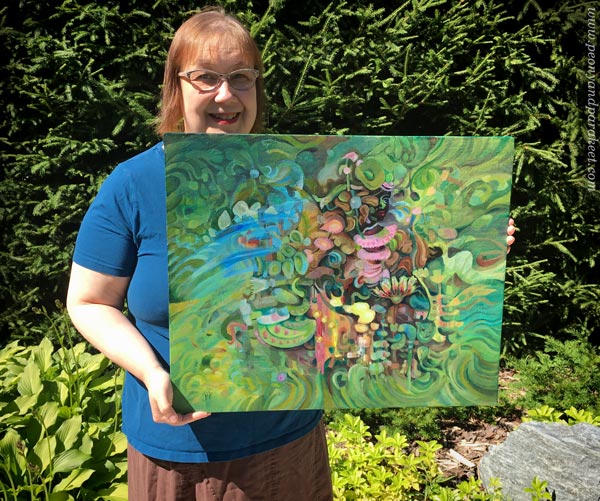
Here’s an acrylic painting that I just finished yesterday. It’s called “Paradise” and it’s quite big: 61 x 50 cm, about 24 x 19,5 inches.
Painting at Late Evenings and Wee Hours
I like to paint in the late evenings when the world quiets down. Now when it’s summer, Finland floods in light, and nights are short. When the blackbirds begin to sign at 3 am, I know it’s time to wash the brushes.
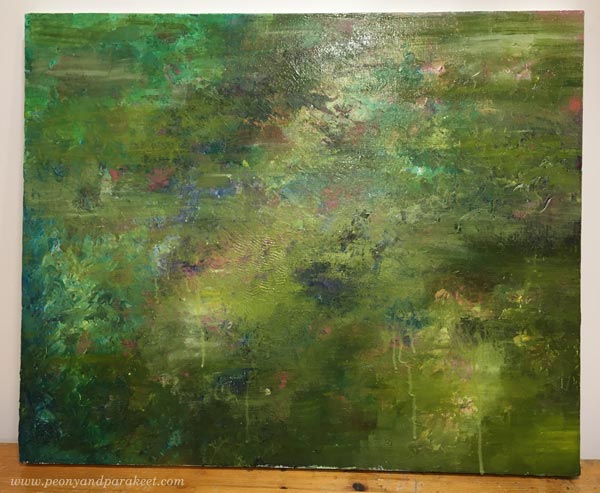
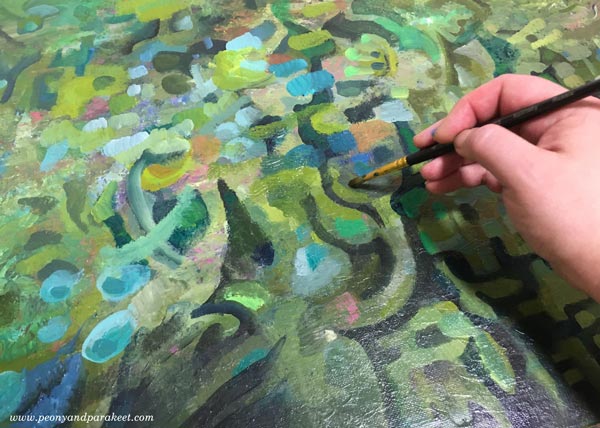
After a long night, I rush to the studio in the morning: “What have you done! You’ll never be able to finish it!”
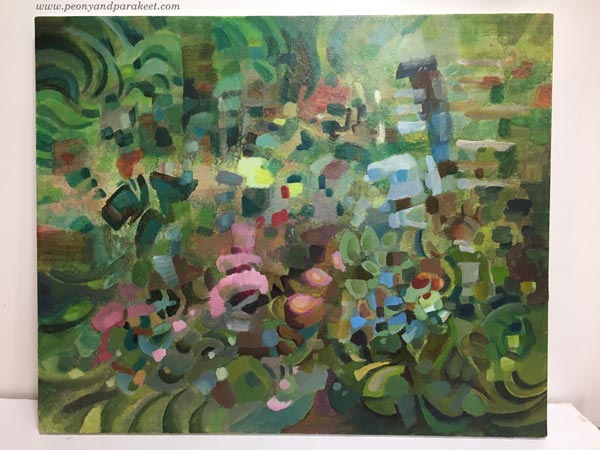
But with this painting, I decided to accept whatever comes up. And with that, I have a little story to tell. I shared it on Peony and Parakeet’s Facebook page recently, but if you missed the post, here it is, with one of the paintings from the teenage years.
My Story about Artistic Spirit
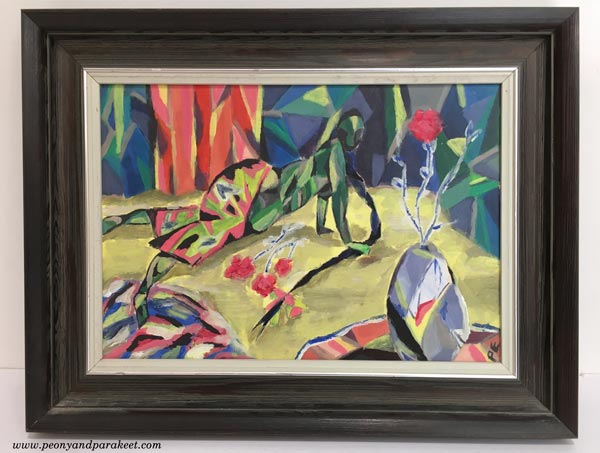
As a teenager, I browsed big art books at the local library. I started hanging around with Matisse and Picasso and they said: “Hey Paivi, take this obsession from us, and make the most of it.” First, their inspiration was like a fever: mustpaint…mustpaint… mustpaint. Then, after too many matissepicassos, it became a burden and I went to study engineering.
During the past five years as a full-time artist, I have been hanging around with other guys – like Da Vinci, Caravaggio, and Rubens. Even if I first thought so, they are not much different. After too many rubenscaravaggios, the empty feeling takes over again.
But recently, I went to my studio secretly, picked the brushes, squeezed the paints, and in silence, I met a spirit. It was not me or any of my masters, but the spirit that arrives when we are ready to let go of the ego.
To paint like me, I need to let go of me. I am pretty sure Matisse and Picasso already told this, I was just so impressed by their names that I didn’t listen.
Abstract, Realistic, or Stylish?
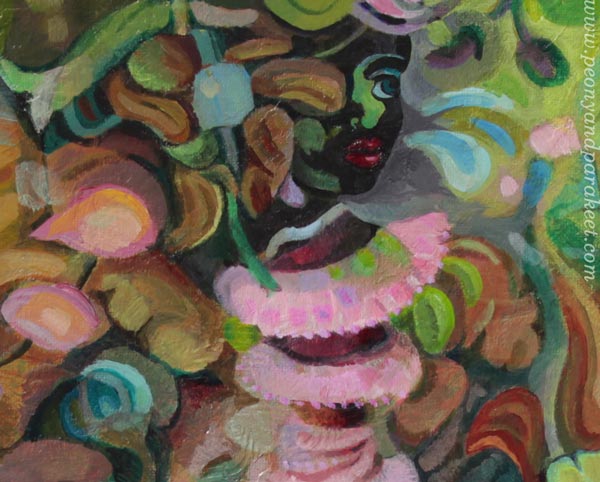
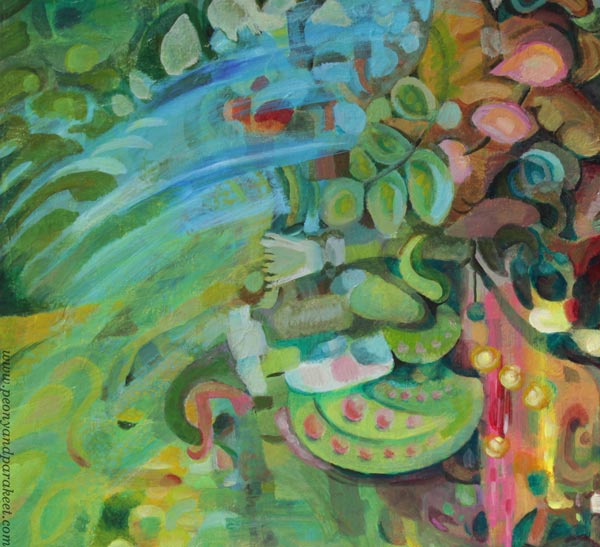
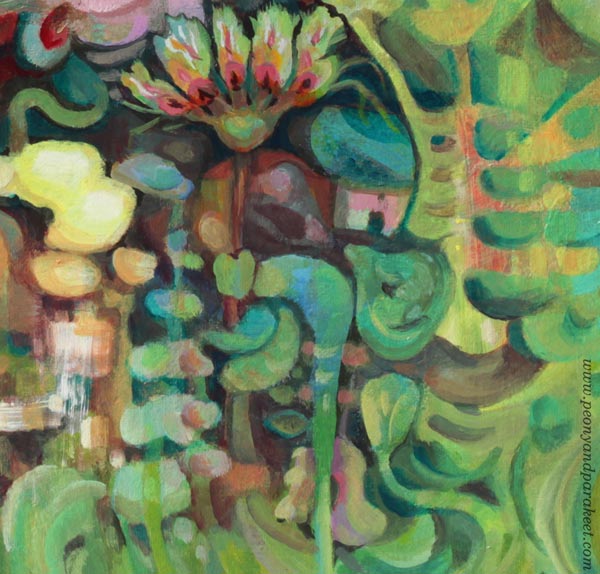
Every time I make a class, I don’t only teach but also learn new things. The newest class Decodashery boosted my confidence to paint decorative motifs right from my imagination. Between “abstract” and “realistic,” there’s a zone that’s “stylish.” Then you simplify what’s real, and complicate what’s not. By simplifying, you dig the artistic spirit out of tangible things, and by complicating geometric shapes, you make the spiritual things more tangible.
I really like this painting, and hope that you enjoy these close-up pics too.
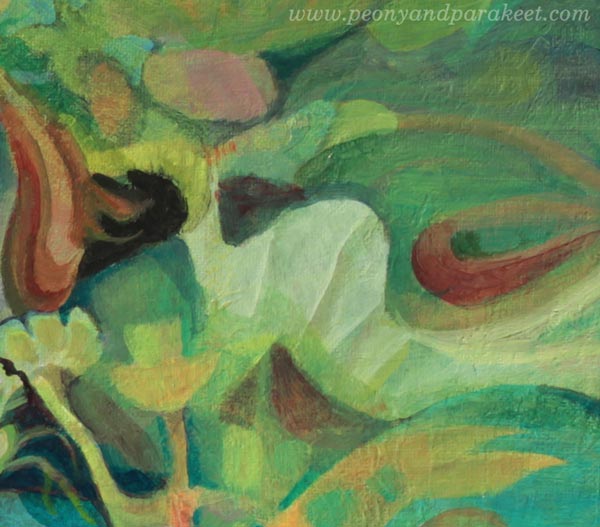
Wishing you many happy moments with painting and drawing!
Imaginary People – How to Paint Their Soul?
This week, the theme is painting imaginary people and how to find their soul. There’s plenty of examples in this blog post!
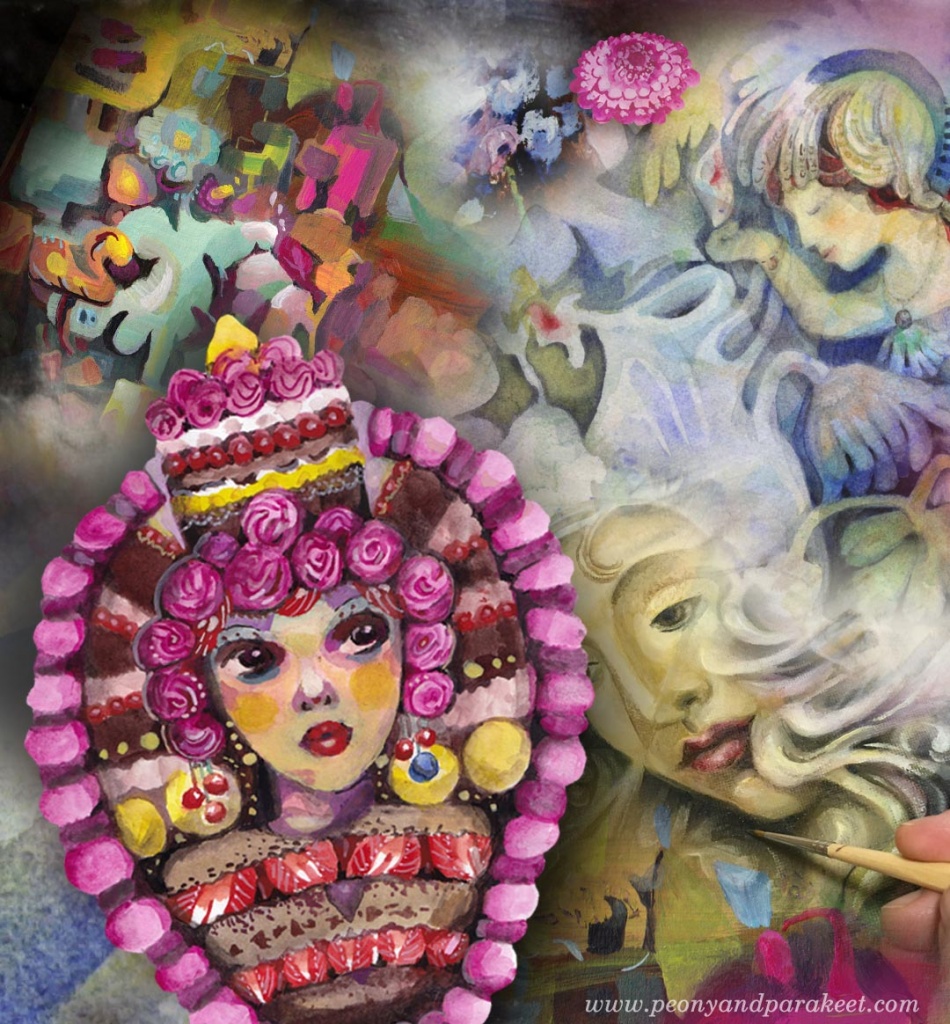
One of the wonders of painting and drawing is that we can give birth to an imaginary person – that we can create someone who breathes, talks, and has a life of her own. However, many times the doll that I have on paper hasn’t come alive. Or she has taken just a few breaths, and after the creative spark has gone, she just stares with empty eyes. So no wonder that I have had a love-hate relationship for painting imaginary people. I want to experience the miracle, but it can also be too much of a struggle.
References – Working with a Soul that Breathes Already
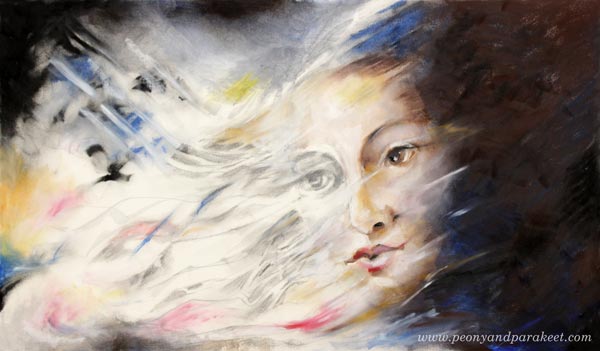
Using a reference may be the least innovative solution but if you find an image that really speaks to you, it can be a good one. Tiny changes in facial features lead to a whole new person so if you don’t follow the reference in the smallest detail, yours is like distant relative to the original – familiar features but still unique. For this oil painting called “Heaven and Earth“, I used a detail of Sandro Botticelli’s painting “Madonna of the Magnificat” (1483) as a reference.
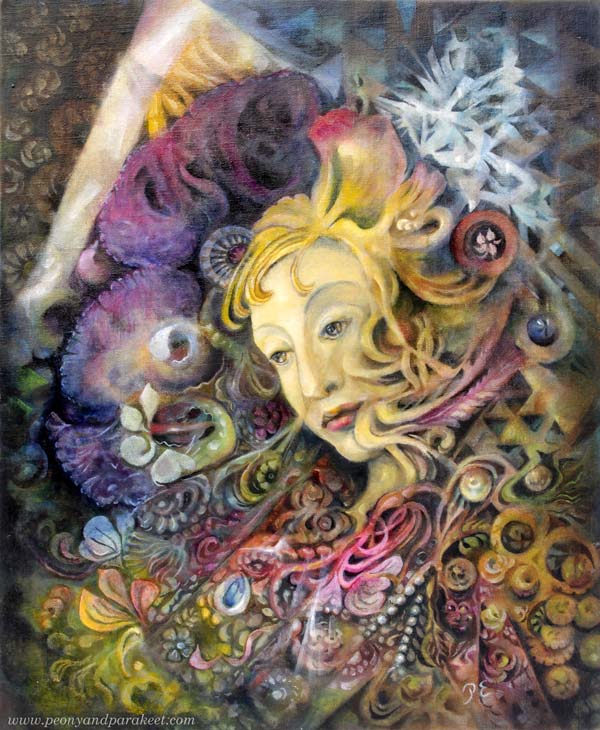
Here’s a close-up of the faces. I changed the angle of the face, opened the eyes more, and made the mouth look more determined.
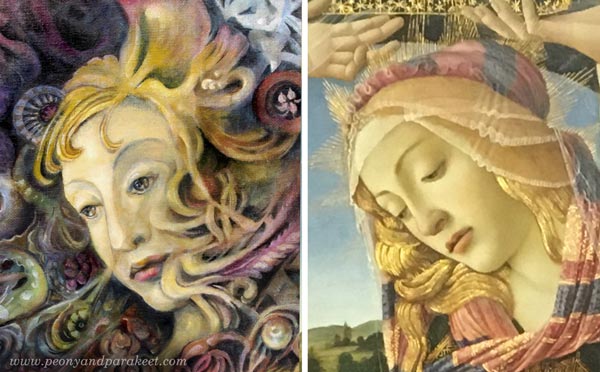
Sounds easy, but I often struggle with finding the soul when using references. With this painting, I tried to slowly work towards an individual personality, but creating a connection took a lot of time. Botticelli painted his soul, and it’s not the same as mine.
Here the work was in the early stage so that you can see how she has changed.
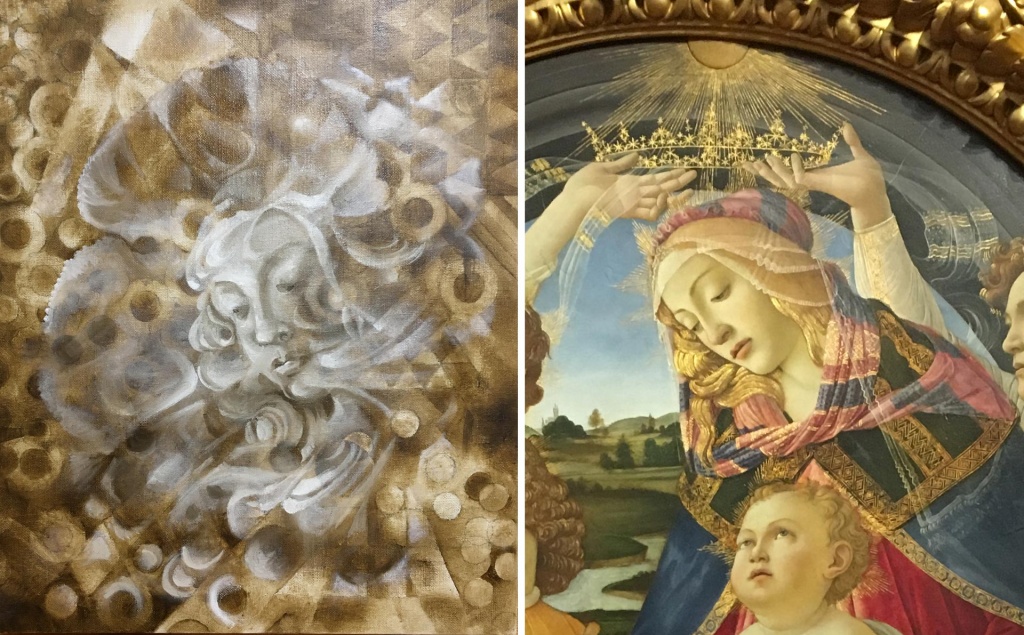
From the struggles of this painting and many others, I have learned this:
Working on the face alone never brings up the soul.
With the Madonna, as soon as I figured out the purpose and the style of the surroundings, I was able to finish the face.
The Soul Spreads Over the Painting
Even if a person is usually the focal point of the painting, the soul is not focused but spread.
The soul is in the setting, in the things, in the atmosphere. Even Botticelli’s Madonna can look just like a bored person without the crown, the light, the child, the book, etc.
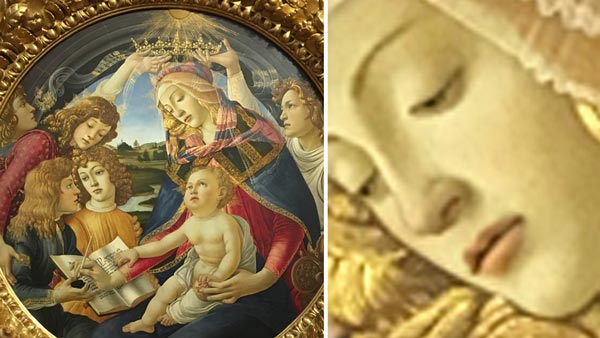
So no matter if you paint intuitively without pre-defined ideas, sketches, or references, or more intentionally with a clear idea of how you want your imaginary people to look like, seek for the soul in everything you paint.
Flowers have soul.

Pots have soul.

Hair and hats have soul.

Inanimate and organic things also give the soul to the imaginary people.
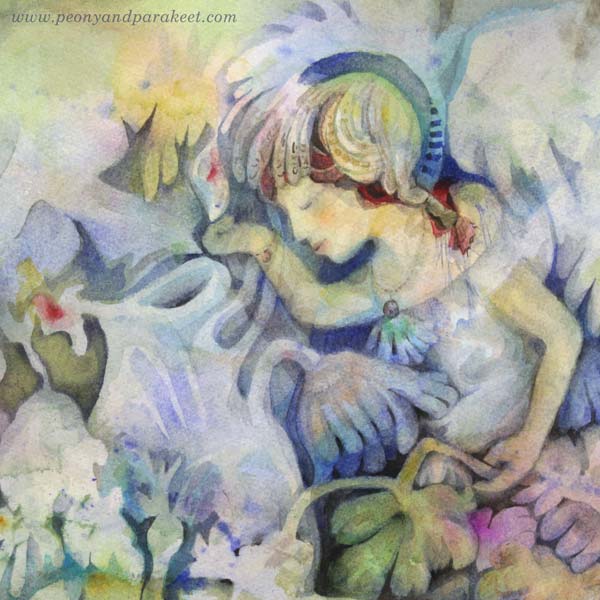
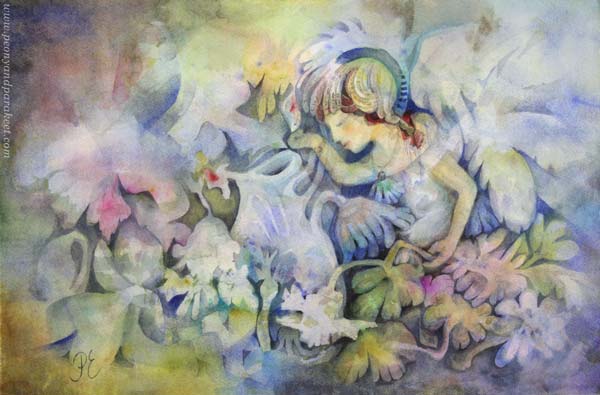
In this watercolor painting called “Mirimer“, the fairy is the focal point, but her soul is spread all over the paper.
Imaginary People Exist in Shapes and Colors As Well
The painting doesn’t even need to have a face. Your imaginary people can be abstract, like in this small acrylic painting that I recently painted on a sketchbook.
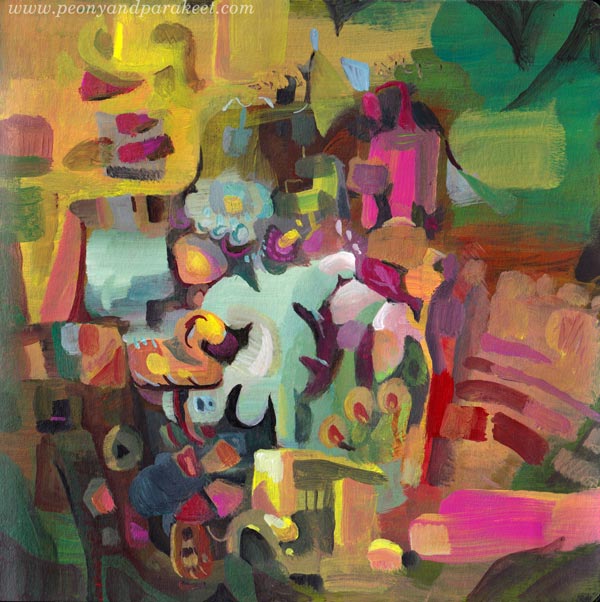
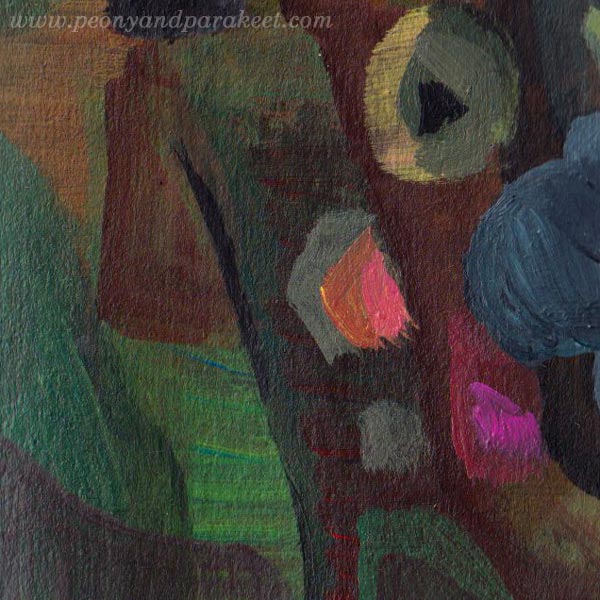
Shapes and colors have soul.
Imaginary People – First or Last?
The idea for this post came from the question that I received a couple of days ago:
“I like your little people peeking out from within your art. I would like to learn more about that. Do you draw them first and paint around them or paint and then save a spot for them?”
I have many approaches.
In Innovative Portraits, we use references and make a sketch. The soul begins with the plan.
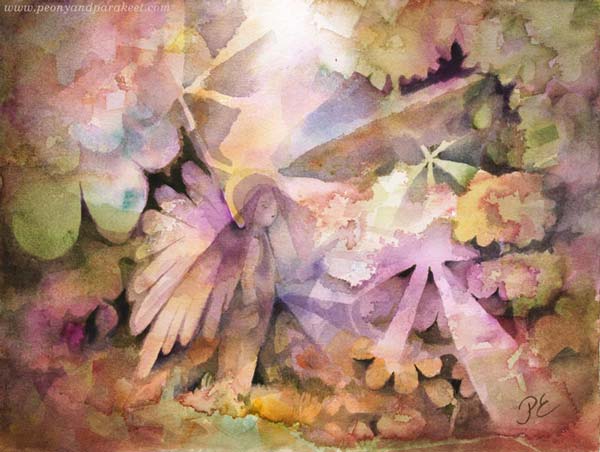
In Magical Forest, we lure fairies to appear intuitively from the watercolor background. The soul begins with the feeling.
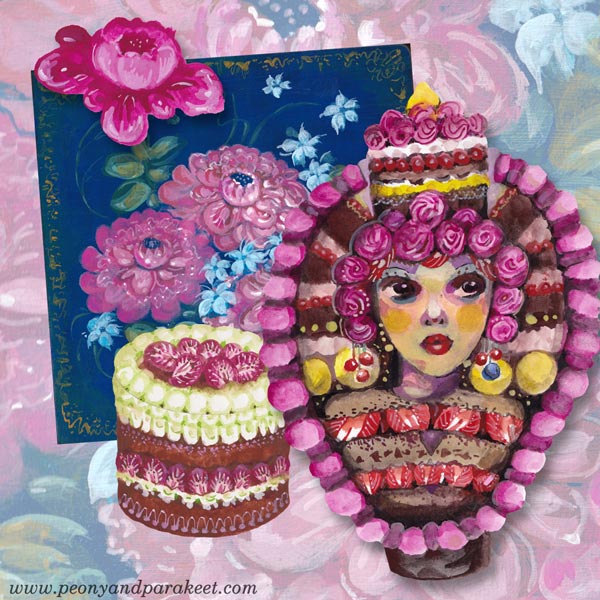
In the new class, Decodashery, we start by building a visual world and then make the dollies to fit with it. So the soul is first just a small flower, then it expands to floral paintings, cakes, lace, and finally, the imaginary people are born. By gradually setting the style and the spirit is the best intentional way to add soul to your work.
Decodashery will begin on June 29, 2020. >> Sign up now!