
Pointillism – A Quick Way, Step by Step!
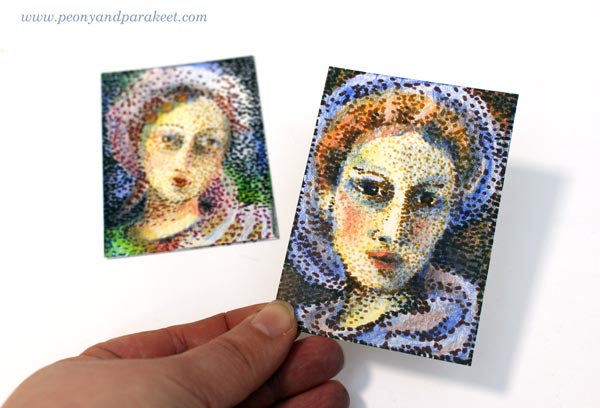
I am honored to be one of the guest artists in Documented Life Project this month. I was given a theme (pointillism) and a project type (artist trading card, ATC). As long as I followed those, I could do anything with any supplies. These kind of challenges are fun because you get such enough restrictions to get started but can still create freely. However, I have one fixation with artistic trading cards. I like them to be portraits, either humans or animals.(See ATCs in this post, for example!) So I chose a very traditional subject, women from the past.
Pointillism Can Be Tedious!
Like most of us, I have always admired Georges Seurat‘s paintings. In the 1980s, a Finnish illustrator made images that were composed of small points. It might have been an artist called Osmo Omenamäki. As a teenager, inspired by him and Seurat, I decided to be a pointillist artist too. I picked my felt-tipped pens and started to draw dots. Oh my! I was barely able to finish a postcard size drawing. I couldn’t believe how many small dots are needed to fill even a small blank area! I was almost traumatized by that experience!
So now, over 30 years later, I didn’t even think about creating the project with felt-tipped pens only. ATCs are small, but not that small! However, with felt-tipped pens, it is easy to make intentional tiny dots in a variety of colors. But I also needed something else to make the coloring faster. Colored pencils leave the spots visible, and they are easy to control. So I chose them to fill the blanks between the dots.
Practicing – Spots with Many Colors
Before the actual project, I practiced my ideas. I made the dots using a variety of colors and then added more colors with colored pencils.

Because the colors in dots weren’t as important as coloring with colored pencils, I got an idea of using brown shades only. It would be like an underpainting, a technique that old masters often used in portraits. They painted shadows with umber and then applied the rest of the colors so that the shadows showed through. So I will show you how you can do a similar kind of “under-dotting” and then apply the actual colors with colored pencils!
1) Under-Dotting with Felt-Tipped Pens
You will need four shades of felt-tipped pens for this step. I use Faber-Castell PITT Artist Pens in colors “Light Flesh”, “Green Gold”, “Raw Umber” and “Caput Mortuum”. I didn’t use any model like a photo but just created intuitively, making the features more accurate color by color.
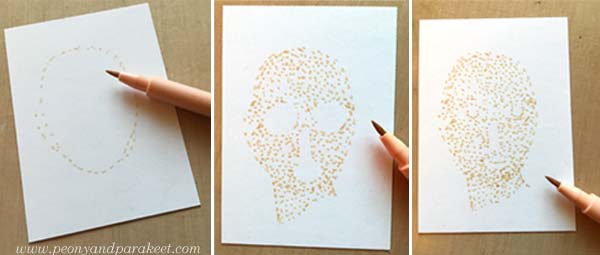
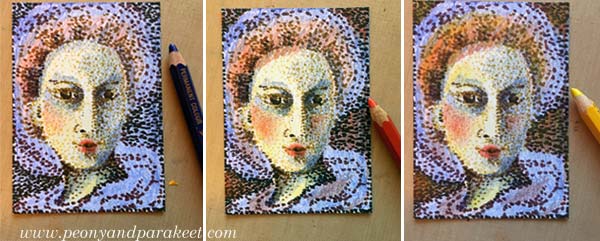
With the palest of color, sketch an oval using small dots. The liberating thing here is that when you start with a pale color and make little dots, you can make many “mistakes” and correct them as you go. One spot in a wrong place can be easily changed! Fill the oval with dots so that you leave blank space where you plan mouth, eyes, and nose to be. When they seem to be in place, add some dots for details. Don’t worry if your woman looks pretty ugly. This is just the first layer!
Change to darker shades and add shadows to the face. Then sketch the hair and clothes using little dots only.
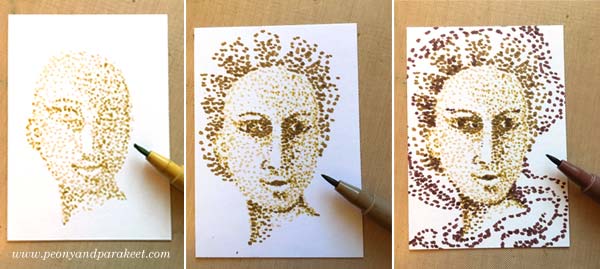
Every shade adds a little bit more to the image.
2) Basic Coloring with Black and Colored Pencils
Now add black spots to the darkest of details. Old portraits often had a dark background, so I added black spots there too.
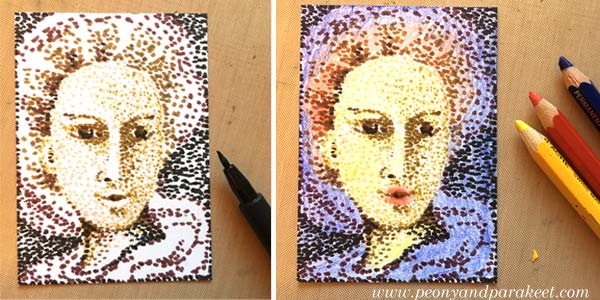
Using colored pencils, color the card so that white shows only where you want to have it in the end. I used Caran d’Ache Pablo pencils in blue, red and yellow. Remember that you can mix colors by layering. You can get many beautiful tones from the primary colors.
3) More Liveliness with Colored Pencils
Finally, add shadows so that the details look 3-dimensional. If you only have primary colors like I had, you can get a dark background by adding blue, red and yellow layers there. If your portrait looks too dark, use an eraser to lighten and soften the colors.
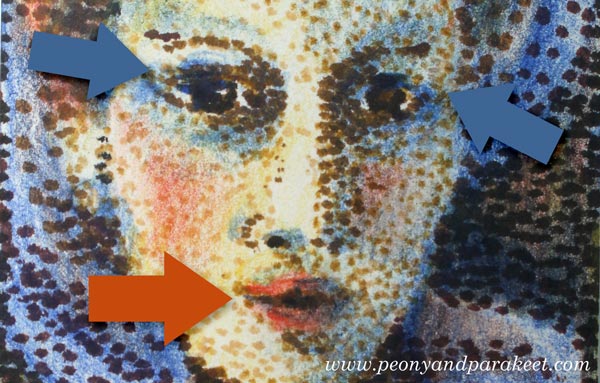
In the end, check the facial features of your woman. Add small lines where you want to turn the attention. Don’t draw the lines near the nose but on the lips and the eyes.
Celebrating Blurriness
Here are my finished cards again. I think they look delightfully blurry!
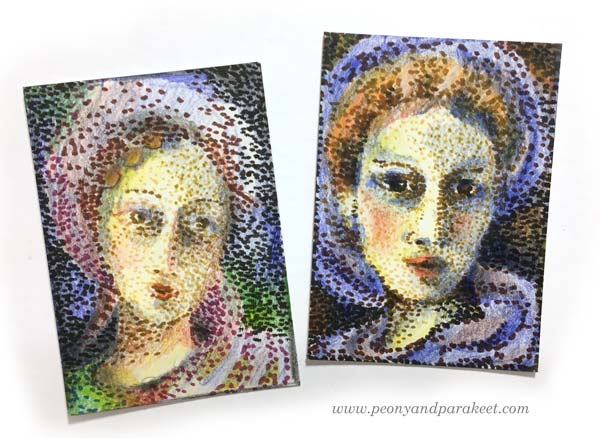
The more I want to reduce stiffness in my art, the more I feel the need to embrace blurriness. With blurriness, I also feel more self-acceptance, more ease with errors, more open to possibilities.
Reducing stiffness is one of the main themes in my newest class too. The class is called Inspirational Drawing 2.0 and it’s about drawing from imagination and inspiration. Watch the introductory video below!
Inspirational Drawing 2.0: Liberate your line and sign up now!
A Decorative Pattern for Art Journals and Beyond
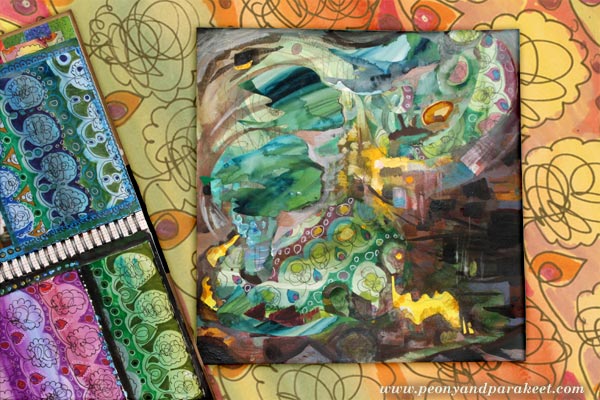
A couple of months ago, I made a flip-through video of a full art journal. Many noticed a spread that was made from decorative papers mostly. I remembered that I took some photos while making the papers and I will share step-by-step instructions here. This pattern is good practice for motoric skills and drawing, but it can also go beyond! I used it for a more expressive purpose, for a collage art piece.
1) Paint Stripes with Watercolors
Use a fairly thin paper and paint it with watercolors. Use a selection of colors to create stripes or curves.
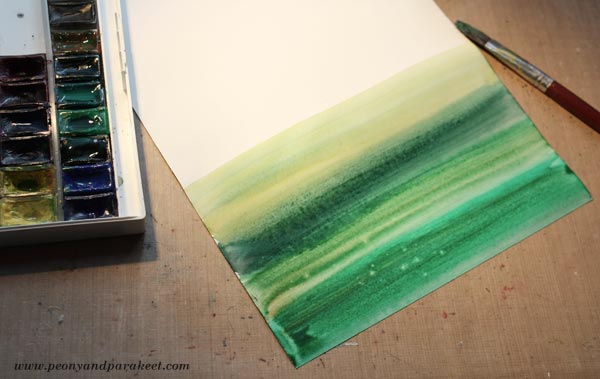
You can add drops of water if you want to make the background more interesting with bleeds.
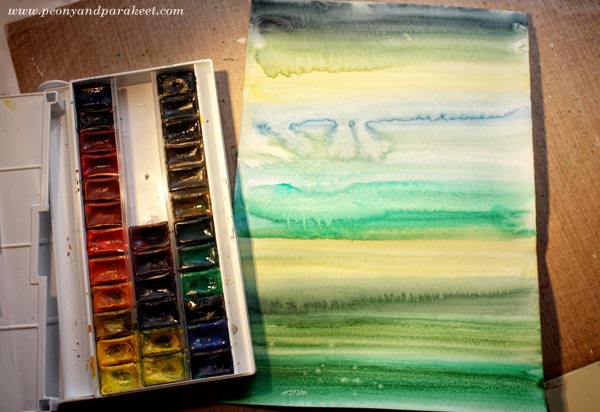
Let the paper dry properly.
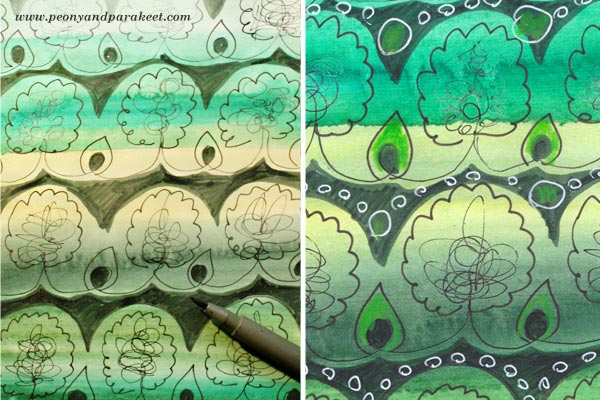
2) Decorate the Stripes with a Simple Loop Pattern
Using a thin-tipped black drawing pen, draw a simple loop and end it with a curve upwards. Without lifting the pen off the paper, add a bunch of loops on the top of the curve. Then continued by drawing a curved line downwards. Repeat and draw the whole row on the same go. Work fast and don’t worry too much about the symmetry or similarity of the loops.
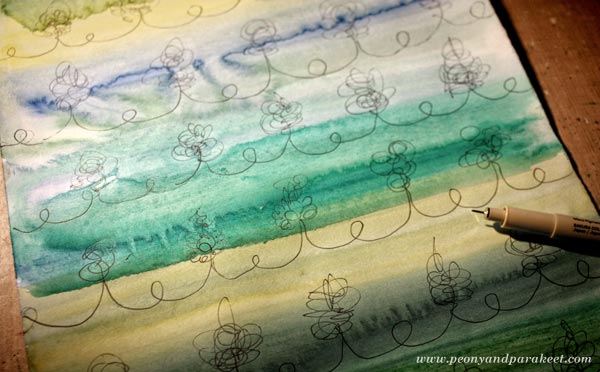
After drawing the rows, frame the loops to make them more distinct. I used simple shapes to create flowers and leaves.
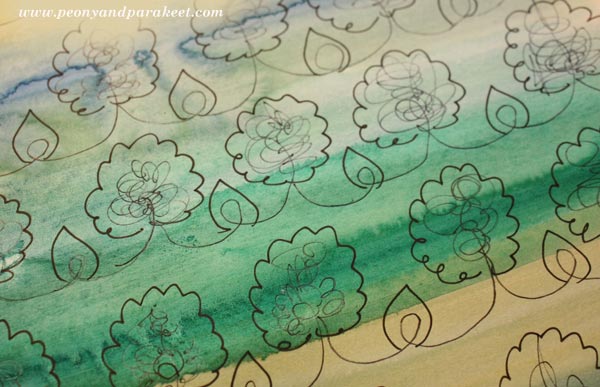
3) Color the Background and Add More Decoration
To make the watercolored layer look more lively, use felt-tipped pens (marker pens) and color the background around the doodled shapes. You can also add more color to doodled details and use a white gel pen to add more decoration to colored areas.
Decorative Pattern in Many Colors
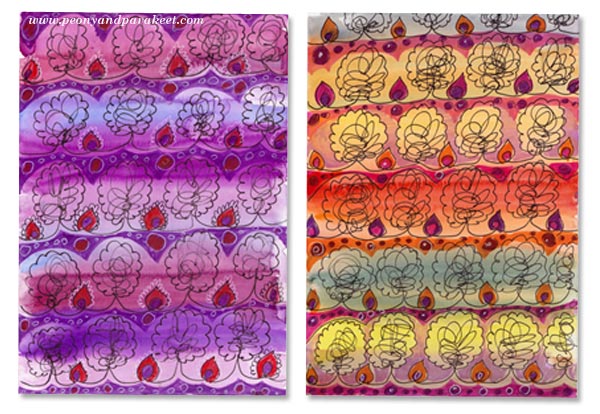
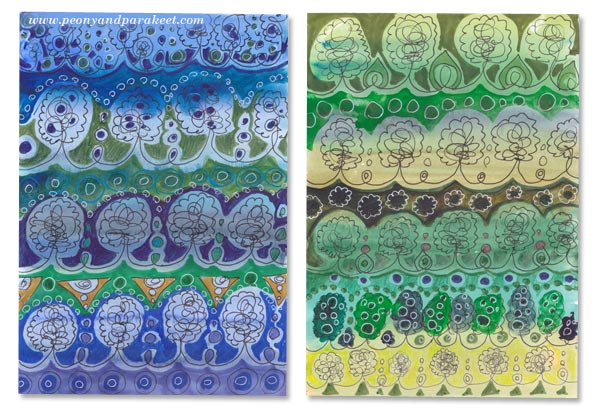
This pattern looks luxurious when you make many papers in many colors with slightly different decorations.

Here are some that I made!
Decorative Pattern in Collage Art
I am fascinated by the interface between art, design, and crafts. The idea for the pattern came from knitting. I wanted to find a similar relaxing circular motion using a pen instead of a knitting needle. So that’s how a craft transformed into a design. But design can also be a part of a more expressive piece.

In this collage, I use decorative paper pieces with paint. My starting point was a watercolor background, acrylic paint, and a piece of decorative paper.
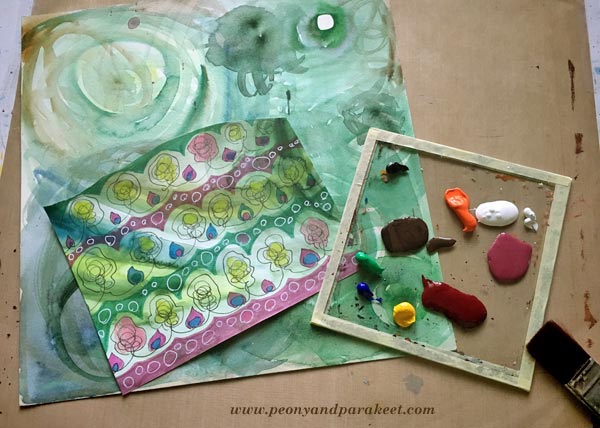
I cut a couple of decorative shapes and glued them on the background with gel medium.
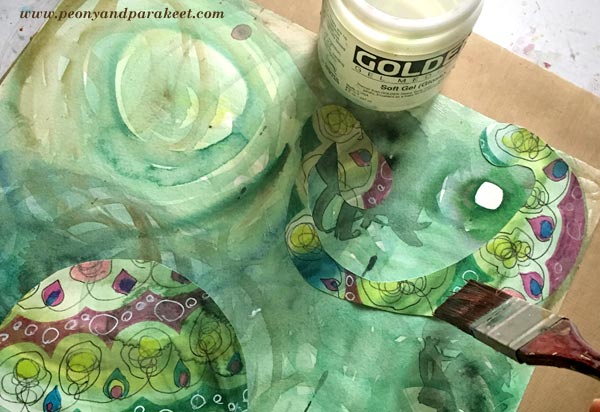
Then I continued with painting using acrylic paints. In the finishing phase, I also used some more paper pieces and few colored pencils. A week or two ago, I heard the geese flying over our house. They were leaving Finland, going to a warmer place for a winter. Their sounds made me think how limited we people are, not being able to fly so freely, not always being able to stick so tightly together. The screams of the geese felt bright yellow and for a short moment, I wanted to join them and not stay in Finland, waiting for snow …
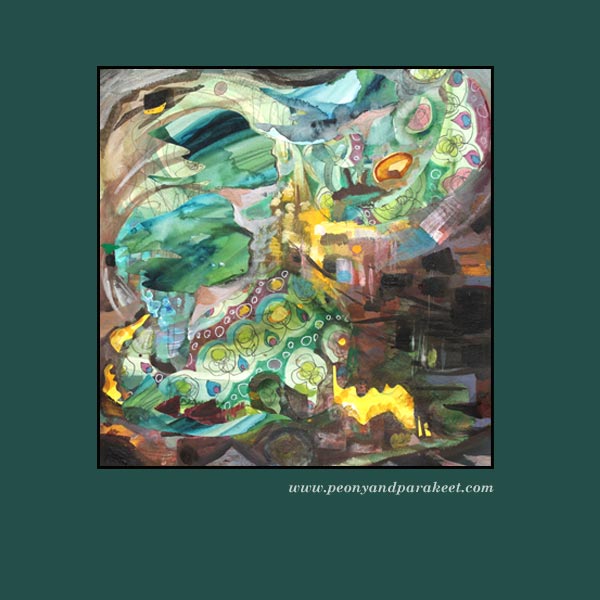
Get step-by-step instructions for doodled collage art – Buy Doodled Luxury!
Painterly Collage in Rut Bryk’s style

Here’s my recent art journal spread, inspired by a Finnish ceramic artist, Rut Bryk (1916-1999). The Espoo Museum of Modern Art is currently showing her work, and as a big fan of her work, I had to see the exhibition!
Rut Bryk
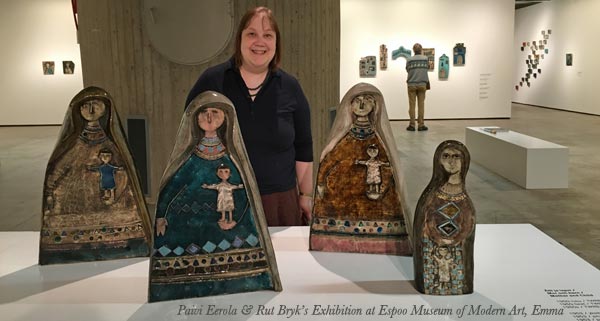
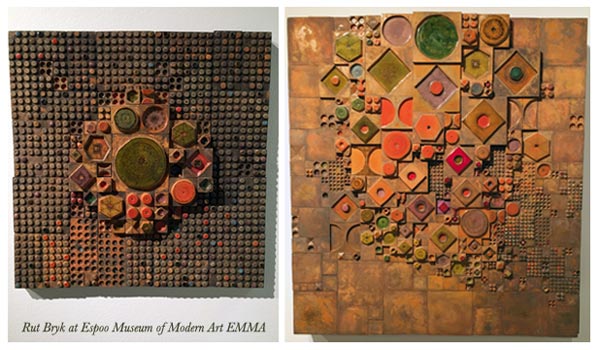
Rut Bryk is very well-known in Finland but not so famous worldwide. However, you might know her husband, the skillful designer and sculptor Tapio Wirkkala. Rut Bryk was an illustrator who got a job at the Finnish ceramic factory Arabia in the 1940s. Her early work was fairly naive and illustrative. But after working with ceramics for some time, she began adding textures to her work. Her 50s pieces were very mid-century modern.
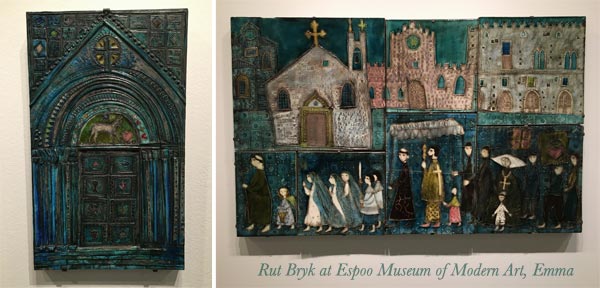
In the 1960s, her work grew more dimensional and abstract.
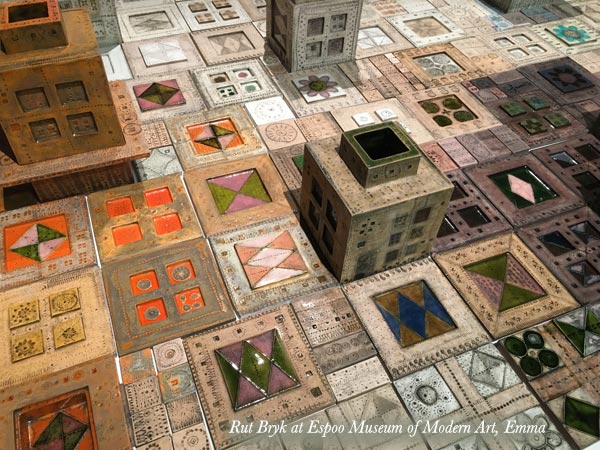
The abstract pieces she made are stunning.
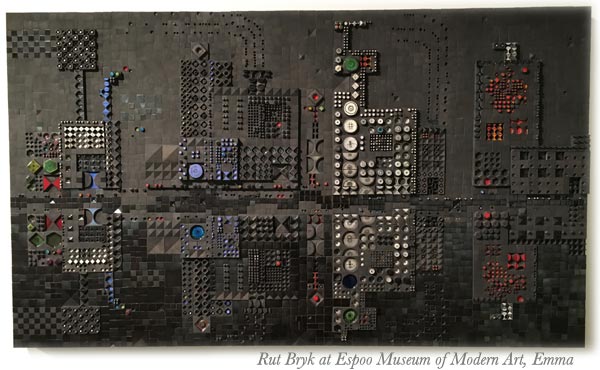
This black city view is one of my favorites.
Many of Rut Bryk’s artworks are composed of small ceramic pieces. They look like quilts or crocheted blankets to me.
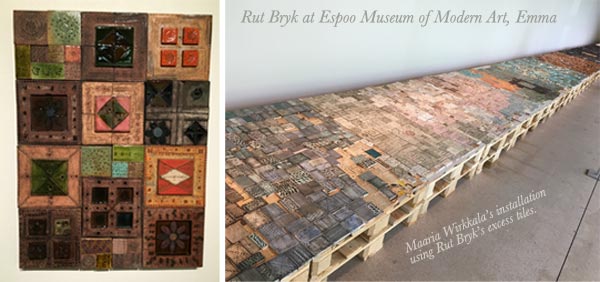
Rut Bryk’s and Tapio Wirkkala’s daughter Maaria Wirkkala is also a well-known artist. She had made an installation of Rut Bryk’s excess tiles for the exhibition.
Create a Paper Collage in Rut Bryk’s Style!
Get inspired by Rut Bryk’s brilliance and create a paper collage with these step-by-step instructions!
You will need hand-decorated papers, acrylic paints, marker pens, and gel medium or paper glue. See ideas for hand-decorated papers: Basic Instructions, Frugal version, Kiwi, Arboretum, Spring Flowers (PDF download)
1) Paint the Background
Paint the background black.
2) Cut Collage Pieces
Cut collage pieces to simple shapes like rectangles, triangles, diamond shapes, and circles. Cut big, small, and medium-sized pieces. To make the pieces look like handcrafted ceramic plates, round the corners and soften the straight edges so that they are slightly wavy. Don’t worry about the colors too much, as you will be painting over them.
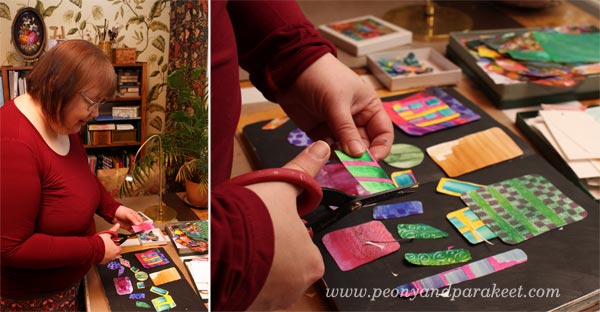
3) Glue the Pieces
Using gel medium or paper glue, begin gluing the pieces on the black background.
Pile up pieces so that some of the smaller pieces are glued to the bigger pieces. Before gluing, add black paint so that the piece on the top will have soft black borders. This will make your work look more dimensional.
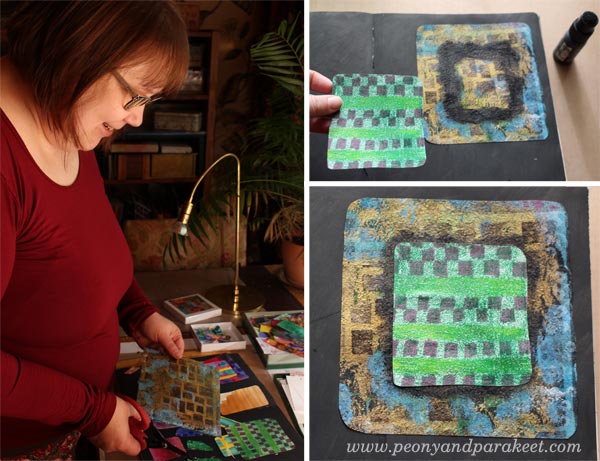
Don’t fill the whole background but leave some of it black.
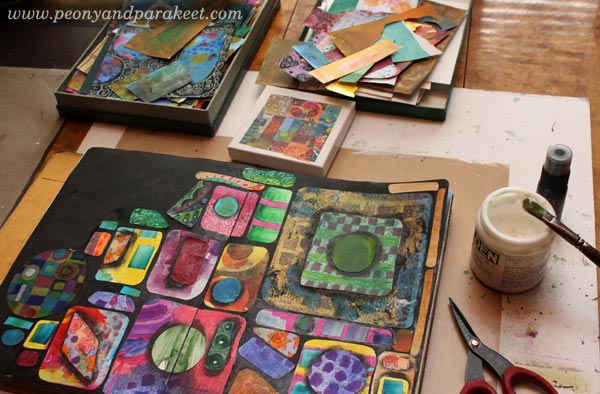
4) Paint Lightly Over the Pieces
To make the pieces look softer and to mute down their colors, add thin layers of acrylic paint over them.
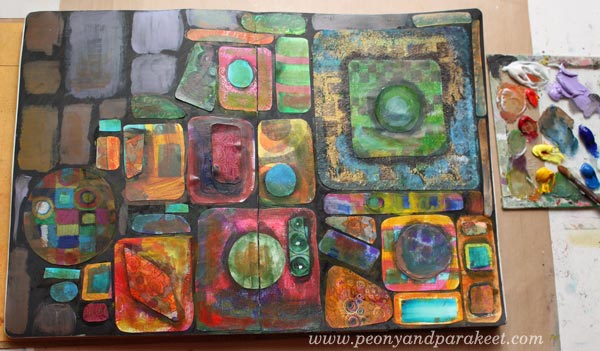
Paint blocks where the black background is visible. Use neutral, fairly dark colors that suit well with the black background.
5) Draw Spotted Grids and Frame Collage Pieces
With marker pens or felt-tip pens, draw spots so that they form grids. These grids can continue over the blocks. The size of the spots can vary. I use Faber-Castell Pitt Artist Pens as they work well on acrylic paint.
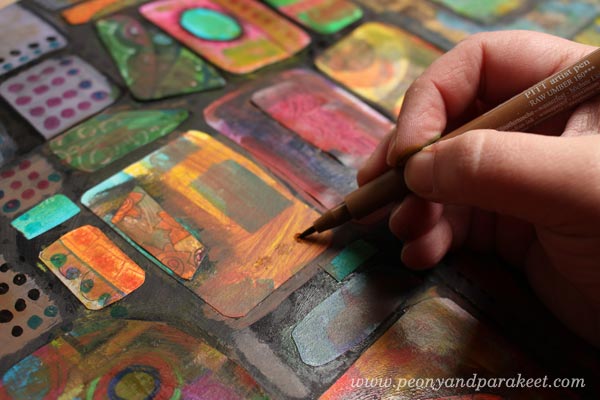
Frame the painted blocks and collage pieces with a black marker so that they look firmly attached to the background. I also used white Chinese marker to add few white lines here and there.
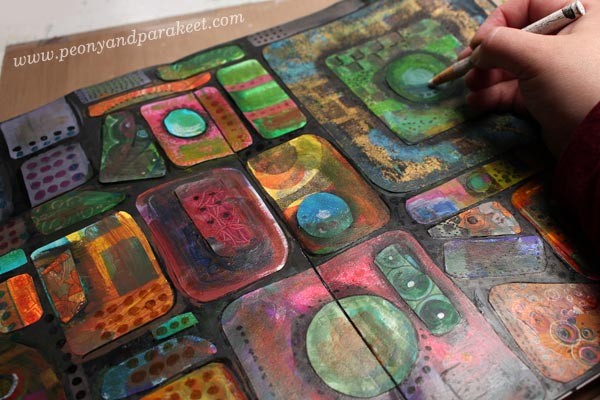
6) Paint Slightly Over Some Areas
To finish your work, add thin layers of paint to some areas. These painted areas represent light and shadows over the overall composition.
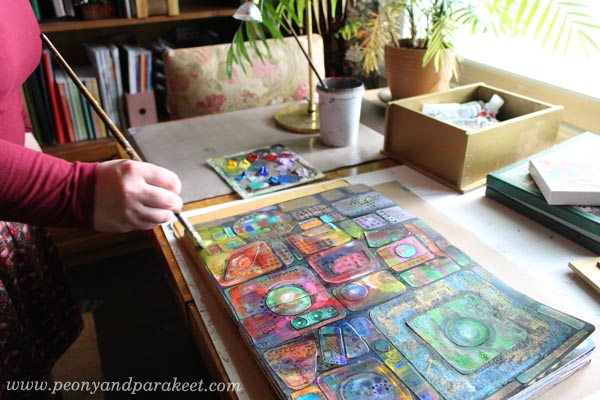
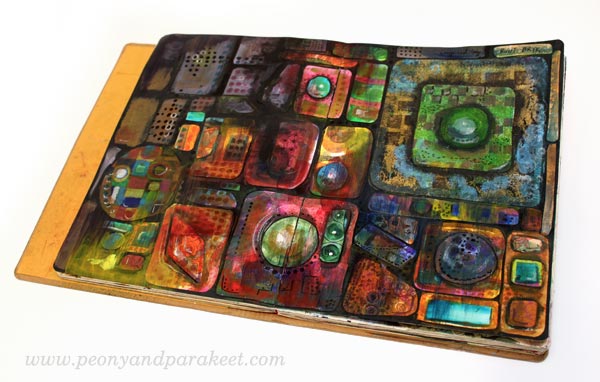
Here’s my finished spread again.
Extra Project – Decorating a Box
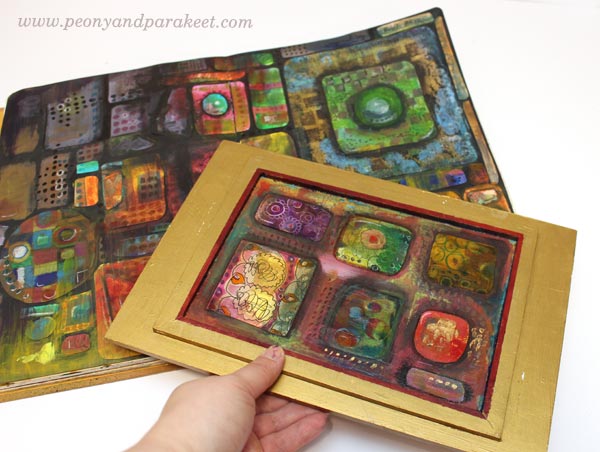
My husband has made a wooden box for my paint tubes. I have painted it golden, but the bottom part of the lid needed some decoration. I had already painted the framed area red, so I just added black paint to the collage pieces.
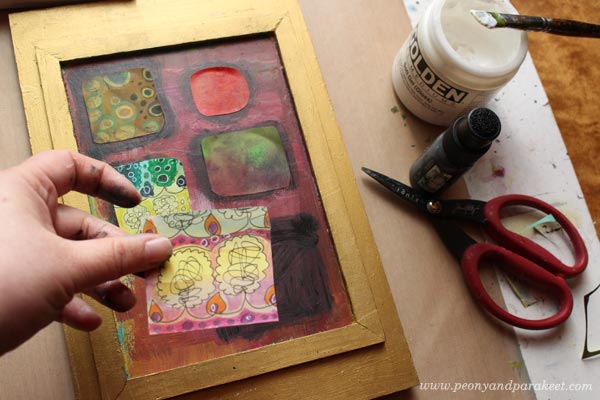
Then I continued the process like in the instructions. Finally, a layer of gel medium was added to protect the paper pieces.
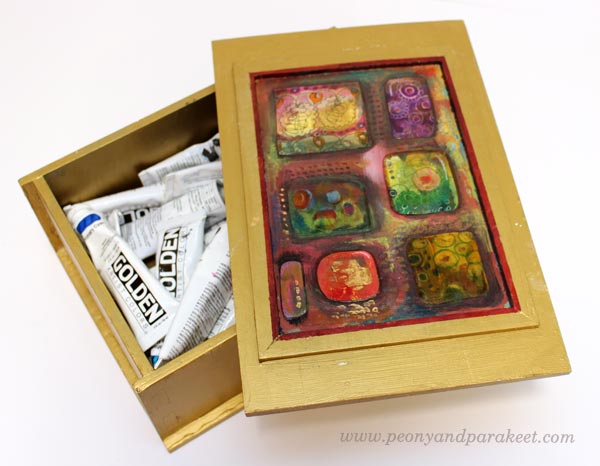
I like the idea of opening the lid and seeing the collage.
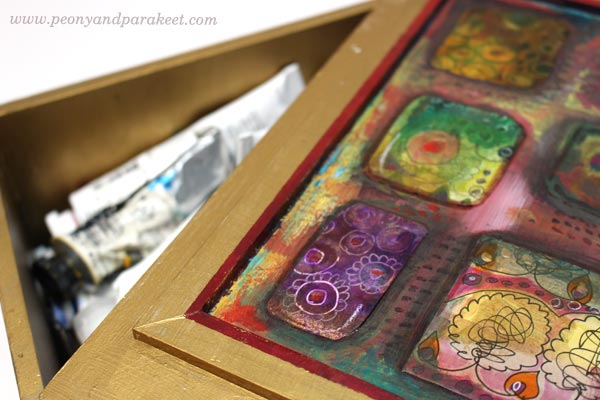
Thank you, Rut Bryk!
Expand Your Artistic Imagination!
This blog post is an example of how you can learn and get inspired by famous artists. This is how I see it:
– If you want to find your own uniqueness, examine all kinds of artists and styles!
– If you have already found your style, keep on experimenting and expanding your skills!
What Artistic Direction to Take?
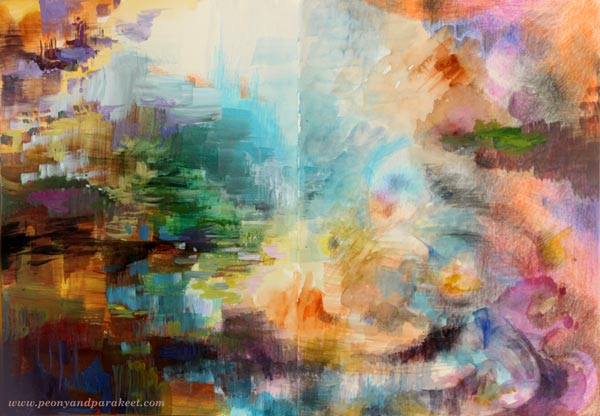
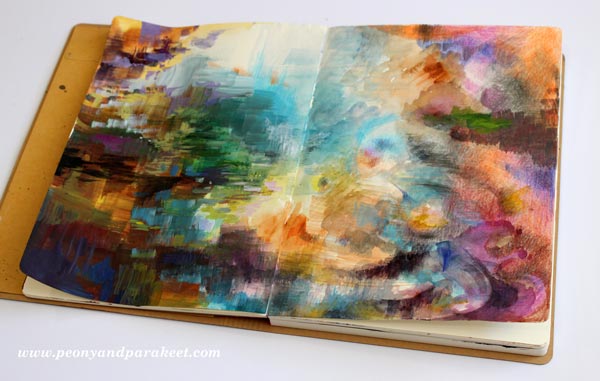
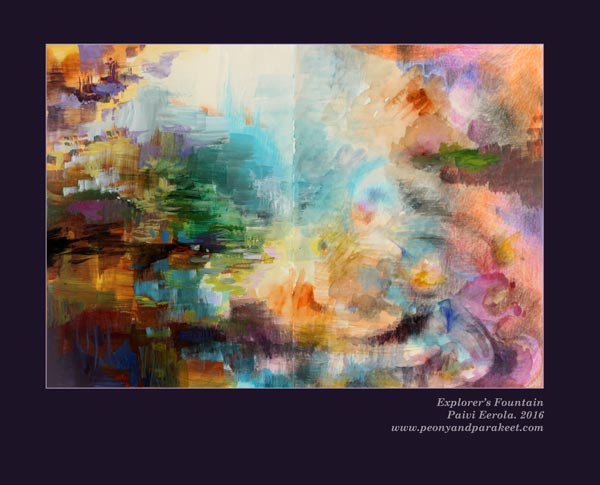
This is my latest art journal spread called “Explorer’s Fountain”. Before showing how I made it, I want to ask you the question that I have been pondering.
When Is the Beginning of a New Phase?
All artists have phases. But how to know when a new one begins? Is creating a continuum or are there certain points when you make the change? Or at least began to change?
I posted this image to Peony and Parakeet’s Facebook page with the text below, and I want to share this here too:
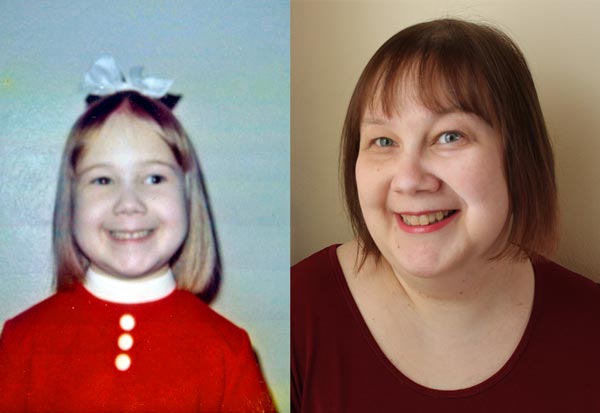
As children, we know what we love. I wanted to be an artist and a teacher. I wanted to write and publish books. I wanted to live with pets. When we grow up, there seem to be more possibilities, and still, they feel less. It’s not much to be a manager when you have dreamed to be an artist. This is how I have felt personally and this is why I think we should do what we have always loved. Because it feels more fulfilling than anything else.
Just recently, art has begun to feel more fulfilling and exciting than ever before. I feel I have new skills, even if I can’t fully point out what they are. I feel I have new thoughts but when I try to grab them, they seem to disappear. My mind is filled with new kind of artistic focus, and still, it’s like it has always been there, now I am just more connected to it. This makes me think that I am experiencing some kind of artistic change, moving from one phase to another.
The changing process is like a rain that starts with small drops. You can then decide whether you go back inside or get out and see what happens!
Learning from Practicing
Teaching classes have been small drops to me. As an art teacher, I see all kind of styles and seek solutions to many kinds of creative problems. I am often so excited about my students and their creations that my own art feels like a secondary thing. But while I have helped people to bring out the best of their skills and get more clarity for their creative direction, it has been a school for me too. It’s like I have got a gift from my students, being able to build my own focus in a new way. So while you have practiced, I have practiced too!
What’s Your Ambition in Art?
I have never understood the controversy between commercial approach and artistic freedom. I think we should search for the best audience to our art and find ourselves through the process. I know most of the people disagree with this. I do understand that many great art pieces wouldn’t have been born with this mindset. But my own ambition of being an artist doesn’t mean creating world-class art and being the greatest of all. I think art as a service instead of end result only. I want to understand how people experience art and develop ways to make creating as fulfilling as possible. – What’s your ambition in art?
Triptych Approach – Create with Me!
Instead of focusing on single artworks, I look for creative concepts and processes. Just recently I got an idea of a triptych. The piece would be created with three different mediums, each taking one-third of the final piece. But this triptych would have soft edges so that it would look like a one piece despite the three distinct elements. Create this triptych with me and while creating, ponder about your artistic direction!
1) Start with Colored Pencils
Color freely with colored pencils so that you fill approximately one-third of the page.
Add few small separate colored areas too.
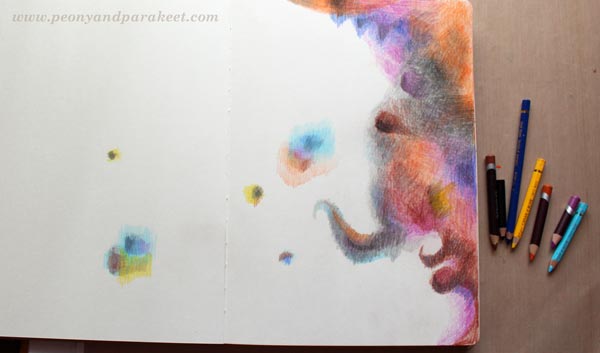
Using Old Pencils
I use Prismacolor and Garan d’Ache Luminance pencils “officially”. For example, all the images of the e-book Coloring Freely have been colored with them. But when I am making a quick spread like this one, I often grab some odd short pencils and use them instead of the fancier ones.
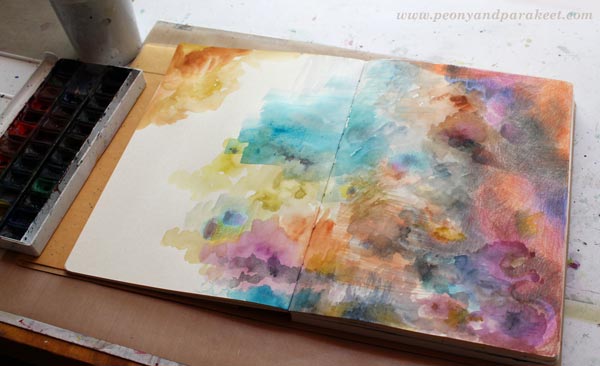
2) Continue with Watercolors
Change to watercolors and paint the second third of the spread.
Try to make the transition from colored to painted areas as soft as possible.
In the end, paint an area that is separate from the main area.
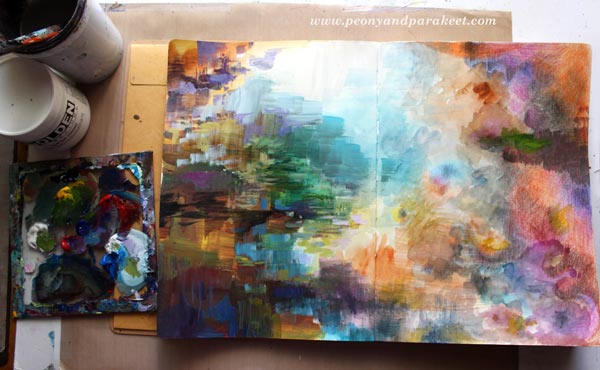
3) Fill the Rest with Acrylic Paints
Paint most of the remaining blank area with acrylic paint.
Add a small painted area on the right where you have colored with pencils. Acrylic paints can be used easily over colored pencils. Don’t cover too much, let every medium show!
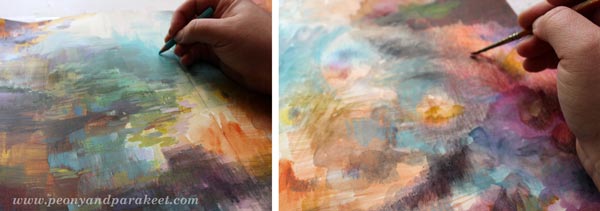
4) Finishing
Go through the whole page and fine-tune the spread with colored pencils and acrylic paints.
Add little details and nuances, don’t repaint the whole page.
Here’s is my finished spread again.
5) Use Leftover Paint
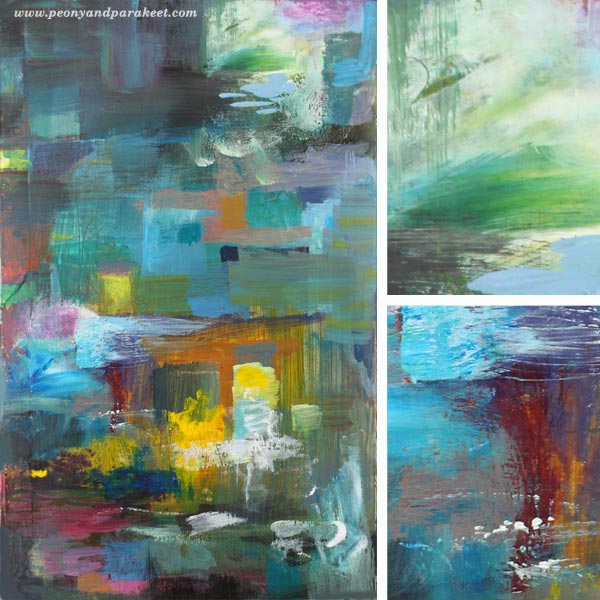
If you still have some leftover paint on a palette, grab a new page and create a quick abstract!
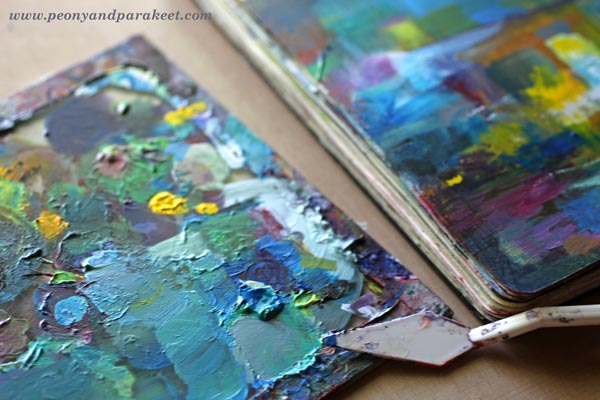
Here’s mine, called “House with a View”.
Analysing Artistic Direction
When thinking about artistic direction, it’s natural to analyze what’s good at the end result – what do you want to take from that to move forward. But it’s as important to think about the creative process and analyze that what felt good there.
After analyzing both ways, I think that my direction is this. I have always loved art history. I want it to show in my art but in a fresh way. I want to build bridges between old art created hundreds of years ago and today’s contemporary art. My latest art class Imagine Monthly already does a lot of that. But I also want to grow as an artist so that my personal expression grows stronger and so that I can reach more like-minded people with both my art and my classes.
Challenge yourself to find your artistic direction
Sign up for Imagine Monthly Fall 2016!