
Arboretum Patterned Paper
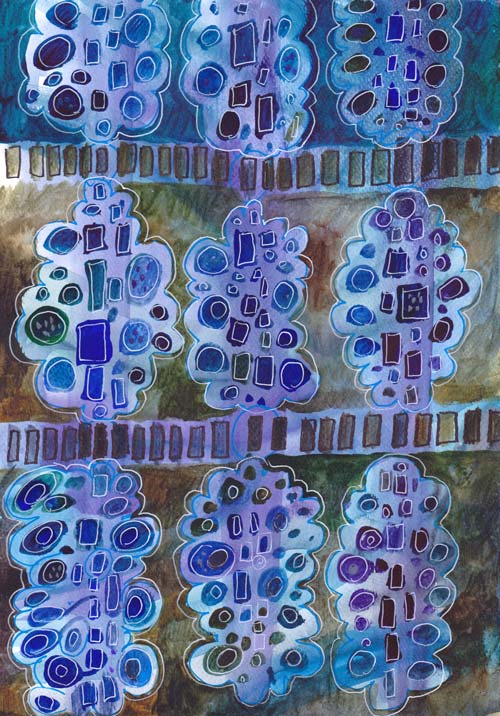
My newest design for hand decorated papers is called Arboretum. Arboretum as a word means a collection of trees. It is often used for the gardens where various kinds of trees from the collection. As you can see below, this design is very versatile: you can create any trees and play with the colors and pattern repeats.

I have used mainly watercolors here, but you can create this pattern with almost any supplies. When I designed this, I was inspired by two things: 1960s retro style and modern quilting.
Living in a house built in the 60s, we have brown, sturdy floor tiles and pine trees in the garden. The whole era celebrated the simple shapes forming simple designs. In modern quilting, solid fabrics are combined with modern patterns. Modern style quilts also often use asymmetrical and improvisational piecing.
I wanted to create a design that would be improvisational as well. I aimed for the painted design that leaves space for variations and self-expression. The simplified black and white pattern picture shows the structure more clearly.
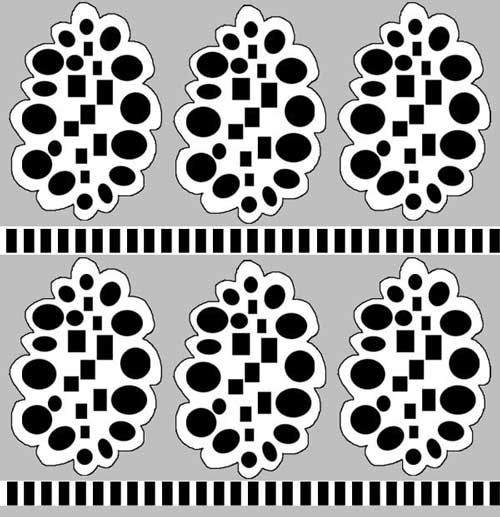
Each of the trees has rectangular shapes in the middle. They represent the trunk of the tree. The rectangles are surrounded by round shapes, which represent leaves. Each row is separated by the row of rectangles, representing the fence or earth. A single tree can also be used alone, as an element in an illustration or as the only image illustrating a text.
Step by Step Instructions for the Painted Design
1) Create the background

Use several colors to create the background. The colors can be intensive but not very dark as this is only the bottom layer that shows behind the trees.
I used thin watercolor paper, watercolors, broad brush and plenty of water. I worked with long strokes from top to bottom and vice versa. The paper was dry, but the brush was very wet. In the end, I added splashes of water to create even more variation.
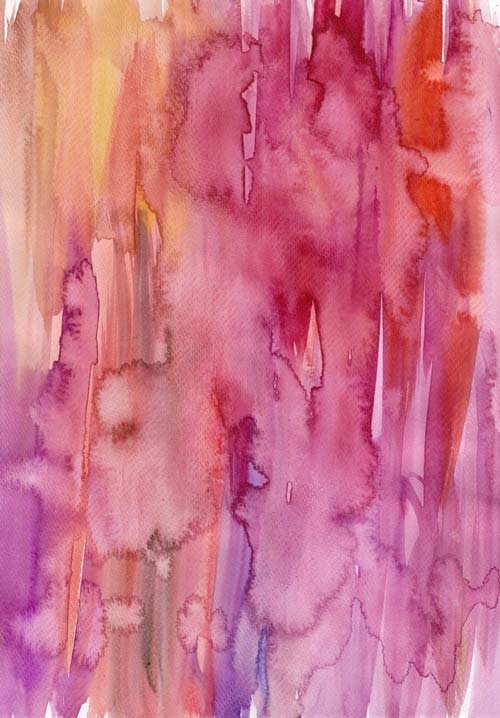
Let the background dry well. If you like the result, and you have a scanner, scan it so that you can use it multiple times by printing it!
2) Add the fences.
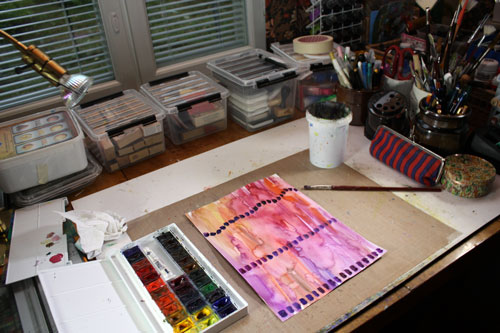
The fences can be straight or curvy. They can break or continue from edge to edge. The distance of these rows determines the size of your trees.
3) Add the trees.

Start with the rectangles of the trunk. Continue by adding circles near them. Create the rectangles and circles in different sizes and different colors. Color variation looks great especially if you maintain the intensity of the color fairly even between the shapes.

Leave some space between the trees.
3) Darken the background around the trees.
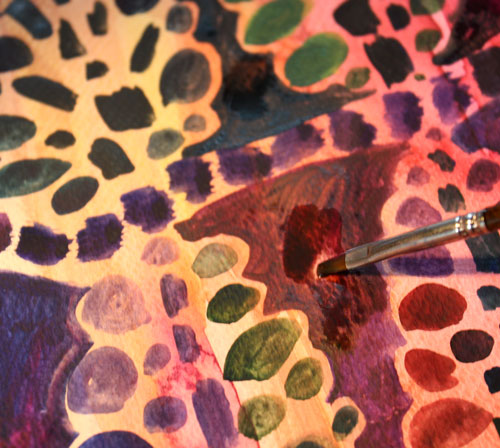
Add darker color to the space between the trees. You can use various colors here too. The dark background represents the sky.
4) Finish with doodles.

Create details to the rectangles and circles. I like to use white gel pen here. You can make each tree look different if you like.
My finished piece is inspired by fall. Thus some trees only had few leaves. On the top row, there ‘s also a tree that has rectangles set like branches. The darkest tree in the upper left corner reminds me of a cone. I could have made an art journal page too by replacing the fence with the journaling. There’s so many little tweaks you can make to this pattern to tell your personal story!

After creating these, I have begun to wonder: what if I cut some of the trees out and created a collage from them!

More patterned papers: Basic instructions + links to more
More inspiration from simple shapes: What to Create from Simple Shapes? 6 ideas
Let me be your art teacher: Subscribe to my weekly emails!
Imitate Ceramic Art!
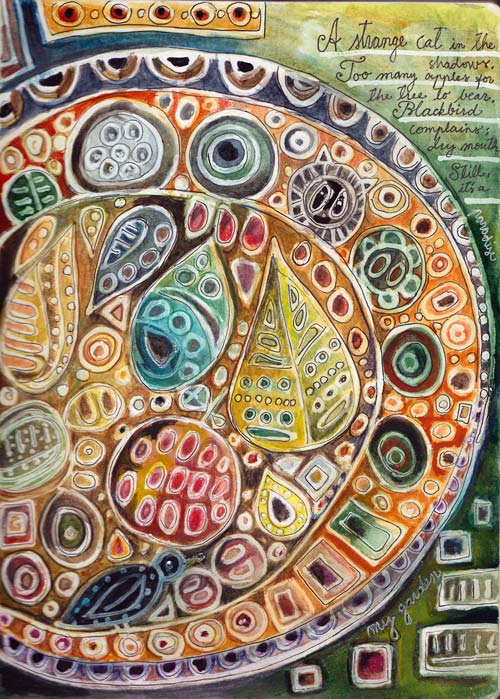
A strange cat in the shadows.
Too many apples for the tree to bear.
A blackbird complains: Dry mouth!
Still, it’s a paradise: my garden.
This is an art journal page where I wanted to achieve two things:
1) imitate Scandinavian ceramic artists of 1940-1960s
2) write a poem and illustrate it
Scandinavian Ceramic Art
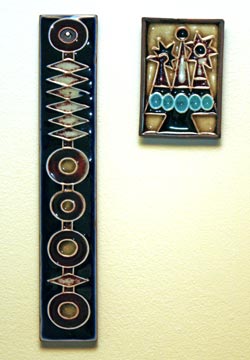 Let’s start with the artists: Annikki Hovisaari from Finland and Lisa Larson from Sweden. They are women who made beautiful ceramic art in 40s-60s. Annikki Hovisaari died in 2004 but Lisa Larson is still alive and she has a website too.
Me and my husband own a couple of Annikki Hovisaari’s work. We have bought those from antique fairs.
I found out about Lisa Larson in Scandinavian Retro magazine nr 1/2014. You can also see the best work of hers by searching from Google with the search term “Lisa Larson tile”
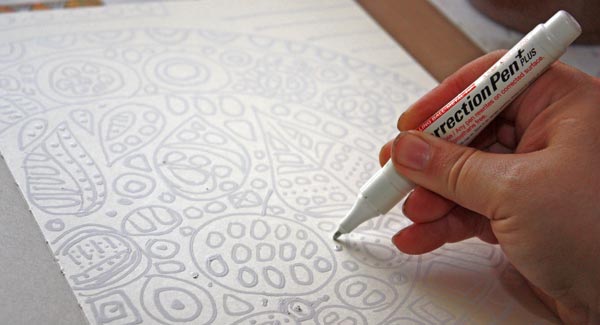
When I examined the work of these two artists, it was clear that a white correction pen would be perfect to imitate the lines. I made a couple of small pages by combining the correction pen with acrylic paints and PITT Artist Pens. However I was not fully satisfied with the outcome. These did not have the liveliness in color that I wanted to achieve.
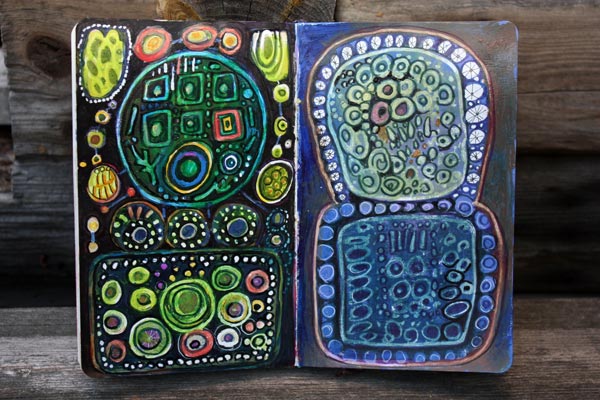
But after making these I realized how I would use the correction pen and what I would combine it with: watercolors! Here’s how you can create your own ceramic tile look!
1) Doodle with correction pen
2) Use watercolors for coloring
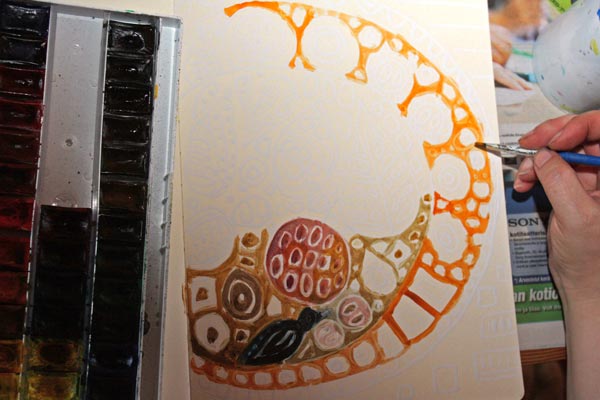
The correction pen works as a resist. You can watercolor over the white doodles. After painting add some water and wipe the paint off from the doodles.
3) Add contrast and draw thin black lines

When you are done with watercolors, don’t stop yet. Add color variation and contrasts to doodled shapes. You can also work with colored pencils when finishing if it feels easier. Finally, take a thin black marker and add thin lines in the center of white doodles or both sides of the doodles. These lines will make your work look sharper and more dimensional.

Here you can see the difference that finishing makes. At this stage, I have also added the poem. Actually, my process began by writing the poem. I have discovered that if I want more depth in journaling, it’s better to write it first.
Have fun with this simple technique!
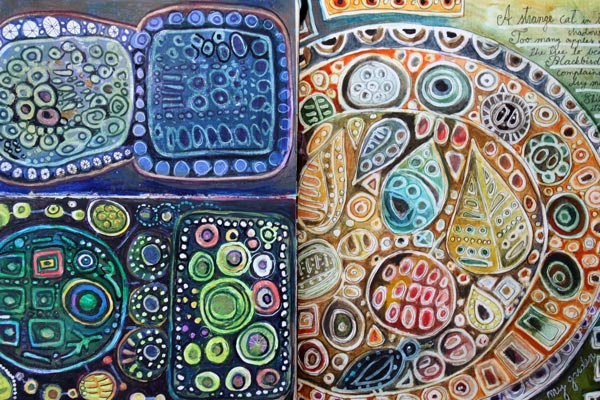
More ceramic art inspiration and playing with simple shapes
>> Modern Mid-Century art journaling mini-course
Fun Designs from Decorative Papers
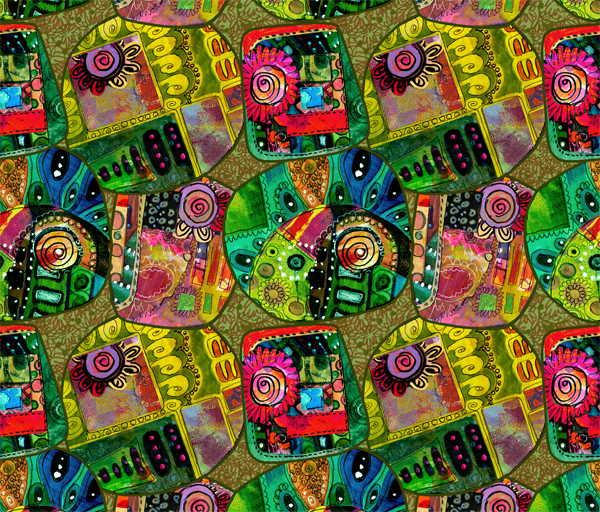
Were you ready for the color bomb? I just could not resist creating this design with the vibrancy that is almost inappropriate. Hopefully, you are like me and need to get your overdose of colors and patterns now and then!
Collage Elements
I have created this surface pattern from handmade collage elements. I often mention how I create single decorative elements which I use in collage art or art journaling later. This time, I made a pattern that is based on those odd elements. These elements are like mini collages. They were made by cutting handmade decorated papers and adding some doodling with markers.
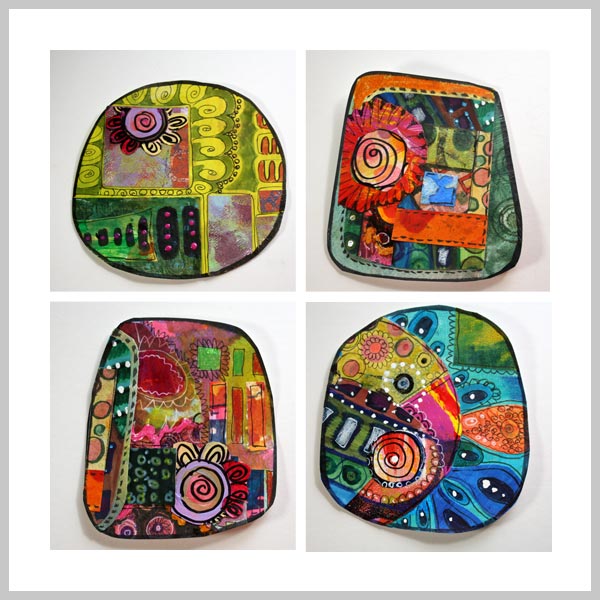
The elements might look complicated but are super simple to make:
1) Combine few paper pieces.
2) Add details with markers.
3) Cut the combined piece in half.
4) Repeat the previous steps changing some of the pieces as you go.
Cutting and combining the cut pieces repetitively is fun, and the result is like a mini quilt. Especially if you add seams with markers like I have done.
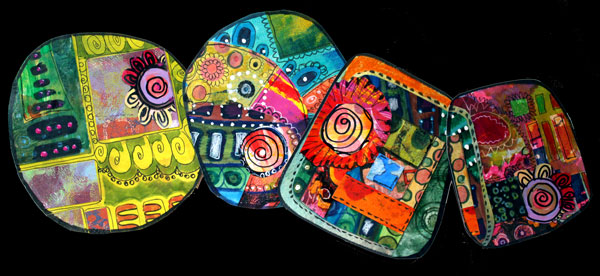
Surface Pattern
When creating a surface pattern, you also need something in the background unless you will put the elements tightly together. I wanted to add the background to make the design more interesting. The plain black background was something that I considered first. But it looked too separate from the pieces.
Luckily I save all kinds of doodles, even the ugly ones. I found a file called “blue mess,” a scanned image of the paper which I made a long time ago.
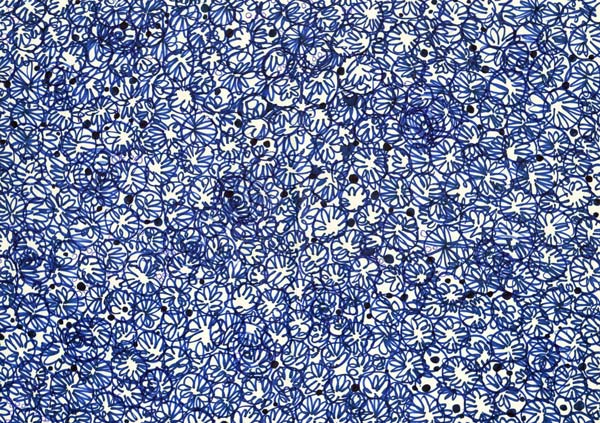
At the time I had thought this doodle was horrible, but now it would be just fine!
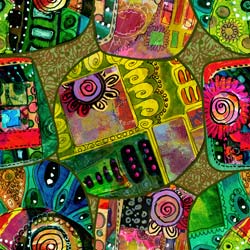 I processed my scanned images at Photoshop image processing software. At Photoshop I created a solid colored background, added the blue mess as the second layer and changed its color. Then I removed the white background from each of the four decorative elements and added a stroke to each element.
The repeat was created so that one decorative element is in the middle, two at sides and the fourth one at the corners. It takes some accuracy to place the elements so that they match when the design is repeated. It would have been easier to have each element separate, but I wanted to create a sort of appliqued look.
If you do not make a commercial pattern, you can just create an artwork manually instead of composing a repeatable pattern on the computer.
Here’s the design again, with more muted colors. This design reminds me of an old quilt, colors faded a bit unevenly but still suitable to be the centerpiece of any room.
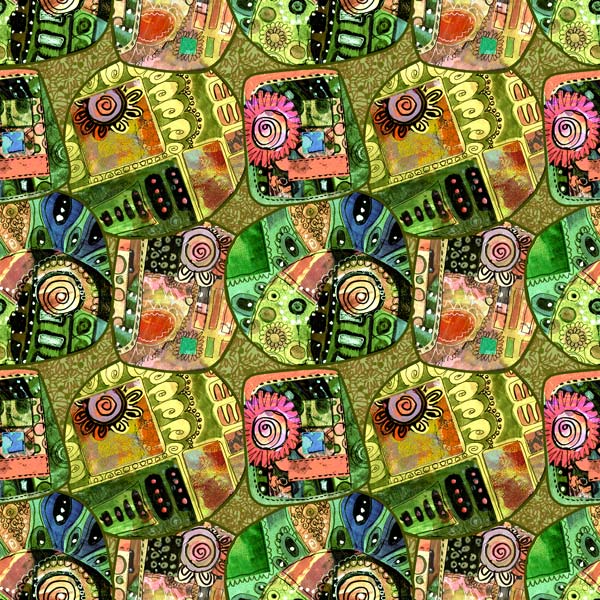
I call this pattern Kira.
Create more hand-drawn collages: Buy Doodled Luxury!
Fabric Collages

The idea for this card came from the pile of fabric scraps that I have. I began to wonder: could I use these instead of papers to create fabric collages?

Fabric Collages – A School Project from the Past
I also remembered one happy moment from the childhood. I was about 10 years old. A teacher asked us to bring fabric scraps to school. We were asked to cut the fabric into pieces and create a collage from them. My schoolmates were not excited but I was thrilled. I cut the fabrics into tiny pieces and began to glue them on a paper.
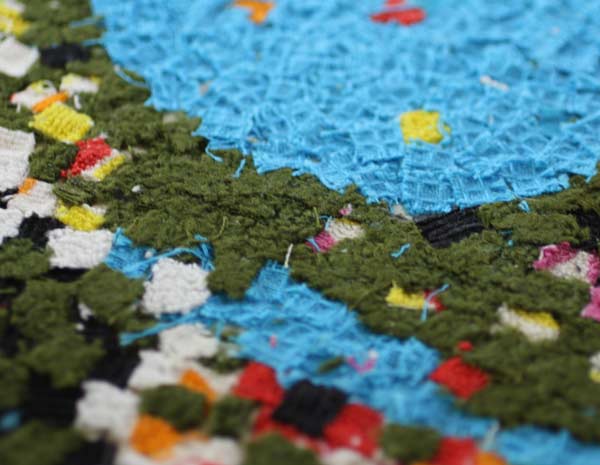
When I had finished the collage, I was very pleased with it. I had also had such a good time. Little did I know that I would be cutting tiny pieces whole my life – that the moment I picked the scissors was to follow me many times afterwards!

1) Cut and Glue the Fabric Pieces
The supplies for fabric collages are simple: scissors, glue, paper, fabrics.

2) Add a Layer of Gel Medium
Because my collage was small, I wanted to add some fine details and extra layering. To be able to do that, I covered the first layer with the gel medium. When dried, I would be able to doodle with markers and create dimensions by adding more layers.
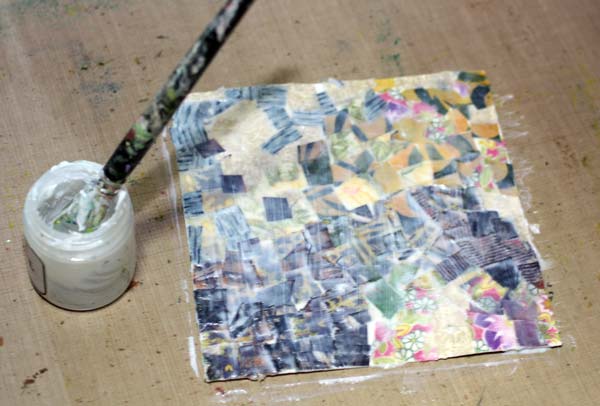
My favorite is Golden Soft Gel Gloss but any gel medium will do. Even if I am not a big fan of buying more stuff, purchasing this is a good investment. You can use gel medium not only to create surfaces but also glueing paper pieces when making paper collages.
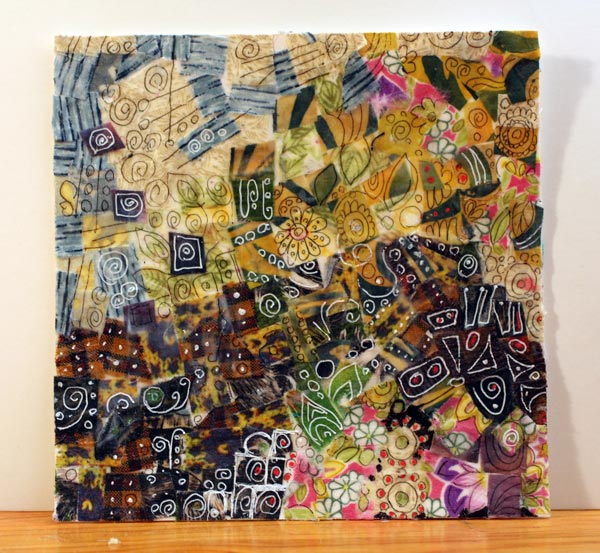
3) Add Doodling
When gel medium dries it becomes transparent and you can doodle with thin markers or gel pens on it. Make sure to dry it first throughly!
4) Add More Details From Fabric Pieces
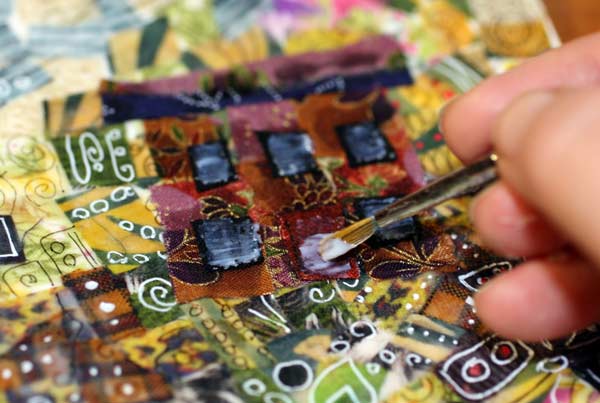
After doodling on the first layer, I wanted to add details like the house in the middle. After constructing the house with fabric pieces and glue, I added gel medium to the details to add some doodling on them.
The photo below shows how the fabric is layered. A part of the card is covered with gel medium and feels like plastic. There are also fabric pieces without any coverage on the top and they feel soft.
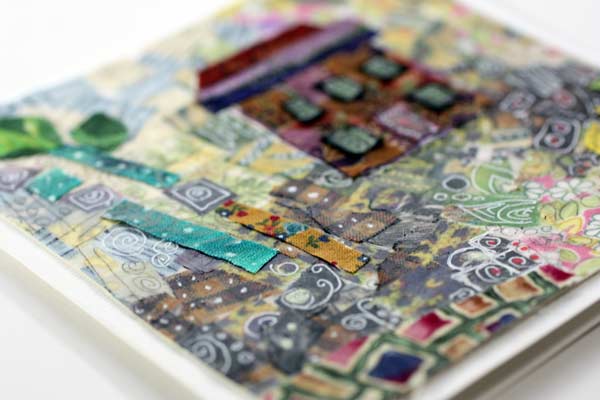
You do not need a sewing machine to enjoy working with fabrics!
Let me be your art teacher: Subscribe to my weekly emails!