
Art Is Freedom

After working against deadlines and taking care of finishing touches in the recent projects, I got a strong urge to experience and express freedom. So I decided to stretch my style by painting something that would not be so detailed. No pens this time, just acrylic paints.
Freedom for the Left Brain
I always get clarity by organizing. This time, I felt I needed to re-organize my working area. I removed storage boxes from the table and picked up only those supplies I was going to use.
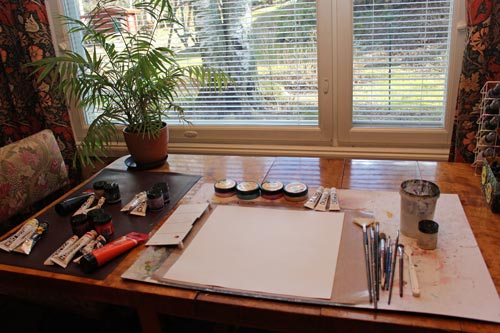
Notice the grouping of paint tubes! I spent a lot of time putting each in their place.
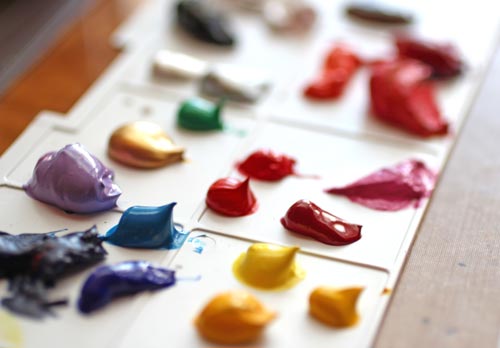
I carefully squeezed each tube of paint to have all the colors ready to be mixed. While doing that, I thought: “THIS is freedom!” Taking time, working slowly, isn’t that the greatest luxury?
Freedom for the Right Brain
I turned the music on. The blank canvas paper was quickly filled with muddy colors. Then I took a sponge and made long strokes. Following the music is a quick way to get the creativity going.
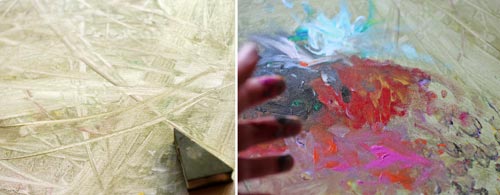
Next, painting with fingers! No boundaries, getting messy, what a great feeling! After a while, I was ready to continue with the brushes.
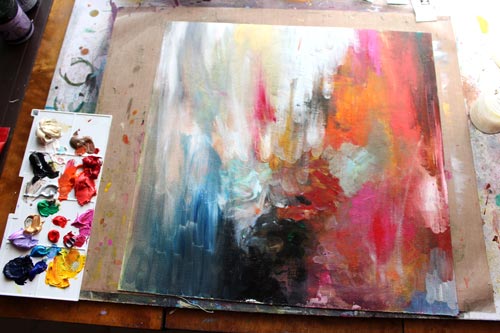
Freedom can be experienced in many ways. This is what I often follow: Setting up the rules, then breaking them, then acceptance. In the last phase, whatever comes on canvas is okay.
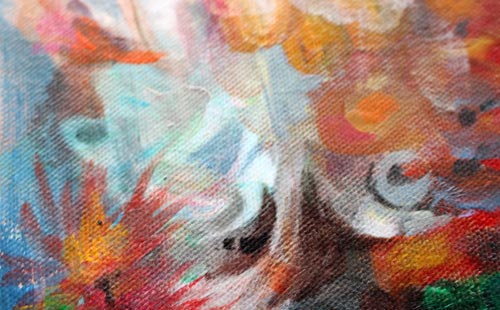
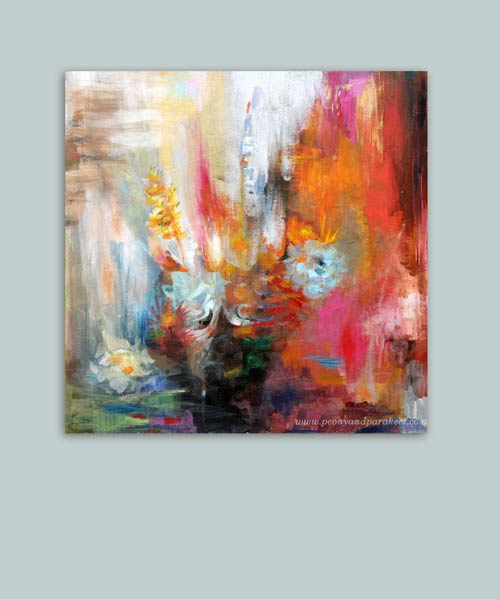
If I listen to music, the painting will often change as the song changes. As a teenager, I used to play the same song all over again to maintain the style of the painting (must have been an agony for the rest of the family to listen to that same song for hours!) Nowadays, it is only exciting to see what will follow when the rhythm changes.
Tips for Freedom
My tips for experiencing freedom:
1) Once you start to paint, instead of gathering all the art supplies, limit what you will use. Think: “These are the only supplies that I have.” Even if it is not true, it will make the commitment stronger.
2) Listen to the music you have not heard before. It takes you off from routines. You can also play a mixture of songs that are all different and new.
3) Observe your thoughts while painting. Those crazy ideas that you normally kill – let them live this time! Be aware that your most intuitive thoughts come up and disappear quickly. Practice self-acceptance so that you will notice them!
Subscribe to my weekly emails – Get a free mini-course!
In the Spirit of Cassandra Tondro
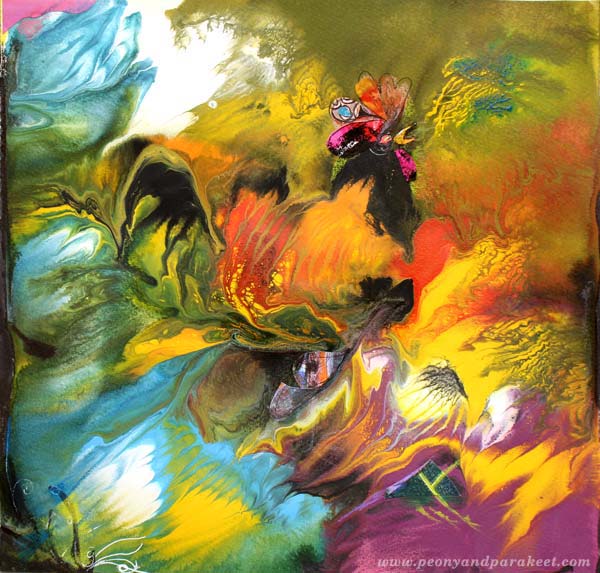
This painting is a monotype print where I have added only few collage pieces and a couple of little details with pens. In this artwork, the rooster is waking us up to notice that in art, whether we are makers or viewers, we are always in the middle of an experience. Thus, if you want to become a better artist, you should not focus on the final results only, but also on the experience.
Cassandra Tondro
There’s a particular artist that I want to introduce for this subject. She is someone that I greatly admire, Cassandra Tondro. I am most honored to have Cassandra Tondro herself answering to my questions! I also got her permission to publish her photo and my favorite artwork of hers called “Illusion” in this post.

The Supplies
Cassandra Tondro has not only thought through about what kind of paintings she wants to create. She has dug deep into the whole creative process. The development of her current way of working has started steps back from what most of us would think. She wanted to find an environment-friendly solution and discovered a way to work with leftover house paint.
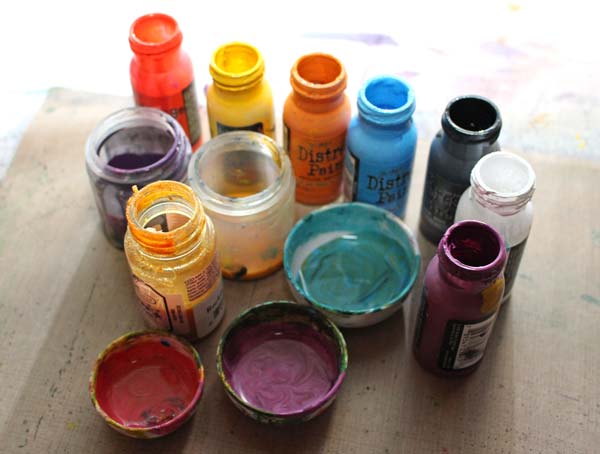
I did not have extra house paint but some odd jars of similar kind of fluid paint like Tim Holtz’s Distress Paint. I also diluted few old acrylic paints with water to get more fluid paint colors.
Working with Colors
Cassandra Tondro has made videos of how she works with the paint. Instead of plastic sheet and canvas, I decided to use a glass plate with blank watercolor paper. My plate is about 12 by 12 inches.

While I poured colors on the plate, I thought about how suitable this process is when you want to forget the rest of the world and have a quality time with your favorite colors. Cassandra Tondro embraces quietness while working:
I like quiet when I work. My experience is that we are surrounded with so much noise all the time — traffic, cell phones, airplanes overhead, radio, videos, Musak in stores. My studio is my refuge from all of that. I like to be alone in the studio — no phone, no computer, no Internet connection — and I like it quiet.
I agree. This is a process where colors are the music players, and the painter is the maestro, fully focusing on how to make it all work together.
Unpredictability
One general characteristic of art is an unpredictable creating process. While you have to accept more unpredictability than usually, there’s a lot what you can control. Choosing the colors and creating color mixtures is one thing. Composing color areas is another. But as Cassandra says, this is an experimental process. Experimenting is also very freeing. As I was unable to repeat the strokes that I usually do, this process tweaked my style to an unpredictable direction.
Movement
When I pressed the watercolor paper against the glass plate, feeling colors crushing between the plate and paper, I felt like running. This process involves physical movement, even if you are working on the table, instead of laying the paint on the floor like Cassandra does. The action, combined with colors, lifts your spirit, forces you to concentrate and makes you curiously excited.
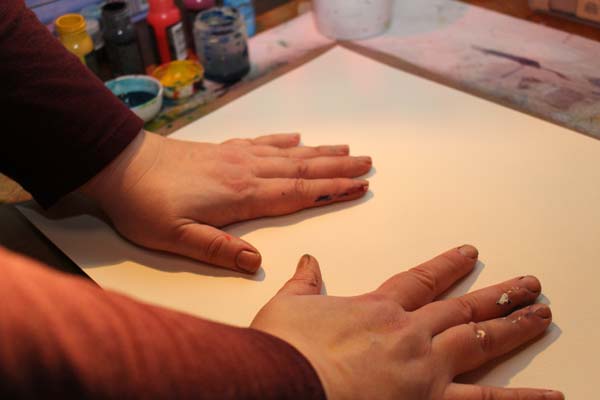
When the paper is turned over, and the artwork is revealed, there’s no quietness anymore! The colors have found their home. They have abandoned the hard glass, and now lie rearranged on the soft paper. A good 24 hours of dry air and they are there to stay!
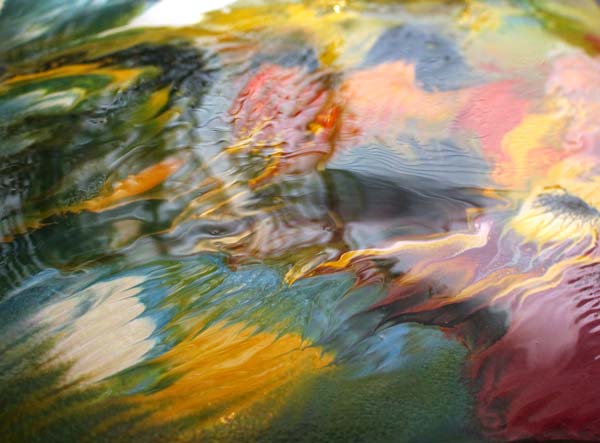
A warning: Once you have made one, you won’t be able to stop!
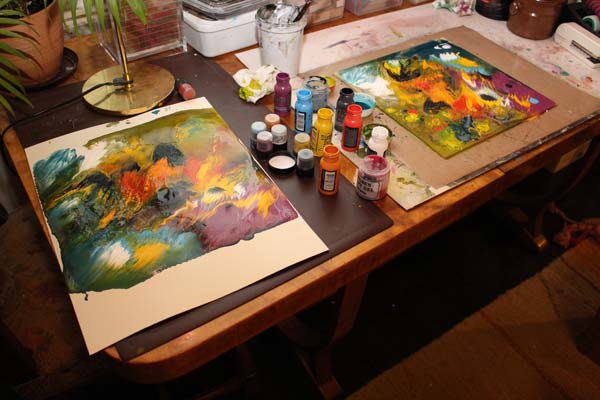
I got fascinated by everything, including the cleaning of the glass plate!
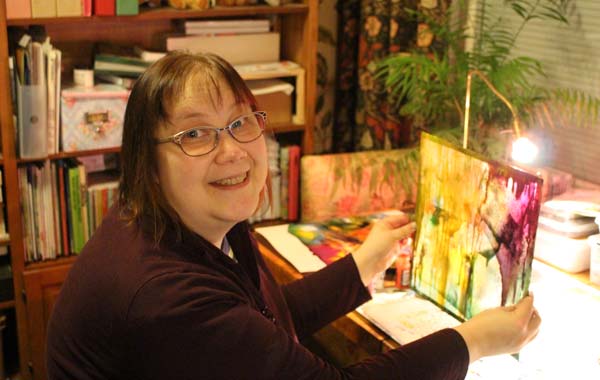
Inspiration
I asked Cassandra where she gets her inspiration for painting:
My inspiration often comes from dreams or during meditation. I like to meditate before I start to paint. It sets the mood for creativity, and ideas often occur to me during meditation. Another good source of inspiration for me is taking a walk. Getting outside and walking frees up my mind, and I sometimes get ideas that way.
This kind of art thrives on the freedom. When I look at my pieces, I hear the colors thanking me: “You released us!” And as colors are so close to emotions, it feels like they have been released too.
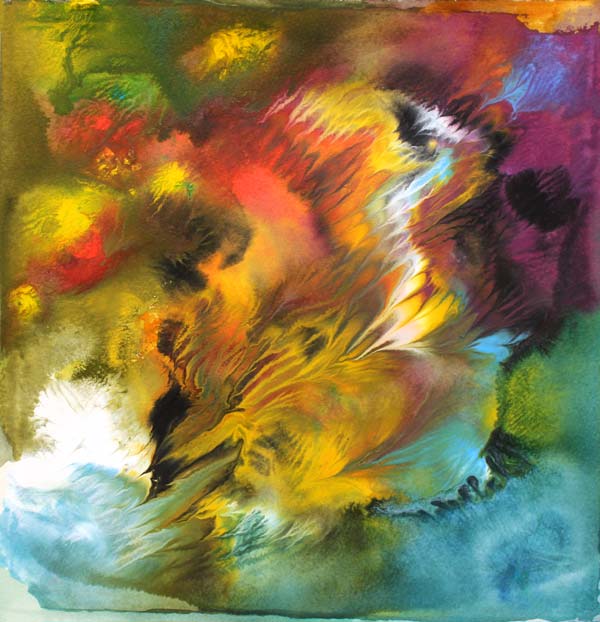
This is the next print after The Rooster.

This piece was made on canvas textured paper instead of watercolor paper. It is not quite as sharp as those made on watercolor paper. If you create small pieces, as I did, I recommend using thick watercolor paper.
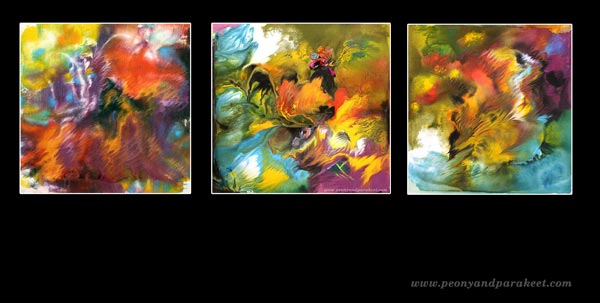
I composed the gallery-style image on a black background, but I think that Cassandra’s work would look beautiful on a brick wall. I like to imagine how the colors would have flown in the air and crashed against the hard blocks.
The more you experiment with this technique, the more you begin to appreciate Cassandra’s paintings. I see her art very powerful. Maybe because it is something totally different from my own, which often includes too much expression, too much explaining. Cassandra’s art is the art of listening. Watching her paintings makes me think: I am free to live, I am accepted, there’s no need for talking.
Let me be your mentor in art: Subscribe to my weekly emails!
From Movie Posters to Art Journal Pages
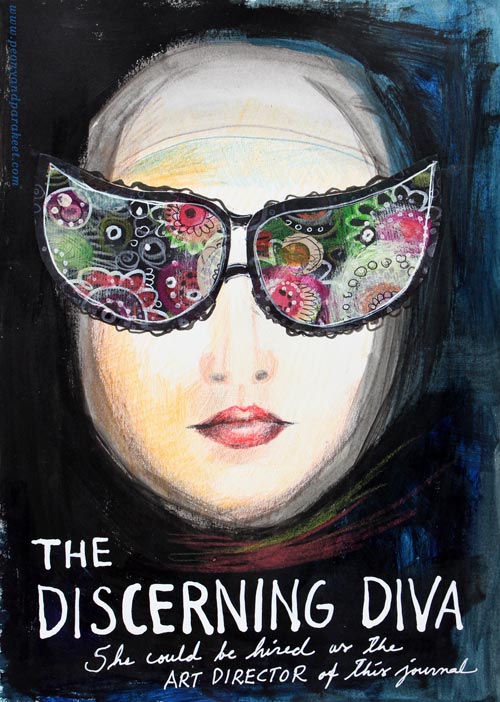
“The Discerning Diva – She could be hired as the art director of this journal.”
This page is my version of the poster for the movie “The Big Lebowski”. I have borrowed the concept of weird glasses and the composition from the poster, but it is still a separate artwork, not an exact copy.
The Discovery of Movie Posters
After learning that I like to use alphabet stamps in the art journal pages, I had been thinking about the next step in journaling. Last week I watched the poster artist James Victore‘s course Bold & Fearless Poster Design on Creative Live. His style has very little to do with mine, but I became fascinated by the visual concept of posters.
Last weekend I found a book about 1990’s movie posters at the local library. I became fascinated by the compositions used in the posters. Then it hit me: maybe I could replace the main elements with my own and apply the visual concept of the poster to my personal stories!
How to pick ideas from movie posters?
I will show you how to make your own “Discerning Diva” (very easy) but before that, I want to show you another poster-inspired page.

The page on the left is inspired by the poster for the movie “The Matrix”. I picked few main elements and the general atmosphere from the poster. The page on the right is made a long time ago, but I like how the two pages tell the story about being inside someone’s brain.
Four tips for picking ideas from the movie posters:
1) Composition: Examine the placement of the title, the grouping of the main elements and the most noticeable color contrasts.
2) Subject: Think about how your life could be applied to the movie.
3) Process: Examine the poster carefully but when you start creating, focus on your page and make it your own.
4) Imagine: Remember that you can replace the elements of the poster with whatever you like. For example, a person can be replaced with a vase of flowers.
Create Your Discerning Diva!
1) Paint the background of the page.
I used acrylic paints to make the background strong and heavy-looking. Leave an unpainted area for the face. Add water to the paint and gently brush the area around the face. Wet strokes create the impression of a thin scarf and add dimension.

2) Color the face.
I used colored pencils to maintain the big contrast between the background and the face. Add some color to the skin. Draw a mouth and a nose.

3) Add glasses.
Go to your box of hand drawn papers. Cut two lenses. Attach with glue or gel medium. Add frames with pens. Make the glasses as decorative as you like!

4) Add text.
Pick a color that has a high contrast with the background and journal on the bottom of the page. I have used a correction pen for the title and a white gel pen (Uni-Ball Signo) for the text below the title.

5) Add finishing strokes.
With colored pencils, add some strokes below the face to represent a scarf.
Add few strokes to outline the scarf near the forehead.
More Ideas for Compositions

Believe or not, this page is inspired by Austin Powers movie poster and hand embroidery! I think that hand embroidery has a lot in common with hand drawing.
Learn to draw from imagination and inspiration!
>> Buy Inspirational Drawing 2.0
Quick Gelli Christmas Cards

This year I had two requirements for the Christmas cards: quick and handmade! The theme had also been selected: candles, suitable for all religions and all ages. All I had to do was to figure out how to make a lot of cards and fast. This first photo is a snapshot from my studio while I was making the cards.
Planning
Before I got my table full of cards and more under making, I had to discover the process of creating the cards. My artistic side wanted something that looked handmade but was still somewhat warm and painterly. The task was transferred to my engineering side who turned on the computer and made a sketch of a single card in Photoshop. The card would consist of two layers of paint. Needless to say, using the Gelli plate would be handy!
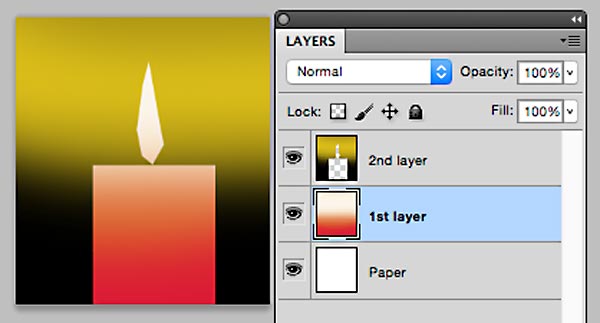
But this plan was not enough. I wanted to create not only one card, but several at the same go. While walking the dogs, I solved the problem. Here are the step-by-step instructions of how to make simple candle holliday cards. You can make them more complicated by adding doodles and such but the basic design is very simple. By following these steps, you can serially produce handmade cards!
Supplies

You will need: Paper, glue, cardboard, acrylic paint in few colors, brush, brayer, scissors, black pen and 8” x 10” size Gelli plate.
Optional: Paper trimmer for cutting the straight edges. Some kind of a stick, a pallette knife or a knitting needle for example, for drawing surface patterns.Double-sided tape if you prefer that to glue for attaching the printed image to the cardboard.
1) 1st Layer: Candles
Paint the center of the plate. The width of the painted area is 5 to 6 inches of the height of 10 inches. You can cut a paper of that width and use it as a guide by putting it beside or under the plate.
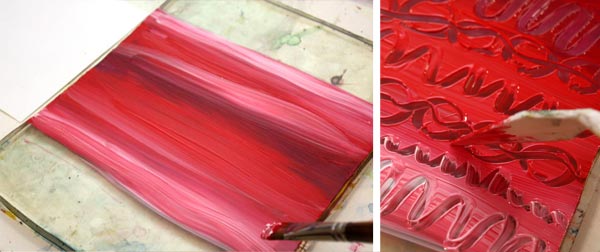
You can draw patterns with a stick if you like. I like to use more than one color to make the candles look lively. You can use brayer for the paint but I prefer to use brush and work horizontally. That way the candles will have horizontal color slides.

Cut your papers to the size of the Gelli plate before printing them. You will get 2 to 3 prints from the one layer of paint. Let dry.
2) 2nd layer: Backgrounds
While waiting the paint to dry, cut the masks for the candles. You will make four candles from the one print. For the four candles, you will need four rectangles, 2-3 inches wide and 5 to 6 inches long. Furthermore, you will need four flames. Fold a paper twice in half and cut one flame at the same go or enjoy your time with the scissors and cut the shapes individually.
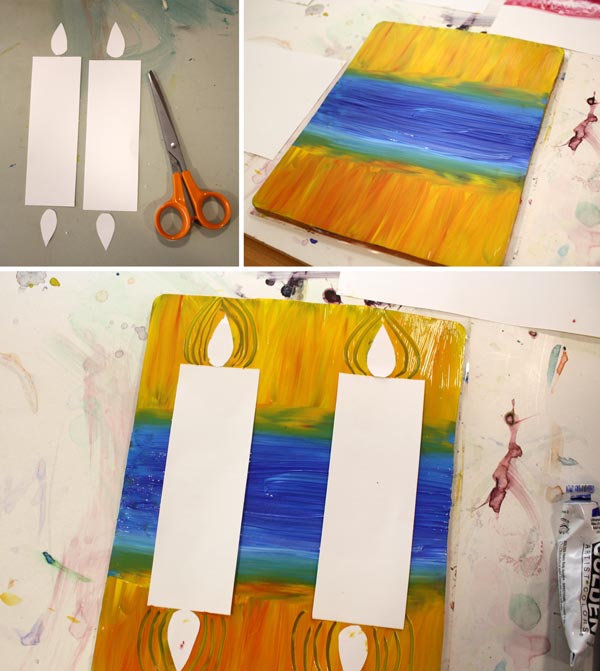
Paint the background with two colors. The center with a darker color (blue, black or green, for example) and the sides with orange yellow. I like to use color mixtures here too. Place the masks so that the distance between them is the twice longer than the distant from the edges. If you want, you can emphasize the flames by drawing lines around them. Make the prints. Let dry.
3) Cut the prints, save the flames
Save the masking papers for the flames. Cut the prints in four parts with scissors or with a paper trimmer.

In the third photo beside the trimmer you can see one alteration of this pattern: use Gelli plate in the other way and create an image with a several candles! By cutting various sizes of masks you get variation for your candles.
4) Finishing
Cut a small part of the background away from the both sides of the print. Cut curvy lines to the bottom edge of the candle. These will make the candle look like it’s set on the snow.
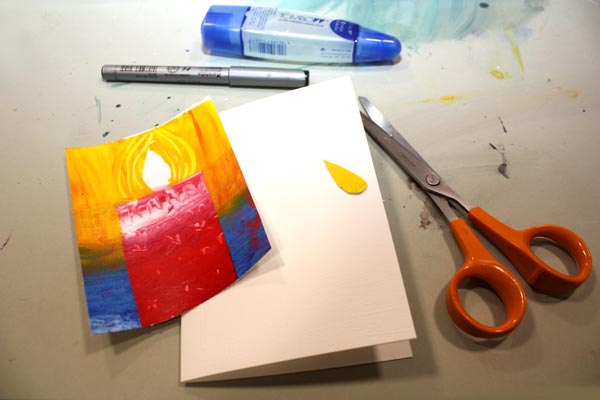
Attach the print to the cardboard. Glue the mask on place or color the center of the flame with a colored pencil or a marker. Draw a wick with a black pen.
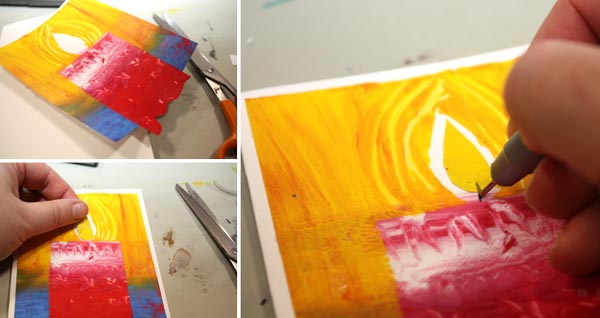
5) Variations!
You can make all kinds of variations from the basic instructions. You can add the number of candles, cut them out and glue many candle on the same card, doodle on the candles etc.

I still have few cards to finish and one more task to do: Write “Merry Christmas” or “Hyvää joulua” (same in Finnish) on each one!
More holiday crafts from the previous years:
Wrapping Paper from Newspaper and Elegant Christmas cards