
Creative Struggles in the Middle of Possibilities

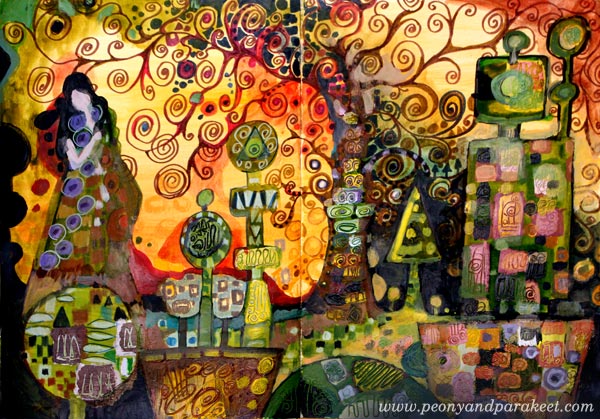
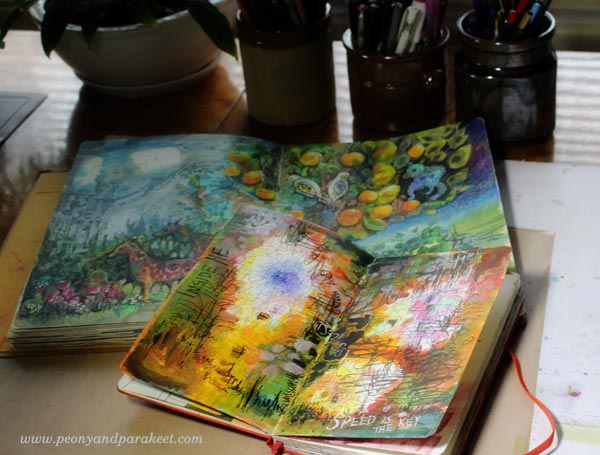
Here’s an art journaling spread that I made for Imagine Monthly Fall. It’s a part of November’s mini-course called Patterned Topiary. For the mini-course, I chose three main themes for the inspiration:
1) Gustav Klimt, the famous artist, and especially his Golden Phase pieces
2) playing with patterns and repeats
3) topiary art, the art of cutting trees and shrubs into shapes. As Gustav Klimt has brilliant portraits, I also included a woman there.
Predictions and Creative Struggles
Some time after creating the mini-course, I started the renaissance painting technique class under Emmi Mustonen. Now when I look at my work (which is still in progress), I see the same woman appearing there. It’s like art could predict the future!

The two projects are very different and still – it’s easy to see that the person who created the first image, the art journaling spread, is the same who’s painting the copy of the portrait. I think this is a brilliant example of why we shouldn’t put ourselves in one corner, but be always willing to learn new perspectives. I could have said that I love freedom and won’t go to the class that is “just copying.” Or the vice versa: that I value old masters so much that I won’t combine them with mixed media techniques or with less-valued art forms like cutting trees. I might have avoided some creative struggles, but I would also have missed the possibilities.
My second project for November’s mini-course is also like a prediction.
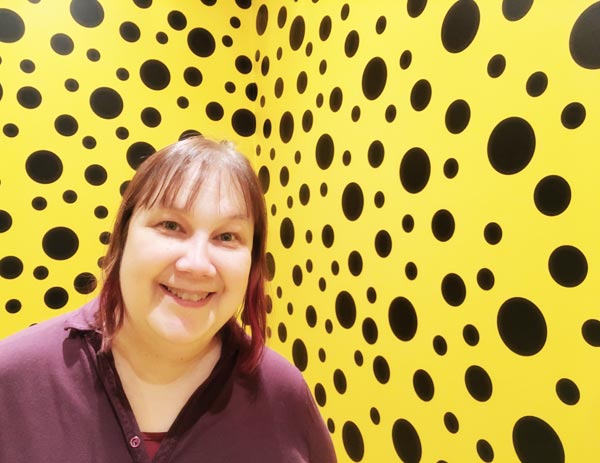
Namely, last Saturday, I went to see Yayoi Kusama‘s exhibition at Helsinki Art Museum. Another celebration of dots and patterns!
Diversity of Themes and Techniques
I have now released 4 of 5 mini-courses for my art journaling master-class Imagine Monthly Fall 2016. There’s a lot of diversity in the projects: painting, drawing, making collages and combining the techniques to create mixed media art. You can still sign up and get all the published mini-courses immediately. There’s also a great community that you don’t want to miss! Seeing many versions of monthly themes is part of the enjoyment! I also lead a discussion related to the theme every month.

Struggles in the Middle of Possibilities
When creating and teaching the mini-courses, I have experienced that art is full of possibilities but still, we fight with the fixations all the time. To me, the word “artist” has so much emotional overload that it feels difficult calling myself one.
But I got a wake-up call recently when someone said to me: “You’re already an artist and you should just embrace that. Doing otherwise is denying who you are.”
Selling My Art in Public!
After pondering that, I decided that I have to stop selling secretly based on occasional requests. I should make my art more accessible. So I set up a shop at Saatchi Art, which is a commercial site for artists. The great thing about Saatchi Art is that you can now also order fine art prints from my pieces, not only buy originals. Some of the paintings are sold already, but you can buy them as prints.

Tell me, which struggles do you have with your creating right now? Are they due to a certain technique, certain conditions or a certain mindset?
Celebrating Artist Friendships
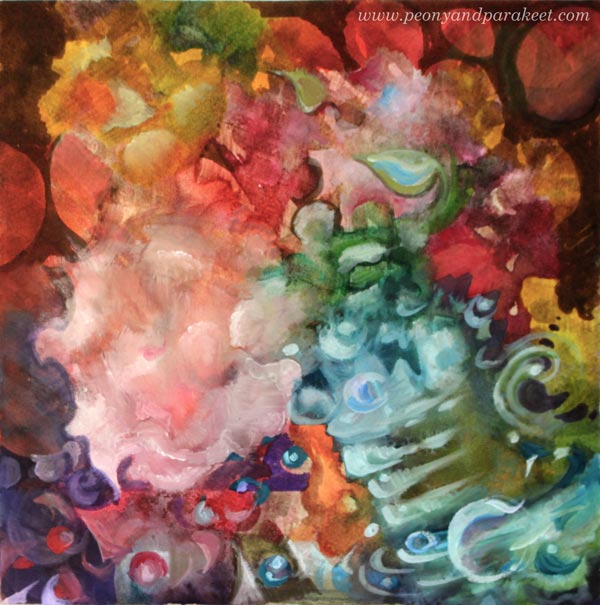
There’s a theme that has been waiting in my blogging queue for a long time. It’s the meaning of friendships in the art world. I was about to write the blog post but then I thought it wouldn’t be as genuine as a video.
In this video blog post, I create a painting using art supplies generously donated by my student. The supplies are Spectrum Aqua Markers, Dr. Ph. Martin’s Hydrus liquid watercolors and Turner acryl gouaches.
Here are the links to the websites mentioned in the video: a ceramic artist Johanna Rytkola, a visual artist Emmi Mustonen, the stick figure drawing class as a part of Imagine Monthly Fall 2016, a local workshop in Finland “Innostu taiteestasi”
Hopefully, you’ll enjoy the video!
Start Drawing from Stick Figures!
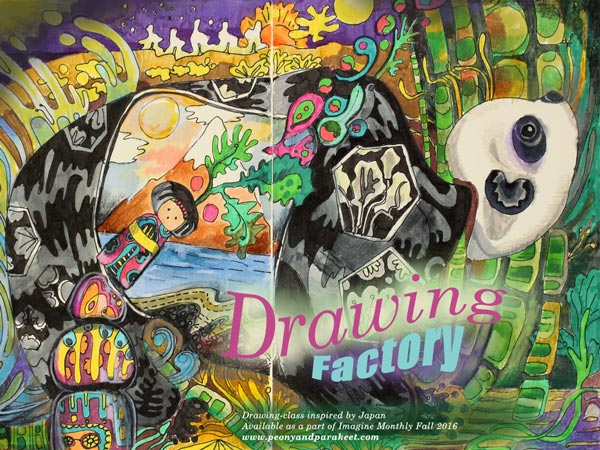
If you browse my blog posts this fall, you would think that I have been painting only. But no, I have drawn too! I’m really happy about my recent mini-course that is available as a part of Imagine Monthly! It’s called Drawing Factory as it’s about drawing efficiently no matter what your current drawing skills are. Plus it’s inspired by Japan, the land of high-production factories and fascinating culture.
Drawing ATC Cards
I got the idea for the mini-course in summer when I got the urge to draw a series of ATC cards.
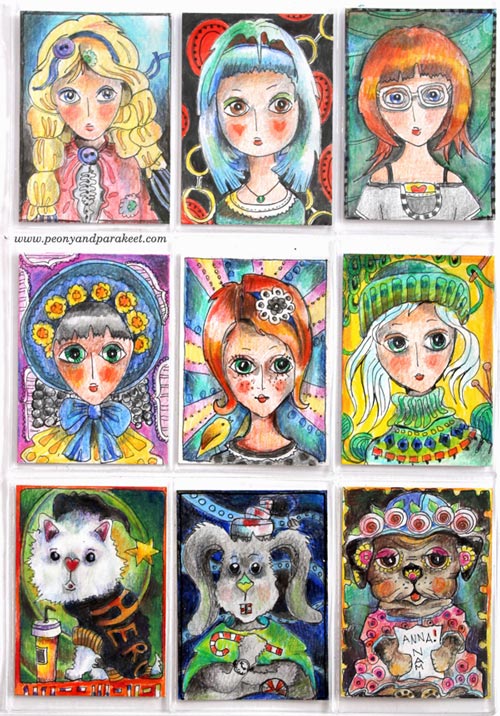
I had so much fun drawing these! While drawing, I thought about how much people use stamping instead of drawing in ATC cards. I felt liberated without them, drawing freely. How could I make hand-drawing more attractive and enjoyable?
Drawing with the Help of Stick Figures
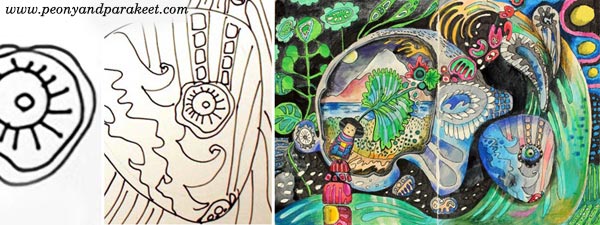
Along drawing this big bunny art journal spread, I developed a series of tips and tricks about how you can create imaginative line drawings without tedious sketching.
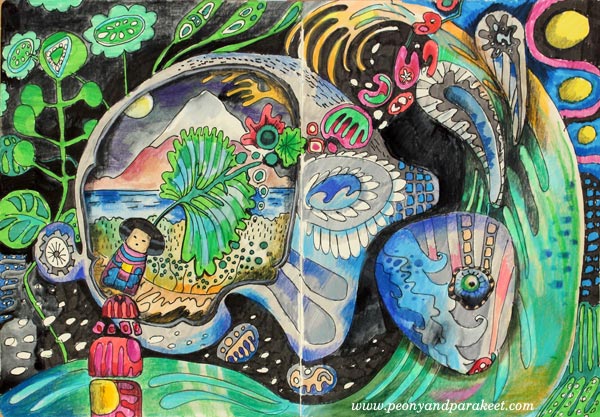
My method is based on stiff lines as people often say: ” I can only draw a stick figure!” But sticks can be an answer, not a problem!
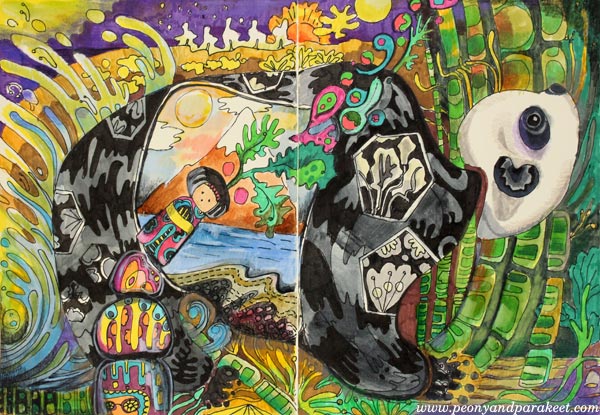
The panda is the project that I am creating in the class video. The video also includes a drawing lesson where I show how to build drawings, or should I say rich illustrations, based on simple lines.
Buy Drawing Factory!
Drawing Factory is now available as an individual self-study class: Buy Now!
Get Intuitive Focus + Reader’s Comment!

“I am all over the place. I need to focus”.
It’s what I often hear when people talk about their creativity.
I used to scold myself there too. After a quilting class, I swore I would use all my creative time to modern quilting only. But after finishing one quilt project, I was ready to knit again. I questioned myself when I drew because I had just made a promise to focus on painting. I found it impossible to stick to one style or one genre of creating, and I saw that as my worst weakness.
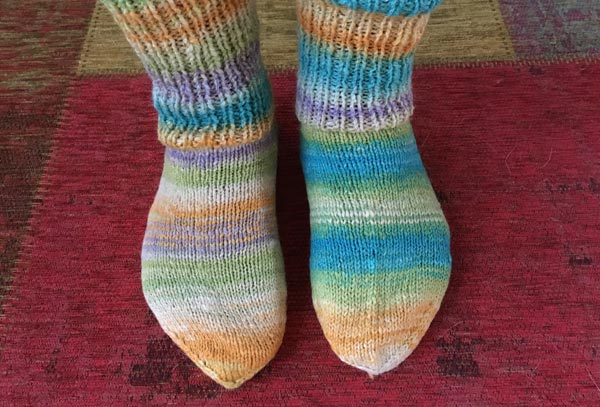
But the more I have been into intuitive art, the more I have realized that creative people often underestimate the connections between what they do. The more conscious I have become about how my creative process works, the less I need to criticize my natural behavior.
4 Ways of Creating
I classify creating as:
– reflecting by creating
– generating ideas by creating
– imagining by creating
– and finally, focusing on the insight you’ve got by creating
If I write about past events in my planner or knit, it’s reflecting. When I get ideas, I create art journal pages or quick craft projects. With a collection of ideas, I can gradually gear my imagination towards the bigger themes that I want to express.
When I create just to save my ideas, I don’t work for hours to get everything right. It’s a piece that had to be created so that I can move on. But when I am creating a bigger project, like my big canvas painting last week, I fine-tune every little detail and put a lot more time into the project.
What Does Intuitive Focus Mean?
Intuitive focus means that you treat your activities as part of creative process. You continuously collect and process theories, techniques, ideas, approaches so that you can create your best pieces now and then. You embrace diversity in techniques, themes, styles, etc. Diversity will not be distracting if you spend enough time for reflecting.
Once you do this, you will get in touch with your root problems:
Your lack of focus on one activity or idea turns into a lack of ways to combine it all together.
Your lack of focus on one technique turns into a lack of foundation that can be applied to many techniques.
Teaching Art – Reader’s Comment
In my last weekly email (do subscribe!) I wrote about whether teachers share openly or not and why would they not:
“Last week, I read a comment somewhere on the internet. It praised a teacher about sharing openly. The commenter also said that she often gets the feeling that teachers hide something. Even if this was not about any of my classes it made me think. Do I share openly? Why would a teacher not share openly? When building classes, I try to focus on the essentials and be understandable, clear and not all over the place. That’s good, right?”
“But when teaching intuitive art, I have to admit that almost anything can be meaningful to the process. A random thought can steer the painting to a new direction. So I decided to add more video to my next class Nature in Your Mind showing how I ramble while creating and how it affects my painting. I also show how I use music to help me let go. While recording, I felt vulnerable. Every time I became silent, I forced myself to ask: what did I just think? There’s also the pressure of time. I can’t create for 7 hours and then make an educational video out of that.”
“So I have to choose smaller projects for the exercises and recordings. But truly, I don’t intentionally hide anything. I don’t think many teachers do. For some, explaining is more difficult than for others. Some find it difficult to give honest feedback. When I started teaching, I made a promise always to give as useful and as personalized feedback as possible while the workshop is running. For many, understanding the slight changes they can make is a game changer. It’s a pity if the teacher never points out those. Probably that’s the situation when the teacher seems to be hiding something. What do you think?”
Meri Andriesse wrote to me as a response to the email:
“I sign up for a lot of workshops in painting and mixed media and I find they vary greatly in content. To be honest, I don’t think some teachers have enough substantive content in their classes and they rush through without explaining why they are doing or not going or un-doing something. So much of what we see and hear focuses on the intuitive part of creativity but I think in order to use intuition you really need some foundation in composition and color theory/experimentation. Your workshops offer that and more and that is why I continue to sign up for them even though I don’t have adequate free time for art making.”
Teaching art is often based on process videos only. Meri comments that too:
“Videos are great, but I also appreciate the pdf documents and diagrams and photos. I wouldn’t hesitate to recommend your classes to anyone really interested in growing their art-making.”
Create intuitive art + set a foundation for your creating!
>> Sign up for Nature in Your Mind!
This is the last chance to register! The registration will close on Oct 10th midnight PST.