
Pumpkin Drawing Step by Step
This week, I wish you Happy Halloween with this pumpkin drawing tutorial. Draw one pumpkin or many, make a simple drawing or an atmospheric illustration – these easy ideas have many possibilities!

My drawing is about 29 x 29 cm (11,5 x 11,5 inches) but you can use these ideas for any size. Start with one pumpkin and then decide if you want more. I started from one on the left bottom corner.

Even if the pumpkin looks very decorative and detailed, it’s fun to color with colored pencils. But first, we make a simple sketch.
Step #1 – Sketch a Pumpkin
Pick a pencil and sketch a pumpkin. Start from a circle and then divide it into sections.

I also added one vertical and one diagonal line to mark the perspective. But as you can see in the image below, my guiding lines for the perspective are short ones. They only define a very small section of the background.

After coloring the first pumpkin, we will add more guidelines to the background.
Step #2 – Decorate a Pumpkin
For each section, color a column of simple circles.

Use zigzag strokes and have fun with colors.
Step #3 – Color the Rest of the Pumpkin
Add a background color for each section.

Leave some white around every circle to get more decoration. You can now decorate the stem too.
Pick a yellow pencil and color over the pumpkin. Yellow adds wamth and makes the colors shine.

Step #4 – Add Shadows and Finish the Pumpkin
Add some shadows around the pumpkin and in the centre.

You can now adjust the decorations and make sure that you have colored the pumpkin carefully. The coloring should cover the paper.
Step #5 – Start the Background Patterning
No matter how big your drawing will be, I suggest that you first focus on the surroundings of the first pumpkin. This is “the seed pumpkin” or “the mother pumpkin.” Draw a safe place for her first before drawing more.
By following the guides from the first step, color checkered patterns.

Use a neutral color. You can later add more color on them.
Step #6 – Draw More Pumpkins
Imagine the magic – so, pumpkins flying freely in the space! With a pencil, draw pumpkins in different sizes.

Make sure that some of the pumpkins are only partly visible and that they are oriented in different directions.

First draw a circle and mark the orientation with the stem. Then divide each pumpkin into sections.
Step #7 Color More Pumpkins and Expand the Background Patterning
Now you can let go with the stiff idea of a perspective and make your own. Color the checkered patterns so that they flow in different directions. Again, use neutral colors for them. You can leave a small part of the background without patterning.

At the same time, you can start coloring the pumpkins as well. Change the orientation of the paper while coloring so that your little squares and circles don’t get distorted.

If you were a little careless when sketching (like I was), the pumpkins may look less like pumpkins and more like decorated circles. Add little bumps to the sections between the ribs to correct this.

Step #8 – Color the Background and Finish Your Pumpkin Drawing
The idea of background patterning is to get a sketch for “the air” – so for the 3-dimensional space where the pumpkins are flying. You can now color over the neutral grid and add new checkered patterns with colors as well.

Get creative and let all kinds of fun stuff appear in the background!

To get the festive feel, spend some extra time with the drawing to make sure your colors are strong, your darks are dark, and the paper doesn’t peek through. What started as a simple pumpkin can now become pumpkin art!

Happy Halloween!
P.S. If you liked this tutorial, check the course Fun Botanicum!
Intuitive Art Journaling
Art is more than re-coloring what we already see. This week, I talk about intuitive art journaling and inspire you to follow your spirit and create more freely.
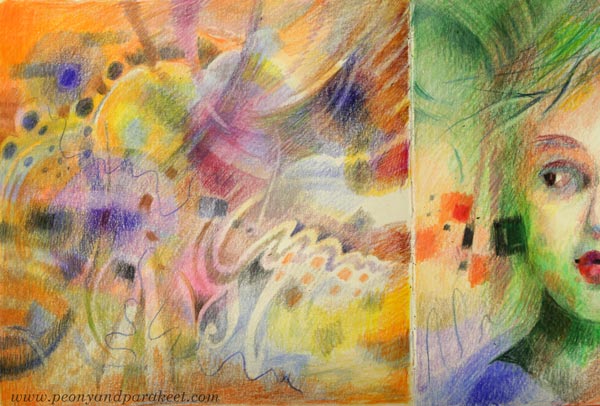
Even if we continuously grow our skills as artists, the joy of art-making disappears if we use too much reasoning. It’s good to practice the technical skills, but it’s also important to arrange time for the intuitive ideas to emerge.
Two Words – “Intuitive Power”
“Intuitive power” – these words suddenly came to mind when I looked at my colored pencils recently. I have been painting a lot, and it has made me miss my colored pencils, those powerful helpers! So, while working on the last pages of my Dylusions Creative Journal, I have been spending some quality time with them.
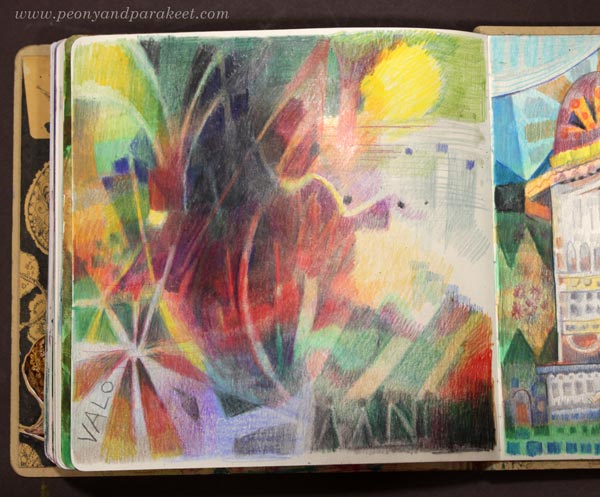
I started with a house, but then moved on to color more freely. I wanted to catch the atmosphere of that place rather than stay in the material level, drawing windows and such.
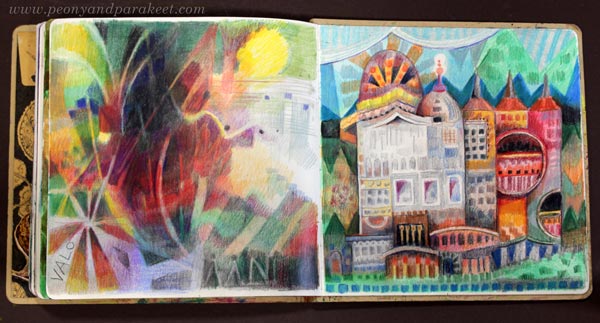
The longer I have been an artist, the more I have wanted to work with invisible things. More than tangible things, I want to express the spirit and the complexity of the world that can’t be photographed. I want to create images that are more like keys to many questions rather than direct answers to one.
Intuitive Artist
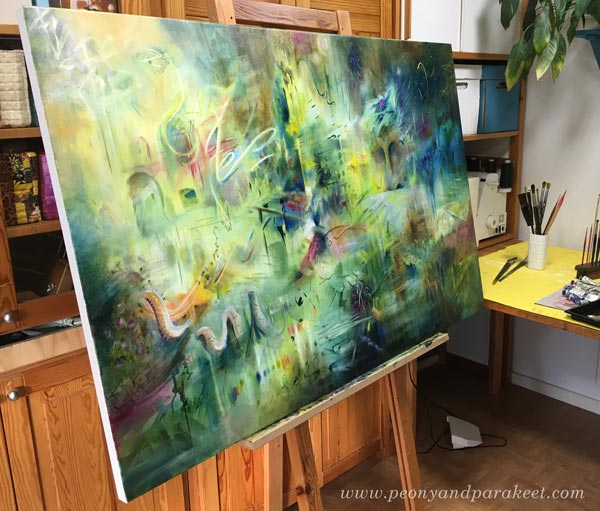
Even if I have embraced and used the word “intuitive” for over ten years, I have now realized that it’s not just one word of the many, it’s “the word” for me. And I don’t mean to narrow myself with the word, but to expand my thinking and creating in the direction that feels natural to me.
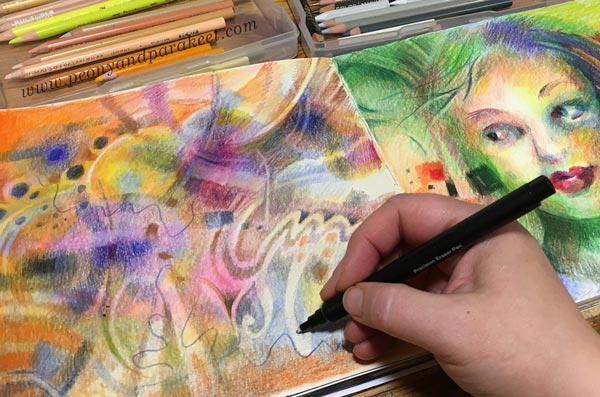
More than a building, I want to visualize the spirit of the place – the sensations that it causes in me.
More than a face, I want to visualize the spirit of the person.
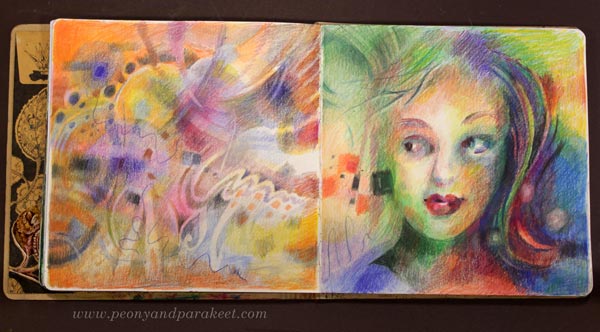
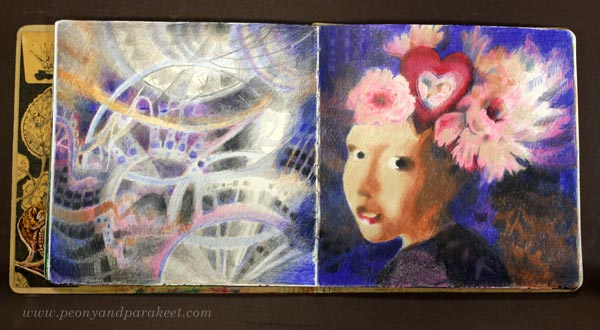
Art Journaling Without Words
Rather than words, intuitive insights can come up as pictures. So, intuitive art journaling can be as simple as creating a series of drawings. The connection with a certain color can be enough to get started.
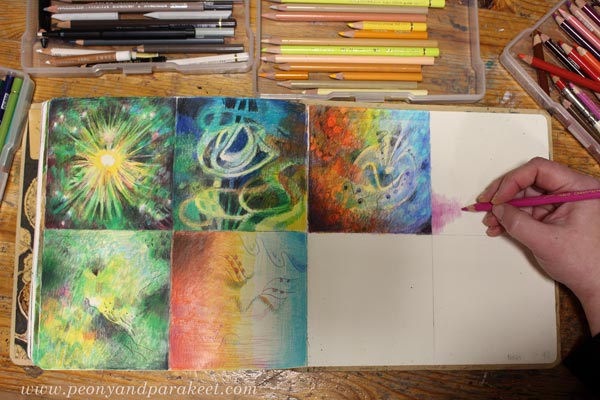
Color is a hole, and if you jump in, you enter the immaterial world. Colored pencils are the easiest tools for breaking the ice between the inner and outer.
“Intuitive power” – what do these words evoke in you?
Making The Art Journal More Magical
I have been working on my square-sized art journal again. This week, I share a couple of magical art journal projects that include hand-drawn collage pieces.
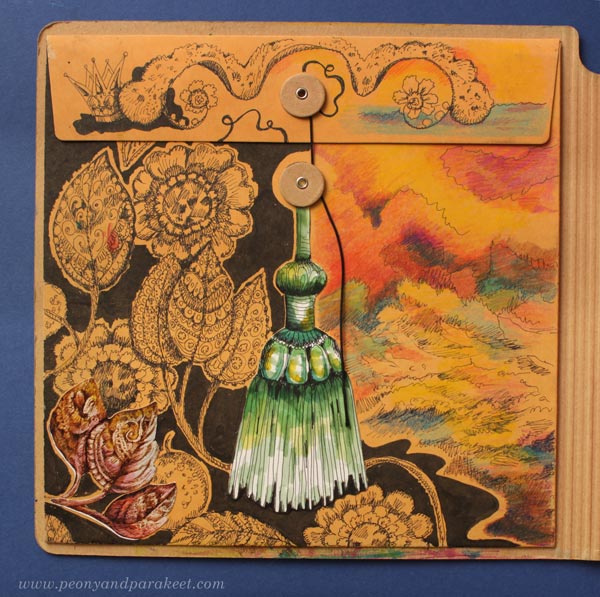
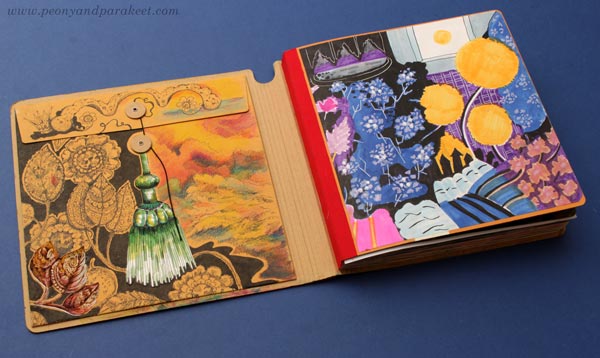
My journal is Dylusions Creative Journal. The first project is the decoration of the pocket envelope that’s on the backside of the front cover.
The Magical Mindset for Art Journaling
My journal is almost full, but I have decided not to hurry with the last pages. Recently, I have started to think that using what I have is better for me. That if I rush with the last pages and buy a new journal, it’s not as good as if I slow down and fully honor those few blank pages. You could call this a magical mindset because it makes you appreciate what you already have: skills, little drawings, time, blank paper.
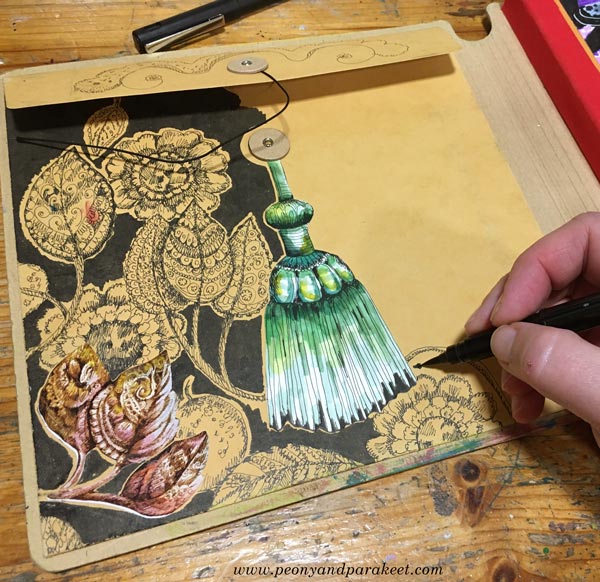
With the magical mindset, you don’t just look forward and think what you could have. Instead, you look back and focus on how you can take the old to the next level.
So, I went to my boxes of joy – the boxes that store my handdrawn collage pieces – and picked a set of leaves from a few years ago and glued it on the envelope. The leaves are a print and smaller than the original drawing. I love some of my handdrawn pieces so much that I have scanned and made prints of them.
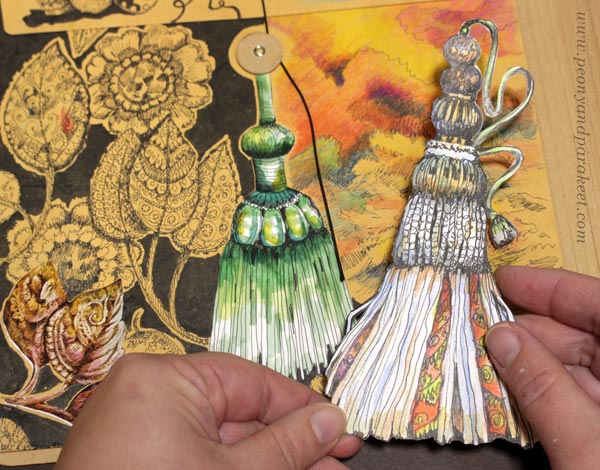
I drew some more leaves and then glued the tassel which is an original drawing too. The tassel divides the image in two parts. I drew and colored a seascape on the right side of the tassel.
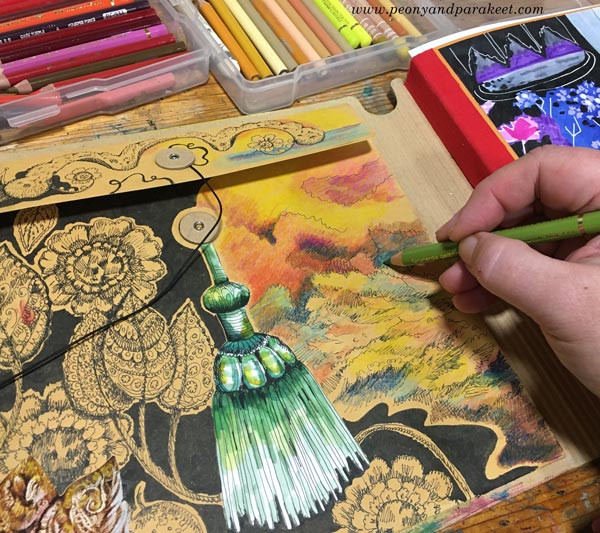
I love the oldfashioned and luxurious look of the envelope now. The inside cover was made earlier with markers.
I had two tassels to choose from. I love them both.
Magical Stripes on Art Journal Page
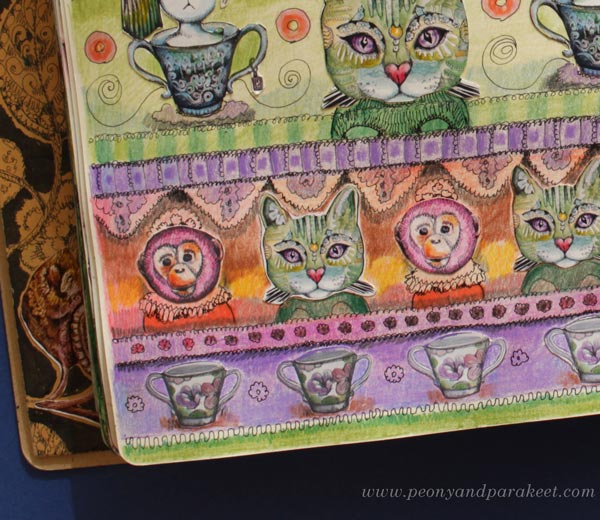
The second project is a page with hand-drawn collage pieces. The idea here is to draw stripes and then decorate them. I made my page so that some of the decorations extend over the stripes.
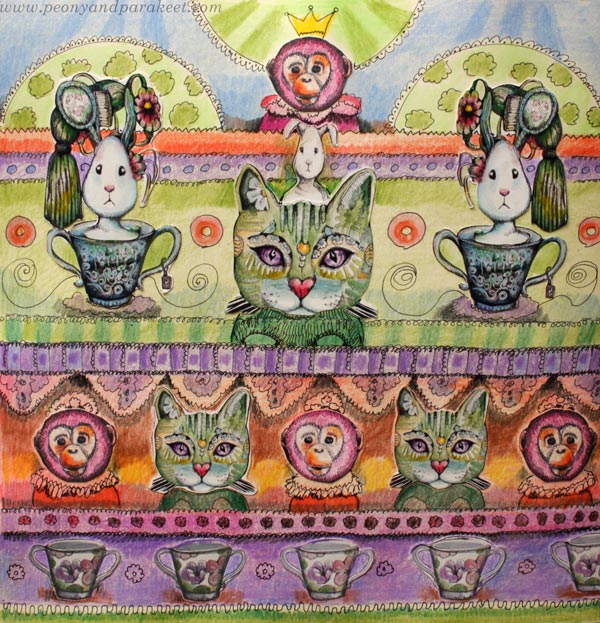
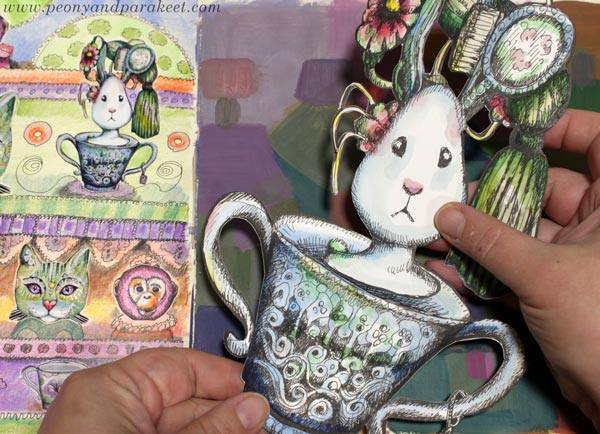
The teacups, the heads of the cats, monkeys and rabbits are prints made from bigger hand-drawn pieces. The rest is drawn with a black drawing pen and colored with colored pencils.
Here you can see the print sheets that I have made for myself and the original drawings. These are all drawn for the courses Magical Inkdom and Animal Inkdom. I had so much fun making these courses. The details are magical and I think the stripy page became magical too.
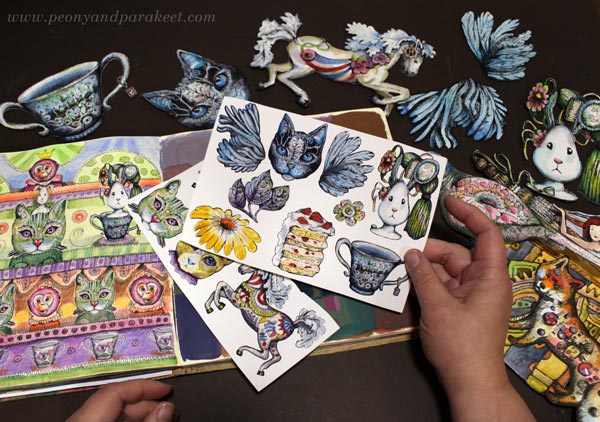
The rabbit and the teacup are two separate pieces.
I have randomly created on the pages over the years. The page on the right is painted and very different in style, but I think these are just layers of time. Like home, an art journal can have some old pieces, some newer ones, and some that connect all the years. I started my journal in 2020.
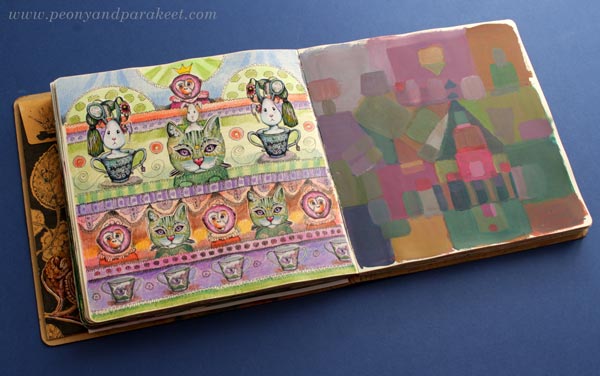
The abstract house could be the place where this magical tea party happens.
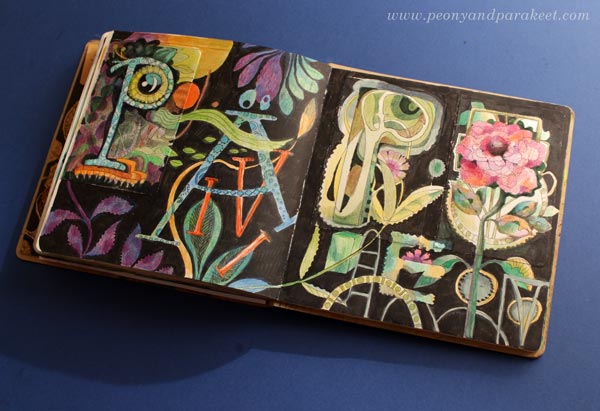
Magical Letters
In the previous blog post “Mini Drawings on Art Journal Pages“, I showed a spread that was still in progress. That’s finished now. I think letters on the black background with some leaves and flowers look magical too.
I hope these projects inspired you to make your art journal more magical!
Mini Drawings on Art Journal Pages
In August, I blogged about the half-empty art journals I should fill up. I had a mini art journal with only a few filled pages. They were mini drawings that I had made quickly a few years ago. I decided to tear the pages out of it and re-use them on my other journals. It has been more fun than I expected!
This is how small the journal was.
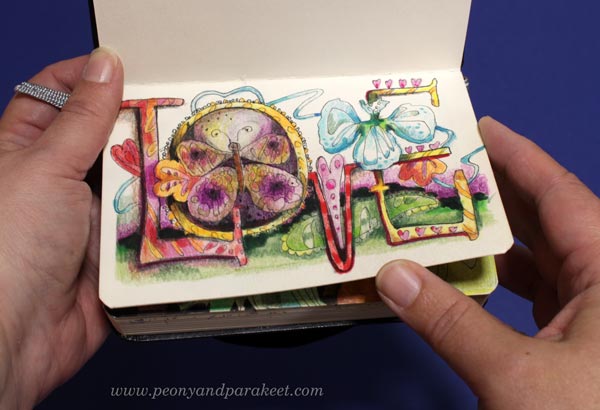
First I thought I just glue the pages on my other journals, like my Dylusions Creative Journal Square, but then got the idea to use the pages as collage pieces.
Art Journal Collage Idea – Cubism
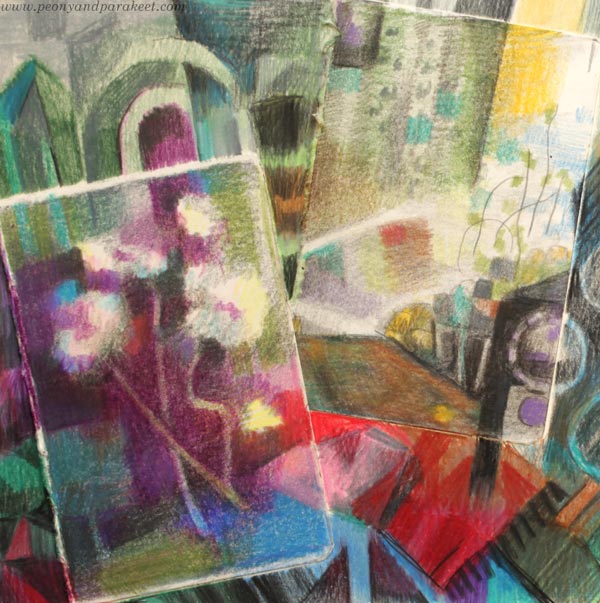
Cubism is about breaking things in pieces and having many perspectives in one drawing. Some of the mini drawings had many angular shapes and that fits well with the idea of using them as a part of cubistic art journal page.
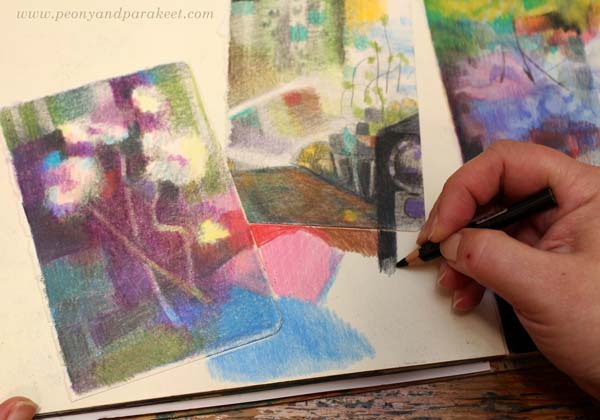
I continued the shapes in the mini-drawings by coloring and also colored new shapes.
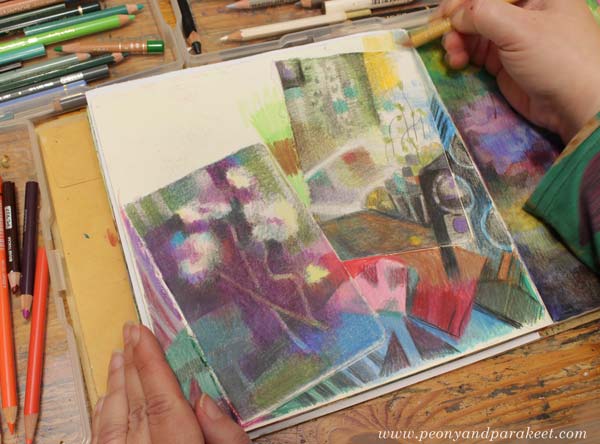
I am really interested in architecture and interiors nowadays so I added some architectural details, a carpet, and such.

The floral page was made in February, and you can see process-pic of it here: Why Draw in The Ready-Made World?
Mini Drawings in a Hand-Drawn Collage
Over the years, I have drawn many collage pieces – boxes of them! The courses Animal Inkdom, Magical Inkdom, Doll World, and Decodashery has directions for them. I have throughly enjoyed making those courses, and I have also used many hand-drawn pieces on my art journal pages.
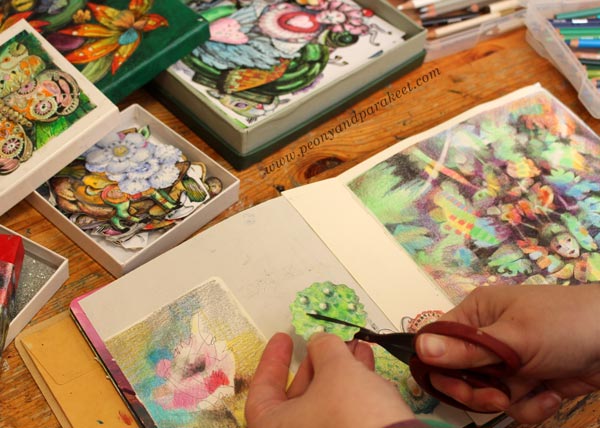
Now I used a mini page as a part of a handmade collage. I also picked some pieces from my boxes, and then combined all together by coloring and journaling around them.
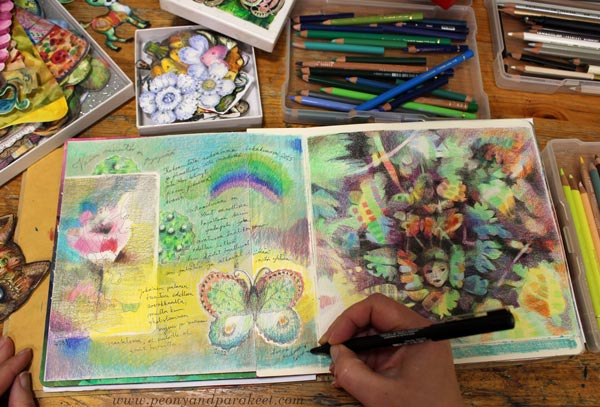
The drawing on the right was made in July 2021, see the bigger picture here: Coloring with the Inner Child.
Art Journal Idea: Creative Lettering on Black Background
I had three mini drawings that were very illustrational, and I wanted to expand their graphic style with creative lettering to the rest of the pages.
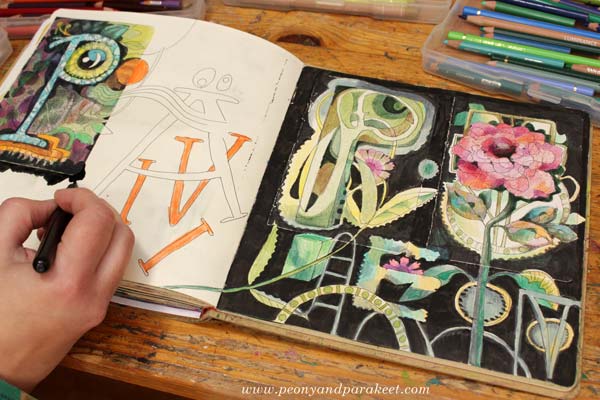
The black background makes the shapes really stand out. This spread is still in progress. I am going to finish the left page in the same style as the right one.
I hope this blog post inspired you to create, and start making mini-drawings you can then re-use!