
Paint Brush Holders and Artful Woodworking
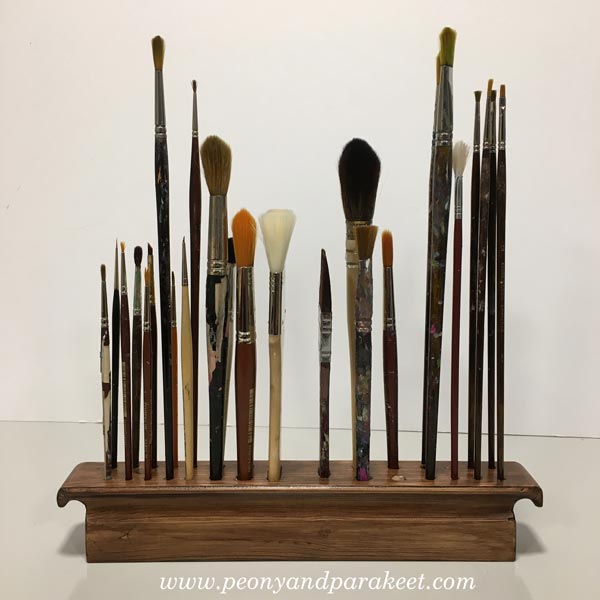
This blog post is dedicated to my skillful husband. He has always supported me as an artist. The support he has given to me hasn’t only been mental but practical as well. He has made countless of wooden items that I have needed for my art, using hand tools mostly. These projects often begin so that I carelessly draw something on paper and ask him to follow the drawing. My sketches inspire him to ask more questions, create prototypes, and when I see the final piece, it’s much more detailed and beautiful than I ever could imagine.
Paint Brush Holders
One of my favorite wooden treasures is the paint brush holder that can hold most of my brushes. It is designed so that I can put it on the shelf and then take it out when needed. I love seeing the brushes in one glance and storing them so that the bristles won’t pend. My original idea was just a simple wooden block with holes but my husband designed and finished the holder so that it’s like a valuable antique piece!
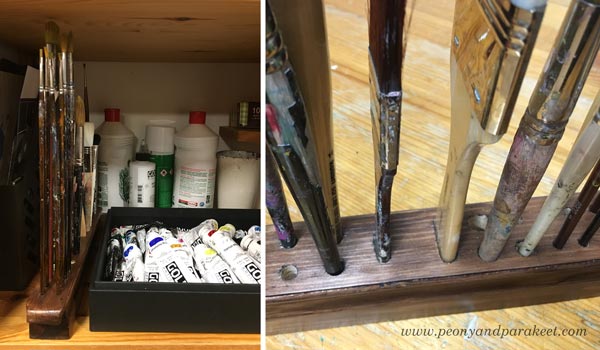
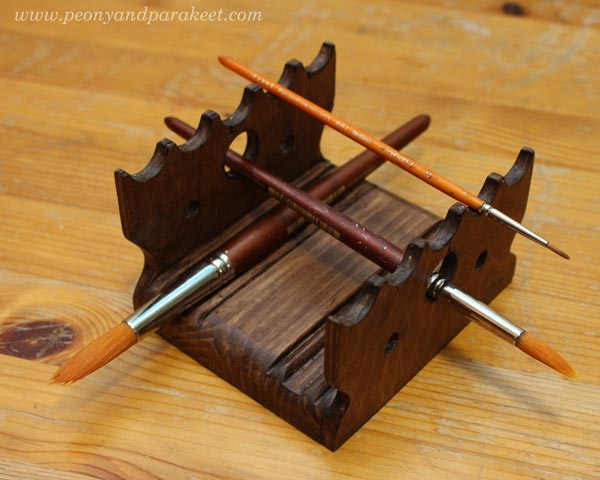
Because the vertical position ruins wet brushes, I always dry the brushes first. That gave me the idea of having a separate holder for wet brushes. “Something simple,” I said again. But my husband came with a better version. This beautiful paint brush holder can hold a lot of brushes in different sizes, and I love how practical the decorative holes are as well. The other side of the holder is slightly taller so that the brushes point downwards. It makes sure that the water won’t travel to the handle.
The Best Easel
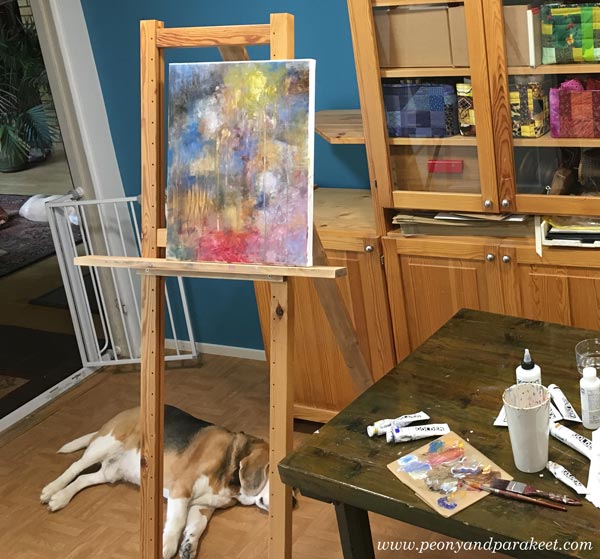
We had an extra upright support of a shelving unit, and I wanted a new easel that would fit with the rest of the furniture in my studio. By adding one more leg and a holder for a painting, my husband turned the support into an adjustable easel!
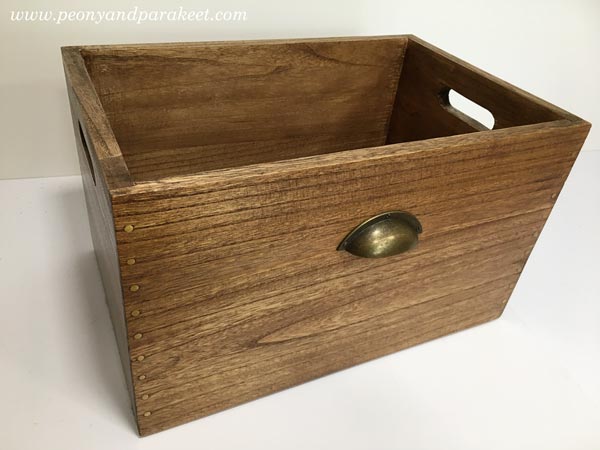
Light-Weighted Storage Box
My husband has made many storage boxes for the art supplies, and this is the newest one. It’s made from paulownia tree that comes from Asia, and it’s very light-weighted. I wanted this box look heavy but feel light, and my husband found the solution!
Perfectionist’s Wastepaper Basket
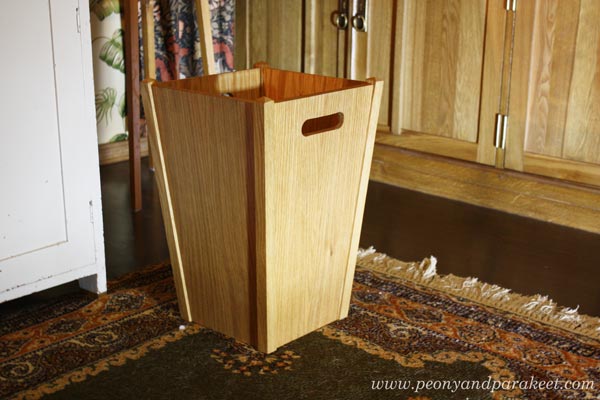
Much heavier but one of my ultimate favorites is the wastepaper basket made from oak. I think it’s luxurious and it makes me smile every time I see it. There’s some humor in living an imperfect life, creating imperfect art in the imperfect world – and having a perfect wastepaper basket!
My Husband’s Journey as a Woodworker
When we were living in our previous home, there was no room for woodworking. About five years ago, we moved to our current house that has more space. That enabled my husband to start the hobby he had dreamed for a long time. Namely, for years he had watched woodworking videos from Youtube. While I was dreaming about the life as an artist, my husband sat on his computer and watched skillful woodworkers drill and plane. Based on the sounds of our small living room, it was like some serious wood projects were going on all the time.

Then, finally when he got his space, he was able to join the gang – get a collection of hand tools and make something beautiful that he can be proud. He thought that his skills would grow in a very short time – that he had learned the most of the necessary lessons by watching the videos. But as you may guess, it wasn’t that easy. He got disappointed. He drew a hole in a wrong place, he chose wood that wasn’t perfect for the project, he made errors when calculating the proportions, and he was surprised by the visual skills that the woodworking required. It was not only that his technical skills were lacking. His ability to balance his designs and to generate ideas for unique pieces were lacking too.
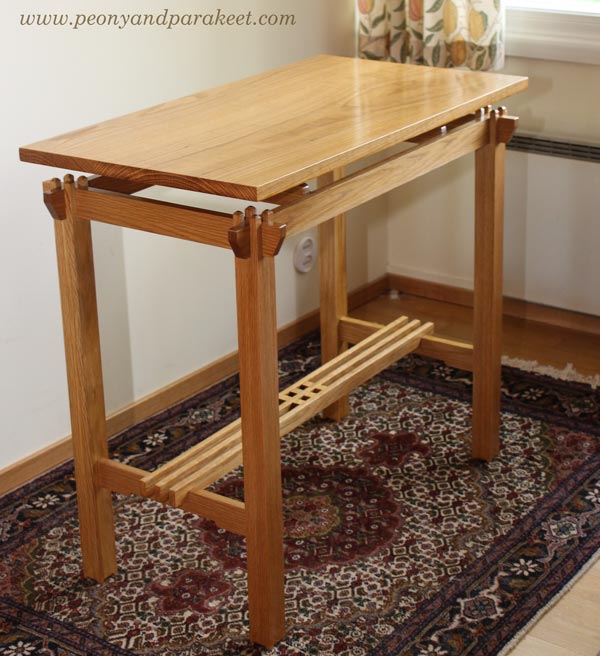
But I encouraged him to continue, and he did. Every project grew his skills. After a couple of years, he made a small table that shows how far he has come. It’s inspired by Japan and the early 20th century. It’s made from oak and finished with shellac.
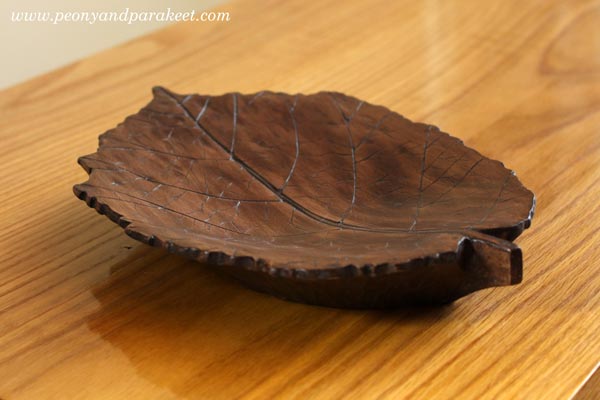
At the beginning of the hobby, my husband wanted to learn to carve. So the very first project of his was a wooden leaf. He started the carving, but it felt too difficult, so he gave up. After finishing the table, he remembered the unfinished project and completed it without struggles.
Even if this post was not directly about painting and drawing, I think that we all can relate to my husband’s journey. Creating art is never as easy in practice than in our dreams. But the happiness that it can bring is priceless. You just need to start and keep on creating!
Let me be your art teacher: Subscribe to my weekly emails!
Painting with Imagination – Watch the Video!
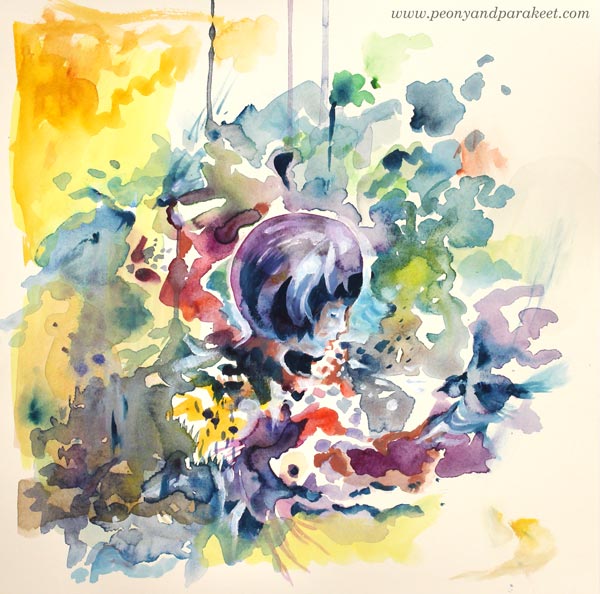
This week, I have made a special video for you! On the video, I paint with watercolors and talk about getting attention and growing imagination. They both are important for any artist. Honestly, it was quite exciting to talk and paint under two cameras, and I was afraid that I would just make a mess when I had so many things going on at the same time. But I tried to make the video so that it would feel like you would be visiting my studio and paint with me there. I hope you’ll enjoy it!
Painting with Imagination – Watch the Video!
Floral Fantasies in 3 Styles Begins Oct 16!

Let flowers make you an imaginative artist! Reserve Your Spot Now!
Do You Feel Insecure About Your Art?
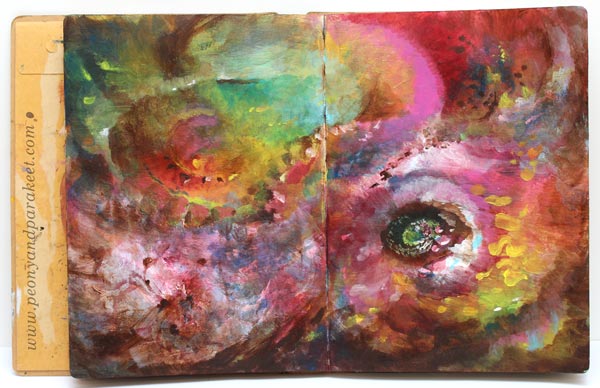
On Wednesday morning, I prepared my studio for a recording. Usually, when I set up the camera, I am excited and ready to paint. But this time I was struggling. However, I did manage to put the video together because it gave me the opportunity to talk about insecurity and self-doubt – common feelings for all artists!
Feeling Insecure and Why? – Watch the Video!
Follow the Inspiration – Join the Live Webinar!

Meet me in a free live webinar! I will be sharing what inspires me currently and giving ideas for your art as well. Join me on September 21st, 11 AM PST / 2 PM EDT / 7 PM BST / 9 PM EEST!
To participate the webinar:
1) Register by choosing “Save My Spot!”
2) Mark the date Sept 21st and your local time to your calendar.
3) Follow the link a few minutes before the webinar begins.
I will be broadcasting live from my studio. Come to get new ideas for your art and chat with your friends in art! You will also hear more about my upcoming classes and how I have been collecting inspiration for them.
The event will be recorded, and the replay will be available for all who register.
Follow the Inspiration: Register here!
Altering a Flower Painting – Inspiration from Vatican Museums

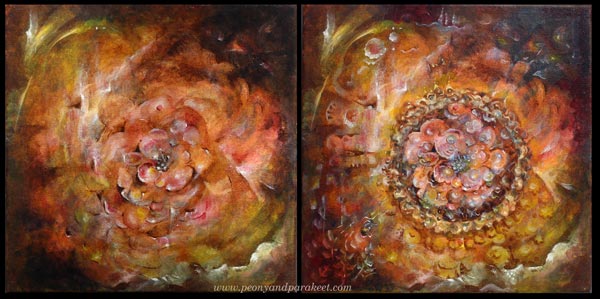
About three weeks ago, I quickly painted a small flower painting while sharing my thoughts about painting softly (see this blog post, which also includes a video).
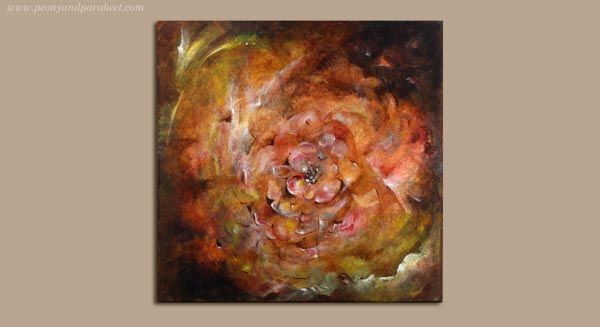
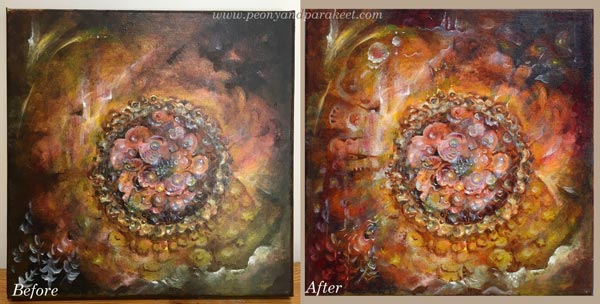
During the past weeks, I have been wondering what to do with the painting. I thought it could be a little more detailed and tell a bit more glorious story. So this morning, I decided to work more on it. Some artists are always afraid of “over-working” their paintings. But I belong to the group who thinks that the painting is almost never fully finished. There seem always to be more ideas I could add and more adjustments I should do.
1) Painting a Decorative Frame
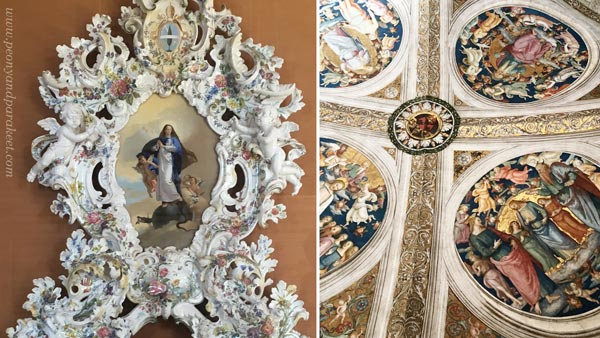
This time I decided to use a selection of old decorative art as an inspiration source. I picked photos that I took from the visit to Vatican Museums in June. I often work like this: letting images spark ideas that I will add to my work. It’s not so much “copying” but picking concepts or generic ideas. My first inspiration came from these decorative panels.
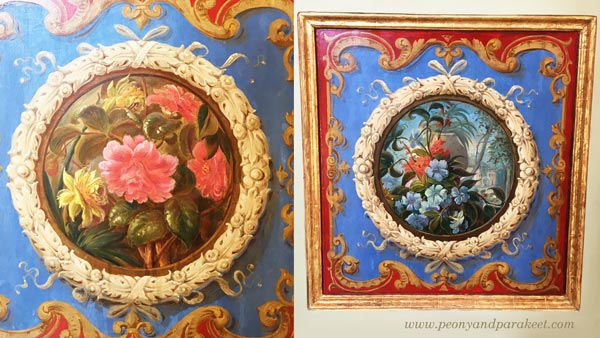
By using a Chinese marker, and a lid of a jar as a template I drew a circle on the center.
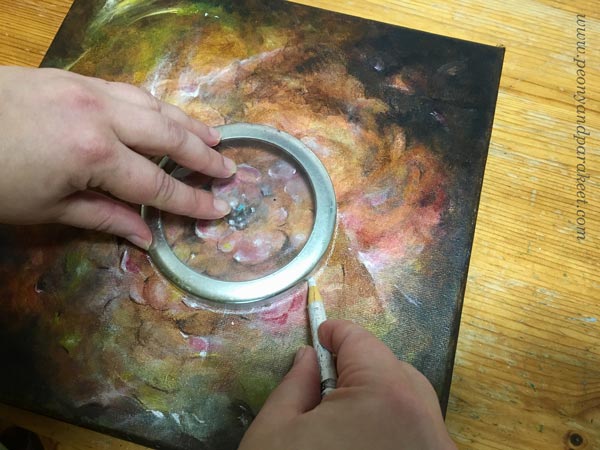
A huge porcelain piece and a beautiful ceiling inspired me to paint a frame with lots of swirls.
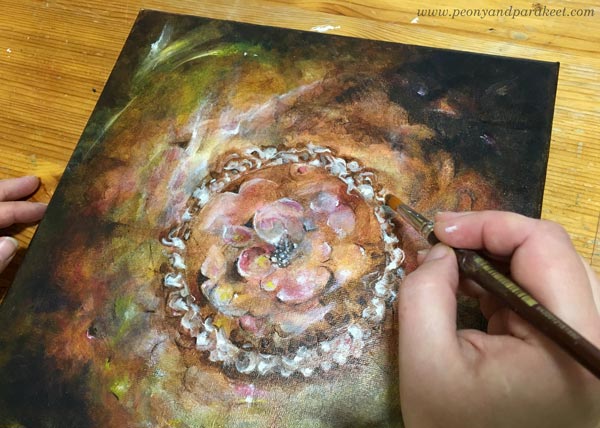
I just added some burnt umber around the drawn line and then painted the swirls in white. I added several translucent layers to make the shapes look more three-dimensional.
2) Playing with Colors and Shapes
The next ideas came from this picture. It’s one of the many beautiful ceilings, so full of images and details that it’s almost overwhelming.

The ceiling inspired me to add more color variation to the painting. I used mostly ultramarine blue, ochre, and cadmium yellow on the center, and quickly some elements with white on the bottom left corner. While waiting for each thin color layer to dry, I pondered what to do with the rest of the painting.

I almost heard a voice saying: “Stop right here, don’t ruin the painting!”
3) Letting Go – More is More!
While browsing the photos taken from Vatican Museums, I remembered the astonishment that came from the number of visitors there were. It was Friday afternoon, but the area was packed. Each huge corridor was filled by us, tourists walking and staring at the beautiful ceilings. The Sistine Chapel was even more crowded. Frescos, mosaics, statues, paintings and decorative textiles covered the surfaces. Everything was full in every possible way. And now in Finland, I was sitting in my half-empty studio with my half-empty painting.
So I said to myself: “Go for it!” And took some extra boost for my confidence by examining a photo of a wonderful wall textile. If men can be this decorative, why not just continue the painting!
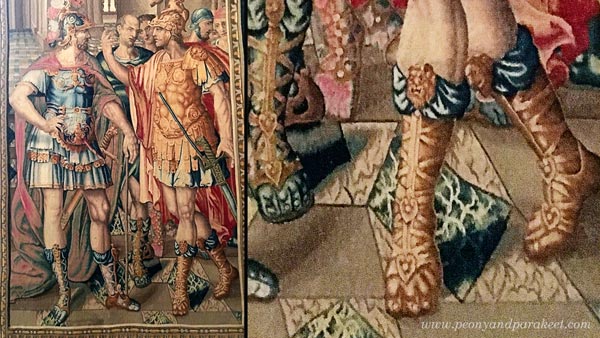
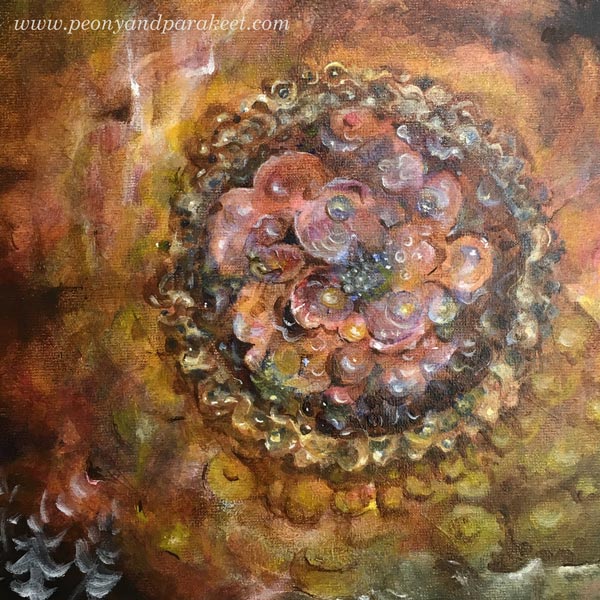
I worked more with the center of the painting, making it grow towards the edges.
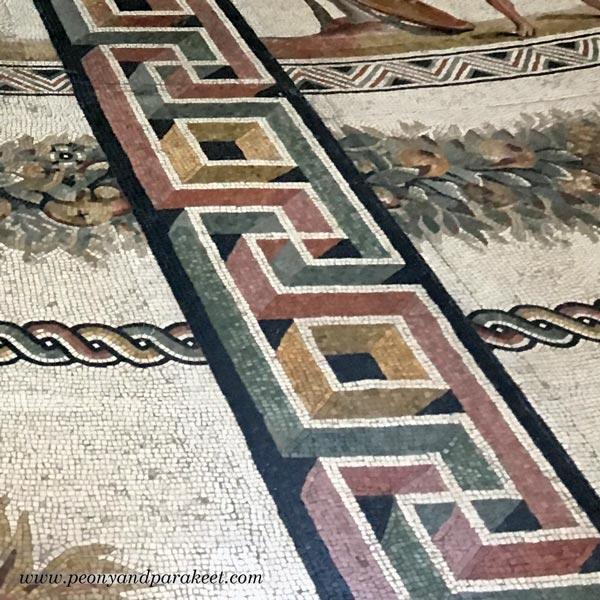
A detail of a mosaic floor gave me an idea to combine geometric shapes with curvier lines.
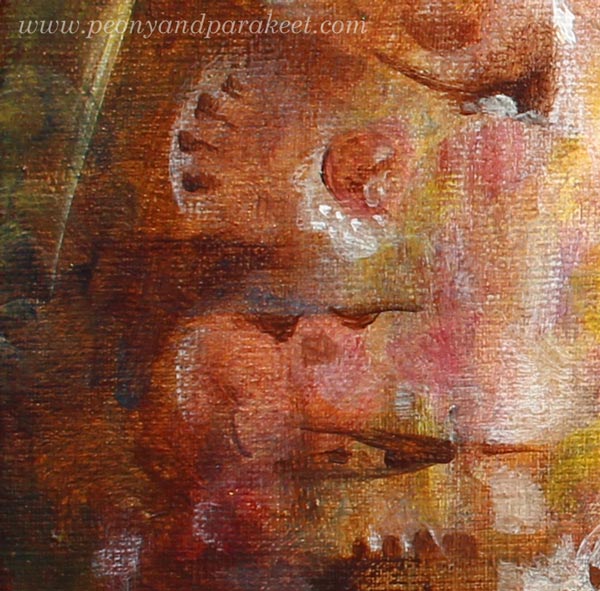
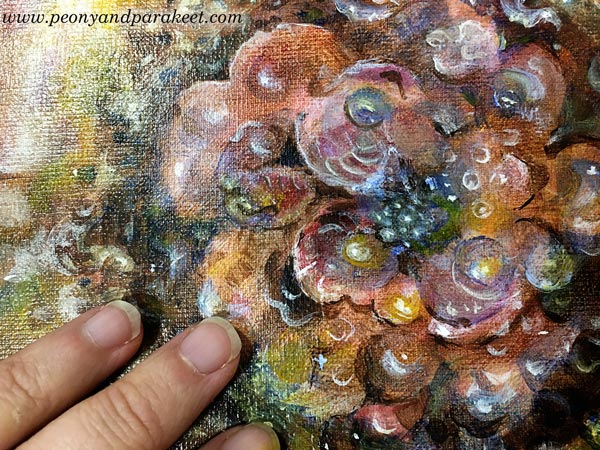
Here’s a close-up showing tiny additions on the left:
4) Bringing up the Expression – Highlighting the Visual Message
Before the final touches, I still had some stiffness in expression. To me, it’s often difficult to fully trust my intuition unless I know what I am expressing. I was almost finished when I realized that my painting is about being a queen of the fantasy, ruling every little detail, making ships change their direction on the sea, and wearing a crown that shines further than anyone could imagine.
Some Close-Up Photos of the Flower Painting
Ships sailing:

The center. This is a very small painting, only 12 by 12 inches total:
Floral Fantasies
Lately, I have been more and more aware of the fact that I want to paint fantasies. To me, the first version of the painting was too bland. I dress modestly, I hate wearing too much jewelry, my home is not full of stuff, and still, I want my art to be full, to go beyond what’s expected and accepted.
I am currently preparing a new online workshop about painting flowers … If all goes well, it will take begin in October.
Let me be your art teacher: Subscribe to my weekly emails!