
Breaking the Rules – Creating What’s Right for You
This blog post is about breaking the rules when choosing what to create.
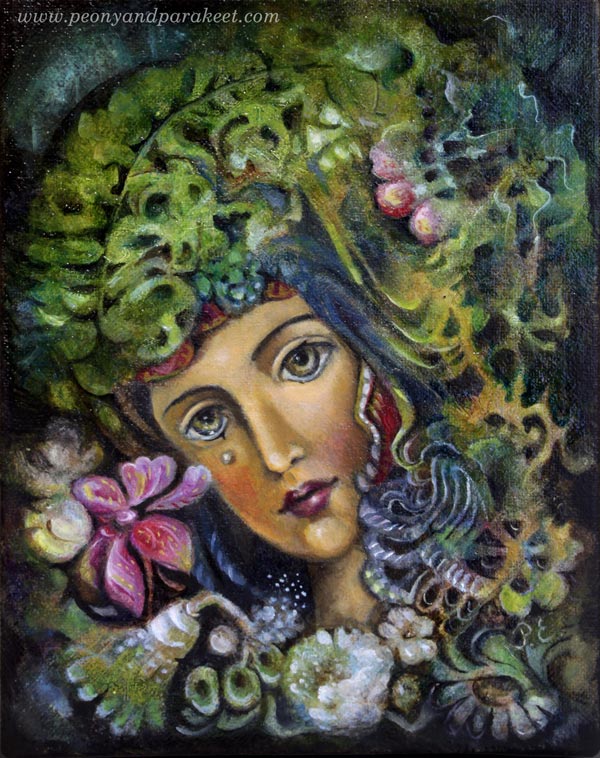
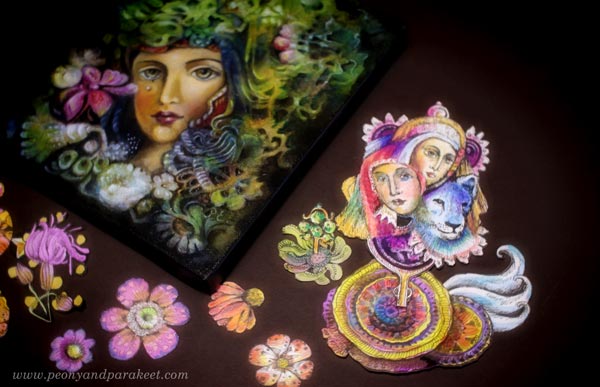
Let’s begin with this oil painting. Oil paintings are big projects for me, and I only finished two of them last year. The first was Temptation, and this is the second one, called Madonna of the Heart.
Following the Heart – Breaking the Rules
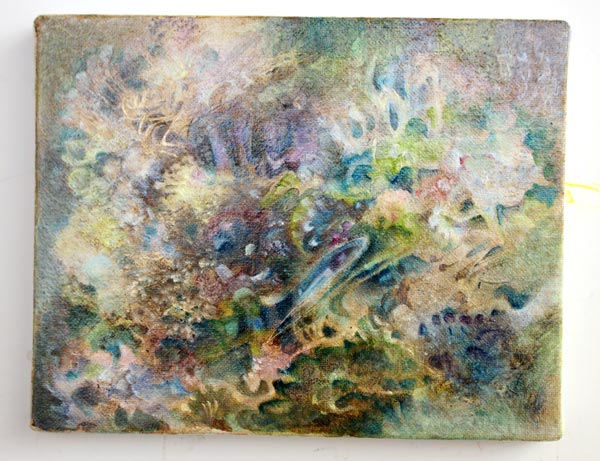
My Madonna is a small painting, only 18,5 x 23,5 cm, but it’s quite detailed. I first planned to make it fully abstract, but then got second thoughts.
As a child, I learned the basics of eastern-orthodox art by attending an icon painting group. I was taught many rules – what colors to choose, how to mix the right tones, how to build layers, etc. It was not just about learning the right techniques, but also obeying the long tradition. The repeating discussion in the group was the difference between right and wrong. There was very little room for creativity, and I loved it! I was about 10 years old and eager to learn new things. Work was challenging, and it was comforting to know that there’s one clear direction.
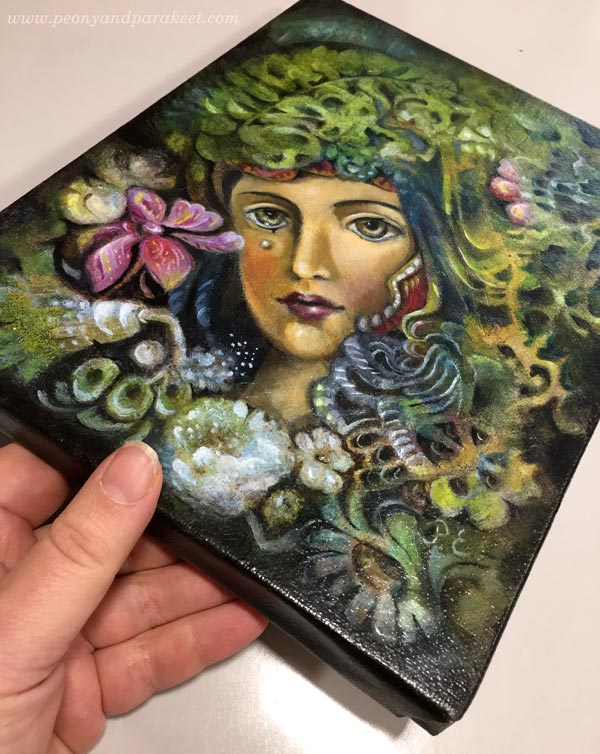
When painting the small canvas, I was tempted to travel back to my childhood, and participate in that small and safe group of icon painters again. But I also knew that it’s very wrong not to follow the rules. My supplies were wrong, my background was wrong, the whole idea was wrong. But it felt natural and tempting, so I made it.
Natural to You, Wrong to Some
Recently, I have found many creative blocks like this one. To paint an icon with oils on an abstract background is wrong to some, but it’s natural to me. I love painting intuitively, and the idea of an icon is the most beautiful that I know. Don’t we all need an image that offers consolation and reminds about kindness? To me, it has nothing to do with any specific religion. Everybody has a right to have a Madonna of the Heart.
While building the class Animal Inkdom, I have also filled my “boxes of joy” with hand-drawn collage pieces. Very soon after starting, I realized that the principle “natural to me, wrong to some” also applies to these small drawings.
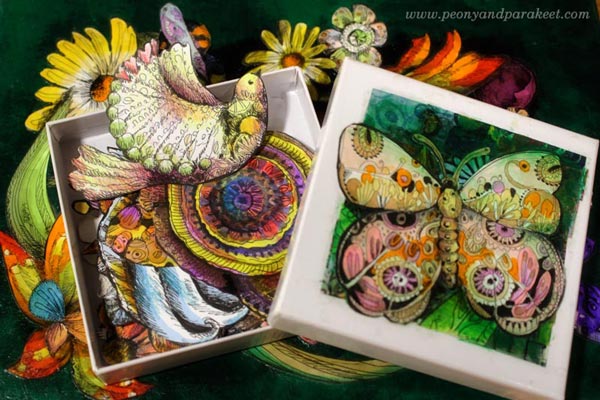
Yes, I love to draw flowers, birds, butterflies, very innocent stuff. But there are also pieces that are quite odd like this one.
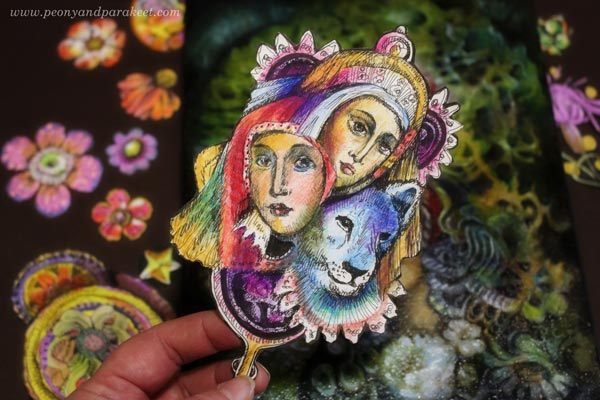
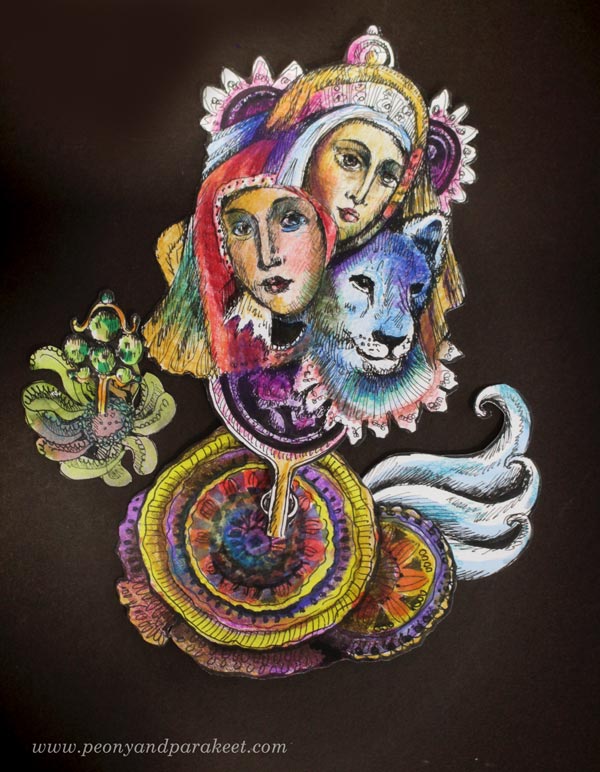
This hand-drawn ornament has two women, both dressed in old Byzantine clothing, and the lion. It has a handle so that it can be held like a sacred image. This small drawing is packed with stories about my childhood. I remember the conversations with my mother, already passed away. I remember my idol, Joy Adamson, and her lion Elsa. I remember my love for blue color. Seeing all that together makes me happy.
I also love to play with the ornament by adding more handdrawn elements around it!
Breaking the Rules Between Serious and Playful
So it happened that a carefully painted oil painting and this little ornament became equal. Of course, not equal in monetary value, but equal in the kind of satisfaction I get from them. And it also feels that this world that I am building is surprisingly inclusive, both humorous and deep. All I need to do is to make what’s natural to me, even if it would look wrong to some.
We often miss this natural zone because we are so focused on what makes sense to others. When choosing what to create, we work with pre-defined labels like “portraits” or “art journal pages” or “abstracts.” We do what seems to be right for the genre, rather than step into the world where someone might not get it, or in the worst case, might get offended. Still, the freedom in art can’t exist without the freedom of imagination.
Come to Play and Draw with Me!
So, I dare to suggest: play with your art! Cross the boundaries between “right” and “wrong”! Follow the general rules of aesthetics but brea the rules of subject matters.
I think that with Animal Inkdom, you can nail it. You will get practical tips and techniques, but there’s also humor and play, all flavored with the love for wildlife.
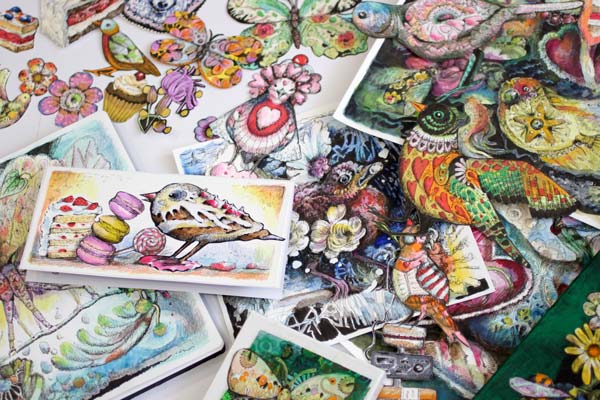
It’s still a good time to sign up for Animal Inkdom! The first one of the five modules is published, and you will get it right away after the registration.
Let’s keep on drawing, and never forget the playing part either!
Guiding Word – Choosing and Visualizing Your Word of the Year
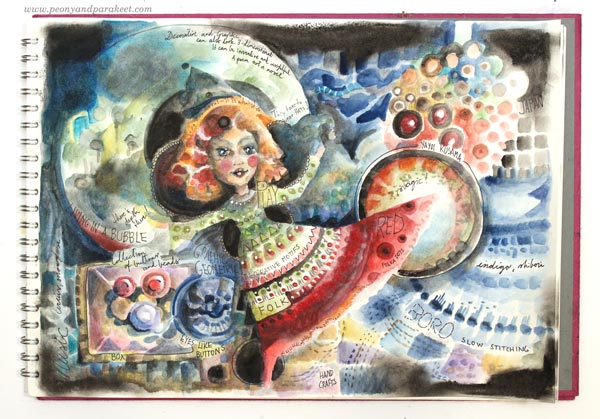
The year 2018 was groundbreaking to me. I was able to include things that seemed separate from my art in my art and build a new foundation for it. It strengthened my visual voice and style, but also, it felt more holistic than just that. I would say that my artistic identity got updated.
As a former software engineer, I see it this way:
Peony and Parakeet 1.0 – intuitive circles and colorful patterns, 2012-2014
Peony and Parakeet 2.0 – from mixed media to fine art, 2015-2017
Peony and Parakeet 3.0 – fantasy illustrations, 2018 -?
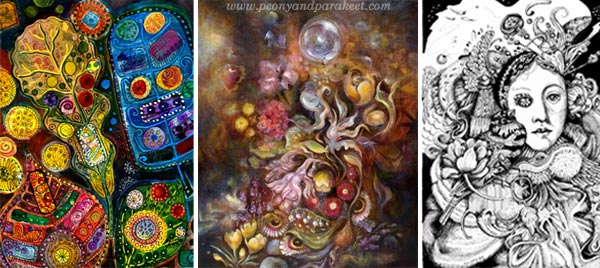
I am not quite sure how to label 3.0 yet, but it definitely started last year and went into bloom during the Inktober challenge in October.
What’s Your Word of the Year?
About a year ago, I developed a process for setting artistic goals. I introduced it to my art community Bloom and
My word for 2018 was “Depth”, and now when I look back, it was related to my old desire to create fine art. But the process of exploring depth was like the symbol of yin and yan. It started a journey towards the opposite word “Play.”
The process of choosing a word and exploring it through art-making had a huge impact on me, so I decided to share it openly. Watch the video to define your word and to explore it more in depth!
Guiding Word – Watch the Video!
My word for 2019 is “Play”. I am looking forward to
P.S. As you probably noticed already, this website and my artist website has been updated! There are still things to adjust and add, but feel free to browse the new look!
P.P.S. I am running a free live webinar The Joy of Drawing on Jan 17, 7 PM GMT – 11 AM PST, reserve your spot here!
The event is gone but here’s the recording!
Creating Horse Art – Reawakened Love!
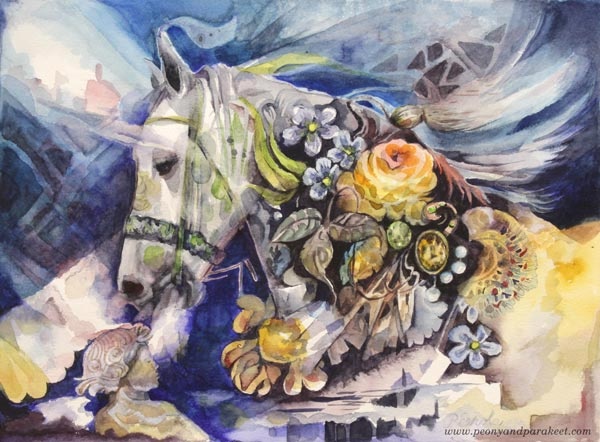
Here’s my newest watercolor painting called “Brave” (for sale in my art store!) I got an idea of using a horse to symbolize bravery that comes with finding your passion(s). Isn’t it a romantic thought to see the passion as a horse inside us, rising from the depth and blowing strength!
Past Passion for Horses
Recently, I have found a lot to be passionate about. Many of those things have been inspiring to me as a child. but I have let them go for tens of years. One of these things is horses. I used to play a lot with toy horses, and I was also addicted to taking care of my hobby-horse, an ugly plastic blue thing! Sadly, I rarely saw real horses and I haven’t ever had a horse as a companion.
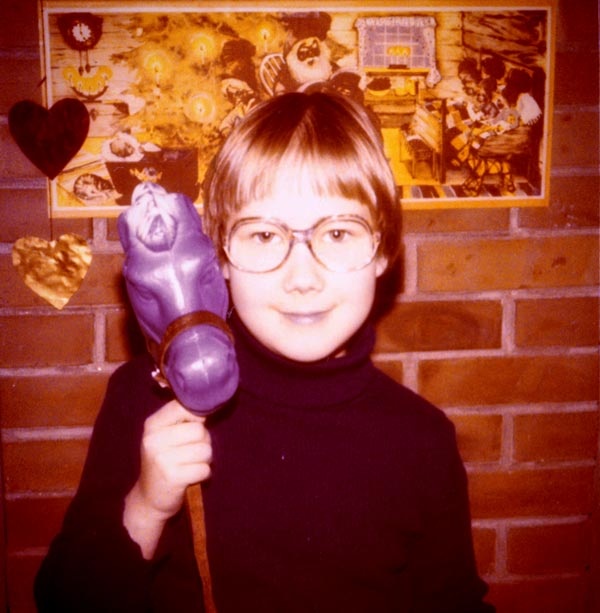
Once my parents took me to a field where a small horse farm offered horse-riding for children. They lifted me on a big Finnish Horse that had no saddle. Someone walked the horse, and I tried to keep myself sitting straight even if the back of the horse was really slippery. I made it to the center of the field and then fell off. The field offered a soft ground, and the horse didn’t step on me. They offered me a horse with a saddle, and it was much more comfortable! That’s most of the practical experience I have about horses. But of course, my theoretical knowledge was much more vast. As a child, I had borrowed all the possible horse books from the library and stayed busy building stables or crocheting rugs for the toy horses.
Finding the Creative Play with Horses Again
It must be early teenage years when I got alienated from the subject. Since then, I had never had a desire to own a horse, to ride a horse, or to do anything with horses. Until I participated in Inktober, the monthly drawing challenge. While making this drawing, my love for horses was reawakened.
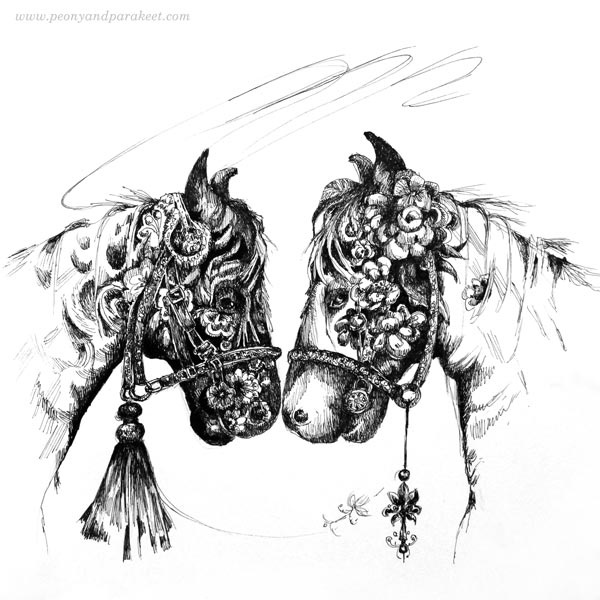
As adults, we easily ignore things that resonate with us but that don’t belong to our outer world. Even if we can draw and paint anything, we easily define ourselves with outer standards. If not having experience about real horses didn’t bother me as a child, it shouldn’t worry now either. I may not be a horsewoman in the outer world, but I can have a stable as big as I want in the inner world.
Creating Horse Art with Watercolors
I started the painting from the flowers and as usual, didn’t use any pencil sketch. It’s a bit risky way to create, but I love problem-solving and knowing exactly what to put and where is not always a practical solution for me. Here are some quick early stage pics! I used a reference loosely for the head of the horse.
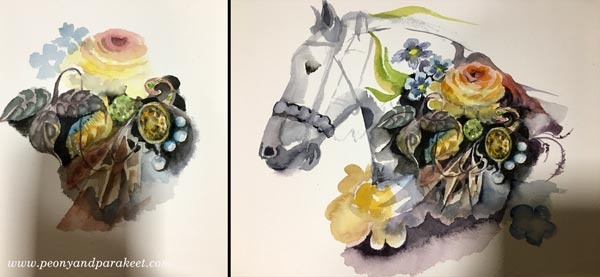
I was painting happily but in the middle of the process, I was in trouble, not knowing how to finish the piece. When working with watercolors, it’s especially tempting to just stop so that the painting doesn’t end up too dark.
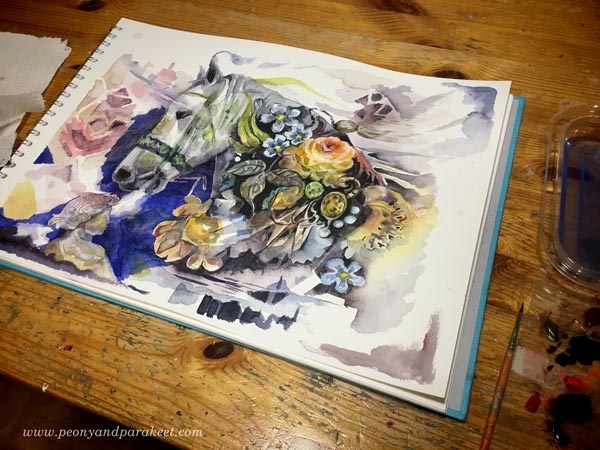
But here, I loved the idea and didn’t want to leave it looking unfinished and busy.
Planning in the Middle of the Project
I took a snapshot of the unfinished painting and made a plan in Photoshop. This is how I help my students all the time, and it’s a very handy skill to have!
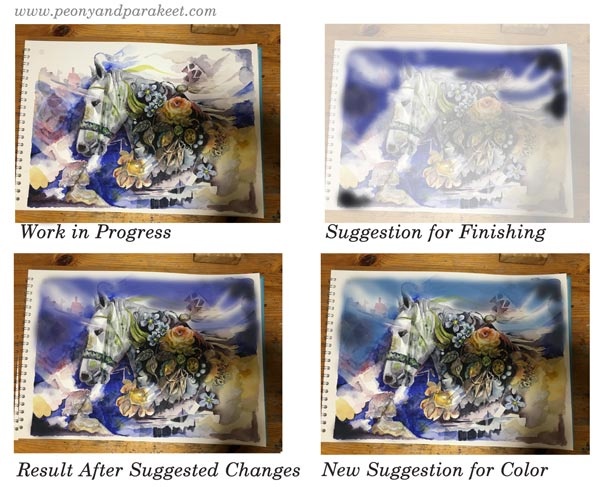
The first image above is the starting point, and the next images are made in Photoshop. They demonstrate what changes should be made next. This time, I also followed the plan. But sometimes it happens, that I end up with a totally different solution but which would have never crossed my mind without the Photoshop play.
Late Night in the Studio
I like to paint so that I watch tv shows or video podcasts on my iPad at the same time. It can happen that I paint a romantic and profound piece and then watch a tv reality show that I can barely stand! Sometimes it feels like the worst the show, the better the painting becomes!
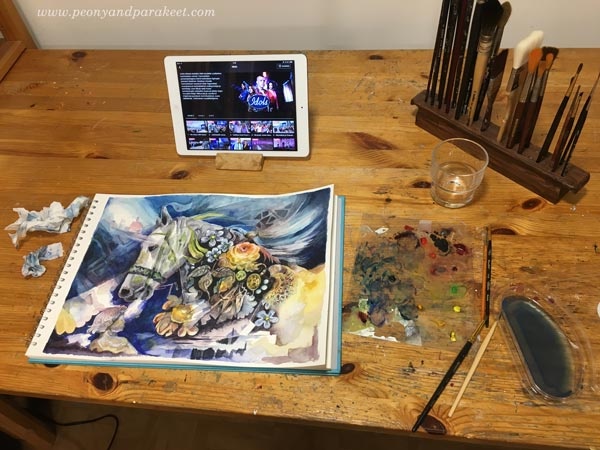
I hope you enjoyed this blog post! What did you love as a child but that doesn’t show in your current creative life?
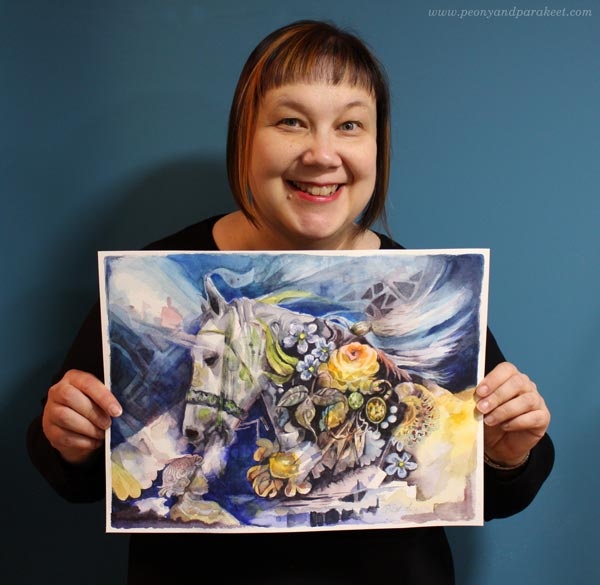
Subscribe to my weekly emails – Get a free mini-course!
Oil Pastels and Spicing Up Your Art

This week, I show you how to use oil pastels with other art supplies. I also talk about spicing up your art, especially by choosing subjects that are so personal that they make you tremble a bit!
Early Memories of Oil Pastels
Making art can be compared to cooking. Sometimes the food tastes good because the ingredients and the way are processed go well together. That was how my mother cooked. Her food was delicious because it was fresh and made with care. Even if our family wasn’t wealthy, the time that she put on cooking, made the meals worth remembering. I still don’t know how she was able to include the thick layer of blueberries into her pie. When there was a local art competition for children with the theme “home,” it’s no wonder that this is what I drew.
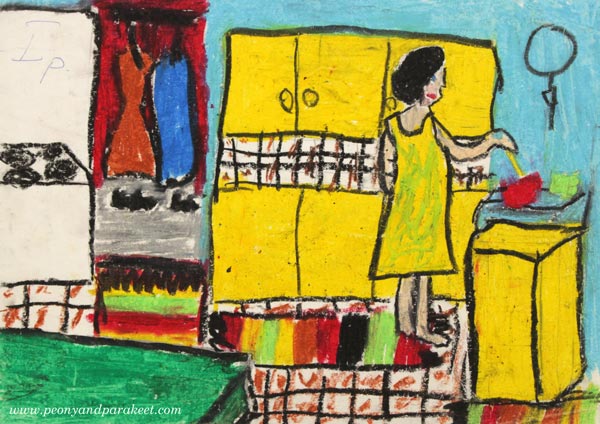
I remember struggling with the oil pastels, definitely not artist’s quality, but the drawing won the first prize. It was a little unpleasant that the organizer has written the prize in the drawing, but now it just adds a nostalgic flair to it.
My mother wanted her children to step away from cooking and caring for the home. She wanted me to get a good education and declined to teach me how to cook. I grew to question what women and men are supposed to do and felt rebellious in that respect. As a result, I went to study engineering and worked in a field that had mostly men.
QUESTION: What memories do oil pastels or other early art supplies bring to your mind?
Sennelier Oil Pastels – First Experiment
I bought a small set of Sennelier oil pastels for mixed media art. I didn’t want to spend money on a bigger set until seeing if I like them or not. My first experiment was to draw a portrait on a small sketchbook.
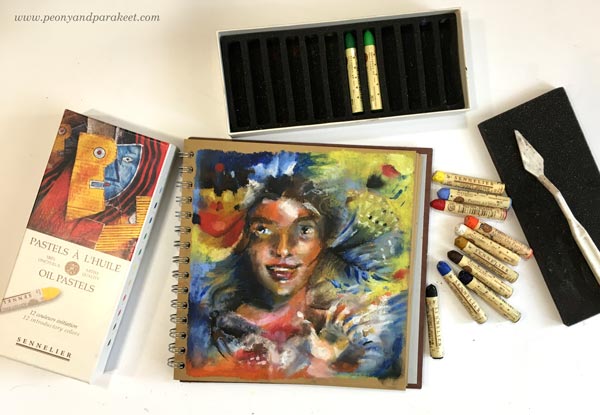
My mother used two spices mostly: salt and pepper. When creating art, salt and pepper are the lightness and the darkness of colors. You need both, but not too much. As beginners, we often think that we don’t need any salt and pepper. That the fresh ingredients – bright colors – will do the trick. But you need some paler and darker colors, not too much, but enough to harmonize a busy painting.
For the first experiment, I thought that making a basic portrait with salt and pepper would be enough. But creating just a pretty face often lacks expression, so I added a hand because oil pastels and fingers go together. No matter how hard I tried to use a palette knife for blending, I ended up enjoying the waxy feel of oil pastels on the fingertips.
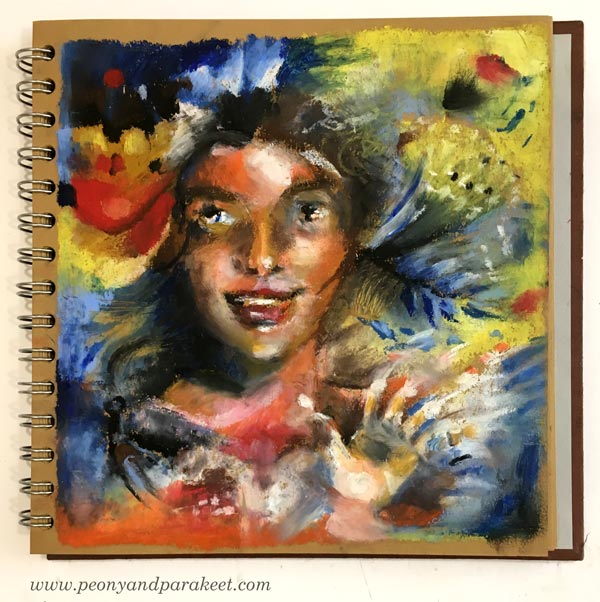
The first experiment made me remember why I had tossed away my old oil pastel set over 10 years ago. Oil pastels are messy! Later in the evening, I made a big mistake of not wiping the table carefully and then placing my cross-stitch projects on the very same tabletop. I had to wash oil pastel marks from the fabrics, and that was very upsetting!
Woman’s World – Oil Pastels with Graphite Pencils
I wasn’t ready to give up oil pastels but headed for the new experiment the next day. This time my idea was to use a sponge for blending and combine oil pastels with graphite pencils. They have called me more and more these days. Maybe it’s because my friend Eeva Nikunen uses graphite a lot and I have one of her drawings on the wall. I am not so much into using graphite alone, but I love using it with watercolors, so why not try it with oil pastels as well!
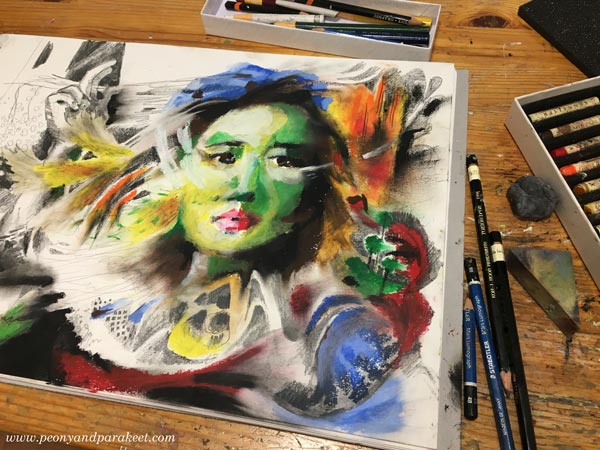
Making of this sketchbook page both excited and scared me. It went deeper than the first page and expressed thoughts that I don’t usually reveal to the public. I support women becoming equal with men, and often think even more strongly: it’s now the time of the history when we women can take power. I believe that it will liberate men too. Many young women say that they are equal already, but my experiences haven’t been quite like that. And when thinking back to the past, even when narrowing the focus only to the field of art, women have been neglected for centuries. So it can be woman’s world now if you ask me.
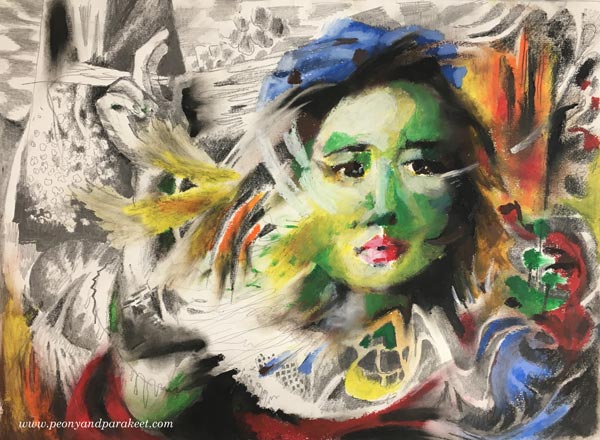
When creating this piece, I realized how much I had been used salt and pepper only: making images that are aesthetically pleasing, but that could be spiced up with the message.
QUESTION: What thoughts do you have that you haven’t expressed in your art?
When you think about “what to put in the background” next time, maybe perfect the face a little less and spend more time with a message no matter “what others think.”
Girl Power – Oil Pastels with Acrylic Paints
When I processed the theme – the power of women – further, I wanted to send encouragement to today’s young girls. Most girls that I have met are very smart but also polite and gentle. I wanted to express my appreciation for them.
This time, I wanted to try acrylic paints with oil pastels, and I also had a perfect reference image in mind. It was a miniature portrait of Europa Anguissola painted by her sister Lucia Anguissola. There were six sisters who all became painters in the Renessaince age, but only one of them, Sofonisba, continued her career. I saw the portrait of Europa a couple of years ago, and it’s sweet and amazingly detailed for a small painting.

This project was created in my Dylusions Creative Journal. Acrylics were my choice for the face, and I started very traditionally, making an underpainting with umber and white.

Again, I didn’t want this piece to be just about the face, so I added a hand too. Here you can see how far I worked with acrylic paint only.
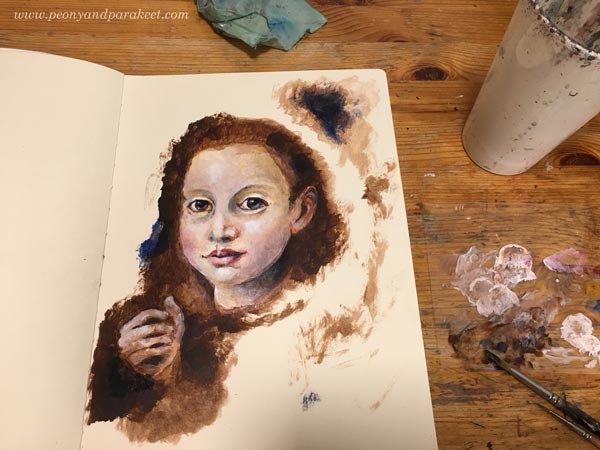
Now to the oil pastels. After experimenting blending with a palette knife and a sponge, I gave up and used my fingers only. But I had a new weapon: baby wipes! They are very handy for removing paint both from the fingers and from the table top. After getting used to having a baby wipe in hand, the messiness of the media doesn’t bother anymore!
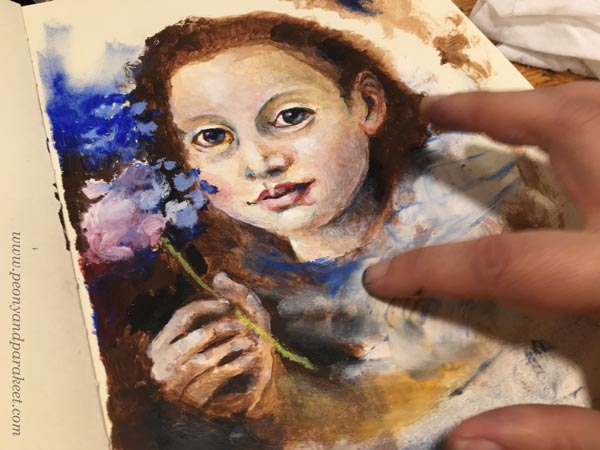
I love blending out the color when working with oil pastels. It feels enjoyable and natural. I am excited to try these techniques with oil paints as well.
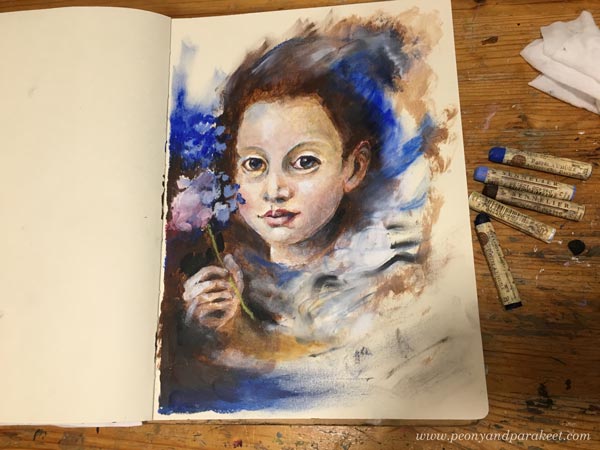
Here’s one technique that I discovered: First, lay several colors carelessly on paper. It’s like throwing the ingredients into the pot!
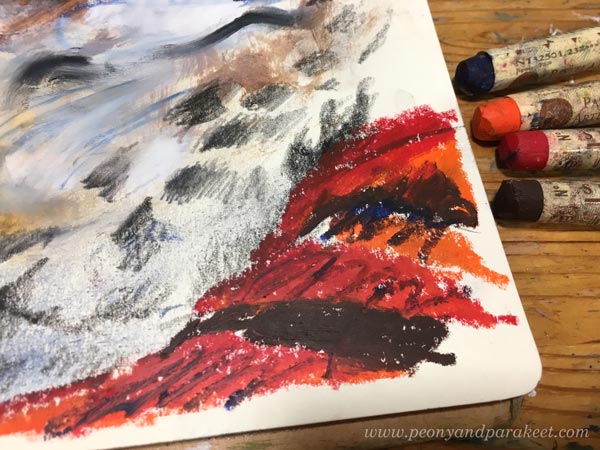
Second, mix the colors with a finger – beautiful – not the finger but the art!
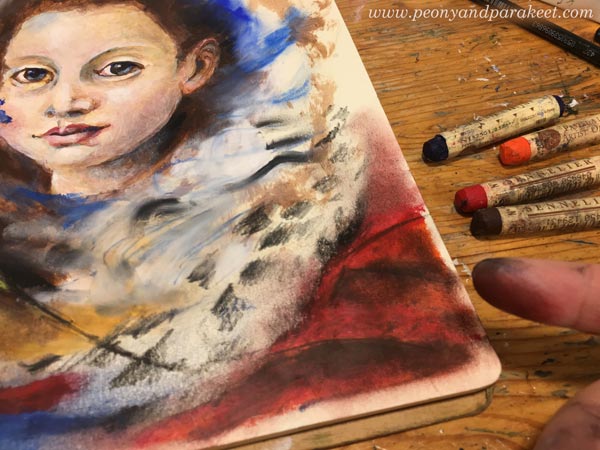
I also wanted to add some pencil strokes too. Loud and bold oil pastels look very appealing when they meet the quiet power of graphite drawing.
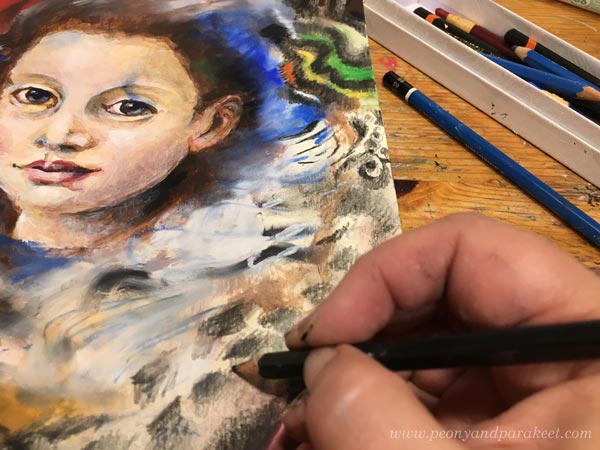
So this one is for young girls: “I wish you all the luck and all the power. Europa Anguissola abandoned painting when she got married, but you don’t have to. You can be anything, and we support you!”
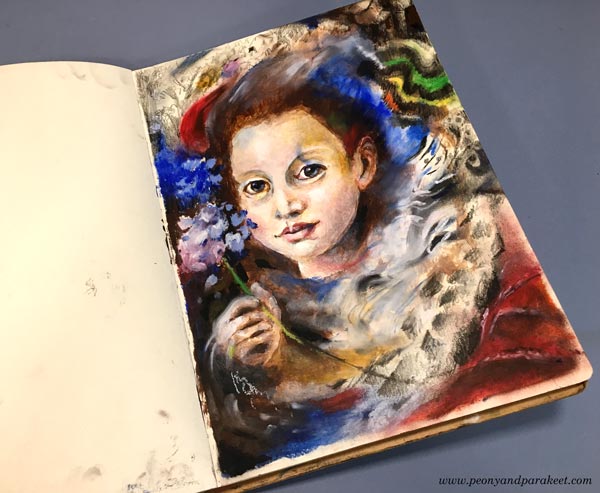
Who do you want to send greetings through your art?
Free Like a Bird – Oil Pastels with Turpentine
The true test for the oil pastels: how do they work with abstract art and intuitive process. This time I used colored pencils and graphite as well.
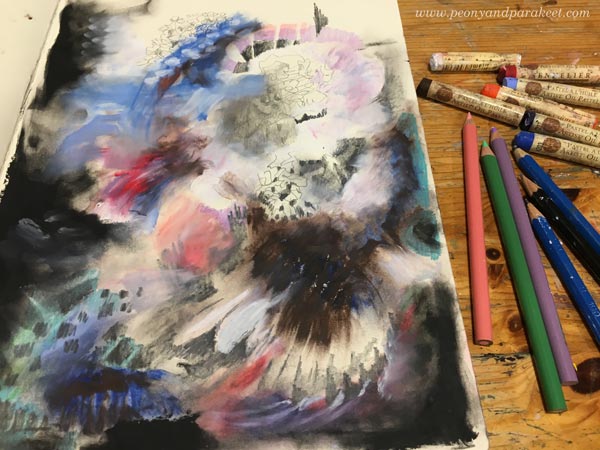
In the middle of making this abstract piece, a new problem came up. I wanted to spread a thin layer of paint, and tone down some areas. I got the idea of thinning the pastel with the medium that I use for oil painting. The painting liquid has poppy oil, Dammar varnish, and turpentine. After googling, it seemed that turpentine could thin oil pastels. So I rubbed some color on a palette, added few drops of the painting liquid and started painting.

The liquid worked very well. Of course, the odor of turpentine can be unbearable for many. Working in small amounts, and keeping the lid closed reduces it a bit, though.
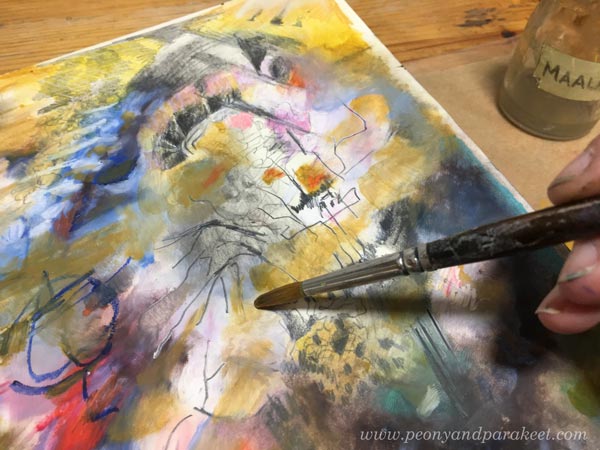
Here’s my finished piece: “Free Like a Bird.” It’s what I hope for everyone, regardless of the gender.
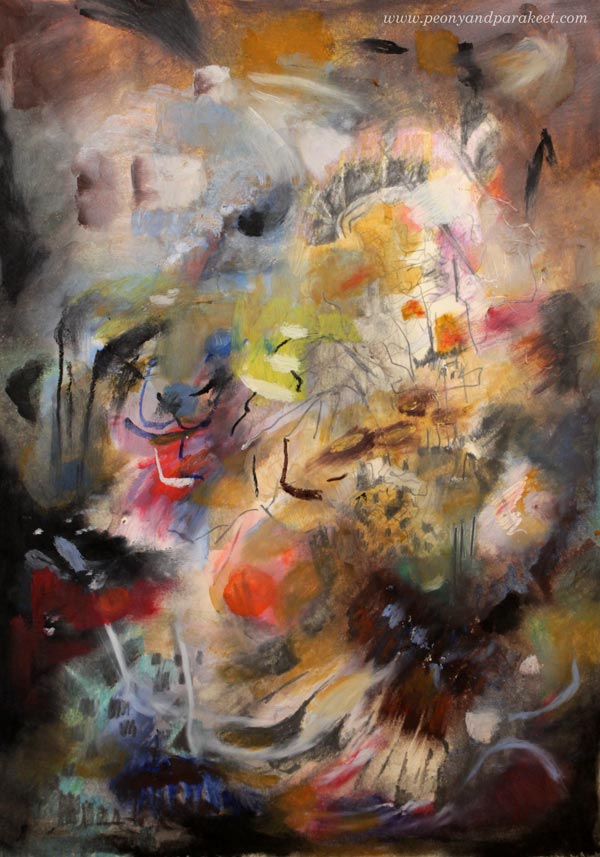
If you compare the images of this blog post, the abstract piece leaves more room for interpretations. Recently, I have felt more and more drawn into creating abstracts, and letting go of delivering a pre-chewed message. Cooking without a recipe can be much harder than you would first think. Making a vast selection of foods, learning to use pepper and salt, helps. But first and foremost, art is not just a matter of learning how to cook a meal. It’s also the matter of choosing what you want to serve to the world. And no matter how clumsy the execution, the subject can be the most significant spice.
The Exploring Artist Begins on Sept 10 – Sign Up Now!
The Exploring Artist is a 12-week group coaching program for artists, between Sept 10 – Nov 30, 2018. This coaching is for you who wants to get clear about your artistic passion and become more open about your art, for example, share your art in social media, blog about art, sell your originals and prints, teach classes, etc.
In The Exploring Artist, you will get coaching as a part of a small and tight-knit group. I will personally help you to put your passion into words and visual insights. We will work together to discover what you want to change in your art, where you want to move forward and how to do it. >> Sign up now!