
Drawing Sceneries with Watercolor Pencils
This week, I have a fun drawing idea: fill a paper with many small sceneries!

For this project, I have used watercolor pencils and Fabriano Accademia drawing paper (size: A4). The paper is very nice with colored pencils and goes well with watercolor pencils too.
Inspiration for Drawing Sceneries
Creating mini-sceneries is easy when you start playing with the scale. Think about a bumblebee – how it first flies over fields admiring the view and then finds a mini-world inside a flower.
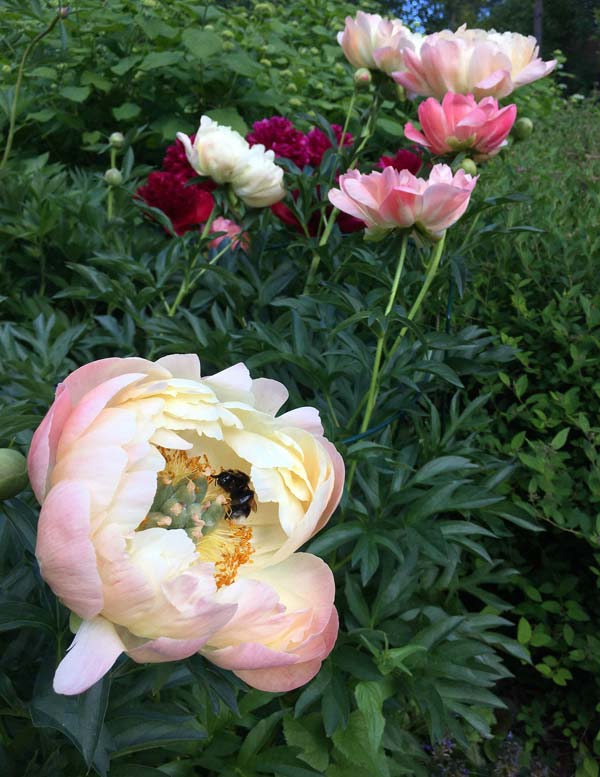
Your mind can be a busy bee, collecting a variety of ideas – big and small.

Your hand can then pick some of those ideas and put them into one picture like it would be a treasured collection in a secret museum. “Faberge eggs,” said my husband when I showed my picture to him.
Watercolor Pencils
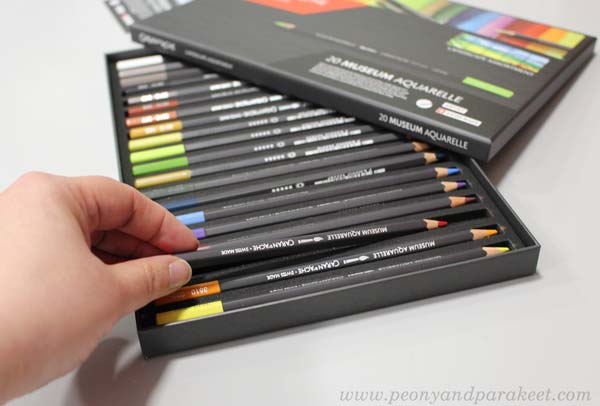
I often use regular colored pencils but slowly I have become interested in watercolor pencils too. I have had a few Caran d’Ache Museum Aquarelle pencils for a while and I love their quality – vivid colors, lovely to hold, and work well without water too. A couple of weeks ago, I bought 20 landscape colors to accompany what I already have.
Mini-Sceneries – Start Here!
Start your collection by picking a circle template, for example, a lid. Draw circles so that they overlap partially. Put one idea into one circle and color each of the circles separately.

This can be a “one in a day” project. Take your time to focus on each circle.
Watercolor Pencils in Use
Watercolor pencils are great for quickly filling larger areas. Color the area lightly and then add water over the colored area.

Let dry before adding a new layer on the top.
Drawing Sceneries – Playing with Styles
My favorite thing is to combine nature-related ideas such as landscapes and flowers with decorative motifs. I like to draw dots, other simple shapes, and lines so that they form frames and ornaments.

In this project, the circles are nature-related while the background has a more ornamental approach.

When you keep the background unified, you can use many styles in one piece. One paper then becomes a diary where anything handmade looks great together because it’s made by one hand and one mind.
Drawing in Ornamental Style

This project is another variation of the earlier blog post: Colored Pencils – Ornamental Approach. If you have taken the course Intuitive Coloring, would you be interested in creating something like this on a course next?
Selling Watercolor Paintings as Gifts
This week, I talk about making and selling watercolor paintings as gifts. At the same time, we celebrate the playfulness of watercolors.

See more and bigger pics at Taiko (online art store)
I love gift shops. My dream for a long time has been that, in addition to large oil paintings, I could sell smaller pieces as gifts. Recently, this has come true. I have sold many of my watercolor paintings not only directly but also via the Taiko online art store and the Gumbostrand Konst & Form gallery.
Art as Gifts vs. Art for Homes
An art buyer never buys art just for need. The work must appeal to the buyer on a deep level. Still, large paintings are chosen more according to the interior, and smaller ones are purchased as gifts. Sometimes a small painting is a gift to the buyer himself, often to someone else.

As a professional artist, I am more known for oil paintings, but I have dreamt that also my watercolor pieces would be in demand. I love to paint them and the idea of a perfect gift inspires me. However, it has taken time to grow my vision of how they should look.
Because I have grown many of my general painting skills with watercolors, my watercolor paintings have quite a similar style to my oil paintings. But with watercolors, I step in a slightly more illustrative direction. I want my watercolor art not to be too abstract, but approachable and atmospheric. See a collection of my recent watercolor paintings here!
Flower Art But With a Playful Attitude
My watercolor pieces usually have flowers. However, I don’t paint just static and spiritless flower arrangements. I see flowers as adventurous human or animal figures and get playful with them. On the one hand, the flowers are like dolls and teddy bears, and on the other hand, they are imperfectly perfect, feeling natural and real.
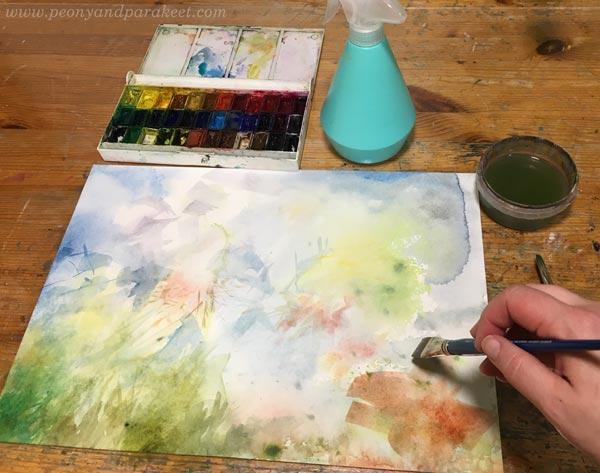
When the playfulness really kicks in, painting is fun.
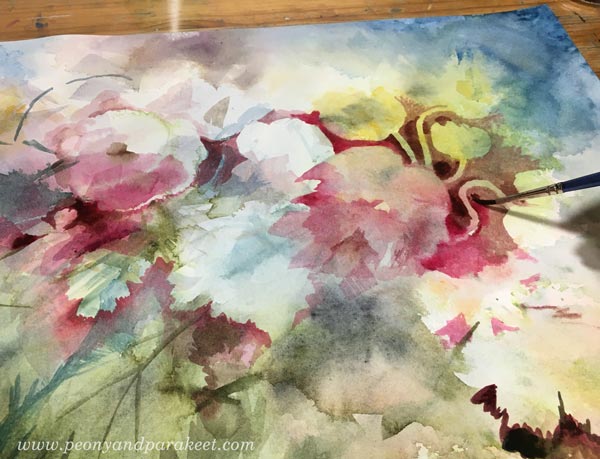
I love to discover plants in the middle of random watercolor spots. I have also a course called Freely Grown about this kind of process.
Taking Several Sessions to Grow the Idea
Usually, the first layers of the painting are fast and only take an hour or two. But that’s when the painting is just a regular flower painting, not a special piece that has a special appeal. Within a couple of hours, there’s not much time to grow the idea further or adjust the details.

I usually paint in several sessions where the first one or two lay the foundation and produce the basic painting, and where the next sessions (usually 2 to 4) grow the story and produce the finished look.

For example, for this painting, I took walks to see flowers and to add some more to the painting. But after a while, that felt too traditional and then decided on the gold mining theme.

The further I go, the smaller the brush strokes become.
Working with a Progress Photo
I find it helpful to take a photo of the unfinished piece, and then use it as a reference. The small-sized picture makes it easier for me to spot the areas that still need adjusting.

Looking at the photo also helps with distancing myself from the actual piece. I can ask: Do I love this? Would I buy this? When selling watercolor paintings as gifts, never underestimate the quality, always try a little higher.
Color over Color
Pigments are very different from each other. Some colors require many layers, and others can be used very thickly. Most artist-quality yellows have good coverage and work well for the finishing touches.

I have recently used smooth (hot press) watercolor paper because it’s best for tiny details.
Gentle Breakthroughs
I want to break boundaries with all my art, but in watercolor, I try to do it more gently than usual. In this painting, the flowers have caught Hokusai’s great wave from Japan and taken it to Lapland to pan for gold. And so it happened that the gold and the flowers started a decorative baroque party and everything small became surprisingly big and grand. Despite all this, this is a flower painting where the viewer can relax and enjoy the joyful atmosphere.

But whatever the story is, I try to express it so that it can evoke different memories and associations in different people. Somehow, the painting must make a gentle breakthrough in the eyes of the viewer – find a soft spot where the immersion can begin.
See more pics of “Kultaa huuhtoneet – Gold Panners” at the Taiko art store!
Freely Grown – Paint Watercolor Flowers with Me!
In the course Freely Grown, I walk you through my watercolor painting process. Because the finishing touches with a small brush are the most challenging, we take the easier route and do them with colored pencils. In Freely Grown, you paint flowers freely without reference photos and create a unique painting from the given techniques and guidelines. >> Buy here!
Liberated Inspiration – Painting Freely
This week, I talk about liberated inspiration and share what I discovered about 8 years ago.
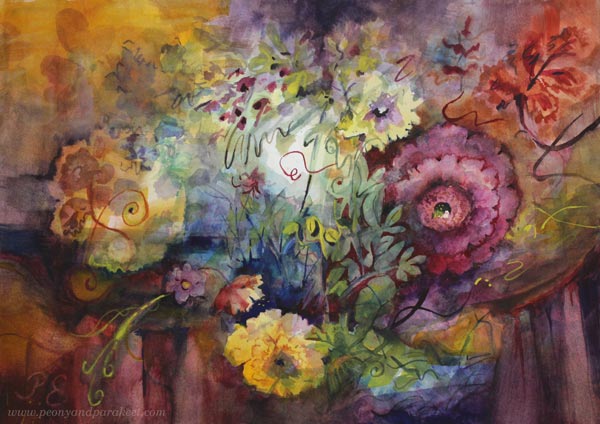
>> See more pics at the Taiko art store!
Liberated Inspiration from 2015-2016
Recently, I have been thinking a lot about the years 2015 and 2016. Then I combined watercolors, acrylic paints, and colored pencils for intuitive still lives. At the same time, I thought about how complex the forms of nature are and how I could create a more finished impression with nuances.
I have those pieces saved in an album. Watch a short video of me browsing the folder! Here you can see only a small part of the pieces – the album is thick!
Liberated Inspiration
These last couple of pieces shown in the video have stuck in my mind. This one:
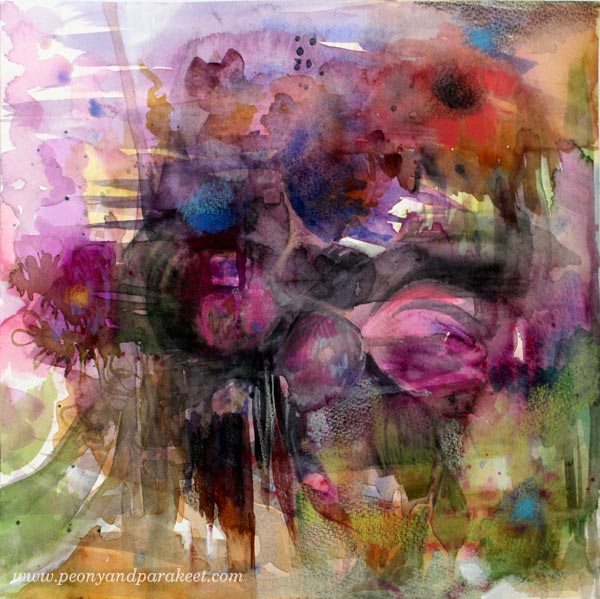
See the blog post about making this!
And this one:
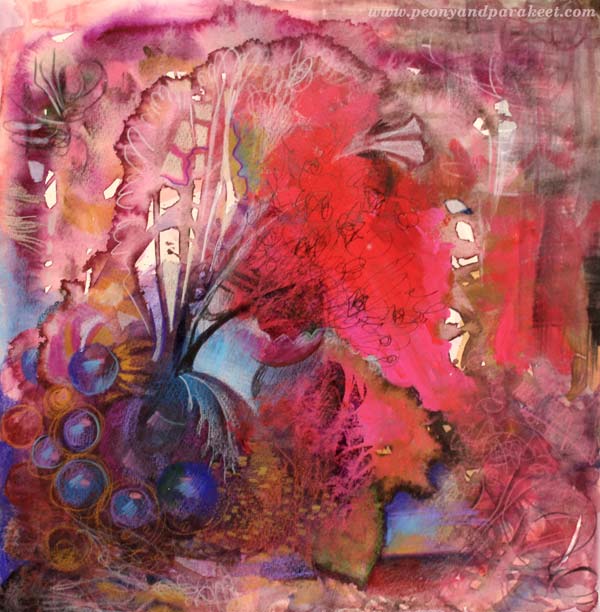
See the blog post about making this!
Both of these have a dark and romantic atmosphere that can be seen often in historical paintings, but there’s also liberated inspiration – meaning that no one dictates what that kind of painting should or shouldn’t have.
You can be inspired by what you have seen, but only pick the atmosphere from it.

I like this kind of inspiration the most. That you are inspired by something, but don’t take it too literally. Liberated inspiration boosts your enthusiasm but doesn’t tell what the final image should be.
I wanted a similar romantic yet liberated feel for this watercolor painting.
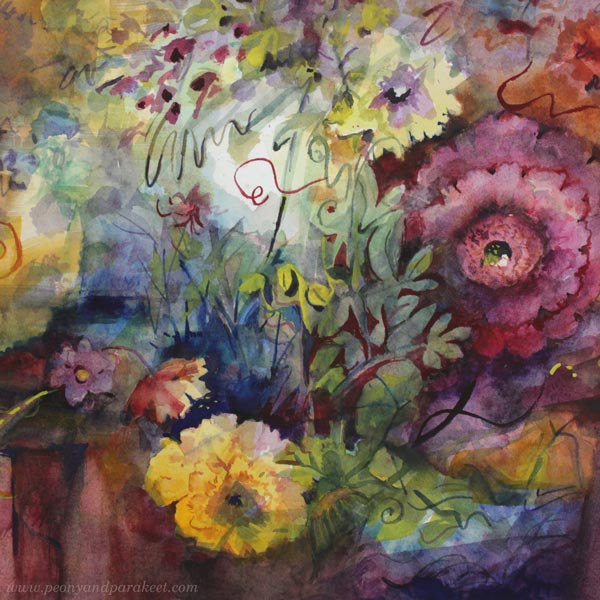
Imagine someone saying: “dinner is served” and bringing you to a table where good company and classical music would make the world look like it’s full of possibilities.
Painting Freely in Watercolor
It has always been important for me to paint freely without models and let randomness meet my imagination. In 2015, I developed a course called Liberated Artist. It was about creating a mess first and then solving it. It was a fun course.
I started this watercolor with a similar mess.
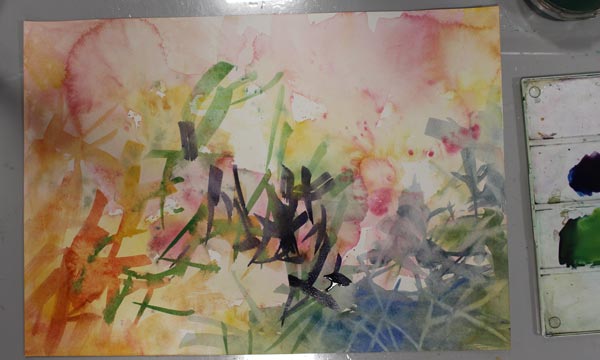
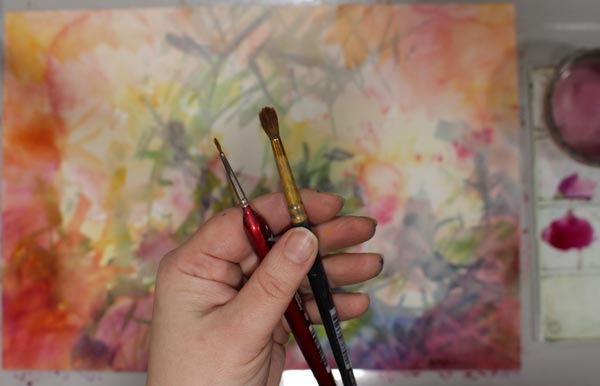
Then I switched to thinner brushes to finish the image.
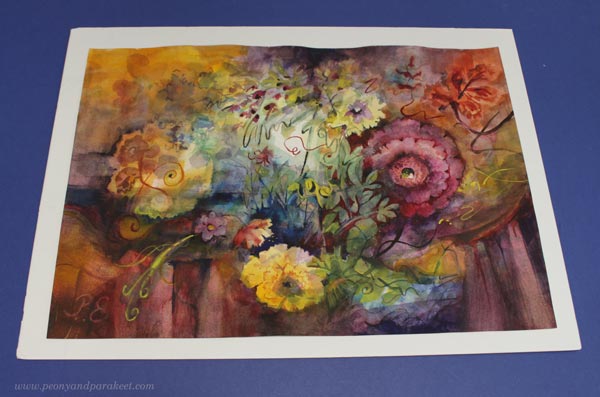
I like the way the imaginative scenery, flowers, ornaments, and the table came all together into one image.
Coming Up: Liberated Artist Revisited
The Liberated Artist course is no longer available, but I got the idea to redo a small part of the course. In that, Päivi from 2015 will teach Päivi from 2024! I will follow the old instructions again, but like an experienced student, I also offer a bit of my current knowledge.
Here’s a sneak peek at the new mini-course called Liberated Artist Revisited.
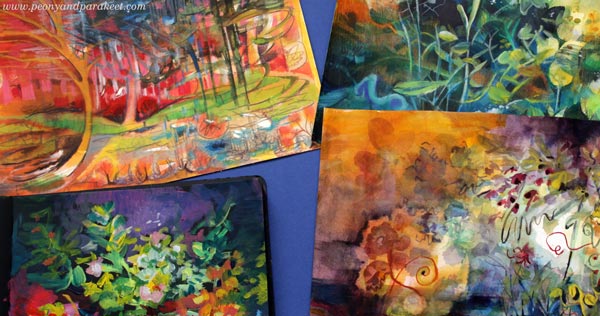
Liberated Artist Revisited will be published within a few weeks, but it’s likely to be a limited edition – only available for a limited time – so stay tuned!
Life After Death – Commissioned Art
This week, I have a commissioned art piece to show you. I have fewer words than I normally do – not only because the project is confidential, but also because this project went beyond words in many ways.

Last fall, I got a commission for this oil painting. It was ordered by a man in memory of his recently deceased spouse. We brought elements of the wife’s life and references to what she liked into the painting. The painting is, therefore, a secret portrait, from which loved ones recognize familiar things, but which do not need to be explained to strangers, unless they want to.
Commissioned Art – Sketch First
I started with a digital sketch. Here you can see the sketch and the final painting side by side.

I painted the sketch freely in the ProCreate app. The sketch is more abstract than the finished work and is more about the impression than the details.
Painting Process
After the sketch was approved, I ordered the canvas. The size of this piece is 50 x 40 cm (about 19.5 x 15.5 inches). Here are the first blurry layers.

I worked several sessions and let the painting dry for 1-2 weeks between the sessions.

The sketch helped with the painting process so that I could save my energy on the details.
Final Treatments
When the painting was finished, I photographed it outdoors. The natural light is wonderful now when Finland has a lot of snow, but the shoot had to be done quickly.

I varnished the painting with Gamvar after the photoshoot.

I like to think that varnishing was like giving a special blessing to the painting.
Spiritual Meaning
This project made my work as an artist feel even more meaningful than before. I learned more about what kind of artist I am.

I thought: “What could be a better assignment than building a bridge between life and death?”
What do you think?