
Writing About Art
This week is dedicated to writing about art. I tell how I write these blog posts, and why it’s beneficial to write about art.

See more pics of this piece in the Taiko online art store!
How I Write a Blog Post
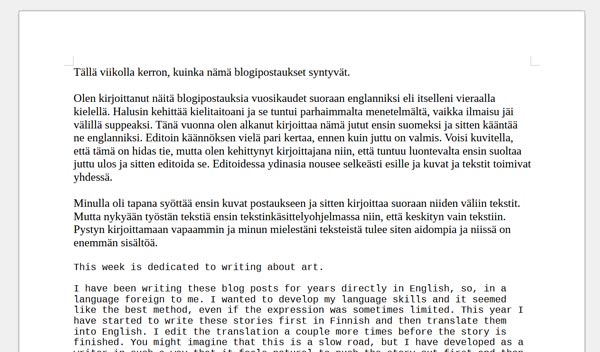
I have been writing these blog posts for years directly in English, so, in a language foreign to me. I wanted to develop my language skills and it seemed like the best method, even if the expression was sometimes limited. This year, I started to write these stories in Finnish first. Once the Finnish text is done, I translate it into English. I edit the translation 2-4 times before the story is finished.
You might imagine that this is a slow road, but I have developed as a writer in such a way that it feels natural to push the story out first and then edit it. When editing, the subject becomes more clear and the images and texts work better together.
I love the interaction between two languages.
When I write in Finnish, I’m already thinking about English. In Finnish, passive constructions and long expressions are used a lot. I’ll try to be more concise right at the beginning. Words and expressions also differ. In Finnish, I can easily get a relaxed and even humorous tone, but I can’t translate it into English, and neither can machine translators. However, I don’t mourn the matter, I think that the union of two languages is like a marriage: both have to give way.
Joyce Carol Oates talks about having a journal separate from the stories and novels. The journal could be more honest and raw, and use a little different style than what ends in the publication. For me, the Finnish script is a bit like that – a stream of thoughts that gets refined with edits.
The Relationship Between Images and Text
I used to enter the images into the post first and then write the texts directly between them. But these days I work in a word processor so that I only focus on the text. I can write more freely and the texts become more authentic and have more content. I can then fit the images between the text and add captions if needed.
Although I decide the topic of a blog post when I start writing it, most of the pictures exist before the text. I strive to always have new photos and I often plan the collection of images weeks in advance. Since this blog is about art and is aimed at visual people, I need lots of pictures. I want to inspire the reader to make art, so the pictures need also express the process, and not just finished works.
Writing Moves Art Forward
Nowadays, many have left blogging and moved to posting on Facebook or Instagram or uploading videos to YouTube. I too write regularly on my Facebook page and Instagram account. Every now and then I also make a video on YouTube.
But writing is magical. When you write a longer story, you don’t just write to others but to yourself too.
And I am not the only one who thinks that way. Last spring, I participated in an artist coaching program by the Finnish Art Agency, where the coach wanted us to write regularly about our art. She emphasized that working with words is important because visual artists often need to tell about their art.
Writing About Art is Almost Similar to Talking About Art
I believe that all who create art also want to talk about it. It’s just very difficult sometimes. Pictures go to the other side of the words and the ideas get mixed up.

Talking about your art can also feel like pompous boasting, even if the recipient would be interested. Long art stories can also bore the listener if she is not as deep in creating. The same applies to writing, you can feel pretentious or be afraid to bore someone, but when you write it’s easier to notice when you’re stuck and repeating yourself.
My art has not only developed by drawing and painting diligently. It evolves every time I write about it. It has developed by blog posts, manuscripts for classes, short video posts, and even description texts, where I have to briefly tell who I am or what inspired me to create a certain piece.
Writing brings out problems. You have to focus on what you really want to say and tell who you really are. There will be a temptation to find words that sound great but not say the truth. But if you can overcome the lure of meaningless words, creativity in you wakes up.

I have noticed that when I can put my wishes and ideas into words, they begin to appear in my paintings. Our creativity strives to fulfill our wishes if it can read them. So, that’s why I am writing about art weekly. Thank you for making me do that!
Do you write – or plan to write – about your art? Tell us more!
Now and Then – Development of Style
I started a grant project in October. The project lasts a year and covers half of my working time. I am making a digital artwork that can be experienced with virtual glasses. This will definitely give a boost for my artistic development, including the style as well.
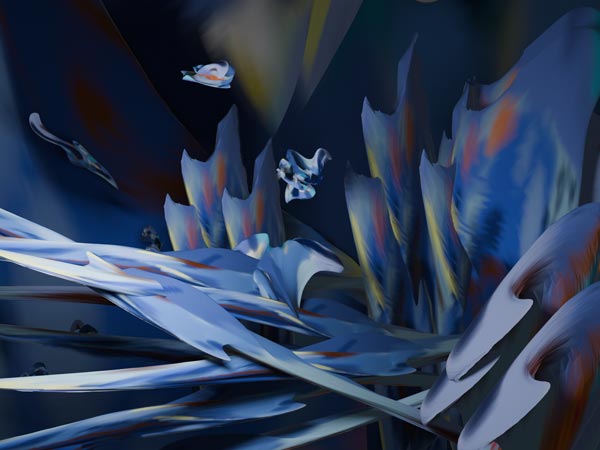
I used a fun sculpting app called Nomad and a 3D modeling software called Blender.
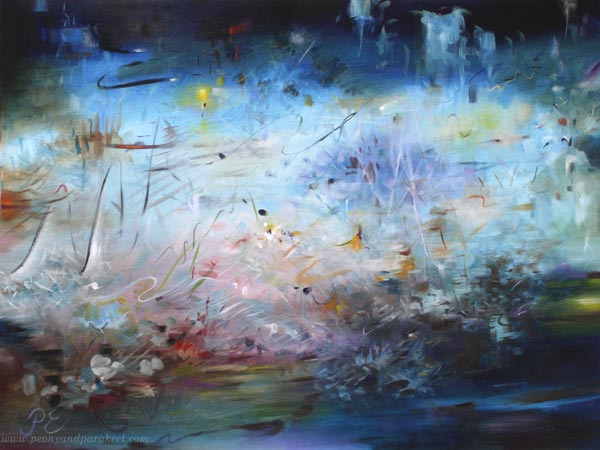
This image is based on replicating one shape only.
One of the recent practical changes is that I have given up using a Mac computer and bought a new Windows gaming laptop, which I call Turandot. I am now writing this blog post with her. She must have imagined that she would be owned by a young man, but no – she has a woman in her fifties. Turandot must have sounded like a great name to her, but after googling it, she might have been upset: Puccini’s opera! Well, she just has to adjust and learn my style.
Style Development – Looking Back
The new big project has made me think back and explain it all to Turandot. Ten years ago, I wanted to learn to paint so well that I would be satisfied with my paintings: “I could then die happy!” I thought that as an artist I had to abandon what I have been until then and build a new vision and a new world of my own.
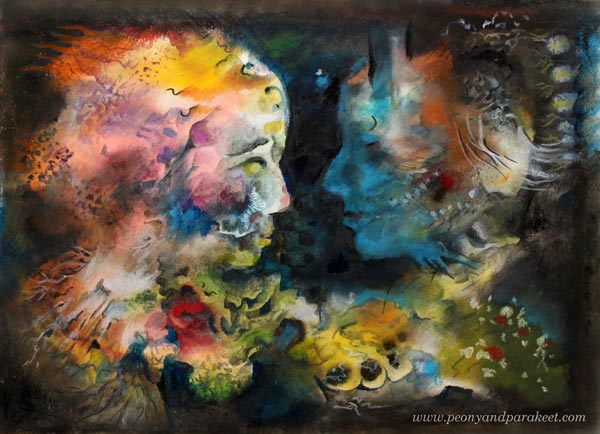
When my paintings started to reach the level I had hoped for, I felt first grateful and then empty. I couldn’t see forward anymore.
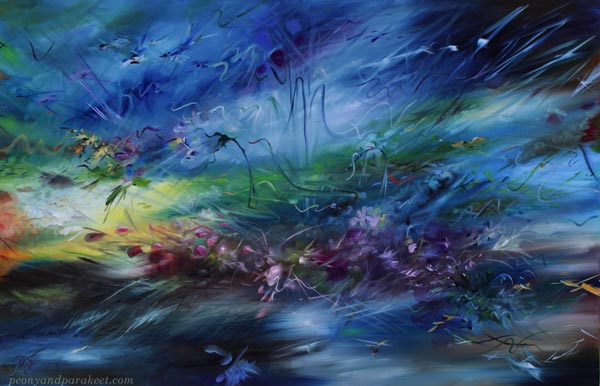
See the gallery of my oil paintings!
Now, however, I’m on the brink of something new again and the crises of the past seem strange: how was I so hopeless? Why didn’t I realize that everything meaningful that I’ve done in my life will tie into my art over time?
Always a Beginner
My artist friend said that I have developed quickly as an artist. However, it doesn’t always feel that way. I always have self-criticism and always notice things to improve. That’s why it feels frustrating now when I’m starting over again and building a three-dimensional digital expression. At the same time, I remind myself that the beginning of today is much further than the beginning 10 years ago – there is a lot that I already know and what I can already see, not only style-wise but in a more general level as well.
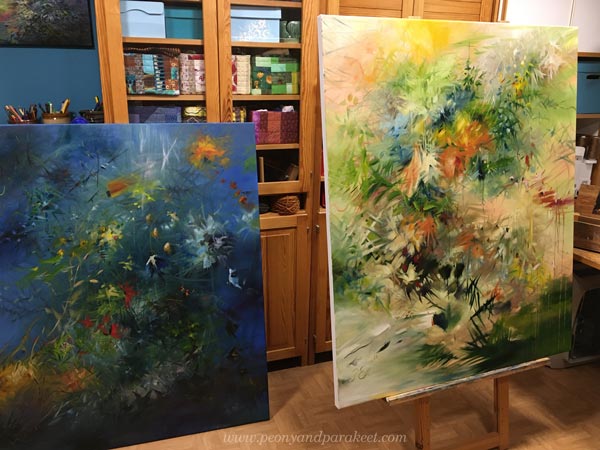
The balance between encouraging yourself and criticizing yourself is essential when making art. You have to be able to observe your pictures as if they were created by someone else and at the same time, you have to see forward – what all this could be and where it could lead when I will learn more skill and imagination.
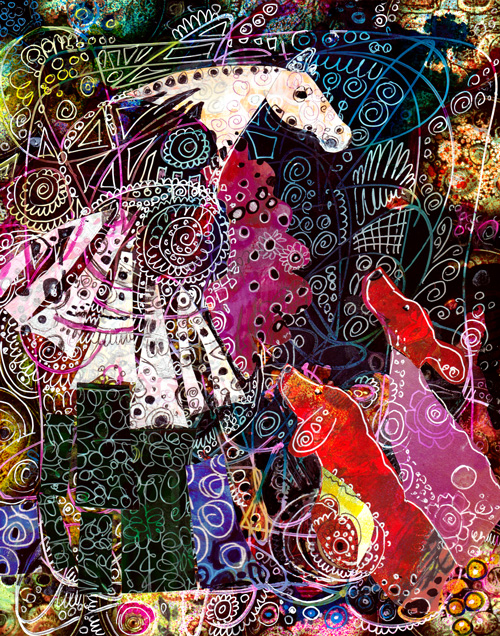
Fortunately, I haven’t listened to those who say that everything you do must be in the same style and form a unified experience. When you’re a beginner, forcing a certain style only leads to getting stuck at a level where you really don’t want to stay. When you’ve done enough, your own style pushes out naturally.
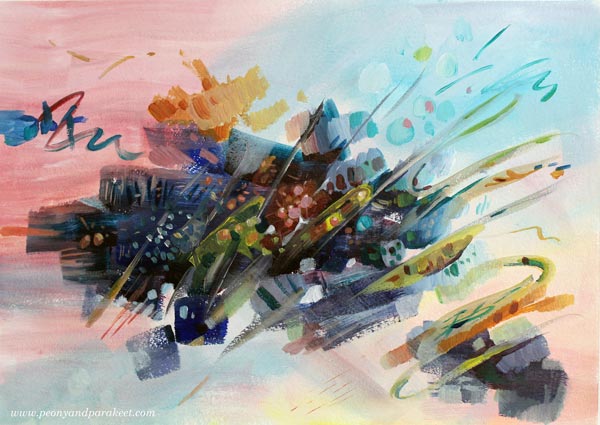
Yarn, Thread, Line, and a Telescope!
10 years ago, my line was clumsy and closed, while now it’s elegant and curious, like a telescope that lets me see beyond what I’m currently aware of.
I’ve always liked knitting and embroidery. Thread and line have a lot in common. That’s where my style started.
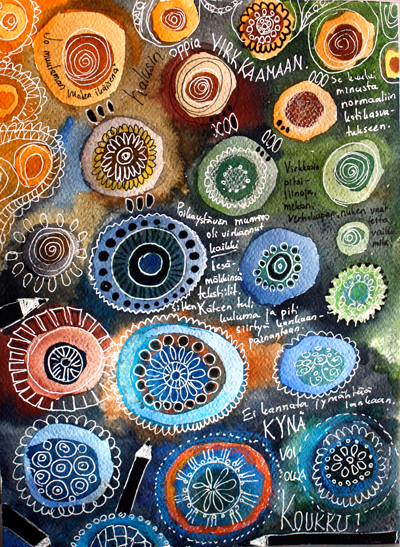
Collageland teaches this style!
Now my task is to continue developing my style and step into the world of digital art. However, I will still be drawing and painting next year, so there is no need to worry that this blog will change too much!
Romantic Watercolor Florals
This week is about red, pink, sugar, and cream – so, romantic watercolor florals!
I had a break from watercolor painting for a long time, but in the summer I started again.
Romantic Flowers and Chicklit
In summer, I had all kinds of complicated ideas for a new course, but my inner voice said:
- – What if we take out the watercolors and do something that hasn’t been done in a long time?
– Can I be a romantic?” my artist-me asked my educator-me.
– You can be as romantic as you want, as long as you work systematically and understandably, she said.
When the camera turned on, a short “Yippee!” went up inside me. Freely Grown was born, but watercolor painting didn’t stop there. I had been dreaming for a long time that I could do something lighter – like the writer Rachael Herron, who wanted to start her career with a profound book, but ended up writing a chick-lit novel. He noticed that chick lit is surprisingly challenging and realized that every genre of literature has its own difficulties.

Watercolor Flowers like Sweet Desserts
I’ve learned a lot of painting techniques with watercolors in the past and it can certainly be seen in my oil paintings. But in the summer I started to be interested in what I had learned while painting with oils and whether I could do vice versa – so, use it in watercolors.
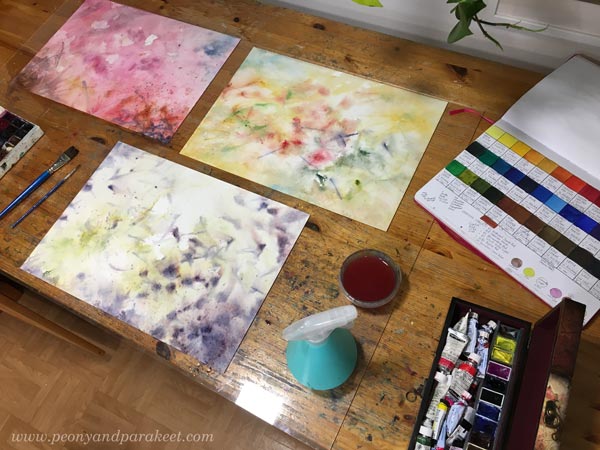
Now I didn’t want to do anything hugely abstract, but sweet flowery paintings. The kind that, if they were food, would have a lot of sugar and whipped cream in them.

An artist should probably only do fine dining, but this has started to resonate with me and it has also been nice to notice that there is a demand for it.
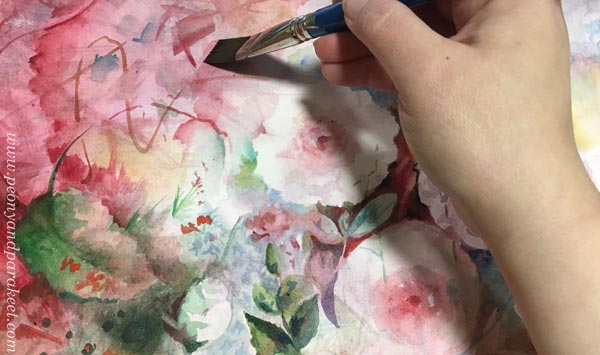
Even now, I’m making a small series for a gallery.
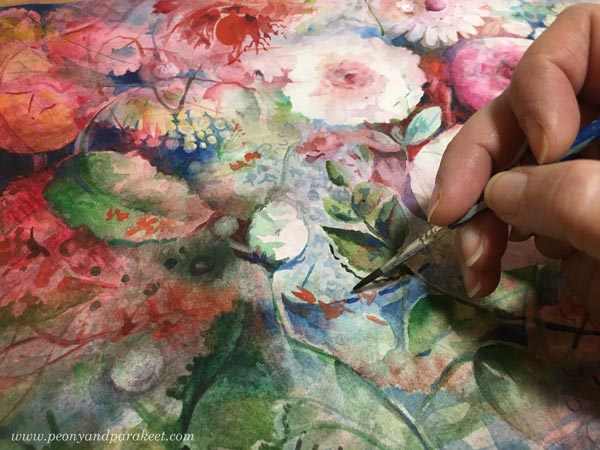
Those Who Won Winter
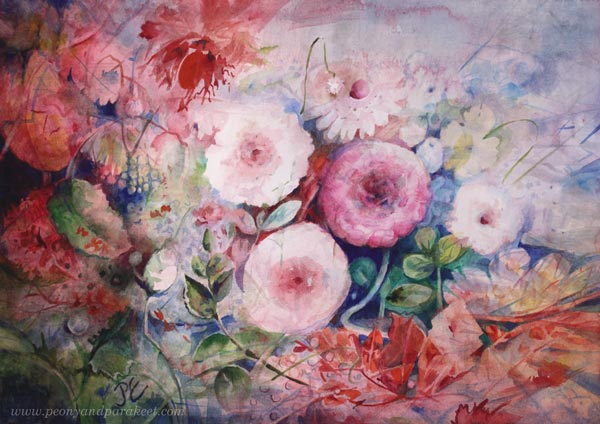
This red-hued Talven voittaneet is the first for the series of four. The name would be translated into English as “Winners of Winter” but it is not quite the same. The Finnish version is closer to the expression “those who won winter.”

My favorite part of this painting is unexpectedly the bottom right. I often leave the edges pretty undefined, but here the bottom part plays a key role. It has melting ice from which the flowers rise.

Imagine flowers winning the winter with their warmth – isn’t it such a lovely thought! I have really enjoyed making these kinds of romantic watercolor florals.
Flowers and Gala
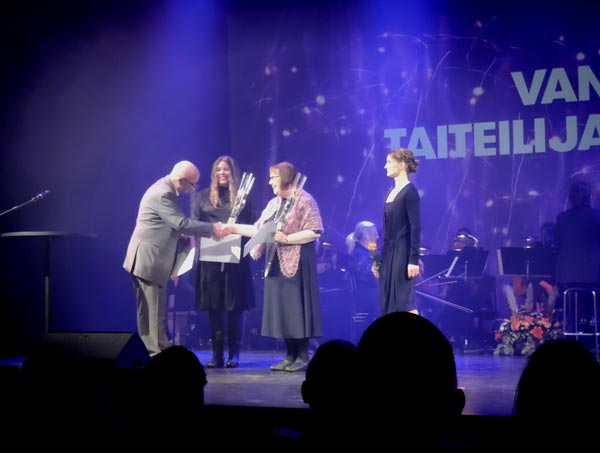
This week has been busy. I already received a grant from the city of Vantaa in the summer for my early autumn art exhibition, but it was celebrated only last Wednesday when the city organized a cultural gala.
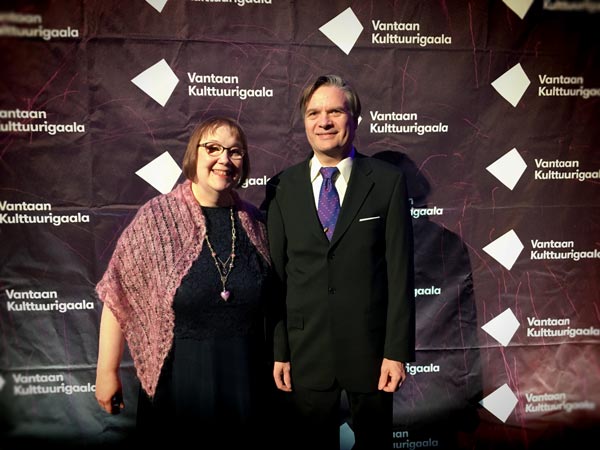
It was nice to be surrounded by respected colleagues. In the picture, a councilor Lasse Norres representing the city congratulates the visual artists. Päivi Allonen and Satu Laurel also received a grant and are there on the stage with me. They have wonderful paintings and I highly respect them both.
Have I mentioned that I love flowers? I think if you’ve been following me for even a little while you know that!
Romantic Watercolor Florals
At the moment, my small studio is a flower painter’s heaven and the flowers have free access there, even if I don’t use them directly as models. The flowers of my inner world may resemble the flowers of the outer world, but they have their own romantic life.
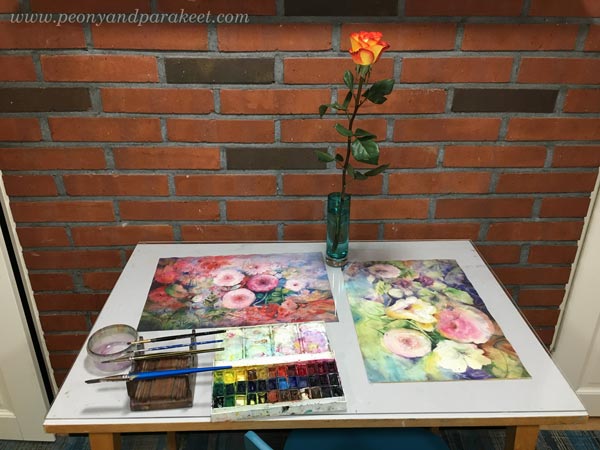
Nice creative moments for your weekend!
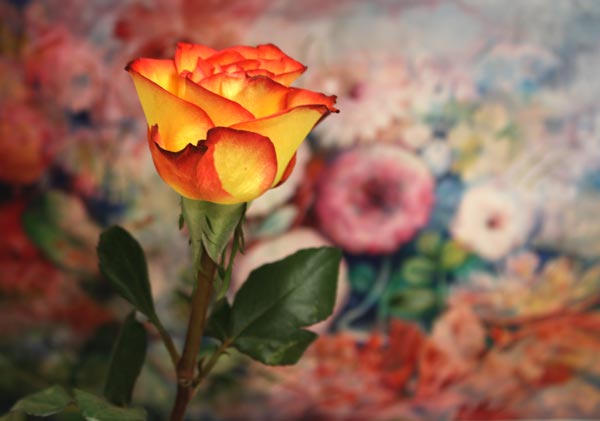
Watercolor Flowers in Louisa M. Alcott Style
This week, I talk about Louisa M. Alcott’s characters and painting flowers in watercolor.

They say that nature should not be humanized, but when I paint flowers, I do that without hesitation.
Splashes Start an Adventure
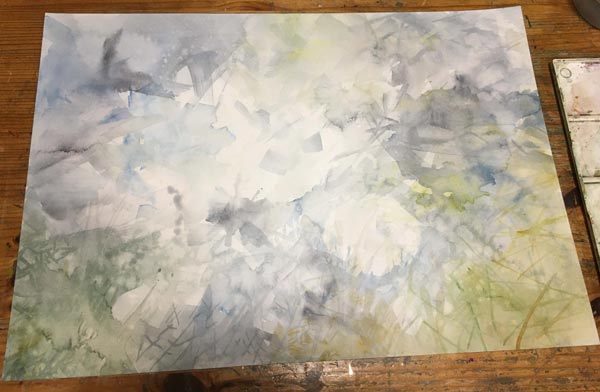
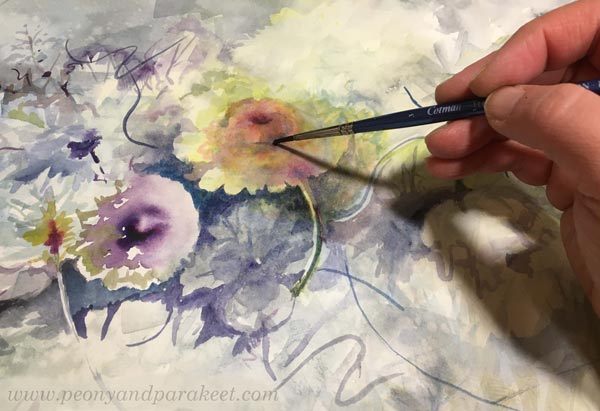
I love getting to know my flowers little by little. Their life begins with random splashes and I try to grow them as freely as I can.
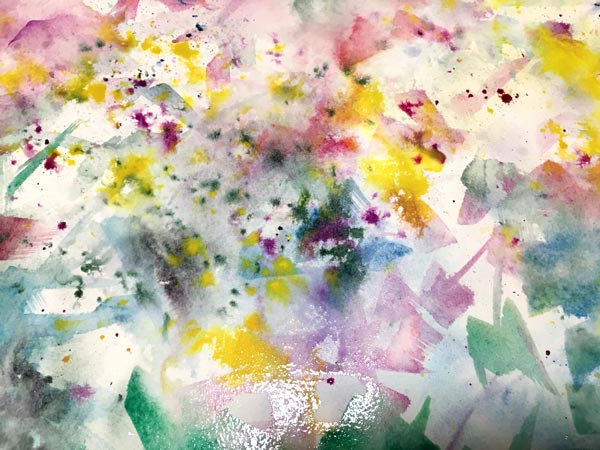
At its best, a painting is like a good book that hooks you into the atmosphere and cannot be left unfinished. It’s always exciting to see what kind of characters turn out on paper and what happens to them.
Little Women by Louisa M. Alcott
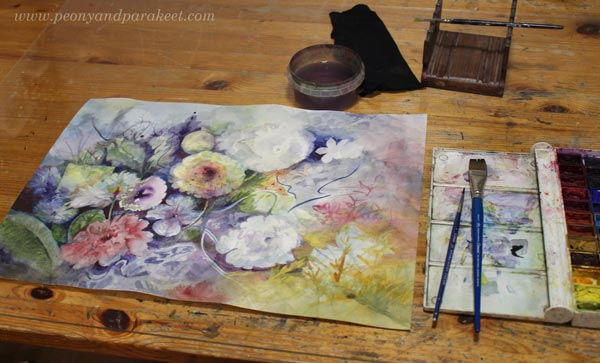
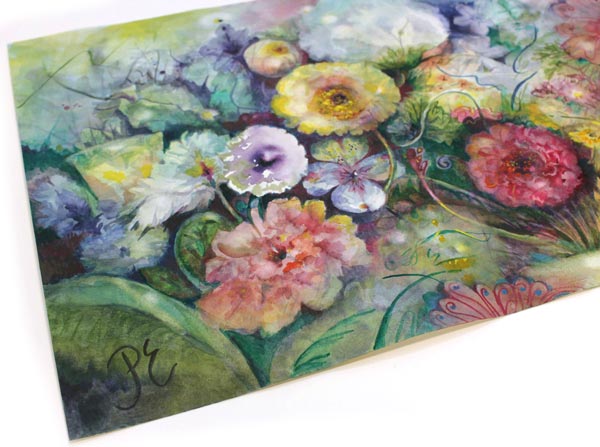
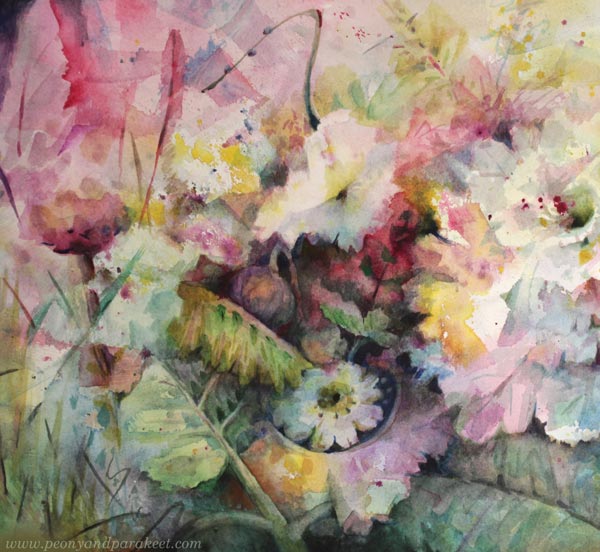
In this painting, the big peony was born first. She is a girl who is sure of her position, but always ready to hug and strengthen others as well. I was reminded of the novel Little Women by Louisa M. Alcott. Could that peony be like Meg, the big sister of the family?

And could there be Amy next to her, a growing beauty and sometimes a bit self-centric too?
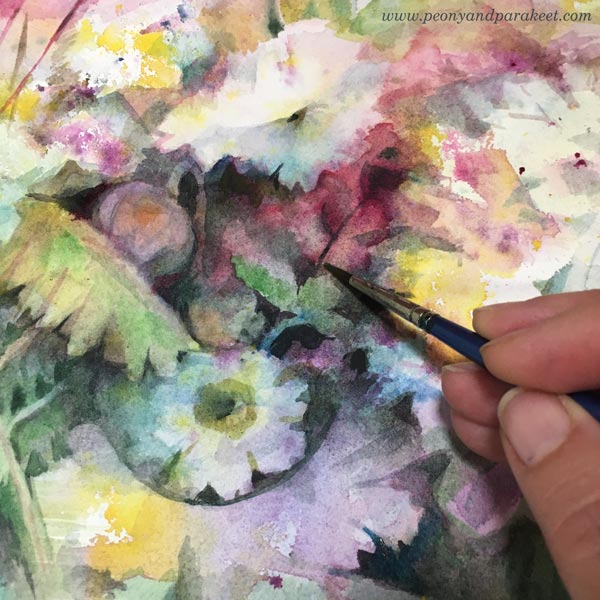
Right below white and glamorous Amy, there’s sweetly round Beth who left this world far too soon.
Painting the Atmosphere
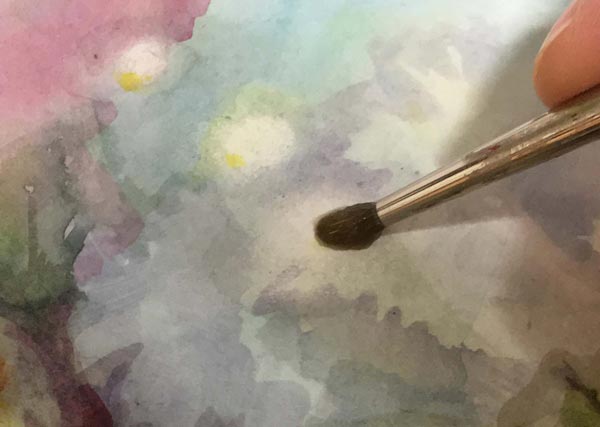
When the watercolor wets the thick cotton paper, I would like to invite you to my little studio and give you a thin brush. Together, we would then paint small shapes like writers working on a common story.

However, as everything in flowers does not have to be literal or recognizable, we could just focus on the atmosphere.
Jo the Tulip
The key figure in my painting is the tulip in the background. He is like Jo, unique and more modern than others, ready to create her life joyfully, but without being forced to the center of the painting. I admired Jo as a child, and it has taken me a long time to dare to be like her – step aside and do my own thing.

Somehow I also think that when you come to my course, you too want to be like Jo – do your own thing, express the flavor of life, embrace the abundance of nature, and allow unapologetic playfulness.
Freely Grown – Sign Up Now!
The course Freely Grown starts next week. I can hardly wait for it to start – join me!
Freely Grown >> Sign up here!