Peony and Parakeet

Fly to Your Inner World and Color the Emotion

Growing as an Artist

4 Big Misconceptions I Have Had About Creating Art

"My love for animals" - An art journal spread by Paivi Eerola from Peony and Parakeet.

I come from a family who always valued arts and crafts, but my parents and relatives were not artists themselves. I spent my childhood drawing and painting, mostly animals because I feverishly wanted to have a pet of my own. My ultimate dream was to become a visual artist. Now when I look back, I see big misconceptions that I had about art. These misconceptions are not rare or unique, I hear and see people talking about them all the time. So I wanted to tell how I currently think about them and what I would say to anyone who has the same experience.

"Hilppa's puppies". A line drawing by Paivi Eerola from Peony and Parakeet.

Misconception #1 – “Am I talented enough?”

People talk too much about talent when they talk about artists and art. I think the word should be banned, especially when talking about children and their creations. There are many other ways to encourage and admire. The problem about the word “talent” is that it implicates a thing that you can’t change in yourself – it’s there, or it’s not. Yes, some people are more visual than others. But there are so much more qualities that are needed for becoming an artist. For example, growing and combining ideas, and seeing principles and concepts behind real objects and events. Instead of just redrawing a photo of my beagle and her puppies in 2007, I could have put the warmth into focus and tell a bigger story about the unconditional love that I was witnessing at that moment.

If you question your talent, stop! Start learning how to process ideas, how to apply visual principles, and how to evaluate the quality of your work. The question implicates that you need to start learning and practicing! I love the ambition behind the question, but stop agonizing over it and start learning!

If you say, that you already are learning, but still question your talent, you are not learning enough on a higher level. If you are watching videos about someone painting, you also need to know the reasons behind the decisions the painter is making. You need to connect the theory with the actions. (That’s why I built the class Inspirational Drawing 2.0 – you will get not only the hows but also the whys)

Making a mess. Read about 4 big misconceptions about making art!

Misconception #2 – “All I want is creative freedom.”

Many years ago, when managing IT projects by day, I needed a creative outlet by night. I wanted to feel free, create loosely and make a beautiful mess. And so often, I only made a mess that didn’t set me free at all. When I was able to freely choose from the vast amount of art supplies, the beginning often felt suffocating. Then there was an agony in the end when I wasn’t able to be satisfied with the result. I added new layers after another and desperately tried to make it work.

There’s one big problem in creative freedom that I missed. To feel free, I needed the opposite. I needed limits and a direction. I didn’t need anything as defined or restricted as a reference photo or an image in my head. I needed to limit my supplies, my colors, and my feelings. As the work progressed I could have become more focused and experienced the freedom through the gained focus. Instead, I was overwhelmed by the choices.

If I could talk to myself now, I would say: “You don’t need freedom, you need to educate yourself in art. You need to explore what and how the master artists have expressed. That way you can find what’s your take on the big themes like landscapes, portraits, still lifes, and abstracts. Knowledge will give you the direction and set you free.”

There has to be a balance between creating and acquiring information. If you only make a mess, you easily invent the wheel again and again. On the other hand, if you only study art history, it can make you feel intimidated. However, knowing more doesn’t make you less unique. There’s no reason to avoid going to art museums, art galleries, browse and read books about art history (I often listen to art related audio books while creating). Understanding the background stories of artists and artworks, helps you to find your personal focus. (That’s why I sell Imagine Monthly Bundle 1 and Bundle 2 – so that you can connect dots between art history and your creative inspiration)

Paintings on the wall. By Paivi Eerola from Peony and Parakeet.

Misconception #3 – “Someday somebody will find me.”

When I started blogging over 10 years ago, I thought that someday someone would get in touch and say something like: “Hello, I am a hugely famous art critique, and I would like to buy your art because it’s so fabulous.” Not probably in those exact words, but you get the idea. I also wished that there would be a lot of people visiting my blog and admiring what I had created. But there were practically very few people visiting my blog even if blogs were very popular at that time.

The best thing that I did back then was that I started following business people. Many recommended setting up an email list. It felt awkward enough to blog, so it didn’t feel natural at all. In 2010, I decided to trust the advice and sent my first group email to 9 subscribers. Even if they had deliberately subscribed my emails, I felt like I was spamming the world. After a year and seven more emails, I had 95 subscribers. I still felt like a spammer, but because the number was growing, I couldn’t stop either. By blogging and sending emails regularly, I got more subscribers, and my feelings changed. Sending the emails felt more like a service than spam, and in 2014, I started posting them weekly. (If you are not a subscriber yet, subscribe here!)

When I write my weekly emails, I don’t write to “hugely famous art critics.” I write to my soul-mates who love art and are always eager to learn more. I write to people who want to explore all kinds of approaches to art and who want to share the enthusiasm and ambition behind all that.

If you are waiting for somebody to find you, make sure that you also do the work. Being consistent and learning business and marketing means a lot. But there’s also one more misconception that I want to bring up that relates to this one.

The Modern Woman, a watercolor painting by Peony and Parakeet.

Misconception #4 – “Images are enough.”

Let’s get back to the time when I started blogging and was hoping to get more readers. Well, yes “readers,” even if I wrote very little. I thought that images are enough. If I made a picture pretty enough, where would I need the words? Do I even have to say my real name “Paivi Eerola,” isn’t “Peony and Parakeet” enough?

But we need the names, the words, the faces, the stories to get connected with people. It’s scary and difficult, but it’s also necessary. As artists, we need to make the process visible. We need to make the knowledge that we have gained visible. We need to open our minds and tell what we feel when we create. We need to tell how our creations can relate to the viewers as well. Even old master painters still need the words. The museums organize guided tours and offer audio guidance through headphones. There are books and biographies. The sad truth is that many of the artists who died undervalued didn’t use enough words.

There are also other things that we need to include than just words. These are the ways we photograph, exhibit and handle our art; the way we show joy about what we have created; the way we participate and include people in discussions rather than staying silent. I refuse to call all that with the word “marketing” because I think it’s much larger than only that. It’s about growing your artistic identity where you can spread your passion and where you feel the need to do so. Then it’s more than about your images – whether they are “good enough” or whether you are “talented enough.” It’s about using art as diversely as possible to connect with people. It’s a good cycle to build, as these connections also improve your art.

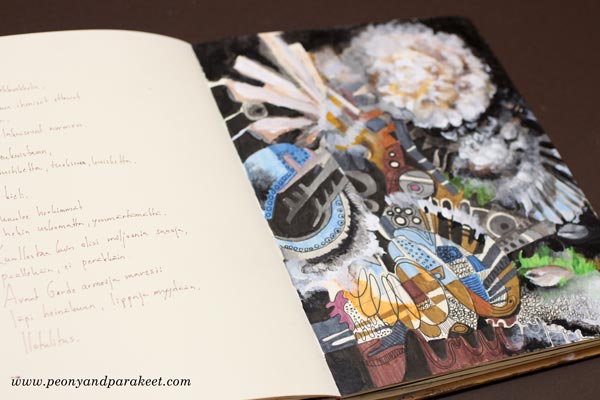
A Finnish visual artist Paivi Eerola from Peony and Parakeet and her art journal.

Check out my new coaching program “The Exploring Artist” for building belongingness, making art that matters, and strengthening your artistic identity! >> Sign up now!

Technique, Style or Identity – Which Comes First to You?

A detail of Gypsy Madonna, an oil painting by Paivi Eerola from Peony and Parakeet

Technique

During the recent ten years, I have wanted to learn and experiment with art techniques. It has been fun to combine all kinds of media and see what comes out. And even when using one medium only, techniques have been important to me. Like recently, when I have learned to paint like the old masters. But with techniques, come the rules: first this, then that. It feels safe at first, but then, it can also be too restricting.

A detail of Vincent van Gogh inspired art journal spread by Paivi Eerola from Peony and Parakeet

Style

To me, the personal style means something that I am comfortable with doing, and that makes my work recognizable. But for a long time now, I have felt a sense of sadness when people say that they want to find their voice. One of my favorite creative play has been to play with styles. Being very intentional about the style issues can take the play out of the game.

Hand-drawn collage art by Paivi Eerola from Peony and Parakeet

Identity

The more I have tried to focus on techniques or style, the more I have thought about the third thing, the artistic identity. I tried to keep all that inside me, but I am not very good at hiding things, so I was about to explode before finally, in the last month, I wrote on Facebook:

“Style or Identity? – Even when working full-time as an artist, I sometimes still have problems in calling myself an artist. I wonder, why there’s so much talk about finding your style and so little about finding your identity as an artist?

It includes me too. I often talk and think about style issues when I should think about identity issues. It’s easier to analyze the line, the theme, the mark making, than talk about things that go deeper.

I mean things like:
1) Why do you make art?
2) How do you define the quality of your art?
3) What’s your role in the art community?
4) What’s different with you from the artists that you admire?
5) When and how do you know that you have succeeded as an artist?

Most of these questions are valid whether you are a beginner or more advanced. The answers change when your journey progresses.”

When your order is 1) identity, 2) style, 3) technique

you allow more play,
you take on bigger challenges,
and you connect more with other artists.

Stay tuned for a new challenge-based coaching class to grow your artistic identity!

Paivi Eerola from Peony and Parakeet with one of her paintings in progress. Read more about finding your style in art!

This post is a sample of my weekly emails. Subscribe here!

Have You Ever Felt Like an Outsider?

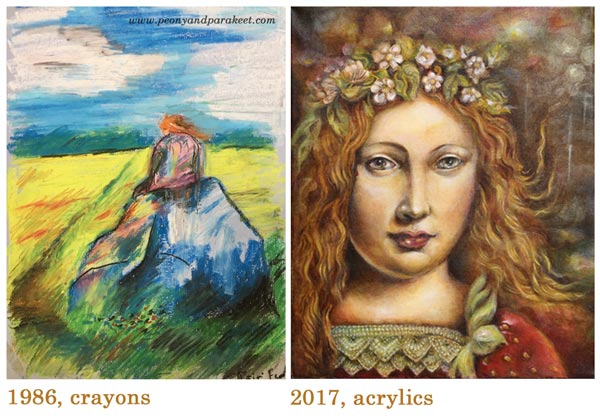
Gypsy Madonna, an oil painting by Paivi Eerola from Peony and Parakeet, combining two Renaissance paintings into one

I have finished a new oil painting called “Gypsy Madonna.” I painted it at Emmi Mustonen‘s class during this spring while learning more about old masters’ painting techniques. It took about 42 hours from start to finish and about four months in calendar time. Every thin layer of paint had to dry before adding a new one. I show you some phase photos, but I focus on the deepest thing that I learned from this painting: feeling like an outsider and what to think about it.

The Basics of the Painting Process

My Gypsy Madonna combines two Renaissance paintings: Boccaccio Boccaccino‘s Gypsy Girl and Leonardo da Vinci’s Lady with an Ermine.

By Boccaccio Boccaccino and Leonardo da Vinci

First I was just on a mission to get better with the painting technique.

Making of a Gypsy Madonna using old masters painting techniques, by Paivi Eerola from Peony and Parakeet

Then I wanted to play with the setting and discovered several stories that could be told through that (some of them are in this blog post).

Making of a Gypsy Madonna using old masters painting techniques, underpainting, by Paivi Eerola from Peony and Parakeet

Experiences of Being an Outsider

One day during the painting process, I remembered a childhood memory of a real gypsy girl. The local library had a weekly hour for children to listen to fairy tales and to play together. We were playing a game where two of us danced in the middle while others were watching. There were a lot of children, all waiting for to be chosen. Someone picked me, and we danced in the center of the ring while others were cheering.

Then it was my turn, and my friend Anne almost stepped up. But I had seen a sad gypsy girl sitting there, head drooping. She knew that nobody would pick her up. It was one of those games that would only depress her. It broke my little girl’s heart to see her sadness. I just had to do it, leave Anne sitting and ask the girl to dance with me. I never forget that smile when we were swirling around. It may have been the best thing that I have done in my life so far.

Making of a Gypsy Madonna using old masters painting techniques, finishing, by Paivi Eerola from Peony and Parakeet

When I continued painting, it was suddenly me in the picture. I became the gypsy girl who gently scratches her pet. The outsider who never got children because she was much more enthusiastic about her love for animals. The outsider who was the only girl in most of the classes when studying technology. The outsider who dreamt about art while trying to tackle the more practical career. There are so many moments when I have felt like a black Madonna, not quite fitting in.

A detail of a Gypsy Madonna, an oil painting by Paivi Eerola from Peony and Parakeet, combining two Renaissance paintings into one

Everybody Is an Outsider

To me, the finished image symbolizes the beauty of choosing differently, being different. Even if I know that it’s perfectly ok to be different, the painting helps me to connect with the feeling on a deeper level. It makes me empathize with other people as well. Everybody is an outsider despite their personal story. We all belong to a minority in some ways. We are all Gypsy Madonnas in one way or another.

A detail of Gypsy Madonna, an oil painting by Paivi Eerola from Peony and Parakeet, combining two Renaissance paintings into one

Have You Ever Felt That Nobody Understands Your Art?

To be honest, I feel shy about showing this painting. It’s not what I usually create, and I have shared some very personal stories. It has crossed my mind for several times how you, as a reader of this blog, might feel confused: “Is this what Paivi is creating nowadays? Is she going back to the Renaissance age?” I have also feared that the dark colors of the painting will make you want to stop reading. But on the other hand, I don’t want to stop exploring. If you don’t explore, you are unable to integrate new things into your creative work. Pablo Picasso has said: “To copy others is necessary, but to copy oneself is pathetic.” So no wonder if there are times when nobody understands what you are creating!

It’s also difficult to grow artistic identity when a part of that experience is feeling like an outsider. When you start creating art, you want to find your personal way to do it, but those discoveries can also make you feel lonely sometimes. This contradictory has caused me to challenge myself. I want to be better at not only understanding my personal feelings but also supporting other artists in their explorations. In the end, we are all on the same journey. We are standing together on the border of art and the rest of the world, expressing the same view through different eyes.

Paivi Eerola from Peony and Parakeet, with Gypsy Madonna, one of her oil paintings. Read her blog post about feeling like an outsider as an artist and how to get through it!

Stay tuned for my new class for building belongingness, making art that matters, and strengthening your artistic identity! The registration will open in May!

4 Social Tips for Improving Your Art – with The Students of Peony and Parakeet

Student artwork from the class Planet Color. Tina Mitchell, Nicaragua.

This blog post is mostly illustrated by the students of the online painting class Planet Color. I am rerunning this class from April 24th to May 7th! Join me to paint fun abstract and colorful art! Suitable for beginners. Sign up before the class starts!

Social Tips

I call this set of tips “social” because instead of just talking in design terms like “white space” or “focal point,” I want to emphasize that art is a messaging tool. We, visual people, are sensitive to visual messages. Every image contains them whether they are added intentionally or unintentionally. As a teacher, I see my role as a guide who helps you to see what your pieces communicate and how you can fine-tune them to express the message that you want to deliver. In this blog post, I explain why beginning artists fail in visual communication and how to fix that. These social tips with sample images will improve the quality of your art!

Colorful mandalas by Paivi Eerola from Peony and Parakeet. Read 4 social tips she has about creating art!

1) Bring Out The Leader, Express an Opinion

One of the things we all struggle the most is expressing an opinion. Even now, while I am writing this blog post, I am struggling with that. When I type the first few sentences, I become aware of all of you who might not like this post. I think of you who feels that you are more of a crafter, not a painter. And of you who thinks that this is too basic and you are far ahead. I am aware of you who likes fewer images, as well as you who don’t ever read a thing. Some images might look too dark or too white to your taste. Or you might not even like or value abstract art. What makes the writing even more difficult is that even my personal taste and opinions change over time, sometimes on a daily basis. And then I begin to think that who am I to write about this anyway. There are always people who know better and whose opinions could be more valuable.

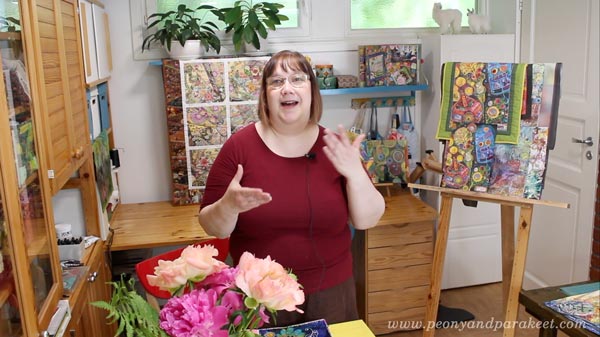
Paivi from Peony and Parakeet browsing art journals.

It’s so easy to walk on that path of self-doubt and then rewrite the whole thing so that it actually says very little, nearly nothing. I might still remember the real meaning of the words myself, but you might not get anything to take with you.

The same thing happens easily in art making too. By making every detail equal in size, sharpness, and color, we end up expressing something that’s nearly nothing. It’s just a gang of evenly spread elements waiting for a leader to be picked. But when you do that – choose a leader, express an opinion, say something with clarity that can make people take sides – then the impact is also born. See how Elaine Wirthlin does that in her painting!

Student artwork from the class Planet Color. Elaine Wirthlin, USA.

2) Build Bridges, Don’t Stay Alone

When I saw a room full of Vincent van Gogh’s paintings in Musée d’Orsay, I was in tears. Yes, the original paintings were much more than what you could expect based on the photos and prints. But there was another reason too. I was crying because the room was packed with people. Knowing how lonely Vincent had been, it felt heart-breaking. Surely, if there had been social media at his time, he would have got his fan base! A small group of forward-thinkers, perhaps.

I don’t think loneliness is good for anyone. Don’t get me wrong – I am all for introvert lifestyle. Being an introvert myself, I wouldn’t dream of reducing my quiet, creative moments. But in the end, being isolated and expressing isolation is never a solution. Sometimes we are in the wrong place at the wrong time like Vincent did, but with the internet, there are soul-mates for everyone. With your art, you can build connections, not enforce divisions.

A detail of a mixed media painting by Paivi Eerola from Peony and Parakeet.

When being interviewed after a long career, Finnish opera singer Jorma Hynninen said: “All artists want to connect with other people through their art.”

Images that include bridges and closeness make us feel happy. In Sue Jorgensen’s work, I see the message how different personalities can work and move on together.

Student artwork from the class Planet Color. Sue Jorgensen, Australia.

3) Play with Many Identities, Become Free of Limitations

When I became more serious about art, I questioned my love for crafts. One of my crafty hobbies was scrapbooking. I took photos and wrote stories about my everyday life. Sometimes I challenged myself to journal and sometimes, I let the photos and the decorations tell the whole story like on the layout below that shows the four seasons by focusing on trees.

Four Seasons. A scrapbooking layout by Paivi Eerola from Peony and Parakeet.

“An artist who also scrapbooks” sounded like a big joke to me back then. But the more ambitious I have become in my art career, the more I have learned to value other things that I do, scrapbooking included. After a long workday, it makes me feel free to take the dogs for a walk and listen to scrapbooking podcasts. After using embellishments and photos, it makes me feel free when I pick up my brushes and work with canvases, without limiting myself to the concept of scrapbooking.

One person can wear many hats. Some people might have seen you only wearing one, and their opinions about you only relate to that. However, don’t let it limit and define yourself in the other areas of life. People who knew me as an IT project manager saw a different side of me than you who reads this blog. I may have inherited my detailed style from the engineering part, but there’s so much more that I want to express and play with, than one chapter in my past.

An art journal page spread by Paivi Eerola from Peony and Parakeet. She has a class called Planet Color for painting colorful abstracts!

Susana König’s painting reminds me of IT business and how it’s all teamwork too!

Student artwork from the class Planet Color. Susana König, Germany.

In Debbie Kreischer’s painting, the decorative style can take a more expressive twist, showing how things are not so black and white after all.

Student artwork from the class Planet Color. Debbie Kreischer, USA.

In Lisa Clemmer’s painting, the colors are soft, but the shapes are dynamic. This controversy makes it compelling.

Student artwork from the class Planet Color. Lisa Clemmer, USA.

Linda Thompson’s painting has playful colors and the dynamics of a fun game.

Student artwork from the class Planet Color. Linda Thompson, Canada.

Lois Dimler’s painting is like a happy circus where everybody has fun!

Student artwork from the class Planet Color. Lois Dimler, USA.

4) Listen to Others, Let It Inspire You

I have always been an idea person. I invent new things quickly and have always been eager to find all kinds of unique approaches, also in art. However, I have also noticed that we often overestimate the uniqueness and the originality of our first ideas. But when we start combining many ideas into one, the result can be something new. My idea of drawing your own coloring page is not that unique but the way I have colored it gives it a modern twist. (Also read: How to Transform Ideas into Paintings)

Paivi from Peony and Parakeet with her art journal.

It’s not good to try to protect yourself from seeing what others do. We consume all the time anyway. If not art, then something else. Listening to other people, seeing other people’s art and getting to know art history is not a threat but an enabler to your personal style. Sometimes it can be a real eye-opener to create from a similar standpoint with somebody else and then compare.

Student artwork from the class Planet Color. Meri Andriesse, USA.

Compare Meri Andriesse’s and Pirkko-Liisa Mannoja’s paintings above and below! They have many similarities, but their style is different. Meri’s piece is soft, carefree and modern while Pirkko-Liisa’s is strong, detailed and historical.

Student artwork from the class Planet Color. Pirkko-Liisa Mannoja, Finland.

I love people who speak enthusiastically about what they have done. Even if they would talk about something that I would never even want to try, like deep-sea diving, it’s fascinating to hear how they express their experiences. While listening, I imagine the places that I would explore if I were that person. It gives me ideas that I wouldn’t ever have found by myself.

We never know enough about art history, other artists, other people, other fields of expertise, other anything! Artist’s mindset is being an immaterial collector – collecting thoughts, stories, visuals, any ideas and then expressing that inspiration. By developing the ability to see nuances in other people’s talk and work, you will also begin to see what’s unique about you.

What tip would you give?

Paivi from Peony and Parakeet with her abstract painting made for the class Planet Color.

Planet Color is available as a self-study class: Buy Now!

Scroll to top