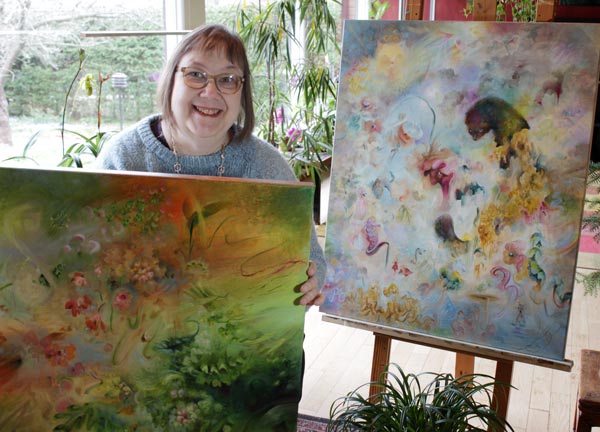
Ikigai – Making Intuitive Painting Feel Natural
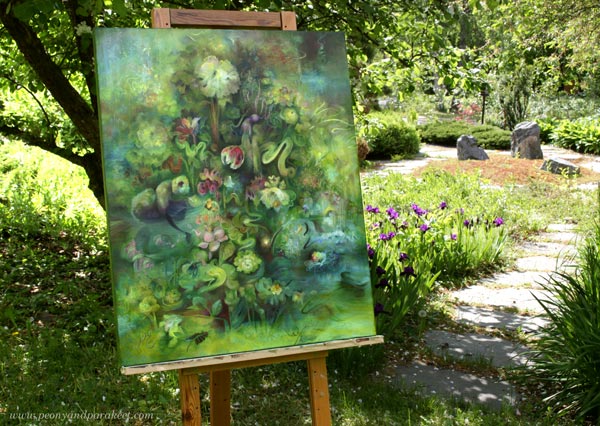
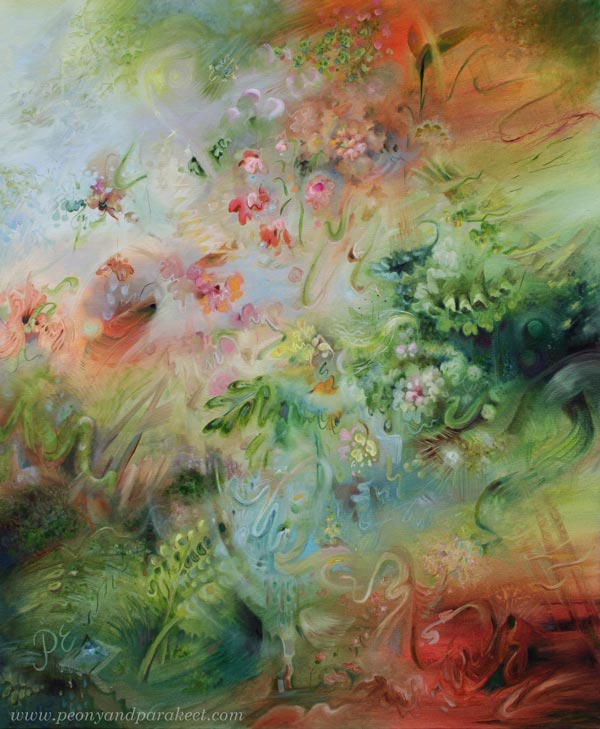
This week, I show you my newest oil painting, ‘Ikigai,’ and talk about how intuitive painting can become logical, and how a logical painting can feel natural.
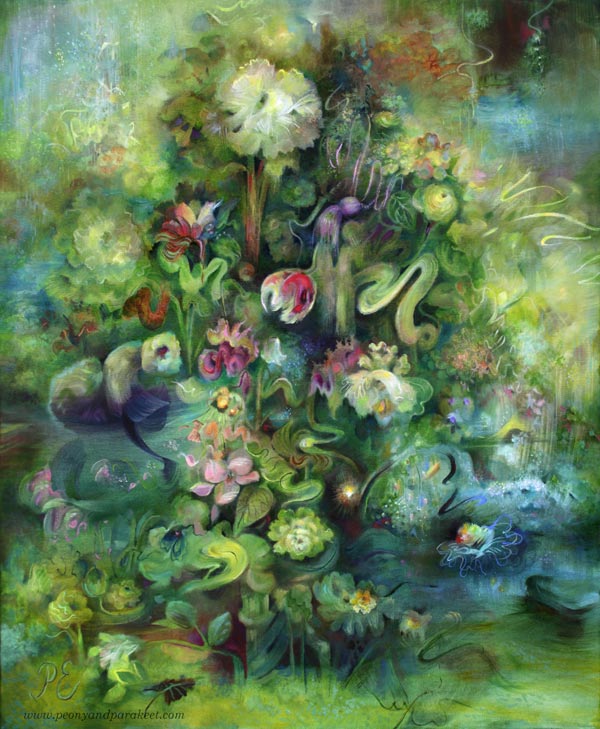
There are many extraordinary elements in this painting, but it still feels quite realistic and natural.
Find the Guiding Element
When you create intuitively, the first layers get all kinds of random details. After that, it is about:
- What to save
- What to tone down
- What to highlight
- What to hide
- What to add
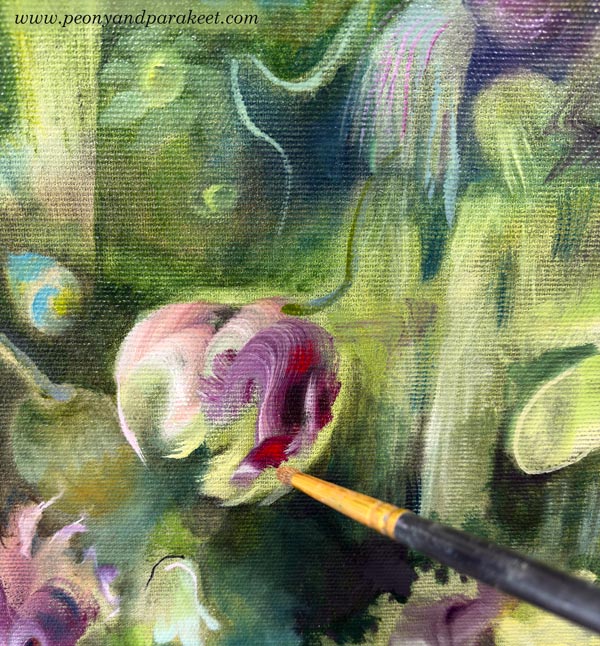
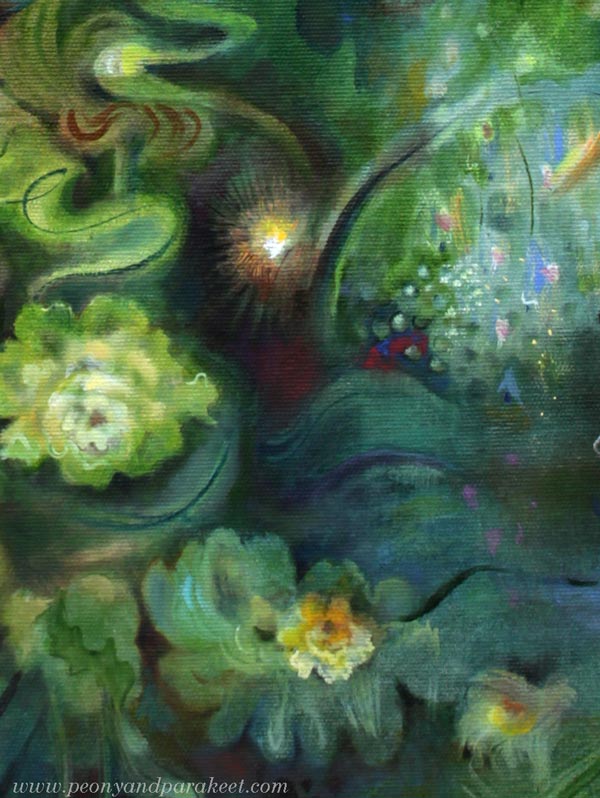
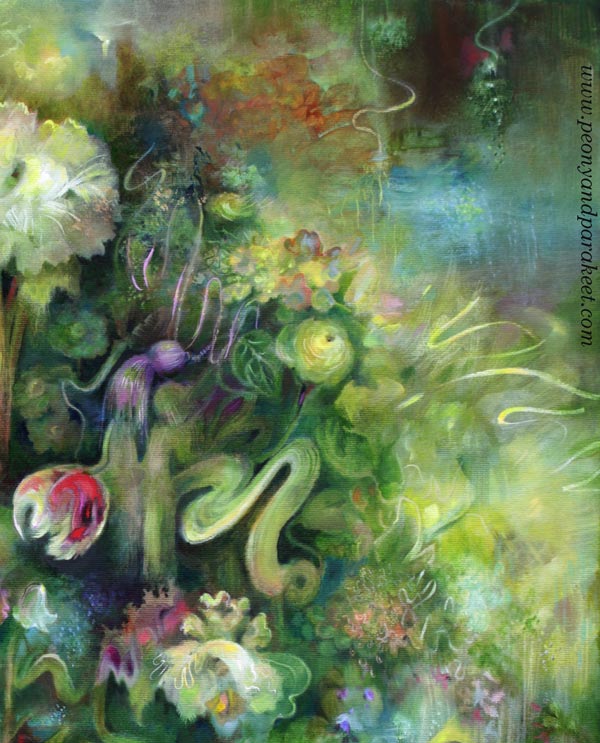
In Ikigai, I looked for an element where the canvas had already come to life as a painting. When I found it, I protected that pulsating spot so that its spirit spread and a small world grew around it.
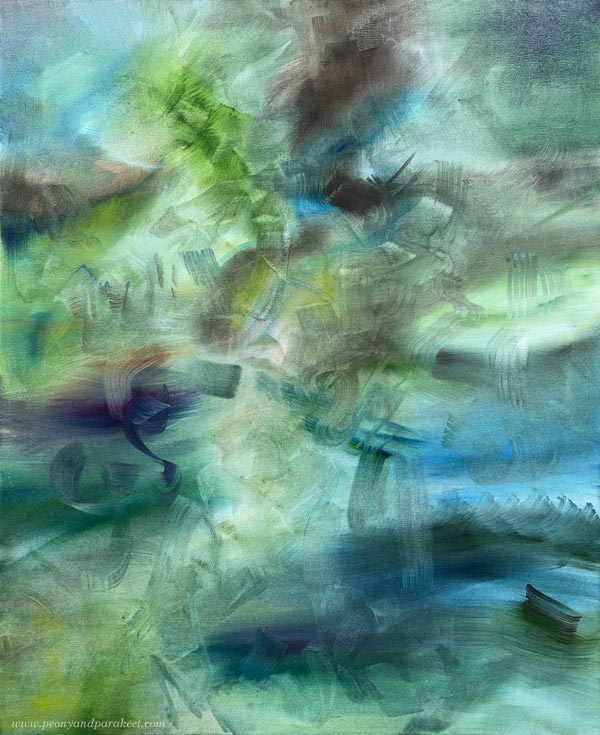
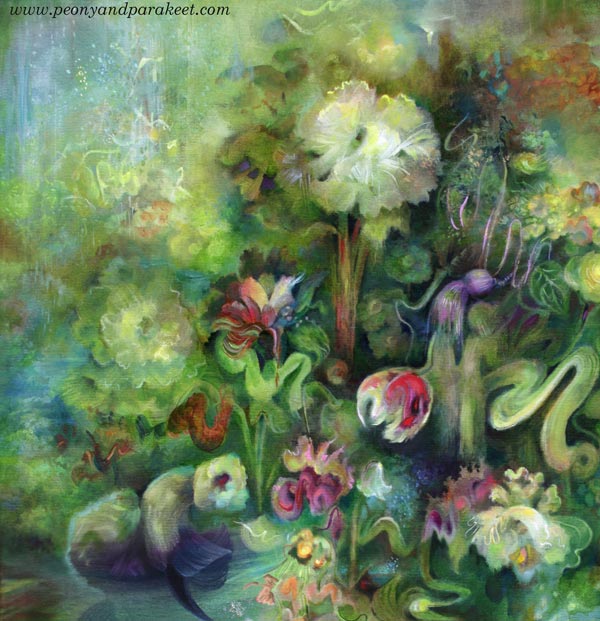
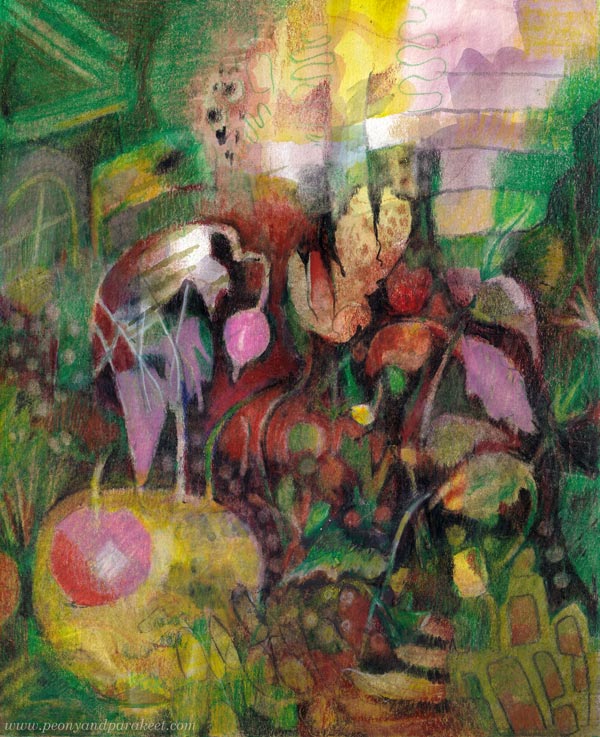
Can you already guess what element guided me through the whole painting? The picture above is the first layer, and the picture below shows the painting in progress.
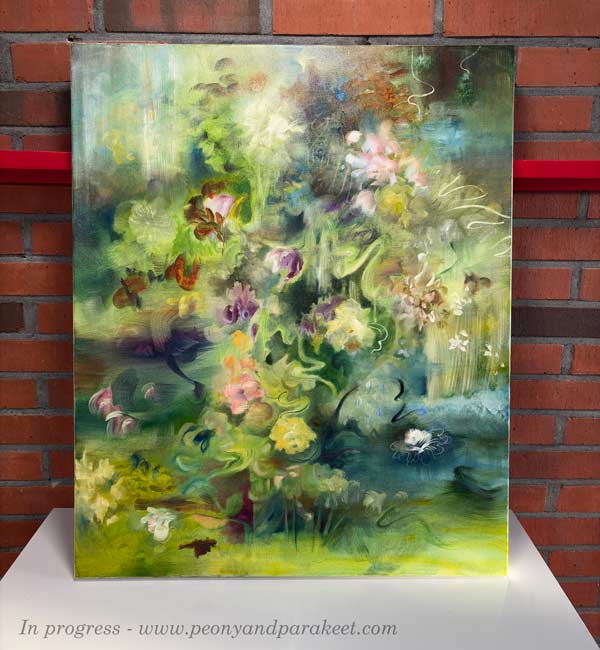
Intuition is like a whisper that can expand into a stronger sense of presence. That requires time and skills, but also logic.
From Writing a Course to Painting a Picture
Lately, I have been writing a script for a new course (some info). The more courses I make, the more I realize how important the script is. Having a script doesn’t mean I cannot choose my words freely when speaking to the camera. It also does not stop me from throwing myself fully into the drawing exercises while the camera is rolling.
Course videos include many different elements: theory, examples, explanations of the process, and reflections on artistic thinking. All of this needs a good rhythm. I need to know what I am saying and how freely I am speaking in different parts of the videos. My goal is to build a logical educational structure behind the course, without forgetting the human side of making art. I want my courses to be inspiring, entertaining, and encouraging, but also educational, so that you will move forward in your art-making.
Painting is very much like making videos. Even if you didn’t sketch beforehand, you still need structures and ways to connect single elements into a whole. You need both technical and expressive skills. It’s also beneficial to be able to see what is essential and to understand the role of logic.
The Logic Makes the Magic
When a painting is logical, it feels natural. Logic in painting does not mean that the picture has to be realistic. Instead, it means that there is interaction between the elements. For example, a weak line can humbly take a curve to go around a strong dot. Or a bright line can send small rays of light over nearby shapes, changing their color. The interaction ties everything together.
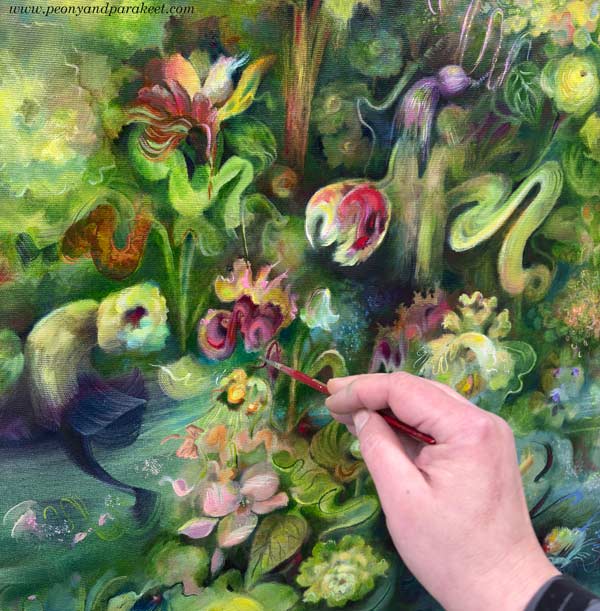
Even a static image can feel alive. At its best, you can look at a painting like an event. It’s fascinating how interaction makes the unreal elements feel real. Being able to express ourselves freely on paper and canvas is one of the best things in life.
Details of Ikigai
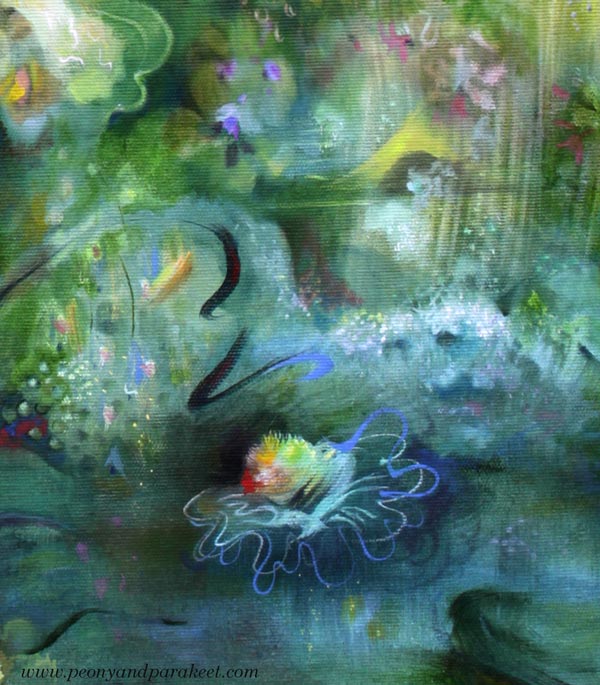
Here’s the guiding element in my painting. I have made some additions to the original strokes, but the spirit is the same.
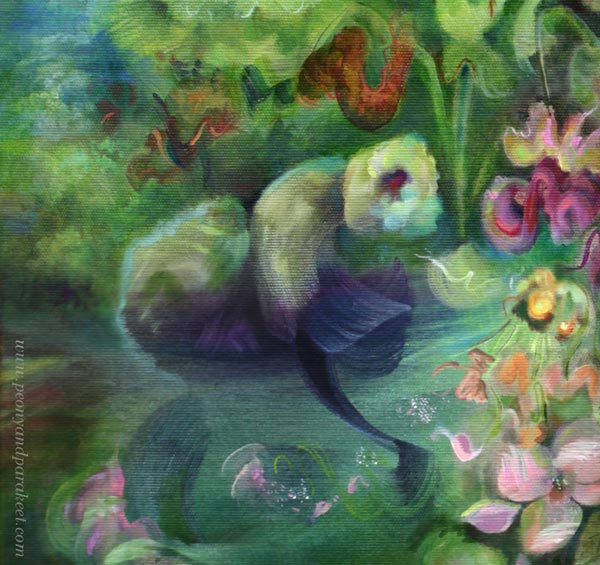
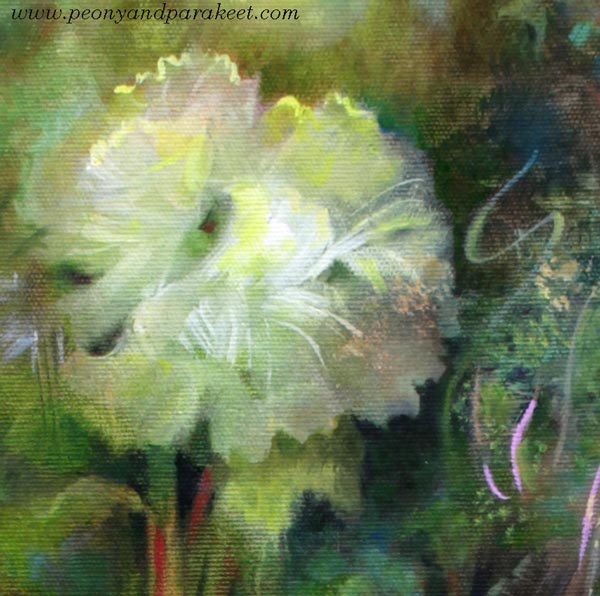
I have noticed that in my paintings, the guiding element is rarely a focal point. Here’s the focal point – the tulip and her two red friends.
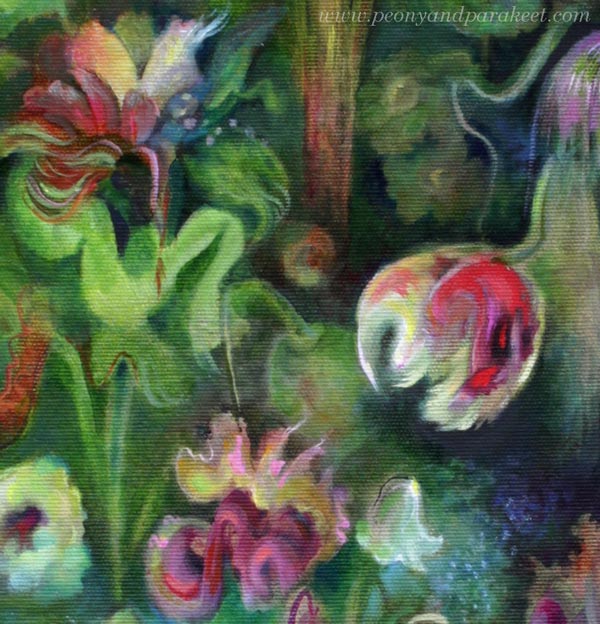
Ikigai – a reason to live, a reason to wake up in the morning. According to this Japanese philosophy, we should orient ourselves toward the point where our passion, mission, calling, and profession meet. I feel like ikigai is condensed into the exact moment where night and morning meet.
In the morning, deep reflection is interrupted by the call to action – get things going! And we get up despite all our responsibilities, but also because of them.
I love this kind of contradiction and complexity of life, and I try to bring it out as naturally as possible in my paintings.
The Four Principles of Ikigai and Making Art
Passion – What you love – Intuitively found
Calling – Why you exist, what’s your inner purpose – Naturally rising
Mission – What you do in practice – Needs logic
Profession – Where you are good at – Skill-oriented
The sweetspot is where all are met and aligned.
What do you think?
Artistic Line Drawing – What Do You Think About This Course Idea?
To me, all visual art begins with drawing. When you want to get to know yourself, draw! When you want to develop as an artist—say, as a painter—draw! To draw is to think. Make your lines come alive, and gradually, a whole new world will emerge, even on a small piece of paper. That’s what artistic line drawing is about.
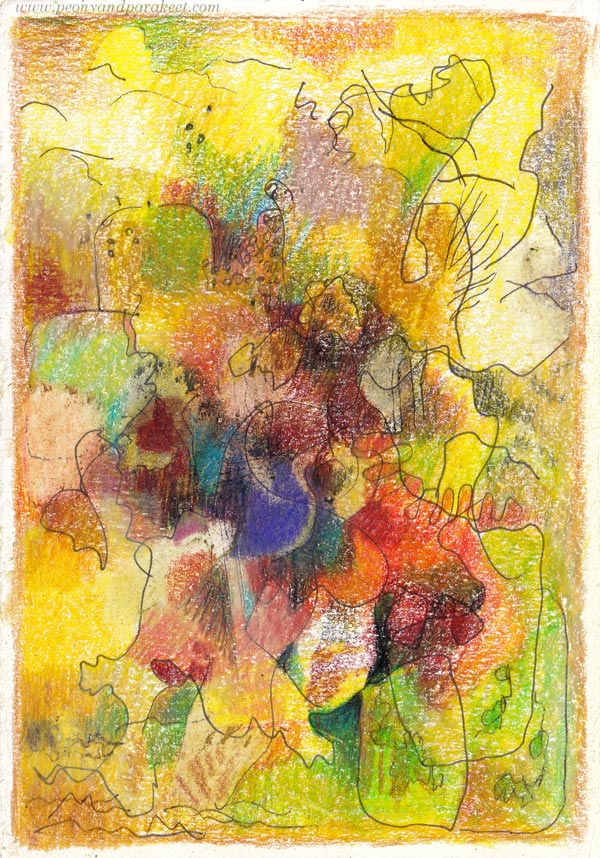
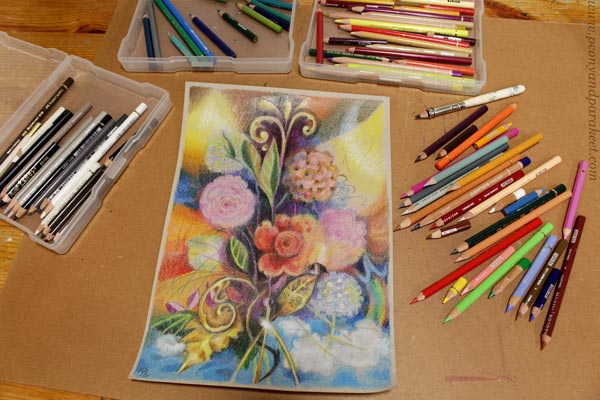
Black drawing pen and colored pencils.
Past and Present Drawing Courses
In most of my courses, drawing plays some role. Free and artistic line drawing is especially close to my heart. In the past, I have taught two courses on the subject: Inspirational Drawing and Inspirational Drawing 2.0. These are already retired. Of my current courses, Mystical Minis comes closest to these.

Passion For Teaching Artistic Line Drawing
For some time, I have wanted to offer more help with line drawing. Not just how to draw, but also how to alter the process to take it in a more artistic direction. By “artistic,” I mean moving beyond the conventional and creating something that is both personal and at least partly abstract. I want to speak especially to those of you who want to create freely and push your boundaries—both in how you think and how you create.
Watercolors and colored pencils.
At first, I thought the material I had gathered over the past few months would be just for these blog posts. But as I have started to unpack the topics, I find myself wanting to share more than what fits into a single post—to show things in both theory and practice. So, I’ve started developing a new course, under the working title Artistic Drawing.
Artistic Line Drawing – Course Themes
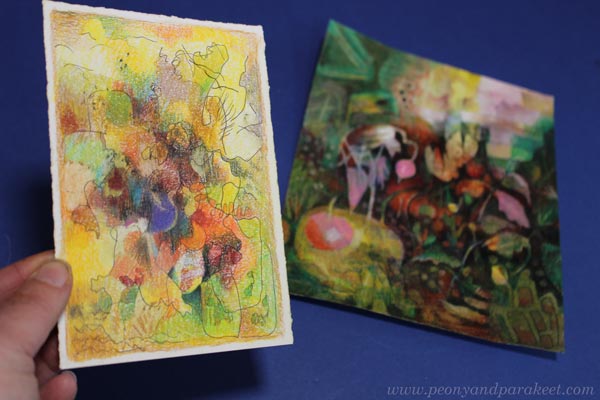
Here are the themes I have selected for the upcoming course:
- Ways to Start a Drawing: I want to help you explore how you begin. You can approach your drawing like an architect, building a clear structure first—or like a gardener, letting everything grow from a single seed.
- Letting Go: If drawing does not make sense and feels directionless, letting go can be difficult. I want to give tips on how to feel free and draw anything without too much inner resistance.
- Interaction: I want to help you notice the possibilities of interaction in the creative process. This is about both how you speak to yourself and how you work with drawing. For example, a line you draw can invite another line to join the conversation.
- The Scale of Shapes: An impressionist draws in a pixel-like manner, placing tiny dots one after another. An expressionist creates larger, vector-like shapes. I want to help you use both approaches and find the combination you enjoy most.
- Presence: At its best, your drawing radiates presence. I want to help you become like a singer who doesn’t just go through the notes, but pours their whole soul out to the audience.
- Clarity: You can begin a drawing with plenty of elements, but towards the end, it is worth striving for clarity. I want to help you discover a minimalism that is not based on scarcity, but on the ability to pick the essential.
- Sense of Style: I want to help you find the things you want to add to your drawings, and the ones you want to get rid of. It is not just about developing a style, but also about developing your sense of style.
Which of these themes interests you the most? What else do you hope to be included in the course?
Three Brave Questions to Ask Yourself about Your Art
This week, I have questions about your art, and I will also share my answers as an example.
As an artist, you’re always asked: 1) where do you get your inspiration, 2) how is your art made, and 3) what does it represent or mean? But when you want to go deeper and find answers for yourself, answer my set of questions instead!
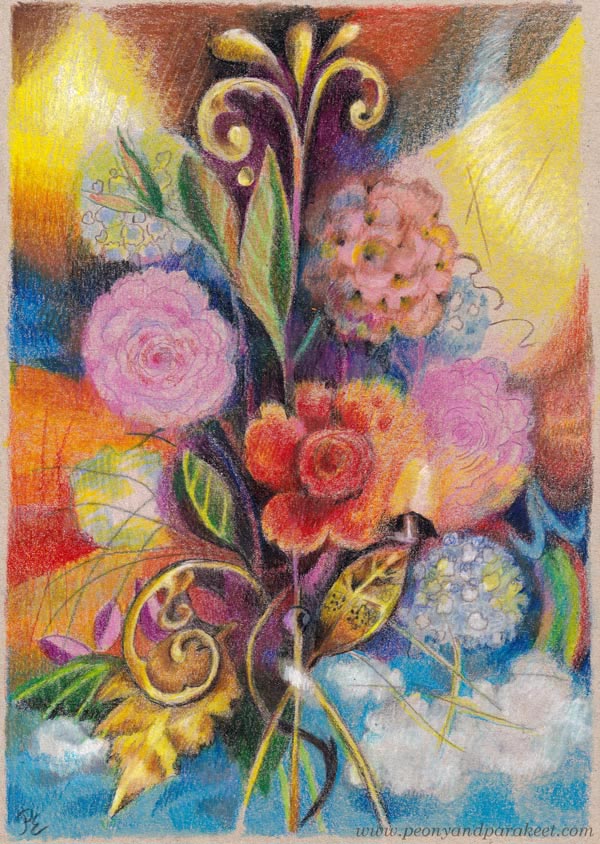
My questions about your art are not positive, but negative. They are braver, but also more grounded, and I think they can be more useful than the ordinary set. When you look at your art through what you don’t instead of do, it can be easier to see what’s truly closest to your heart. If you only dare to admit the truth…
Question #1 – What Subject Do You Always Return to (No Matter How Much You Resist It)
For some, it’s portraits; for others, landscapes. For me, it’s flowers. I actually feel a bit embarrassed about being a flower painter. A woman over fifty, painting flowers … you know the stereotype.
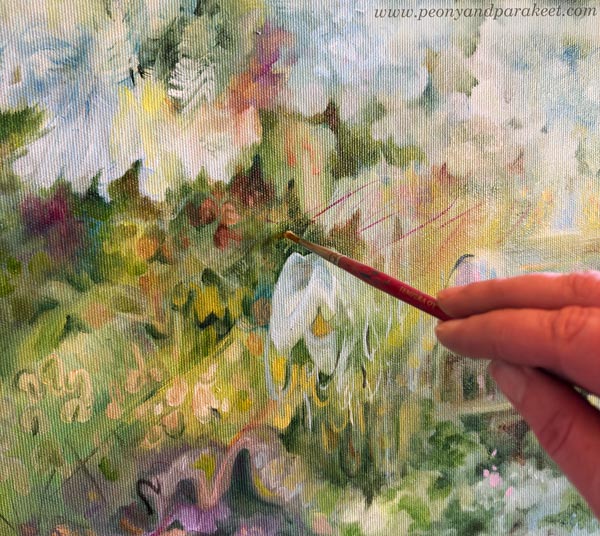
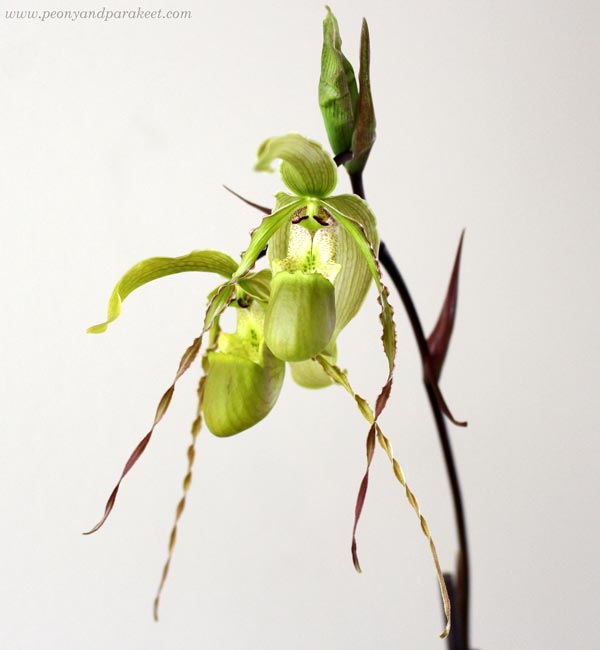
But I feel like my love for flowers and plants runs deeper than many artists. I have rare orchids, a flower garden, and I see flowers as pets with personalities.
But I also have to admit that I planned to create a drawing of a female figure for this blog post. It never got past the early stages; I just wasn’t inspired. Then I tried an abstract idea. I started several, but still nothing. I wasted at least four hours and filled the bin with my scribbles. Finally, I gave in and drew those flowers.
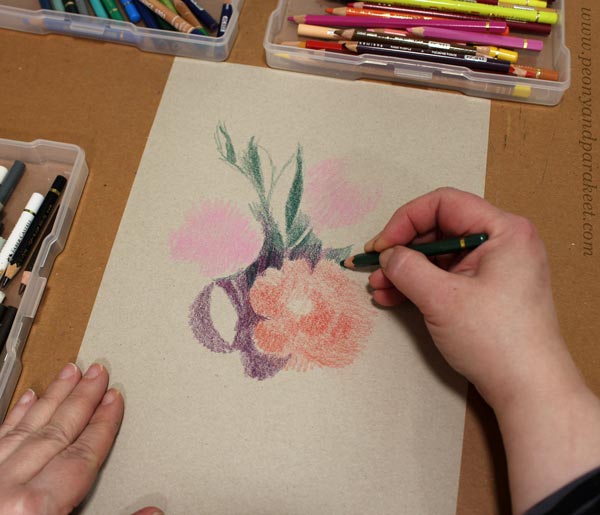
It was so much fun. I felt like I found myself again. “This is so superficial, Päivi!” a voice inside me said, while at the same time: “I love this world above the clouds, where flowers bloom, and everything shines.” So, I’m sorry to post flowers again!
Question #2 – What Do You Break in Your Creative Process?
Rather than convincing yourself how you follow the tradition and how you build the image, think about the cracks in your process. What should you do, but you really don’t? How does that affect your art?
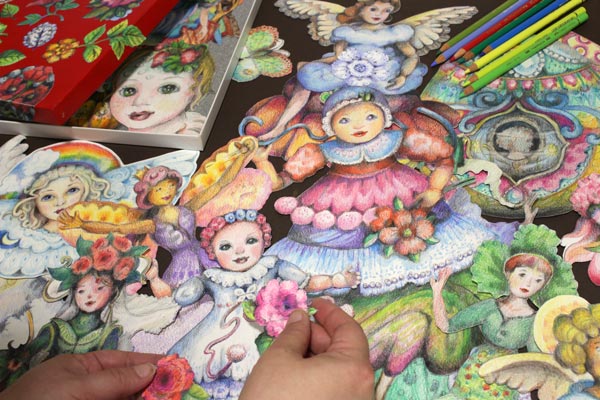
There’s one stage I always try to avoid: sketching. Predictability just kills my motivation. That might be why I don’t draw people so often. When I was creating the course Doll World, I learned how to sketch human anatomy. It’s a very useful skill, but it didn’t stop me from avoiding it. It’s nice to know I can draw a person in any position, but at the end of the day, I’d rather be drawing flowers or ornaments.
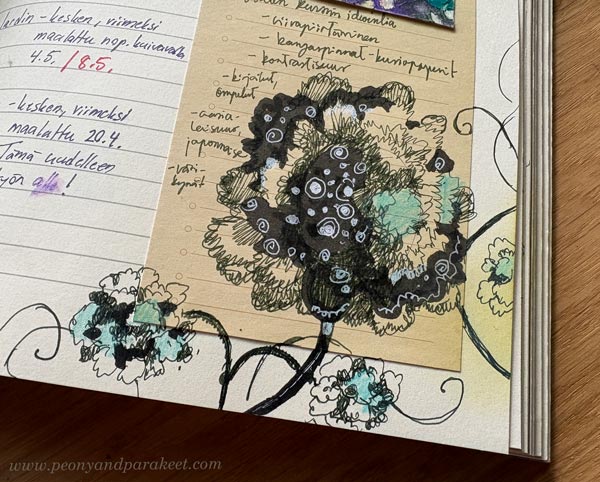
For my oil paintings, I do some prep work by researching and writing down ideas. Sometimes I’ll doodle something small in my planner among the written notes.
But I do practice drawing a lot. Even the drawing for this post is kind of a study for my paintings.
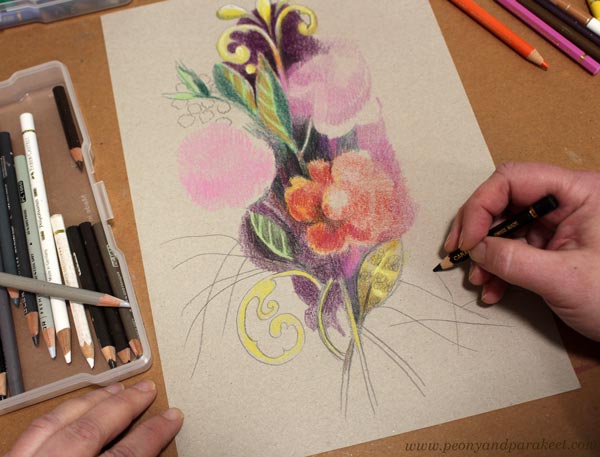
However, I never recreate the same image. I want to break that predictability and leave room for those sudden “aha!” moments.
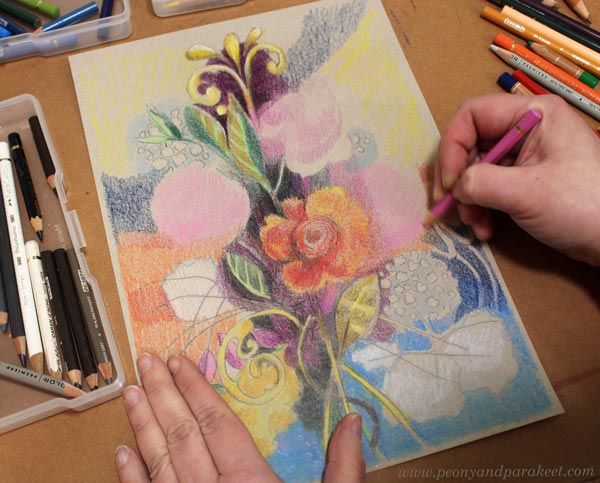
No sketching, no pencil/eraser thing – I’m a little embarrassed by this answer. I have so much respect for the old masters like Rubens and his peers; I think about them every day. I’m also constantly trying to improve my technical skills. But — and Rubens is probably rolling his eyes now — I try to do it without sketching!
Question #3 – What Do You Defy With Your Art?
The world is full of good things that inspire us and that we want to promote. Of course, we would like those things to add meaning to our art as well. But I believe that creativity can’t be forced. You can try to overlay meanings onto your art, but that will only obscure its essence and remove its clarity.
With my art, I’m not defying authority, climate change, social division, inequality, or war. There are many things I oppose as a person, but for some strange reason, they have nothing to do with my art. My art is about defying something as mundane as everyday life.
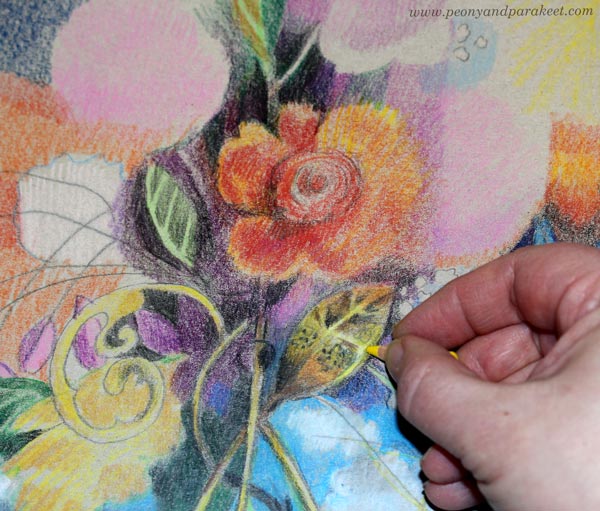
I respect those who capture the everyday, but that’s just not me. I’m not the kind of artist who sketches the houses in her neighborhood or portrays the ordinary lives of ordinary people. My art doesn’t come from the beauty of the everyday; for me, beauty begins where the everyday ends.
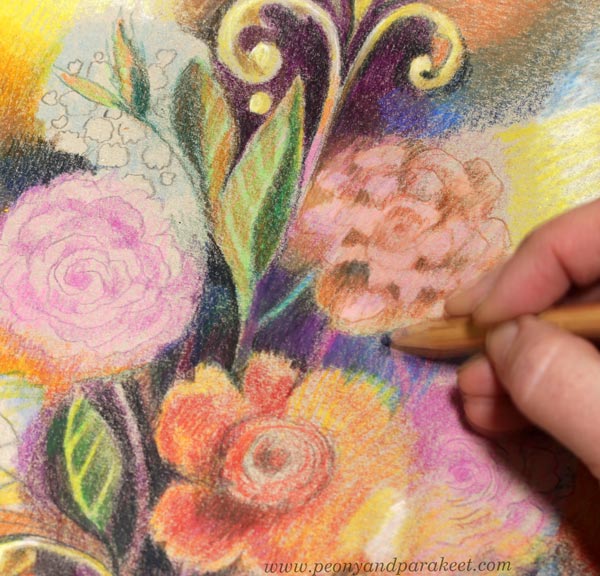
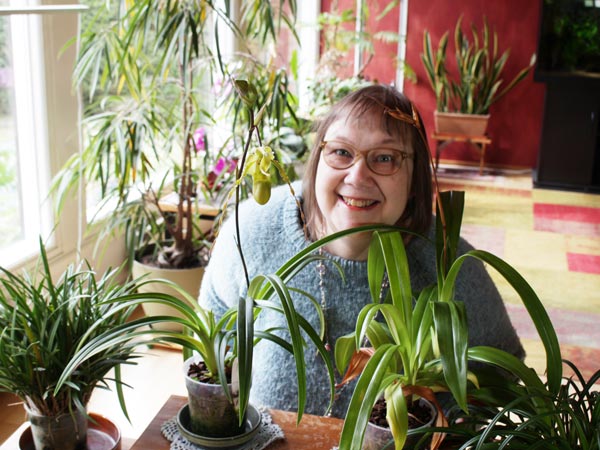
Now I should mention that I’m not a particularly “special” person myself, even though I’m a full-time artist. I work regularly and with discipline. In my free time, I mostly walk the dogs, take care of the plants, do crafts, and clean. I wear wool and cotton.
But when I’m making art, everyday life is far away. I admire the Baroque, rare collectibles, palaces, luxurious fabrics, and historical gowns. I’m a romantic, a nostalgist, and an avant-garde thinker—anything that rises above the mundane pulls me in like a magnet.
I suppose there’s something superficial and embarrassing in that, too. Isn’t luxury the indication of a materialistic mindset?
What’s Behind the Questions about Your Art?
Behind the awkwardly truthful answers, I see a kind of sacredness that inspires me immensely. It’s a connection to nature’s ultimate luxury, to my own intuition, and to a human-made beauty that lifts the spirit.
How would you answer these three questions about your art?
Can Playful Art Be Serious?
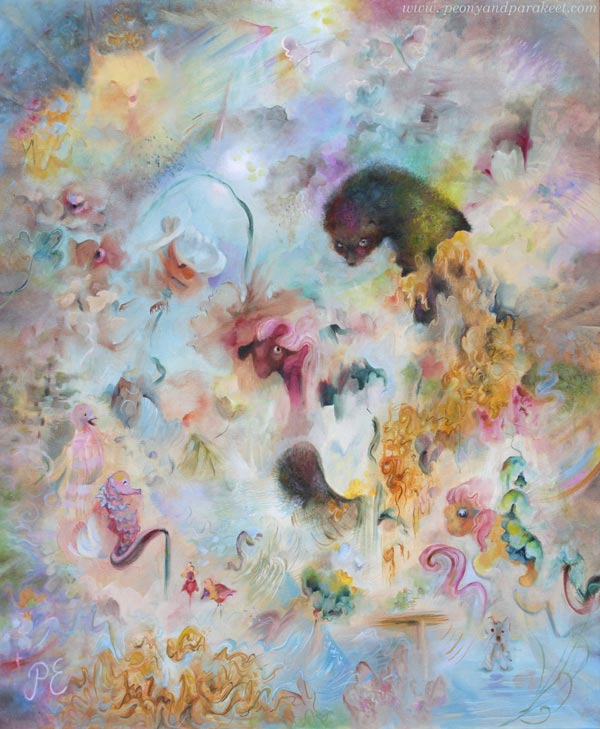
This week, I want to talk about my newly finished painting titled Fauna. This is one of my most peculiar pieces, filled with strange ideas. With this, I want to challenge us to ponder the question: Can playful art be serious?
Ideas Have a Mental Age
This painting combines many ideas. I tend to come up with all sorts of ideas quite easily, and I usually try to categorize them: some make it here to the blog, some become sketches in my planner, and others turn into courses. Only the most mature ones are usually included in the paintings.
But let’s think about this word: mature.
Ideas have a mental age. Some ideas are like those of a five-year-old, while others contain ancient wisdom. For a long time, I have tried to ensure that my best ideas are “sensible adults”.
Fauna’s Ideas
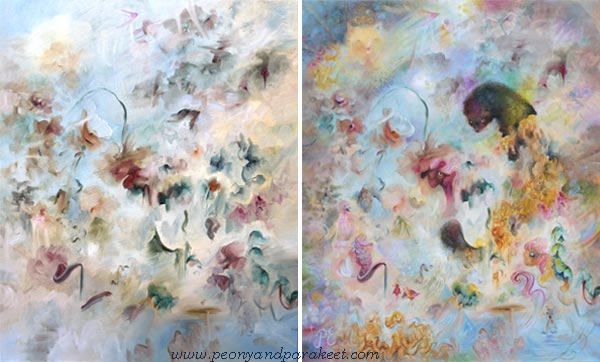
Fauna started from an old idea: the Baroque style and historical ceiling murals. So I thought that the painting could feature flowers and have plenty of light blue. Here’s how it started:
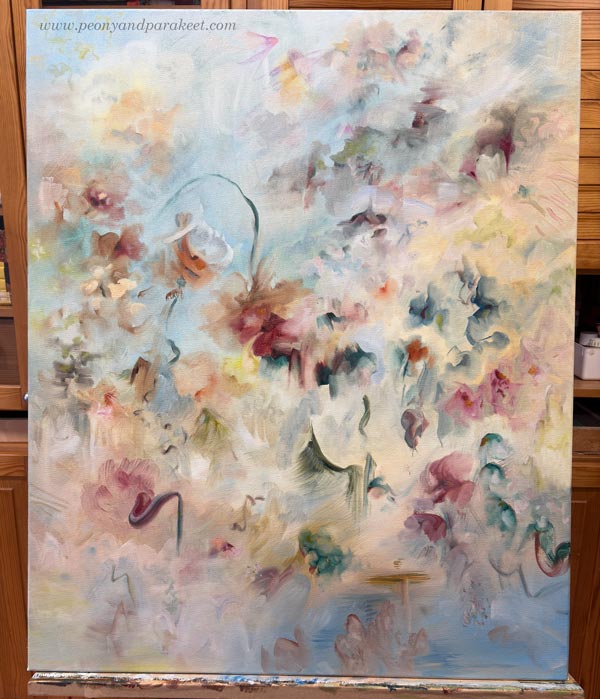
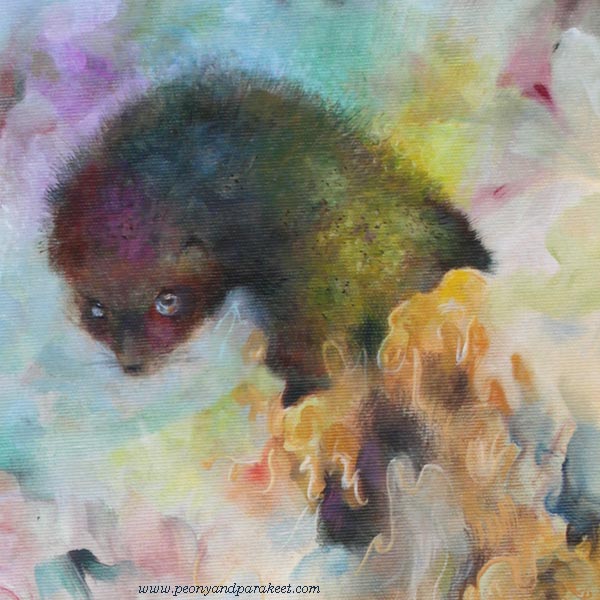
But then I heard my inner child whisper that I should include an animal: “Fur is so wonderful to paint. Let’s include something like a ferret!” The adult me wondered, “Who would want a painting featuring a weasel?” But you know, some ideas are like tiny butterflies that appear and vanish in an instant, while others are like moose that take over your entire mind. And this was a “moose idea.” It wouldn’t leave me alone, so fine —let there be a weasel of some kind!
But what else could be included?
Words help when I am brainstorming. I read through various word lists and wait for the moment my intuition says “Bingo!” That’s how I found the word “hunaja” – honey. I thought about the intricate swirls of the Baroque style and the way honey drips, and I boldly added them to the painting.
Here I am painting the fur. I use not only short strokes, but also paint small patches with different tones. Layering is the key!
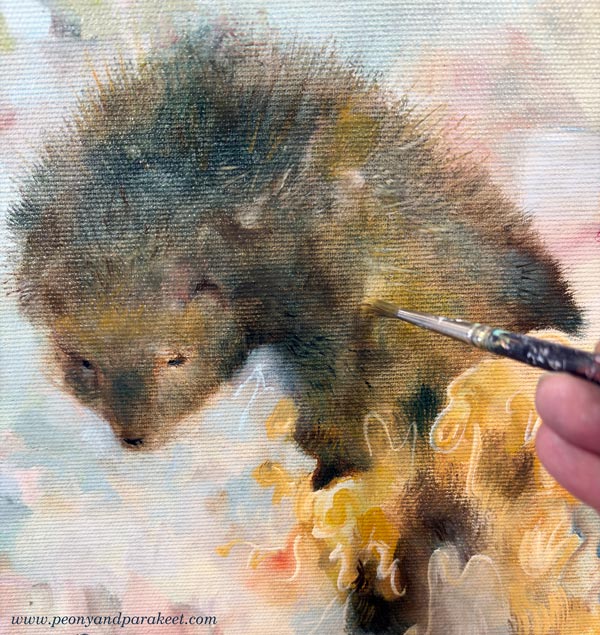
In the final version, the fur is softer and shorter, and lit by a rainbow. It took some time to decide whether the fur should be spiky or softer.
With the idea of painting honey, I found myself on a “mad path” where I stopped categorizing my ideas and challenged myself instead: could I create a painting that looks like a floral piece from a distance, but reveals a more playful character upon closer inspection? Could the animal theme lead toward animal figures—even toys? I wanted to achieve a purity of style that isn’t tied to a single era, but rather to my own way of dealing with shapes and lines.
Here you can see the beginning and the end side by side.
Playful Art – Drawing Animals
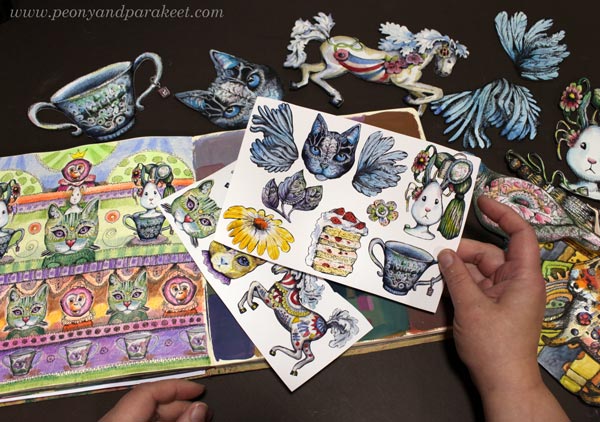
I have always loved animals and have drawn them a lot. Drawing with a pen is much easier than drawing with a brush.
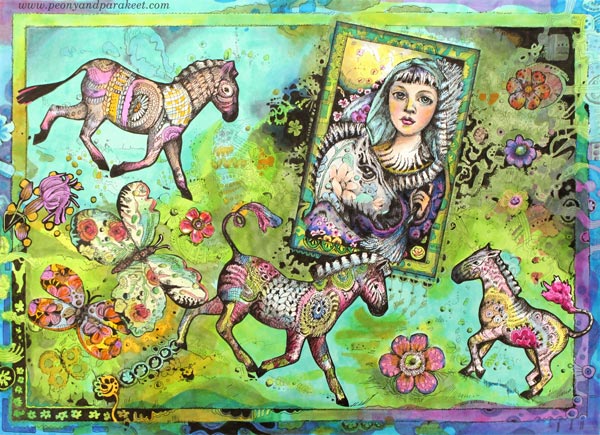
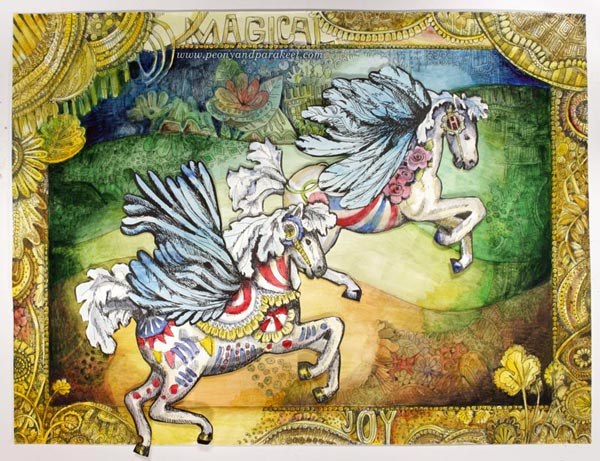
Animal Inkdom and Magical Inkdom have been highlights of my course creation because, while making them, I decided to believe that everyone wants to draw animals. That mindset brought a lot of confidence and joy to the process, which also translates into the atmosphere of the courses.
I have had so much fun with all the animals drawn in those courses. My father used to draw with quite a similar technique, so I have continued on his path here.

The Playfulness is in the Details
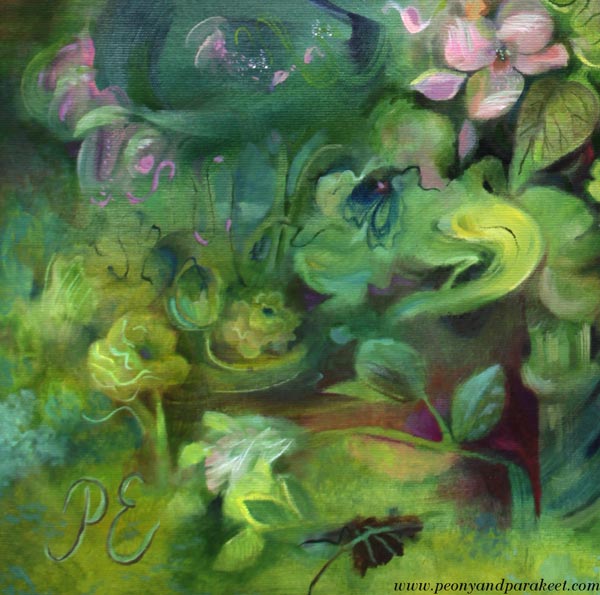
Fauna is full of playful details. Many of them are quite subtle, barely noticeable. Here are some detail pics.
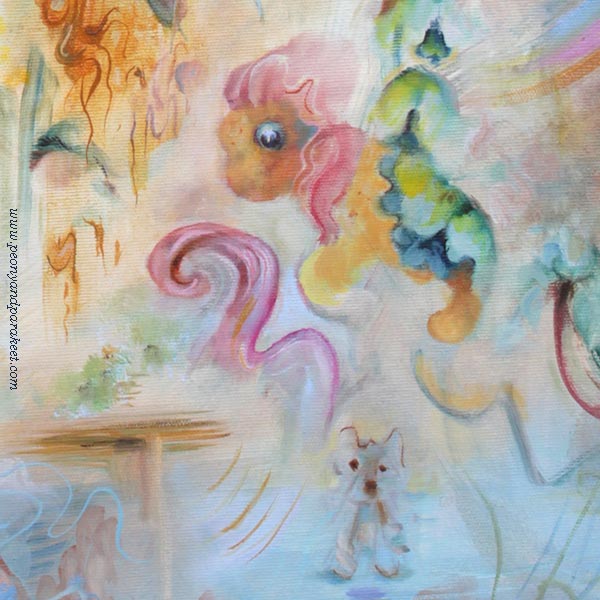
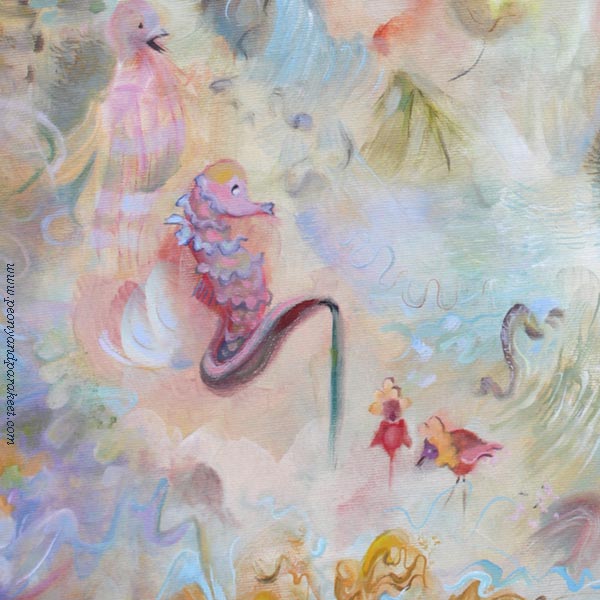
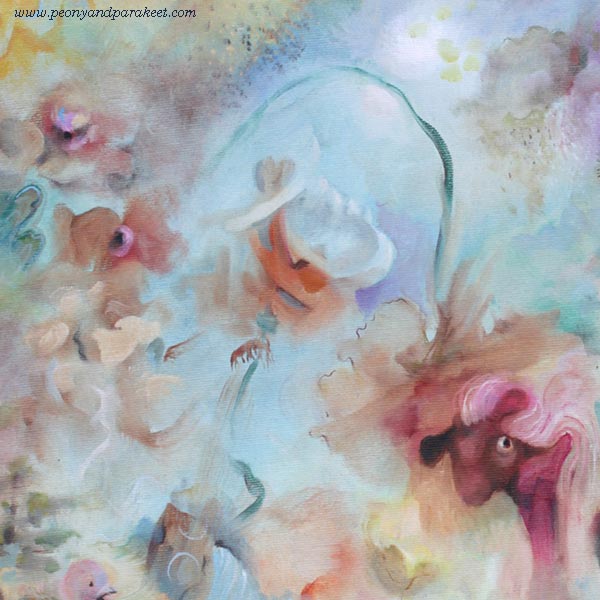
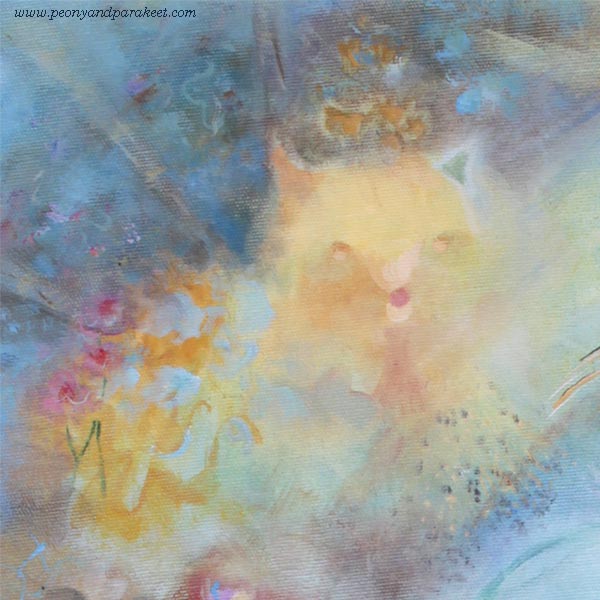
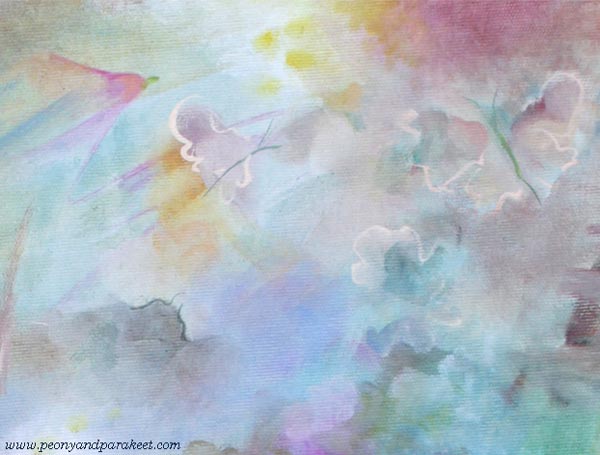
I see myself in this painting—all the versions of me at different ages, with ideas of all ages.
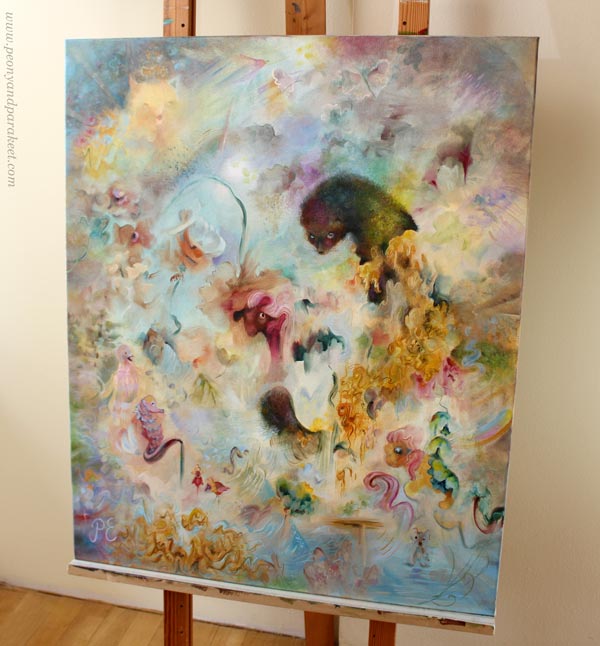
Even if Fauna was a challenge to create, it was also fun. I think I will create more of this kind of playful art.
Age of Ideas – Just Playing or Only Focusing on the Serious Side
This painting process made me reflect on how people who start making art often fixate on the “age” of their ideas. Some decide they are just having fun and playing. Others believe that skills—and thus art—can only be born through realism. But as artistic thinking and skills develop, there is an opportunity to combine the playful with the more serious. It is possible to be a child, an adult, and an elder all at once. Art doesn’t need to be narrowed down, because creating is a search not just for oneself, but for a broader understanding of humanity.
Fauna is a bit different from Halo – the painting that I showed last week.
See the blog post about creating this painting
See more pics and a video at Taiko Finnish Online Art Store
Which one do you like more – Halo or Fauna?