
Paul Klee and the Art of Learning
This blog post is a personal story about being a student of Paul Klee. I will also share my thoughts about art classes and about their effect.
Paul Klee’s Pedagogical Sketchbook
It was a late evening at the beginning of July – one of those white nights that take place in the middle of summer in Finland. When the sun is up, it’s more tempting to stay awake than to go to sleep. It also felt better to pick a brush and paint than to slow down with knitting or watching tv. My brain activity was high. I didn’t want just paint, I wanted to learn something new.
While pondering about learning, I remembered a thin book that had been on my shelf for a while. It was borrowed from a library a few weeks ago and I hadn’t opened it since. The title was called “Pedagoginen luonnoskirja” – Pedagogical Sketchbook, written by a famous abstract artist Paul Klee in 1925. The original version was written in German. In 1953, it was translated into English and finally into Finnish in 1997. The long timespan proves that the book has some ever-lasting content. But when I began to examine the first chapters with the brush in my hand, it seemed very uninspiring. The pages were black and white, no color, but the worst thing was: it looked like a math book! It had formulas, diagrams, references to geometry, anatomy, physics … What was I thinking about when I borrowed this book!
Abstract Art Theory for the Left Brain
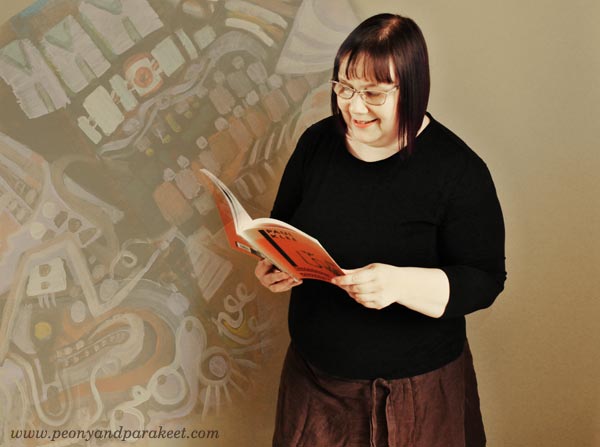
But then, I remembered that my artistic side wasn’t playing along when I found the book at the library. Being so thin, it could hardly be seen on the shelves filled with thick art books. Seeing its cover, my engineering side that got interested: can there be formulas for art? Is this the book that teaches the left brain to understand the right brain?
So even if I had my art journal open on the table and paints ready on the palette, I decided to switch gears and start reading the book – slowly and carefully like engineers do. After a couple of minutes, I was hooked. I was mesmerized by the world the book presented. Phenomenon familiar from my physics studies were tied into modern abstract art. The book was broken into three parts. Each part contained short chapters. like tiny lessons. I decided to begin studying each chapter so that the engineer in me would read it first. Then she would explain it to my artistic side who in turn, would fill an art journal page by playing with the concepts.
Side note: Interested in the book? Here’s a link to Amazon.com. There’s also a free PDF of the book available if you google it but I don’t link it here, as it may be an illegal copy.
Paul Klee’s Ideas in Practise
When I eagerly studied the book, I felt I had a teacher, Paul Klee himself. It was exciting to listen to him talking about muscular movement, material structures, disturbed balance, how the perspective is experienced or how the blood circulates in a body. And most of all, how it’s all connected to visual communication and visual art. I imagined being one of his many students and even one of the most enthusiastic ones. I was constantly raising my hand, not only asking questions but also questioning: how did you come up with this idea, why have you omitted this fact?
Do These Ideas Suit My Style?
Even if I was painting and reading like a maniac from one chapter to another, I was also in doubt. Stiff figures that I painted looked very old-fashioned to me. I had a teacher who hadn’t experienced the digital age, who hadn’t seen or created any contemporary art. “Tell me, Paul Klee, do these rules apply to many styles, including mine?”, I kept asking.
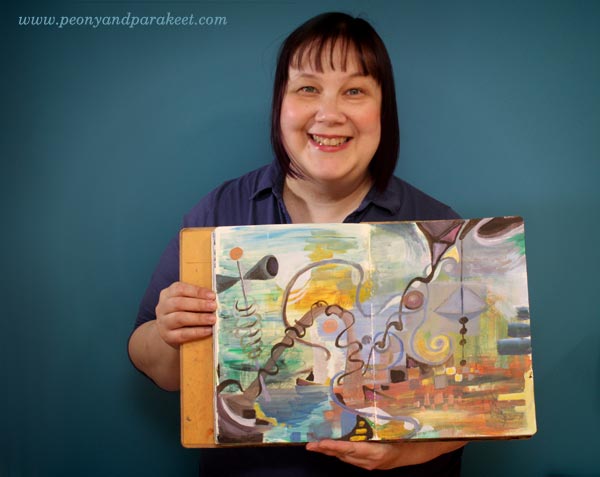
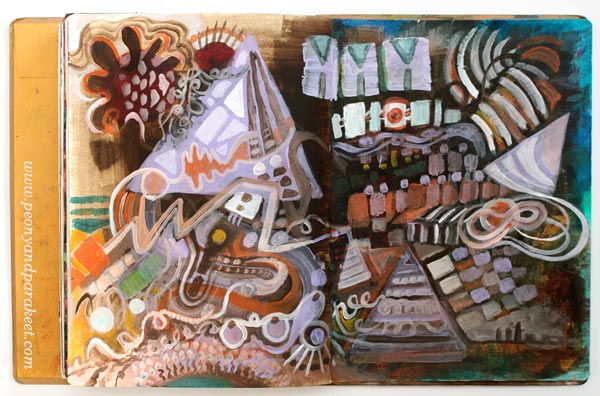
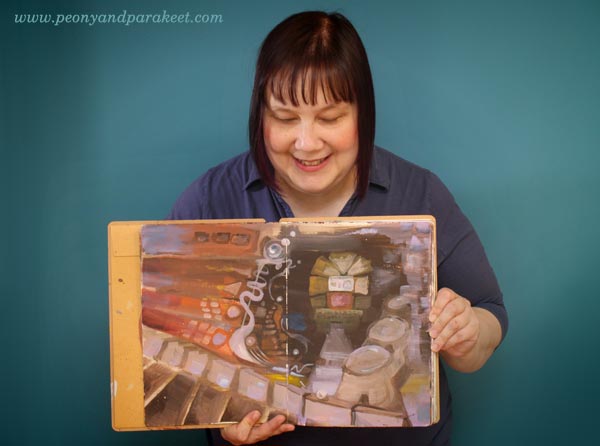
But despite of the constant battle in my mind, I couldn’t put the book away. I went from one chapter to another and eagerly waited what my teacher would present in the next one. And when the last chapter was completed, I felt sad to leave the classroom and say goodbye to my teacher. During the session, I had completed three big art journal spreads. They all looked like the middle of 20th century to me. The session seemed to be nothing else but a fun engagement when the sun finally set down.
The Aftermath of Learning
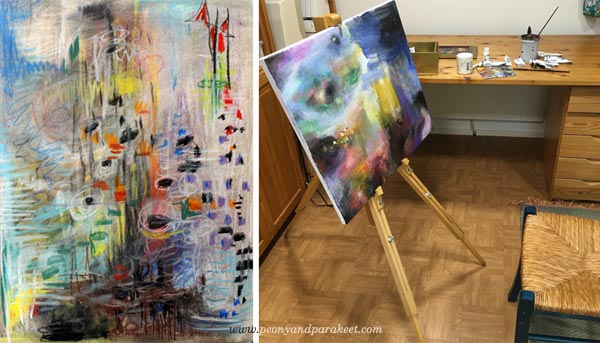
During the next weeks, I saw sudden glimpses of Paul Klee. When I was taking photos, drawing, painting or just observing, Paul Klee’s theories began to merge with my own thinking and with my own style. The three spreads that I had made were exercises only. Once I left the classroom, I was free to apply those theories where suitable. This is what happens in every art class. You might think that the exercises are not fit for you. You might have doubts if the class fits your current style. And when you leave the class you might think: “Oh well, I don’t know if I ever do this again.”
But like the blood needs oxygen, creativity needs new theories, techniques, and ideas. They are no threat to your style, they are essential to continue developing your style. That’s one main reason why I challenge you to learn new techniques at Imagine Monthly (you can still sign up!). That’s also a reason why I will be inviting you to join my newest online painting workshop, starting in October.
Coming Up: New Painting Workshop
I am really excited about this! Be assured that I will have something special for the beginners and a lot of new to focus on for the more advanced painters. The theme for the class is expressing nature. The registration for the new workshop will open next week with a short-time early bird pricing. I will give more details about the class then.
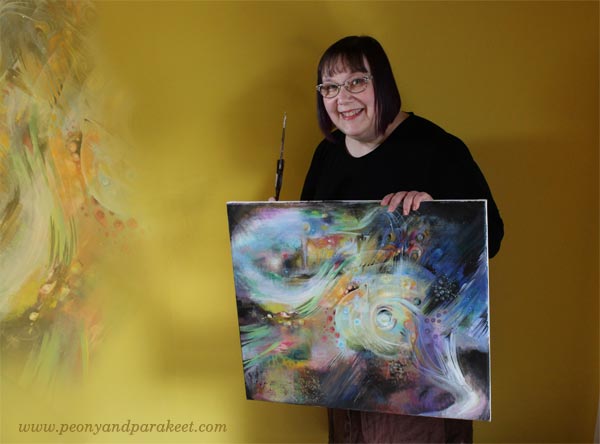
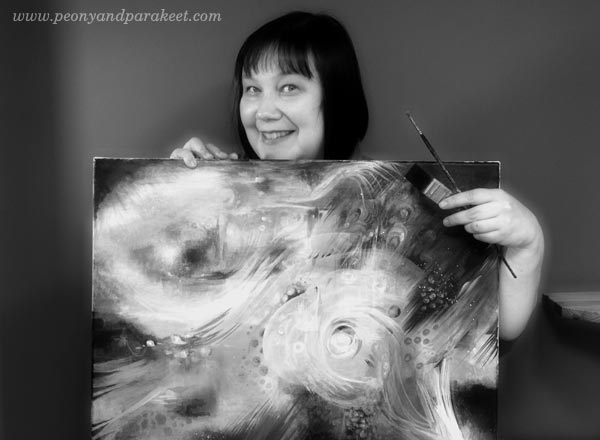
While building the class I have practiced the techniques and ideas on a big canvas. This painting is still in progress, but I want to show it to you just to be able to compare the art journal pages above and how Paul Klee’s teachings have merged into my own style. That’s what’s my goal with you too: that you’ll have a fun time with the classes and that you will be able to mix new things with what you already know and love.
Update 4 years later: I have a new class based on Paul Klee’s and Wassily Kandinsky’s teachings – Floral Freedom! >> Buy now!
Have Some Vincent van Gogh in Your Life!
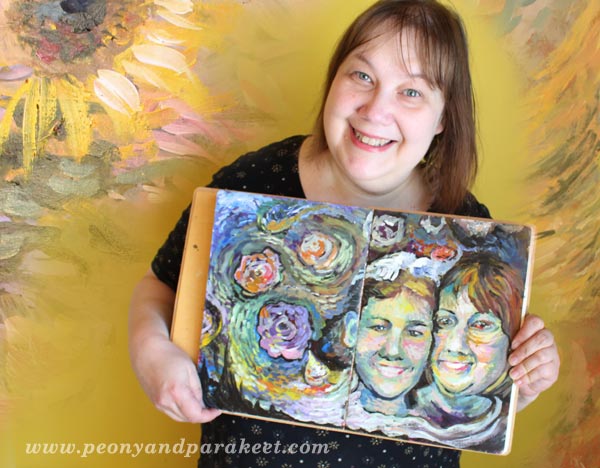
When I opened Imagine Monthly Fall 2016 art journaling class for registration, my question to the first participants was: “What is your favorite artist?” The ultimate winner was Vincent van Gogh. So I went to the local library and picked up two huge books showcasing all his paintings. I wanted to create a class that inspires not only playing in his style, but which also makes people relate to him. I wanted to enable people to put their world next to his and see it in full color like he did.
Life in Full Color
Whether you are an actual engineer or not, I think that you too have an inner engineer. She likes the home to be organized and clean. She takes responsibilities seriously. She worries over the practical stuff.
But then, truly, you also have an inner artist. She doesn’t care what time it is or whether she’s hungry or not. She doesn’t have a clue if somebody needs her to be somewhere else. Her world has no linear time. She has no other duties than to explore. She sees colors and textures when the engineer sees dirty laundry and a shopping list. No, she would not stay alive without the inner engineer. But the inner engineer could never live the life in full color without the inner artist.
Vincent van Gogh
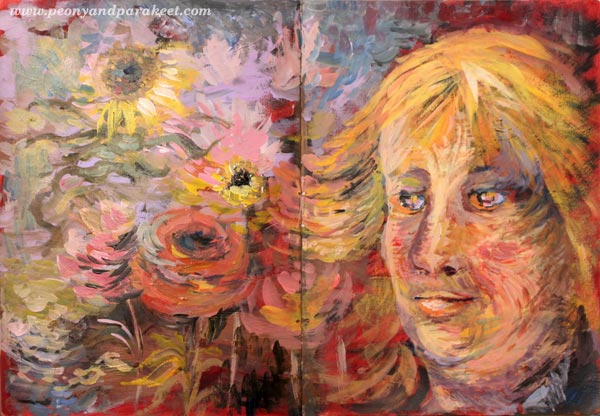
Here’s what every inner engineer knows about Vincent van Gogh: He was a poor artist from the 19th century, painting with thick medium. He had mental issues and he sold only one painting.
But the inner artist feels that he was her soul-mate. He saw the yellow sky and blue ground when other people saw the perfect weather to sow the seed. He saw glorious sunset when other people saw withering flowers. For people of that time, his portraits and sketches looked clumsy even if he had caught the essence. Namely, in his world, the essential thing to do was not to engineer but to express. Instead of aiming for objectivity, he was the master of subjectivity.
Van Gogh Moments

I believe that most people create art because they need “Van Gogh Moments”. In those moments, you can pick any color for any object, not only green for the grass like the inner engineer would suggest. In those moments, you can not only play with colors but also experience the interaction between the hues and shades. Just like van Gogh did! If you look at any detail in his paintings, you will see the interaction of colors.
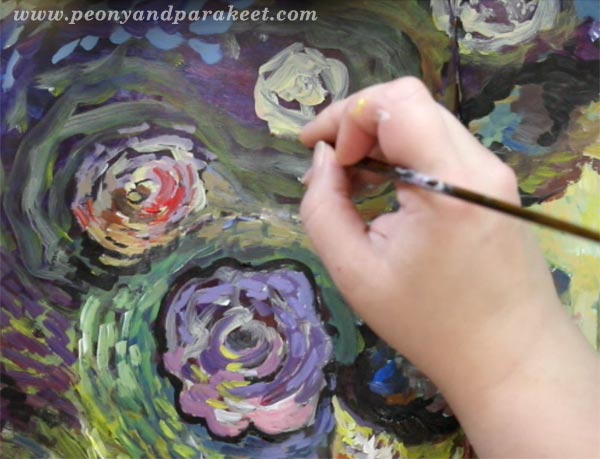
So while the inner engineer waits for the important phone call, the inner artist hears her colors speaking. While the inner engineer worries if she will ever meet someone again, the inner artist paints him or her right there beside her.
Selfie Fantasy
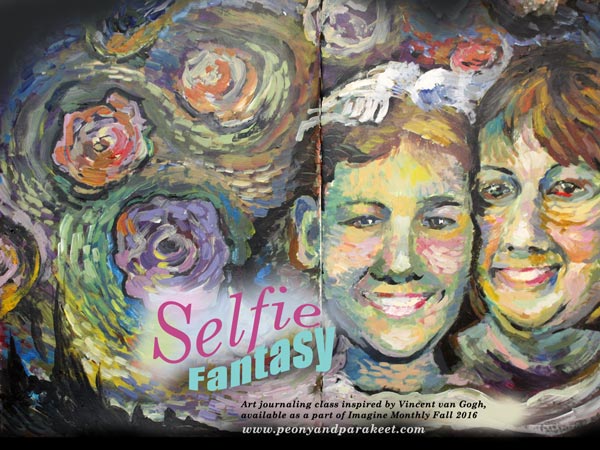
When I browsed through the two big books of van Gogh’s paintings, I realized that a big part of his production was portraits. They were either self-portraits or portraits of other people. So in Selfie Fantasy, you will not only learn easy ways to create a colorful and swirly scene in Vincent van Gogh’s style. You will also get step-by-step instructions for adding some familiar faces onto your art journals. In the class video, I use those methods to paint my mother and me. My mother is there on the spread, glowing on her wedding day, much earlier than when I was born. This time she is in the foreground because in real life she was always the one in the background, supporting my creativity. She truly was my inner engineer until the day she passed away about 25 years ago.
Give some “Van Gogh Moments” for your inner artist!
Sign up for Imagine Monthly Fall 2016
and get an immediate access to Selfie Fantasy – Sign up now!
Build Imagination with the Students of Peony and Parakeet
During the last spring, I have seen gorgeous pieces of art made from the mini-course Painter’s Ecstasy. Like in the previous blog posts (this one and this), I want to share some of them with you.
Build Imagination with Watercolors!
The pieces of this post are made with watercolors mostly. In my experience, watercolors are the supplies to go if you just stare at the blank paper and have no ideas in mind. They are soft and not so exact than pens or acrylics. It’s also easy to see something interesting appearing and start building new details from that. Maintain an open mind and not try to figure the end result beforehand. Instead, start with a general idea in mind.
1) Start with Mixed Emotions
Because creating art should be enjoyable, we often want to express positive feelings. But to get more connected to your piece, analyze your emotion more in detail. It’s often mixed: joy can hold tears of affection, happiness can contain worry, love can include dependency of some kind. This doesn’t mean you have to dwell on negative emotions but pondering about the more complicated nature of emotions can also free up your imagination. When controversial issues are allowed, it’s a sign to your mind that anything is allowed. This, in turn, will build imagination!
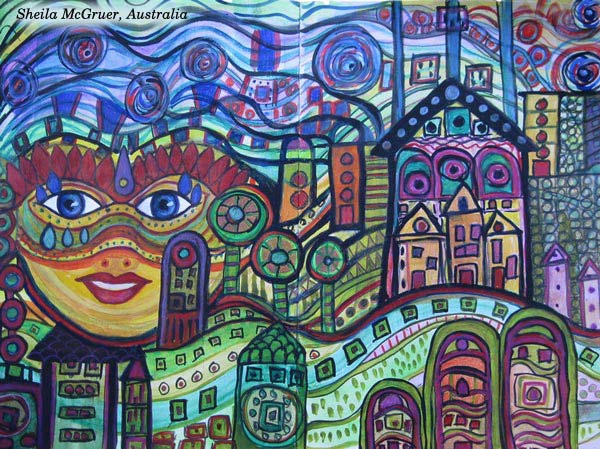
Sheila McGruer’s art journal spread tells a visual story about a woman who has an origin. This would not be so expressive without the teardrops!
2) Get Surreal
People say: “I do only abstracts”, “I focus drawing faces”, “I like landscapes”. Break the rules and combine various approaches. Could abstract contain faces? Could faces include landscapes? Could geometry meet human parts? Could 3-dimensional meet 2-dimensional?
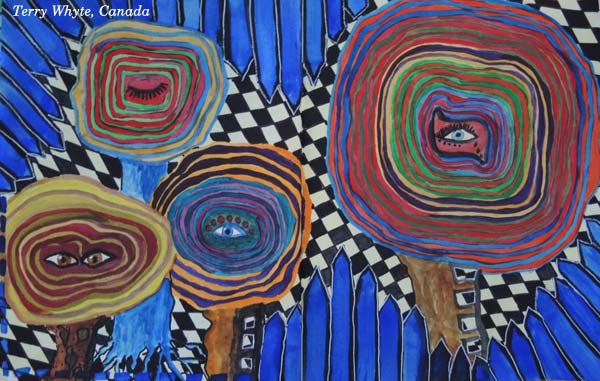
Terry Whyte‘s piece is fascinating. It’s simple if you count the elements but mind-blowing if you examine their relations. A wonderful example of how the surreal can look like!
3) Play with Proportions, Colors, and Abilities
Can houses be smaller than faces? Can trees be red and purple, then change their color and leave off the ground? Anything can be possible in your art journal!
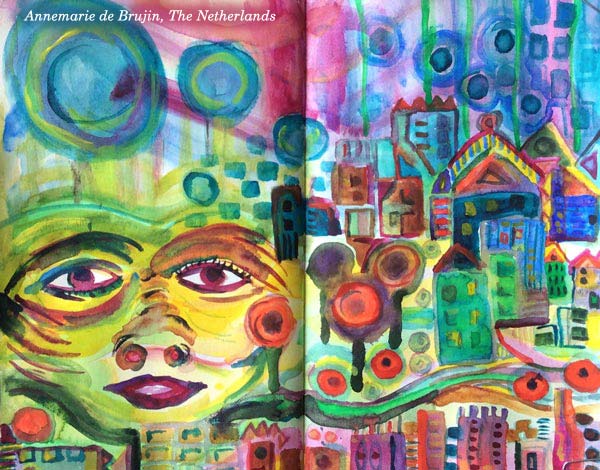
Annemarie de Brujin plays brilliantly with proportions, colors, and dynamics. The painting feels like an experience, more than just an ordinary scene.
4) Envision Your Location
Mind-travel to a place where you would like to go! It can be a real location, an imaginary one or the mix of many! Nothing has to be exact. Get inspiration from the colors and the atmosphere. Make your art journal a mind-traveler’s notebook!
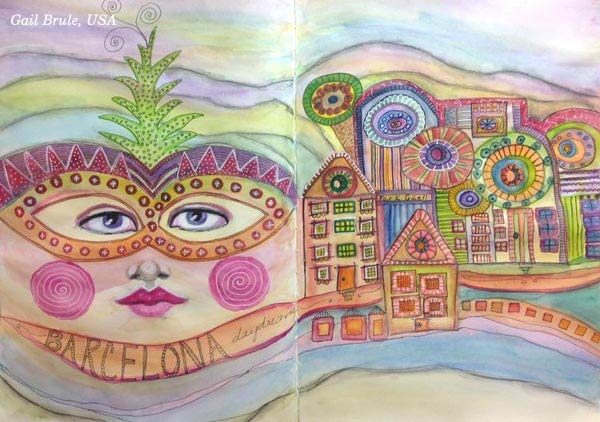
Gail Brule‘s art journal spread is a wonderful interpretation of the city Barcelona. Mountains, the beach, Gaudi, the colorful street life … it’s all there!
5) Treat Inanimate Object as Humans
One of the easiest ways to get the imagination going is to treat anything inanimate as a living object. Can a house have an identity of its own? Can a group of items look like a choir of brilliant singers? How do the trees look like when they are smiling?

Claudia Kern has created more than a landscape. The painting is like a big and inviting party!
6) Merge Everything into One Flow
Instead of adding single elements, build connections and flow to your piece. Connecting lines also connect the viewer to the painting and it all seems to make sense. This way, small elements can be used to build big pictures.
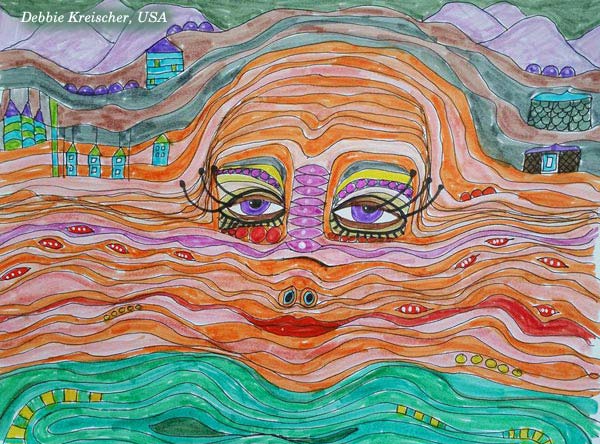
Debbie Kreischer shows it so well: we are all part of the same flow!
7) Express a Conversation
If you always do faces, why not creating more than one and express a connection between them. Then take it even further: what are they talking about, where are they walking, why are they together? Show it all visually!
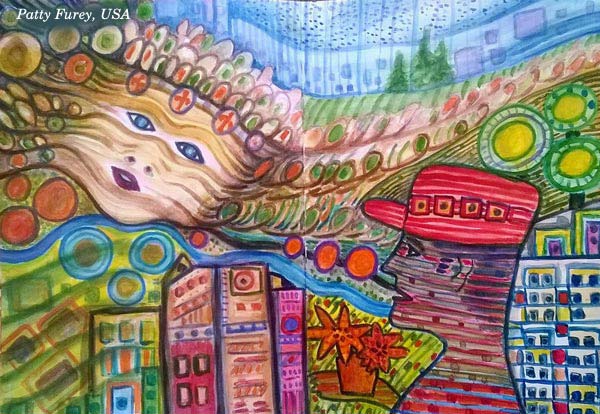
Patty Furey’s dreamy woman and dynamic man is the perfect couple to dive deeper into the story. They seem to live in a city. Maybe the man has brought the flowers for her. She seems to be the country girl in her heart, though! These kind of pages that evoke stories are the best ones. If you like creative writing as well, use your image as a starting point for a poem or for a short story!
8) Get Ideas from Treasured Items
Open your treasure box or shopping wish list and analyze how the single items are constructed. Does your favorite blouse have ruffles? Do you grave for jewelry that holds the beads elegantly? How are the details of your dream handbag? Thinking like a designer can give ideas to an amazing art!
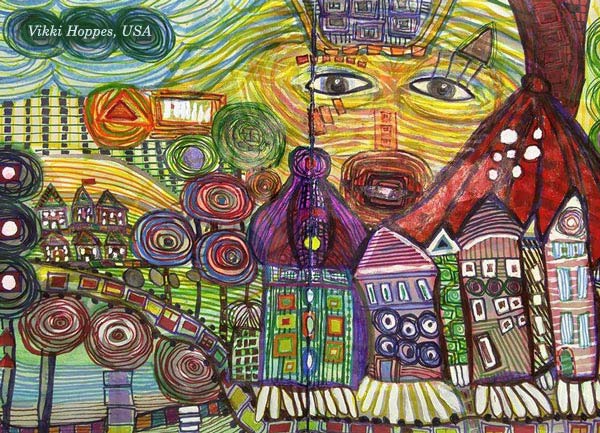
Vikki Hoppes’ painting is a great example of how to build imagination by constructing elements creatively.
Painter’s Ecstasy
When planning Painter’s Ecstasy, I spent weeks examining the paintings of Friedensreich Hundertwasser. He had students but to my knowledge, they didn’t get much guidance, only a green classroom:
– “I tell them nothing. I just put the plants there and leave them alone together.”
My first sketches were made with few bold strokes but they didn’t catch the essence. Sketch by sketch, I slowed down and toned down. Hundertwasser called his way of working “vegetative painting” as it develops slowly. It doesn’t start with drum rolls but with little bell sounds. The techniques that I discovered with trial and error
make starting easy but stopping almost impossible when you reach the spheres of painter’s ecstasy!
This mini-course, Painter’s Ecstasy, was published at “Imagine Monthly Spring 2016” art journaling class. It’s now available individually as a self-study class – Buy here!
You can also buy all the 6 monthly classes as a bundle. I will also release the classes individually one by one later this summer, and show more ideas on how to apply them.
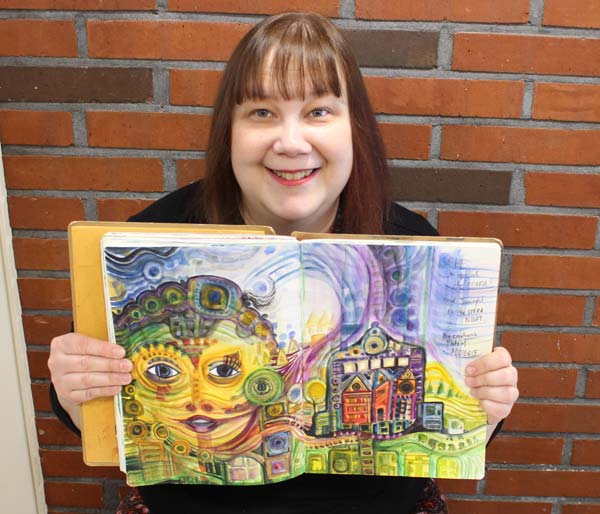
Build imagination, right now!
9 Collage Ideas from the Students of Peony and Parakeet
This spring, I have seen gorgeous pieces of art made from the mini-course Doodled Luxury and I want to share some of them with you. There were so many great pieces that choosing was difficult but this time I thought to share pieces that are very idea-driven. You can never have too many collage ideas, especially if you process several at the same time!
1) Many Variations of One Shape
Gina Meadows shows beautifully how hand-drawn elements are all like from the same family when created by the same person. I also love how it’s full of feather-like shapes. They repeat the idea of a free, observing bird.

2) Solid Ground
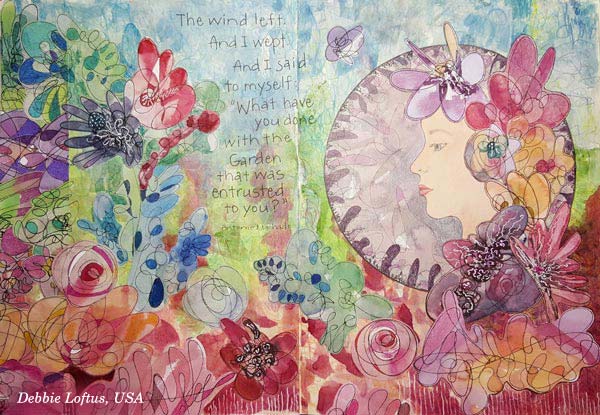
The second art journal spread that I want to show you is by Debbie Loftus. Her work is a wonderful illustration of the quote she has picked. This piece also reminds me of how we can create very free-flowing, beautiful mess that still speaks harmony. This can be done by simply making the bottom of the page strong and solid. This piece communicates how we as humans see nature. It’s full of weeds and still so beautiful!
3) Mystery That Can Be Revealed
Mary Werner’s lady looks a bit mysterious here – but wait until you see the second picture!
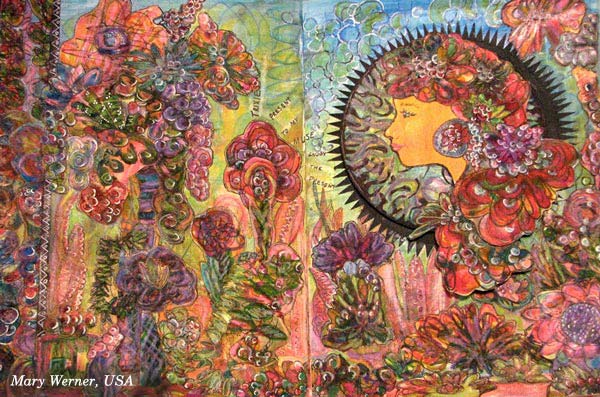
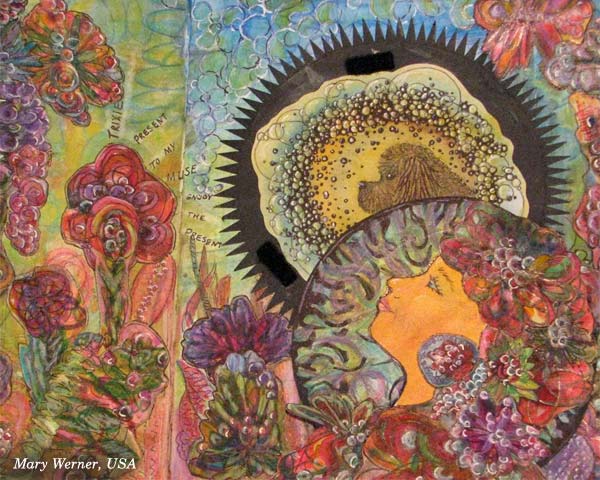
The lady has a secret, a dog who is her muse, making her to relax and take in much more than when walking outside alone. Mary has used velcro to attach the lady above the muse. Isn’t it a great idea to include a hidden mystery!
4) Spiritual Softness
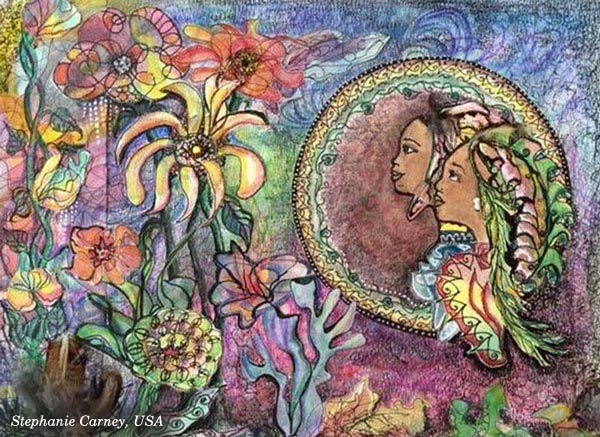
Speaking of true friends, Stephanie Carney has illustrated two sisters. I love the way they look at the flowers, sharing the same experience. Examine how softly the round frame has been decorated and compare it to others! These kinds of little nuances can communicate a lot visually!
5) Real Person in a Fantasy
Terry Whyte made her granddaughter the central person. Isn’t this spread a treasure? Combine your hand drawing with the photos and start building your own fantasies!

6) Many Sides of One Personality
Satu Kontuvuori included her cat who is a very wild character. Even if she stays still in the image, it’s like the wildly flying bird is one of her many lives. If you are expressing a personality or any subject that has many sides, you can scatter it into various elements of the same piece. That way you will focus on one theme but still express it in a free-flowing and rich manner.

7) Focal Point Balances Richness
Speaking of focus … Christie Juhasz has a trick for creating a clear focal point. See how her mermaid is sitting on a white frame! Even if the work has full of details, white circle makes sure that the main character gets noticed.

8) Movement + Space to Breathe
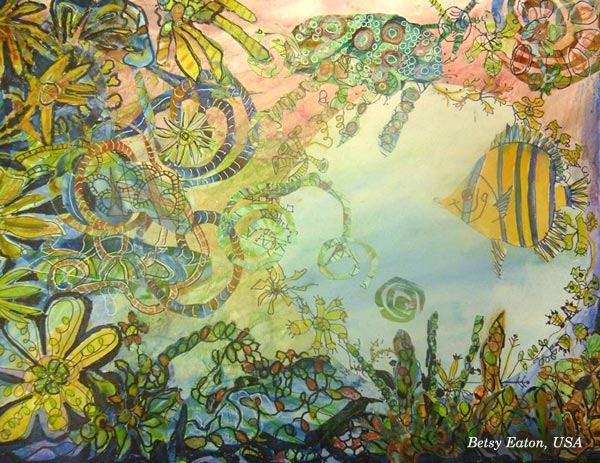
Another great example of using circles: look at Betsy Eaton’s fish and how there’s a circular space around it. Brilliant! Another thing which makes this so appealing is the movement of elements. That dynamic feel has been created by adding swirly shapes.
9) Rainbow Softness
Kathy Lewis (a.k.a KjAllison) made a gorgeous spread full of multicolored elements, like mini-rainbows. This makes me think about macro photography and dew drops! Soft transitions of colors – why not use them in your next art journal page?

Doodled Luxury
This mini-course, Doodled Luxury, was published as a part of Imagine Monthly Spring 2016 art journaling class. It’s now available individually as a self-study class – Buy here!
You can also buy all the 6 monthly classes as a bundle. I will also release the other 5 classes individually one by one later this summer, and show more ideas on how to apply them.
Start doodling and collaging, right now!