
A Fairy Called Shyeling – Finding Your Silence Instead of Your Voice
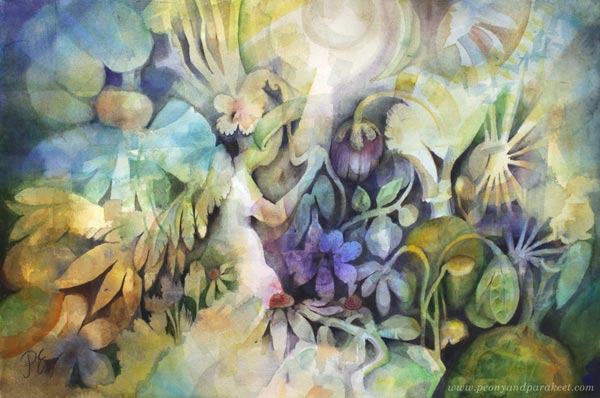
I call this watercolor painting “Ujokki” which is not a real word at all. “Ujo” means shy in Finnish. Maybe it could be something like “Shyeling” in English, expressing a timid and sensitive fantasy figure.
What Is The Shyeling?
The shyeling sees the little miracles of nature, the growth of the plants and how the light hits on the petals. She smells the soil, walks barefoot on the moss and listens to dewdrops falling on the ground. The shyeling is the most delicate and vulnerable part of us that we wish to connect and show through our art. It’s a silent power that originates from the memories and nuances rather than a loud voice demanding the ownership of the stage.
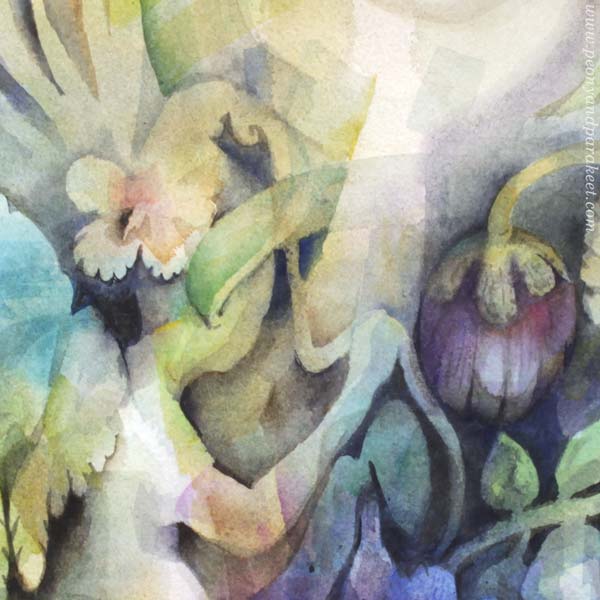
In my painting, the shyeling is pictured as a little flower fairy with big wings of imagination.
Why the Shyeling Is So Difficult to Find?
When I led IT projects and solved problems that involved different parties, personalities, and systems, the strength that I needed to possess was very different from what the shyeling has. Dealing with crises and interruptions echoed hard in my mind, and it scared my shyeling away.
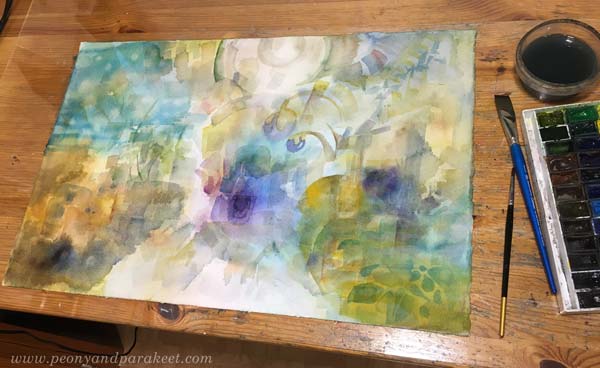
I have also mistakenly thought that shyelings are everywhere and for anyone. All my life, I have created art so that it pleases other people’s outer expectations. I haven’t even always noticed that. It’s been partly a subconscious and partly a practical thing. Shyelings don’t understand money, time, or numbers. They are weak and meaningless creatures in today’s busy world. But still, if we find ours, we don’t want to let go. We often talk about finding a visual voice, but I believe it’s more about finding our silent power.
Taming Your Shyeling
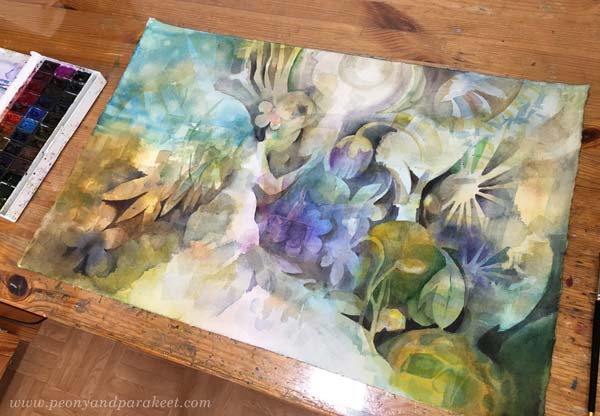
I have many paintings and drawings, where I have started to walk towards my shyeling but my impatience has taken over. The fact is that the less you have created, the longer the journey feels. But when you keep going, the destination will feel closer, and you will enter the zone where your shyeling skulks.
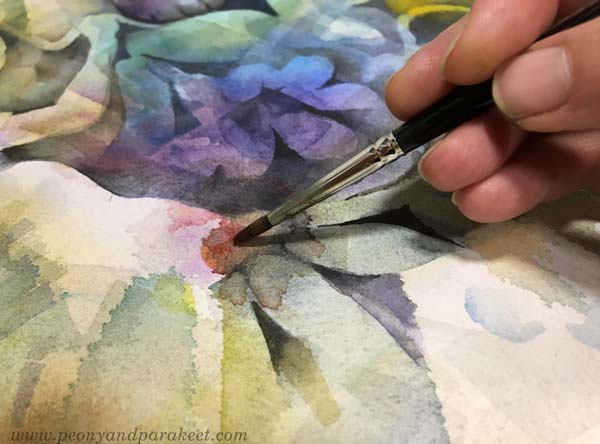
Also, remember that shyelings are like wild animals that need to be tamed. Taming needs skills, and skills need practicing. So be open to learning from other people’s shyelings. Yours might not be ready to appear from the bushes yet, but she’s been watching you, feeling more comfortable day by day.
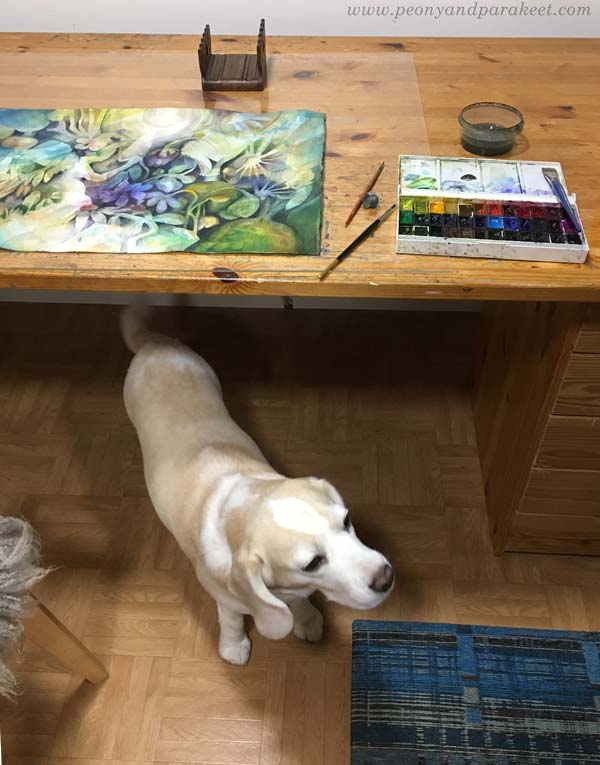
Get Closer to Your Sheyeling!
Recently, four things have taken me closer to my shyeling. First, I have stopped questioning my love for painting plants and flowers. If I like to do that, so be it. It’s not really about replicating the plants that I see anyway, but to use their shapes for creating new organic systems.
Do this: Create a piece about things that feel too familiar to you. Keep the idea process short, almost non-existent, create what you find the easiest. But, at the same time, lengthen the time that you usually take to create a piece like that. What do you discover during that extra time?
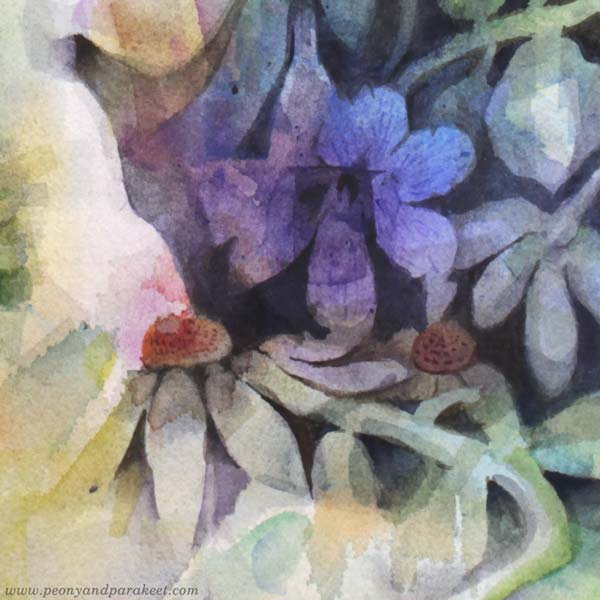
Second, I questioned why many landscape paintings look so empty to me. I found the answer from a childhood memory, always imagining nature as a luxurious place. I wrote more about this in the previous blog post.
Do this: Look at the old photos or dig our old things that reconnect you to the age when you were less than ten years old. What can’t be seen in the photos? What did you do when you were alone and nobody took pictures?
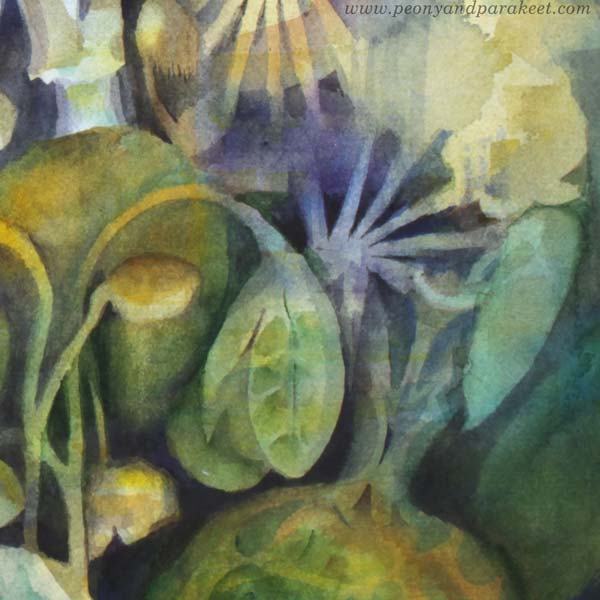
Third, I have challenged myself to become more skillful in expressing the atmosphere and space with light and shadows.
Do this: Evaluate your recent pieces so that you list things that lack there. Collect a list of things that you want to be present in your art. Then pick one thing that you start practicing more.
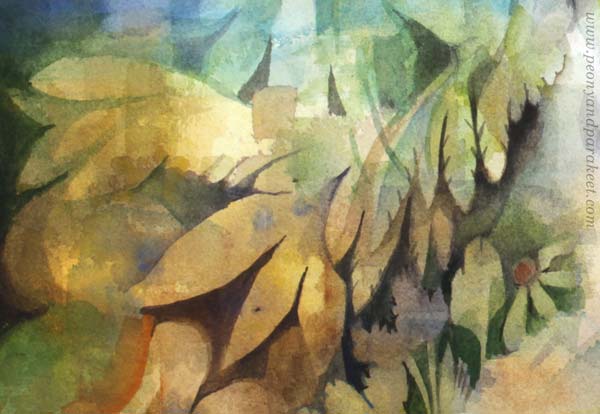
Fourth, I have practiced drawing and painting human figures without references. When I paint without references, I feel free and peacefully silent. Then there’s always a chance for my shyeling to appear.
What do you need to practice next to get closer to your shyeling?
Fantasy Forest – Combining Two Ideas in One Painting

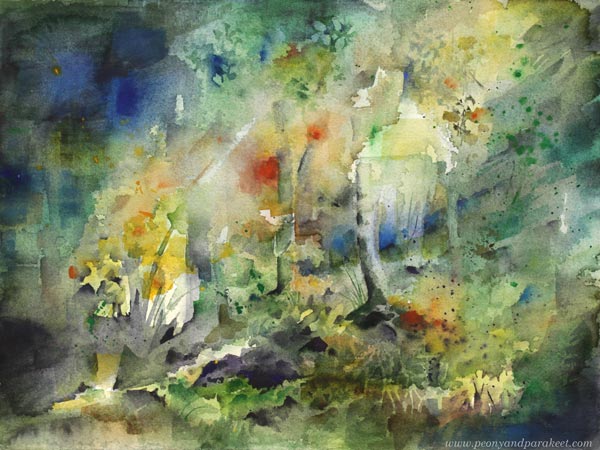
I just finished this fantasy forest! The painting is called “Once Upon A Time.” I think this will begin a series of fantasy watercolor landscapes. Recently, I have got lots of inspiration from daily walks.
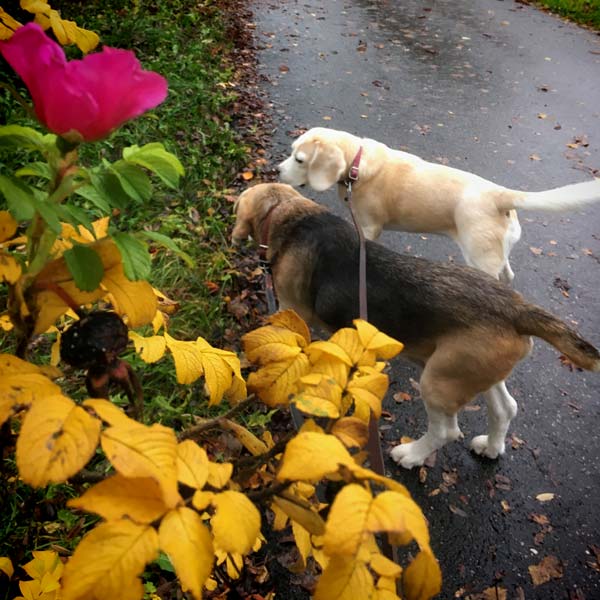
First Idea: Forest Is Like a Golden Palace
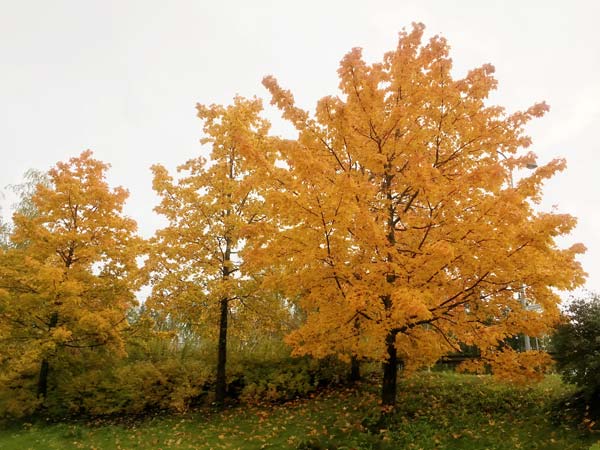
This fall has been beautiful, and I have especially enjoyed yellows and oranges. It looks like the trees are decorated with gold, and even the most modest specimens look noble and precious when the sun highlights their leaves.
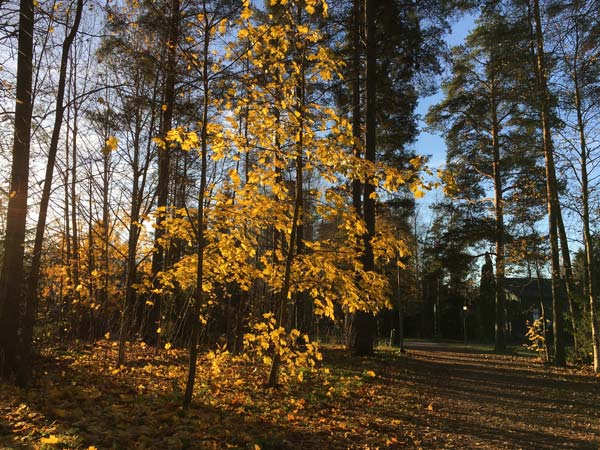
The fall sceneries took me back to childhood when I used to wander in the surroundings. Often it was an escape from boredom, sometimes from unpleasant feelings. I didn’t admire nature like adults do. I saw myself as the queen of England (because I didn’t know anything more exotic and powerful!), pacing around her palace. Trees were pillars of the luxurious hall, and the mosses were sumptuous carpets. In my eyes, every living plant became a grand artifact, contributing to my perception of ultimate beauty.
Earlier this fall, I painted this watercolor scenery that perhaps has some remains of those childhood memories.
>> Watch the video of making this watercolor painting!
Two Watercolor Painting Stations
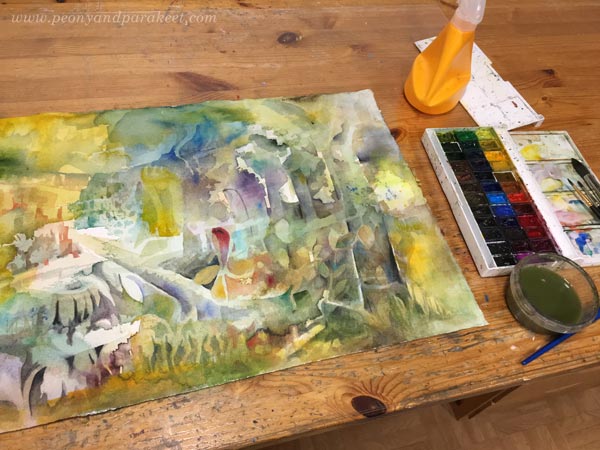
When painting with watercolor, it’s important to be patient and let the paint dry properly before adding more details on the top. I have learned that just staring at the painting and waiting for the layer to dry is not a working solution to me. I try to figure out something else to do too. This time I had two painting stations and another painting also got some layers even if I didn’t get to finish it.
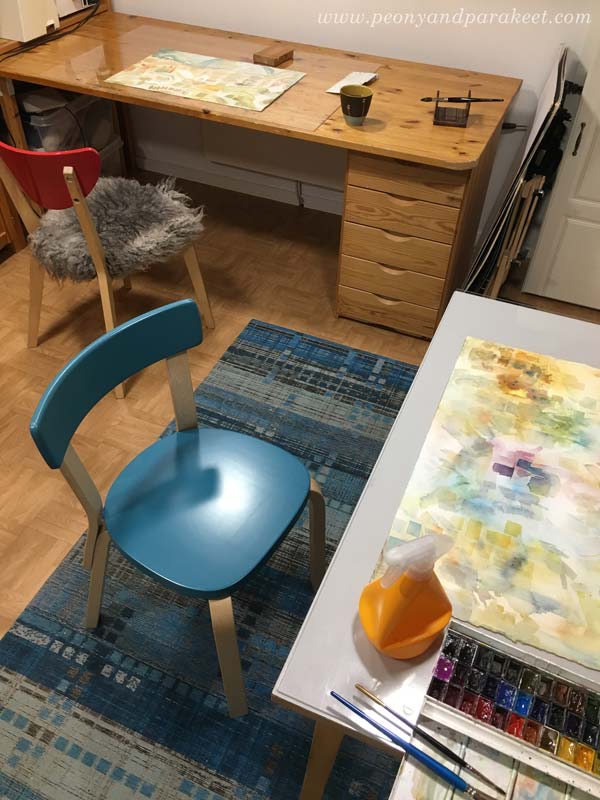
I have big plastic plates covering the top of the tables so that I can splash water quite freely.
From a Building to a Fantasy Forest
I started the paintings with simple geometric shapes and used photos of interiors as inspiration. The staircase of Palais Garnier inspired the painting of this blog post.
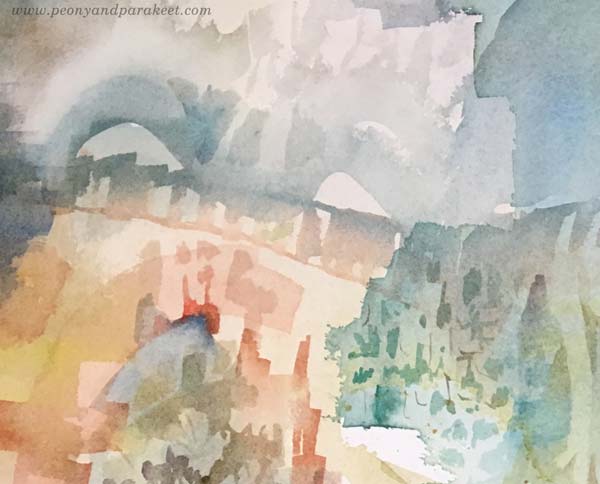
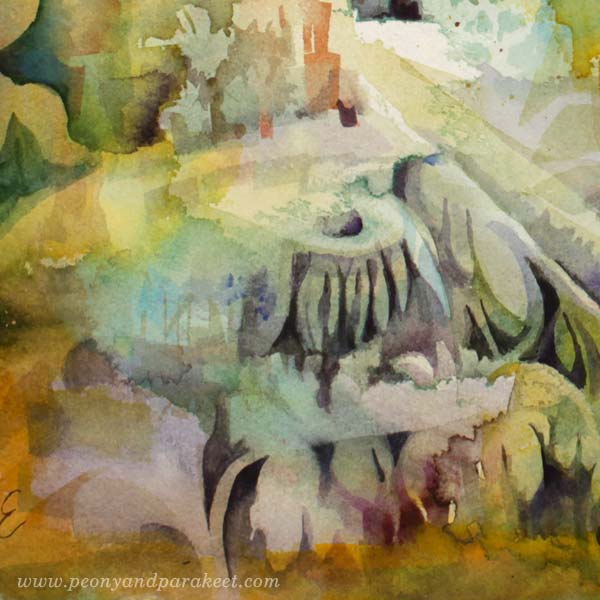
Here you see some details of the painting in an early stage. The elements are more architectural-looking than organic. Maybe because of my childhood experiences, I find it easy to see the connection between interiors and outdoor scenes. If I look at the photo like the one below, it’s more difficult for me to pick the shapes that define the 3-dimensional space.
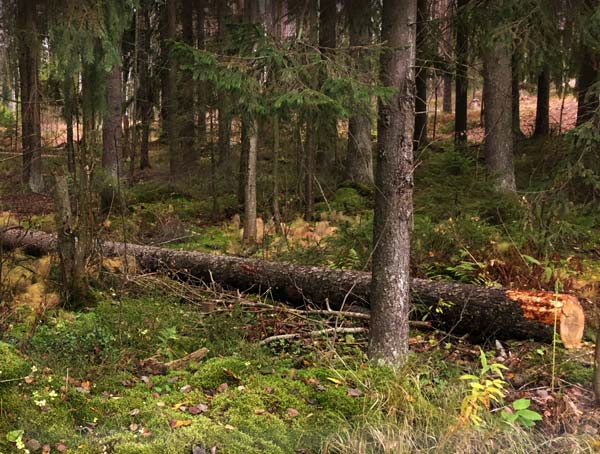
When I continue the painting, I change most of the shapes so that they are more organic.
At this point, I was working from my imagination only. I find it most freeing when I don’t have to keep any photos visible. I had quite a flow here, listening to old cembalo music and painting!
I like those leaves in the bottom corner. It’s always a bit pity when something pretty appears near the edges. I had to tone them down a bit so that they don’t steal all the attention.
Second Idea: Orchids
Orchids have never been my thing until I received my first one from Patricia, one of my students, as a birthday present. I was so impressed by getting the orchid that I learned to take care of it. When I changed the pot, I was fascinated by its roots. The months went by, and I became more and more interested in all kinds of orchids. A few weeks ago, I went to see a show organized by The Finnish Orchid Society.
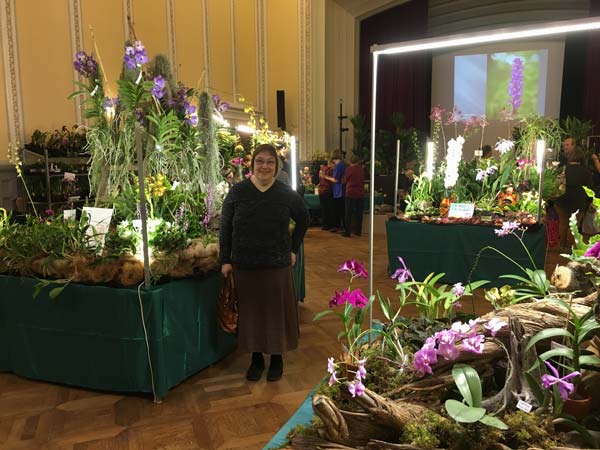
So no wonder that my second idea was to add orchids to the fantasy forest!
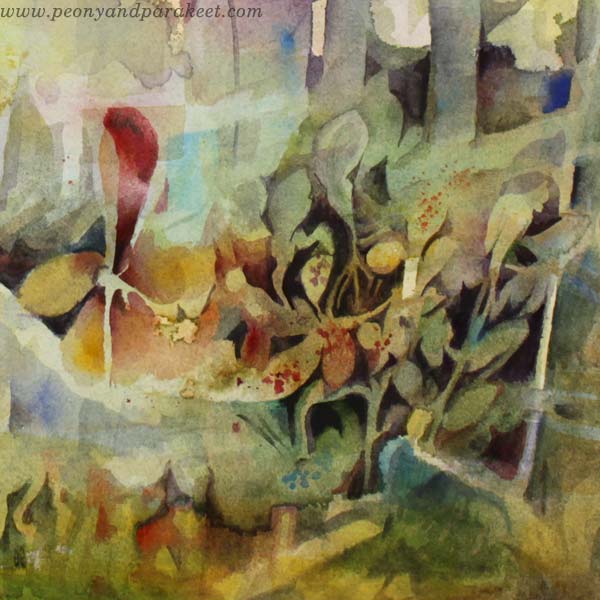
I have quite a few orchids to take care of nowadays. All of them don’t show in the picture below … These plants are as inspiring to me as the golden forests!
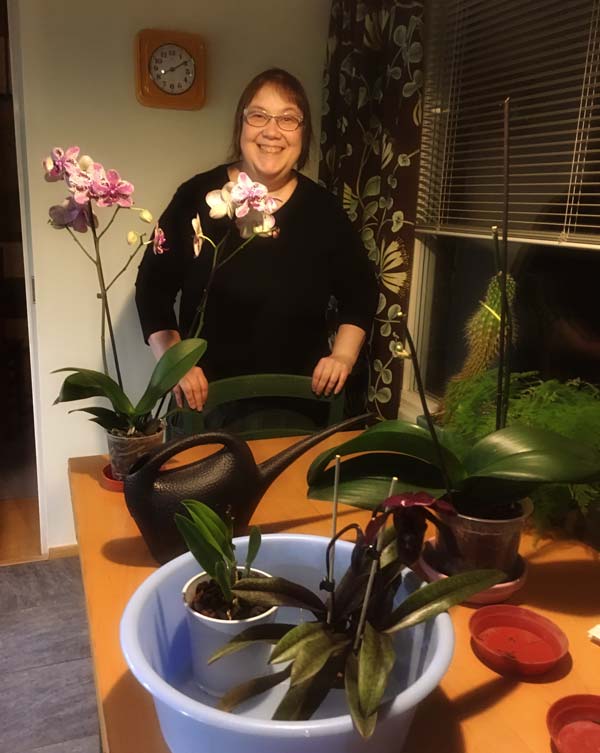
Fantasy Forest
Here’s the finished piece again, combining the ideas of seeing a forest as a luxurious place and expressing the love for orchids.
I hope this inspires you to paint a fantasy forest!
How to Use Art Prompts for Self-Expression and Creative Enjoyment
Now when Inktober is running, art prompts are especially popular. This week, we use them so that they highlight more than suffocate our self-expression.
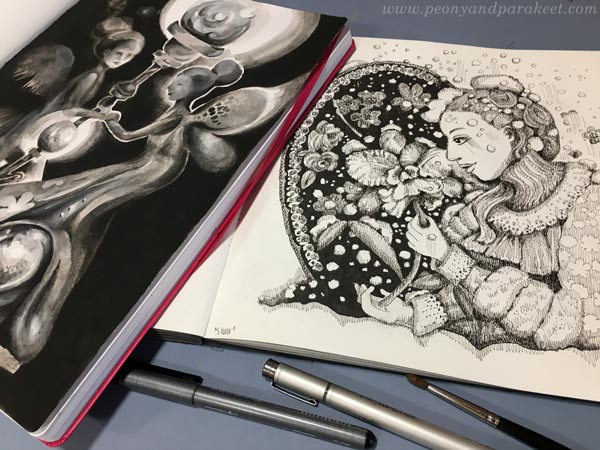
Art Prompts – Threat Or Opportunity?
Using art prompts is a tricky thing. The prompt can be your master, telling you literally what to create. You can take “Snow” and draw a pile of white stuff, and then wonder if that was fun at all. On the other hand, many say that they want to create freely from their ideas but then struggle with getting in touch with what they truly want to create.
I have been using art prompts successfully to expand my artistic expression and to become more clear with my artistic vision. For me, a prompt is a starting point to discover things I love to spend time with. I don’t just draw the first idea that comes to my mind, but process it further before I start drawing.
Ideas vs. Techniques – How to Become a Better Artist with the Help of Art Prompts?
Art blogs rarely talk about processing ideas, and in general, the discussion about art, especially when artists lead it, is very technique-heavy. But if I had to choose between ideas and techniques, my choice would be ideas. In my opinion, it should be ideas that make you learn the techniques, not vice versa. The art that is only about mastering the techniques is more like craft – it can be skillfully made, but the freedom of expression and creativity doesn’t shine through. On the other hand, we sometimes create art that is packed with emotion that other people don’t see. Then the process was cathartic, but the lack of techniques flattened the expression.
Balancing between the ideas and the techniques is not easy, and all artists struggle with it. If you focus on the techniques only, the process of creating becomes joyless and meaningless. The ideas bring back the passion for creating. That’s why I also talk about ideas in my classes.
This week, I share my ideas behind the recent Inktober prompts (days 11-18). I rate how difficult each prompt was for me between 1 to 5, how I discovered the ideas for the images, and what I learned from the process. Like last week, I have also written stories for each image, articulating my thoughts after the creation process. This post is also an example of how you can use journaling to clarify your artistic vision. Words go well together with the art prompts. If you feel the need to write as a part of the actual image, you can challenge yourself in visual expression. Think about how you could visually express the words you want to write!
Prompt 1 – Snow
Difficulty: 1 – Easy
Ideas: I live in Finland, I know snow! I was thinking about the harshness of winter and if my new orchids will survive it. I am always inspired by Russian folk art and wanted to the illustration look like a northern fairytale.
Lessons Learned: When I look at the image, my emotional reaction is strong. This is who I am and what I love to create at the moment.
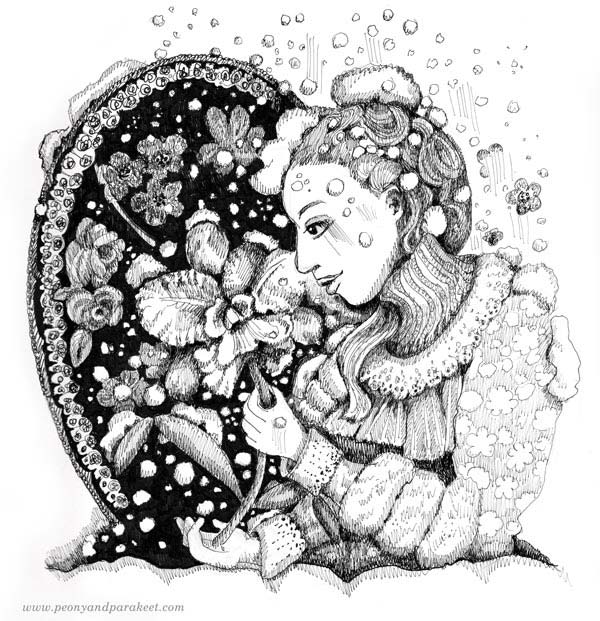
Story: Hope carries us. When times are hard, we have the need to protect and nurture. We want to find something to fight for. Even if those things are like rare orchids, freshly wounded, impossible to plant, we want to believe they can be saved. Women have the strength to give a home to a helpless. As well as the weakness to suffocate with love. Still, it is one of the reasons why the world functions, how we can cope through the snowy seasons, and why absolute compassion still exists in this universe.
Prompt 2 – Dragon
Difficulty: 4 – Challenging
Ideas: I elaborate on my challenges more in the story part below, but this prompt made me feel that it has to be done quickly and with as little damage as possible! So I picked my sketchbook and found a face, painted with watercolors, and decided to made it look like a dragon. The agony disappeared once I started drawing, and I really enjoyed adding horns, scales, and all.
Lessons Learned: Drawing can be a role-play or a dress-up party where I can stretch my perception of myself.
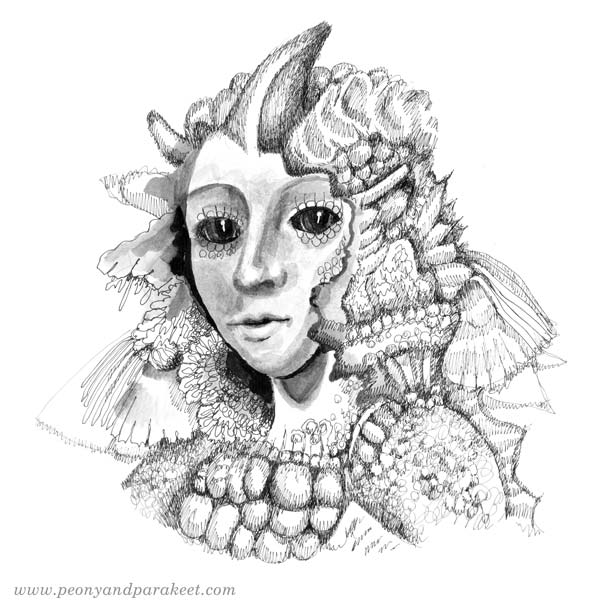
Story: This prompt has been the most uncomfortable for me so far in this year’s challenge. I do like to draw animals, but I haven’t seen myself as the one who draws dragons. I realized that I was also questioning whether YOU want to see any dragons either, and every time I begin to overthink what I should or shouldn’t draw, there’s a creative block that I must overcome. So, I wanted to show myself that yes, I can be the dragon lady. I don’t just create art to protect and admire what I love, but to become open to new adventures. I had a lot of fun drawing this one, inspired by Renaissance too!
Prompt 3 – Ash
Difficulty: 2 – Normal
Ideas: Ash reminded me of the Phoenix bird, and I wanted to include some orchids too. My original idea was just to make a woman rising from the ash, but I accidentally drew the thumbs on the wrong side of the hands! Then I remembered cupids from old paintings and added the two little girls so that the hands are theirs. I really like those two mischief-makers.
Lessons Learned: Working with the non-erasable media stretches creativity and mistakes can take the work to the new level. The processing of ideas can happen also while creating, not only before.
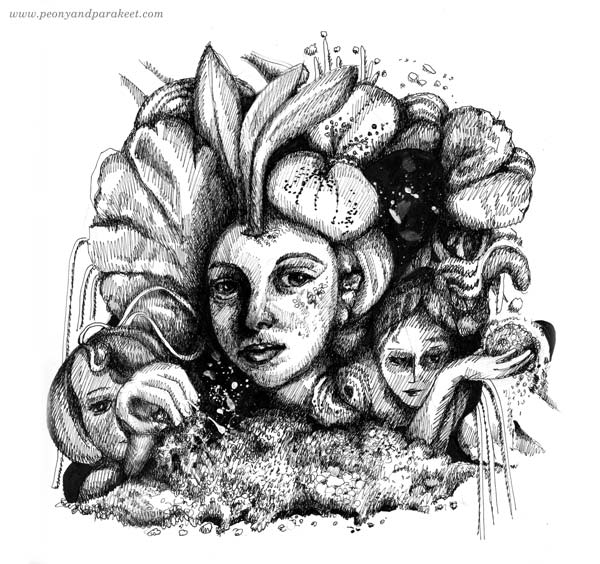
Story: We are all mythical phoenix birds. When one era ends, another one begins. About 10 years ago, I had a long row of African violets. Then a few years later, I fell in love with Streptocarpus flowers. Now they are gone, and I am beginning a new era in my hobby of growing houseplants – the era of orchids! So my love for plants is regularly reborn. Do you recognize this kind of rebirth in your life?
Prompt 4 – Overgrown
Difficulty: 1 – Easy
Ideas: One of the easiest prompts for me! The image came instantly to my mind, and all I had to do is to draw it. I wanted to make the hands, legs, and wings for the playful fairy so that they are very plant-like.
Lessons Learned: I need to draw more fairies. It’s funny that I haven’t ever been drawn to them before this year, and now I am really fond of them! I guess I have found my way to interpret their playfulness.
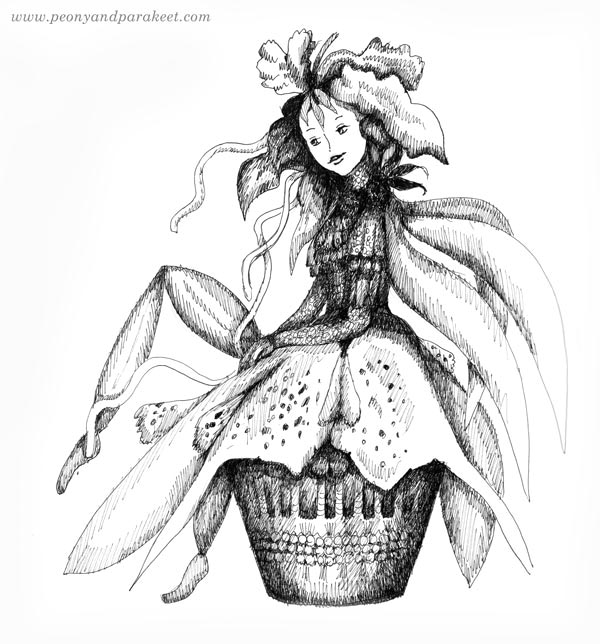
Story: I used to think that when my art grows, it will become deeper and deeper, reaching the remotest end of fine art. But during the past couple of years, my images have become more humorous, playful, and illustrational. It’s been surprising to notice that the same building blocks and ideas that could express the agony in the world can be used for making illustrations that include hope, even childishness. I cherish this child in me, and I want her always to grow bigger than her current pot. And at the same time, I want to protect her from becoming so big that she stops seeing life’s little pleasures.
Prompt 5 – Legend
Difficulty: 5 – Agonizing
Ideas: I hated the prompt. It made me think about photo-realistic images of Marilyn Monroe and old rock stars which are not my favorite art at all. Then I tried to approach the subject from the story-perspective, and all that I could think of was Robin Hood, King Arthur, and other similar historical stories that didn’t inspire me. I realized that I needed to pick a legend that I truly appreciate, and Jane Austen came to my mind.
Lessons Learned: I really like this illustration! There’s a lot of elements, but their hierarchy is so clear that the image is easy to look at. It was perhaps because I started the sketch in the evening, but finished the image the next morning. All the ideas that I had, fell in place during the night.
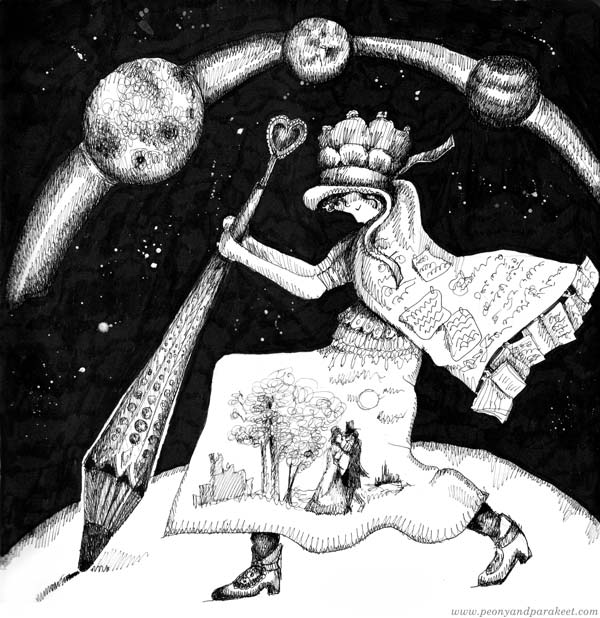
Story: Jane Austen is one of the most famous women in history. Do you think she predicted that? Did she know her books would make an impact on the world for hundreds of years? But there she was, alone with her thoughts in late evenings like creative people do, planning her plots. Her life was just a blink of an eye in the universe, but still, the cosmos echoes her name. Generations after generations, we have a human bond with her – no matter how linear time feels and no matter if we really even knew what she looked like.
Prompt 6 – Wild
Difficulty: 2 – Normal
Ideas: Because the prompt is so general, I just picked an inspirational image from my Instagram archive, and started from there. The image was a photo of an old clock, and it reminded me how the sense of time disappears when creating. So I made the clock look like it floats and falls apart, and followed my intuition for all the other elements. The couple on the left corner probably came because I have been watching Dancing With the Stars while drawing!
Lessons Learned: I like to express movement and create surrealistic illustrations. It makes me feel free, and sometimes it’s important to focus on the process of creating rather than controlling the result.
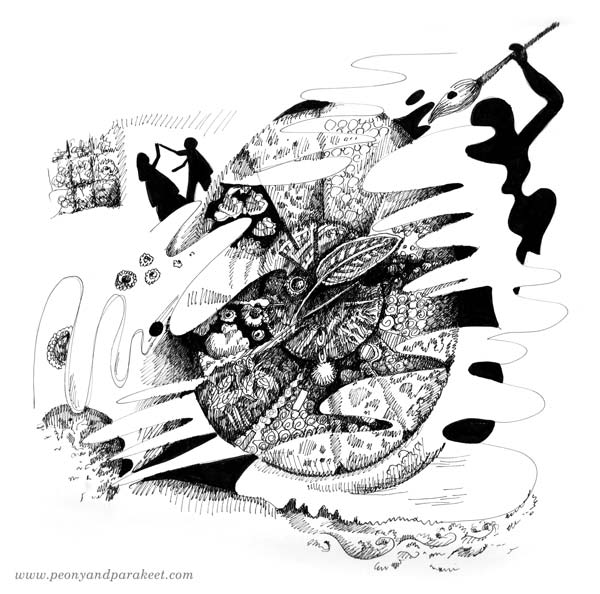
Story: There’s a place in your mind where everything gets mixed, where nothing stays static, and where rules are broken. What you can’t do is only other people’s false assumptions. The way they define drawing – or any other skill – doesn’t matter anymore. You are in a place where all is wrong and thus so right. Time flies, and you live forever. Go wild and get creating to travel there!
Prompt 7 – Misfit
Difficulty: 3 – Hard
Ideas: This prompt was for Friday, and I want Fridays to be a bit more light-hearted than other weekdays. So I wanted to make a humorous illustration that would start the weekend in a cheerful mood. First, it felt a bit challenging to combine the prompt with the humor. I love to draw women in historical dresses, and it made me think about how romantic mind and everyday chores are a definite misfit!
Lessons Learned: The empty space can be used to highlight the message. Here the composition is built so, that the romantic steps toward the past (to the left), the butterfly scene directs the eye towards her face and lower lip, and the empty space highlights the bucket. The bucket and the emptiness of the horizontal scene created by the hem are central to the message. It took a couple of extra sketches to get all the elements in place.
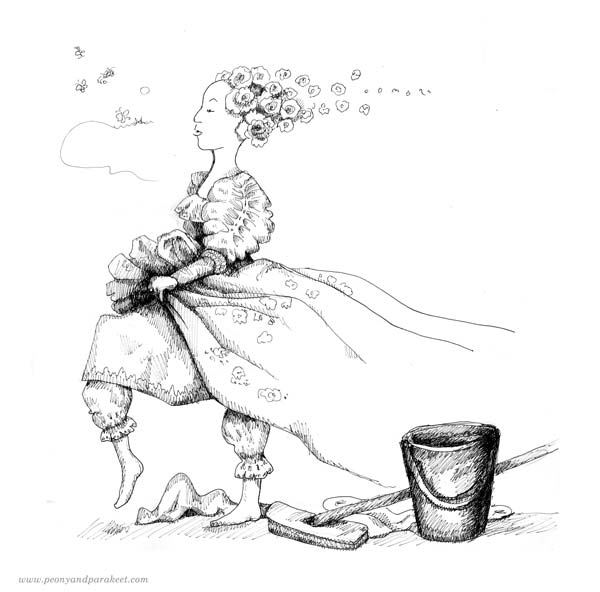
Story: Sweeping, scrubbing, dusting … Misfit chores for artistic souls like us, at least today!
Prompt 8 – Ornament
Difficulty: 2 – Normal
Ideas: I have been drawing ornaments quite a lot lately, and I love it. Every time I design an ornament, it makes me feel like I am doing something that I am meant to do. It’s probably because it’s so close to my studies in engineering and industrial design. This time I wanted to make an ornament that’s not symmetrical, and that would also express a personal story.
Lessons Learned: Many of my ideas easily take the form of an ornament, and I would also like to teach making them! (Would you be interested?)
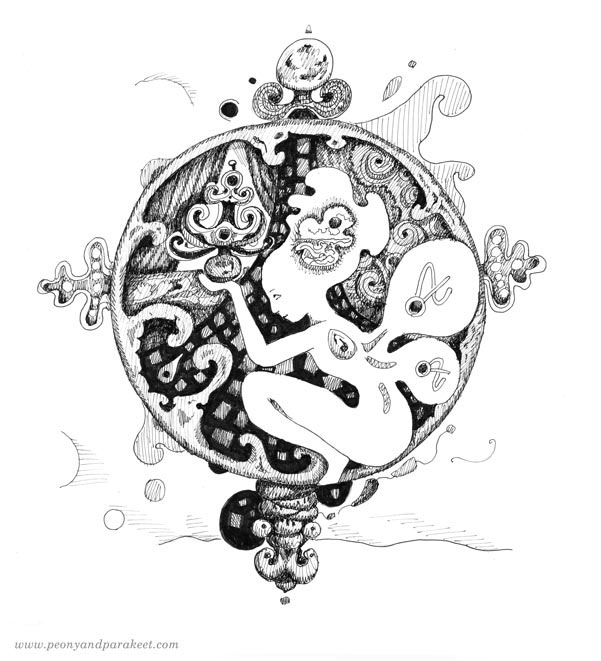
Story:
This prompt is especially close to my heart. It reminds me of how important it is to become the true self. When I studied industrial design, I realized that my expression was too ornamental. “Simplify, simplify,” my teachers said. Plastic stuff that we were taught to design has to be manufactured as cheaply as possible. But I took another route and geared towards art. Ten years have passed by, and I still struggle to accept how ornamental I see the world.
But that’s how it is. To me, an ornament is a time machine. I can travel through the history of humanity by merely picking shapes of any era. It also brings me closer to my roots. My grandfather studied drawing, and my father drew to me when I was a child. These two men passed away a long time ago. I never got to see my grandfather, and I wasn’t very close to my father. But now there’s this strange yet pleasant feeling of being who I am meant to be. I continue the chain of generations, fulfilling not only my dreams but also my father’s and grandfather’s secret wishes. These people enabled me the life I am living, and I am giving back to them by drawing and designing – being as ornamental as I can be.
Repeating Art Prompts – Another Version of Ornament
Difficulty: 2 – Normal
Ideas: I started working with the prompt “Ornament”, but then realized, that this one is a more time-consuming piece. So I finished it for Day 19, instead of making the official prompt of the day. The idea became from art deco table lamps. They often have a statue that holds the bulb. I didn’t use any reference for this one, and lately, my drawing skills have grown so that I have drawn a lot without any references. I enjoy that a lot!
Lessons Learned: This one started as a quick sketchbook drawing, but I got hooked about the idea and made it a gouache painting, black and white, in the spirit of Inktober. The paper of the sketchbook (Leuchturm A4) wasn’t suitable for wet media, but I finished the painting anyway. My gouache paints were Arteza in colors Noir and Titanium White. Noir wasn’t pitch black but more greyish tones. The cheap paints usually have white to lower the price. The process would have been much more pleasurable with the art supplies of better quality. It would be best if the idea, the technique, and the choices of supplies would serve each other!
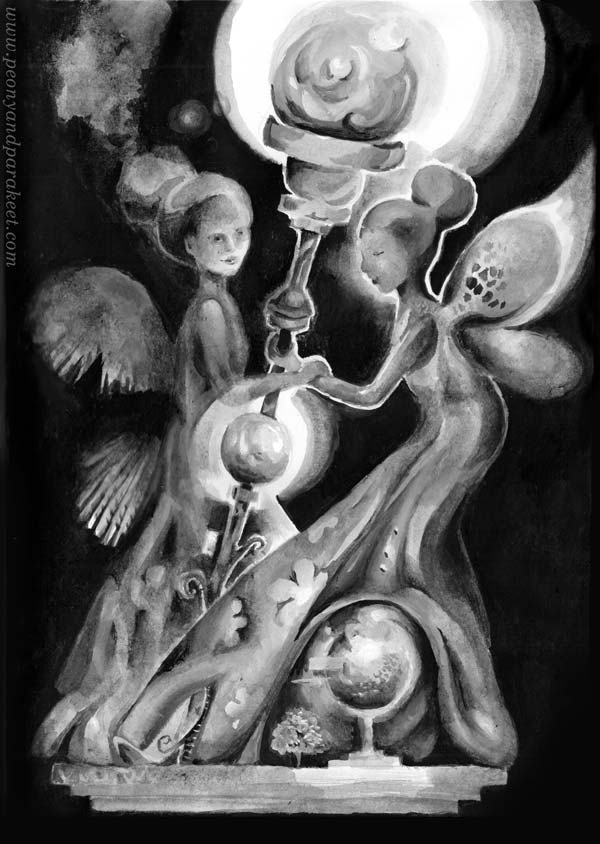
Story: I call this “The Guardians of Imagination” and it is to our soul sisters in art. They keep the lights of imagination switched on, and support others to do the same. They bring the best of the past times to this day, so let’s thank them, and let’s be sisters to them as well.
This painting is my last contribution to this year’s Inktober. I am currently working on a big illustration project, and want to focus on finishing it next week.
More About Art Prompts
Here are some older blog posts that you might want to check out too.
Experiences from Inktober 2018 when I finished all the 31 prompts:
The best art prompts of this blog:
- Fort the lovers of Matisse, Kandinsky, and other 20th century artists: 13 Prompts for Expressive Art
- 10 Rococo Art Ideas for Creative Romantics
- Guiding Word – Choosing and Visualizing Your Word of the Year
Let’s keep creating, my soul sister in art!
Between Fine Art and Illustration – Combining Both Into One Artwork
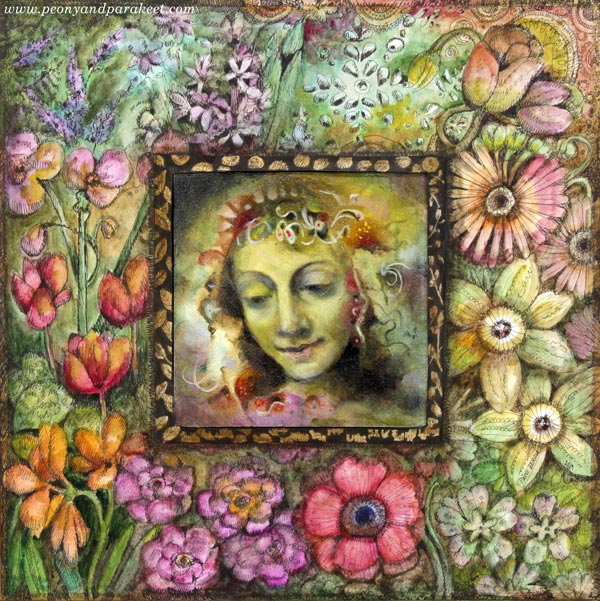
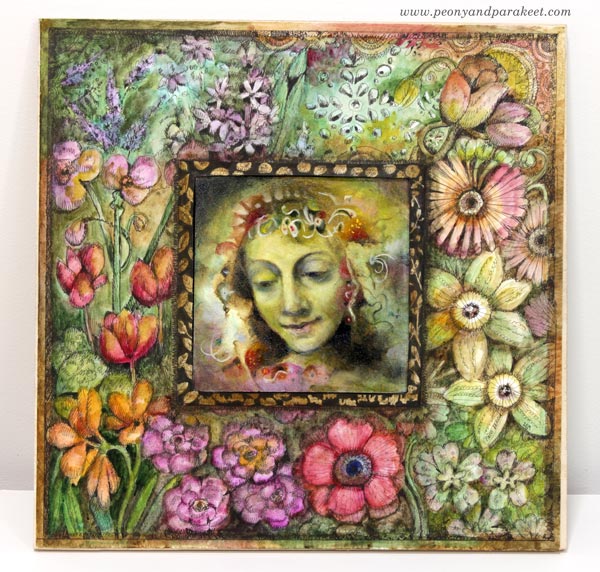
This week, I continue showing pieces that will be presented in the upcoming group exhibition “Flower Gardener’s Diary” (Kukkatarhurin päiväkirja, 9.- 22.9.2019, Hietsun Paviljonki, Helsinki). This one is called “Flower Fairy’s Year.” I will be presenting both paintings and drawings, so I wanted to create a piece that would build a bridge between fine art and illustration. I hope you find this project inspirational!
Inspiration Piece: Wheel of Fortune
When building the class Magical Inkdom earlier this year, I made a fun drawing called Wheel of Fortune. It has a center that’s separate from the rest of the piece, and it can be rotated so that the heads of the figures change. The bigger drawing is attached on thick cardboard so that it feels like it’s a game board, not just a flimsy piece of paper.
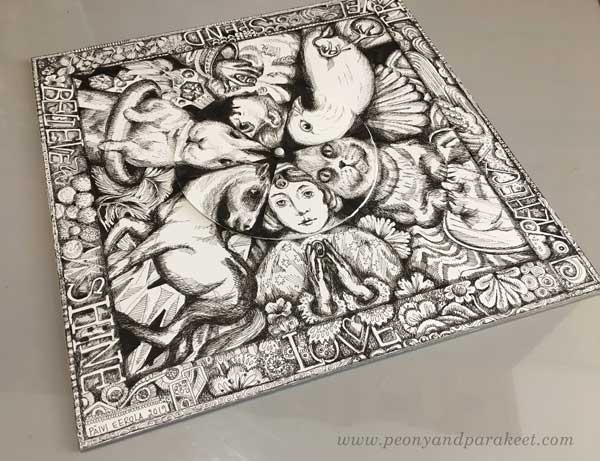
I wanted to use the idea of a separate centerpiece and sturdy base for this project too.
Fine Art Centerpiece: A Miniature Oil Painting
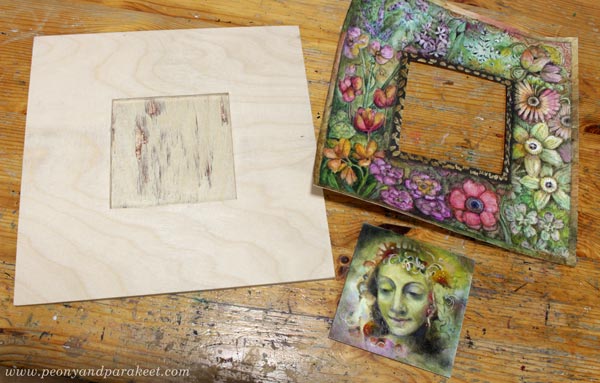
The project started by finishing a miniature oil painting that I suitably had in progress. It’s only 4 by 4 inches.
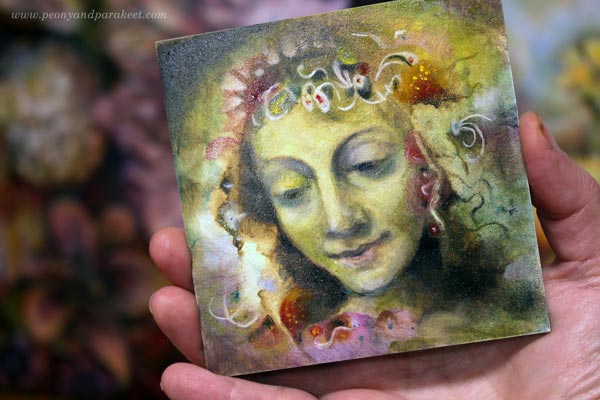
The painting was made very traditionally. I sketched the face with charcoal, and then made an underpainting with umber and white. I used Bernardino Luini’s portrait of Saint Catherine as a loose reference for the facial features.

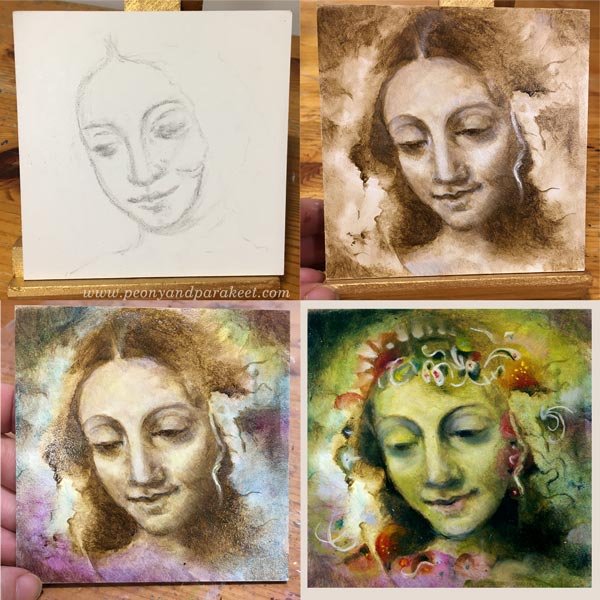
The color layers were thin so that the previous layers stayed visible too. It took a bit of courage to give a green wash to the face, but I really like the result. Decorations were easy and fun. They are quick lines and shapes that make the saint look like a floral fairy.
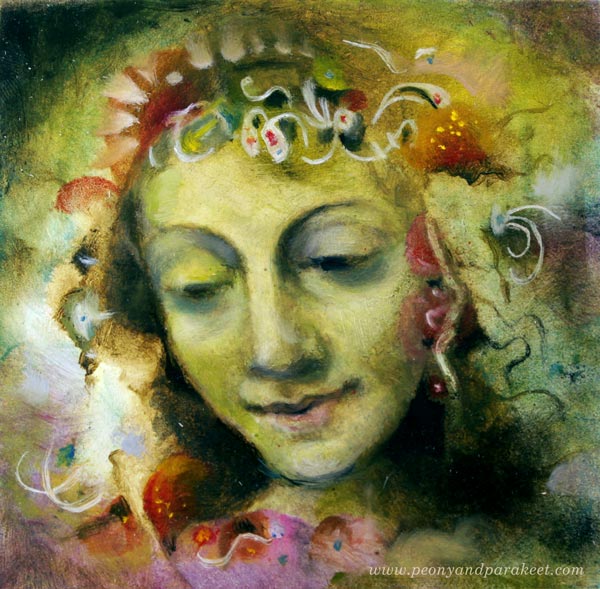
With oil, the most difficult thing is to wait for every layer to dry separately. Other than that, I find oil easier to handle than acrylic paint.
Illustration: Decorative Flower Frame
For the frame, I cut a piece of Bristol paper. It’s about 10 by 10 inches.
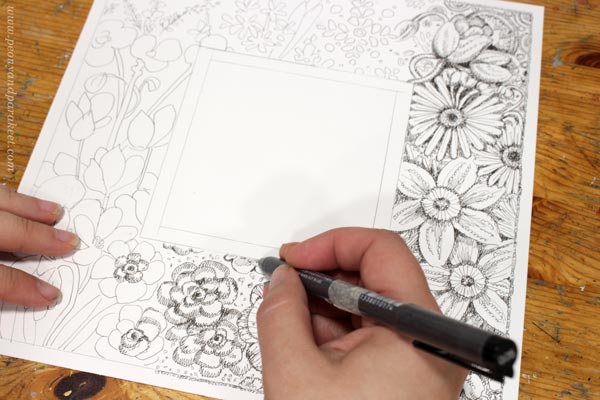
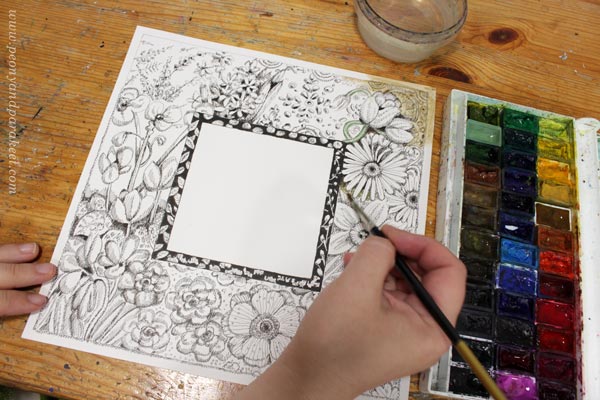
I wanted to include flowers from January to December so that the frame is like a clock that has months instead of hours. The drawing was made with Copic Multiliners (I mostly use 0.05 tip), and I colored it with watercolors.
Plywood Base
My original idea was to cut two layers of cardboard so that the topmost layer would have a 4-by-4-inch hole. But when I told my husband that “Ideally, the base would be wooden”, he went to his workshop and came back with a hand-carved plywood base!
Putting All The Pieces Together
I painted the plywood black near the surroundings of the miniature painting. It makes sure that the plywood won’t show if the piece is observed from different angles. I varnished the oil painting with Gamvar and let it dry overnight. I put a plastic plate over the frame to reduce the curviness of the paper after painting it with watercolors.
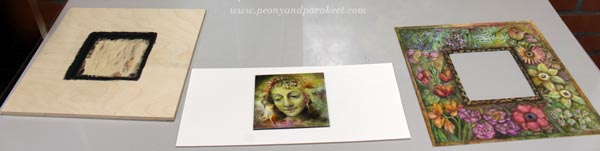
Then I glued the painting to the base with gel medium and attached the frame with double-sided tape. Finally, I marked a line of 0.5 cm from the edge of the base and made sure that the motifs extend there. This piece will be professionally framed, so I didn’t want to leave too much empty space around the edges.
Between Fine Art and Illustration
In the art world, there’s a lot of talk about choosing between fine art and illustration. Many define fine art so that it comes up solely from the artist’s own creative expression when illustration illustrates a story or can easily be used with the text. One way to separate them is the number of copies. Fine art pieces are often unique or manufactured in very limited quantities only when illustrations are more of everyday art, consumed by the masses. Some say that it requires talent to create a piece of fine art, and just art education to create a piece of illustration.
In my artistic path, I have found the definitions both helpful and destructive. It has been essential for me to expand to illustration – to learn how to visualize text and written ideas. It has made me more connected with the surrounding world, and it has also brought me more work. However, I feel that art is free, and without exploring that freedom, it’s also difficult to create insightful illustrations. So I have tried to keep up with both worlds.
However, I hate when people say that you have to choose between fine art and illustration. For me, bringing the two approaches as close as possible has been a working solution. I think this project shows really well how one is not the enemy for the other.
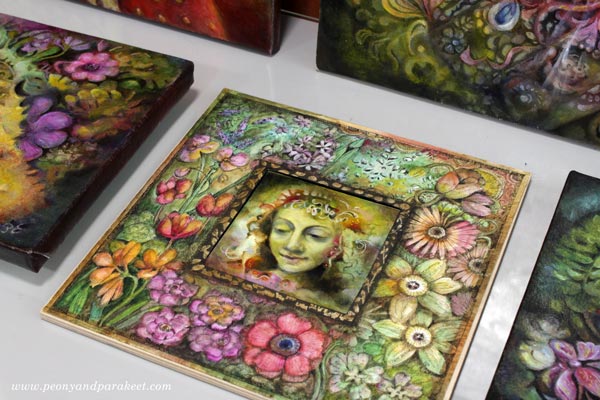
I can’t wait to show you more pieces that I have finished for the exhibition! I will also have many framed and will blog about how I selected the frames in the upcoming weeks. Stay tuned!
Come to draw fantastic art (+ fantastic frames) with me –
Sign up for Magical Inkdom!
Right after the registration, you will get all the lessons, and you are good to start drawing! >> Sign up here!