
Painting Small Wildflowers
This week, we explore the beauty of small wildflowers and find what we can learn from nature when painting them.

>> See more pics at the Taiko Online Art Store!
I had a small blank canvas that I wanted to paint on before Midsummer. I did it with acrylic instead of oil because acrylic paint dries faster and you don’t have to wait days for the layers to dry.
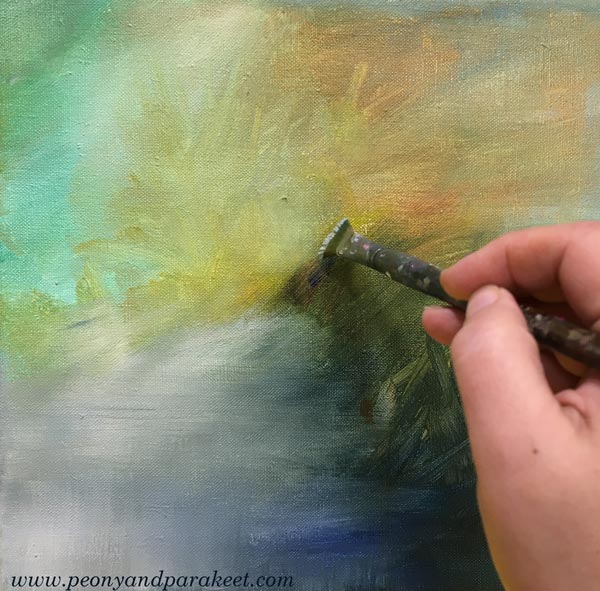
My idea was simple: wood geraniums – or do you call them cranesbills? In Finnish the plant is called “metsäkurjenpolvi” and they bloom everywhere now in June. We have them in our garden too, but I mostly study them on morning walks. As a child, they were my favorite flowers when it comes to wild flowers.

Even if I sometimes take photos of small wildflowers, I don’t want to paint from reference pictures, but freely. I can check the structure and shapes of flowers or leaves from photos, but if I start copying the exact detail, my expression stiffens. It’s like my head begins to ignore my heart, and that’s never good for art-making.
Starting with Big Brushes
At the beginning of the painting process, I don’t even know exactly what I want to express. The mood of the painting grows little by little and when I start, I’m clumsy and quite careless.
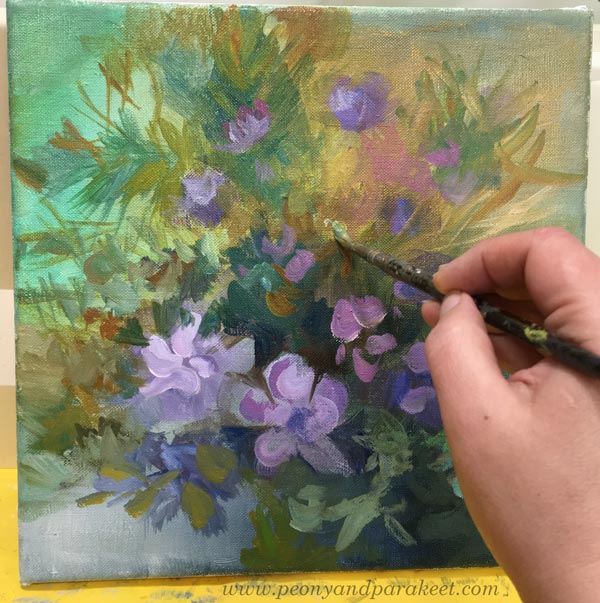
It’s actually pretty quick to make a nice little flower painting if you only think about one plant and don’t aim for anything else. But these days, I don’t want to leave any painting at that level. I want to offer more to look at and combine many observations in the same painting.
Here’s my painting from Day 1 to Day 2. The right lower corner didn’t change much, but the center and the right upper corner changed a lot. And the painting became more detailed.

Some paintings are great with the more abstract and loose touch. But here, I wanted to express the delicacy of small wildflowers and honor their tiny details. I also wanted to make the painting look more natural.
Beautiful Mess with Thin Strokes
Nature is wild and messy. We easily overlook that beautiful mess when we look at wildflowers in a meadow. Our eyes pick out our favorite flowers, and we don’t see all the other plants that are trying to get in the way. Grasses come to the front of the flowers and intersect everywhere. There are endless layers of plants if you look at the view as accurately as possible. Even when looking at this photo, did you notice all that layering?
It seems contradictory that the more romantic and spiritual I want to paint, the more I have to open my eyes to the reality. I need to paint those hays over the pretty wildflowers and let the nature make a beautiful mess in the canvas too.

Small Doses of Conflicting Colors for Flavor
In nature, the colors also get mixed with each other, and there are reflections and conflicting tones. So, even if the number of colors in the painting is limited, you always have to find a small dose of some different tone to spice it up. For example, add some bright red to make the purple flowers delicious! Similarly, cold greens need brownish tones.

In Finland, Midsummer is a big celebration. The nights are white now in the end of June and you can admire the flowers without going to sleep at all.

Paint abstract florals in acrylics with me: >> Buy Floral Freedom!
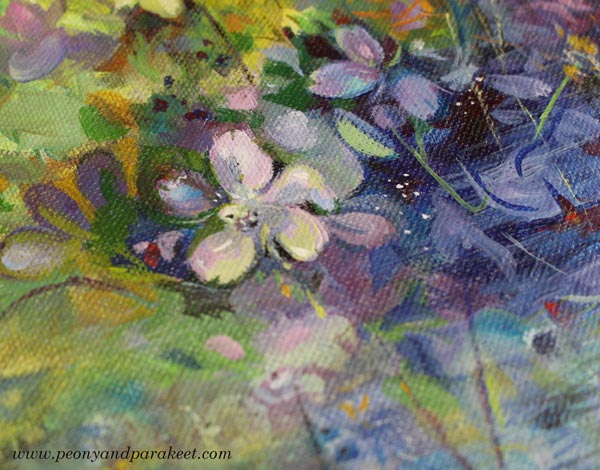
With these pictures, I wish you a wonderful Midsummer and lots of joy in observing and painting tiny treasures – small wildflowers!

Painting small wildflowers – Could this be your next art project?
Coloring an Intuitive Selfie
This week, we draw an intuitive selfie, so without a camera or a mirror. Let’s pick the colored pencils and create a self-portrait freely and intuitively!
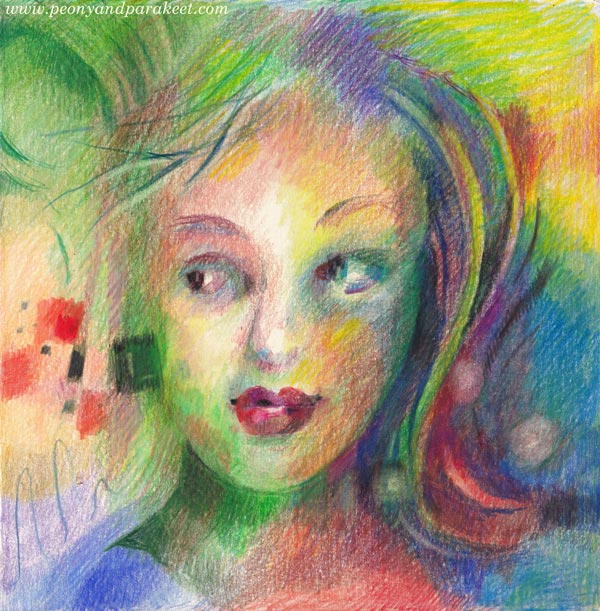
We use the pencils as a camera and draw the face as it’s a photo taken from the inner world’s view. At the same time, we explore blurriness, freedom, and asymmetry. Watch the video!
Coloring an Intuitive Selfie – Watch the video!
I am creating my page on the Dylusions Creative Journal (Square, 8 by 8 inches) but you can use any paper and any size.
In the video, I talk about the difference between doing coloring pages and coloring a blank page, and how I have processed my word for the year “Release”.
Inner vs. Outer Selfie
It would be great to hear your thoughts on becoming freer and making an imperfect intuitive selfie. Leave a comment below!
Summer Watercolor Art with Origin and Attitude!
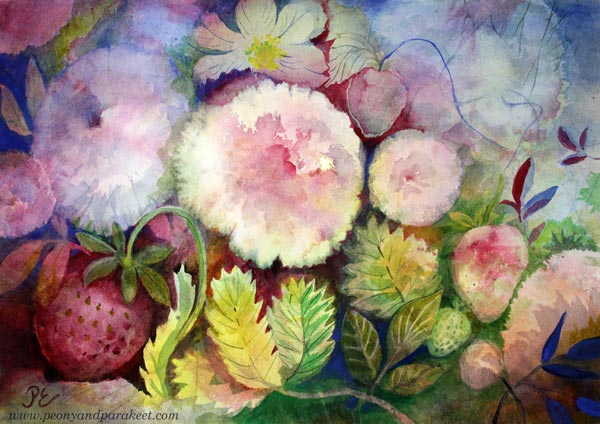
This week, I talk about creating summer watercolor art so that it’s fun and interesting. The season that you currently have doesn’t matter. It’s all about finding your origin and attitude!
>> See more pics at the Taiko online art store!
Although the seasons influence my paintings, I mostly want to paint summer. In winter I yearn for summer, in spring I plan for summer, in summer I live summer and in autumn I remember summer!
Starting Summer Watercolor Art
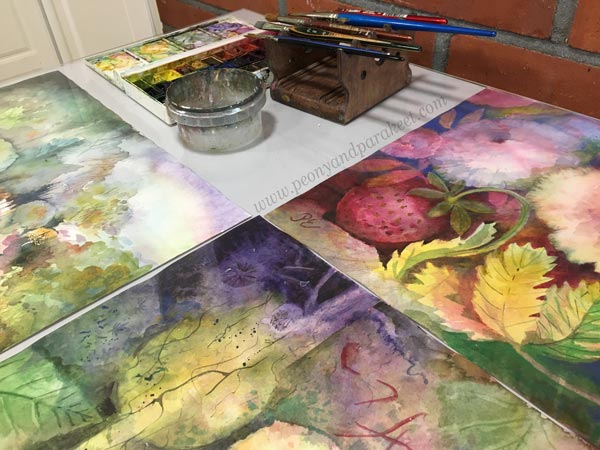
The best summer month in Finland is July because it’s warm and of course, has peonies and strawberries like in the painting. But when I started the painting, I had no idea what would come up. There were just splashes of color and plenty of water.
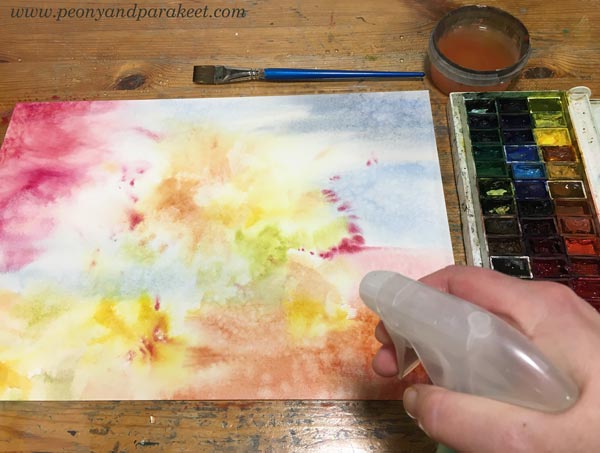
I like my summer watercolor art to have this kind of intuitive foundation with exciting randomness.
Finnish Summer
Peonies bloom at the turn of June and July and that is also when the best strawberry season begins. Finnish strawberries are really sweet, because the Finnish summer ripens them slowly. As a child, when asked for a favorite meal, I answered: Strawberries and whipped cream. I guess I was quite a romantic already!
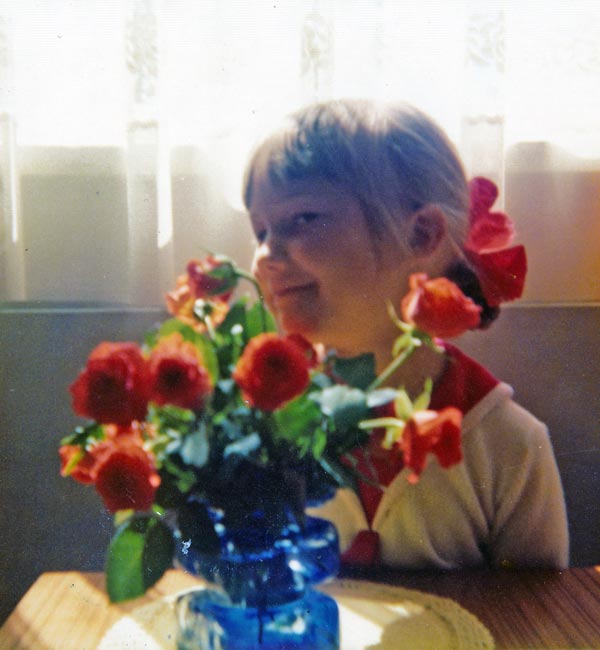
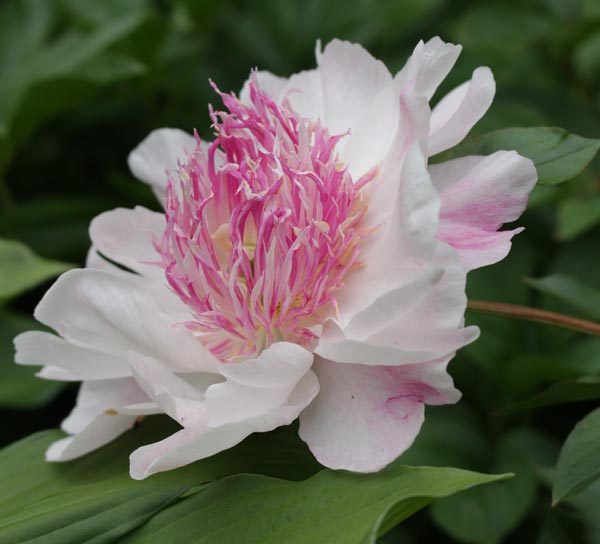
Peonies are my favourite flowers and I have written a lot about them on this blog. Our garden has over ten different peonies and I am eager to see them bloom. I hope that winter has not disciplined the most delicate varieties too much.
In summer, everything turns upside down: frost turns into heat, darkness into light, heavy turns into light, and light turns into heavy. Summer makes the big picture blurred and the details become more important. What felt heavy in winter is hardly remembered in summer. And small moments, even small irritations, become more noticeable in summer. This must be the effect of continuous light.
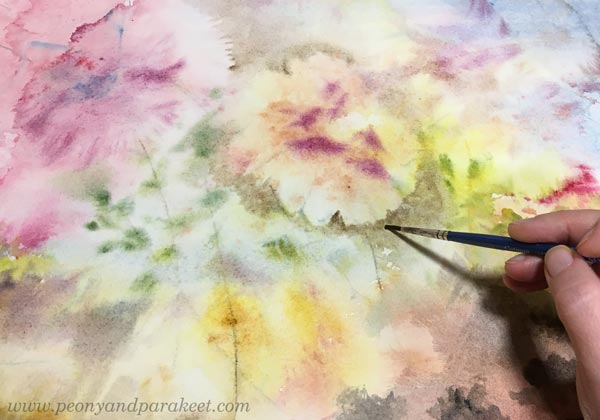
I know foreigners who come to Finland in summer with eye patches. But for me, lack of sleep and summer go together. I am done with the pitch-black winter when morning sleep is still deep. The boring black-and-white sceneries are finally replaced by the rich colorful details that is food for my paintings.
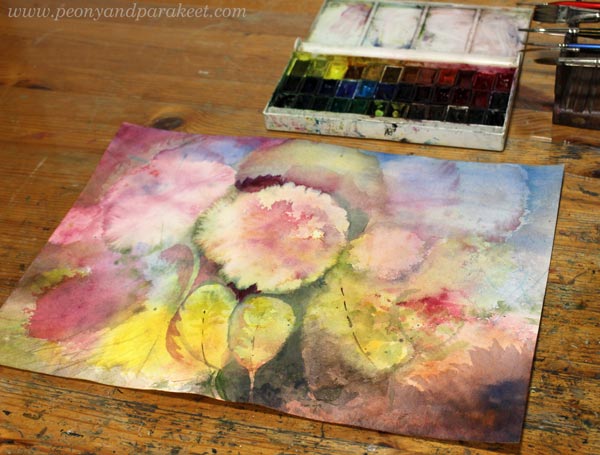
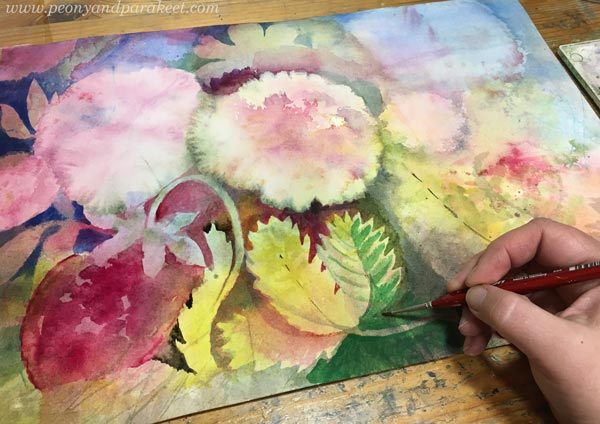
Look how the leaves changed when I started adding details!
Finnish Simplicity vs. Central European
When we visited Amsterdam in May, we went to the Antiekcentrum, which is a huge antique flea market.
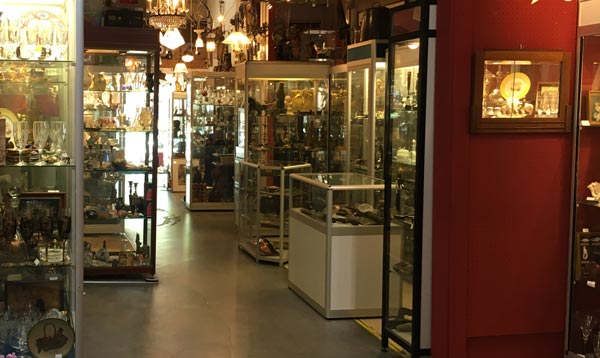
If there were a place like that in Finland, it would be full of Nordic design from the 1900s to the 1950s. Finnish high culture has a short history and our taste is a much more simplified version of Central European styles.
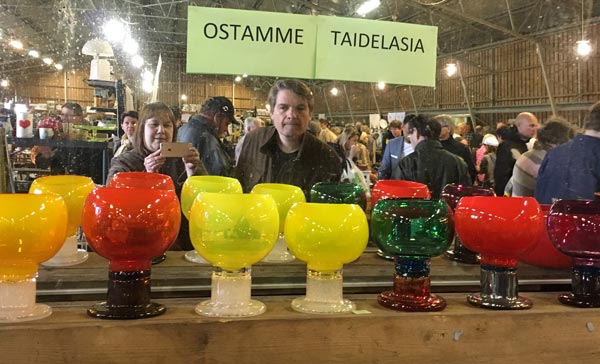
Our straightforwardness is not only in design, but it’s everywhere in Finland. We speak directly, often too directly, and value simplicity.
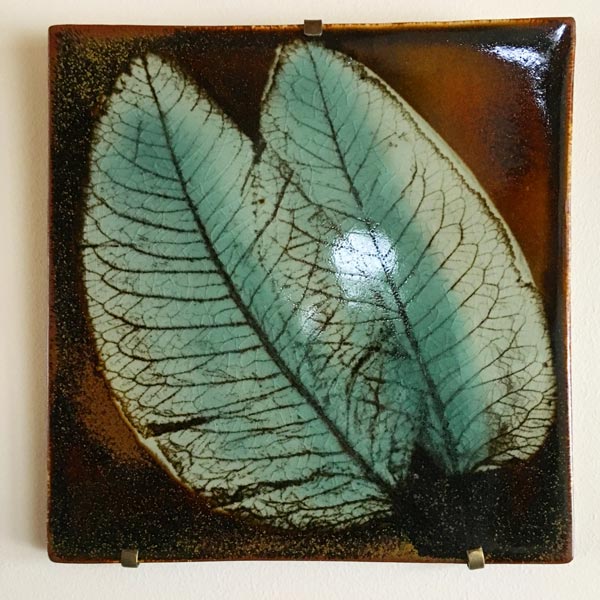
But despite the yearn for simplify, Finland is full of hidden romantics. The inner world of the seemingly rude people can surprise you. Our connection to nature is so immediate that not only strawberries and peonies but all the nature’s treasures creep into our souls so that we are not separate from them. Finnish people are confusingly simple and at the same time enormously diverse.
Details Make Any Peony Your Unique Peony
After the trip, I am increasingly aware that this is a part of Finland and Finnishness that I want to convey to you through this blog and my courses. I am aware that even if we share the love for art, we all have a little different point of view if we pass the big picture and turn our attention to the details. So, nuances in visual language and vocabulary!
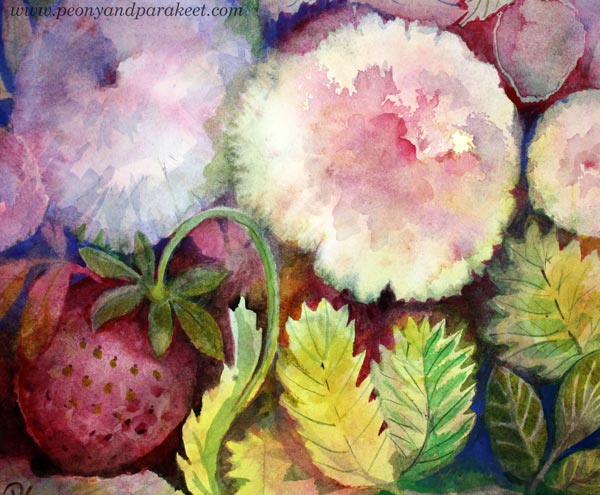
If you look at the world as a big picture, your art becomes too mundane. When a peony is just a flower, art-making gets boring like Finnish winter: “How to draw a peony,” you will google and then draw a picture that has nothing unique.
Instead, think about your origin and attitude! Surrender to the details and let the heaviness of the earth and the lightness of the sky immerse you in what you draw. Maybe there’s a cloud who dreams about staying still, and a peony who dreams about seeing the world from the sky. By taking the creative attitude, the strawberries can grow bigger than their stems can hold.
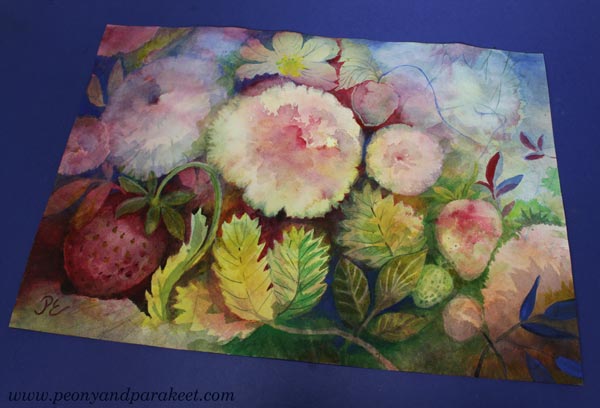
Of course, these are just examples. My point is that in art, you can change everything and make anything possible when you:
- know your origin: Find what already grows in you!
- stretch the idea of any mundane thing: Allow imagination and empathy!
- work the details long enough: Give time for your creativity to find you!
What do you think?
P.S. I am currently recording a new course about watercolor painting. It’s an independent sequel to Freely Grown and focuses on the idea of building a visual vocabulary.
Visual Vocabulary First, Style Second
This week is about visual vocabulary and how to widen it.
I often hear the worry about finding the style, but more rarely about widening the vocabulary. Style is a quality word, but vocabulary is more about quantity. Still, it’s as important, and you can’t find the style without growing the vocabulary!
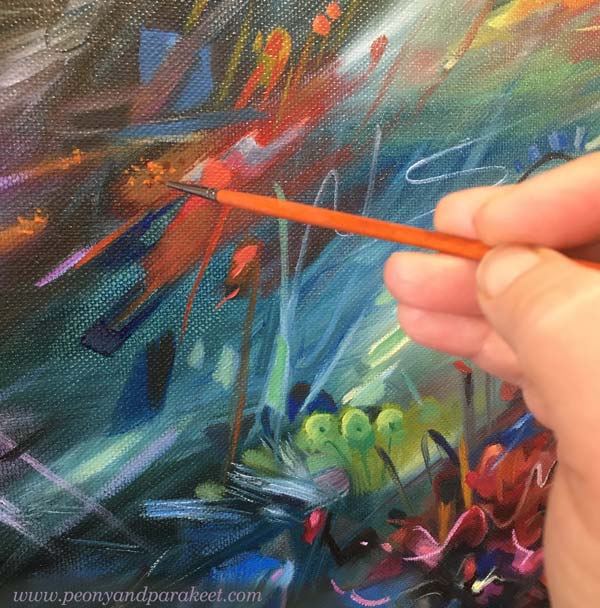
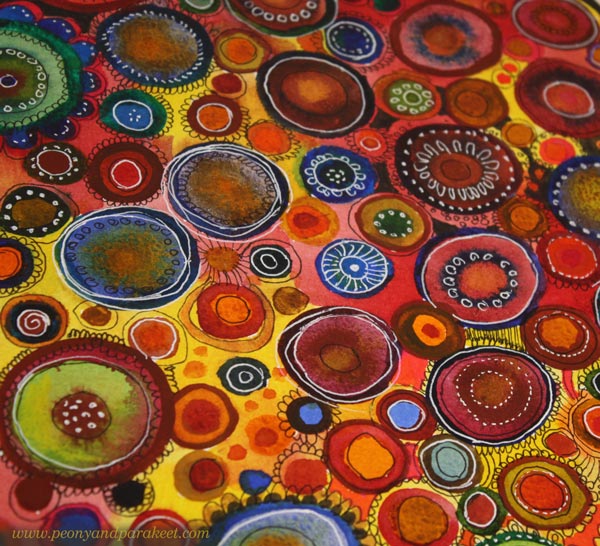
Often when we create art, we use a limited variety of shapes and lines and often the most ordinary ones. For example, your strokes may be quite straight and have very little variety in thickness. Or your shapes can be mostly basic geometric shapes. When I started, I mainly drew circles and my pieces were very symmetrical in general.
Forget the Style, Grow the Visual Vocabulary!
When you want to widen your visual vocabulary, look at the details of your work. There are seeds that can grow into great things. For example, could you repeat a random spot that almost disappears into the background and build a subtle texture from it?
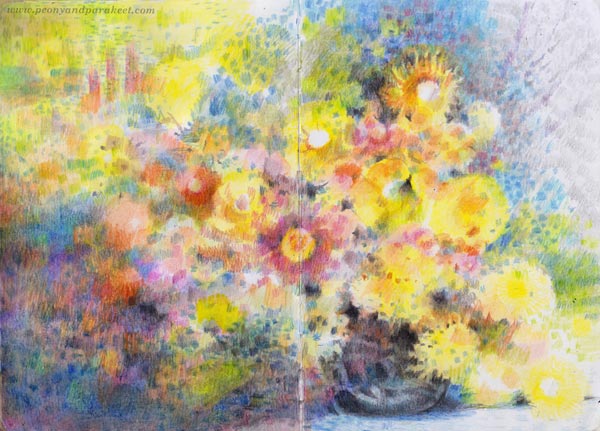
Look at your drawing line and think about whether it could deviate slightly from its path. Could you make a notch somewhere and thus make the shape more interesting?

Imagine you are a child who knows only a few words. Then it’s not important to question what the topic should be, but to find more words to tell any. Stop worrying whether you should create faces or landscapes and make a wide range of art to grow the visual vocabulary.
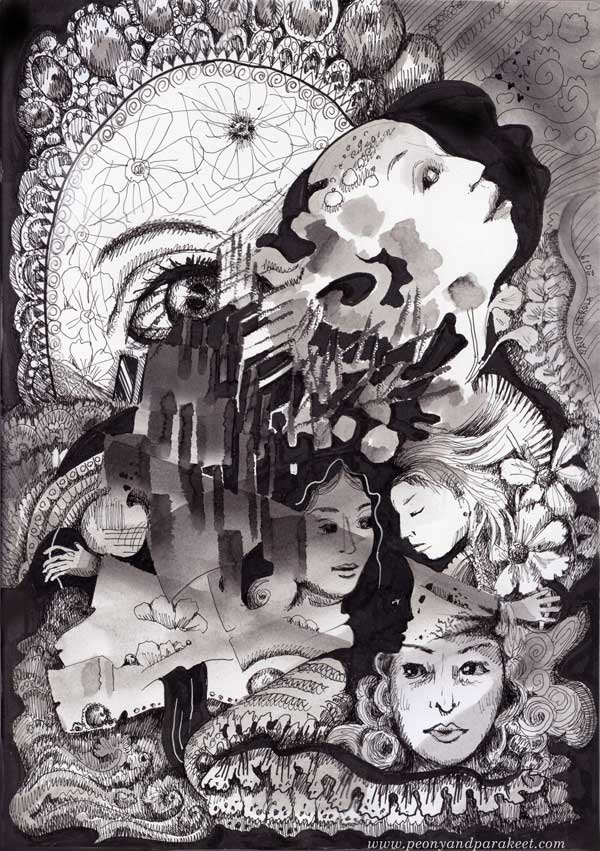
When you can draw a wide range of shapes, curves, lines and have many ways to color, repeat, break up and assemble them, you can produce visual stimuli on the paper that makes your imagination work. From this collaboration, art is born.
Outer Inspiration – Borrowing “Words” from Others
By looking at art, you can find words, i.e. shapes, that you want to incorporate into your own vocabulary, i.e. style.
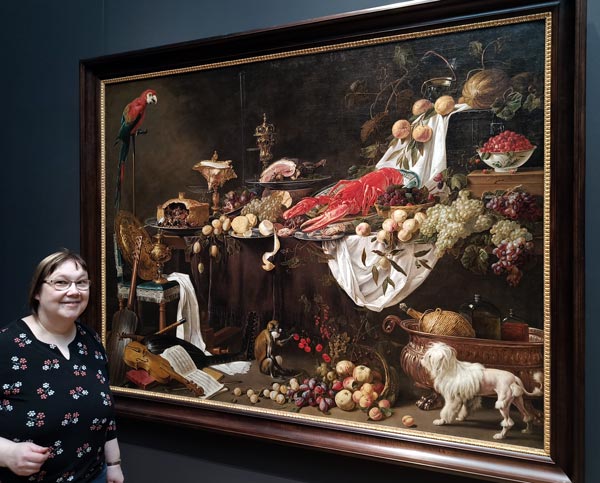
Art history is like an encyclopedia where we can pick what we like. Any art can be seen as abstract – just focus on finding a variety of shapes and colors.


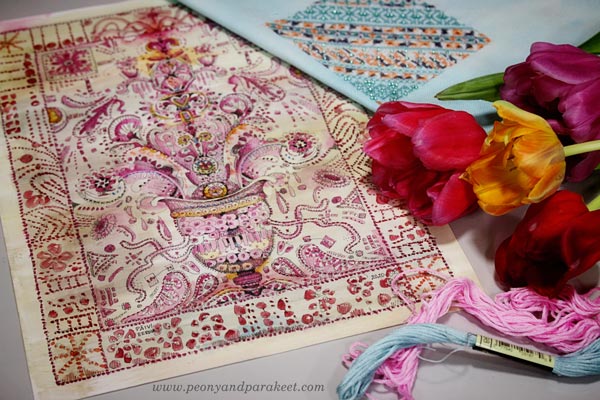
Your vocabulary can be inspired of not only fine art, but crafts as well.
Imagination Sets Who You Are
Too much outer inspiration causes copying, so don’t leave your imagination out of the equation! Imagine you are a singer who takes a popular song into your repertoire. Then you enter a singing competition and are told: “You sound a lot like the original singer of the song, but we want to hear who you are.”
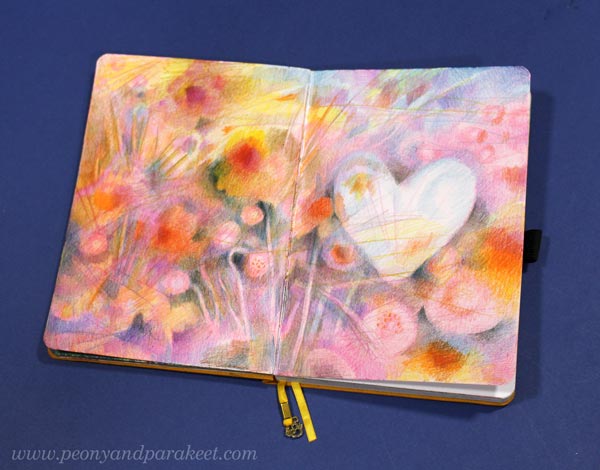
So we need not only to expand our expressive language, but also to develop our imagination. Visual vocabulary and imagination are a pair, and art needs both.
For example, you can draw a circle and give it a meaning, but can others see it? With imagination alone, the expression remains hidden. With a rich expressive language, we can make art enjoyable for others as well.
Welcome to My Courses + What I Want to Teach
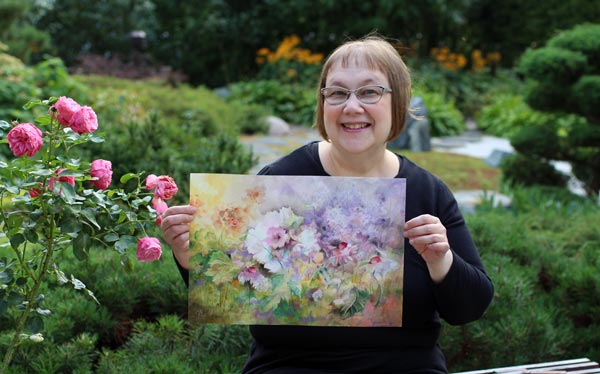
The goal of my courses is to develop both your visual vocabulary and imagination.
First, I want to get you to draw something a little differently than you have done before and thus enrich your visual vocabulary. Second, I want to make a crack in your everyday thinking and plant imagination in it. I want you to ask: “What if?” and to respond with something completely crazy – something that makes you feel free to tell completely new kinds of stories.
When art emerges from this starting point, richly and vividly expressing itself, you will find your style.