
Maximalist or Minimalist? Style Experiments in Art Journal Pages
This week, we experiment between maximalist and minimalist styles.
Every time I open one of my art journals, I feel a sense of relaxation. It’s time for experimentation and risk-taking. In art journals, failure can also be success. Page by page, I learn to know myself better and thus, express things that can also be relevant to others. Now I wanted to experiment with style and picked my Dylusions Creative Journal for that.
Maximalist – Multiply!
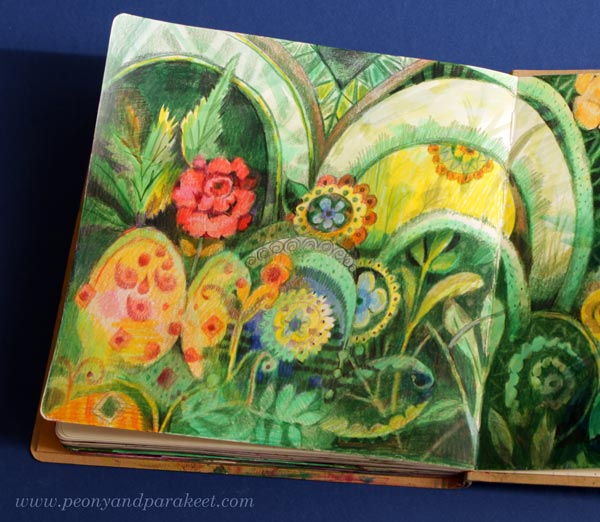
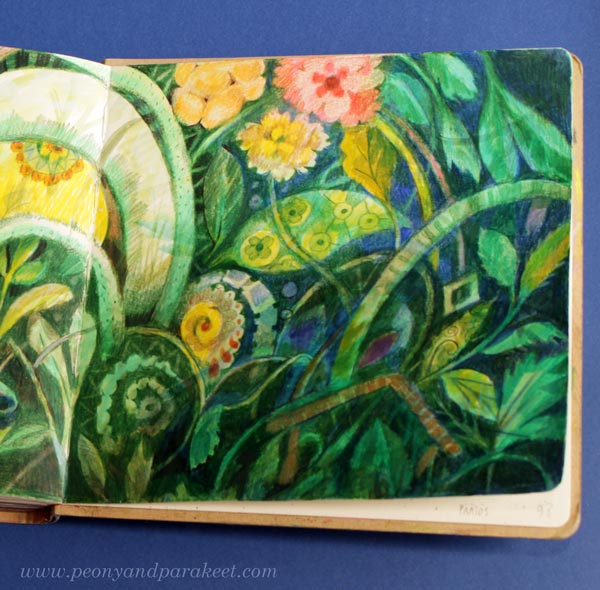
I know that I’m more of a maximalist than a minimalist, so I started with that and made a spread with the principle of “more is more”.
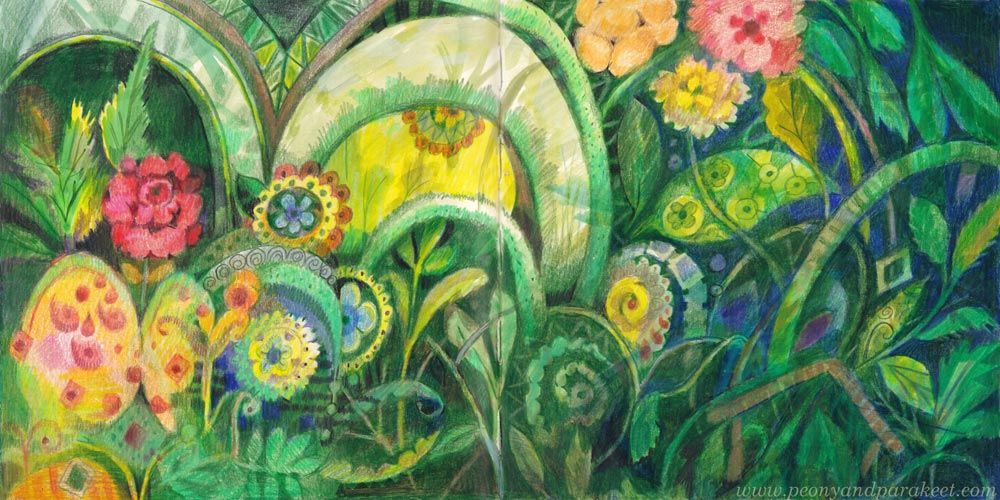
I’ve started to be fascinated by buildings, both exterior and interior, and here too motifs began to create a sense of space as they turned into ornaments.
It was so fun to add a new detail on top of another that I forgot to take more pictures of the different stages, but I started with watercolors and soon moved on to colored pencils.
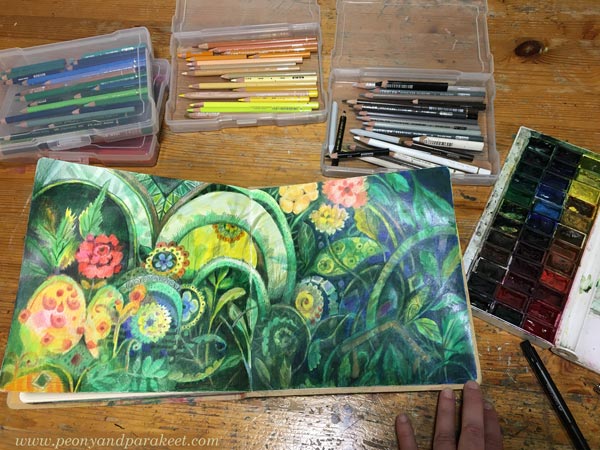
I’m fascinated by abundance and luxury. I connect that with the courage to be brave and let it all out. When I feel like that, the maximalist style is born effortlessly.
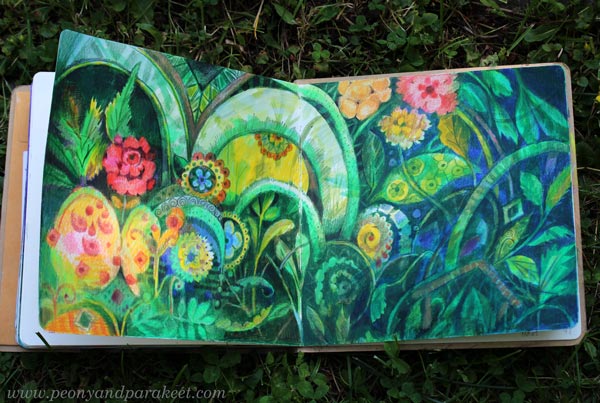
Adding details and dividing one shape to many can be done over and over again. I could have refined my drawing even more!
Maximalist or Minimalist – Adult or Child?
For me, maximalism is associated with adulthood and minimalism with childhood, although many probably think the opposite: that as a child you sprawl and as an adult you can prune. But when I look at my childhood drawings, I can say that my poor drawing skills made me a natural minimalist as a child.
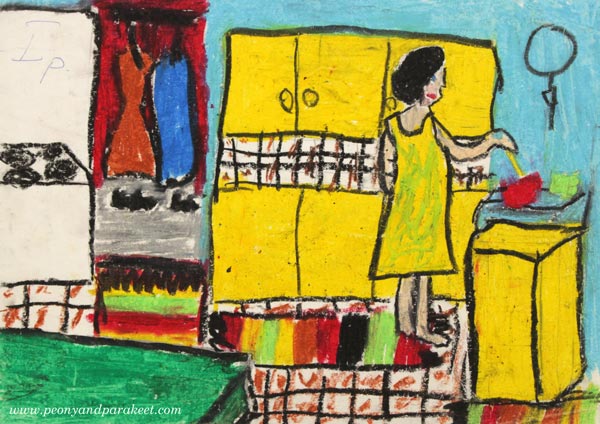
It was a little unpleasant that the organizer has written the prize in the drawing,
but now it just adds a nostalgic flair to it.
But let’s remember that even as an adult, we can grab a light marker and start coloring with clumsy strokes and without outlines.
Minimalist – Simplify!
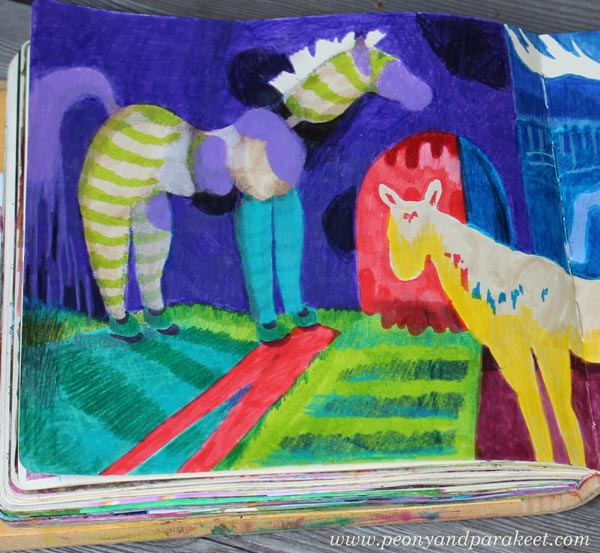
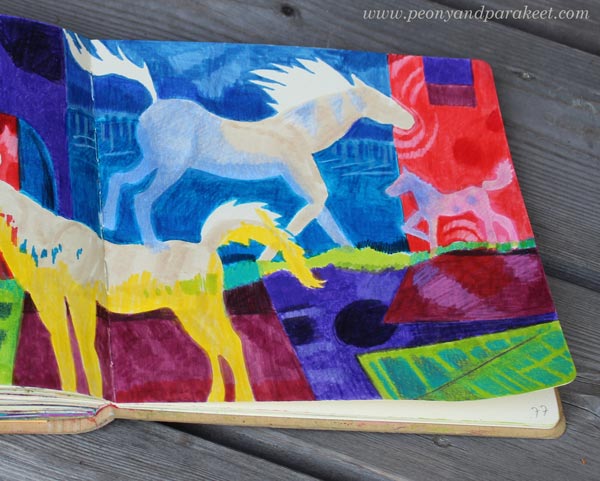
I colored the shapes of horses directly on a blank piece of paper without outlines. When I colored the background, I then refined the shapes.
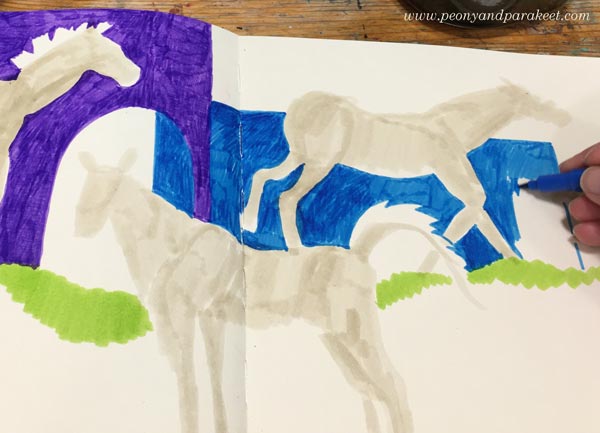
As a child, I loved playing with plastic horses and red tights were my favorite accessory.
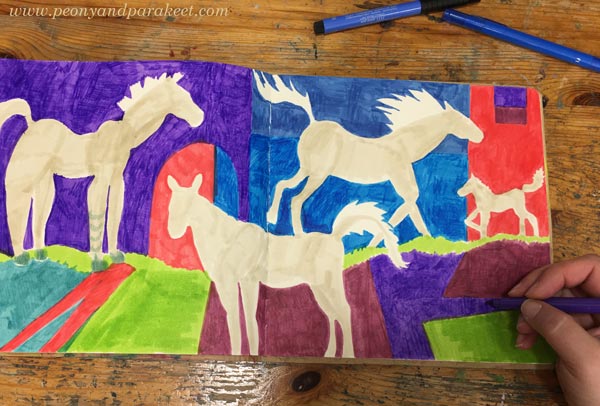
While making this art journal spread, I felt a deep connection not only to my childhood in the 1970s, but also to my teenage years in the 80s.
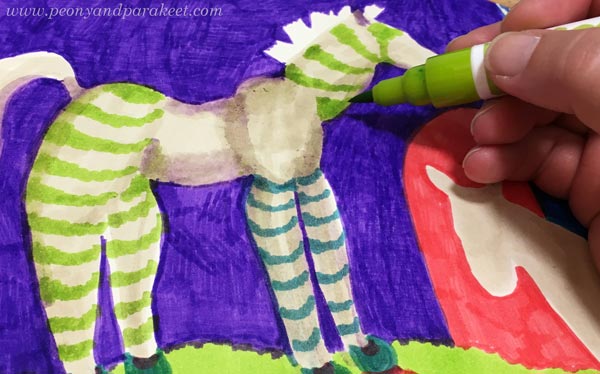
Back then, everything was still possible and ahead. The horses galloped wildly in my small room, but my mind was already far away in the outside world.
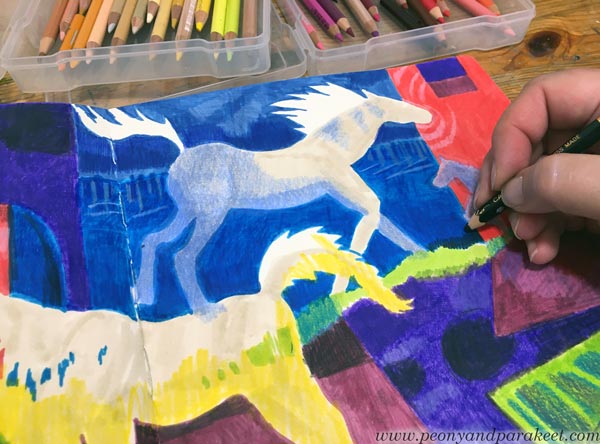
The controversy between the style and the content is the key here. The picture is clear, and the colors are raw, but the atmosphere is intense and a little mysterious.

It is as if I were each of those four horses. At the same time, a playing child, a baby seeking support, a galloping youth, and an adult whose life is still a mystery.
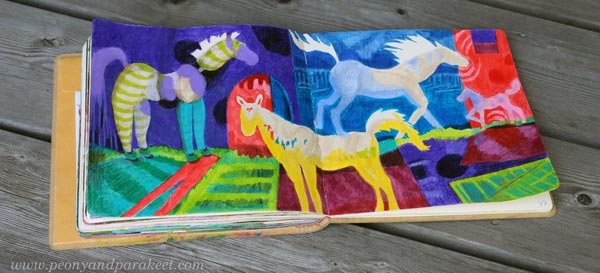
When I compare these two spreads, I think that I could give the minimalist a little more space, and it would not reduce the expression, maybe vice versa?
What do you think? See the pics below and leave a comment!
Exercise: Maximalist or Minimalist?
Try the same experiment in your art journal!
Creating Menagerie
This week, I share a recent acrylic painting called Menagerie and talk about the process. This is an example of making the most of the rich visual vocabulary – the topic that I talked about in last week’s video, but now we focus more on the idea of the piece rather than the style.

Recently, I have been thinking about the news feeds and their many truths. Although things are presented in beautiful phrases and pictures, the truth is much more complicated, and there are layers behind them. The same applies to people. Even though we try to be human, we are still animals, too.
When I paint, I struggle with the same thing: should I paint a flower or a soul?

I want to create beautiful paintings, but on the other hand, a painting is like a person. If you treat the painting superficially, you don’t get to see its true beauty.

I seem to paint better if I can partly focus on something else!
My goal is to give my paintings the freedom to be themselves and this painting really revealed its heart to me.

However, my task is not only to reveal the wild nature of the painting, but also to gently train it.

Menagerie is sold already. I hope it will bring joy to its new owner.
Details of Menagerie
Here are detail pics of the finished piece. I like how the style of this painting is partly illustrative. It looks like it’s partly drawn with a brush.

I wanted to create an impression that the animals are captive but still wild and strong enough to break free.

This painting has many layers and details.

I tried to bring up the similarity between flowers and animals.

Here you can see the big flower up close. The brush strokes are loose, but still, I painted them with a lot of thought and care.

I hope this inspires you to create too!
Filling an Art Journal
One of my projects this summer is to fill one of my art journals – Dylusions Creative Journal Square. I hope that these pics from my current in-progress journal, inspire you to start filling your art journal!

Reaching Saturation Point in Filling Art Journal
I think art journals have a saturation point. When most of the pages are full, you have to give the book a little more attention than usual. This journal was started in 2020, and I have filled it here and there over the years.

One spread can have things done in many different years. So the book is full of temporal layers, and I think they make the best art journal.

and finally added a zebra made in the style of Animal Inkdom.
Magical Inkdom also has fun projects for these kind of small drawings.
Practicing in an Art Journal
My courses appear a lot in my art journal, because I often practice on the pages or later glue pictures I made for the courses into it. I hope my course participants do the same!

and then added some more painted petals in acrylic.
Journaled “Sweet” with watercolors.
Part of being an artist is to be happy with your own development, and also to be interested in what you have done before.
This and That Will Magically Come Together
When my art journal is full, I will make a video of it, where I go through it and talk about each spread. I also know that when the journal is finished, the flow of the spreads feels much more coherent than when I was filling them.
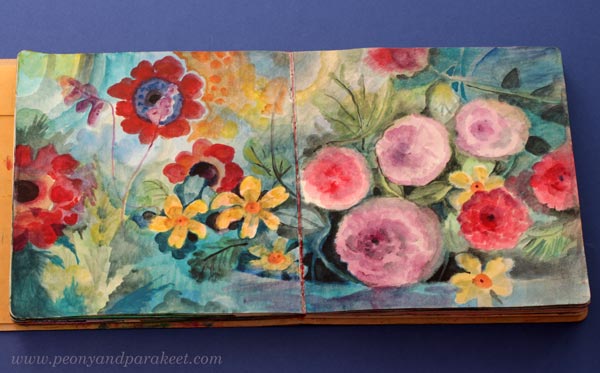
In the style of Freely Grown.
One thing that applies to all art journals, sketchbooks, and notebooks is that they are most beautiful when full. When you purchase one, it looks too beautiful to fill, but once you hold a full one, it feels much more valuable. I am looking forward to that!
Painting a Mystery
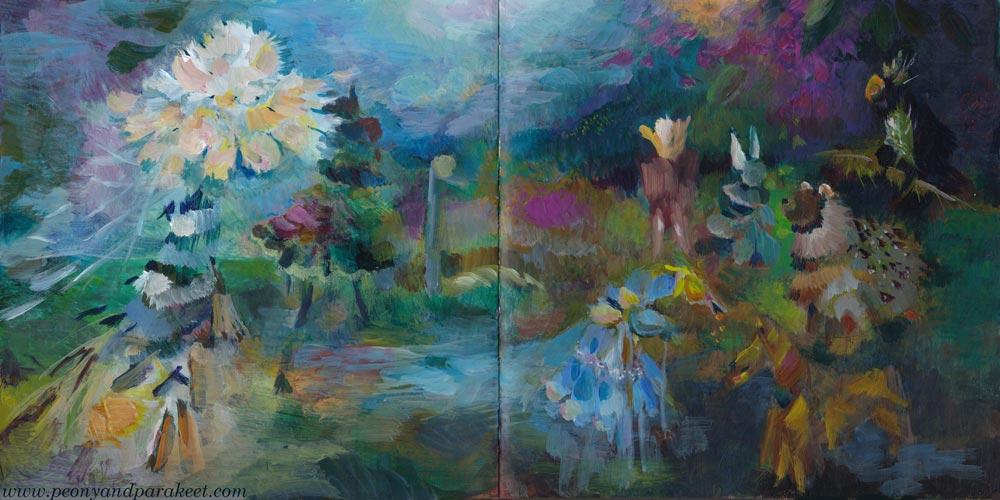
This week is about painting a mystery and entering another world through art-making. My paintings are in an art journal and made with a loose touch.

It All Started from a Withering Bouquet
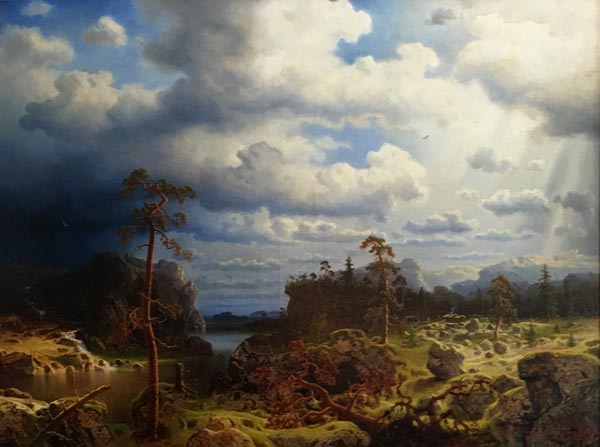
“The Midsummer bouquet has withered. I have to throw it in the trash,” I said. “But the setting is just like those old masters’ paintings,” my husband replied unexpectedly. And so I remembered this once again.

Once Upon a Time
Once upon a time, there was
and there still is a world that you can get to from anywhere.
At first, it’s dark, but you can hear a woman reading a letter to someone.

You hear a clock ticking backwards, generating more time.

Then you know that it’s time to take a brush in your hand.

Squeeze the handle firmly and hear the trees moaning as their trunks slowly sink to the ground.
First, it feels silly to paint because there’s nothing to see.

But the darkness gradually disappears, and you realize that you are not alone.

Those strange creatures are all familiar to each other and, in a strange way, to you too.

In this world, everything has been mixed up.
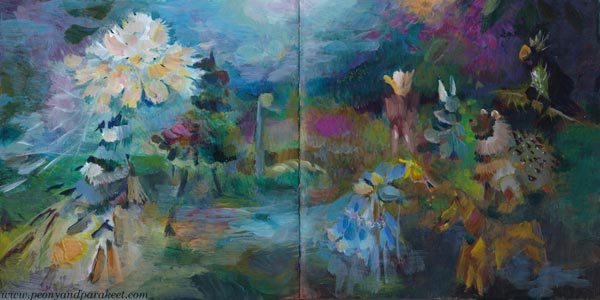
You are the wind that shook the flower, and in blowing the petals back, you lost your soul to it.

You are the chair for which the imagination built a room to rest.


In this world, everything is unfinished. But if you are willing to hear and feel instead of only seeing what’s expected, everything is ready enough.

Painting a Mystery – Background Story
The idea of this blog post came from that short conversation with my husband. Then I had to take a photo of the bouquet and make it in the style of old masters.
After that, I remembered taking a photo of a painting called “Woman Reading and a Man Seated at a Table” at the exhibition of the H’Art Museum in Amsterdam. The painting is by Frans van Mieris from 1676.
While browsing my image archive, I was drawn by another photo, taken in the same trip to Amsterdam. It was a decorative mantel clock from 1782 in the Rijksmuseum.
The clock took my thoughts to a more recent visit in Porvoo, Finland, where my husband and I went to see Johan Ludvig Runeberg‘s home. The lovely interior was from the 1860s, and there was a big painting that I really liked. I took a photo, but haven’t succeeded in finding out who painted it.
After gathering the photos, I picked up my art journal (Dylusions Creative Journal Square) and started painting. I didn’t copy the photos, but let them soak in freely. I was just inspired by the atmosphere they evoked in me.
Hopefully this blog post inspires you to paint freely without strict plans and definitions. Painting a mystery is both fun and addicting – I am already eager to create more!