
Painterly Collage in Rut Bryk’s style

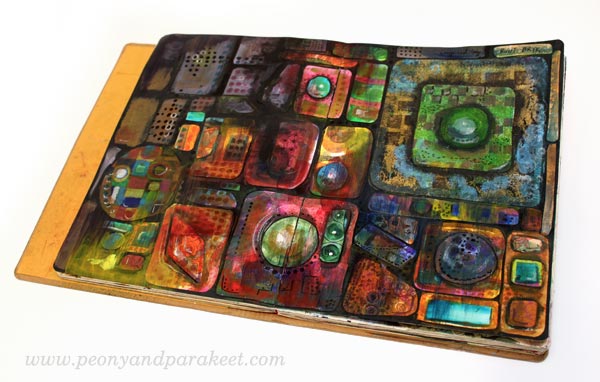
Here’s my recent art journal spread, inspired by a Finnish ceramic artist Rut Bryk (1916-1999). Espoo Museum of Modern Art Emma is currently showing her work and as a big fan of her work, I had to see the exhibition!
Rut Bryk
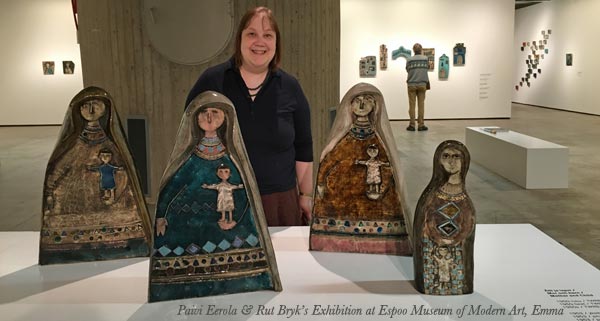
Rut Bryk is very known in Finland but not so famous worldwide. However, you might know her husband, a skillful designer and sculptor Tapio Wirkkala. Rut Bryk was an illustrator who got a job at Finnish ceramic factory Arabia in 1940s. Her early work was fairly naive and illustrative. But after working with ceramics for some time, she began adding textures to her work. Her 50s pieces were very mid-century modern.
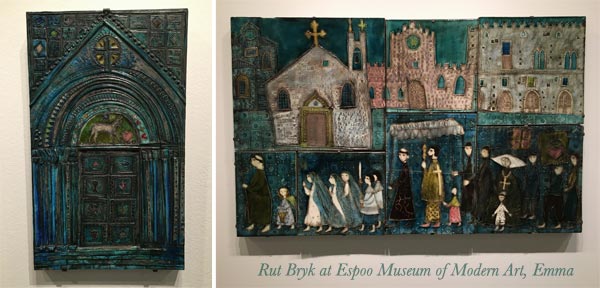
In 1960s her work grew more dimensional and abstract.
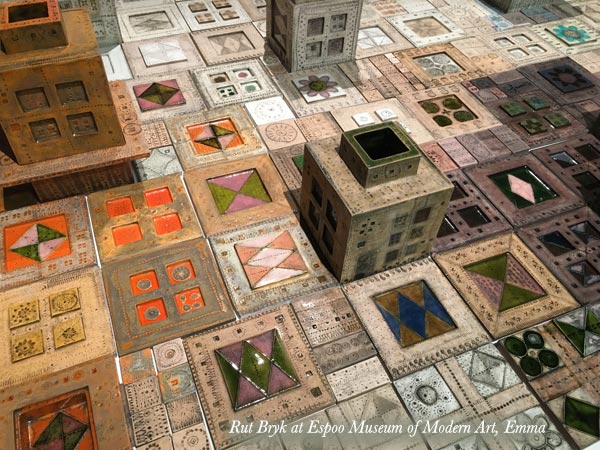
The abstract pieces she made are stunning.
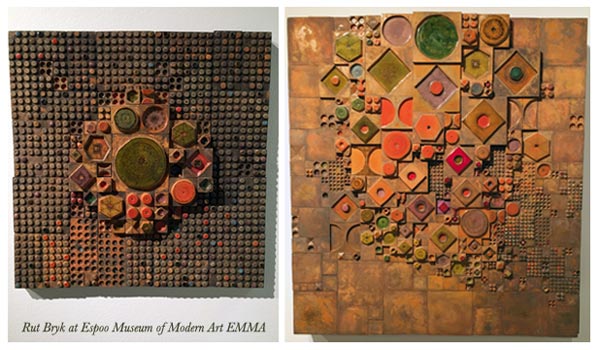
This black city view is one of my favorites.
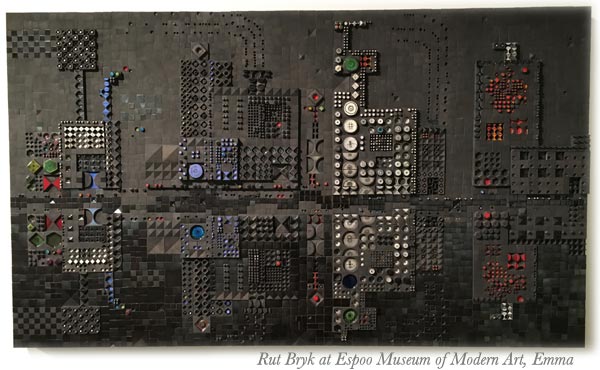
Many of Rut Bryk’s artworks are composed of small ceramic pieces. They look like quilts or crocheted blankets to me.
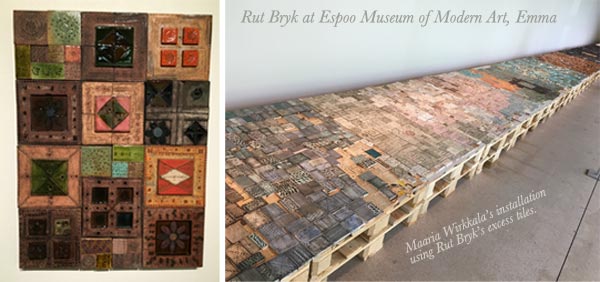
Rut Bryk’s and Tapio Wirkkala’s daughter Maaria Wirkkala is also a well-known artist. She had made an installation of Rut Bryk’s excess tiles for the exhibition.
Collage in Rut Bryk’s Style!
Get inspired by Rut Bryk’s brilliance and create a collage
with these step-by-step instructions!
You will need hand-decorated papers, acrylic paints, marker pens and gel medium or paper glue. See ideas for hand decorated papers: Basic Instructions, Frugal version, Kiwi, Arboretum, Spring Flowers (PDF download)
1) Paint the Background
Paint the background black.
2) Cut Collage Pieces
Cut collage pieces to simple shapes like rectangles, triangles, diamond shapes and circles. Cut big, small and medium-sized pieces. To make the pieces look like handcrafted ceramic plates, round the corners and soften the straight edges so that they are slightly wavy. Don’t worry about the colors too much as you will be painting over them.
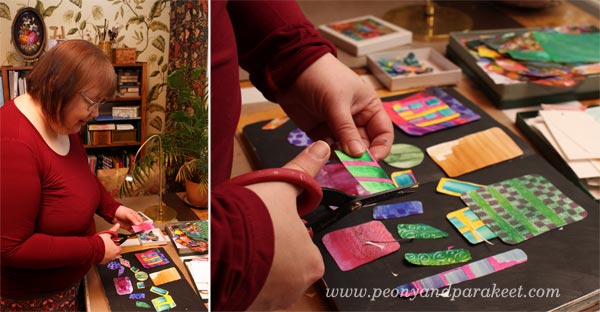
3) Glue the Pieces
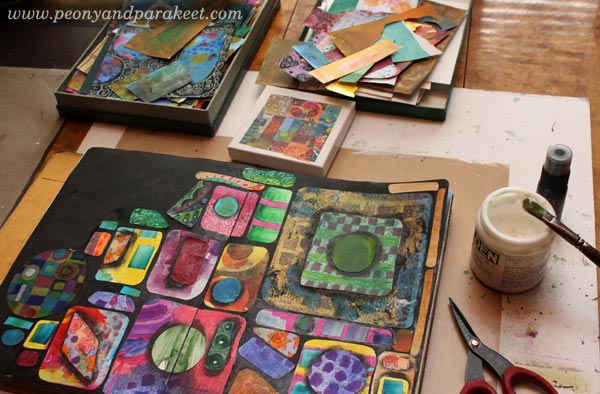
Using gel medium or paper glue, begin gluing the pieces on the black background.
Pile up pieces so that some smaller pieces are glued on the bigger pieces. Before gluing, add black paint so that the piece on the top will have soft black borders. This will make your work look more dimensional.
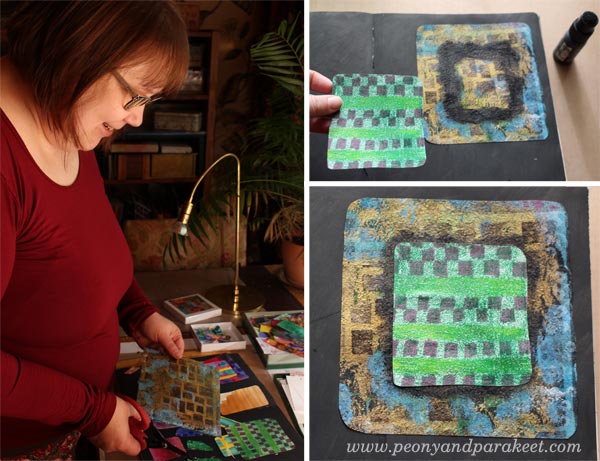
Don’t fill the whole background but leave some of it black.
4) Paint Lightly Over the Pieces
To make the pieces look softer and to mute down their colors, add thin layers of acrylic paint over them.
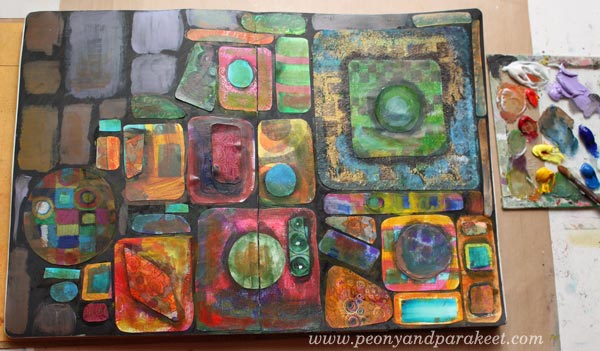
Paint blocks where the black background is visible. Use neutral, fairly dark colors that suit well with the black background.
5) Draw Spotted Grids and Frame Collage Pieces
With marker pens or felt tip pens, draw spots so that they form grids. These grids can continue over the blocks. Also the size of the spots can vary. I use Faber-Castell Pitt Artist Pens as they work well on acrylic paint.
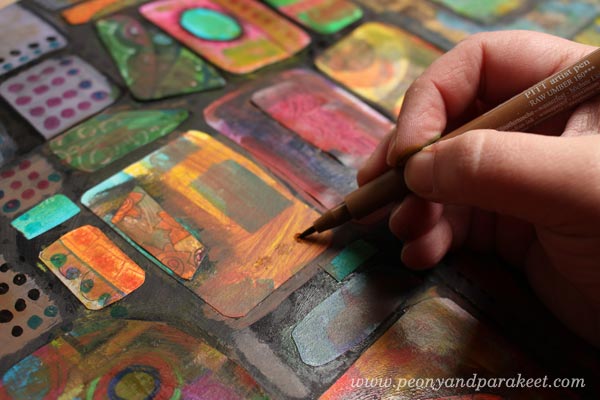
Frame the painted blocks and collage pieces with a black marker so that they look firmly attached to the background. I also used white Chinese marker to add few white lines here and there.
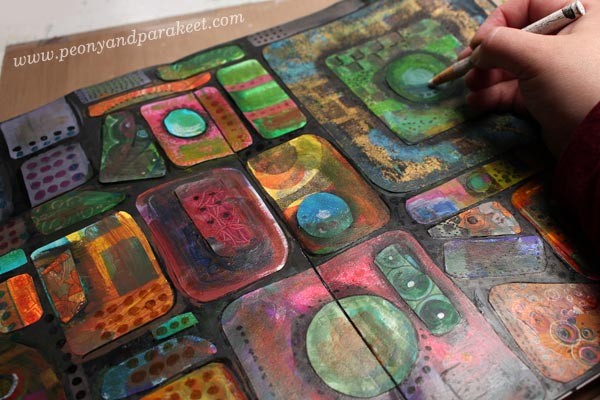
6) Paint Slightly Over Some Areas
To finish your work, add thin layers of paint for some areas. These painted areas represent light and shadows over the overall composition.
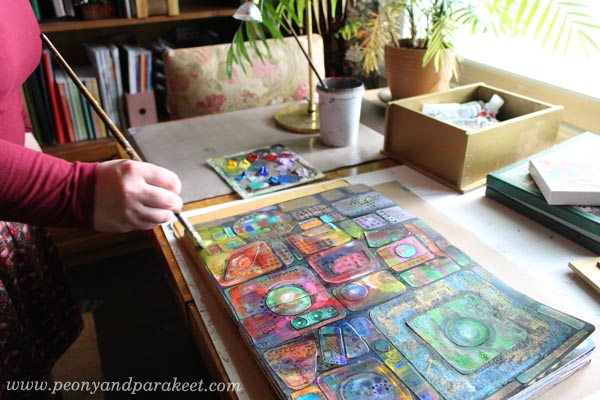
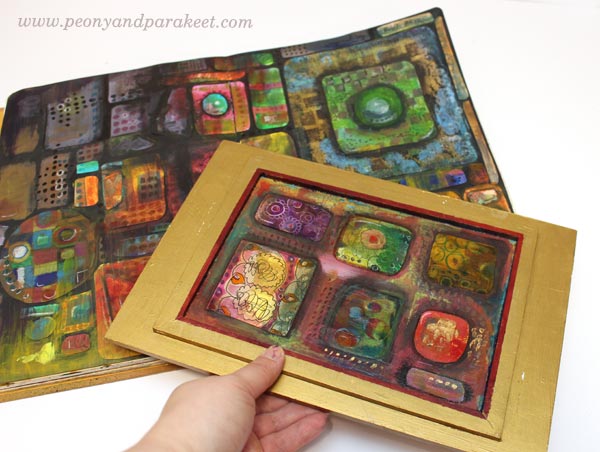
Here’s my finished spread again.
Extra Project – Decorating a Box
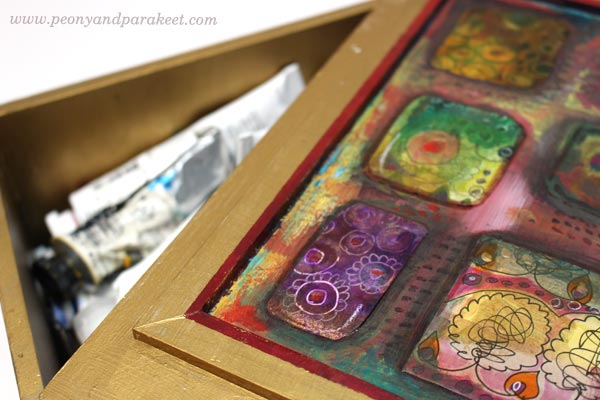
My husband has made a wooden box for my paint tubes. I have painted it golden but the bottom part of the lid needed some decoration. I had already painted the framed area red so I just added black paint to the collage pieces.
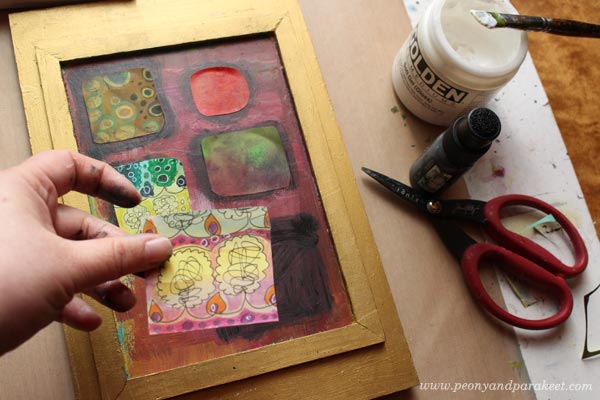
Then I continued the process like in the instructions. Finally, a layer of gel medium was added to protect the paper pieces.
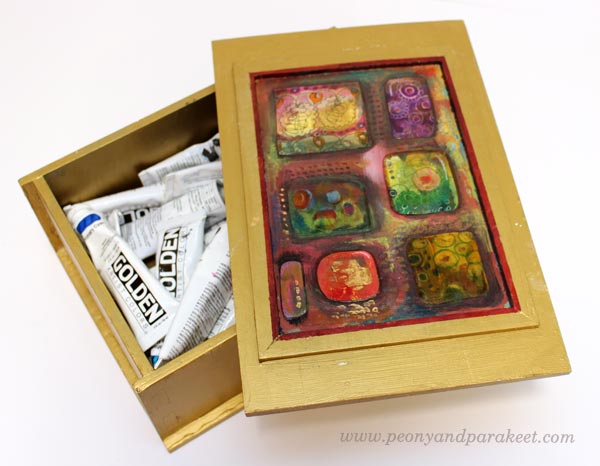
I like the idea of opening the lid and seeing the collage.
Thank you, Rut Bryk!
Expand Your Artistic Imagination!
This blog post is an example of how you can learn and get inspired by famous artists. This is how I see it:
– If want to find your own uniqueness, examine all kinds of artists and styles!
– If you have already found your style, keep on experimenting and expanding your skills!
It’s exactly what my art journaling masterclass is all about. Every month a new artist or style is introduced, and you will get detailed instructions on how to create a project inspired by it.
Move Forward in Art Journaling!
>> Buy Art Journaling Bundle 1
>> Buy Art Journaling Bundle 2
Create Internal Seascapes!

This is my latest mini-course for Imagine Monthly. It’s last of the six mini-courses of the spring season. The theme, a stormy sea, is so expressive that I included a special mental coaching session for each step in the video.
Inspiration for Seascapes
My main inspiration for the course came from the two famous painters: Joseph Mallord William Turner and Ivan Aivazovsky, both masters of expressing storm and water. I also studied contemporary artists, one of which is from my home country, a Finnish painter Petri Ala-Maunus.
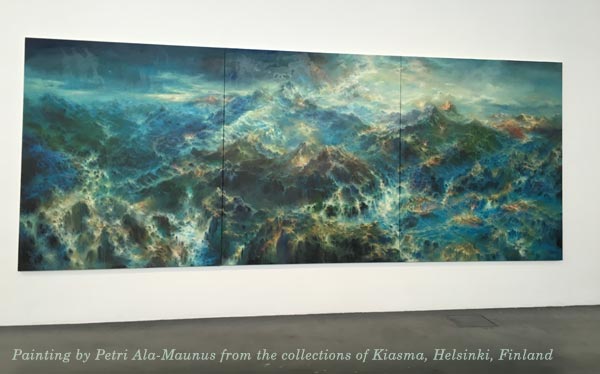
One of his masterpieces can be seen at Kiasma, which is a museum of contemporary art in Helsinki. Just went there a few weeks ago and will again, the main reason is just this gorgeous painting!
For me, Petri Ala-Maunus’s work is an internal landscape. It’s like a view to the inner world with valleys and mountains, seas and storms, ready to be explored and seen again and again. I would like to see a painting like this on the evening of a rough day and then again in the morning, to get my energy flowing.
So, aren’t powerful seascapes a perfect theme for creating art journal spreads? See my Pinterest board Internal Seascapes for more inspiration!
My Versions of Internal Seascapes
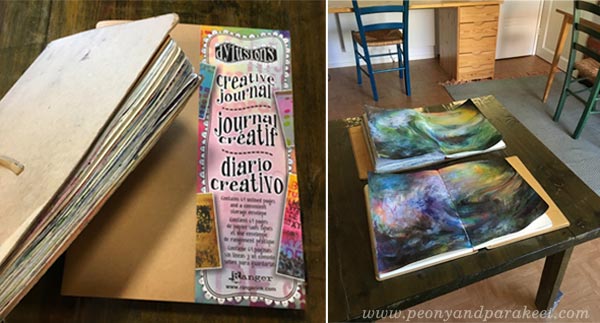
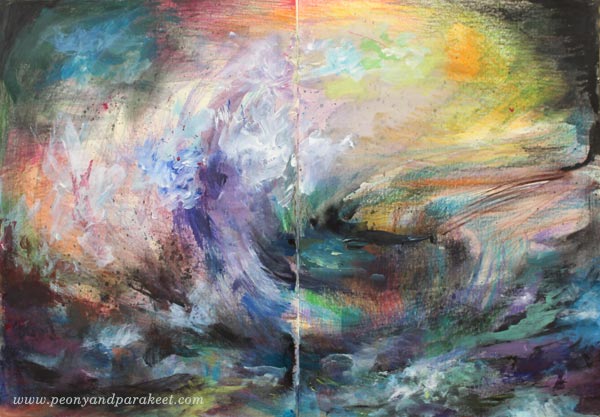
I made the first version before recording the process in the video. I am also talking about the details of this one on the mini-course.

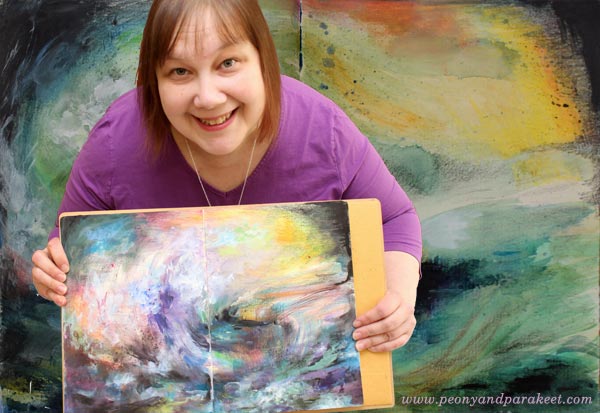
The next one is the mixed media painting that I create in the course video. It has six steps, and it’s very easy to start! I also explain how to get connected with your emotions when creating the painting. The mindset changes, as the painting progresses. This way you will get the expressive and layered result in the end. The mini-course also gives a lot of guidance on how to finish your work.
Imagine Monthly – From Fine Art to Art Journaling
The community of Imagine Monthly has meant a lot to me this spring. A few years ago, I really missed talking about fine arts and how to apply them to art journaling and mixed media. It feels amazing that I have now found so many like-minded people through my classes. So this last mini-course of Imagine Monthly is partly my gift for the participants. I have put my truly best effort to make the best class possible. It also has a longer video, 45 minutes instead of the regular 30 minutes.
Create Internal Seascapes!
Imagine Monthly Spring is over, but you can buy it as a self-study class! >> Buy Imagine Monthly Spring Bundle
Stormy Scenery is also available as an individual mini-course! >> Buy Stormy Scenery
Art of Making the Most of the Ugliest
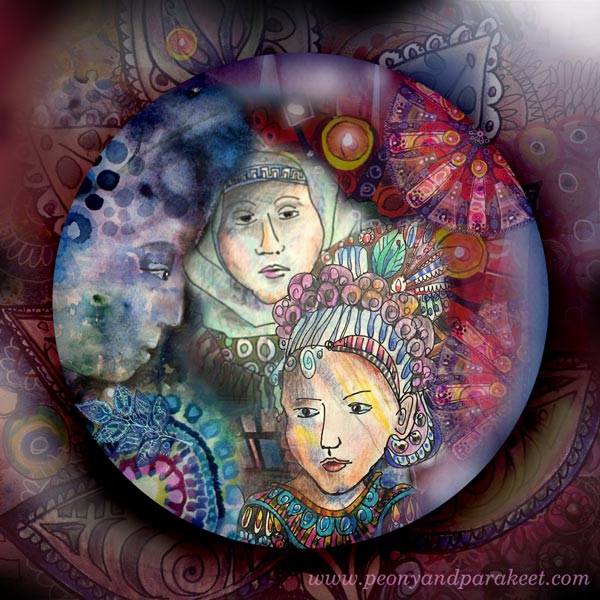
This is a surprising video story about a continuous creative journey and about the art of making. If you are interested in reusing your art or creating digital art from your handmade pieces, this video is especially for you. (You might have seen some of the work shown here if you have liked Peony and Parakeet at Facebook.)
From Quilting to Digital Art – A Video
Let me be your mentor in art: Subscribe to my weekly emails!
Mid-Century Modern Style for Art Journals
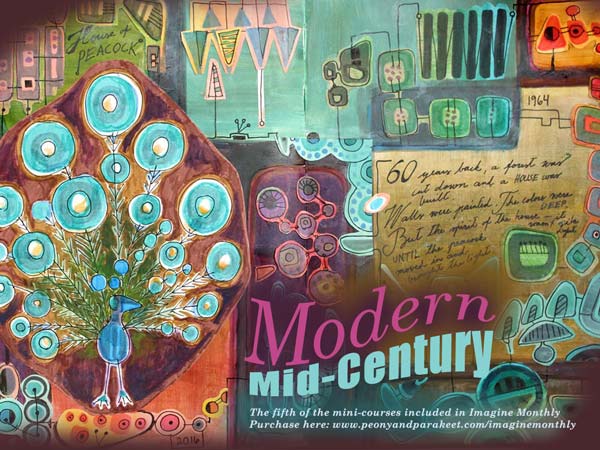
This spring, I have published a new art journaling mini-course each month for Imagine Monthly. May’s mini-course is called Modern Mid-Century. This mini-course is all about mid-century modern style. You can use it to create decorative art journal pages that are not only flowers and hearts but show a wider range of designs.
Discovering a Magic Formula of Mid-Century Modern
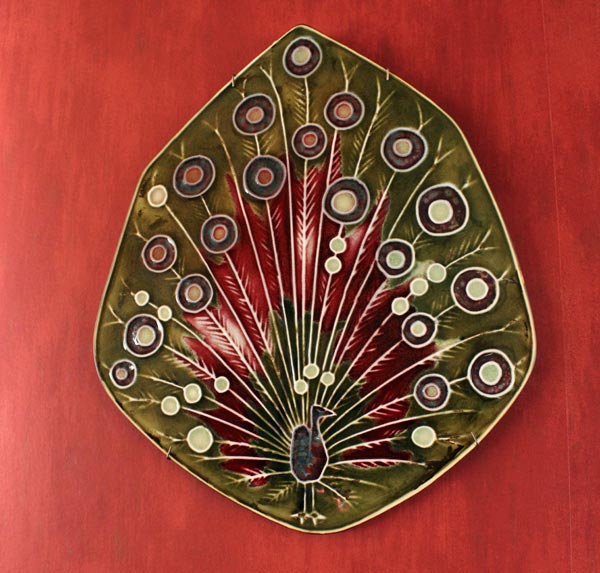
The main inspiration for the Modern Mid-Century mini-course came from Annikki Hovisaari’s ceramic Peacock (“riikinkukko” in Finnish). Annikki Hovisaari was a designer in the Finnish ceramic factory Arabia in 1960s. We have the peacock on the living room wall. I look at it each day, admiring. So much can be expressed with simple shapes and thin lines! The mini-course includes plenty of samples.
When I begin examining a new style, I try to see what’s essential there. What could be removed without changing the impression. And also: what could be added without loosing it. It’s like calculating a formula for a certain style. The secret is not trying to solve the whole big equation. It would be too difficult and highly argumentative. Even the experts of 20th century styles argue whether something is mid-century modern or not. I try to avoid that and just pick few of the central features. Then I focus on their relationship, forgetting the rest.
The best art classes give you ideas that you can expand and adjust to your liking. Whether you like mid-century modern or not, you can use the basic formula. With that, you can move forward towards your own ideas and aesthetics. This kind of conceptual approach will bring focus to more personal than to the style itself. Instead of trying to follow the style, you will be making new discoveries through it.
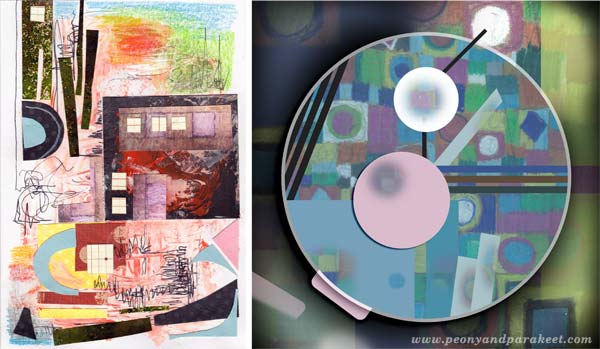
I made a couple of small pieces after finishing the mini-course. The first one, on the left below, is a birthday card made for my husband’s nephew. The second is a digital piece combining the idea of mid-century modern and the concept of a watch.
Create Your Own Mid-Century Modern Art
Sign up for Imagine Monthly! You will not only get Modern Mid-Century, but all the mini-courses published so far, immediately after the purchase.
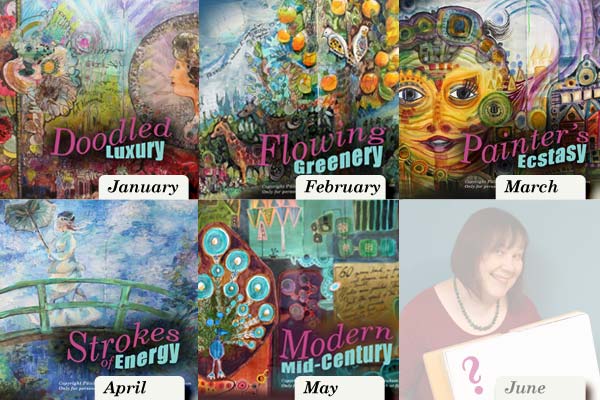
Imagine Monthly also has a private discussion group at Facebook. It’s fun to see what everyone has created from the mini-courses. In the middle of the month, I also lead a discussion topic related to the month’s theme.
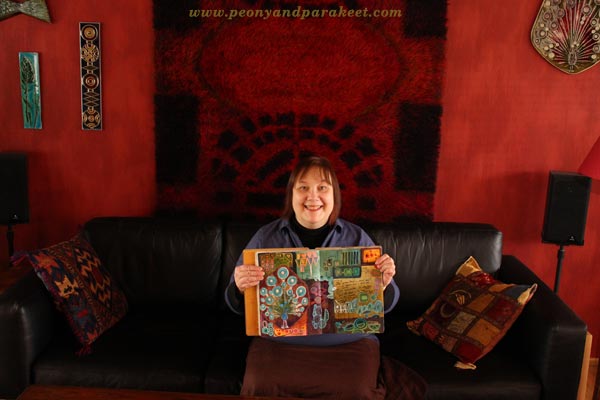
I believe that every art journal needs pages that are handpainted and handdrawn. It is joyful to browse pages that are more like illustrations than just layers of paint. With Imagine Monthly you will get new formulas for stretching your skills and discovering new techniques. Sign up now!