
Pop Music in Art Journal
This week – turn some pop music on and start art journaling!
Since I started working full-time as an artist in 2014, my taste for music has gone wider. Listening to different genres has enriched not only my life but also my art. Music has taken me to all kinds of visual worlds. Even one sound can bring color or a shape to mind.
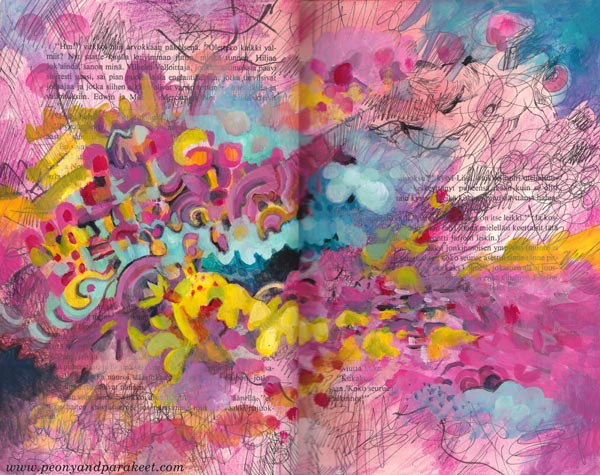
I have an old book as a music-inspired art journal. I like how the variety of music is shown on its pages. Now I wanted to make a spread inspired by Asian pop.
Sometimes Music is a Human, Other Times a Machine
Asian pop music is fun to listen and very easy-going – like an acquaintance who is always ready for a visit to a candy shop and to have a light conversation about current movies.
But when I paint big paintings, I prefer music that’s more like a vehicle – no melodies, only interesting sounds that make me go deeper and deeper in concentration.
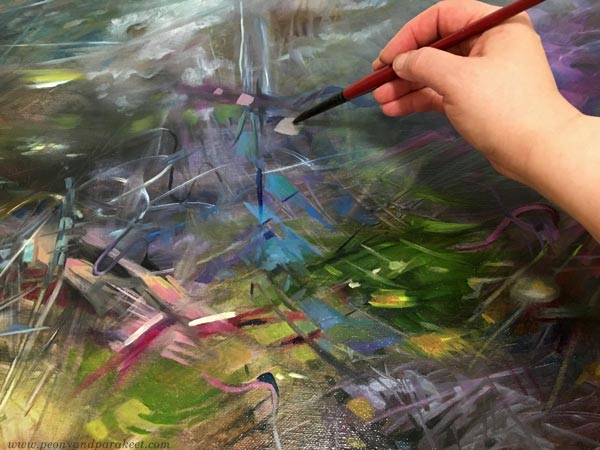
Without a repeating chorus and clear rhythm, I don’t feel the need to express the music or paint at its speed. That’s how I have become a fan of contemporary classics that I used to find too boring.
Pop Music in Art Journal – Playtime with a Friend
But this week, I wanted my friend back. I went to the Finnish radio website and turned on the newest of “Papananaaman K-Pop Show” which plays current Asian pop. My candy store was the box where I keep my red, pink, purple, and orange colored pencils.
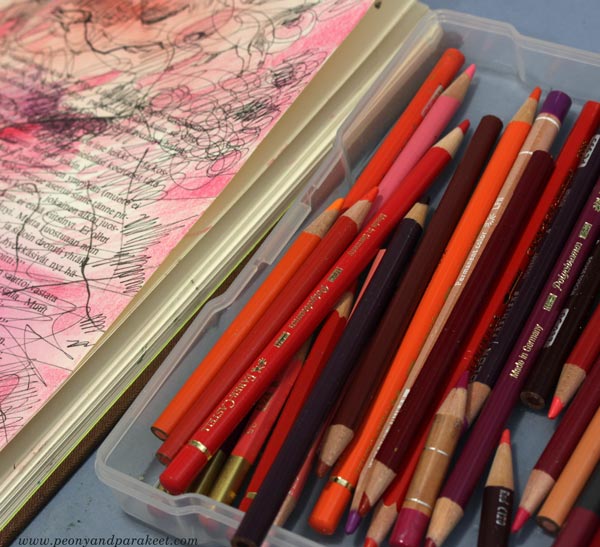
My music-inspired pages are in the “beautiful mess” style that I show step-by-step in an art journal mini-class called Music. It’s relaxing to create step by step and not worry too much about the “proper” supplies. I played with black pens, stamping inks, and the shortest pencils.
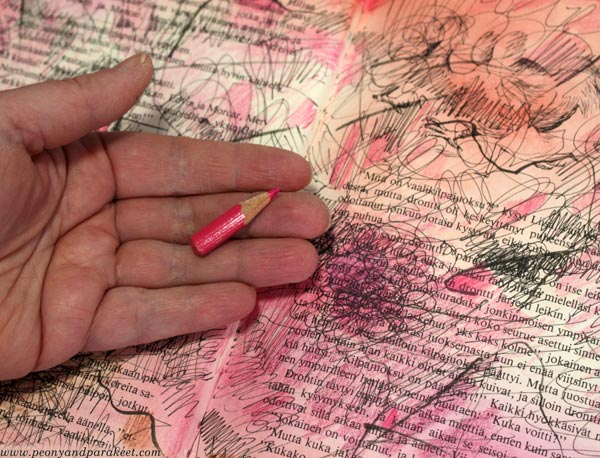
When I create canvas paintings, I use oil paints, but acrylics are great for this kind of messy play.
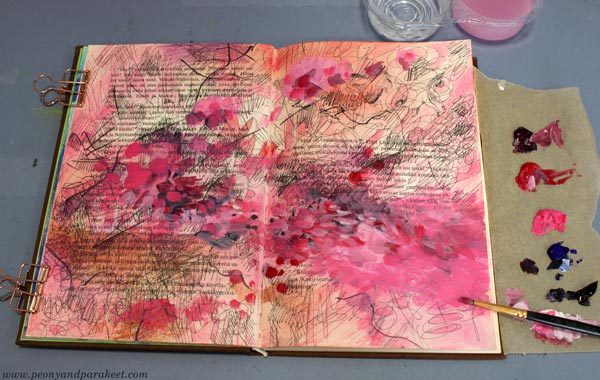
The spread started as red, but I then introduced a wider range of candy colors gradually. This mono-tone approach is great when you want to keep things simple first, and then splash the colors in.
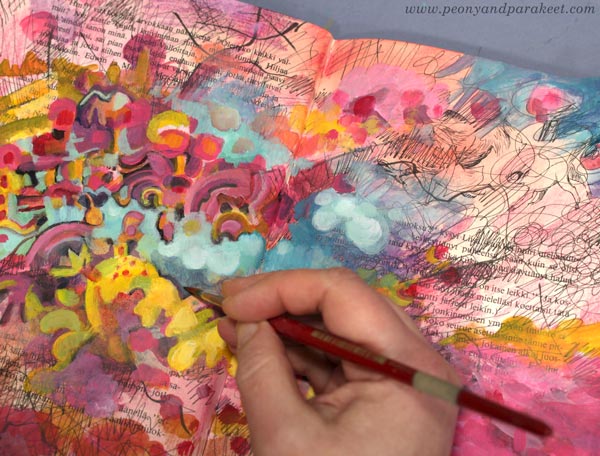
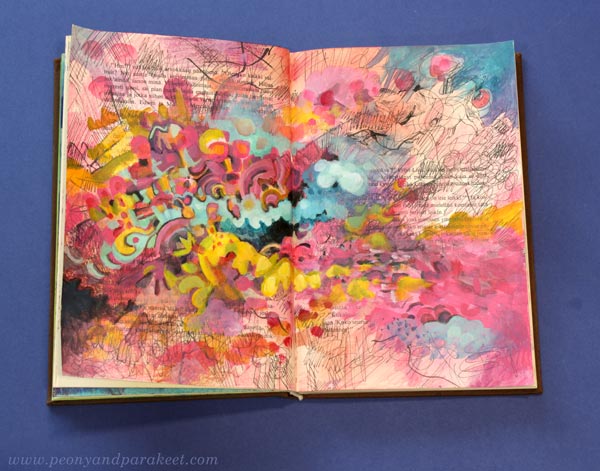
I like the candy colors and the informal look of the finished spread – pop music in an art journal!
I showed the spread to my Blythe dolls and they also gave their approval: “If that’s how you see Asian pop, we can live with that.”
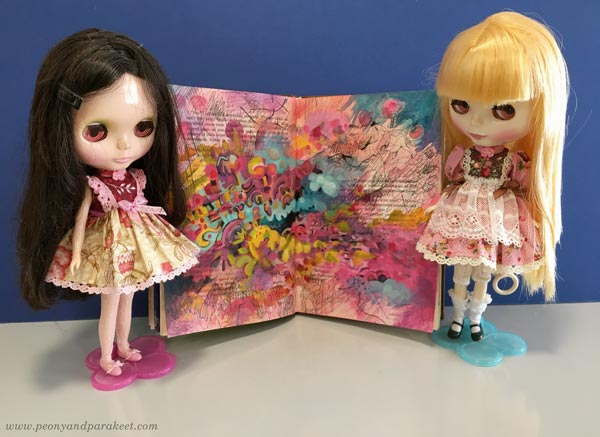
Maybe these dolls have made me listen to Asian pop in the first place! One thing so often leads to another.
Music in Art Journal – Step by Step!

The art journal mini-class Music is now available as an individual class. But you have to be quick – it will go away on Feb 7! >> Buy here!
Start a Music-Inspired Art Journal!
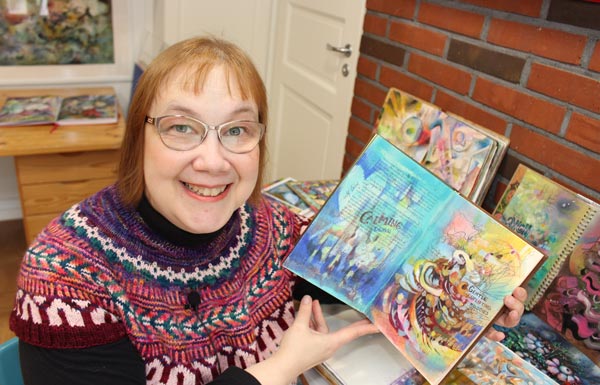
In 2020, I made a mini-class for a collaboration project that included several artists. Each picked a topic that raised the feeling of gratitude.
I chose music. I had just seen a documentary about a musician called Avicii. He was a young Swedish boy who got into composing electronic music and, within a few years, became a world star. His story ended too soon, though.
This month, I read a biography about Avicii. The book had more explanations for why the life that everybody envied was unbearable. But still, his music feels pure and bright.
When I hear A Sky Full of Stars, I am a little girl on a cold Tuesday evening in Eastern Finland. After participating in an icon painting group, I walked down the snowy hill looking up. The starry sky was blue-black, I realized. Not black like for those who glance carelessly or blue like for those whose skies were always blue. Working with colors had made the world look more beautiful.
What song takes you back in time?
What colors do you find there?
Avicii composed dance music but was inspired by folk songs and old pop music that his father used to play. He open-mindedly mixed different styles and genres.
Which things can you bring from the past to refresh your art?
Which ideas from your queue could you combine?
Avicii started a song from a few sounds and short melodies and then layered them together.
Pick a pen and scribble something small along with your favorite music, then layer colors on the top!
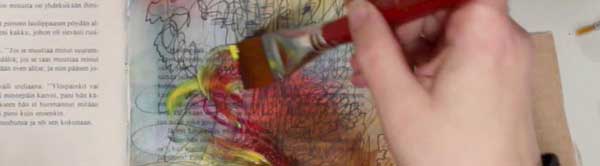
So, I suggest starting a music-inspired art journal!
I can now offer the class from the collaboration of 2020 individually. Only 15 EUR (about 17 USD), but be quick, the class is available for purchase only today to Feb 7!
Wild Botanical Art – Create with Colored Pencils and Watercolors
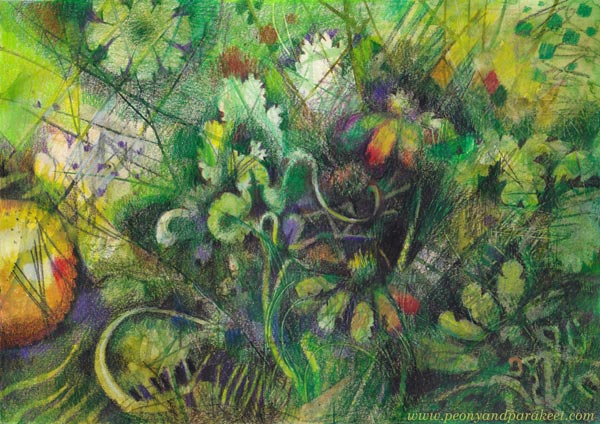
This week, I created wild botanical art. I drew plants with delicate details like in botanical illustrations, but with a few differences. My plants are not any real species, and the jungle where they grow is more like my inner world at its best, not a real location on the planet.
Watercolors First!
Before putting colored pencils into work, I made some backgrounds with watercolors. I had very smooth watercolor paper – hot press quality. My friend Eeva Nikunen recommended Arches Hot Press paper that she has used for detailed graphite drawings. It’s a bit pricey but so smooth and lovely for colored pencils too. However, any smooth watercolor paper would work with this technique.
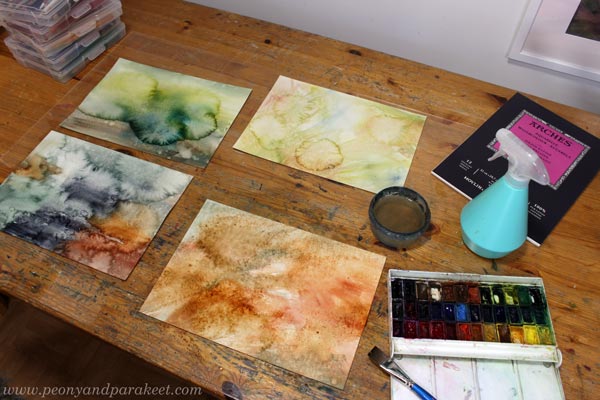
I used a lot of water for the first layer and made random splotches with a spraying bottle. This kind of wild watercolor painting is fun, but when I tried to pick one of the four experiments for colored pencils, I found the results uninspiring. So I asked myself what kinds of nature’s shapes or colors would I want to see more, and answered: “All kinds of hays inspire me a lot!”
Love for Sharp-Shaped Botanicals
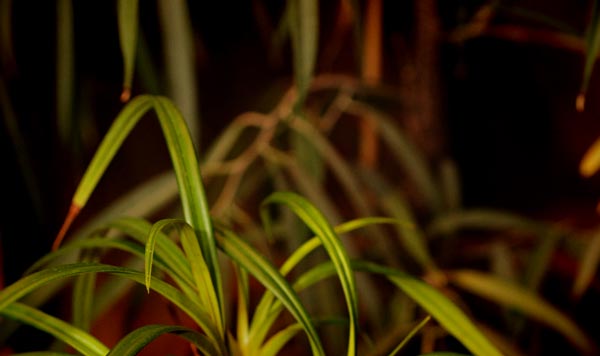
We have lots of house plants that have sharp leaves.
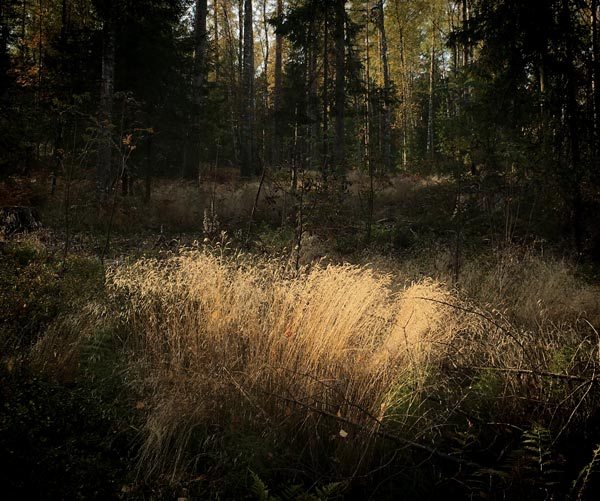
And when I walk in nature, I always look for hays and how light hits them.
So, then after some drying time, I made thin lines that went wildly here and there.
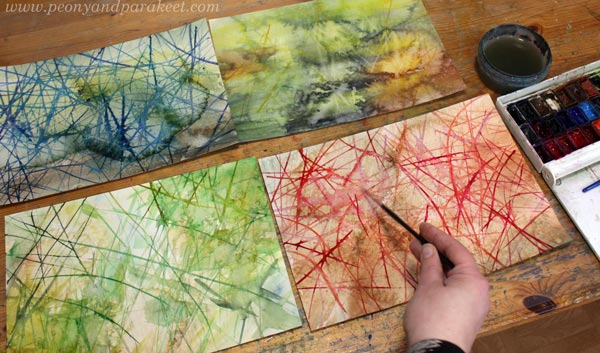
After the lines, I found the green one on the bottom left very inviting, so I chose that for coloring.
Coloring Freely and Wildly
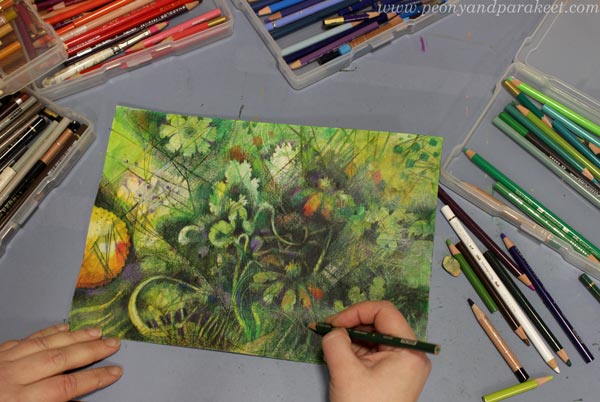
Colored pencils work well on the watercolor background and smooth paper. It was enjoyable to color freely. I didn’t follow the shapes or lines painted in watercolor but created new layers.
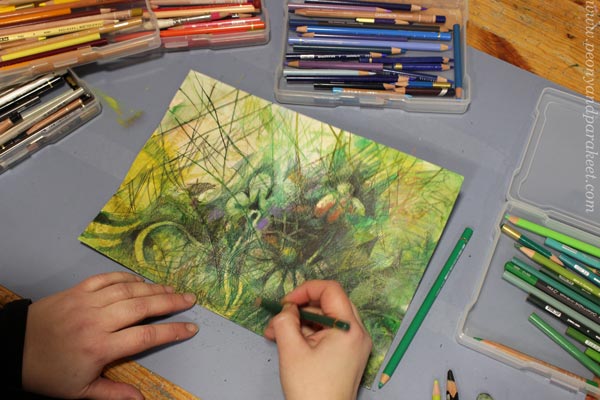
I have started to store my colored pencils in shallow plastic boxes grouped in color families. This way, every pencil gets seen, and the differences between tones are easy to identify.
Should Plant People Draw Plants?
My husband and I are plant people. Our home is filled with house plants and we have all kinds of plants in our garden. It has been quite a job to save the plants from our new puppy Saima!
Plants have also always been present in my paintings. But recently, I have thought that maybe I could focus more on them with colored pencils too. It often feels that I come home when I am inspired by plants and travel abroad when I am creating something else. I want to challenge myself out of my comfort zone, but if there’s a strong resonation, like a secret companionship, should I listen to it?
More Wild Botanical Art – Playing Mode On!
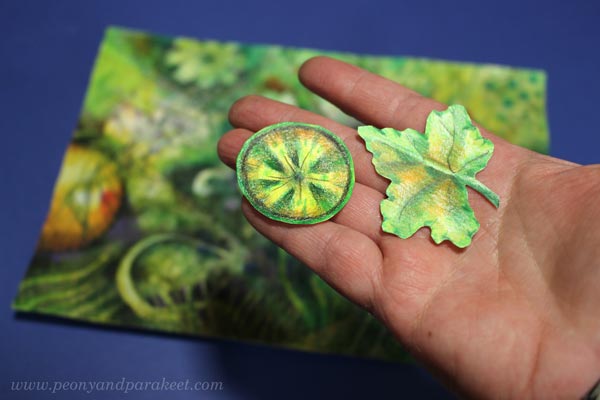
It was so much fun to work on this project that I wanted to do more. So, I colored these small scraps – a fruit and a leaf!
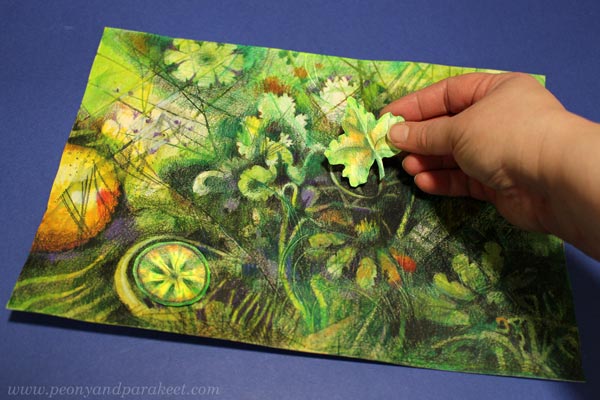
And then it was playing time. How wild can this go?
Create Wild Botanical Art – Five Tips!
- Start by creating a wilderness that calls you.
- Color layers of random shapes and lines. When you see something that could be a plant, turn it into one!
- Don’t worry about identifying the plants – treat them as rarities that only you can find!
- Make detailed a little more detailed – botanical art goes crazy with details!
- Revamp – Add some plants from your box of joy!
- Bonus tip: Nature is full of curves, so make sure you also have some.
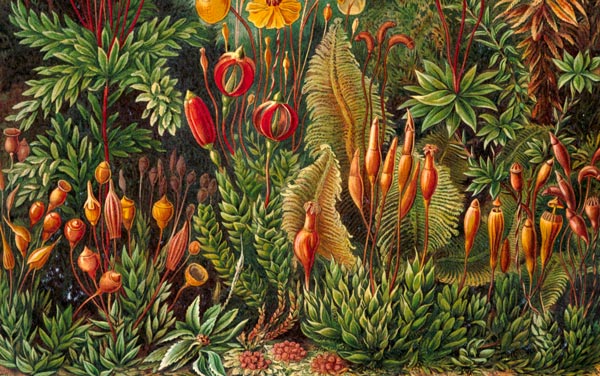
Botanical Art by Ernst Haeckel
Many years ago, a blog reader mentioned Ernst Haeckel’s botanical art. Since then, I have admired his work. Here’s a part of his illustration from 1904. Lots of greens spiced with warm colors and so many details!
Mine is not nearly as sharp and detailed as Haeckel’s, but I approve it anyway. Plants have different personalities, and so do their interpretations!
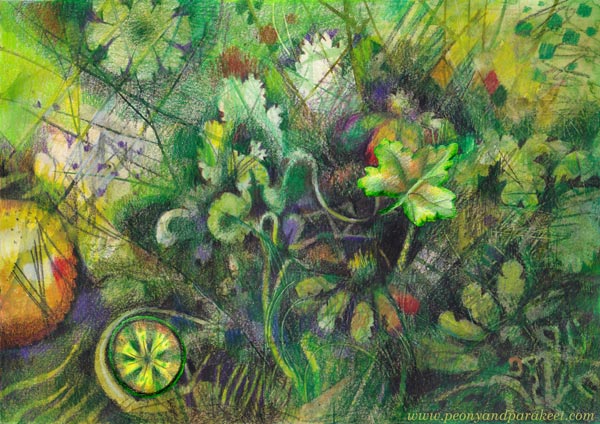
Tell me, do you like drawing plants? What kinds of plants especially?
Creative Take on Damask Motifs
This week, we look at damask motifs from a new perspective. I challenge you to make this traditional motif your own and use it in your art!
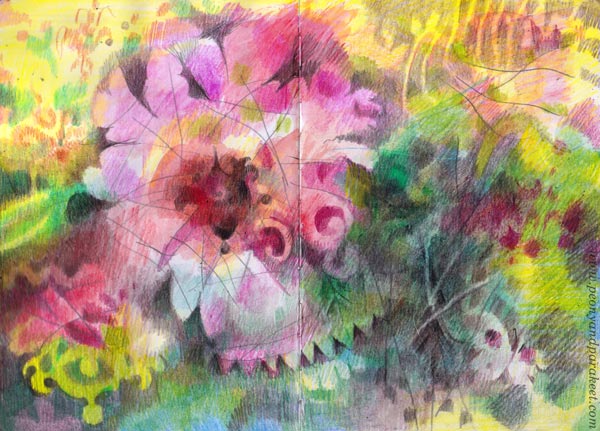
It all started from a dream I saw a few days ago. “You should wear more decorative clothes, Paivi,” I was telling myself. “Like the old historical dress that you had at a ball as a teenager.”
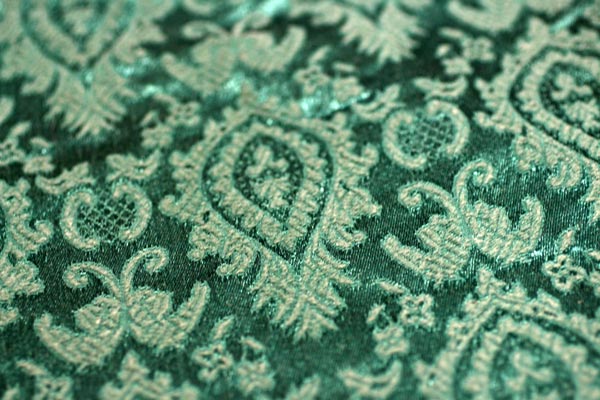
I still have the dress. It has damask motifs – woven ornamental patterns that seem to never go out of date (more about their history). The idea of perfecting not only the actual swirls but also the shapes between is a good drawing practice that doesn’t have to be boring at all!
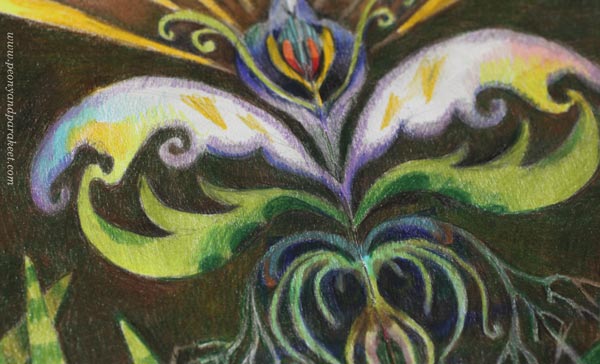
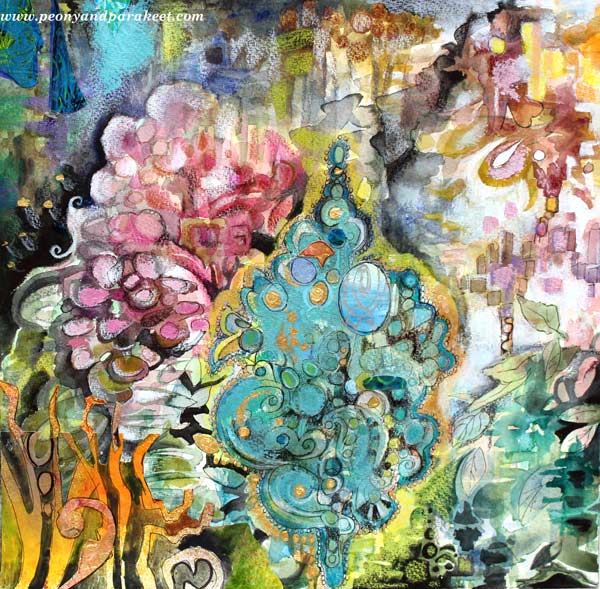
This week, I played with colored pencils mostly, but in 2015, I made a mixed media piece called Rococo. So check out this post too!
Damask Lady
The reason for my dream was an unfinished page in my colored pencil journal. I had started it at the end of last year but found it terribly uninspiring. I didn’t feel any connection with the figure, and she looked like someone had forced her to be there. In a way, that had happened. After a series of big paintings, I was knackered, as readers from the UK and Australia would describe. I had no motivation to take a brush and only a little to do something with colored pencils.
First, I added a bit of watercolor to cover white and then colored intuitively without any predefined ideas or models.
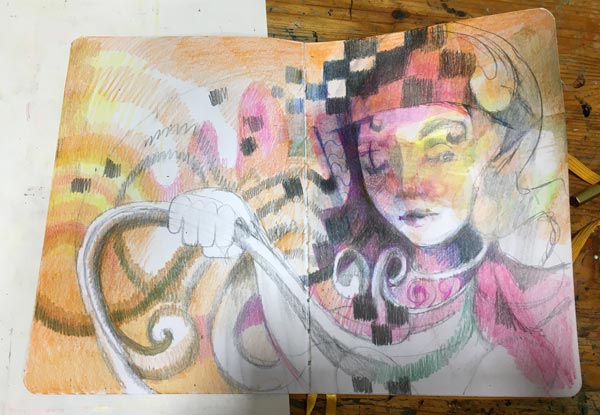
Sometimes it’s just that when you are tired, it’s best to leave the piece and come back later, even if it would be a tiny spread in a small journal. After the dream, I knew what to do: play with damask motifs!

I feel drawn to this damask lady. She looks both curious and self-confident – everything I would like to be in this new year!
Looser Damask Motifs – Nature
I got so inspired by coloring the swirly lady that the next spread was born quickly. Again, first some watercolor splashes, and then details with colored pencils.
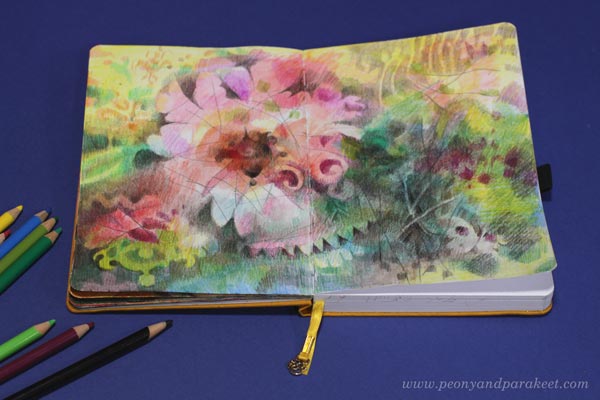
If you compare the flowery spread above with the portrait below, you see the change in looseness. The flower is much freer than the lady, but I like both. I like how damask motifs can be seen as a part of nature – snow on trees, water drops, butterfly wings and their spots. But I also like how they can be more architecture- and design-related and a part of human fantasies and mysteries.
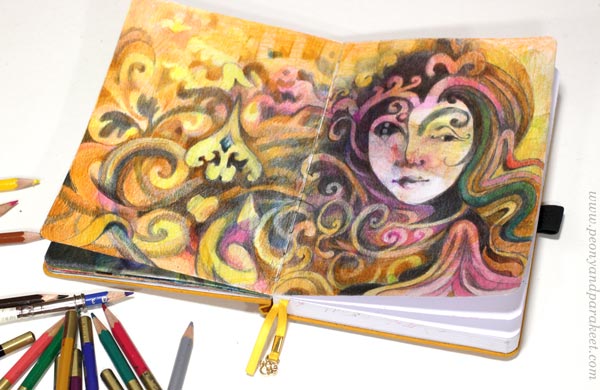
Which take do YOU like more?
Sketching a Damask Motif
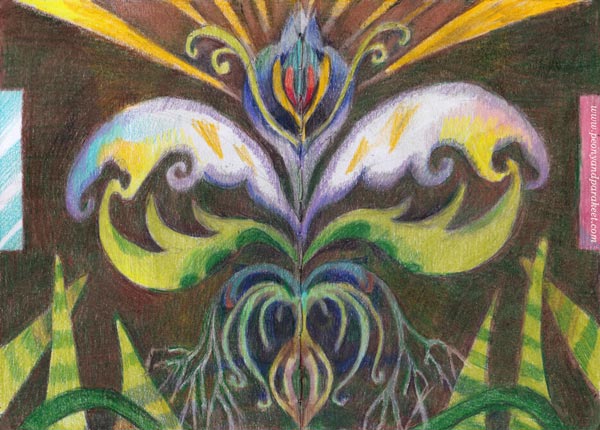
Next, I wanted to go even further in stiffening the expression. I would design a damask-inspired motif so that there would be no looseness at all.
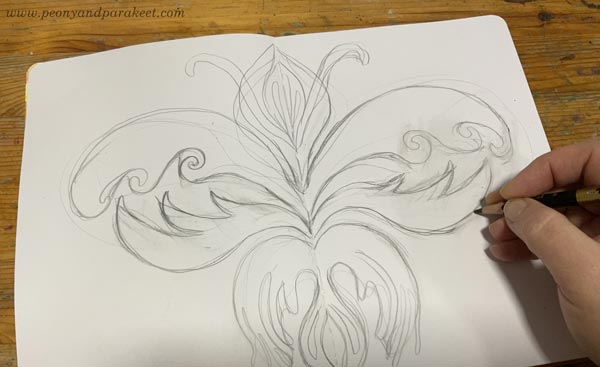
I started by sketching the motif in the middle of the spread, using the fold as a guide to achieving the required symmetry. In damask motifs, the negative – the shape of the background – is as important as the positive is. So after the careless sketch, I then went through the surrounding area and adjusted its swirls.
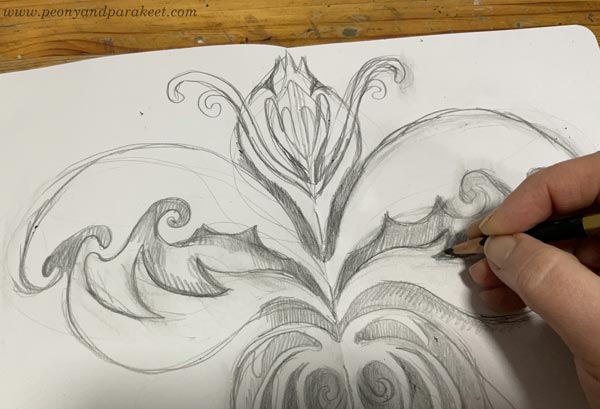
This motif felt like a forbidden fruit. I was surprised to hear myself saying: “You have crossed the line now, Paivi. Even if you always paint the inside, now it will be reverse – illustrating the outside world.” I didn’t get this first at all – I thought I was just drawing was a simple flowery ornament inspired by damask motifs!
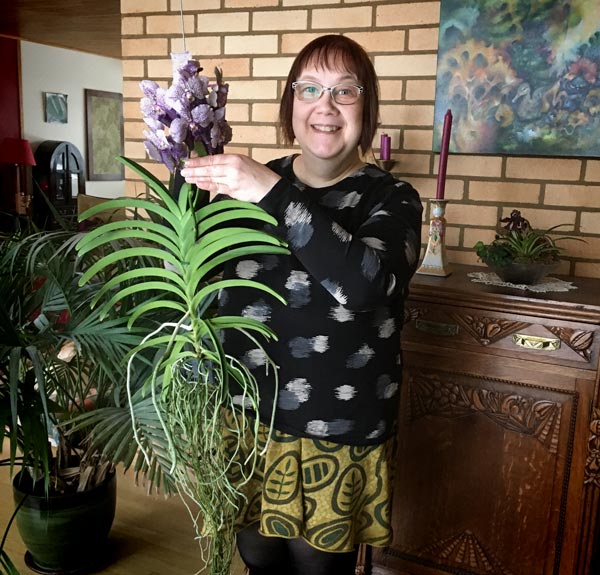
But when I was making the finishing touches, I realized that my drawing did illustrate the outside world – our living room: a wooden ceiling, windows on the left, a wall rug on the right, a vanda orchid hanging without a pot, and the snake plants growing lower.
Here’s a picture of my vanda when it was blooming in 2020!
This spread is not loosely made at all, and yet I find that the looseness is how I unconsciously picked and interpreted the subject.
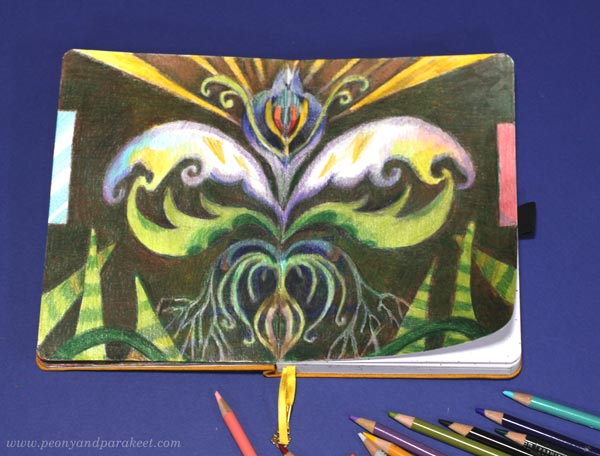
Which of the pieces of this post inspire you the most?
Are you inspired by the stiffness or looseness?
How do you want your damasks to look?
Please leave a comment! It would be so interesting to know!