
Artistic Line Drawing – What Do You Think About This Course Idea?
To me, all visual art begins with drawing. When you want to get to know yourself, draw! When you want to develop as an artist—say, as a painter—draw! To draw is to think. Make your lines come alive, and gradually, a whole new world will emerge, even on a small piece of paper. That’s what artistic line drawing is about.
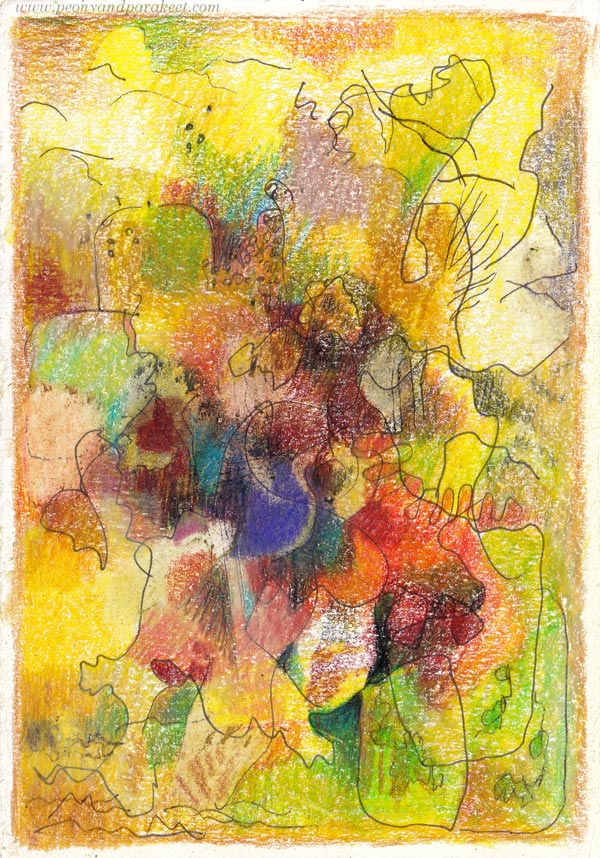
Black drawing pen and colored pencils.
Past and Present Drawing Courses
In most of my courses, drawing plays some role. Free and artistic line drawing is especially close to my heart. In the past, I have taught two courses on the subject: Inspirational Drawing and Inspirational Drawing 2.0. These are already retired. Of my current courses, Mystical Minis comes closest to these.

Passion For Teaching Artistic Line Drawing
For some time, I have wanted to offer more help with line drawing. Not just how to draw, but also how to alter the process to take it in a more artistic direction. By “artistic,” I mean moving beyond the conventional and creating something that is both personal and at least partly abstract. I want to speak especially to those of you who want to create freely and push your boundaries—both in how you think and how you create.
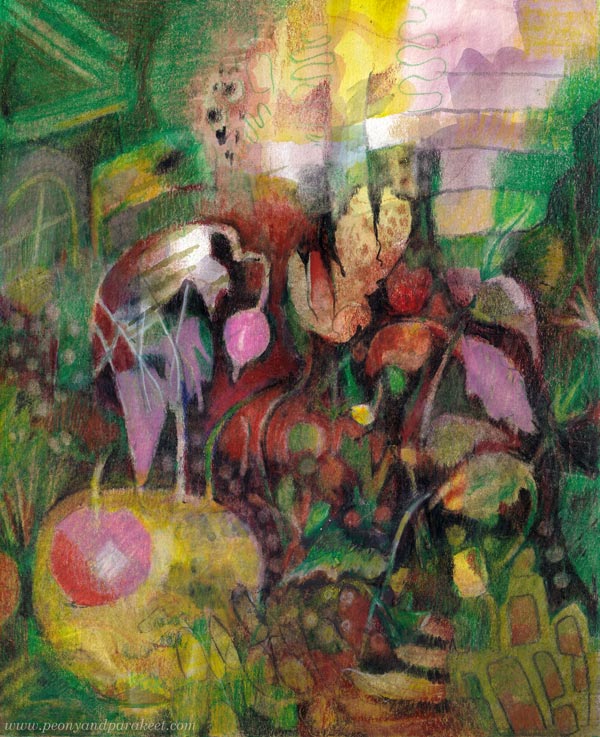
Watercolors and colored pencils.
At first, I thought the material I had gathered over the past few months would be just for these blog posts. But as I have started to unpack the topics, I find myself wanting to share more than what fits into a single post—to show things in both theory and practice. So, I’ve started developing a new course, under the working title Artistic Drawing.
Artistic Line Drawing – Course Themes
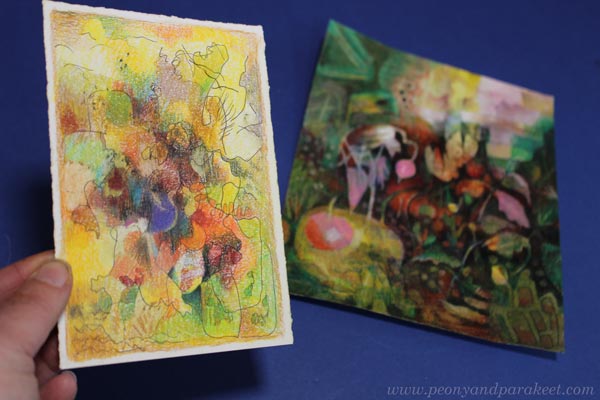
Here are the themes I have selected for the upcoming course:
- Ways to Start a Drawing: I want to help you explore how you begin. You can approach your drawing like an architect, building a clear structure first—or like a gardener, letting everything grow from a single seed.
- Letting Go: If drawing does not make sense and feels directionless, letting go can be difficult. I want to give tips on how to feel free and draw anything without too much inner resistance.
- Interaction: I want to help you notice the possibilities of interaction in the creative process. This is about both how you speak to yourself and how you work with drawing. For example, a line you draw can invite another line to join the conversation.
- The Scale of Shapes: An impressionist draws in a pixel-like manner, placing tiny dots one after another. An expressionist creates larger, vector-like shapes. I want to help you use both approaches and find the combination you enjoy most.
- Presence: At its best, your drawing radiates presence. I want to help you become like a singer who doesn’t just go through the notes, but pours their whole soul out to the audience.
- Clarity: You can begin a drawing with plenty of elements, but towards the end, it is worth striving for clarity. I want to help you discover a minimalism that is not based on scarcity, but on the ability to pick the essential.
- Sense of Style: I want to help you find the things you want to add to your drawings, and the ones you want to get rid of. It is not just about developing a style, but also about developing your sense of style.
Which of these themes interests you the most? What else do you hope to be included in the course?
You Can Draw Patterned Papers!
This week, I answer the question: “I want to draw, but don’t know how or what! How to start?” My suggestion is to start with patterns. So, draw repeated shapes and make a collection of patterned papers that you can use for collage art, for example.
The No-Pencil Approach
I usually start my line drawings with a black thin-tipped drawing pen or a blue ball-point pen.
If you say you can’t draw, say goodbye to the pencil era. Don’t be one of those who sketch many parallel lines and erase all the time! A pencil is a crutch that might feel helpful, but trust that you can walk and pick up a pen. The first steps may be scary, but when you risk more, you draw better. Your line is not just a vague and neutral curve, but one that expresses your existence.
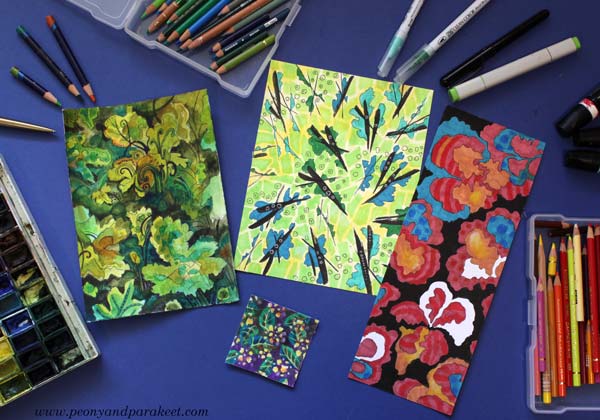
Let’s draw four patterned papers!
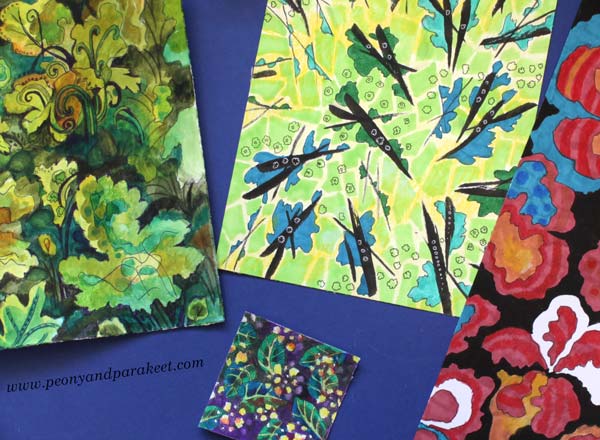
Paper #1 – Small Flowery Shapes
Pick a tiny piece of paper and a pen, not a pencil. When you can’t erase, you focus more and draw better. Small paper doesn’t need anything grand, so clusters of tiny flowery circles are enough, and if not, you can add some leaves.
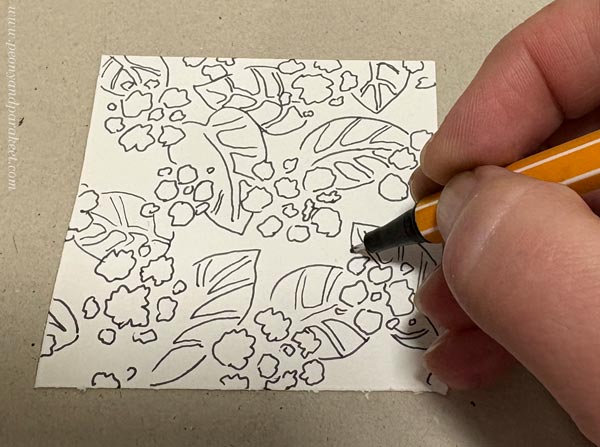
I colored my pattern with colored pencils. The fun thing with colored pencils is that you can use an eraser to add more patterning. I have a precision eraser pen that is handy for small dots. If you use a bigger eraser, color the dots smaller after erasing.
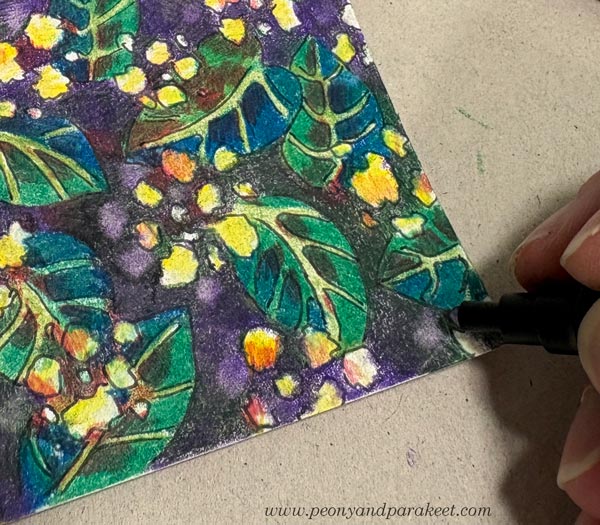
I love colored pencils because it’s easy to layer the colors to get a variety of tones.
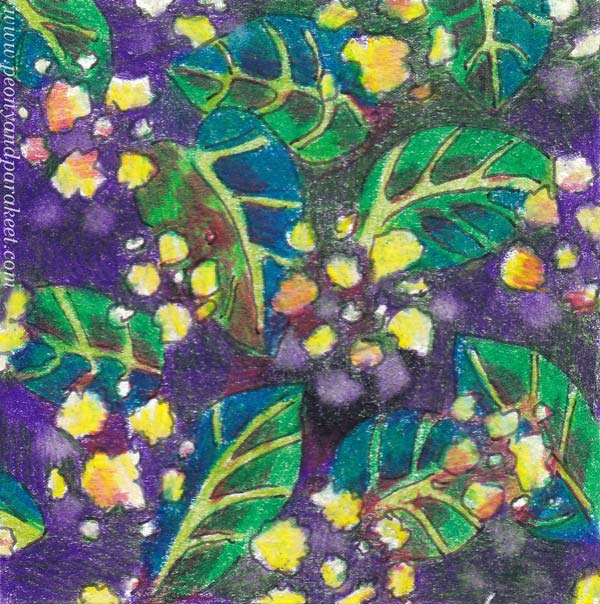
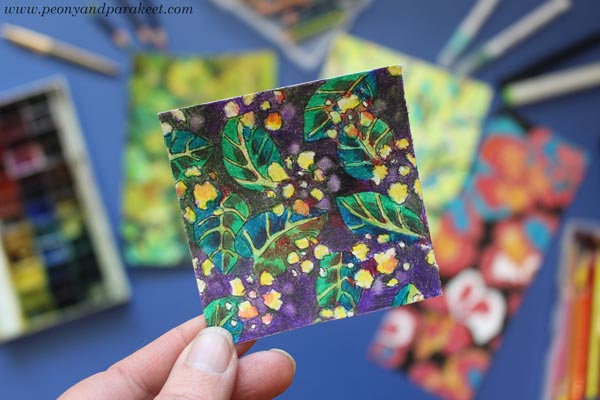
People may say: “It’s just a pattern, not a picture.” Or: “Tiny scraps mean nothing.” But I think it’s a packet of seeds, ready to grow and expand. The first paper may be a secret thing, something you glue on your notebook or planner, to freshen up all the mundane words like “To do” or “Meeting at 9 AM.”
Paper #2 – Big Nested Shapes
Let’s get bolder and pick a bigger paper! The shapes should now be so big that most of them are only partly visible.
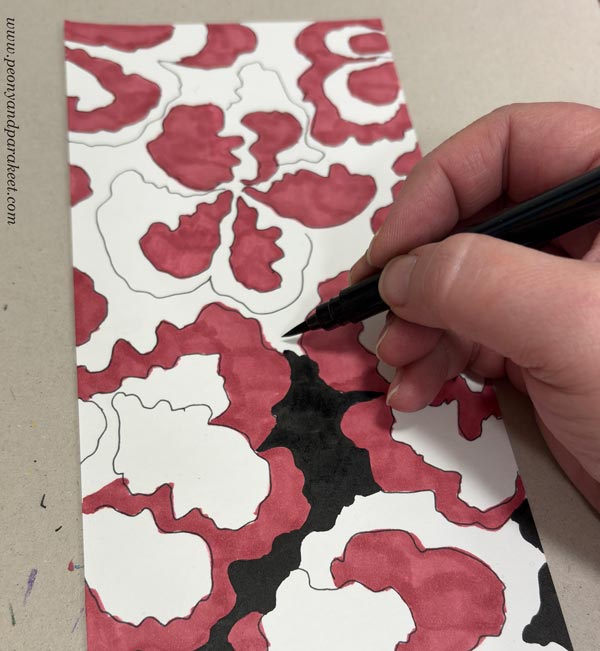
Draw nested shapes. The first lines define the inner shapes, and the second lines are the outer shapes that group them. These are fun to color! I used felt-tipped pens and strong contrasts.
Then I added circles, stripes, and some color variation with colored pencils.
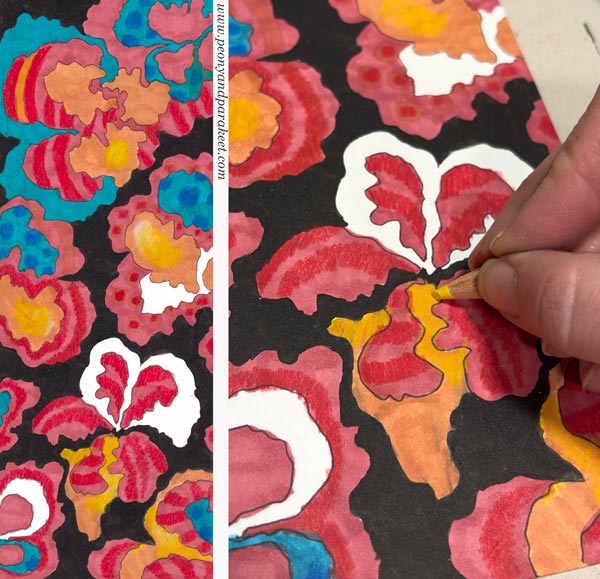
When the motifs are big and the colors bold, the shapes can be quite simple. The Finnish design company Marimekko has produced great patterns over the years. See inspiring examples here at Marimekko’s site!
Paper #3 – Dynamic Strokes
Pick a pen with a brush tip. You can also use ink or watercolors with a paintbrush. Draw clusters of three intersecting strokes. Then draw curvy lines that travel around the strokes. The result is dynamic and looks like flying trees or the sight when looking up at the trees. You can add small, flowery shapes and circles too.
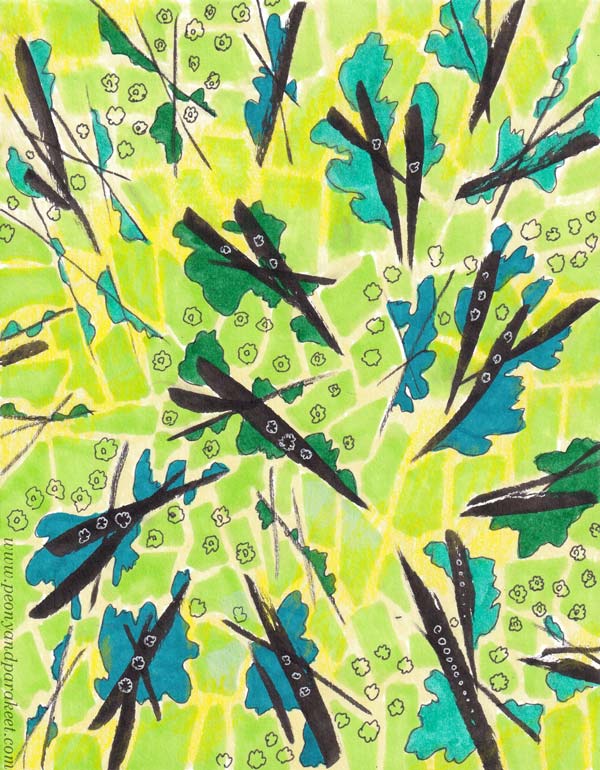
I also played with the background and added a free-form low-contrast grid that is like a city map or a tiled wall. The more you draw patterns, the more you will cluster and layer. This way, you will gradually move towards making expressive art rather than staying in the area of surface design.
Paper #4 Traveling Line
Now let your line travel more freely. Repeat what you have learned in the previous exercises, but do it in a more relaxing way, without too much care about what comes on paper. Think about the line being just a foundation for coloring.
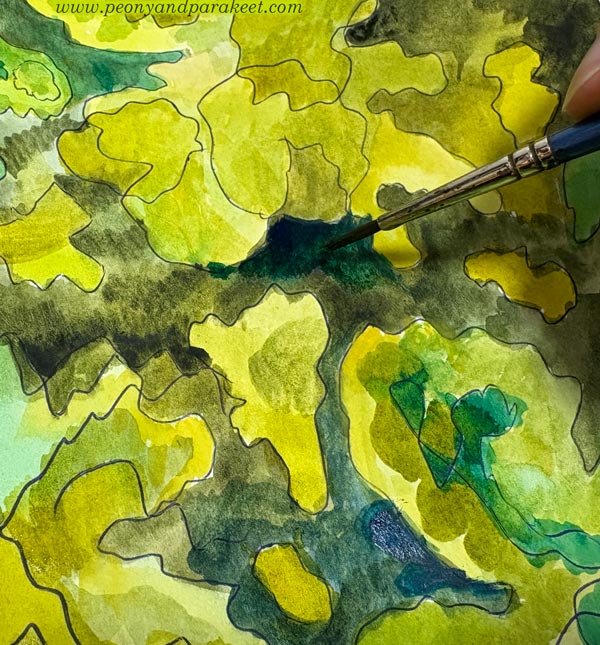
When the first lines are just a foundation, you can add decorations like swirls and small dots, which are often seen in surface patterns. Some motifs might be more decorative than others, and the result becomes more like scenery than a design.
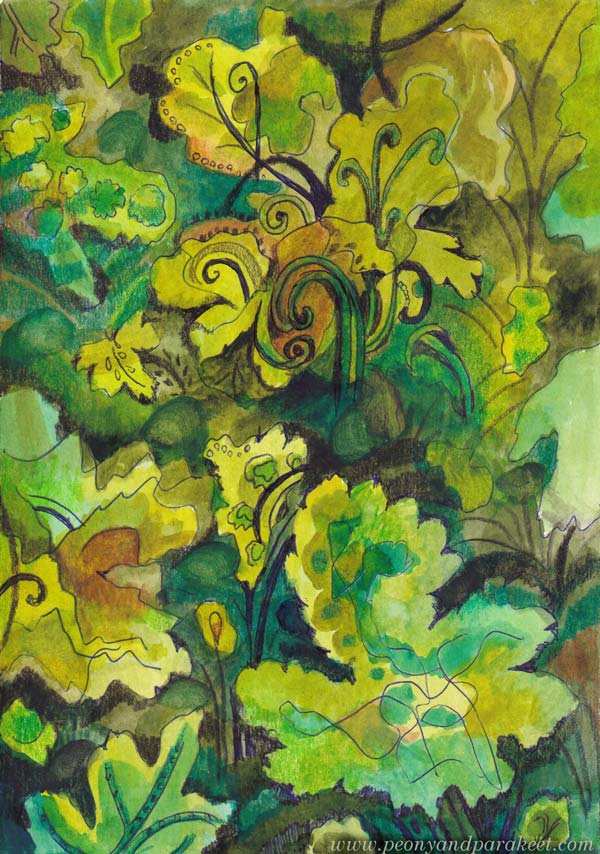
I used a regular ball-point pen for the first lines, then colored the paper with watercolors, and finally added decorative details with colored pencils.
To Draw Freely? – What It Is
Drawing means letting your pen take the lead. It means guiding it forward, meandering, and turning. It means traveling your own paths, daring to go back, and driving over and past them. When drawing freely, you don’t really care about the destination, but you want to enjoy the ride.
Your pencil should be firmly on the road, but not so heavily that it’s hard to move. A person who travels with their pencil and focuses on the line knows how to draw, unlike those whose line merely flits across the paper before fleeing. Drawing isn’t about the line representing something, but about the line having someone who treasures it.
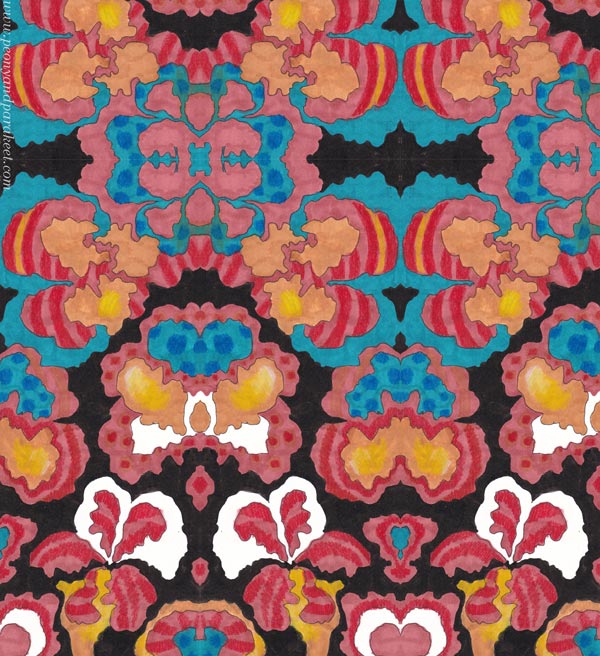
Extra – From Hand-drawn Paper to Digital Kaleidoscope Pattern
If you can use image processing software like Adobe Photoshop, scan or photograph your design and duplicate it several times. Flip some copies vertically and some horizontally to build a continuous kaleidoscope pattern.
Draw and Use Patterned Papers -More Inspiration
Use your papers! See this project: Painterly Collage in Rut Bryk’s style
Create more paper and make collages: See the class Collageland
Draw freely: See the classes Intuitive Coloring, Joyful Coloring, and Mystical Minis
Video: Artist’s Life and Inner Inspiration
This week, I made a video blog post where I share what I have been working on lately. This watercolor piece is one of them.
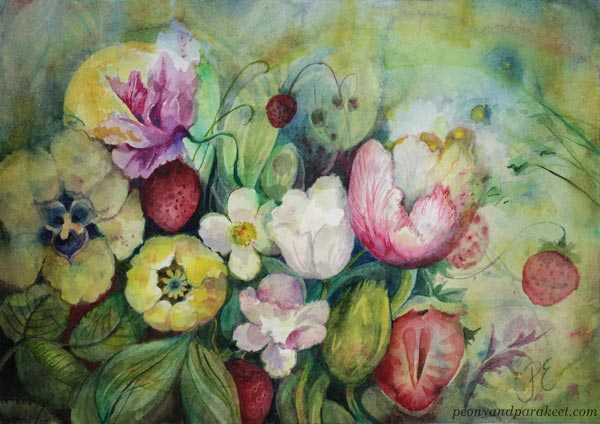
In the video, I also talk about the inner inspiration – that not everything has to come from outside, but there’s a lot within our inner world already.
You get to see my planner for 2026, which is also my art journal. It’s a notebook that has pictures of Jasmine Becket-Griffith‘s art.
Artist’s Life and Inner Inspiration – Watch the Video!
My favorite topics – flowers, watercolors, colored pencils, and abstracts – are all covered in this video.
In the last part of the video, I share my joy about the newest course, Mystical Minis – abstract art with colored pencils – Buy Now!
50 Art Ideas in an Art Journal
This week I have a special treat for you: a flip-through video of my full Dylusions Creative Journal. It has 50 art ideas, not only for art journaling but for art-making in general.
The pages are mostly made with colored pencils, watercolors, and acrylic paints. I also have many that have hand-drawn collage pieces.
I started the journal in 2020 and finally finished it now in 2025. There are so many memories saved in it. But I didn’t want the nostalgy to take over, but tried to make the video as useful and as easy to watch as possible.
50 Art Ideas – Watch Now!
There’s so much ideas that I thought it would be handy for you to have all the ideas and links listed.
List of Art Ideas and Links to Related Content
#1 Borders
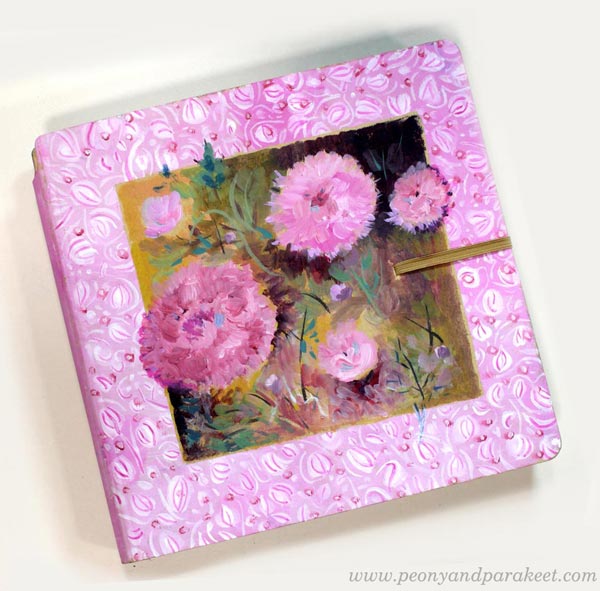
Get inspiration from books and paint covers so that they have borders.
#2 Draw a Tassel!
Draw a decorative object like a tassel rather than an animal or a person.
Blog post: Making the Art Journal More Magical
Course: Animal Inkdom
Course: Magical Inkdom
#3 Forgotten Supplies
Check what supplies you have and use those that you haven’t used for a very long time. At the same time you can decide if you really want to keep them.
Blog post: Art Supplies I Should Not Use Anymore
#4 Introduce Yourself!
Tell who you are in words and pictures.
#5 Title
Give the book a title that inspires you.
Blog post: Adding Text and Layers to Your Pages
#6 Makeover
Paint over any page so that the previous layers show through. Then add details on top of everything.
#7 Alice in Worderland
Paint a place where strange things happen.
Blog post: Painting a Mystery
Blog post: Wonderland Art – Inspiration from Alice in Wonderland
#8 Indoors and Outdoors
Paint a room with large, open windows. Imagine that the outside world floods in.
Blog post: Painting a Mystery
#9 Cafe Bakery
Imagine a lovely cafe where you bake cakes.
Course: Decodashery
#10 Paint with Pencils
Use colored pencils like they are paints and color without outlines.
Course: Intuitive Coloring
#11 Child’s Drawing
Use a child’s drawing as a starting point for a page.
#12 Hole
Make a window from one page to another by cutting a hole.
#13 Scribbles
Pick a black pen and scribble and doodle your heart out. Then use the drawing as a coloring page.
Blog Post: Don’t Just Create Circles
Blog Post: Doodler’s Sampler Step by Step
#14 Transparency
Draw on a transparent film or print your drawing on the film.
Blog post: Creating Wood by Doodling Layers
#15 Safari
Draw animals and use unconventional colors and details.
Course: Animal Inkdom
#16 Time Travel
Combine your art from several years into one spread.
#17 Happy
Collect happy things and write comforting and hopeful thoughts.
Blog post: Mini Drawings on Art Journal Pages
#18 Inner Child
By creating, we cherish our inner child. Let her face appear in one of your pages.
Blog post: Coloring with the Inner Child
#19 Columns
Add drawings and paintings as vertical stripes on the spread.
#20 Free Video: Colored Pencils – Intuitive Approach
Blog post: Colored Pencils – Intuitive Approach
#21 Underwater
Let blue tones dominate the background and create an underwater scenery.
#22 Nighttime
Imagine what can happen in the night when no one is watching.
#23 Fairytale
Make up a fairy tale while you draw.
Blog post: Picture Prompts – Creating Art Journal Pages with Handdrawn Animals
Course: Animal Inkdom
#24 Wings
You can draw wings on almost anything.
Blog post: Picture Prompts – Creating Art Journal Pages with Handdrawn Animals
Blog post: Angel Drawing for the Inner Child
Course: Magical Inkdom
#25 Four Seasons
Express spring, summer, fall, and winter in one spread.
#26 Seed Flower
Start with a single flower.
Blog post: Flower for Your Art Journal
Blog post: Expressive Watercolor Flower Collage
#27 Floralize!
Leave some happy parts of bad art visible and then paint flowers on the top.
More ideas for revamping:
Blog post: Revamp Art Journal Pages So That They Spark Joy!
Blog post: Revamping Watercolor Painting with Watercolor Pencils
Blog post: Art Makeover – Revamp Your Old Paintings!
#28 Carve & Stamp!
Carve a lino plate and use it as a stamp.
You can also use a gelli plate.
Blog post: Gelli Plate Meets Fine Art – Monoprinting Ideas for Art Lovers
#29 Lemons
Express your appreciation for lemons or other fruits by painting or drawing them.
Blog post: Painting And Drawing Fruits
Course: Fun Botanicum
#30 Vermeer Girl
Re-create the face from Johannes Vermeer’s painting Girl with Pearl Earring.
Blog post: Vermeer Girl with Heart – Draw with Me!
#31 Glow
Make a drawing that glows without using any glitter. Use soft transitions from light to dark.
Blog post: Bringing Old-World Feel to Abstract Painting
#32 Spirit
Visualize the person’s spirit, not only the face.
Blog post: Intuitive Art Journaling
Blog post: Coloring an Intuitive Selfie
#33 Puzzle
Glue a couple of small drawings on the page and continue their outlines so that they form a new image.
Blog post: Mini Drawings on Art Journal Pages
#34 Easy Start
Paint the background with watercolors and then use it as an inspiration for coloring.
Blog post: Why Draw in the Ready-Made World?
#35 Stripes
Paint stripes of your current favorite colors.
#36 Scan, Print, Collage!
Scan your drawings and print them smaller. Use the printed images for a fun collage with stripes.
Blog post: Making the Art Journal More Magical
Course: Magical Inkdom
#37 Block
Paint rectangles and triangles to make a design.
Blog post: Building and Breaking – Revealing Artistic Potential
Blog post: Art Quilts in a Modern Way
About Paul Klee
Blog post: Paul Klee and the Art of Learning
Course: Floral Freedom
#38 Chapter
Make a themed chapter of several pages for your art journal.
Course: Hearts and Stories
Course: Fun Botanicum
#39 Storybook
Make a storybook page.
Blog Post: Art Journal as a Storybook
#40 Childhood Memories
Get inspired by your childhood and draw things you loved back then.
Blog post: Maximalist or Minimalist? Style Experiments in Art Journal Pages
Blog post: Choosing the Word for 2025
#41 Dolls
Rather than drawing a realistic person, design a doll with all the accessories.
Course: Decodashery
Course: Doll World
#42 Dark Background
Make an impact with the contrast between bright flowers and dark background color.
Blog post: Imagining Flower’s Spirit
#43 From Back to Front
Add more than one color to the background and, at the same time, adjust the shape of the foreground objects.
Course: Freely Grown
Course Wild Garden
#44 Modern
Make organic shapes more angular and thus more abstract and modern.
Blog post: Making Florals More Modern
#45 Letters
Imagine that the letters are fictional characters and add expression and decorations to them.
Blog post: Making the Art Journal More Magical
Blog post: Draw Your Own Fonts
#46 Watercolor Love
Paint flowers with watercolors.
Course: Wild Garden
Course: Freely Grown
#47 Castle
Imagine a building that is full of fun details.
Blog post: Intuitive Art Journaling
#48 Experience
Imagine being in an imaginary place.
Blog post: Intuitive Art Journaling
#49 More Is More
Be a maximalist, and get inspired by nature’s abundance.
Blog post: Maximalist or Minimalist? Style Experiments in Art Journal Pages
Blog post: Following the Inner Color
#50 Jewelbox
Divide the page into small compartments and color the compartments one by one.
Need More Than These 50 Art Ideas?
See the blog post from 2020: 75 Ideas in an Art Journal
I hope you enjoyed this post and put the art ideas in use. Let’s keep creating!