
Painterly Collage in Rut Bryk’s style

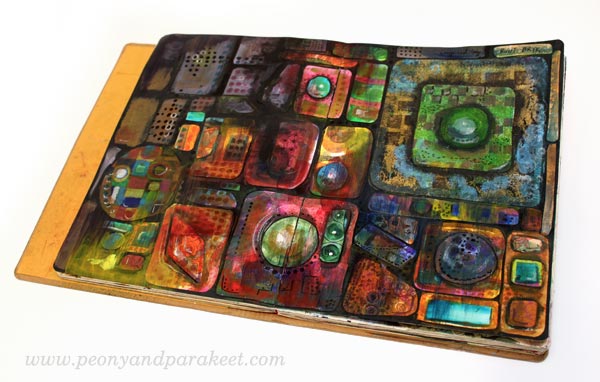
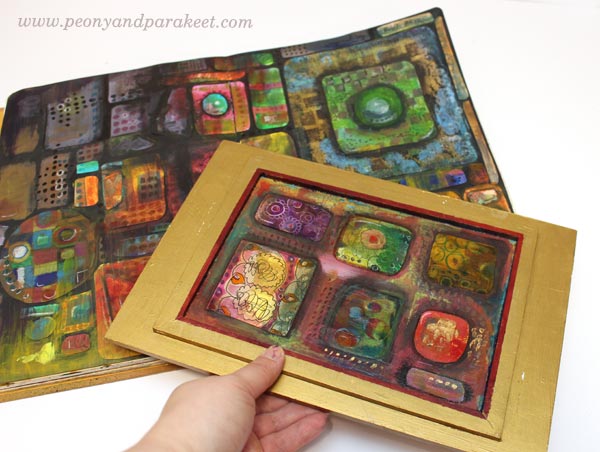
Here’s my recent art journal spread, inspired by a Finnish ceramic artist, Rut Bryk (1916-1999). The Espoo Museum of Modern Art is currently showing her work, and as a big fan of her work, I had to see the exhibition!
Rut Bryk
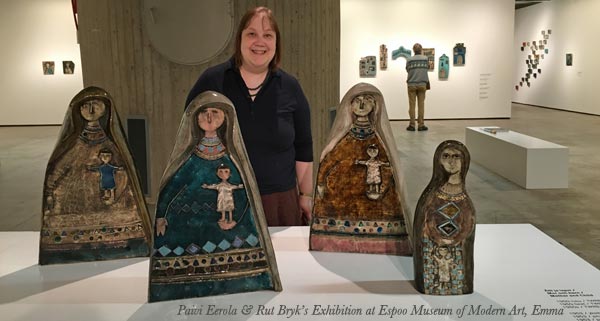
Rut Bryk is very well-known in Finland but not so famous worldwide. However, you might know her husband, the skillful designer and sculptor Tapio Wirkkala. Rut Bryk was an illustrator who got a job at the Finnish ceramic factory Arabia in the 1940s. Her early work was fairly naive and illustrative. But after working with ceramics for some time, she began adding textures to her work. Her 50s pieces were very mid-century modern.
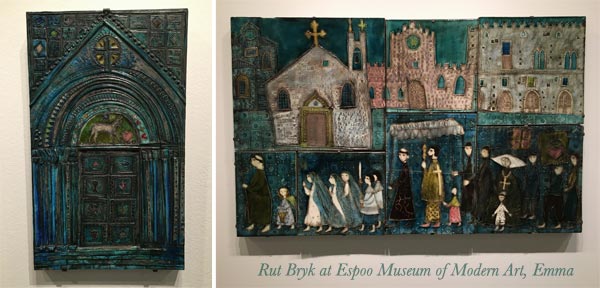
In the 1960s, her work grew more dimensional and abstract.
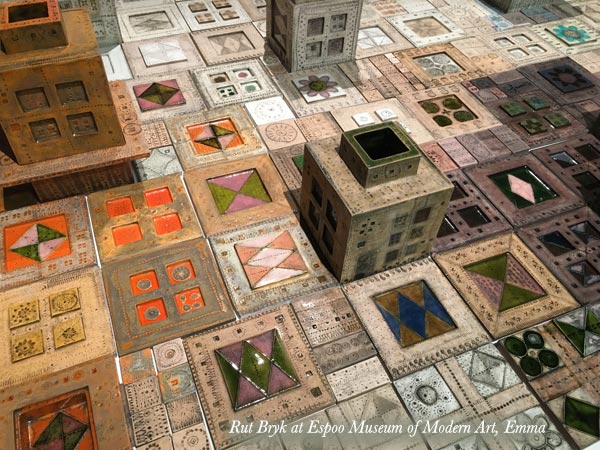
The abstract pieces she made are stunning.
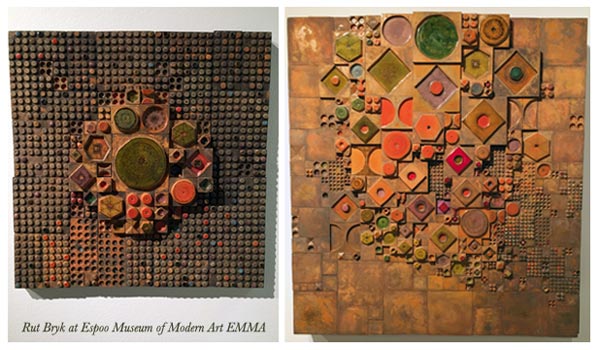
This black city view is one of my favorites.
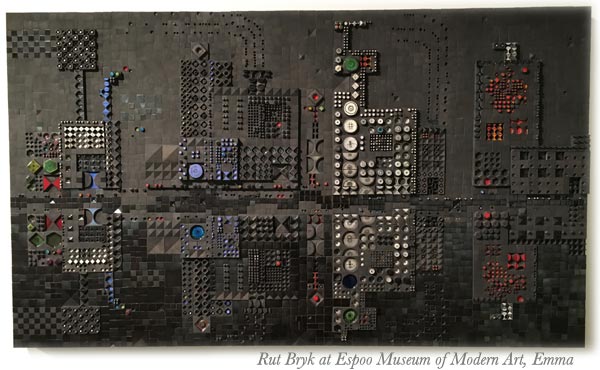
Many of Rut Bryk’s artworks are composed of small ceramic pieces. They look like quilts or crocheted blankets to me.
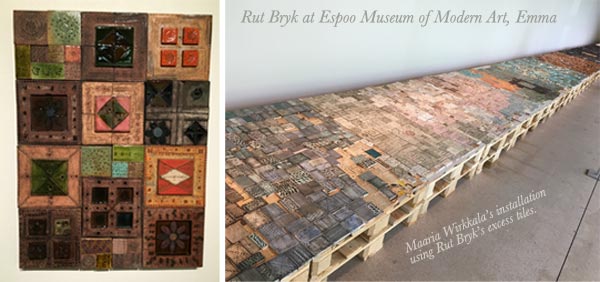
Rut Bryk’s and Tapio Wirkkala’s daughter Maaria Wirkkala is also a well-known artist. She had made an installation of Rut Bryk’s excess tiles for the exhibition.
Create a Paper Collage in Rut Bryk’s Style!
Get inspired by Rut Bryk’s brilliance and create a paper collage with these step-by-step instructions!
You will need hand-decorated papers, acrylic paints, marker pens, and gel medium or paper glue. See ideas for hand-decorated papers: Basic Instructions, Frugal version, Kiwi, Arboretum, Spring Flowers (PDF download)
1) Paint the Background
Paint the background black.
2) Cut Collage Pieces
Cut collage pieces to simple shapes like rectangles, triangles, diamond shapes, and circles. Cut big, small, and medium-sized pieces. To make the pieces look like handcrafted ceramic plates, round the corners and soften the straight edges so that they are slightly wavy. Don’t worry about the colors too much, as you will be painting over them.
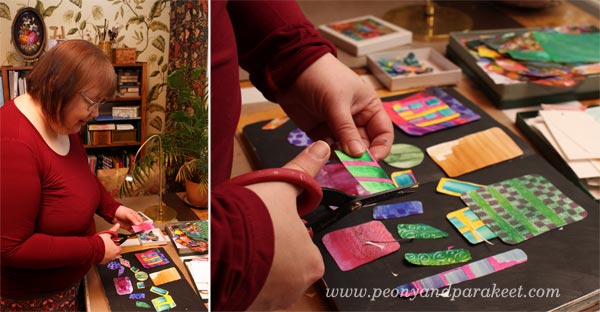
3) Glue the Pieces
Using gel medium or paper glue, begin gluing the pieces on the black background.
Pile up pieces so that some of the smaller pieces are glued to the bigger pieces. Before gluing, add black paint so that the piece on the top will have soft black borders. This will make your work look more dimensional.
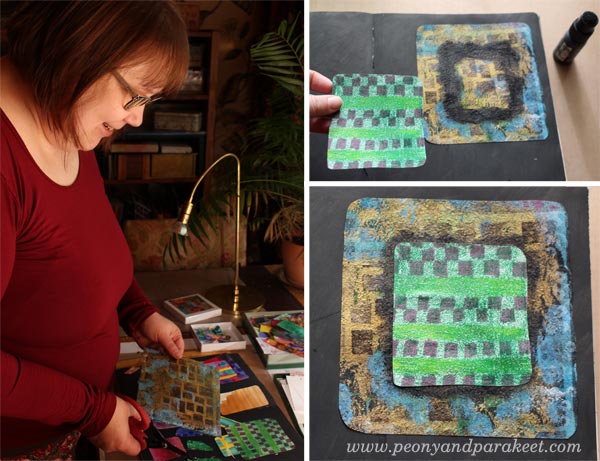
Don’t fill the whole background but leave some of it black.
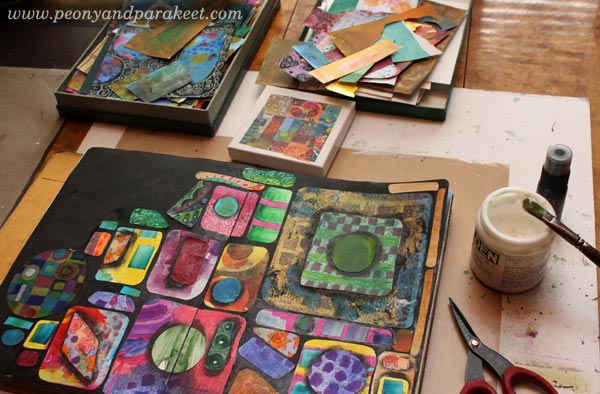
4) Paint Lightly Over the Pieces
To make the pieces look softer and to mute down their colors, add thin layers of acrylic paint over them.
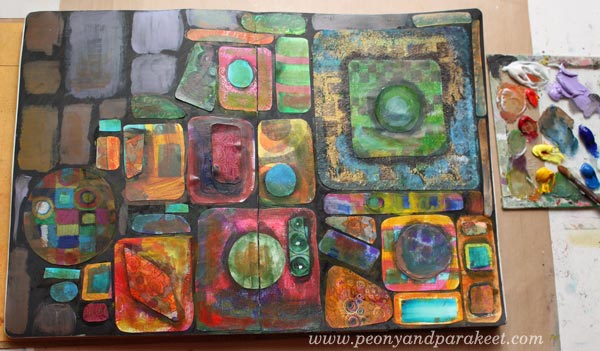
Paint blocks where the black background is visible. Use neutral, fairly dark colors that suit well with the black background.
5) Draw Spotted Grids and Frame Collage Pieces
With marker pens or felt-tip pens, draw spots so that they form grids. These grids can continue over the blocks. The size of the spots can vary. I use Faber-Castell Pitt Artist Pens as they work well on acrylic paint.
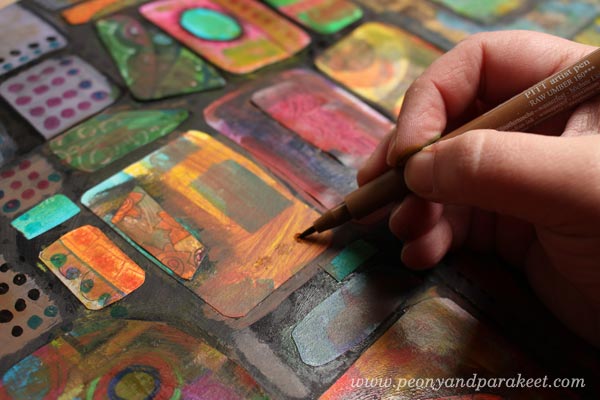
Frame the painted blocks and collage pieces with a black marker so that they look firmly attached to the background. I also used white Chinese marker to add few white lines here and there.
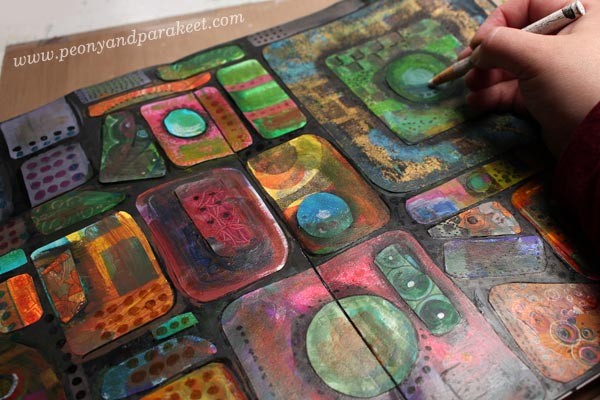
6) Paint Slightly Over Some Areas
To finish your work, add thin layers of paint to some areas. These painted areas represent light and shadows over the overall composition.
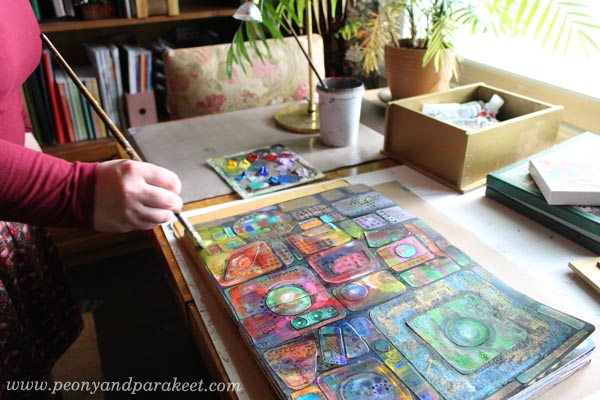
Here’s my finished spread again.
Extra Project – Decorating a Box
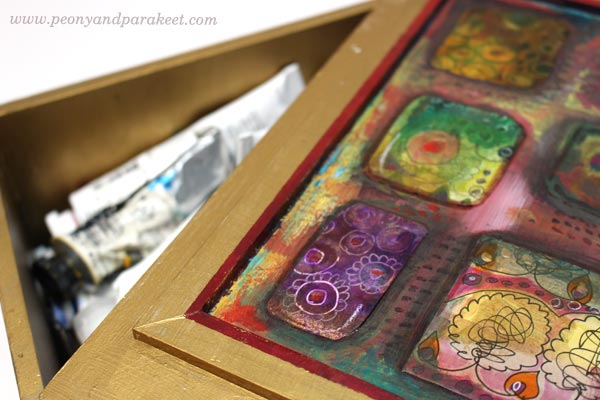
My husband has made a wooden box for my paint tubes. I have painted it golden, but the bottom part of the lid needed some decoration. I had already painted the framed area red, so I just added black paint to the collage pieces.
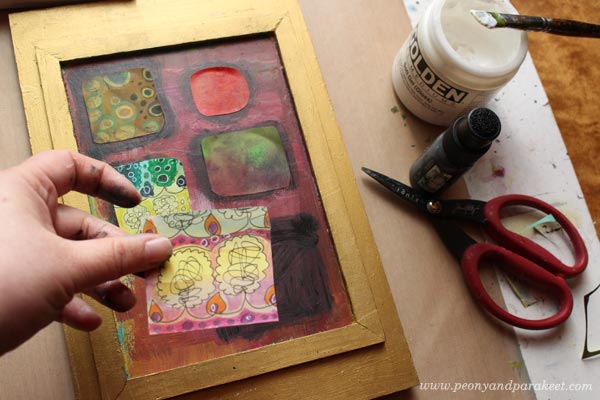
Then I continued the process like in the instructions. Finally, a layer of gel medium was added to protect the paper pieces.
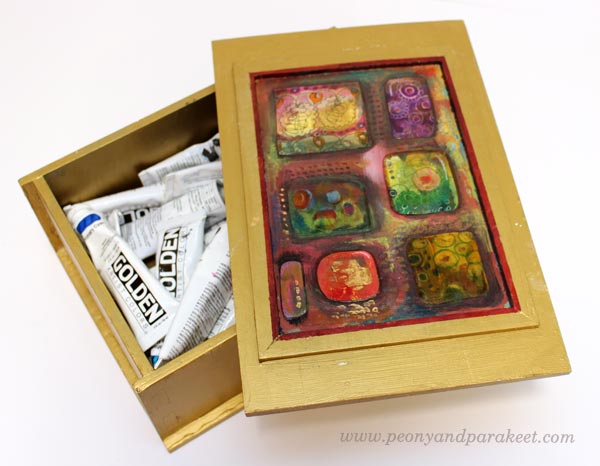
I like the idea of opening the lid and seeing the collage.
Thank you, Rut Bryk!
Expand Your Artistic Imagination!
This blog post is an example of how you can learn and get inspired by famous artists. This is how I see it:
– If you want to find your own uniqueness, examine all kinds of artists and styles!
– If you have already found your style, keep on experimenting and expanding your skills!
Create Internal Seascapes!

This is my latest mini-course for Imagine Monthly. It’s last of the six mini-courses of the spring season. The theme, a stormy sea, is so expressive that I included a special mental coaching session for each step in the video.
Inspiration for Seascapes
My main inspiration for the course came from the two famous painters: Joseph Mallord William Turner and Ivan Aivazovsky, both masters of expressing storm and water. I also studied contemporary artists, one of which is from my home country, a Finnish painter Petri Ala-Maunus.
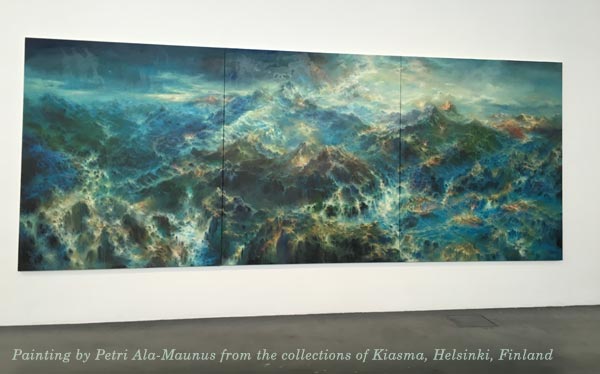
One of his masterpieces can be seen at Kiasma, which is a museum of contemporary art in Helsinki. Just went there a few weeks ago and will again, the main reason is just this gorgeous painting!
For me, Petri Ala-Maunus’s work is an internal landscape. It’s like a view to the inner world with valleys and mountains, seas and storms, ready to be explored and seen again and again. I would like to see a painting like this on the evening of a rough day and then again in the morning, to get my energy flowing.
So, aren’t powerful seascapes a perfect theme for creating art journal spreads? See my Pinterest board Internal Seascapes for more inspiration!
My Versions of Internal Seascapes
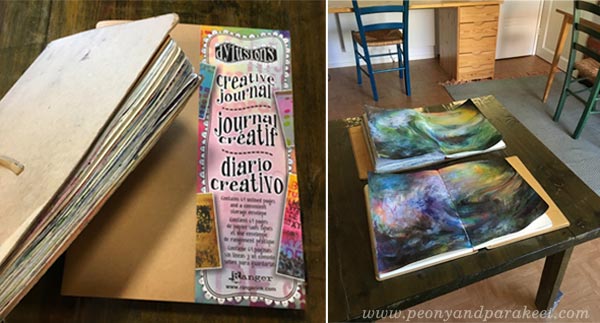
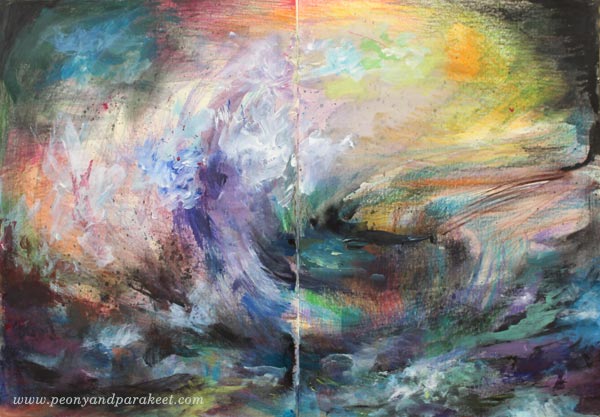
I made the first version before recording the process in the video. I am also talking about the details of this one on the mini-course.

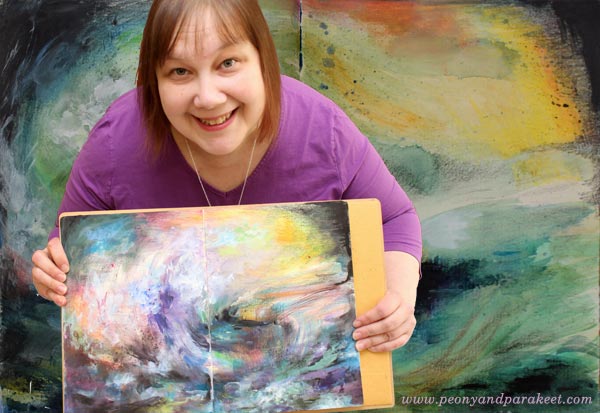
The next one is the mixed media painting that I create in the course video. It has six steps, and it’s very easy to start! I also explain how to get connected with your emotions when creating the painting. The mindset changes, as the painting progresses. This way you will get the expressive and layered result in the end. The mini-course also gives a lot of guidance on how to finish your work.
Imagine Monthly – From Fine Art to Art Journaling
The community of Imagine Monthly has meant a lot to me this spring. A few years ago, I really missed talking about fine arts and how to apply them to art journaling and mixed media. It feels amazing that I have now found so many like-minded people through my classes. So this last mini-course of Imagine Monthly is partly my gift for the participants. I have put my truly best effort to make the best class possible. It also has a longer video, 45 minutes instead of the regular 30 minutes.
Create Internal Seascapes!
Imagine Monthly Spring is over, but you can buy it as a self-study class! >> Buy Imagine Monthly Spring Bundle
Stormy Scenery is also available as an individual mini-course! >> Buy Stormy Scenery
How to Know when Your Artwork is Finished?
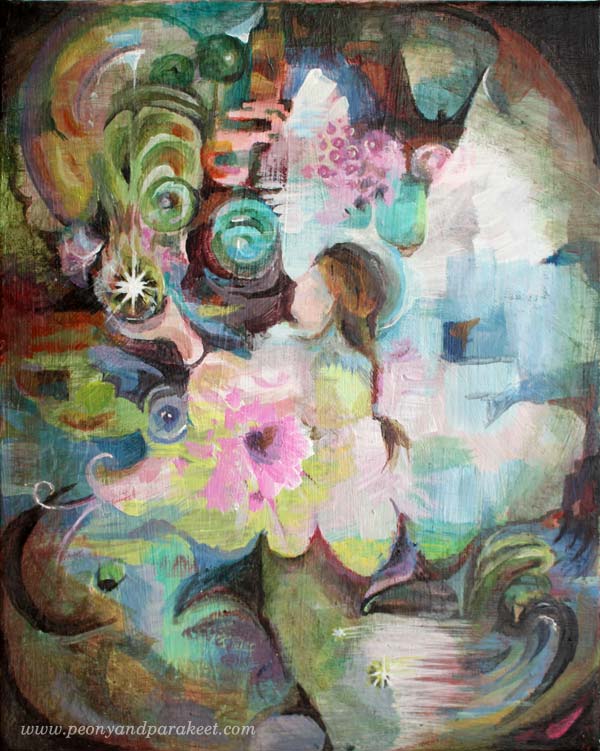
This is my latest painting called “Healing Power”. Painting this piece was so much fun so I decided to work with acrylics on a canvas. I’ll show you the main phases of creating this painting while giving my view on how to know when the artwork is finished.
Finished Artwork? – How to Analyze?
I have heard many bits of advice on how to decide when your artwork is finished. The worst is: “When you feel like it is”. Often you are just tired, fed up and that’s not a good point to finish. Take a break instead, sleep overnight and then continue!
Then there are more technical approaches like this one including infographics or based on historical studies and interviewing artists like this one. But as my students usually want to bring more content and self-expression to their art I have composed a simple and short check list focusing on those only. And instead of diagrams, I show how I deal with the issue in practice.
1. Do You Have an Opinion?
Every time I begin creating, I have pretty conventional ideas. Like here, I thought that I would make a flower painting and express “tranquility”. But to truly express tranquility, I show also include anxiety. I should have an opinion, a personal view on the difference between tranquility and anxiety.
Now you say: “But this is just flowers and nothing deeper”. I don’t think so. If you want to express yourself, you should express an opinion of some kind. This doesn’t mean you have to begin with an opinion. It’s more like vice versa: stay open to what is going to appear! But if you don’t have any more thoughts than “flowers”, “tranquility”, “pink”, you are not finished yet.
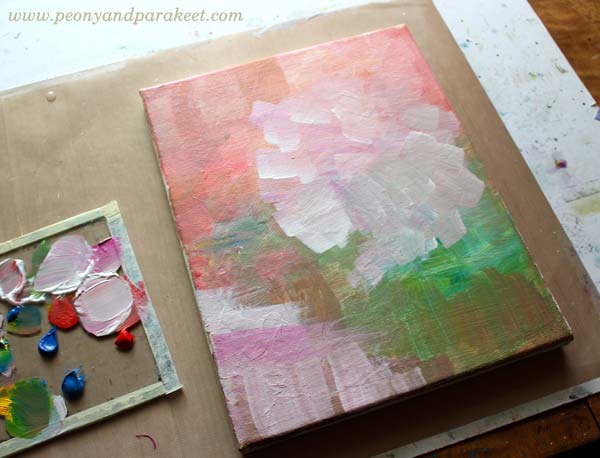
So while thinking about opinions, I got anxious and added some of it: brownish red!
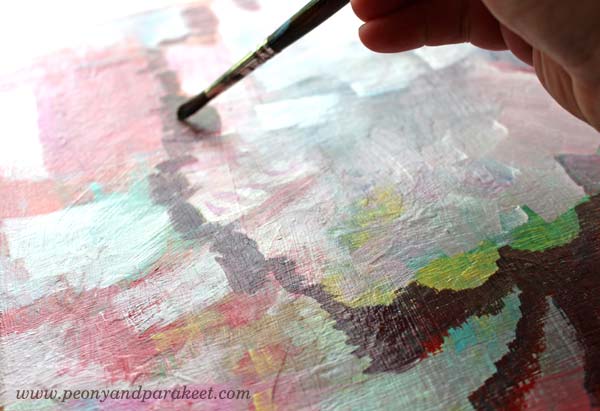
Another way of asking this: “Does the painting have both light and darkness?”
2. Do You Have a Focus?
When I continued the painting, it felt good to add rectangular shapes on it. Then some more colors, then some directional brush strokes. But directional or not, I really didn’t have a clue where I was going. Maybe this could be a flower bunch and the white part on the bottom could be a pot. If so, I should make them more clear.
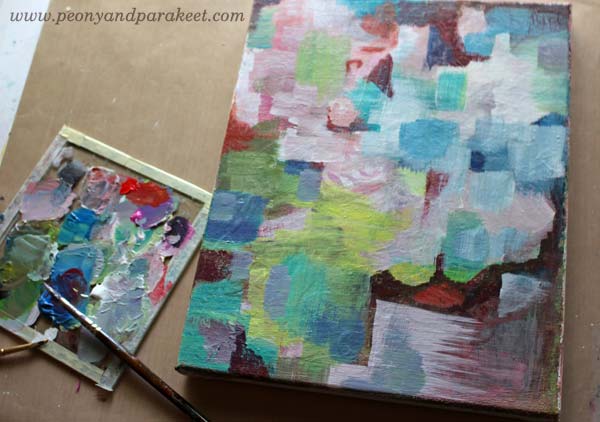
Another way of asking this: “Is it easy to know where to look at first?”
3. Have You Told a Story?
I continued the painting by turning the it upside down as it seemed to be even easier to build a pot with flowers that way. When I was at step 1 (see the image below), the painting was a bit too busy so I added dark thin layers to make it easier to look at (step 2). But then, what does this painting mean? Does it really connect with my thoughts? No, not really!
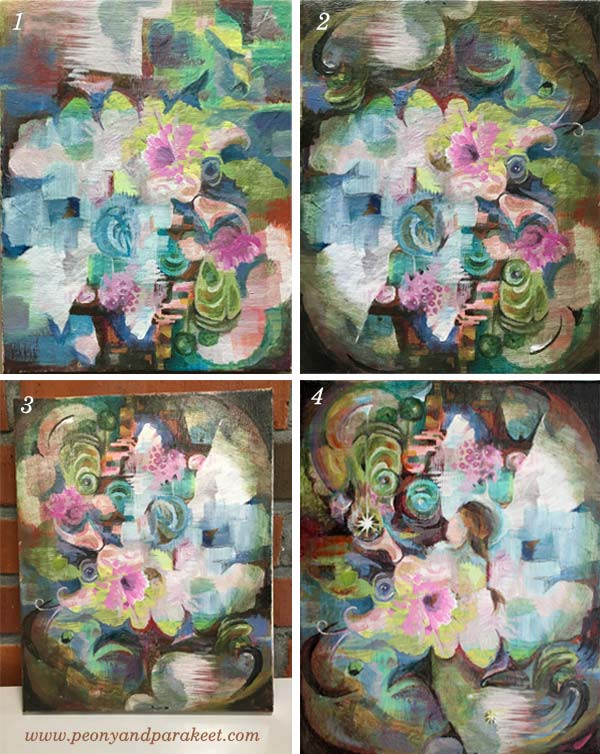
After a break, I turned the painting upside down (3). I saw a woman there, wearing a hat and taking care of the flowers. Maybe that could be a start for a story? I continued painting, trying to make the woman clearer.
Then it hit me: she was some kind of an angel, holding some kind of a magic ball. And finally: this is about healing, a subject I have been thinking a lot lately. My older dog Cosmo has had stomache problems and I have worried about him. I have also thought about many of my students, either in the middle of the sickness or having someone close to worry about. If only I could have the magic power to make everything what’s wrong, back right!
Another way of asking this: Does every element on your artwork contribute or lead to what’s most important?

This finished artwork is for you who would like to have that magic ball of healing power.
Let me be your mentor in art: Subscribe to my weekly emails!
What Artistic Direction to Take?
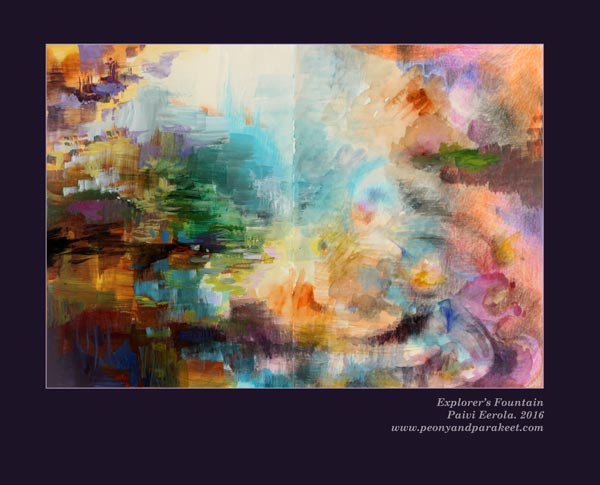
This is my latest art journal spread called “Explorer’s Fountain”. Before showing how I made it, I want to ask you the question that I have been pondering.
When Is the Beginning of a New Phase?
All artists have phases. But how to know when a new one begins? Is creating a continuum or are there certain points when you make the change? Or at least began to change?
I posted this image to Peony and Parakeet’s Facebook page with the text below, and I want to share this here too:
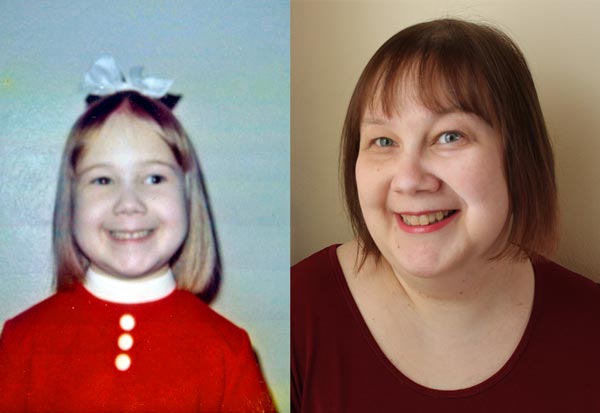
As children, we know what we love. I wanted to be an artist and a teacher. I wanted to write and publish books. I wanted to live with pets. When we grow up, there seem to be more possibilities, and still, they feel less. It’s not much to be a manager when you have dreamed to be an artist. This is how I have felt personally and this is why I think we should do what we have always loved. Because it feels more fulfilling than anything else.
Just recently, art has begun to feel more fulfilling and exciting than ever before. I feel I have new skills, even if I can’t fully point out what they are. I feel I have new thoughts but when I try to grab them, they seem to disappear. My mind is filled with new kind of artistic focus, and still, it’s like it has always been there, now I am just more connected to it. This makes me think that I am experiencing some kind of artistic change, moving from one phase to another.
The changing process is like a rain that starts with small drops. You can then decide whether you go back inside or get out and see what happens!
Learning from Practicing
Teaching classes have been small drops to me. As an art teacher, I see all kind of styles and seek solutions to many kinds of creative problems. I am often so excited about my students and their creations that my own art feels like a secondary thing. But while I have helped people to bring out the best of their skills and get more clarity for their creative direction, it has been a school for me too. It’s like I have got a gift from my students, being able to build my own focus in a new way. So while you have practiced, I have practiced too!
What’s Your Ambition in Art?
I have never understood the controversy between commercial approach and artistic freedom. I think we should search for the best audience to our art and find ourselves through the process. I know most of the people disagree with this. I do understand that many great art pieces wouldn’t have been born with this mindset. But my own ambition of being an artist doesn’t mean creating world-class art and being the greatest of all. I think art as a service instead of end result only. I want to understand how people experience art and develop ways to make creating as fulfilling as possible. – What’s your ambition in art?
Triptych Approach – Create with Me!
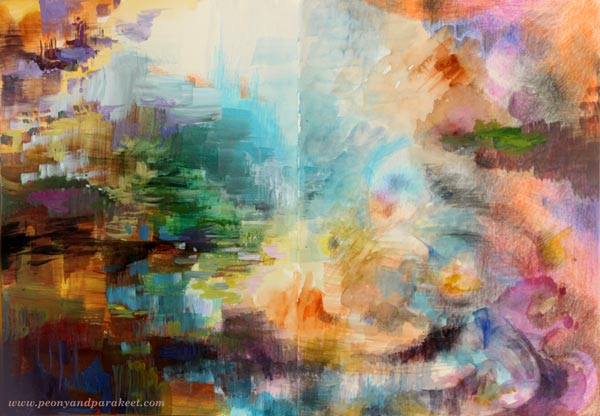
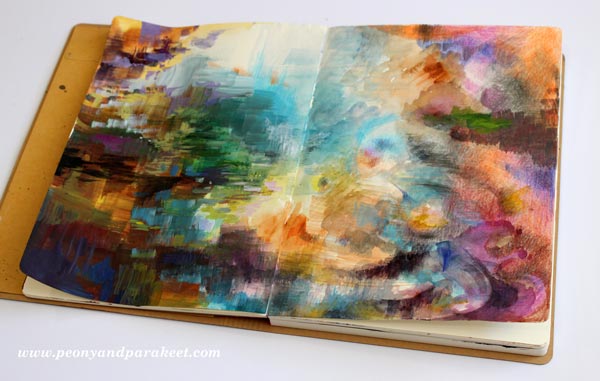
Instead of focusing on single artworks, I look for creative concepts and processes. Just recently I got an idea of a triptych. The piece would be created with three different mediums, each taking one-third of the final piece. But this triptych would have soft edges so that it would look like a one piece despite the three distinct elements. Create this triptych with me and while creating, ponder about your artistic direction!
1) Start with Colored Pencils
Color freely with colored pencils so that you fill approximately one-third of the page.
Add few small separate colored areas too.
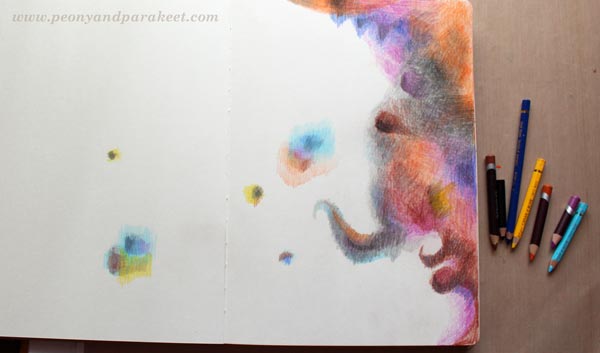
Using Old Pencils
I use Prismacolor and Garan d’Ache Luminance pencils “officially”. For example, all the images of the e-book Coloring Freely have been colored with them. But when I am making a quick spread like this one, I often grab some odd short pencils and use them instead of the fancier ones.
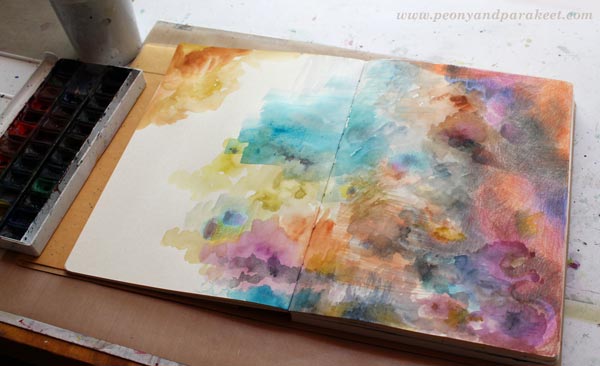
2) Continue with Watercolors
Change to watercolors and paint the second third of the spread.
Try to make the transition from colored to painted areas as soft as possible.
In the end, paint an area that is separate from the main area.
3) Fill the Rest with Acrylic Paints
Paint most of the remaining blank area with acrylic paint.
Add a small painted area on the right where you have colored with pencils. Acrylic paints can be used easily over colored pencils. Don’t cover too much, let every medium show!
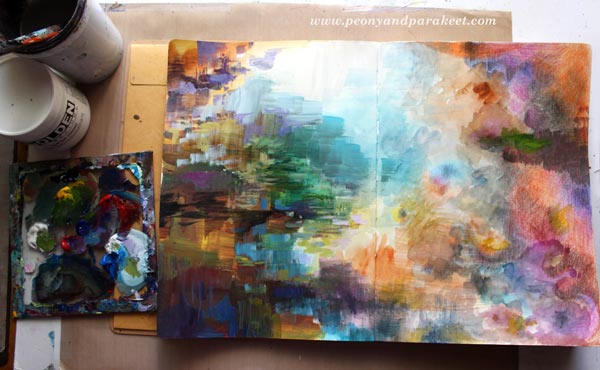
4) Finishing
Go through the whole page and fine-tune the spread with colored pencils and acrylic paints.
Add little details and nuances, don’t repaint the whole page.
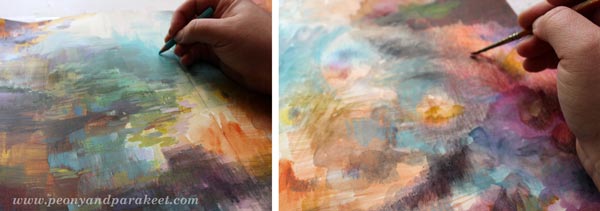
Here’s is my finished spread again.
5) Use Leftover Paint
If you still have some leftover paint on a palette, grab a new page and create a quick abstract!
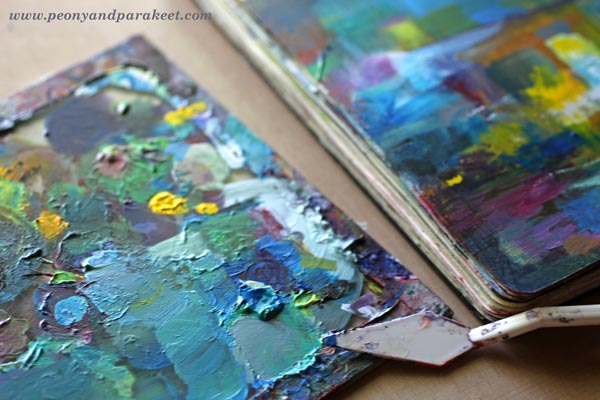
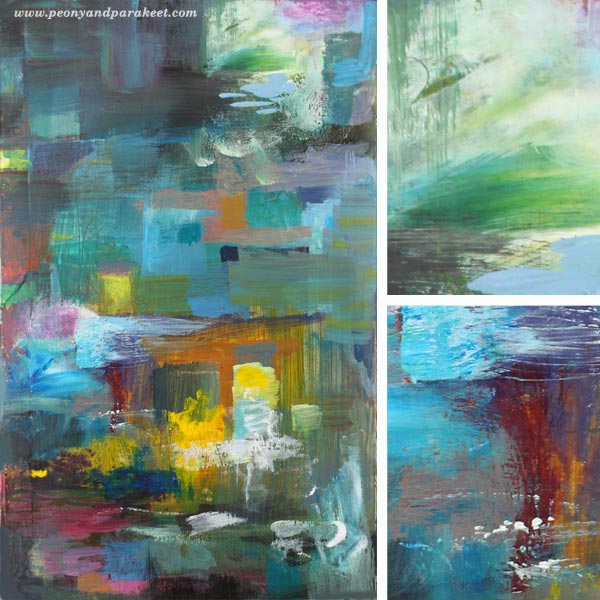
Here’s mine, called “House with a View”.
Analysing Artistic Direction
When thinking about artistic direction, it’s natural to analyze what’s good at the end result – what do you want to take from that to move forward. But it’s as important to think about the creative process and analyze that what felt good there.
After analyzing both ways, I think that my direction is this. I have always loved art history. I want it to show in my art but in a fresh way. I want to build bridges between old art created hundreds of years ago and today’s contemporary art. My latest art class Imagine Monthly already does a lot of that. But I also want to grow as an artist so that my personal expression grows stronger and so that I can reach more like-minded people with both my art and my classes.
Challenge yourself to find your artistic direction
Sign up for Imagine Monthly Fall 2016!