
About Playfulness and Spirituality in Art
This week, I talk about spirituality in art and claim that you also need humor and playfulness to become a spiritual artist.
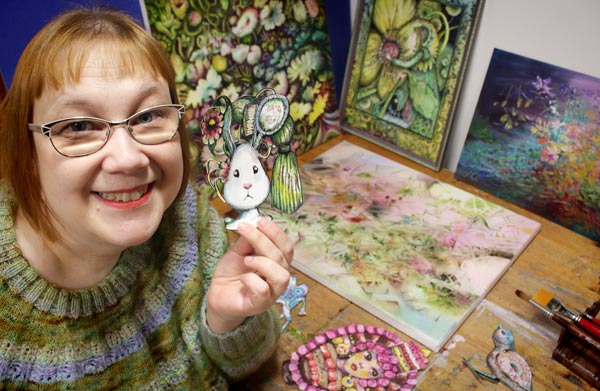
I like to gather my work – big and small – together and mix and match them like they would be pieces in a puzzle. It also helps me to see if my classes support each other and ponder if I have approached imagination and art-making from all angles.
Paul Klee and The Power of a Child
My newest class Floral Freedom is the most schoollike of all. It is based on Paul Klee’s and Wassily Kandinsky’s teachings of abstract art. In the class, I have tried to focus on two books – Paul Klee’s Pedagogical Sketchbook and Wassily Kandinsky’s book Point and Line to Plane. But the books’ teachings have inspired me to search for background stories – find what enabled these artists to invent the abstract methods and theories.
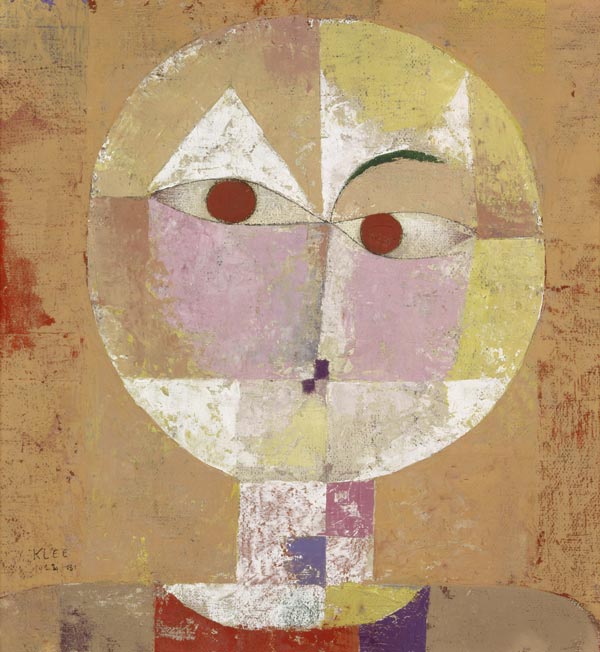
One of the things that needed an explanation was that Paul Klee’s book is full of diagrams like it would be written by an engineer, and yet, his artworks are often playful, some even childish. Look at this painting, for example!
During the first world war, Paul wasn’t a soldier for a long time but transferred to a safer job where he was in the middle of aircraft engineers. But earlier, when he started a family, Paul wasn’t very successful in art at all. His wife worked to support them, and Paul practically took care of their only child, Felix. It wasn’t usual to be a stay-at-home dad in the early 20th century!
When Paul was taking care of Felix and struggled with art-making, he found humor and playfulness that later became a part of his signature style. But it’s not only that! When Paul became close friends with the masterful Wassily Kandinsky, he also made Wassily less serious and more playful. So here’s to all stay-at-home dads and mums!
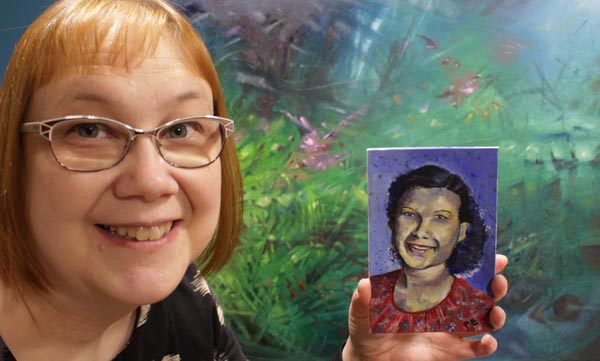
There’s a recent finished painting in the background.
From Product Play to Spirituality
I believe that art happens when one extreme meets another. When my organized mind watches the snowstorm. When I want my art to be about happiness and life and realize that taking it deeper requires confronting fear and death.
In my experience, when you want your art to be more serious and spiritual, humor and playfulness must have some role too. And vice versa, the longer your walk in the path of play, the more serious and spiritual it gets.
When I started my blog over ten years ago, my art-making was very product-based. I bought new supplies almost weekly and experimented with all kinds of techniques and effects.
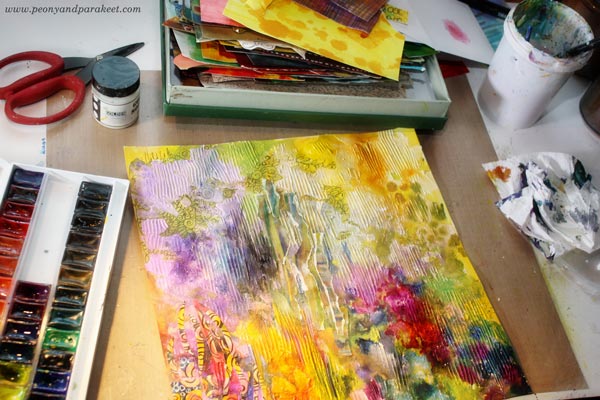
But the more I created, the more I wanted to move from materials to ideas and imagination. Instead of discovering ten new ways to produce circles on paper, I wanted to learn how to make the circles interact and transform into other shapes. This way, my art has gradually become not only more playful but more spiritual as well.
Paul Klee said:
“Art does not reproduce what we see; rather, it makes us see.”
Rethinking Spirituality in Art
Nowadays, I connect playfulness with spirituality. It has also made me rethink how I approach spirituality in general. Here’s what I wrote this week on Peony and Parakeet’s Facebook page and on my Instagram feed:
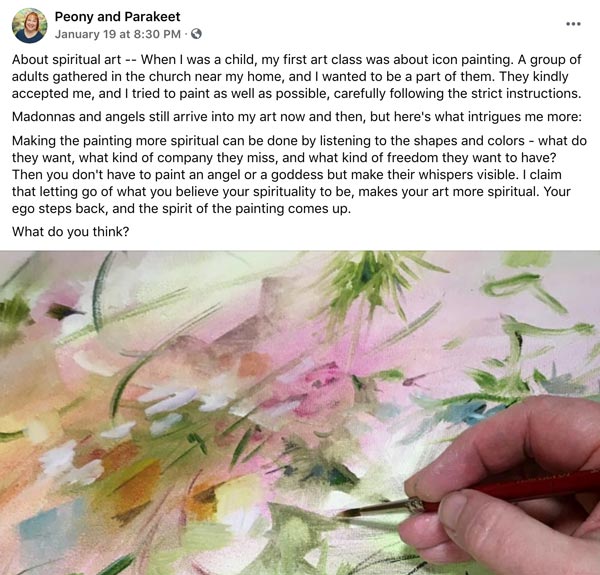
It would be interesting to hear what do you think. Does spirituality have a role in your art?
Impressionistic Floral Painting on Structure Paste
This week, I show how I made an extraordinary floral painting with acrylics and structure paste. See how I achieved the historical look!
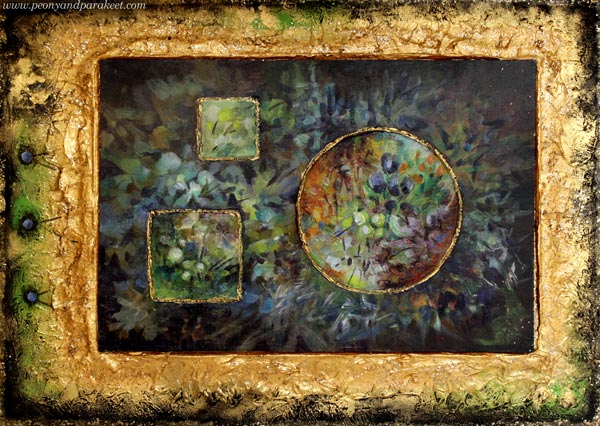
I call this piece “Old Art Yearning” because I desperately miss Europe’s palazzos and museums. It would definitely be the time to pack the bags for a few-day trip to Vienna or some other old city, but I chose differently because of the pandemic. But first, look at the interior of Palazzo Doria Pamphilj in Rome. My husband and I visited the place on June morning in 2017, and it was pleasantly quiet, just suitable for dreaming about living there in the middle of luxury.
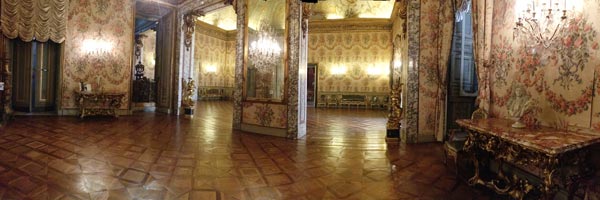
So, what luxurious can you do when you are asked to stay home and be safe? I decided to create something that’s like a soft drink for the old art thirst: fake but sweet and consolating!
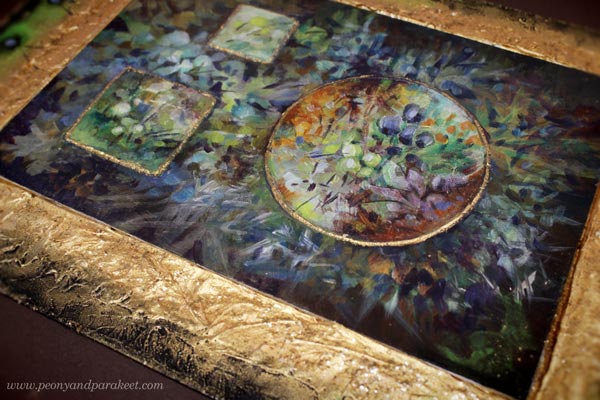
The idea of using structure paste is from the summer, but back then, I didn’t quite see as far as I did this week.
Structure Paste Inspiration from Clay
This summer, my friend Johanna Rytkölä, a ceramic artist ran a flower pot class for a small group. My husband made a stylish and minimalistic bonsai pot, but mine came out quite different!
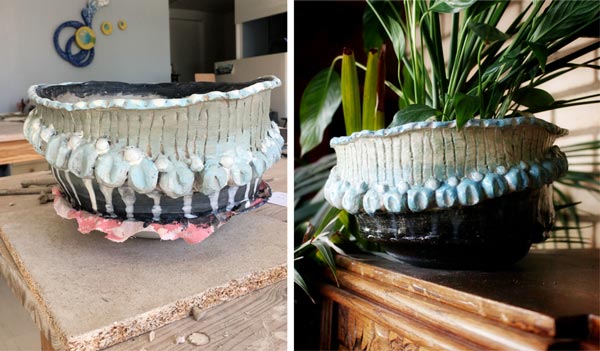
Even if my pot was not perfect, I wanted to experiment with a 3-dimensional surface for a painting right away. I dig out a jar of structure paste that some call molding paste as well. I have blogged about the paste twice before. In 2014, I made cardboard templates to create reliefs for a mixed media piece and in another project, I made surface textures with a variety of tools.
I decided to try the template technique again, and cut simple geometric holes to a thick cardboard.
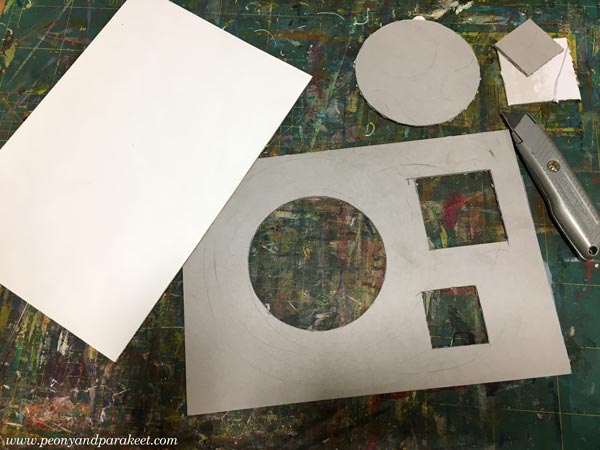
Then I placed the template on the top of the painting board and filled the holds with structure paste.
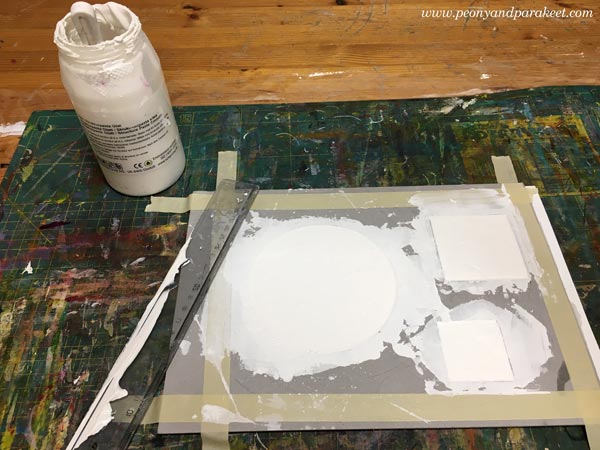
I wasn’t completely satisfied with the edges of the structure paste shapes and put the board away.
Acrylic Painting on Structure Paste
But now, when I wanted to create something with historical feel, I remembered the board, and started painting on it. The small imperfections didn’t bother me so much anymore. All pieces can’t be so serious anyway. There has to be some room for creative play too!
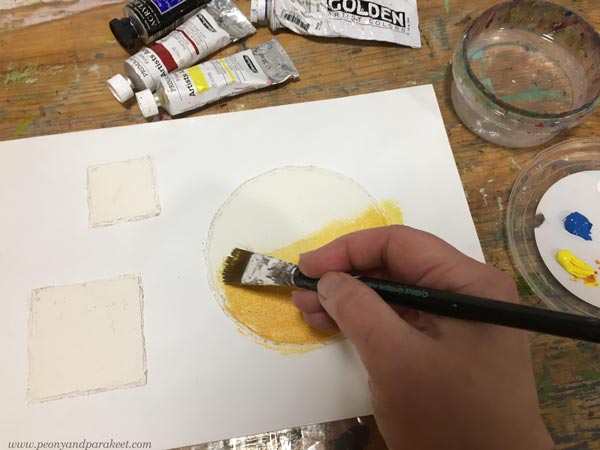
I decided to paint something loose and impressionistic that would still look decorative.
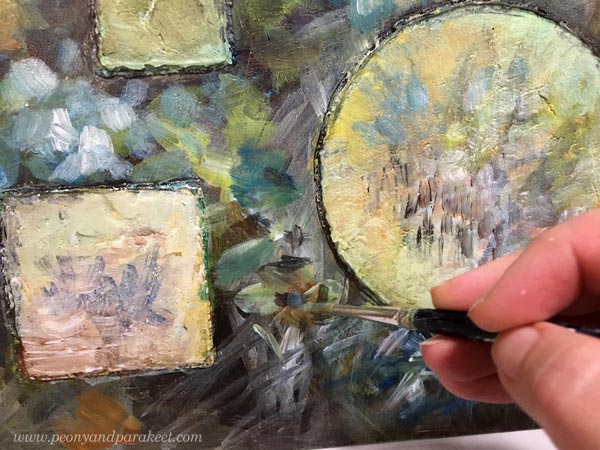
On the reliefs, the strokes were sharper and more controlled than on the background.
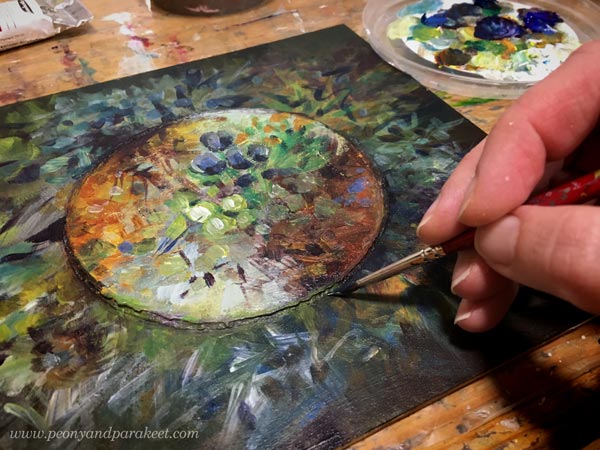
But before I made the finishing touches, the piece looked too bare to me.
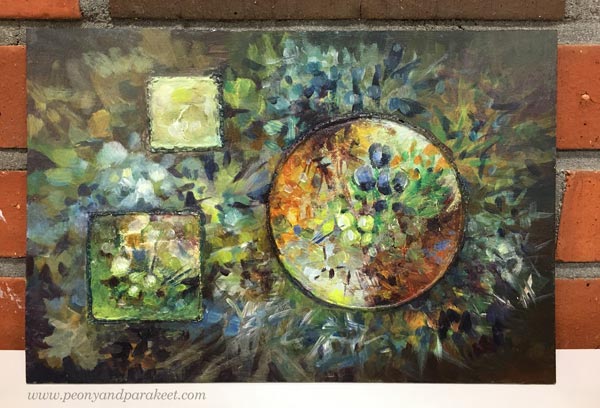
It needed a frame!
Making a Frame from Structure Paste
I still had some structure paste left and I found a piece of cardboard too. I traced the outline of the painting on a soft foam board and used that as a template for the center.
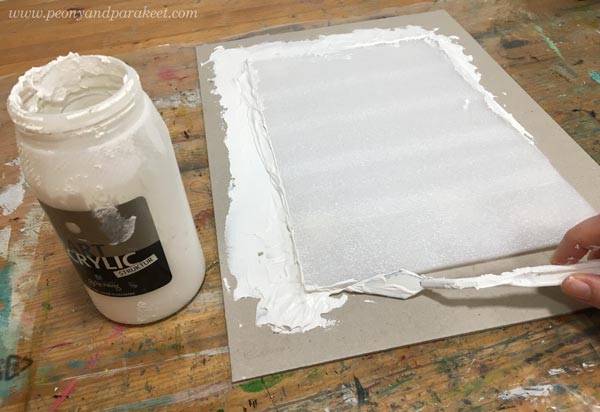
It’s not easy to make a smooth surface of the paste so I didn’t even try. Historical frames had all kinds of textures so the hills and valleys would look ok when painted.
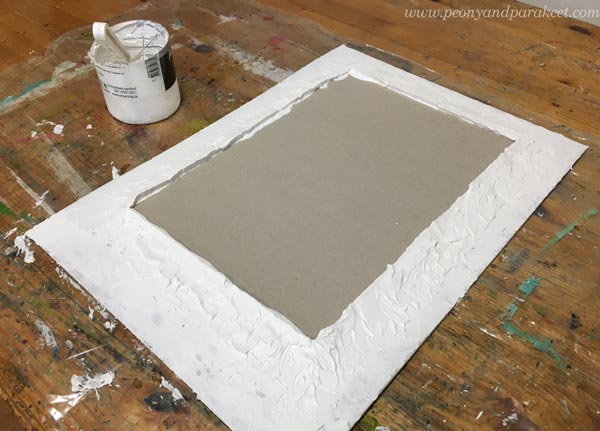
I painted the outer edge of the frame black and the inner edge with gold paint.
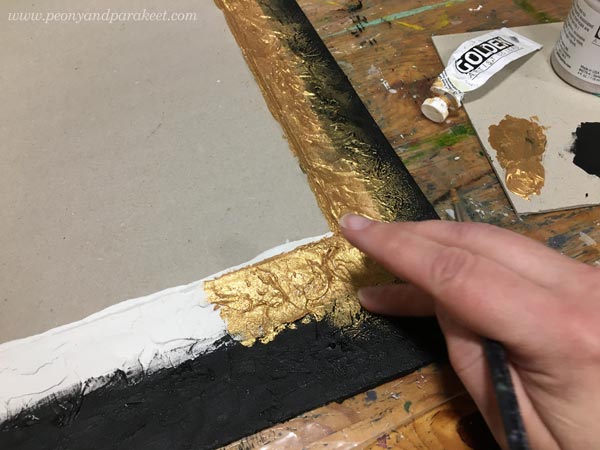
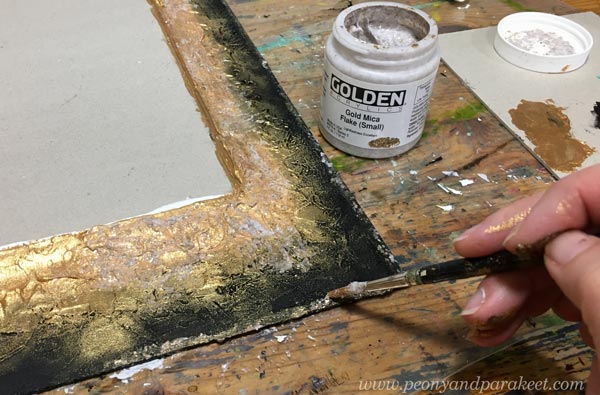
The transition from black to gold became lovely when smudging the paint with fingers. I also added some gold mica flakes on the top of the gold parts and near the edge.
Then the painting got some finishing touches and gold paint too.
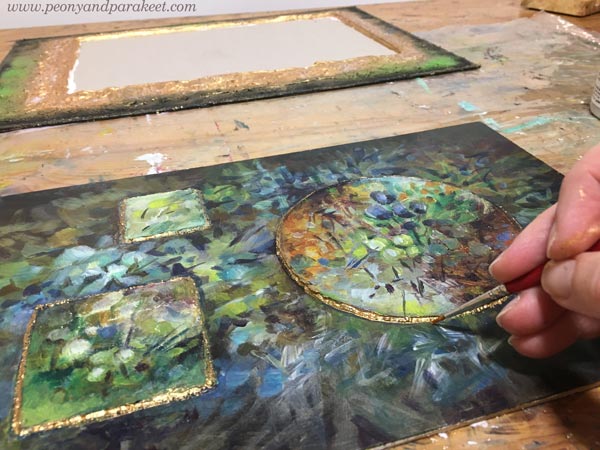
I also added some acrylic paint on the frame.
A Mini-Monet for Old Art Yearners!
The finished piece is a bit clumsy, but I love the historical feel.
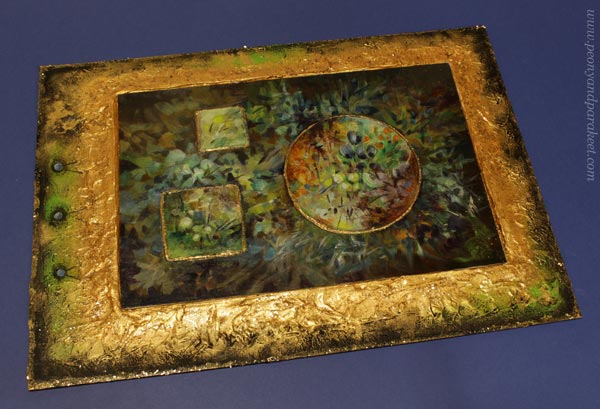
It’s my mini-Monet!
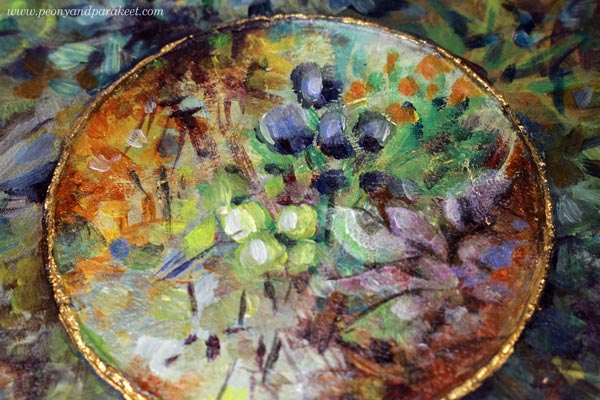
The unevenness of the structure paste in the edges looks quite good with the gold paint.
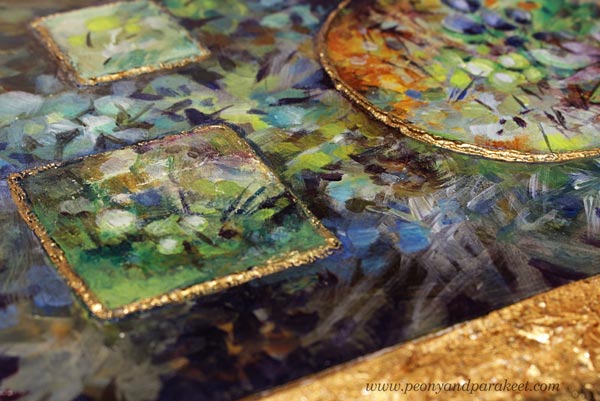
The frame was intentionally placed so that it’s not quite in the middle. This way I could make the piece more interesting. I really like how these painted spots look like nails or blueberries!
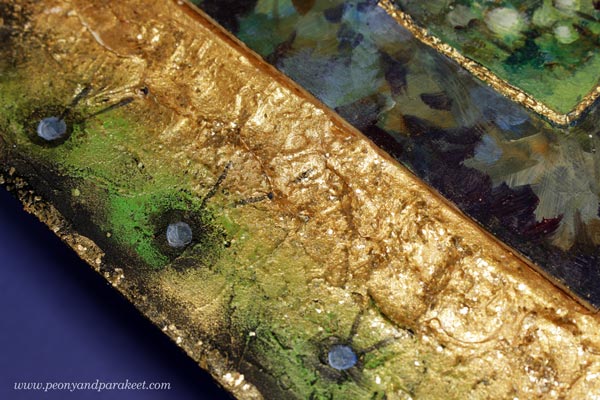
Just cardboard, structure paste, fake gold, acrylics, but I enter the gentle world of old art by looking at it!
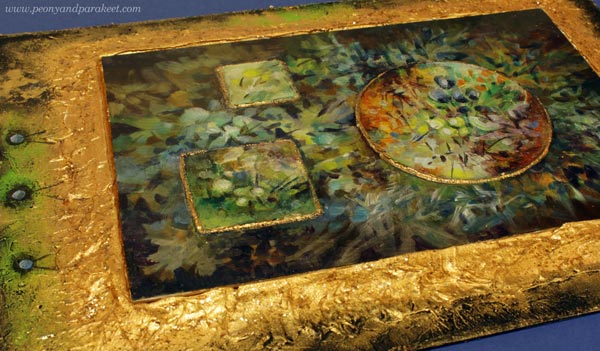
I display this piece in our library room which has more old-fashioned style than my studio.
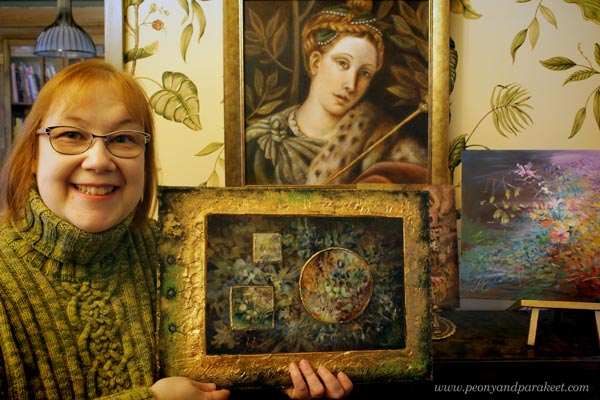
My painting has simple strokes but it’s still romantic. I have bent the principles of abstract art to serve the impressionistic style. It’s so much fun to paint freely like this!
Paint Dreamy Florals to Free Your Spirit!
Floral Freedom – the floral class based on Paul Klee’s and Wassily Kandinsky’s insights on abstract art – will begin on Dec 4, 2021. In this class flowers are not just passive decorations, but they fly, sing, and dream! >> Sign up Now!
Floral Freedom is 20% off for the rest of November, so now is a good time to sign up!
>> Sign up now!
Paint a Poem!
This week, we’ll talk about poems and how to turn them into paintings!

This acrylic painting is called “Terät liitävät kirsikkapuista,” and it’s my interpretation of Valter Juva’s poem from 1902.
The Finnish name is a bit difficult to translate. Terät liitävät have a double meaning: 1) blades flying in the air 2) petals falling freely. Namely, a petal – terälehti – is a compound word in Finnish. Terä is a tip or a blade. Lehti means a leaf.
This is not the only language-related thing in the poem, and I struggled with the translation. But here’s the best I could do!
English Translation of Valter Juva’s Poem
| Terät liitävät kirsikkapuista, ja virta vieno ne vie. Se tyynine suvantoineen mun onneni kymi lie. | Edges fall from cherry trees and are caught by a gentle stream. The river and its pools are the well of my serene. |
| Suviyössä, mi tuoksuu ja värjyy, veet kultahan sulautuu; se lekkuu lännessä päivä ja idässä kuultaa kuu. | In the summer night, that smells and glows, waters melt in gold; in the west, the day is stirring, and in the east, shines the moon. |
| Niin hiljaist’ on ja tyyntä! Ja koskien alla veet ne ahtaassa piirissä viipyy, mut siinä on syvenneet. | It’s so quiet and calm! And under the rapids, waters dwell in a tight round but have become deeper and deeper. |
Passion for Poetry
When I was a teenager, poems were my passion in the same way drawing and painting have been. I used to read poetry, and almost daily, wrote my own. I even entered competitions, and some poems have been published. Later, this love for poems have reappeared occasionally: I have read or written some. In 2014, I even wrote a blog post about illustrating poems in art journaling.
But now, it feels that poetry has come to stay. Every time I open a big book (Runojen kirja – Book of Poems) that I won in a poem-writing competition in 1981, I see something that I want to paint. The book has over 800 pages filled with four centuries of Finnish poetry, but it’s not just that. With the book, I remember many poets that I used to read. My mind is blowing, and my brushes are jumping! “Paint paint paint,” they cry!
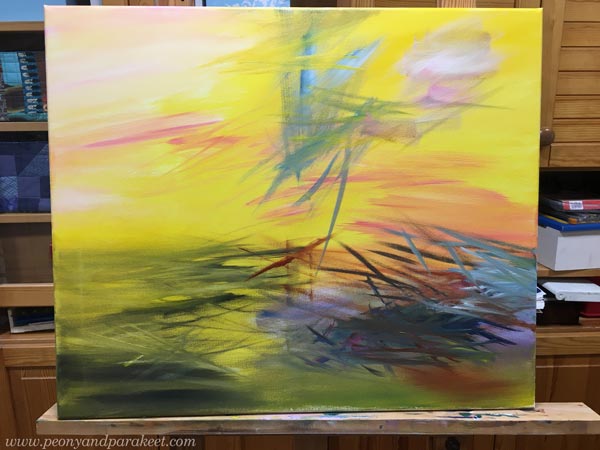
Valter Juva’s poem was new to me, but I got inspired right away. This painting has a lot of yellow in the background!
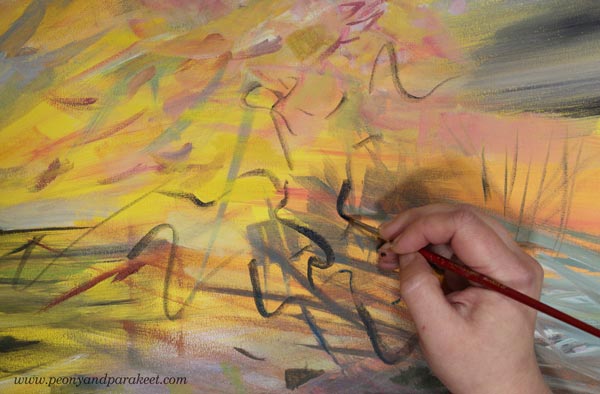
It was a joy to paint those sharp petals and curvy cherry trees that so willingly release the flowers. The size of this painting is 50 x 60 cm (about 19,5 x 23,5 inches) so I was able to paint the details more roughly and quite quickly.
Paint a Poem – Trust the Inspiration!
Painting a poem doesn’t have to be about illustrating every word. It can be more about finding a personal view – how the poem loosely explains your current life and often past experiences too.
In Valter Juva’s poem, the connection between Japan (cherry trees) and Finland (bright summer nights) blew my mind. You who have read my blog for a long time, know that both my husband and I love everything Japanese, and we also have a Japanese garden.
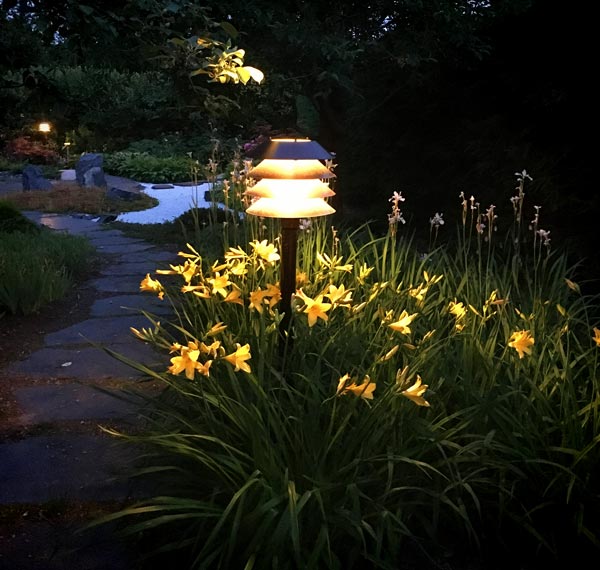
White nights were magical last summer! East and west meet like in the poem!
Paint a Poem – Color the Words!
Poems are filled with interesting words that can have a double meaning or a specific nuance. We don’t even have to know what strange words actually mean. It can still have a certain feeling to us, and we can express that with colors and shapes.

In Valter Juva’s poem, there’s a Karelian word lekkuu which means moving or stirring. To me, it has a relaxed undertone which makes me think about yellow-orange curves floating in the air, just above the water.
Paint a Poem – Break Borders!
In art, whether it’s poetry or painting, we can break borders. We don’t have to stick with one geographic location but create one that has characteristics of several places. Similarly, we are allowed to freely travel in time, from childhood to ancient history, and from the current moment to fantasy.
By changing the rules of reality, we can make representational elements symbolize more abstract things. They can be inanimate objects or nature’s elements, for example. In Valter Juva’s poem, waters have deep knowledge, In my painting, static trees take off and timid flowers jump from the plane.
Also, we can be magicians and make any material change its state. In the poem, water becomes gold, and in my painting, light is less immaterial and more touchable and concrete.
Poems are filled with metaphors, so why not let them in your paintings too!
Which poem would you like to paint?
Paint the Emotion – New Free Mini-Course!
Here’s a teaser, do subscribe!
If you have already subscribed, check your inbox, I have sent the course to you today!