
Roaming Instinct – Why Not to Limit Artistic Inspiration
This post is about artistic inspiration and spirituality and enabled by Arts Promotion Centre Finland. This is the seventh blog post of the project, see the first one here, the second one here, the third one here, the fourth one here, the fifth one here, and the sixth one here!
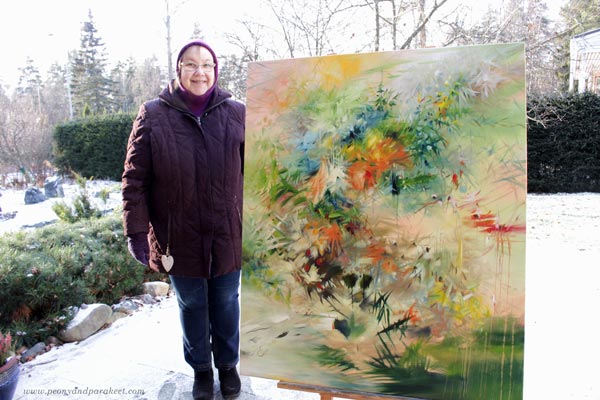
My second big painting is called “Roaming Instinct.”
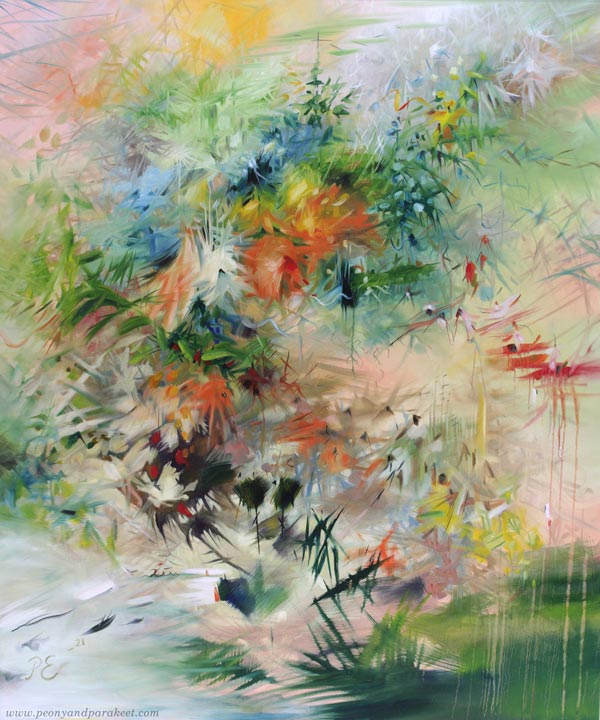
This painting and the previous big one have been really significant to me.
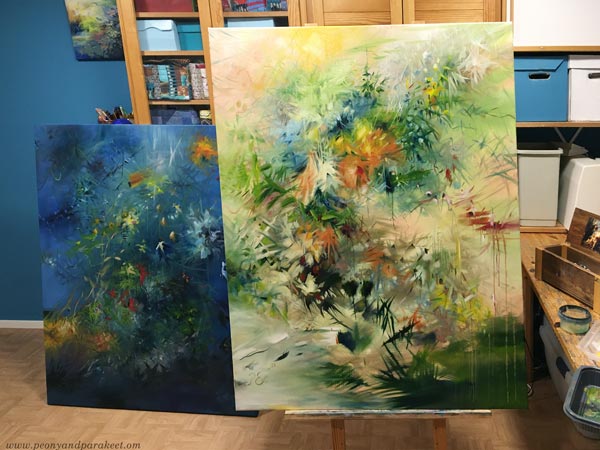
Regular practice and the big size have helped me to relax and let go – break the glass between the inner and the outer world, as Wassily Kandinsky would say.
Can There Be Too Much Artistic Inspiration?
As long as I have created art, I have been inspired by a variety of things. It has often felt like it’s too much.
Here are some:
- old portraits in fancy dresses
- houseplants and their pots
- midcentury-modern interiors
- colorful kitsch
- primitive dolls
- dressage horses
- English country gardens and cottages
- Tibetan yaks
- base jumping
- mountain climbing
- skateboards
- graffitis
- physics
- outer space
- mathematical algorithms
The list is ongoing and overwhelming!
I think this is not exceptional at all. The world is full of artistic inspiration. Like animals, we have a roaming instinct to explore further. No wonder they say that the hard choice for art-making is to choose what inspiration to pick.
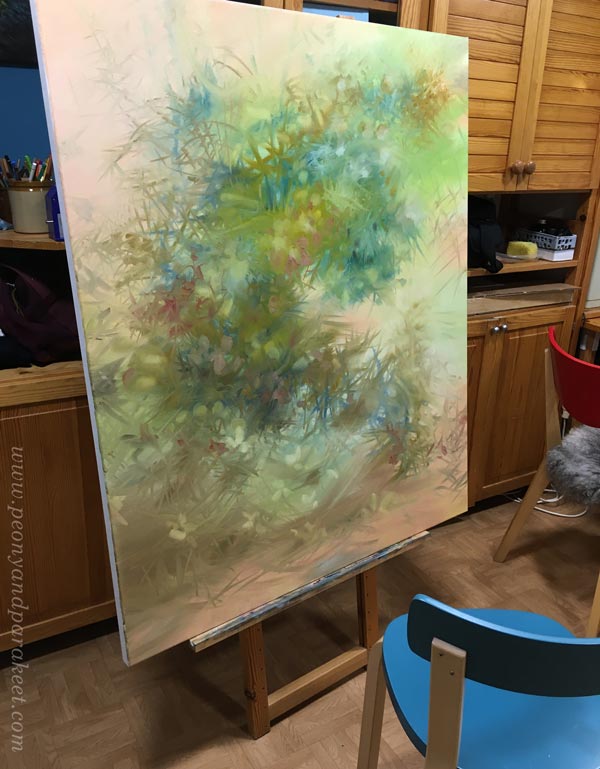
But recently I have felt like I don’t have to pick. No matter what I paint, I can bring it all together. If I paint a flower, it can look like a nomad, or a mountain, or a furry animal, or a space station, I don’t have to define.
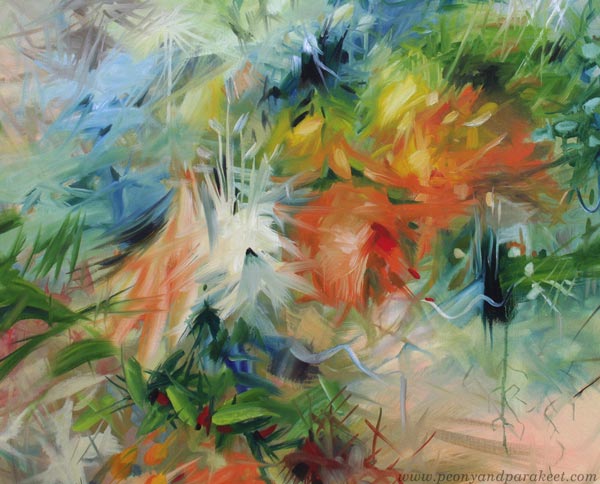
Every element can have a strong identity and the overall scenery can have a strong sense of location even if I can’t name it. Some people say my paintings are underwater sceneries, others see outer space. For me, they can be both, and yet neither. I feel I am delivering more than what can be labeled.
Finding Your Artistic Voice/Style/Spirituality/Identity – Whatever You Call It!
I have created art for a long time expecting to become better at what to pick and why. I assumed that art would make me know myself better and yes, it has. But it’s surprising that now when I am painting, it doesn’t really matter who I am and how I get inspired. My art is not to limit or to focus but to integrate.
When I started the project, one of the goals was to get clearer about my spirituality. My question was: “Can a former engineer create spiritual art?”
At the moment, I find it difficult to separate physical from the spiritual. All material things seem to have a spirit and everything immaterial seems to have a figure. When I paint, they mix and merge, and after a while, the painting seems to have a mind of its own. It tells what it wants, and my job is to obey.
Does this make sense? What do you think?
Art Inspiration from Lucas Cranach the Elder
This week, I gather inspiration for the next painting of a series, enabled by the grant that I got from Arts Promotion Centre Finland. This is the third blog post of this project, see the first one here and the second one here!
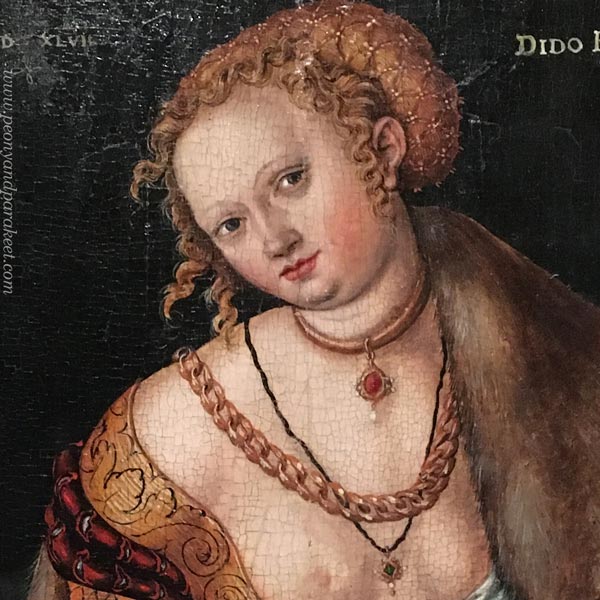
German Renaissance Portraits by Lucas Cranach
The first painting of my series (The Empire of Light) was inspired by Sandro Botticelli, Italy. Now I move further up in time and on a map and go to Germany to meet Lucas Cranach the Elder (1472-1553). Here’s a spread in my colored pencil journal inspired by Cranach’s style.
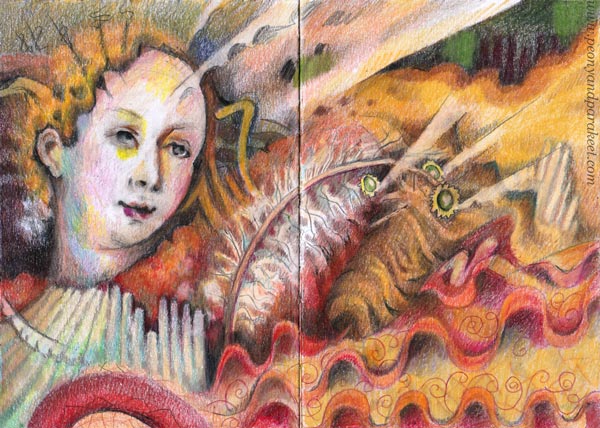
She is a weird-looking little woman but so are Lucas’s portraits too.
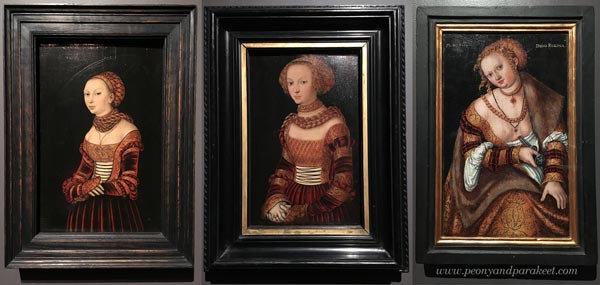
Their faces are small and not so pretty at all, at least according to today’s standards. Are these two even smiling at all? Is that boredom or irony?
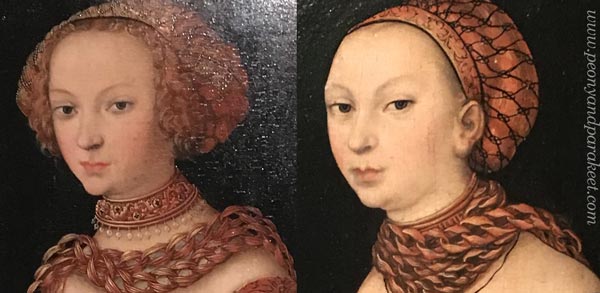
Cranach’s women seem so arrogantly materialistic that it doesn’t feel suitable for a series about spirituality at all. But because expressing light is impossible without painting the darkness, I have decided to explore spirituality’s ultimate opposites as well. Like insolence, materialism, and money.
Lucas Cranach’s Super Production
Lucas Cranach the Elder wasn’t just a painter. He was a businessman who ran a workshop and a pharmacy too. His unusually large workshop wasn’t just for fine art. Printing presses produced religious images for people who had less money.
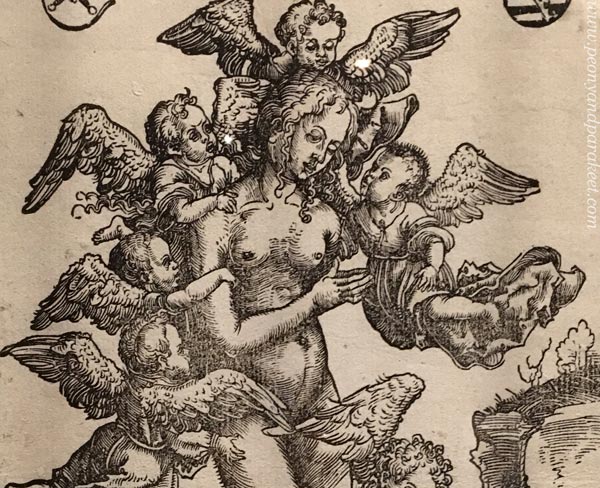
Lucas Cranach surely knew how to run a business. When he needed pigments, he decided to found a pharmacy at the same go. He got friends with prestigious people like Martin Luther. I can imagine Lucas whispering to Martin at a dinner: “What kind of images does your religious movement need? I can produce thousands of them!”
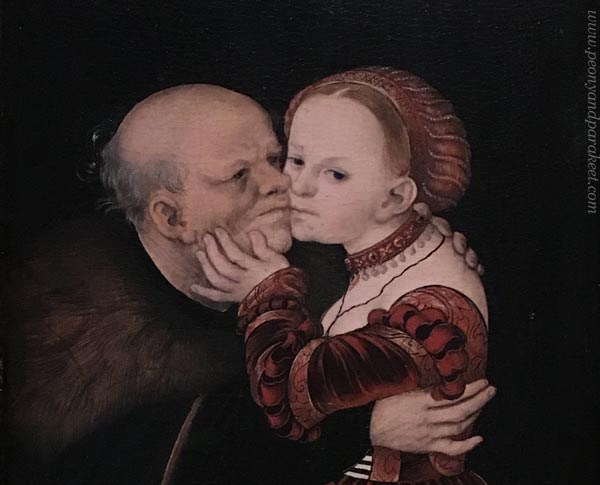
He must have had a sense of humor too. And yet, his figures and the way he painted the clothing, are a bit stiff and clumsy.
From Cranach’s Bluntness To Sharp Pencils
When Botticelli made an elegant curve, Cranach added a straight like like saying: “That’ll do. They won’t notice it anyway.” So my Cranach imitation was built around similar angular lines and weird proportions.
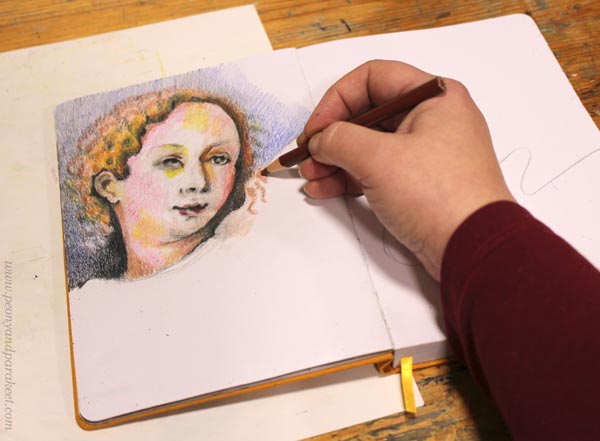
But the more I worked with the face, the more real it felt. The woman wasn’t just an angel but had vices as well. She felt so relatable and maybe because I was glancing at my new sharpener. In the middle of the spirituality project, I had become very materialistic and spent almost 150 EUR on it.
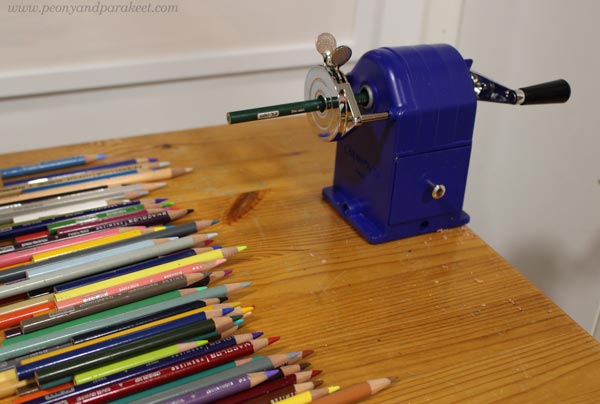
Botticelli’s goddesses wouldn’t be even willing to touch it. But Cranach’s women would grab the handle without hindrance. They would crank fast and smile quietly, and it would all look a little immodest.
My workshop has produced a lot of pencil shavings lately.
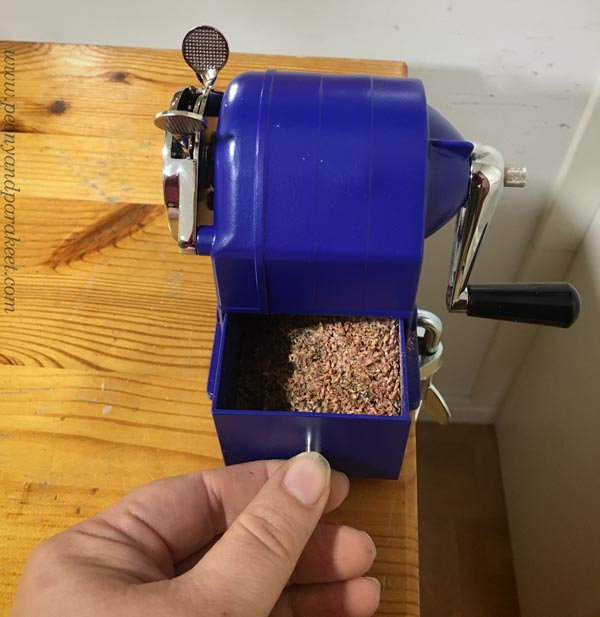
I can assure you that all my pencils are sharp!
Long Live the Spirit of Lucas Cranach!
Queen Dido’s smile in Cranach’s painting is deceiving. She had made a decision to leave the materialistic world.
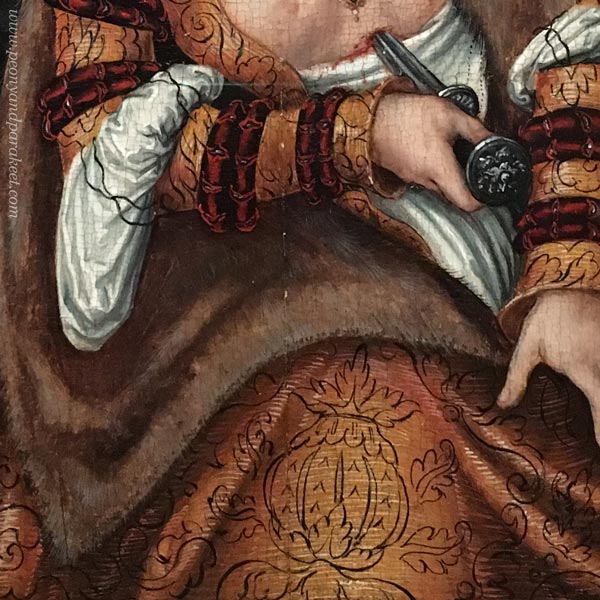
Her story goes like this: Dido founded the city of Carthago after her husband died. Then her lover, a Trojan hero Aineias was taken away and in agony, she killed herself.
Black and white always go together. Dido was not just a wealthy royal, but a sensitive woman too. Maybe Lucas Cranach and Martin Luther had deep discussions over dinner. Perhaps my sharpener will live longer than I do and serve many enthusiastic colorers after me.

The most inspiring detail in Dido’s clothing is this carelessly painted ornament on the hem. It just floats there! It doesn’t follow the folds of the fabric at all. But its living line documents Cranach’s spirit.
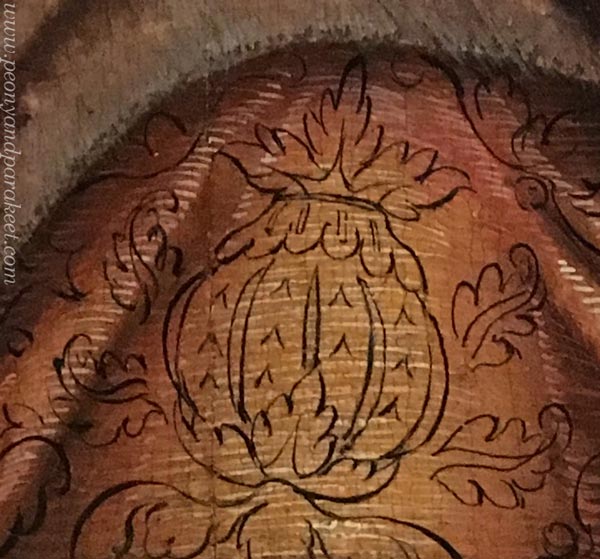
No matter what the subject is, art always carries a spirit with the way we draw lines.
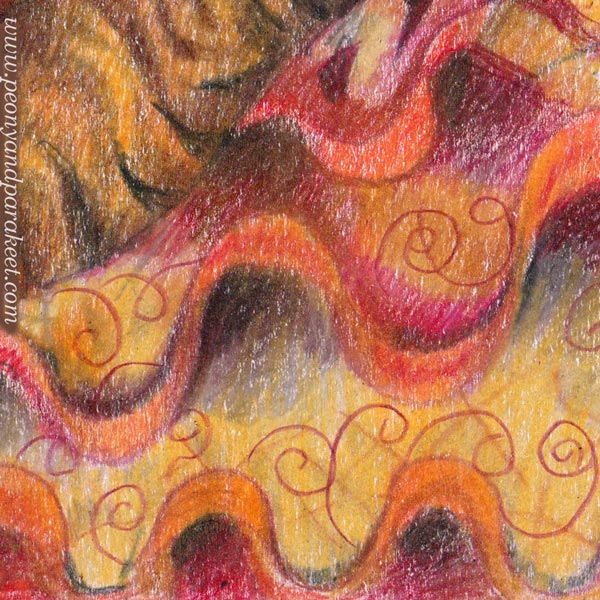
Like Cranach, I made two layers of lines, first x-shapes, then swirls.
Colored Pencil Journal
This journal spread will be my inspiration for a new abstract oil painting.
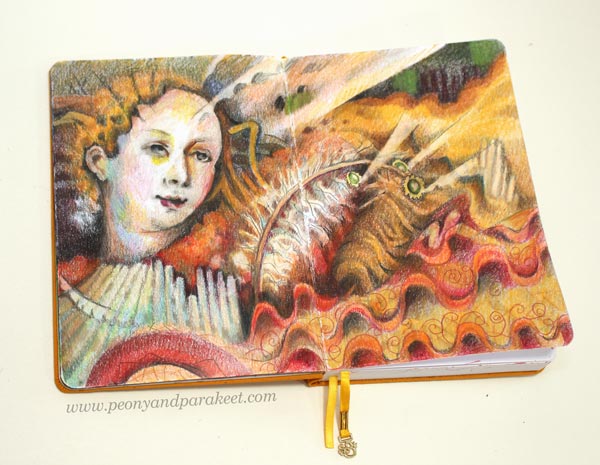
My little journal has quite many drawings already. I browse it often and it brings me joy.
Do you also have an art journal, a visual diary, or a sketchbook that you like to browse and fill? Can you find your living line there?
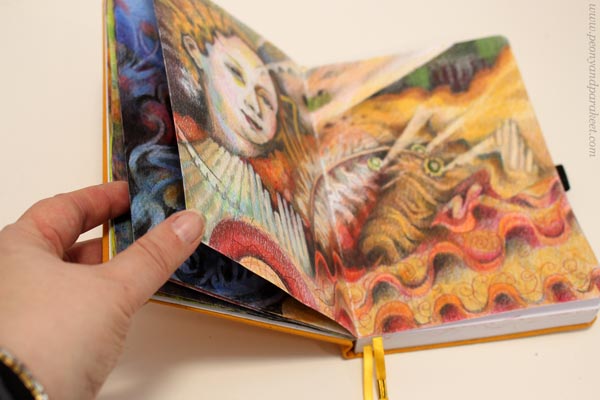
P.S. My photos of Lucas Cranach the Elder’s paintings are from an exhibition in 2019, see this blog post for more pics!
Colored Pencils Revisited – A Story Behind Intuitive Coloring
This week, I have a personal story about my newest online art class Intuitive Coloring.
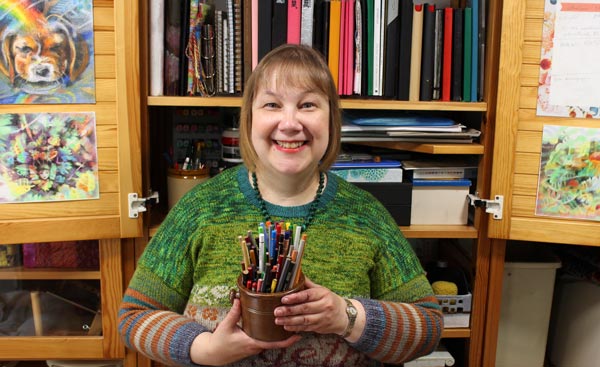
In 2014, I made a business plan to quit my day job. My goal was to teach online art classes, and I listed titles that sound funny now, like “Colored Pencils Revisited.”
I presented the plan to a local business advisor. Even if she didn’t know much about teaching internationally, she felt that I should do it.
“If you fail, you won’t fall from high,” she said,
referring to my modest list of investments and expenses.
Starting small is a beautiful thing. To gather what you have and mix it with something new. To revisit what mattered once and find a new intuitive way to do it again.
Revisiting – What Mattered and Still Does
As a child, I ran a craft shop in the attic. I remember the excitement when I heard my sisters on the steps and the satisfaction when my sister held a simple crochet chain and said: “Oh, Paivi, this is so long that it should be priced higher,” laying much more coins on my hand than expected.
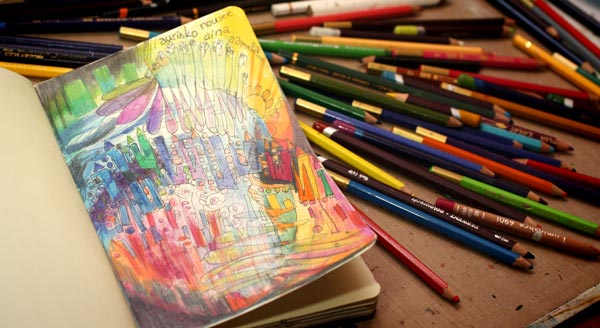
I also remember the joy when my mother had just sharpened colored pencils. They were in a small open plastic box and ready to be picked. Many of them were too short to go to the sharpener, so my mother had used a knife. She did that weekly because the pencils got used all the time.
I guess Intuitive Coloring could also be called Colored Pencils Revisited.
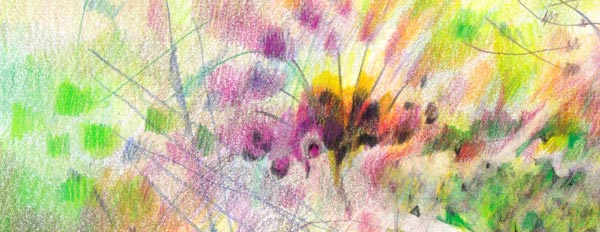
With the pencils, we will revisit the inner attic and connect with what matters.
It’s a small risk and a small investment, but still, something that can start small and grow bigger.
Intuitive Coloring will begin on Monday, Sept 20. Sign up now!
Pick your pencils and come to color with us!
>> Sign Up Now!
Starting a Colored Pencil Journal
This week, I started a project that I have been thinking about for quite a while: a colored pencil art journal! I hope this post inspires you to keep a visual journal too.
From Mundane to Fantastic
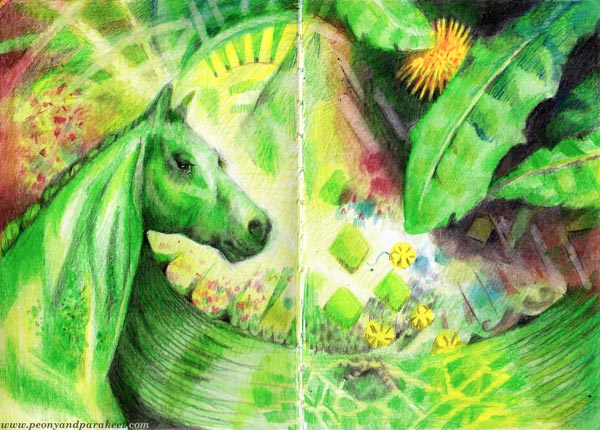
The idea of this journal is to connect everyday events with the world of fantasy. I want it to be a visual diary that is inspired by the ordinary but still goes beyond it. I
Books and Pencils
I have kept small art journals before too, and they still feel inspiring many years later. The two old art journals below are Moleskine sketchbooks.
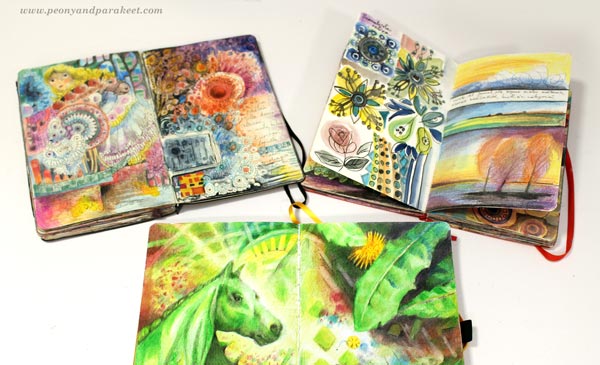
The new one is a blank notebook from Archer & Olive. I chose it because I really like Archer & Olive as a company, and I’ve grown to like their bright white paper for bullet journaling. The size of the new notebook is A5 (5,75 x 8,25 inches), so a little bigger than the old sketchbooks but still very manageable.
When ordering the notebook, I got a discount code, so click here to get 10% off if you haven’t purchased from Archer & Olive before.
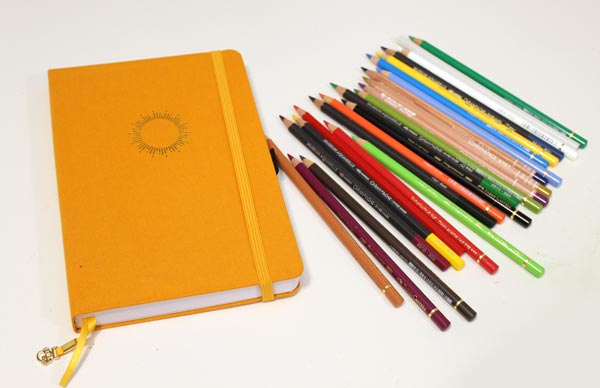
I have been purchasing new pencils too. Yesterday, I went to Helsinki to visit art supply stores and got some colored pencils – a mixed selection to expand my knowledge of different brands. So far, I have mostly used wax-based pencils like Prismacolor Soft Core and Caran d’Ache Luminance, but now I also got oil-based Faber-Castell Polychromos pencils. I also bought some Caran d’Ache watercolor pencils and more Luminance that has been my favorite so far. I have always mixed all kinds of pencils in my drawings and continue to do so!
Starting a Colored Pencil Journal
I usually fill an art journal by choosing the pages randomly. But because this journal is about my everyday life, I wanted it to be chronological and start from the first spread. It’s exciting to see how it will change and what kind of secondary stories the images will tell.
What to Draw First?
I suggest you let your journal develop intuitively so that you move from one association to another and mix all kinds of ideas together. So often, the fantasy is in the mix, not in the single element.
My first ideas: a horse and moss greens. A horse because I love to draw them and moss because currently, our garden has plenty of it. We like it more than grass, so we are not complaining!
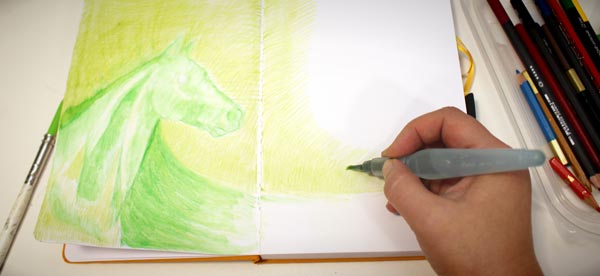
I don’t use water often, but now with the thick 160gsm paper, I smoothened the strokes of the bottom layer with a water brush. After drawing the moss horse, dandelions and all kinds of weeds came to my mind. Namely, while watching the puppy, I have been weeding almost daily and thinking that weeds are quite pretty too.
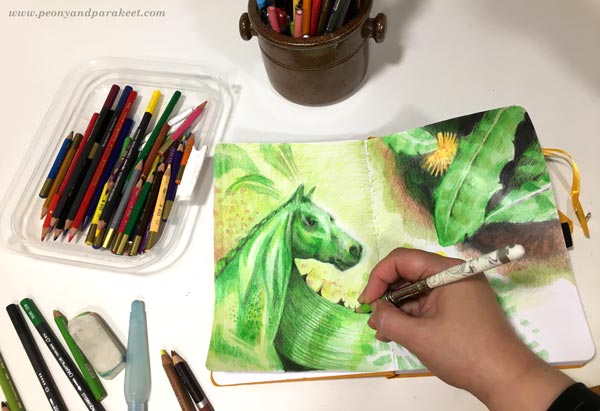
Let the Ideas and Associations Flow!
Then, of course, there’s this puppy, Saima! She makes me look at the leaves, twigs, stones, everything that she can find on the ground. My favorite moments in creating are those when I focus on the details and forget the surrounding world. I think Saima does the same many times in a day. For her, reality feels like a fantasy. We, adults, need to find the fantasy in our minds.

I tried Derwent’s burnishing pencil for the first time and quite liked it.
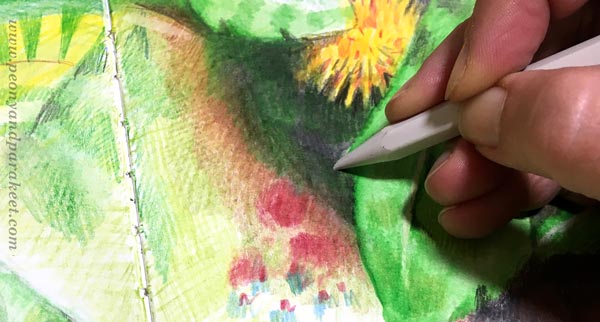
I was also inspired by rain, the wet tiles in the backyard, sunny mornings, and how I love old portrait paintings even if I can’t fully understand why. My favorite fruits are lemons, and it will be exciting to see how many times they reappear in the journal.
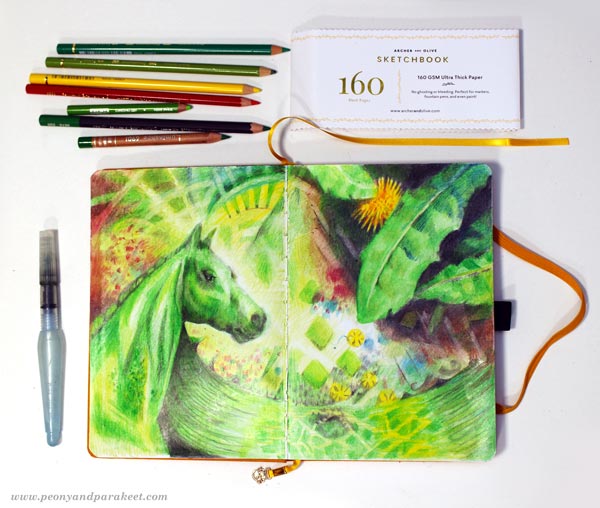
A spread with pencils is not a big project like a canvas painting, but can still feel satisfying, especially when the journal progresses.
What do you think?
P.S. For more colored pencil inspiration, remember to sign up for Intuitive Coloring!