
Art Plans for the New Year
The year 2020 was so different from the expected that it feels odd to make any plans for 2021. But I love planning and have some exciting art plans that I want to share with you!
Getting Further in Fabric Design
My education is in design, and I have designed fabrics now and then, mostly for my own needs for quilting (one of my dear hobbies). But in 2021, I really want to dive deeper into designing surface patterns.

I want to start selling my designs, but also share them and the creative process with you. I want to create a class that uses those ideas, maybe a Gelli printing class, or a class for making patterned papers, or a class for enriching expressive paintings with fashionable pattern repeats. I will take some time to learn more about fabric design, and it’s exciting to see what will come out!
Painting with Confidence
Last year, my art got a new kind of freedom. I started trusting myself more and my inner world became much larger. The size of the paintings and the speed that I made them also grew.

I want to continue in this path, making even bigger and bolder pieces, and more importantly, feeling confident yet open. I want to be open so that I express my sensations with all my senses, not only what I see. I want to honor my idols Paul Klee and Wassily Kandinsky like I have already done in the class Floral Freedom.
Writing about Art
It has taken a long time for me to realize that my job is not only to paint but also to write. I write these weekly blog posts, weekly and monthly newsletters, short stories to my Facebook page, and scripts for videos. It’s often more than a thousand words per day. Even if I am a visual person, I like to find words for what I do and see. It also makes me a teacher, I think.

For a long time, there’s been a battle in my mind related to writing. “People like to see, not read,” I have said and tried to get away from writing. Being a bad reader myself, I know! But words don’t leave me no matter what I tell them. So, let it be so. I will continue to write about art in 2021, and I want to grow as a writer as I have grown as a painter and a teacher – get more confidence and skills so that the result is both unforgettable and refreshing.
Art Plans – Change in Identity
Art plans always hold the change in identity. In my plans, I am not only a painter and teacher, but also a designer and writer.
What art plans do you have for the new year? What kinds of titles does your plan give to you?
What to Paint on Canvas?
This week, I invite you to think about what you should paint. It’s a general question and applies to any medium, but if you have purchased a canvas, the pressure is even higher. My story starts with dogs, and even if they don’t seem to match with the painting, they do. Read the story!
Childhood Without Dog of My Own
If I had to choose one thing that dominated my childhood, it would be the yearning for a dog. When my sister was pushing me in a stroller, I was pointing and screaming “hauva,” which a Finnish word for “doggie.” “How could you instantly recognize a dog from any other animal no matter how it looked,” she wondered.
My father was a policeman, and he had trained two german shepherds a long time before I was born. But a family photo album had a few photos. “Jumi,” was the name of the more handsome one, and I must have drawn him hundreds of times with a trembling hand of a toddler. I pictured the dog standing on the top of the mountain in a sunset. It was an exotic view because there weren’t any mountains in the countryside of eastern Finland. I only saw them if I kneed down, looked up, and stretched my imagination.
Walking in Nature with Imagination
My envy and admiration for all people who had dogs grew steadily, and at the age of five, I had several that were in constant observation. One of them was Kaisa, a vet whose mother lived in a big apartment building next to our house. She had a Finnish spitz and sometimes kindly invited the children of the neighborhood for a forest walk. We were a small and noisy crowd. Everyone had their turn to hold the leash, and even if it was only a few minutes, I still remember how powerful I felt.
So even as a young teenager, I imagined dogs around me whenever I went for a walk. The boring life in a small town became much more bearable when I didn’t have to look around, but only to a close distance. There they were, two brown labrador retrievers that behaved exceptionally well no matter where I took them.
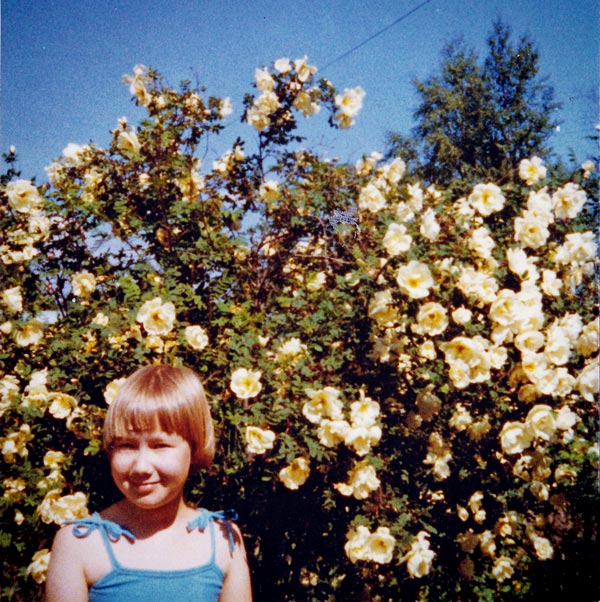
I preferred labradors because the royal family of England bred them. I had always wanted to be the queen of England, so my labradors certainly originated from Sandringham. My friend Anne had got a hold of a catalog of the Crufts dog show, and I excitedly picked the parents for mine. Every time I drew or knitted a dog, I tried to invent the best kennel name for me. “Starway’s” was one of my favorites. By then, my sister had married a man who had a spaniel, and from the spaniel club magazines, I found a new favorite breed: an American cocker spaniel.
Goodbye, Boredom!
The older I got, the more evident it became that I would leave my home town. Instead of frustratedly strolling in the fields and woods of the east, I would be happily hurrying on the busy streets of the south. And not alone, but with an American cocker spaniel of my own!
I would gladly say goodbye to lazy hot summer days when there was nothing else to do than examine the tussocks. When I once pointed them to my mother, she quietly said that our grass wasn’t proper like the apartment building had. But I found it much better. Instead of staring at individual blades, my imagination made wonders from the tussocks. They were luxurious carpets, cushions, and chairs, and when they looked up, I greeted them back. My grass tussocks were like dogs who had them – a flock that was always around and willing to join whatever I did.
When I got my first dog, I was already living in the south. It was an American cocker spaniel, of course. I lived in a flat, but between high buildings, there was a small wood. Unlike me, Anja had been born in an urban environment, and everything in nature wondered her. When she jumped back in surprise after seeing an ant, I realized that I was a country girl – no matter how much I loved palaces!
My next dogs have been beagles. With them, I am back in the world where looking down and examining closely is highly appreciated. Tussocks, hays, wildflowers, and brooks have returned.
What to Paint on Canvas?
In my artistic path from childhood to this day, I have thought that I should create the luxury that I don’t have. That my creativity is at its best when it produces what I miss. But in 2020, when the world quieted down, humble tussocks saw their moment. “Stop haunting me, you don’t even have a voice,” I whispered to them. “We have – and you used to listen, remember?” they responded.
And yes, when I pick the brush, I hear them again. Instead of trying to master the visual state of what I know very little of, I am painting the sounds in the deep. All that time when I wanted to be the queen of Sandringham labradors, I was, and I still am – a herder of mixed-breed tussocks!
How about You – What Should You Paint?
What you need to paint is not what you want to get and be, but what you have always got and been. The solution is not to find and paint what you love but to look in the opposite direction, find what’s been the most ordinary for you, even if it wouldn’t be that for others. The solution is not to paint how things look, but how they sound, smell, taste, and feel. In the book Point and Line to Plane, Wassily Kandinsky talks about releasing the inner sound of a shape.
With the tussocks, the teachings of the abstract masters Paul Klee and Wassily Kandinsky have been groundbreaking to me. They have enabled me to paint more freely than ever and I have also built a class Floral Freedom from these teachings. Floral Freedom is especially for you, who wants the painting to look loose and naturally abstract, but who hasn’t find satisfactory results from “just making a mess.”
Good Accidents – When to Improvise
Art is never about just making a mess. Artists who say so are just unable to put it into words. Wassily Kandinsky and Paul Klee were not only exceptional painters but also exceptional teachers. They defined abstract art in methods and diagrams. In Floral Freedom, you get their theories in an easily understandable form and use them to paint flowers.
In this video (after the first two minutes), Helen Mirren talks about Wassily Kandinsky’s art. She first assumed Kandinsky’s work was just improvisation – “instinctive and improvisational and wild and of the moment,” but later learned that his work is constructed with care and thought.
Here’s how she says this:
I can also relate to what Helen Mirren says about acting – that you have to give the impression of the improvisation and naturalness and learn what’s a good accident. But I also have the definition of a good accident in visual art: it’s what you have used to see and know.
I feel that I know everything about the soul of grass tussocks. When I paint them, I don’t have to worry about people not liking them, not even if someone can paint them better. This grass is not any grass but how a 5-year old Paivi saw it, walked on it, and what she imagined from it.
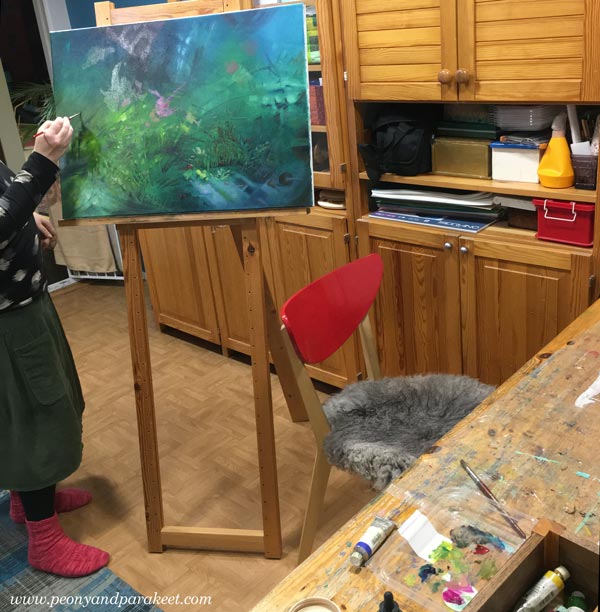
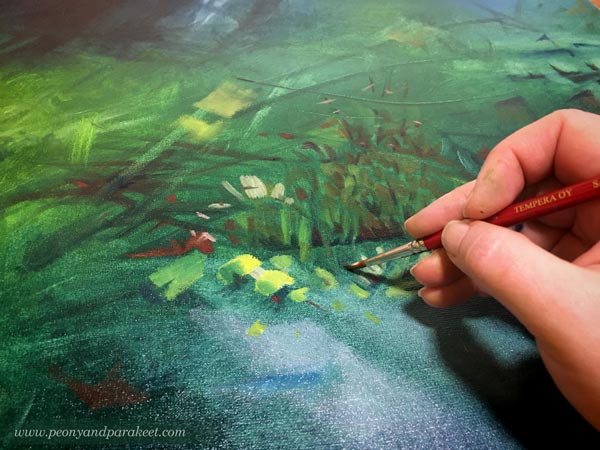
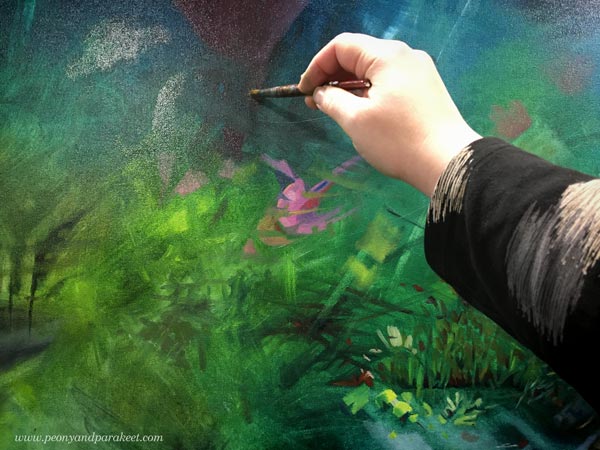
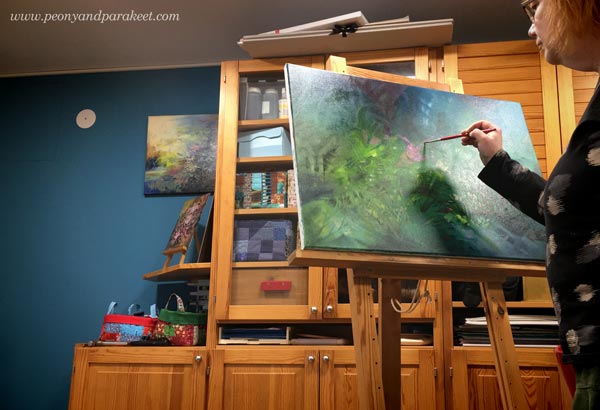
I paint sounds of plants as I hear them, freely and without references. I don’t plan what to paint on a canvas, and I don’t follow any image of my mind. It feels like improvisation, but the process is technical and systematic. One shape follows another and I dive deep into the painting, creating and releasing tensions.
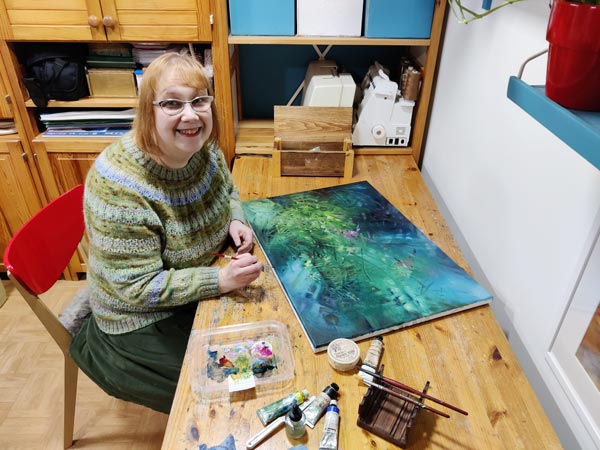
I am filled with excitement and emotion, but work systematically and intentionally, translating from spiritual to visual.
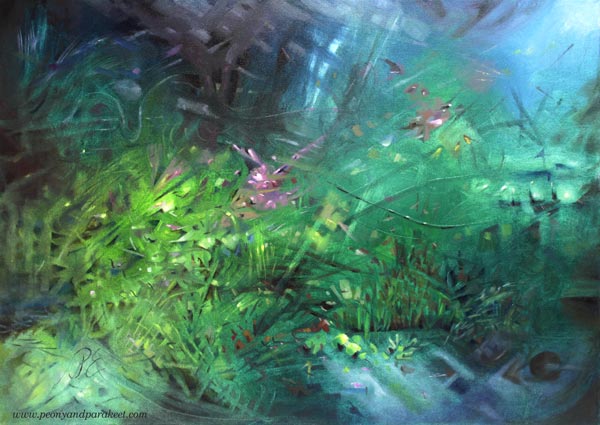
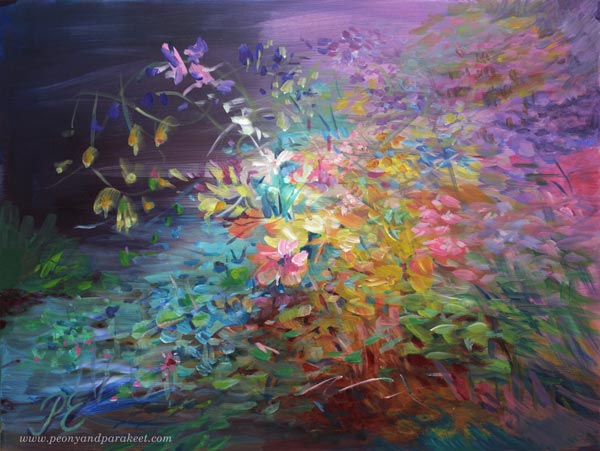
I really enjoyed painting this one – the first one of the new year! It’s called “Syvällä soi” which is a bit difficult to translate in English but it means that some are playing instruments or singing in the deep so the translation could be “Sounds in the Deep.”
Floral Freedom – Paint Dreamy Florals to Free Your Spirit
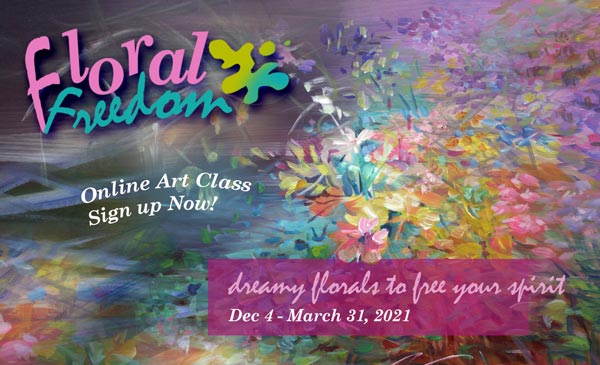
Come to learn the theories behind abstract art, and paint flowers with me – Sign up for Floral Freedom! We use acrylic paints for the projects. The class has already started, but you can still hop in. You will get the published lessons right away, and you have plenty of time to catch up and connect with me and the community. This class is comprehensive, and suitable for self-study too. Sign up now!
New Beginnings

Has this happened to you?
I want to start a new chapter in art-making, change direction, and feel the excitement again.
Some say that this “new-beginning-thinking” is a thread for their artistry. That their problem is not to stick with one thing long enough so that the work is more coherent.
But new beginnings are built within creativity. Like nature, we need a new season now and then. In spring, trees begin to grow new leaves, and meadows new flowers. When nourished, they grow stronger and more beautiful year by year.

My new class Floral Freedom is this kind of creative nourishment. You will start building your visual language all over again. I teach both in theory and practice what I have learned from the two master abstract painters Paul Klee and Wassily Kandinsky.
Floral Freedom combines the intellectual and the emotional side so that you will wholeheartedly enjoy painting again. You won’t copy photos but use abstract techniques to express the flowers of the soul.
Yes, it will be a new beginning.
You will gather your paints and look at them from a new perspective.
You will paint lines and shapes with Paul’s and Wassily’s point of view.
You won’t see flowers right from the beginning but still end up with a floral painting!
You will stop dividing what’s abstract and what’s concrete,
and your art will grow from those insights.
The beginning that builds the foundation is never a thread but a strength.
We often wait for the right time to the new beginning. It’s easy to postpone it, I know. My mother passed away with too many regrets. The time never seemed to be right. A new beginning would always be somewhere in the future.
I have had a similar problem with Floral Freedom. I have wanted to build this class since 2016, after reading Paul Klee’s Pedagogical Sketchbook. But there have always been excuses – what I am capable of and what’s appropriate and safe. This summer, I even planned not to build a new class at all. I have made so many of them already.
But then I heard me saying:
“Don’t leave without teaching what you have got from Paul and Wassily! You’ll always regret not doing that!”
And yes, the better time for the class may come, but this is also a fact:
new beginnings don’t wait forever.

As you see, Floral Freedom is a very special class. I hope you will join me, pick the paints and brushes, and give yourself the joy of a new beginning.
Black Friday Week Sale
Floral Freedom is 20% off.
The sale ends on Monday, Nov 30, midnight PST.
The class begins on Dec 4.
>> Sign up now!
Kaiho – Painting the Longing
This week, I talk about the Finnish word “kaiho” and how art can bring up deeper longings than we first realize.
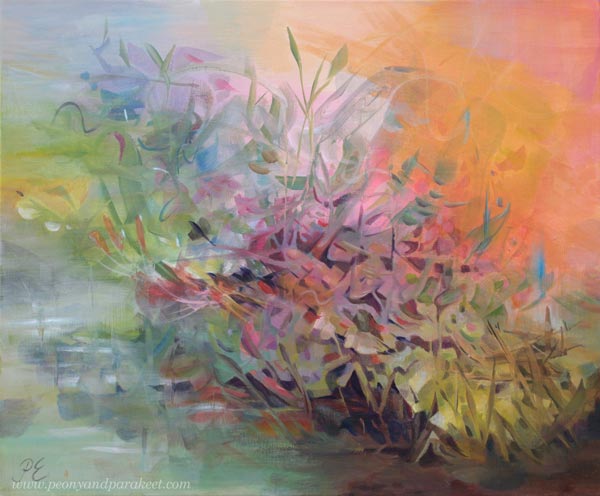
I created this acrylic painting at the end of September. It’s called “Sammumaton kaiho” which is something like “Unquenchable Longing” or “Extinguishable Longing” in English, but I think that this time, the Finnish name is much better.
Kaiho is one of the most heart-breaking words that I know. It’s not like kaipaus (yearning) but something much quieter. And being a short word, it’s like a whisper in the air.
Say it softly with me: “kaiho” (kaaiihoh)…
It feels like a piece of a deep agony flies away with the word. Maybe every language has these kinds of soothing kaihos that don’t belong to the daily vocabulary, but that need to get out now and then.
Quick Start with Happy Colors
I started the painting by filling the canvas with candy colors. With a big brush, it was quick and fun.
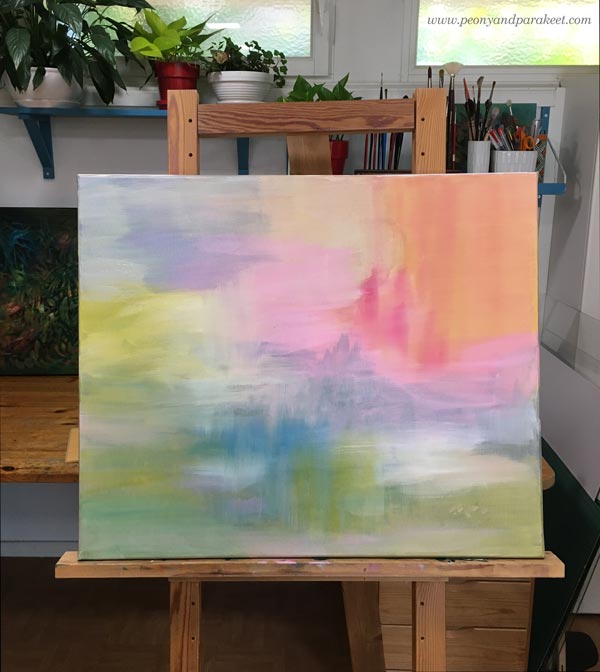
I didn’t overthink the subject, but painted plant-like shapes and tried to enjoy the process as much as possible.
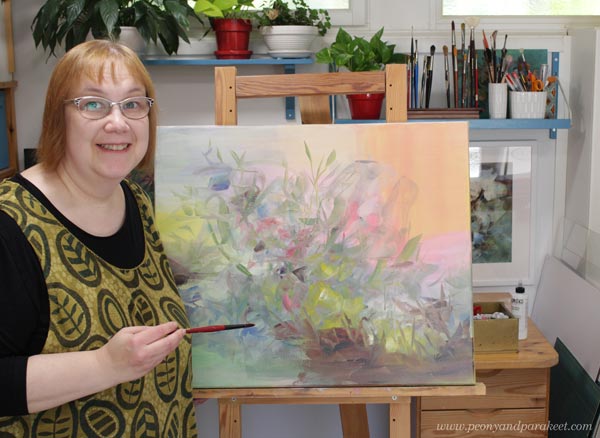
In the photo above, the painting is still quite young. But it progressed quickly!
Finlandia Raised the Longing
It was Friday evening when I was adding final touches to the painting. At the same time, I was watching – well listening to – Voice of Finland. It’s a singing contest, pretty similar to American Idol.
Even if all the songs are usually rhythmic pop songs, one singer had chosen differently. He sang Finlandia, a hymn, instead. Every Finn knows Finlandia, and it brings many stereotypical images to mind: forests, lakes, swans, snow, blue, white. I have heard the song thousands of times. But this time, I was painting too, and it always boosts my senses.
Do You Know Finlandia?
The song is composed by Jean Sibelius in 1899, and a poet V.A Koskenniemi has written the lyrics.
>> Here’s a great article about Finlandia, including an English translation for the lyrics.
Watch BBC Symphony Chorus and the BBC Symphony Orchestra conducted by Finnish Sakari Oramo, play the song.
Remembering What’s Lost
With Finlandia, I was reminded of what I no longer have. As a child, I lived in Karelia, Eastern Finland, near the Russian border. Finland lost a part of it in a war in 1940, and it has left its marks on future generations as well. But personally, the bigger loss was leaving Karelia to study engineering, and quickly after that, losing my mother.
Here’s an earlier picture of me, my mother, and a close friend Saimi Norimäki. Saimi was born in Western Finland, and she was much more straight-forward and brave than what we had used to see. But she was a woman with a warm heart, and I have many fond memories of her.
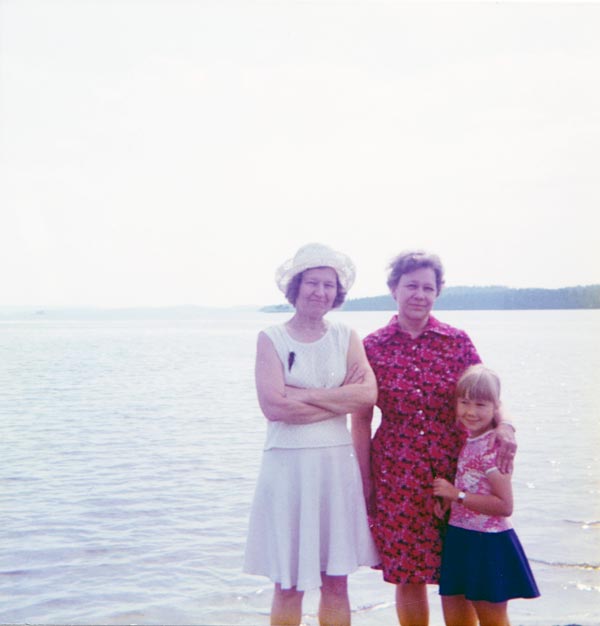
This photo is a good representation of the sadness that I have. The colors have faded away, there’s a lot of empty space, but I still remember the people.
A More Joyful Longing
However, when painting along with Finlandia, I was able to dig through the sadness and find the longing that was more joyful. I asked myself: “What are you painting, Paivi?” The answer came quickly:
“I paint what I know best – what it is like to walk on Karelian meadows on a hot summer day, how the warm and rough ground feels, and how the soil smells. I know what the heart of Karelia is, its temperament, culture, and nature.”
I also remembered many old Finnish songs, poems, places where I used to go as a child, and the word: kaiho.
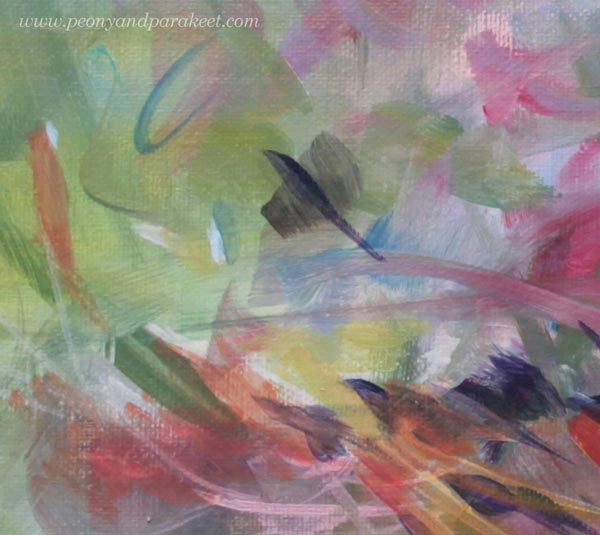
They say that Karelian people often laugh and cry at the same time. We tend to get caught by emotions, and easily see polarities in them. So even if my painting has happy colors, it also has this kaiho, this longing, that’s unquenchable – that never leaves me.
I now believe we all have layers of longings. Under a sad layer, there can be a more joyful one. In a global world, each of us has many identities, many cultural impacts, and it’s easy to forget some of them. So when creating, we are not purely painting the longing what we are consciously aware of, but how we are truly built. With this natural integration, art has the power to make us feel more whole and grounded.
Finished Painting
“Is this the painting that needs a hanging wire,” my husband asked pragmatically the next morning.

When weather allows, I photograph my paintings outside.
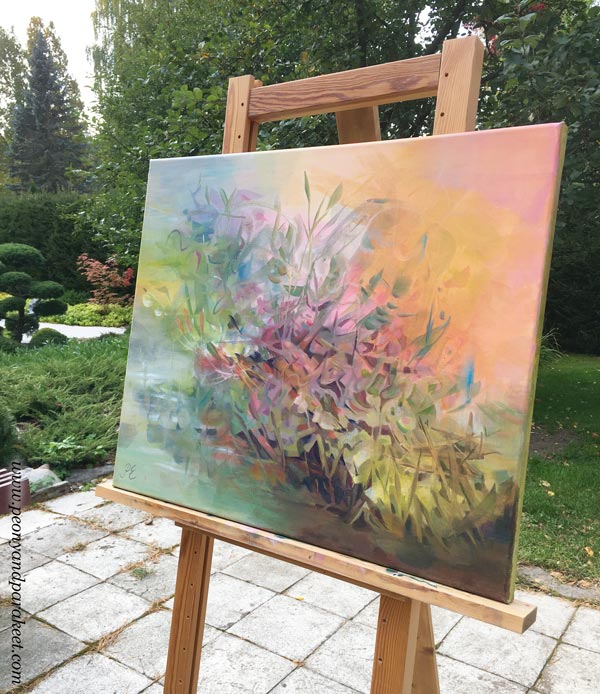
This painting is 54 x 65 cm – about 21x 25,5 inches.
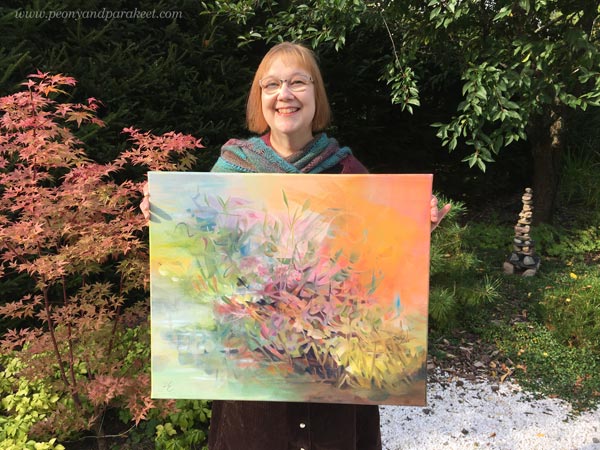
My Journey of Painting the Longing Continues
As a young woman, my mother got a book of poems which I now have. The book is called Ruiskukkaehtoo (Cornflower Night), and it’s written by Anna-Maija Raittila.
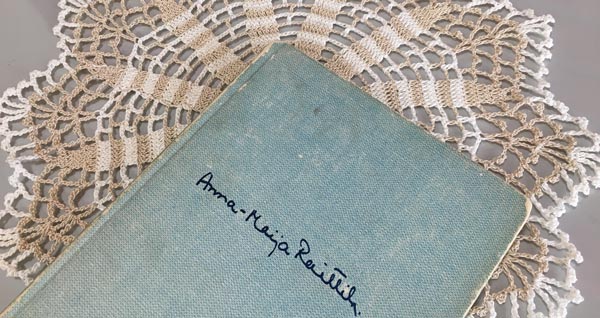
Ruiskukkaehtoo is also one of the poems, and my goal is to paint that! Not so much to illustrate the poem itself, but to express what comes to my mind from it. Even if it’s a poem and not a song, it has a captivating rhythm. I am pretty sure it will take me back to painting the longing.
Create with Me!
- See the new free mini-course Paint the Emotion! The painting of this post was made with pretty similar techniques.
- Stay tuned for a new class! I am working on the new class Floral Freedom. It’s about painting freely by using the principles of Paul Klee and Wassily Kandinsky. The registration will open in November.
- Sign up! Does music play a big role in your art-making? Sign up for Creative Junk Journal 2020 to get my mini-course about expressing your favorite music!