
Imagining Flower’s Spirit
When you want to draw or paint flowers that look unique and alive, imagine their spirit and discover what they would love to wear.
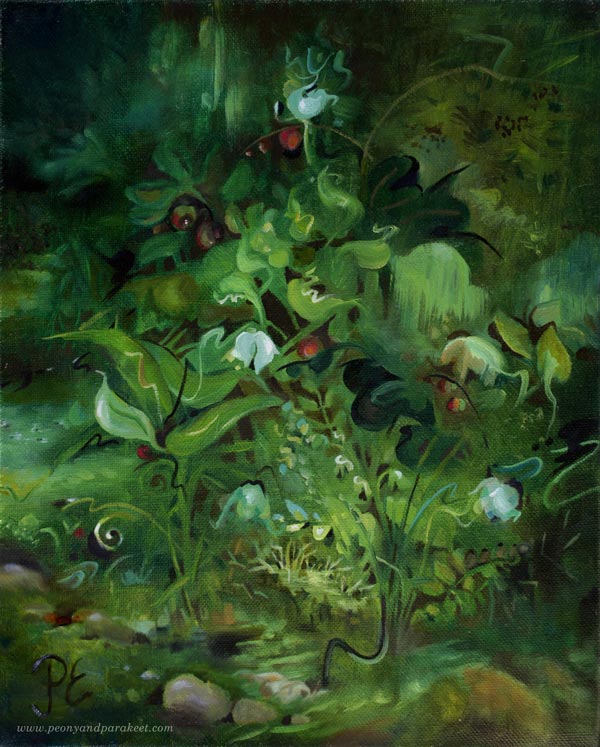
Art is not only about techniques and replicating what we see. When you create, you have permission to imagine and be convinced that you know something more than anyone else. You are the best scientist in your imaginary world! In your world, you can mix different fields, like botanical illustration with fashion design. That’s what I did in this painting called Kielomieli.
Kielomieli – The Mind of Lily of The Valley
We have lily the valleys growing in our yard and even though I don’t pay much attention to them, I feel like I know them. That plant spreads in the shade and may seem modest, but its mind is always alert and it observes the world sharply.
This little flower also knows how to influence people. Even before I was born, in 1967, Yleisradio, the Finnish national broadcasting company, organized a vote for Finland’s national flower and the overwhelming winner was kielo – the lily of the valley. It makes Finns kneel and admire its fine shapes. Unlike other flowers, the color is secondary to the lily of the valley, until it produces berries. With berries, it underlines that it is not just a white, innocent little flower. Everyone knows their toxicity.
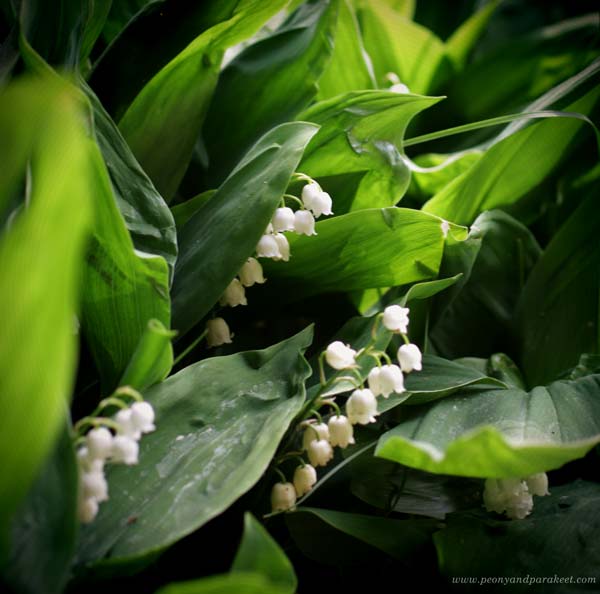
The lily of the valley’s mind is a group mind where everyone dances to the same rhythm. It still doesn’t mean that a single plant would not also be an individual. She just doesn’t share her own thoughts publicly.
Many people love lily of the valleys, but this plant is not a rose that craves attention. Even if it lies low on the border of the earth, its mind is more sublime than that of other flowers. It sees far and high, and nothing can discourage it.
Choosing the Style to Go with the Spirit
When you think about the flower that you want to draw or paint, ask her about her style and aesthetics. For example, is it bohemian, classic, gothic, or country? If the flower would be a human, how would she like to dress?
Clothes can express the spirit.
In flowers, the details of petals and leaves are also very similar to the folds and seams of clothing. I often find it helpful to think about dresses, hats, and jewelry when painting plants.
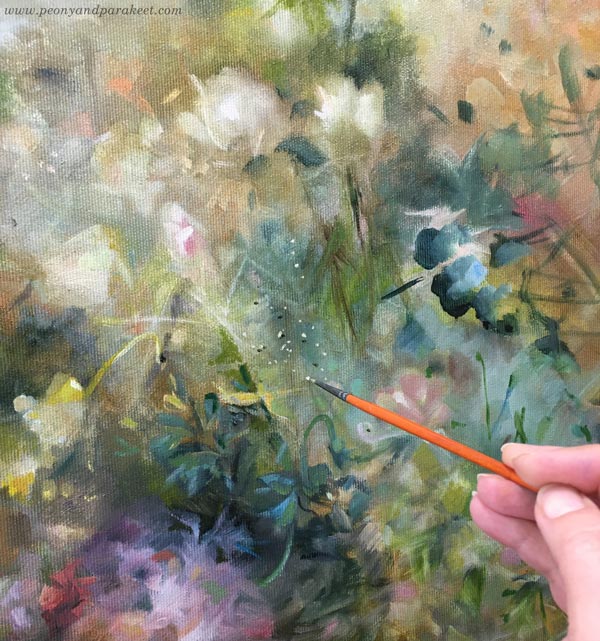
I imagined the lily of the valleys to be formal and stiff. They wouldn’t wear a bathrobe in a photo but choose a classic-lined dress or a jacket. So I chose to paint them in a decorative style. First, I practiced painting roses in that way – see this blog post for more instructions!
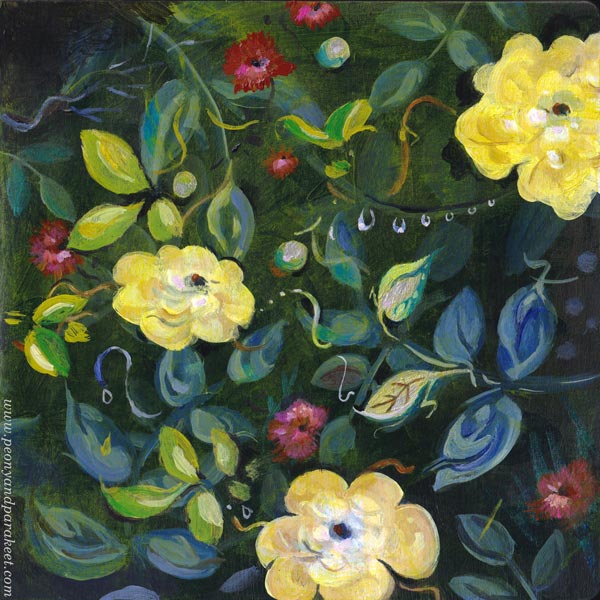
I have noticed that making a study speeds up my painting process even if the final painting would be different.
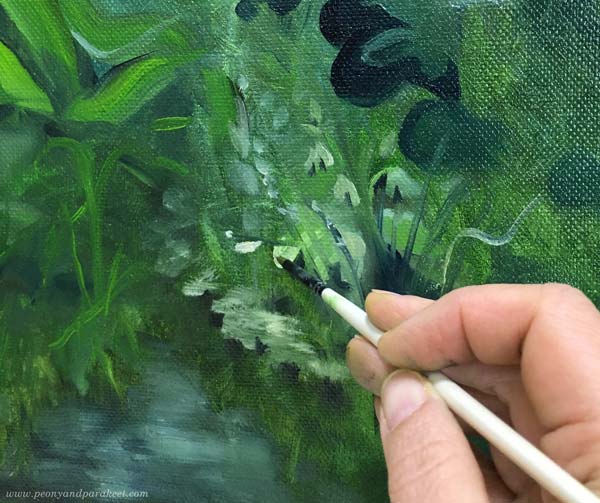
Once I had “loaded” that decorative style to my hand, I painted Kielomieli – the lily of the valley’s spirit.
Flower’s Spirit – Flower’s Portrait!
When visualizing the flower’s spirit, think about yourself as a portrait painter.
You don’t need a face to express a flower’s spirit. When the color choices, shapes, and lines are aligned, they all paint a picture of a character.
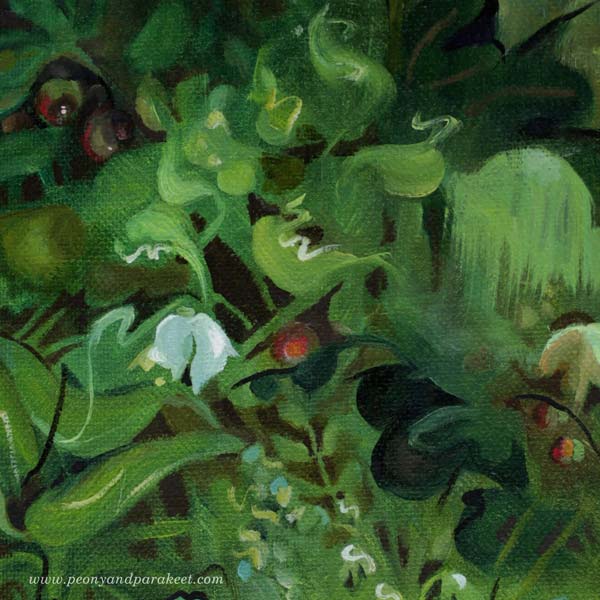
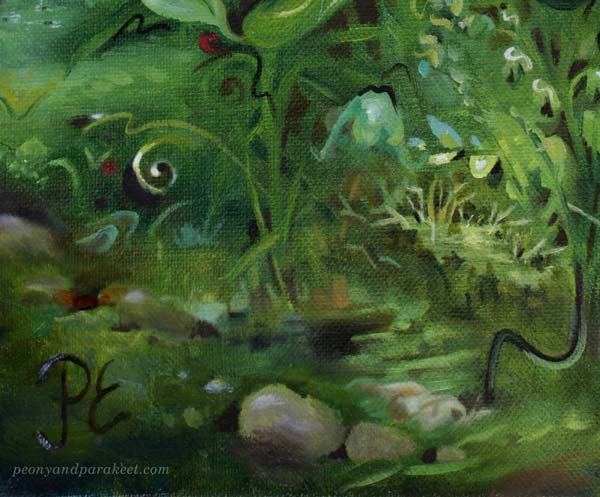
I hope this blog post gave you new ideas to break the glass between reality and imagination!

Five Tips for Painting Nature’s Richness
This blog post is for you who want to create less stiff and more abstract art. First, I suggest rephrasing your goal. Say you want to get closer to nature – to paint nature’s richness!
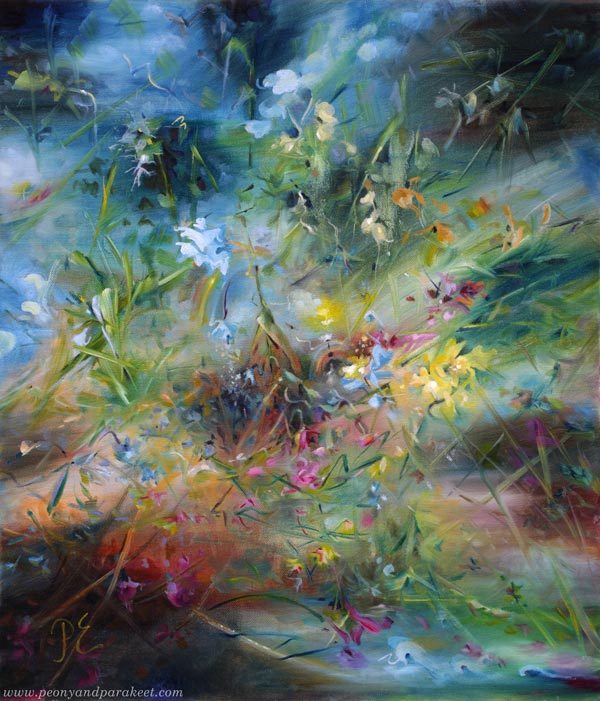
In this painting, flowers fly recklessly in every direction. This kind of disorder is part of nature’s richness. I used to think that it could be achieved by quickly throwing paint here and there, but I am much more successful when I create these beautiful messes in an orderly way.
Experiencing Nature’s Richness
Although I live in a big town, there is a cornfield in our neighborhood. I often walk along the path that goes by it. In August 2020, I was walking with my dog Stella. When I reached the beginning of the trail, I was greeted by a magical sight. The surroundings of the path were full of butterflies!
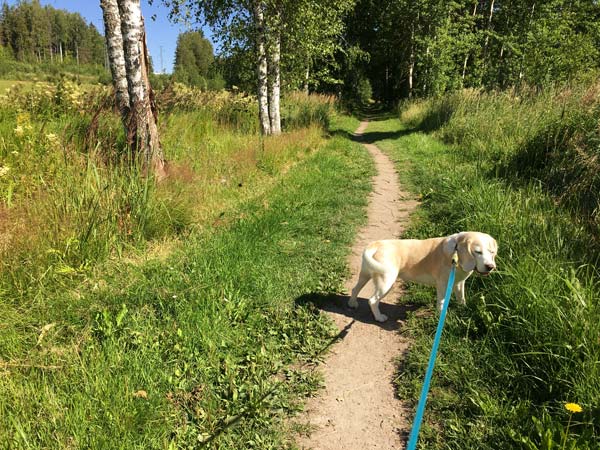
I tried to take photos, but only close-ups were successful. Butterflies are such small and fast insects that they cannot be distinguished from a distance, even if there are many of them.
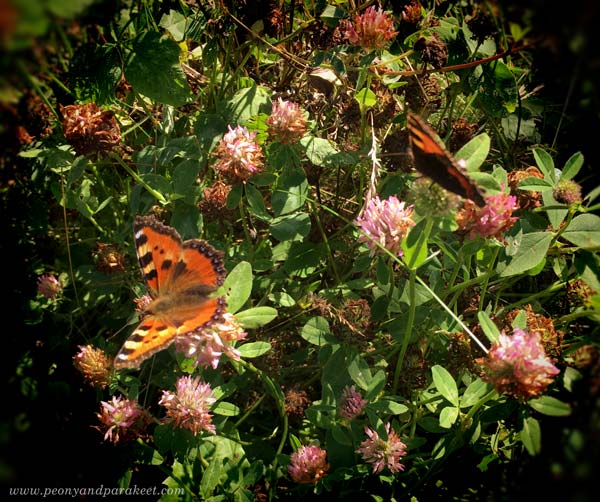
But the experience stuck in my mind. Now, years later, I wanted to capture it but in a bit different setting. I wanted to depict a situation where someone would throw a bouquet of flowers in the air and they would magically start flying in the air like butterflies.
Working in Layers
I started the painting by making a background for it. I painted a grid in the style of Paul Klee. I teach this beginning technique in the course Floral Freedom.
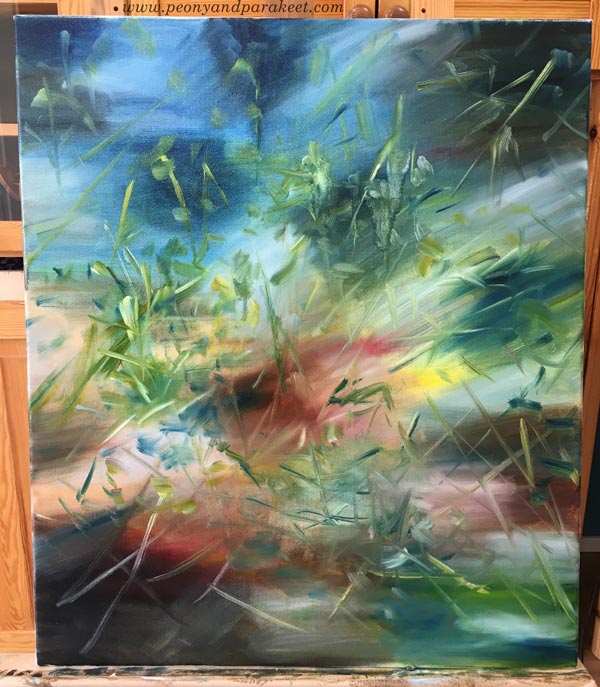
I then started to create nature’s richness on top of the grid with brushstrokes. I added flying flowers several times and dried every layer before starting a new one.
Taking Photos for Inspiration
I often take photos of plants and nature scenery. Even Claude Monet has said: “The richness I achieve comes from nature, the source of my inspiration.” I don’t use the photos as references but for teaching myself nature’s language. I examine an image to see nature’s richness, for example, the shapes that light throws and all the variation there is if you forget what the image represents.
Take a look at this flower bouquet I put together for Midsummer: the flowers consist of several layers and have differences in size and shape.
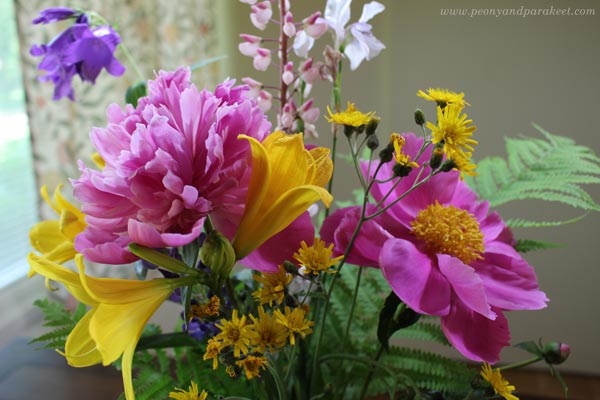
Think about one flower as a collection of strokes that form motifs.
Five Tips for Painting Nature’s Richness
When you add motifs on the background, remember nature’s richness and do otherwise than what you are used to:
- Don’t cover it all over again! Create a sense of depth by covering the previous layer only partly. This way, every layer has fewer motifs than the previous one. Paint the first motifs with muted tones and slowly introduce stronger colors.
- Don’t repeat the same thing! Get natural variation by painting many different repeating motifs. Change the sizes and distances of similar motifs so that they look more irregular. Use many brushes and think about every stroke as a word. How rich is your language?
- Don’t design fabric but tell a story! Make an expressive image, not only a surface pattern. Despite the chaos, make one area stand out. Make this focal point stronger by adjusting some other distinctive motifs so that they clearly point to it. Avoid spreading white spots everywhere. They distract the viewer and make the painting flat.
- Don’t leave your motifs lonely! Bring more unity by connecting motifs together. You can use lines, intersections, and surrounding space. Think about the painting as a collection of mini landscapes.
- Don’t hurry! Give your painting time to grow. Take breaks and keep your painting somewhere where you can observe it. You have probably already tried many times to paint quickly, now choose another way and slowly immerse yourself in the painting.
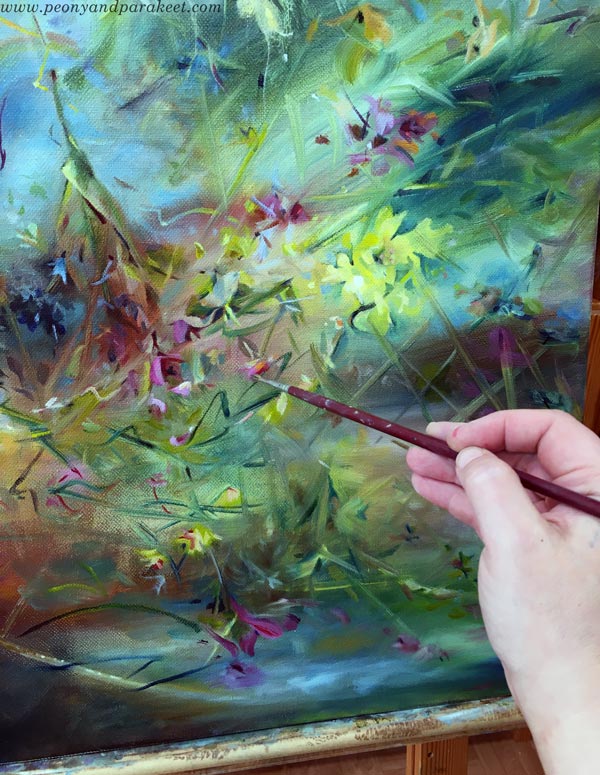
In this orderly way, the painting begins to look more and more finished naturally.
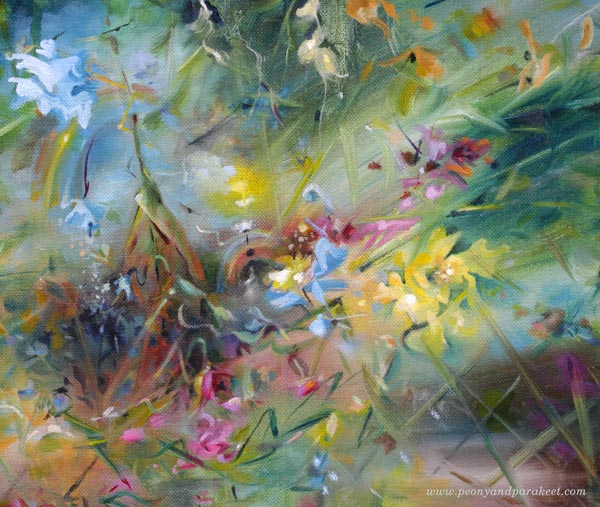
At the last layer, it takes some courage to paint larger and brighter motifs on top of smaller and more muted ones.
Nature’s Richness – Expressing Mortality in Immortal
A part of nature’s richness is to allow some flowers to fall and die, and some rise and fly. Dark colors, sad strokes, and downward lines all give power to the bright and happy ones. You can take your piece outdoors and see if it’s one with the surroundings. My course Floral Freedom is packed with techniques and further ideas.
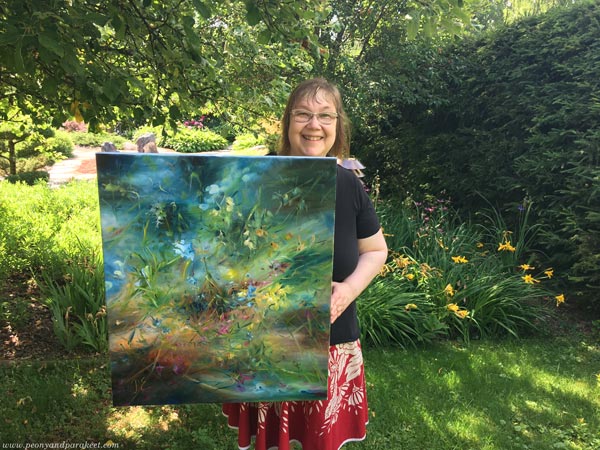
This painting “Immortal Bouquet” tells about the hopeless desire to live forever but also about the fact that life does continue when thinking about nature. An immortal bouquet is an unreal wish for the one who gathers the flowers, but on the other hand, it’s also true: flowers are reborn in nature every year.
What do you think?
Disappearing Garden – About Transience and Creating the Best You Can
I’ve been painting for the exhibition “Taiteilijat Albert Edelfeltin tunnelmissa – Artists in the Mood of Albert Edelfelt”, which is in August-September. Now I want to present the main work of my new series to you. It’s about transience and called “Katoava puutarha – Disappearing Garden”.
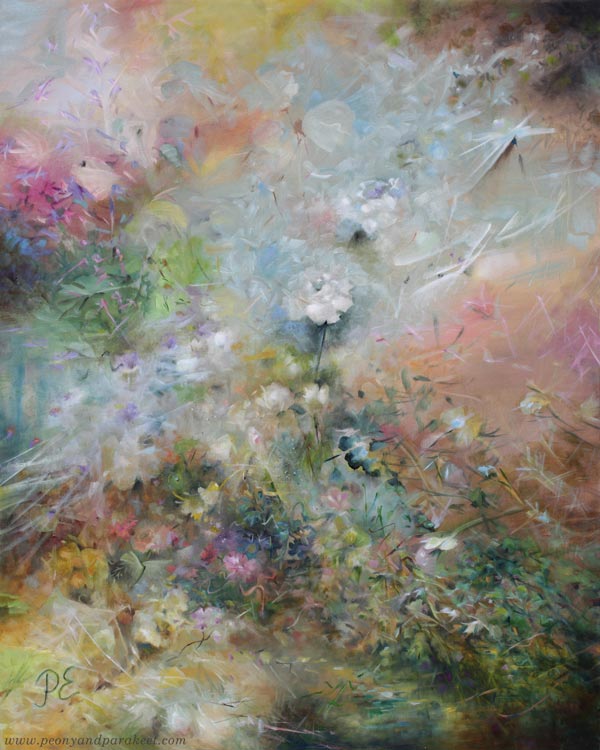
There is sadness in this painting. For years we had a neighbor who liked gardening. She fell ill and died and the rich garden has now been turned into a lawn. It made me think about how perishable we are, including our work. We are disappearing gardens, no matter how much we would like to think otherwise. So let’s enjoy our flowers while they still bloom!
Impression of an Old Painting
Disappearing Garden has many small details and a lot of work went into them. But because of the subject itself, it seemed important to spend time and patience on this work. I wanted to create the impression of an old painting that reaches across the eras as if overcoming its core problem: transience.
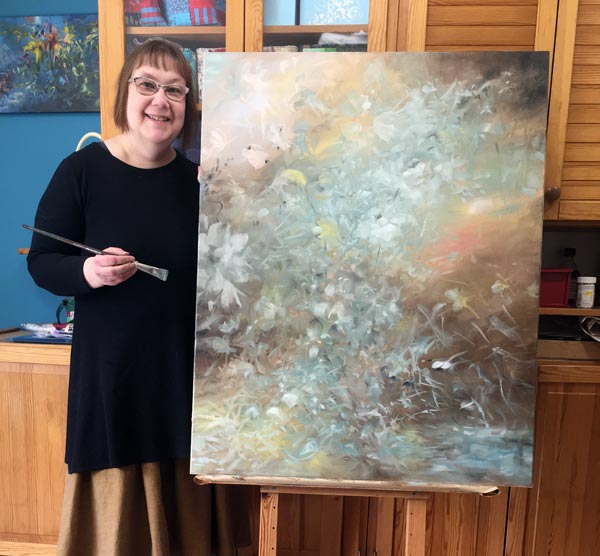
I usually make paintings in pairs, but this time I had a pair already ready: last year’s finished painting Queen of the Night. It is a dark shade and I wanted to make a light counterpart to it.
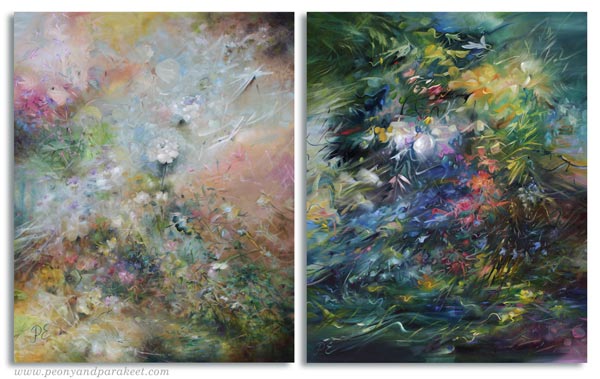
Both of these works are inspired by bygone eras: the 18th and 19th centuries.
About Transience and Creating the Best You Can
While painting The Disappearing Garden, I thought about how important it has been for me to practice a lot. But recognizing my transience, I now want to paint as well as I can. Life is hectic and a new start is always tempting. I can make dozens and dozens of nice and small pieces and collect likes with them. On the other hand, I can wait for the perfect time and perfect vision: question my artistic core and taste and where my focus should be.
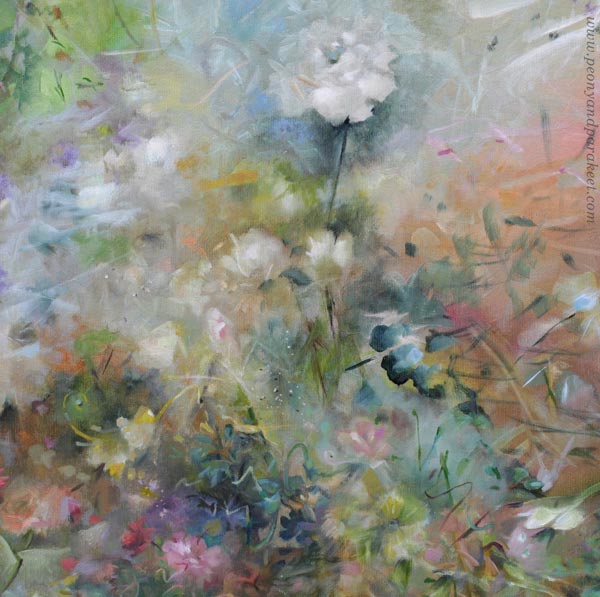
But it’s also so that life is constantly changing. If I don’t capture this moment, will I achieve anything? That’s why it felt important to give this painting as much attention as it wanted.
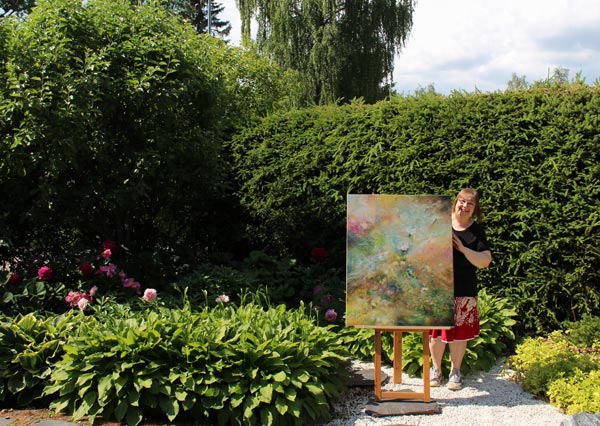
Do these thoughts resonate with you?
Everyday Life as an Artist
This post is about my current everyday life.
I was going to tell you that my life has been very ordinary lately: I wake up in the morning, take the dogs for a walk and start painting. In the evening, I practice my ideas with the ProCreate app or knit and let my subconscious work on art-making.
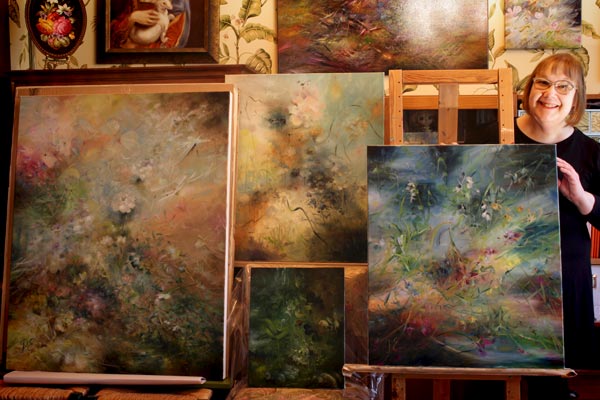
But if my dead parents heard about this life, they would claim that it’s not ordinary at all!
Visiting Exhibitions
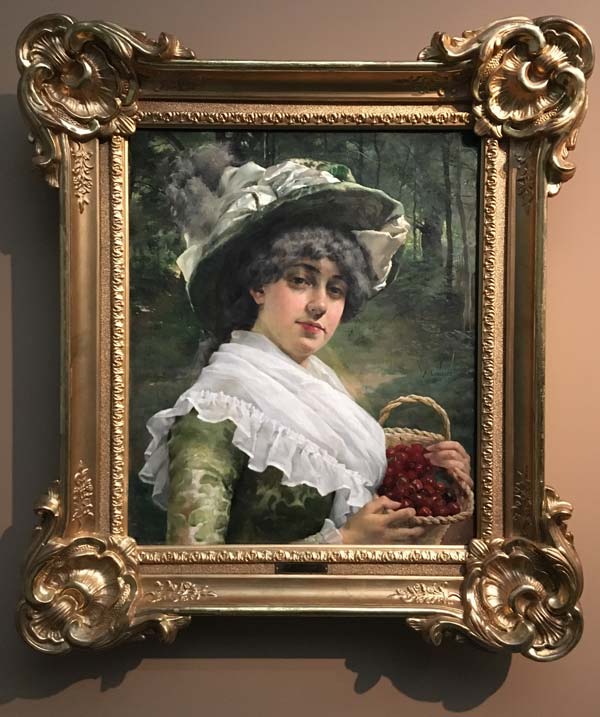
Last week, I went to the big exhibition presenting the work of Albert Edelfelt at the Ateneum art museum in Helsinki. When I sat down to listen to seminar presentations about his work, my parents came to mind. They would have liked to see the exhibition. And they would be amazed to learn that I went to see it because of my work. I wanted to examine Edelfelt’s brush strokes in real life because I’m currently painting works for the show called “Taiteilijat Edelfeltin tunnelmissa – Artists in the Mood of Edelfelt.”
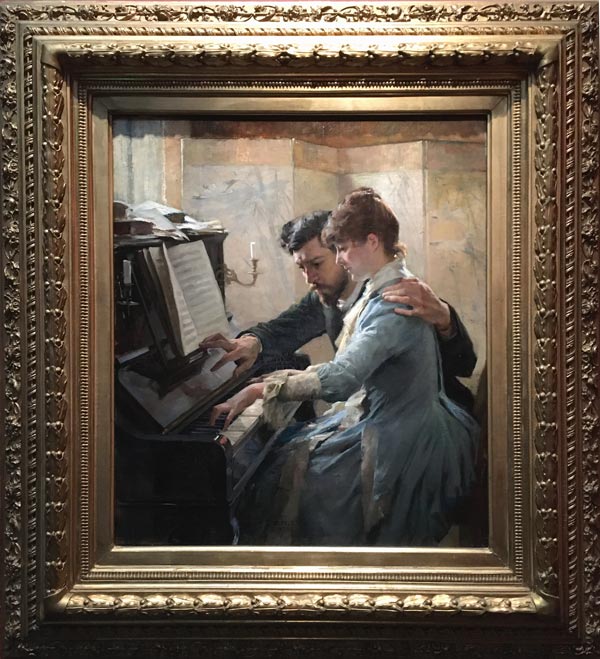
It’s important to me to see what other artists have created. It makes me feel connected, discover new techniques, and it inspires me to do things a bit differently than what I see. I often ask: what’s lacking if this would be my work? In the painting above, I would have added abstract elements on the top, depicting music.
Pressures of Everyday Life
All work becomes mundane when you do it systematically and goal-oriented. There will be pressures that you didn’t even think about in your dreams. You have to remember to order the supplies in time, plan the sizes of the paintings, the subjects, and the schedule for each one, pick up dog hair from unfinished works at the time of shedding, clean the paint tubes, wash the brushes carefully, wonder if anyone likes the painting and worry if it’s finished or not. Making a series of paintings is always a financial investment.
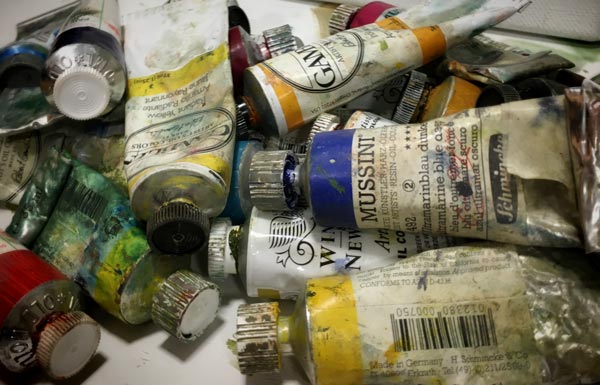
But when I am washing the floor from oil paint stains or doing something else mundane related to painting, I want to remember how wonderful it is to work on this project.
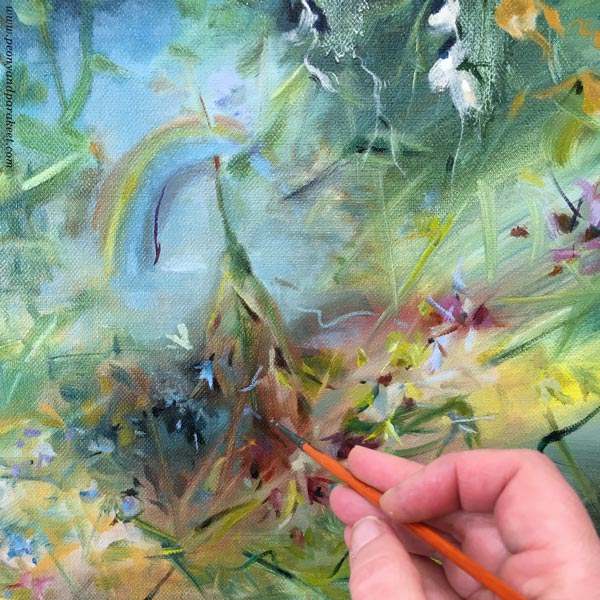
After all, I love art history, and the very thought that my paintings go to the place where Albert Edelfelt spent his summers is inspiring.
Everyday Ponderings
Lately, I’ve been thinking about why I always deal with longing in my paintings. I easily lean into nostalgia. Albert Edelfelt depicted people and landscapes realistically, but he also sometimes dealt with history and went back in time.
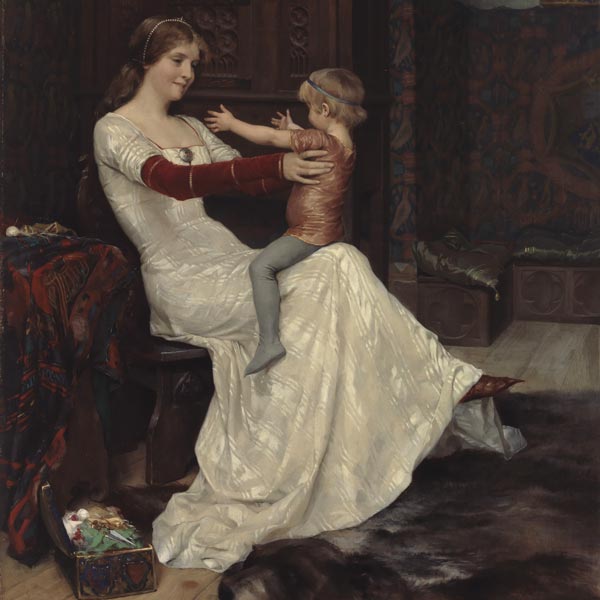
However, the difference between me and Albert is that he was interested in how things could have really happened and did detailed background research. I’m more inspired by how things could have gone differently.
I don’t know how my parents thought my life would turn out. Many times it has gone differently than I would have guessed myself! Sometimes for good, sometimes for bad. Life as an artist is very unpredictable. Just when you think you have to stop, a new project comes up.
Everyday Task – Planning for the Future
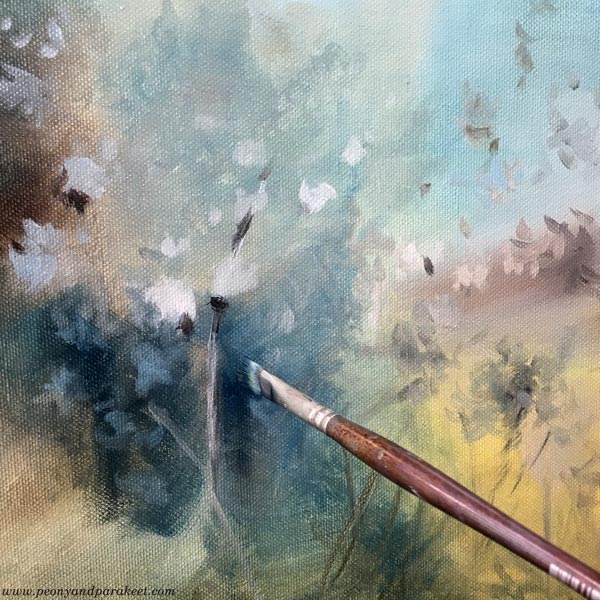
One of the hardest things in being an artist is to always move forward and think bigger. When this year’s plans are set, the next year begins to worry.
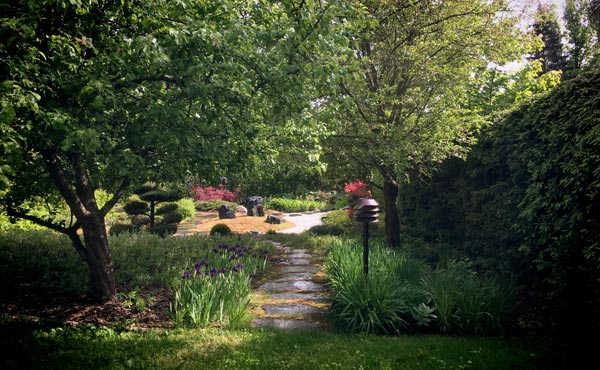
Artists are always in progress and very similar to gardeners. When a person says: “My garden is now finished,” you know that it’s the beginner speaking. Gardens are never finished!
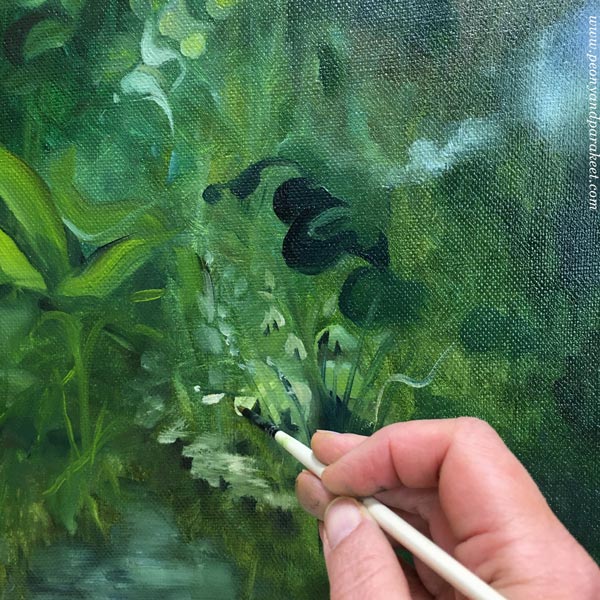
It’s the same thing with art – you will find yourself, but then you will change and have a new you to find. I try to get the most out of this everyday life because it too is about to change for sure.