
Pros and Cons of Becoming an Artist
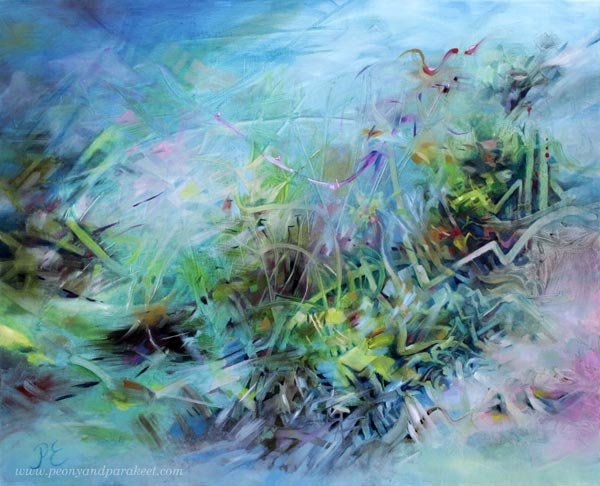
This week, I share my newest painting, and thoughts about a life change after becoming an artist – even if I don’t quite know where I will be heading next myself.
All my life I have wanted to be an artist. But first, I went to study software engineering because it was a much more sensible thing to do at a young age. And I loved computers. How can a girl love machines so much?
There’s this girl in me who looks in the future and gets excited about technology. And then there’s another girl who looks back to history and wants to paint like Rubens or Kandinsky.
Pursuing the Dream of Becoming an Artist
After I got my degree in 1996, I repeated to myself “Paivi, you are a master of science – “diplomi-insinööri” for a couple of years. It felt so unbelievable!
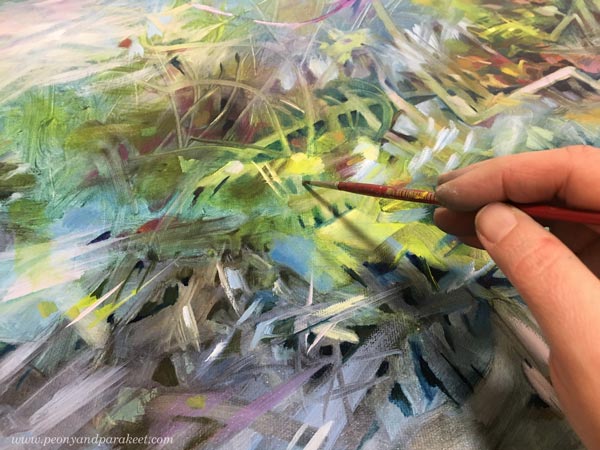
But I had this other dream that I wanted to pursue, and it felt like my life would be too short for that. So many years were given to technology. However, in 2014, about seven years ago, I decided to give it a go.
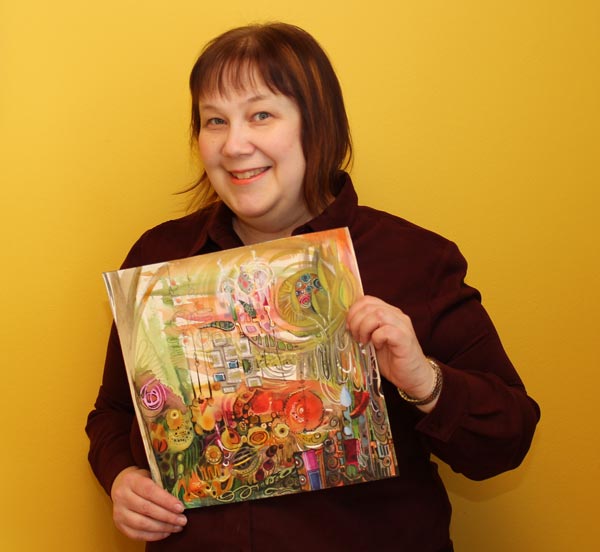
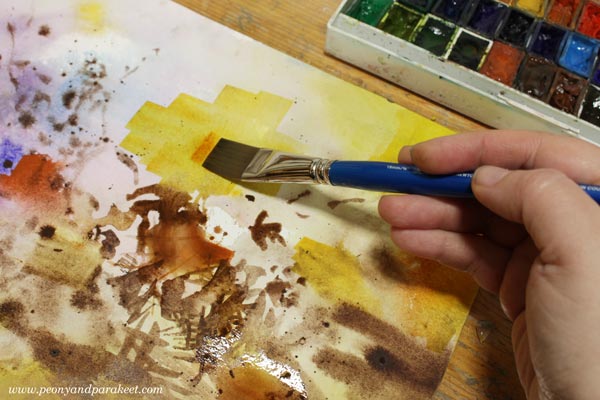
Every day since then I have banged my head against the wall between the outer and inner world. I have learned to draw freely, get intuitive with watercolors, illustrate animals and magical fantasies, and paint flowers and abstracts.
I thought that I would be learning and teaching for the rest of my life, never coming home, but fully enjoying the journey.
Breaking Through in Becoming an Artist
However, this year, I found myself breaking through, seeing a new horizon. I had to really push myself to give finishing touches to my newest class Floral Freedom, and after reading Wassily Kandinsky’s book “Point and Line to Plane” the final small pieces fell in their places. It was like a big equation in an engineer’s mind became solved, and I found myself whispering: “Paivi, you are an artist.”
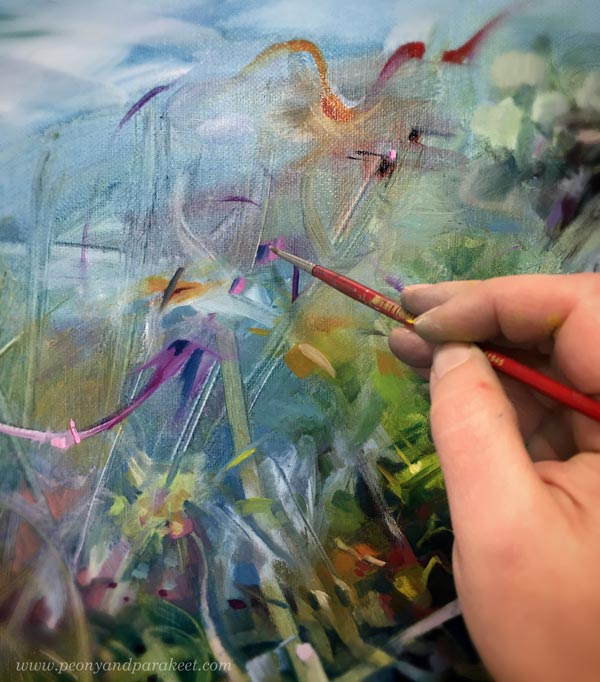
And similarly, as after graduating in 1996, the achievement felt unbelievable. But this time, its tone was different. It was not a validation received from others but from myself and thus, felt more holistic and life-changing. Yes, I may have been an artist for others for some time already, but finally, I have become an artist in the eyes of myself. It has made me want to put recent paintings side by side and continue the series boldly and unapologetically.
There’s also unexpected sadness in this happiness. The imaginary world that I have been building for the last years has fully opened, but with that, something has closed too. The old routines are gone. I no longer question what I should create in terms of subject or style. All I have to do is to fill a palette and start painting.
I am still unaware of what’s coming next. How to sustain myself. How to live after solving a puzzle that has been in my head for 53 years.
Blackbird in a New Territory
Every morning when I open the door, I see blackbirds in our front garden. They seem modest and hard-working. They rarely rest, and when they sing, it seems to be for a purpose. These colorless birds don’t ever surprise or make my head spin.
But yesterday, I noticed that a blackbird had left the garden and entered my inner world. And it was so delightful, like a sign of hope in all the unawareness and misery that I have had recently. Isn’t it amazing that someone so insignificant as a blackbird can reach a soul, even secretly? That someone so plain and muddy can shine so brightly when it lands in another territory!
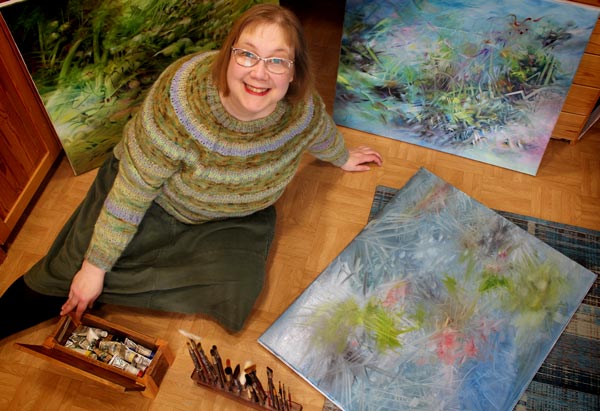
I hope you’ll stick with me, take my classes,
and hop in where ever you are in your artist’s journey.
I promise to stay around and help you as a teacher and a coach
at least for the rest of this year.
Can or Can’t Draw – Did You Know This About Drawing?
Before you decide whether you can or can’t draw, read this!
Last week, I re-organized my art supplies. Paints and painting mediums got a more accessible location, and pens and other drawing supplies went into a closet. It was a consequence of the revelation that I had become a painter.
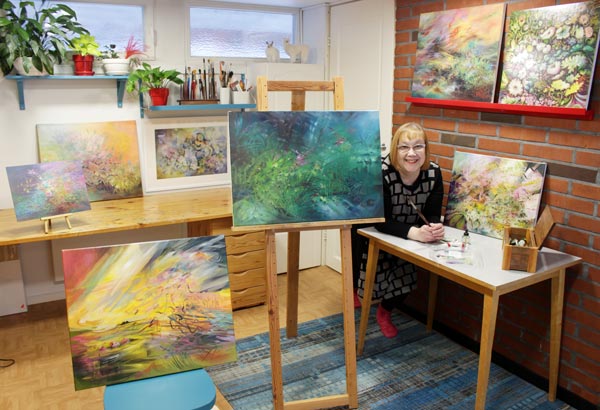
But instead of declaring the love for painting, this post is about drawing!
Namely, my journey in art has been gathered around finding my line. To me, the line is the voice. It’s the leading singer, while colors and heavier shapes are the rest of the orchestra. The line itself is enough to make any piece of art sing.
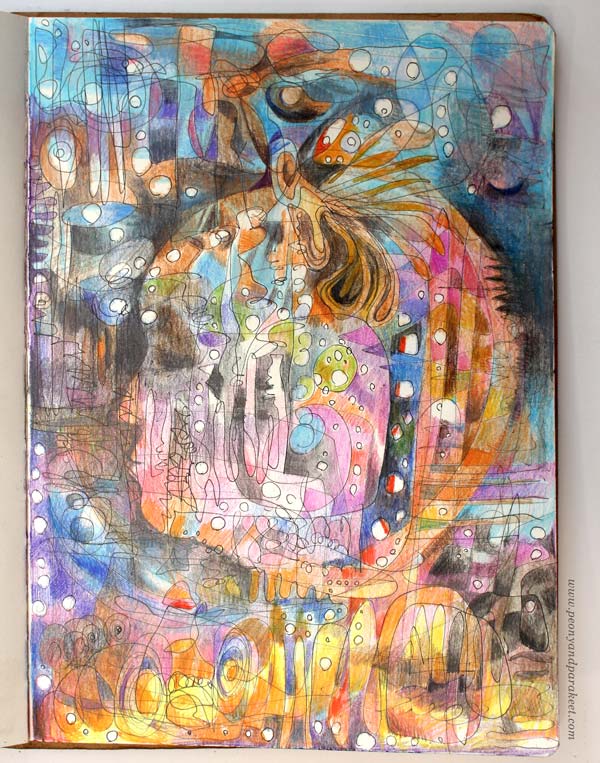
“I can’t draw” was my problem for too many years. Then I realized that we define drawing too narrowly.
We aim for the skills of drawing realistic objects and then end up worrying about the stiffness of our work. “I want to be more spiritual, I want to be more abstract, I want to see me in my drawings.” Have you ever thought like this?
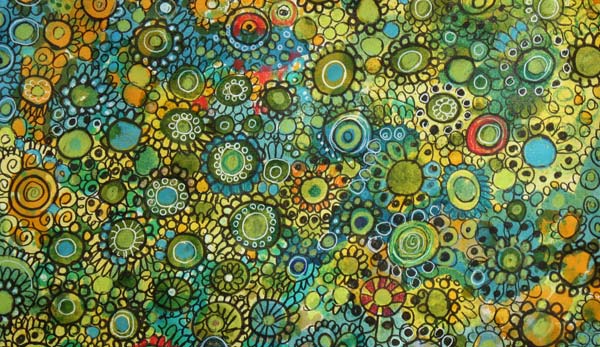
My solution was to abandon references and start drawing circles.
Don’t Just Draw Circles!
Those years spent with circles now felt like a waste of time. I didn’t have guidance for freehand drawing, and I did what felt comfortable at first. But circles are closed and rigid shapes, and when you want to open up and loosen up, you need to open and loosen your circles too.
Here’s a short 4-minute video from 2017 that shows how you can move forward from drawing circles.
Drawing – like any art – has two sides.
One side is a skill of controlling a pen or a brush so that the result is attractive and aesthetically pleasing. But drawing is also a skill of getting out of control and expressing the limitlessness of the mind.
Both skills support each other. Clarity and stiffness add ornamental beauty to loose lines. And drawing wildly helps with showing more personality when you want to be in control.
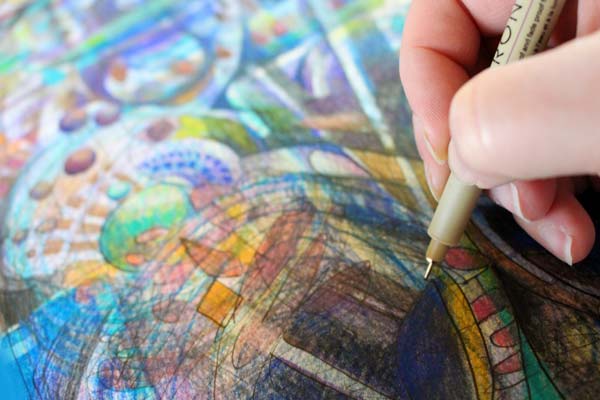
For me, exploring drawing from the other angle was ground-breaking.
I developed a class called Inspirational Drawing, where we draw and color freely but also use inspiration images to boost imagination. Inspirational Drawing 2.0 is the latest version of this popular class.
You know you can draw when drawing feeds inspiration.
When I paint, I start with a vague idea and go where happy accidents lead me. I don’t need much to get started. The first idea can be just a color combination from an old painting.
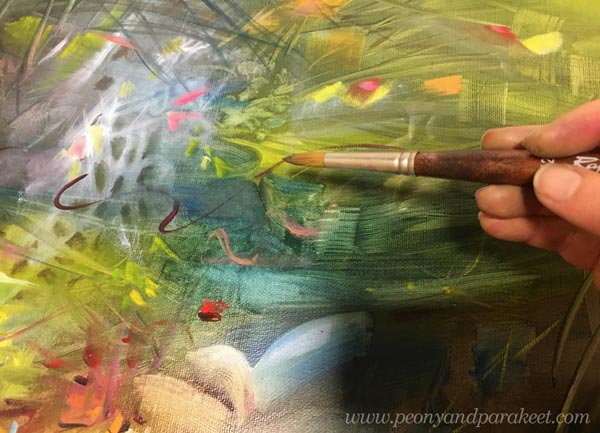
By practicing inspirational drawing, I found my living line, and the energy that’s packed into it is enough for any sized painting. My line sings, and the rest of the orchestra supports it.
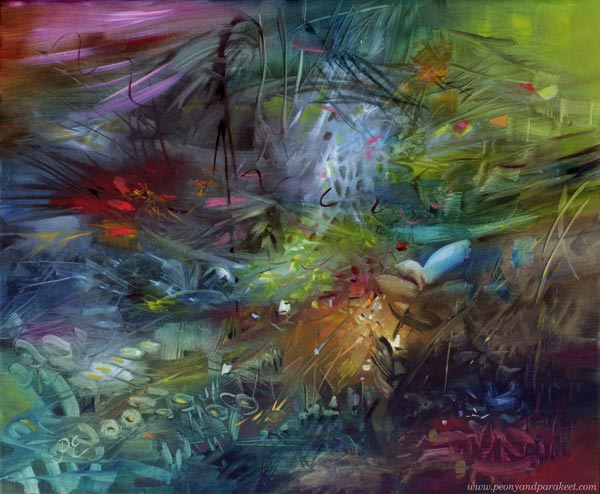
So, isn’t it sad if we try to improve our art without paying any attention to our line?
If we try to release the expression without releasing the line, giving the full power to the leading singer?
If we say we can or can’t draw without allowing free expression?
What do you think?
Your Art and Loosening Up
This week, I talk about being unique and loosening up in a video. You also get to see me working with a new oil painting.
Your Art and Loosening Up – From a Former Engineer
With the video below, I want to get you to think about how much you do layering. But this time, I don’t talk about the actual layers of the painting, but the layers of you and your life – the more abstract stuff. Namely, we often lead our artistic direction too literally and don’t allow contradictory or silly ideas. I hope you enjoy this video!
This is a little different than many of my videos. I would be interested to hear how you like it! Do leave a comment!
Links Relevant to the Video
- Ilun Handu Duunaa, Episode 44 (in Finnish)
- Paul Klee and Wassily Kandinsky at Wikipedia
- Paul Klee’s Pedagogical Sketchbook at Amazon.com (affiliate link)
- Wassily Kandinsky’s Point and Line to Plane at Amazon.com (affiliate link)
- Floral Freedom (the abstract floral class!)
Design Principles Translated to Intuitive Painting
This week, I talk about design principles for intuitive painters. This is for you who paint because it’s a spiritual act!
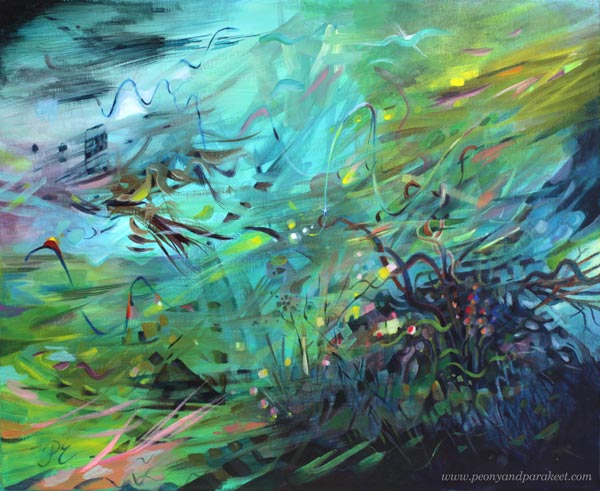
While making this acrylic painting, I thought about how intuitive painters often feel a disconnection with general art advice like “make sure you have a focal point.” Even if I teach online classes, I often find advice that solely focuses on the technical part misleading because it talks so little about artistic expression and the experience of making art. Design principles can be like a bible for technically oriented people and a blank book for those who want to approach the subject more emotionally. But it doesn’t have to be like that!
Design Principles and Intuitive Painting
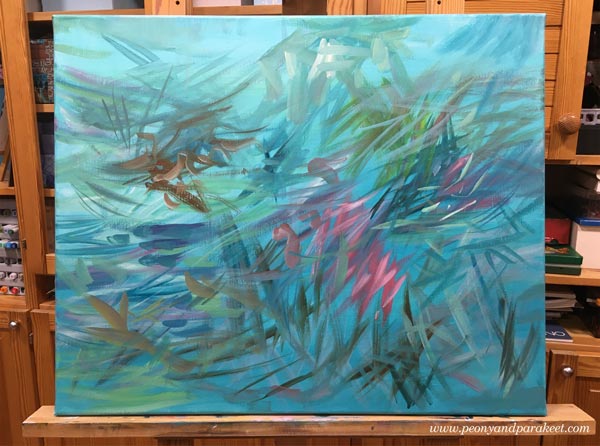
Intuitive painting differs from following a predefined idea, a reference photo, or a sketch. Let’s take the focal point as an example. Intentionally, you should start what matters the most and make it noticeable. This way, you have a clear focal point, and your painting delivers a clear message. But when you paint intuitively, there’s no message when you begin. The painting process is about connecting with your spirit and being open to what wants to come out. Here’s what my painting looked like after the first layers. Yes, there’s some resemblance with the finished piece, but not so much that the advice would make sense.
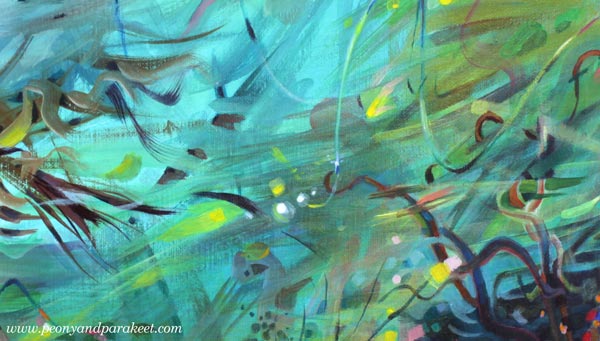
The focal point (the small pale yellow rectangle in the dark area) and its supporting element, the row of white dew drops, were added much later. Here are the dewdrops and the many layers more closely.
On the other hand, I don’t agree with those who say that lighting candles and taking a spiritual mindset should be enough. There are also those who believe in natural talent – that you either can or can’t paint – which I most strongly oppose.
For me, intuition is about bringing knowledge and creativity work together and listening to what they have to say. When I want to move forward, sometimes it’s about growing my knowledge, sometimes increasing my creativity, but often it’s also getting better at listening – quietly observing what the painting wants to become.
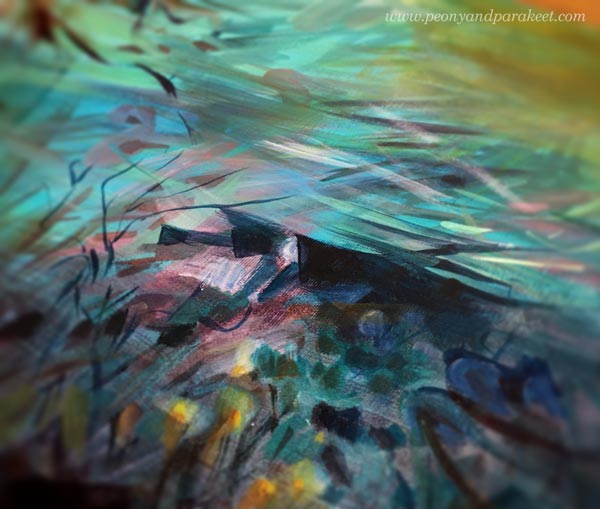
When I notice a shape that looks like it’s whispering to me, I want to strengthen it. And sometimes, these shapes later disappear under new ones, but they still showed me the way.
Let’s go through 7 design principles and translate them from intentional to intuitive painting.
#1 Emphasis
In intuitive painting, aiming for emphasis is often about finding a suitable title and adjusting the painting to express the title. For me, painting is quite far before the first ideas about the title come up. However, the first ideas are usually the most conventional ones, so I keep painting and diving deeper.
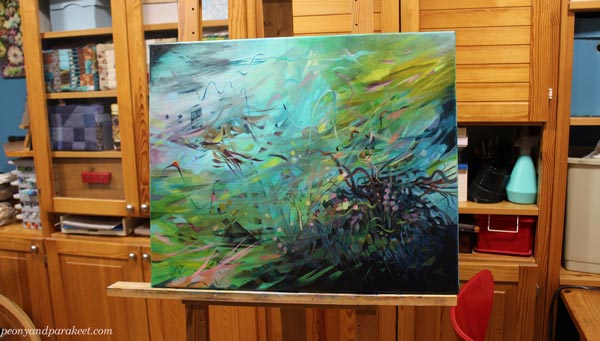
I thought this piece was finished, when it looked like this. The title that I had in mind was “Windy Tales” or “Wind Blows in a Fairytale.” But it was still too generic, so I kept asking: What fairytale?
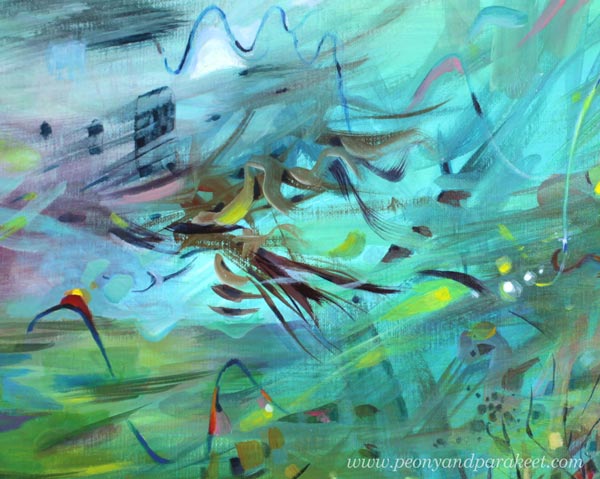
After the painting session, knitting late at night, I got the answer: Snowwhite! So next morning, I added some more white and other colors of Disney’s Snowwhite.
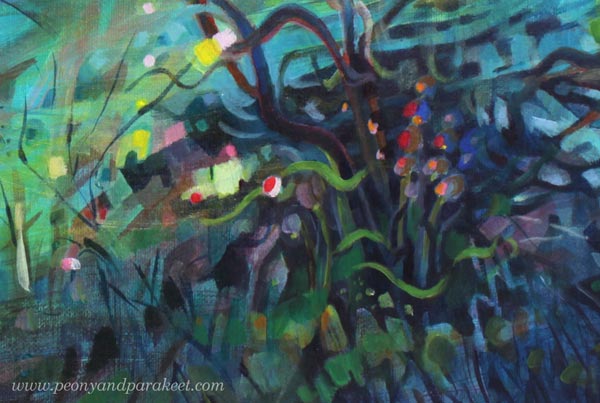
I feel that these small adjustments released the spirit of the painting.
Intuitive doesn’t have to mean fast. We can take breaks and let our intuition and connection grow between the sessions.
#2 Balance and Alignment
The emphasis needs extra effort, but balancing is what we do naturally and so much that it suffocates expression. Be aware that “intuitive” often become “balanced” and nothing else.
The easiest way to balance a painting is to make it symmetrical. So taking an asymmetrical approach – even just for a couple of layers – makes you more expressive than any meditation! Imagine a horizontal and a vertical line in the center of your work and force yourself away from constant balancing strokes.
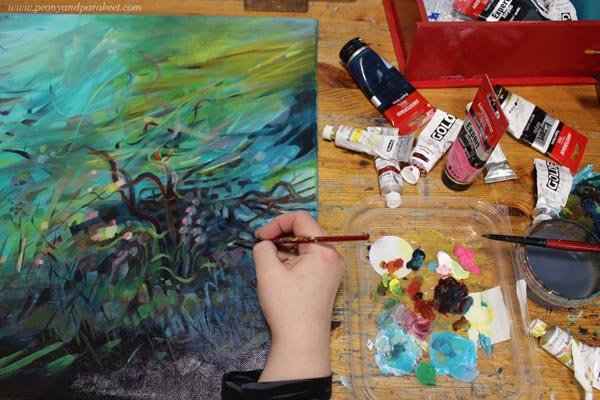
So for intuitive painters, getting off-balance is more important than creating a balance right from the beginning. In the end, you can balance the image with a few strokes if needed.
#3 Contrast
Intuitive painters have a strong connection to colors. I often begin with a specific color combination in mind, and colors feed my ideas. Yes, I like pinks, turquoises, bright yellows, bright greens … but I also have to remind myself that like a spring flower, a spirit of the painting rises slowly from mud.
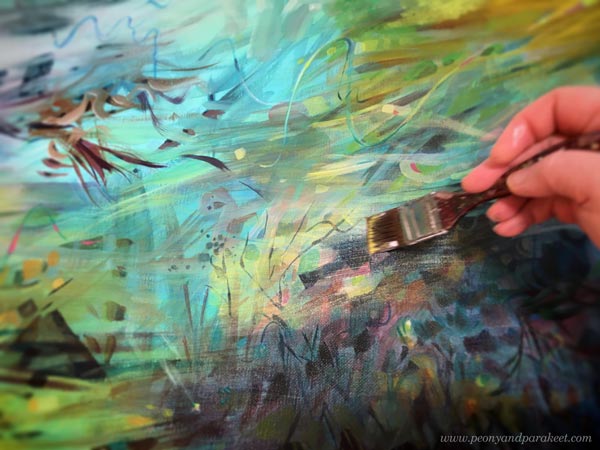
This design principle is not so much having different colors, but having differences in lightness and darkness. For intuitive painters, it means that we have to process colors that we lay on the painting. So not just squeeze tubes, but to create our own color mixes so that the spirit is not only on the paper or canvas but also on our palette.
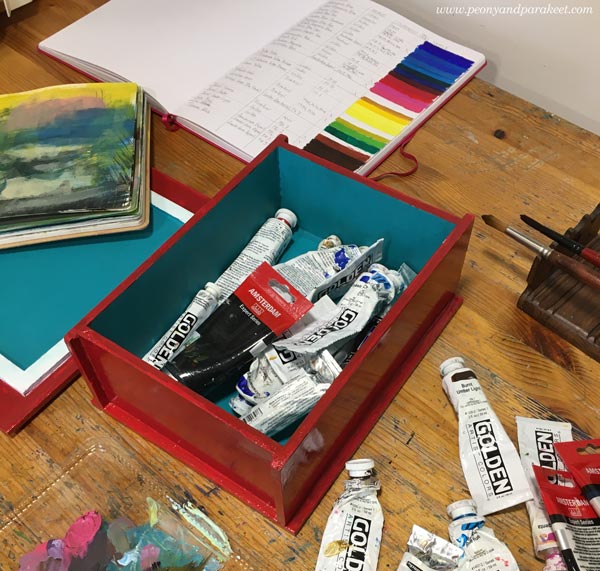
When we slowly create the color mixes, we have time to connect with the tone, adjust its darkness, seek for the genuine response that has a longer-term effect than what has been industrially produced.
#4 Repetition
The best way to think about repetition is to express echo. Instead of constantly balancing your painting by looking at the big picture, focus on one shape that you have just painted and imagine its spirit. How would the shape echo itself?
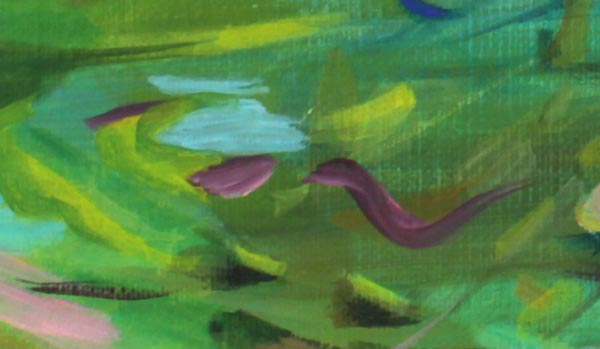
The echo is never identical to the original spirit. The echo is weaker, and there’s never just one sound, but a few.
#5 Proportion
In intuitive painting, we paint energy. Energy gathers to form cells, then clusters that get bigger and bigger. It’s easiest to see these clusters by looking at the painting from a distance or by taking a photo and reducing it.

If your painting is full of clusters, all the energy is static, and you need more openness in shapes and lines. If all the clusters are similar in size, then the overall energy is impermanent and less powerful.
#6 Movement
Intuitive painting connects us with the tradition of storytelling. We don’t just deliver a spirit but a story about its power. In visuals, we can build paths from one element to another so that the eye can effortlessly move around the painting like it’s listening to an impactful story.
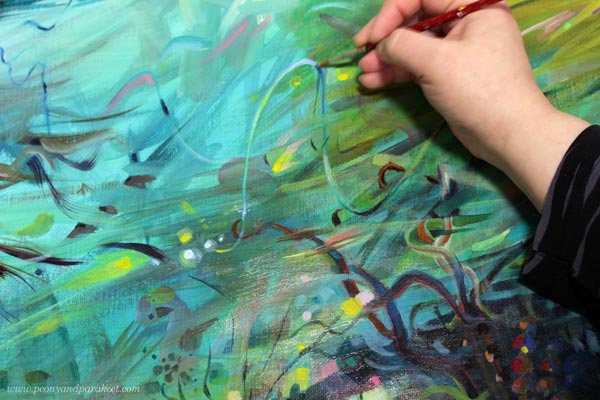
Rather than painting separate elements, connect them with lines or layering one slightly over another. Make sure that all your elements are not round and stop the eye, but pointed that move the eye forward and build flow and movement. So, when you feel the connection with the painting, create connections visually too.
#7 White Space
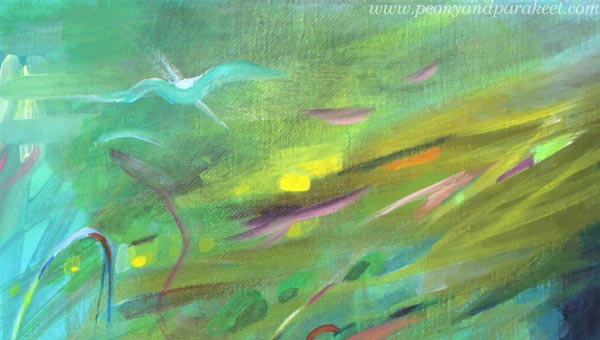
Intuitive painting is less about arranging space and more about filling space, but white space is still relevant if you think about it as breathing. A painting doesn’t only need a spirit – it needs to breathe. If you paint boldly, everything bland will help with breathing. Adding muted yellows around a bright yellow spot makes the yellow spot breathe.
Design Principles Apply To All Art
So, you see, intentional and intuitive painting are not so different after all. The process and the values are a bit different. Still, it’s like humans – we come from different countries and cultures, speak different languages, but with some translation, we can feel togetherness across the borders.
If you like this article, you will love my class Floral Freedom! There I translate Paul Klee’s technical and Wassily Kandinsky’s spiritual teachings so that you can paint abstract florals freely. >> Buy Here!