
Expressive Abstract Style Tutorial – Paint a Beautiful Mess!
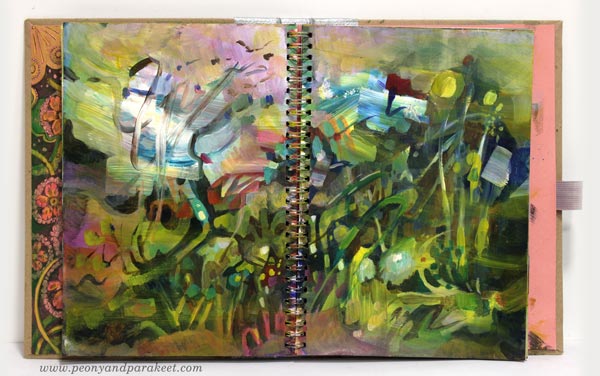
This week I have a video about painting in an expressive abstract style. It’s a very contemporary style which many artists have nowadays. It’s based on loose strokes, and I guess it’s the style that many who are not so much into art say that even a child can do it, but it’s not quite like that! Watch the video!
Are you interested in creating abstract art? Do you wish to learn more about abstract art in my blog and in my classes? Leave a comment!
Artistic Spirit between Abstract and Realistic
This week’s theme is the artistic spirit. I share a new painting, glimpses of my painting fever, and inspire you to explore the zone between abstract and realistic art.
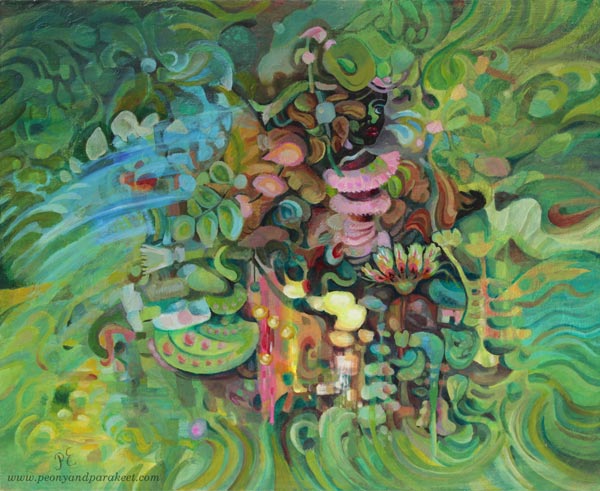
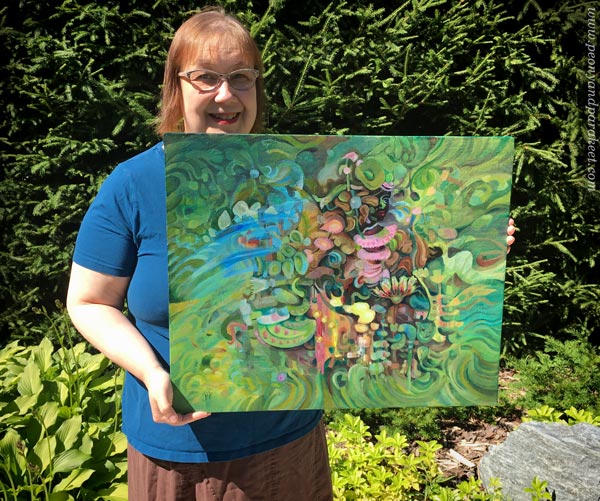
Here’s an acrylic painting that I just finished yesterday. It’s called “Paradise” and it’s quite big: 61 x 50 cm, about 24 x 19,5 inches.
Painting at Late Evenings and Wee Hours
I like to paint in the late evenings when the world quiets down. Now when it’s summer, Finland floods in light, and nights are short. When the blackbirds begin to sign at 3 am, I know it’s time to wash the brushes.
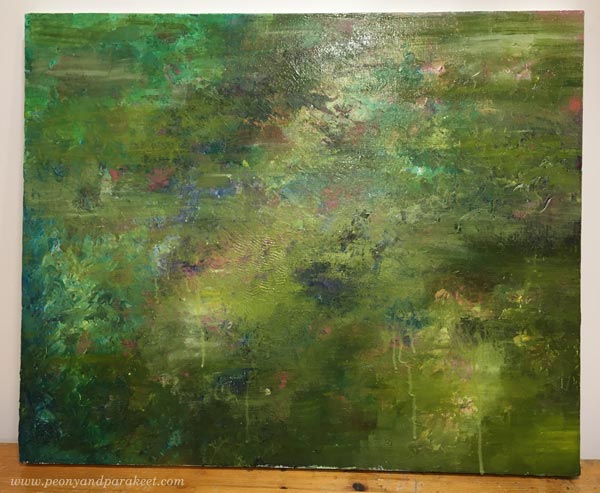
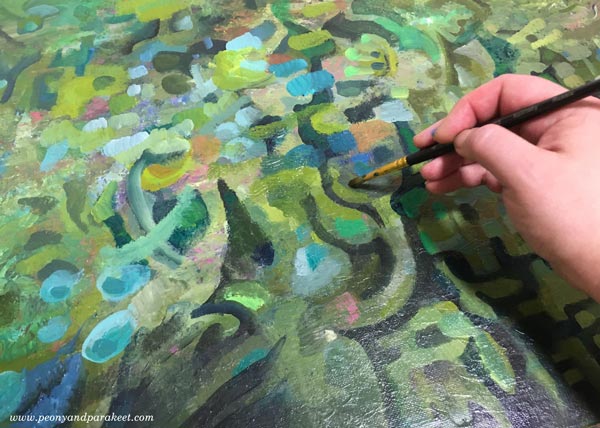
After a long night, I rush to the studio in the morning: “What have you done! You’ll never be able to finish it!”
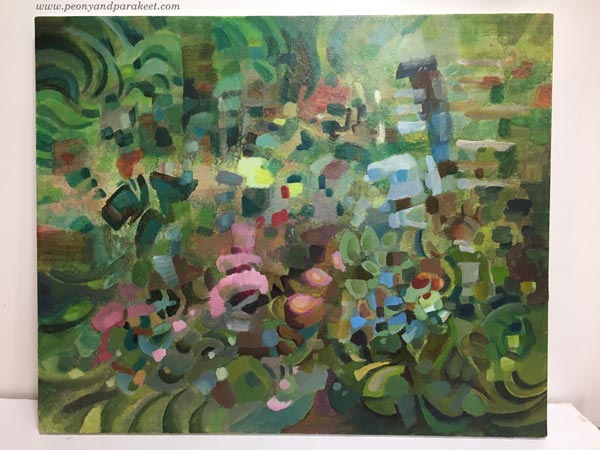
But with this painting, I decided to accept whatever comes up. And with that, I have a little story to tell. I shared it on Peony and Parakeet’s Facebook page recently, but if you missed the post, here it is, with one of the paintings from the teenage years.
My Story about Artistic Spirit
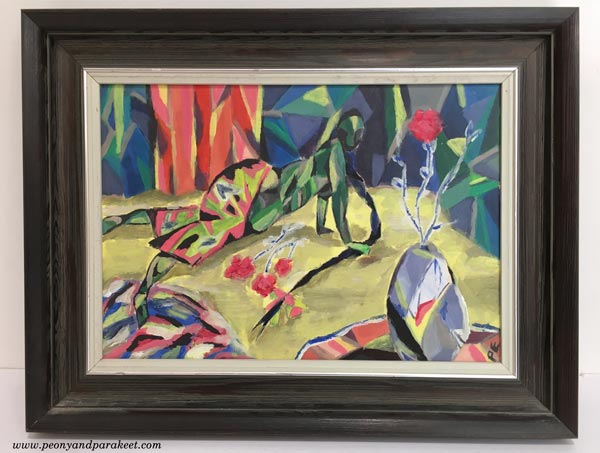
As a teenager, I browsed big art books at the local library. I started hanging around with Matisse and Picasso and they said: “Hey Paivi, take this obsession from us, and make the most of it.” First, their inspiration was like a fever: mustpaint…mustpaint… mustpaint. Then, after too many matissepicassos, it became a burden and I went to study engineering.
During the past five years as a full-time artist, I have been hanging around with other guys – like Da Vinci, Caravaggio, and Rubens. Even if I first thought so, they are not much different. After too many rubenscaravaggios, the empty feeling takes over again.
But recently, I went to my studio secretly, picked the brushes, squeezed the paints, and in silence, I met a spirit. It was not me or any of my masters, but the spirit that arrives when we are ready to let go of the ego.
To paint like me, I need to let go of me. I am pretty sure Matisse and Picasso already told this, I was just so impressed by their names that I didn’t listen.
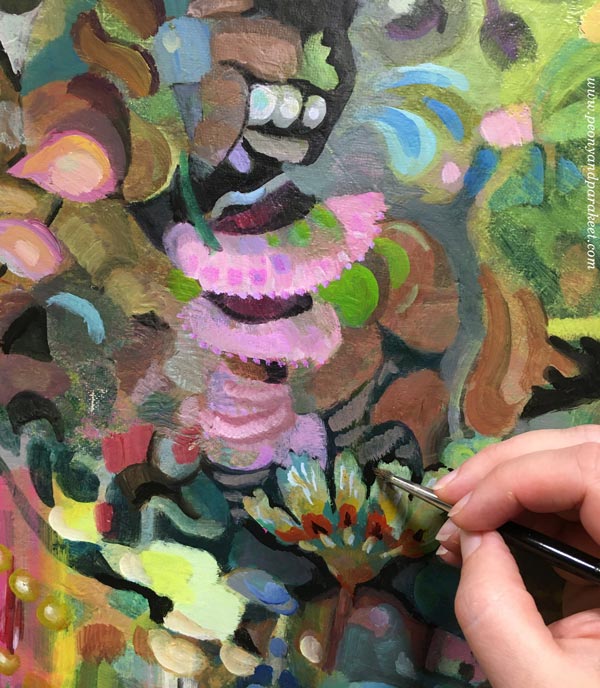
Abstract, Realistic, or Stylish?
Every time I make a class, I don’t only teach but also learn new things. The newest class Decodashery boosted my confidence to paint decorative motifs right from my imagination. Between “abstract” and “realistic,” there’s a zone that’s “stylish.” Then you simplify what’s real, and complicate what’s not. By simplifying, you dig the artistic spirit out of tangible things, and by complicating geometric shapes, you make the spiritual things more tangible.
I really like this painting, and hope that you enjoy these close-up pics too.
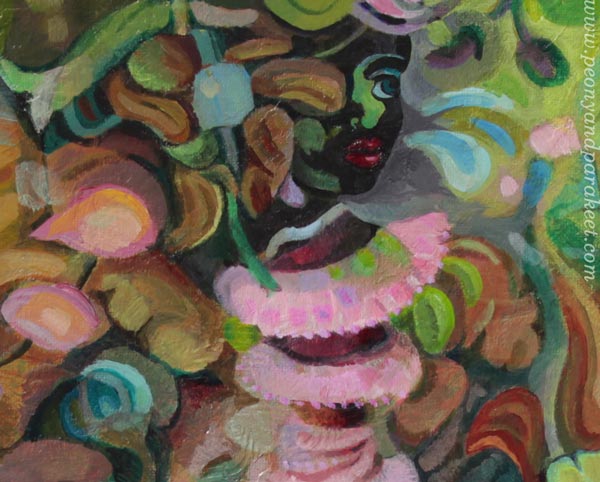
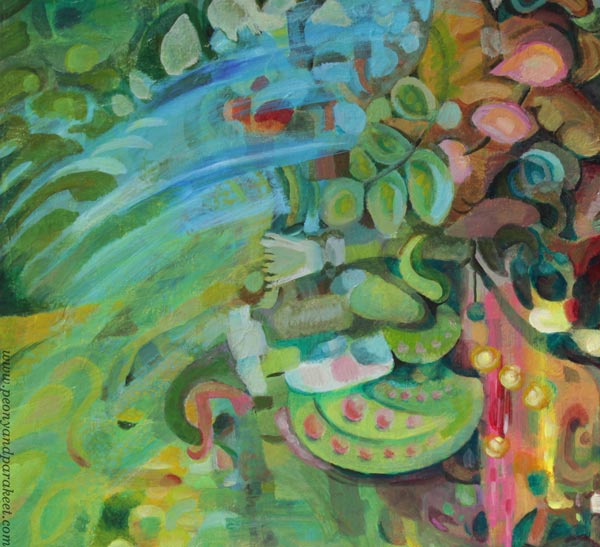
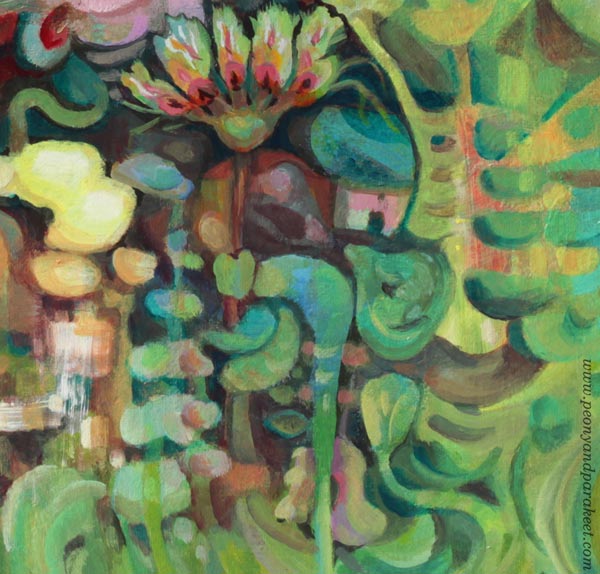
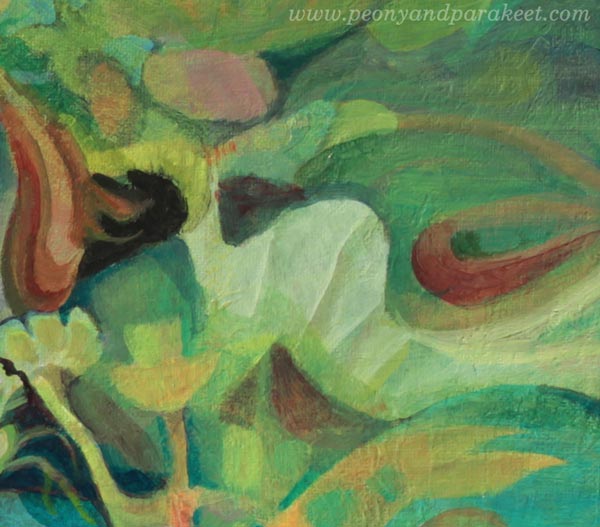
Wishing you many happy moments with painting and drawing!
Imaginary People – How to Paint Their Soul?
This week, the theme is painting imaginary people and how to find their soul. There’s plenty of examples in this blog post!
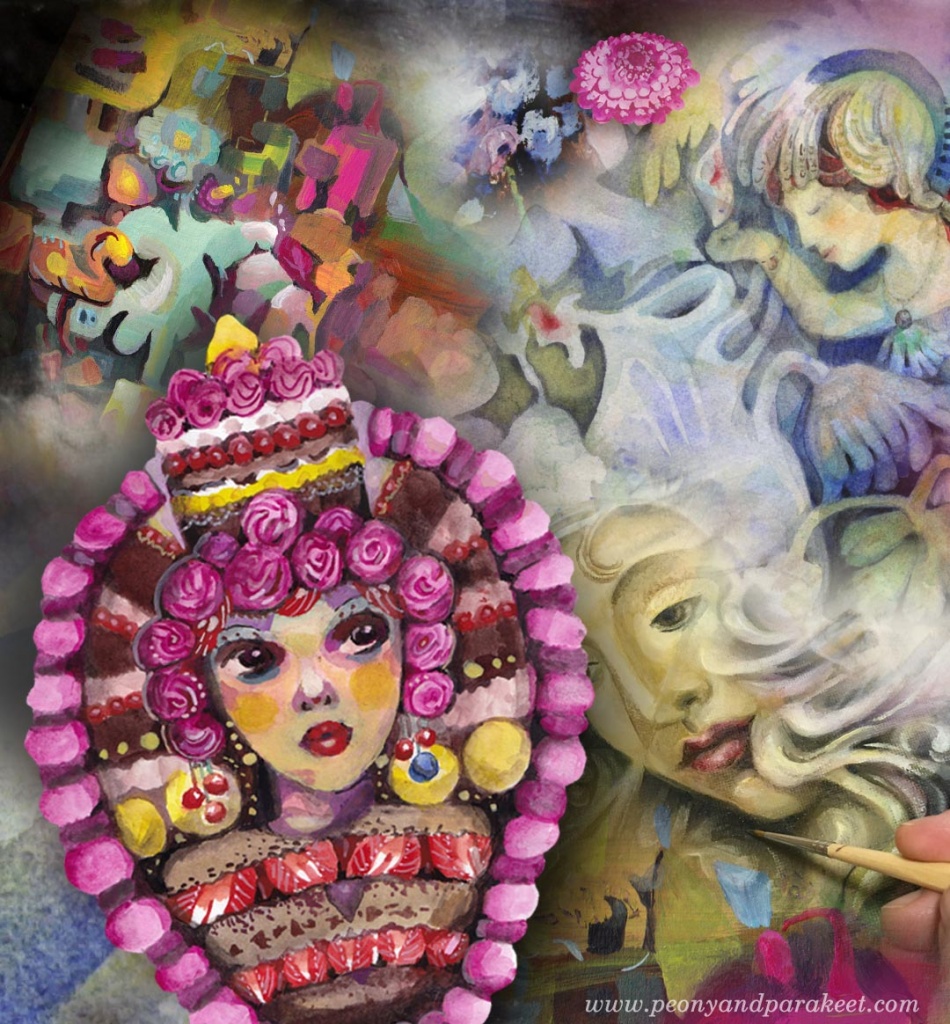
One of the wonders of painting and drawing is that we can give birth to an imaginary person – that we can create someone who breathes, talks, and has a life of her own. However, many times the doll that I have on paper hasn’t come alive. Or she has taken just a few breaths, and after the creative spark has gone, she just stares with empty eyes. So no wonder that I have had a love-hate relationship for painting imaginary people. I want to experience the miracle, but it can also be too much of a struggle.
References – Working with a Soul that Breathes Already
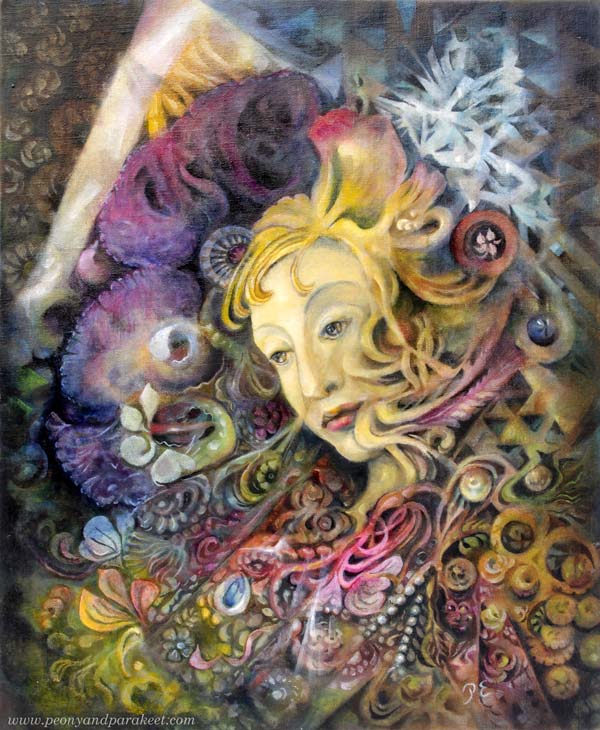
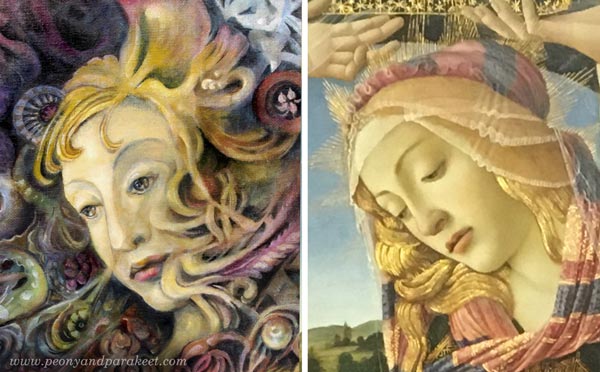
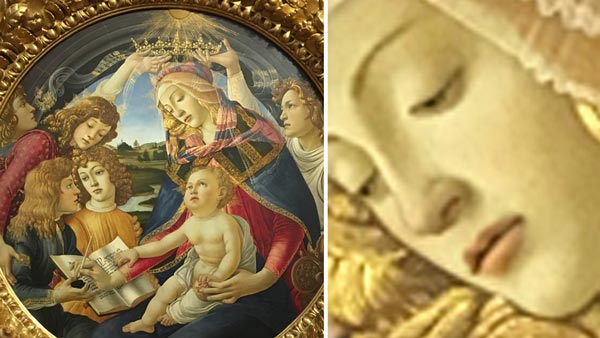
Using a reference may be the least innovative solution but if you find an image that really speaks to you, it can be a good one. Tiny changes in facial features lead to a whole new person so if you don’t follow the reference in the smallest detail, yours is like distant relative to the original – familiar features but still unique. For this oil painting called “Heaven and Earth“, I used a detail of Sandro Botticelli’s painting “Madonna of the Magnificat” (1483) as a reference.
Here’s a close-up of the faces. I changed the angle of the face, opened the eyes more, and made the mouth look more determined.
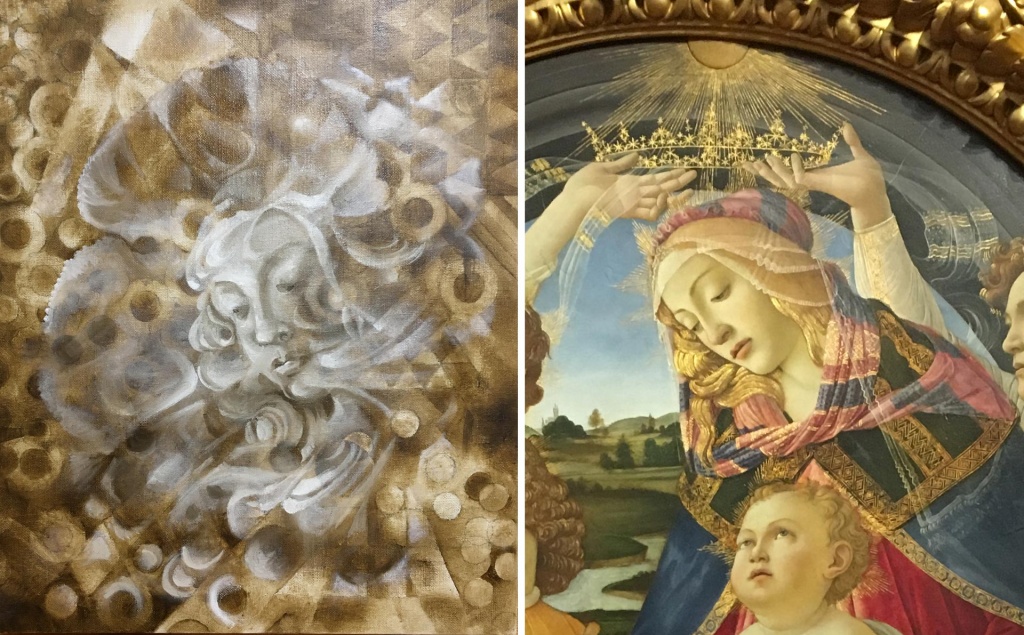
Sounds easy, but I often struggle with finding the soul when using references. With this painting, I tried to slowly work towards an individual personality, but creating a connection took a lot of time. Botticelli painted his soul, and it’s not the same as mine.
Here the work was in the early stage so that you can see how she has changed.
From the struggles of this painting and many others, I have learned this:
Working on the face alone never brings up the soul.
With the Madonna, as soon as I figured out the purpose and the style of the surroundings, I was able to finish the face.
The Soul Spreads Over the Painting
Even if a person is usually the focal point of the painting, the soul is not focused but spread.
The soul is in the setting, in the things, in the atmosphere. Even Botticelli’s Madonna can look just like a bored person without the crown, the light, the child, the book, etc.
So no matter if you paint intuitively without pre-defined ideas, sketches, or references, or more intentionally with a clear idea of how you want your imaginary people to look like, seek for the soul in everything you paint.
Flowers have soul.

Pots have soul.

Hair and hats have soul.

Inanimate and organic things also give the soul to the imaginary people.
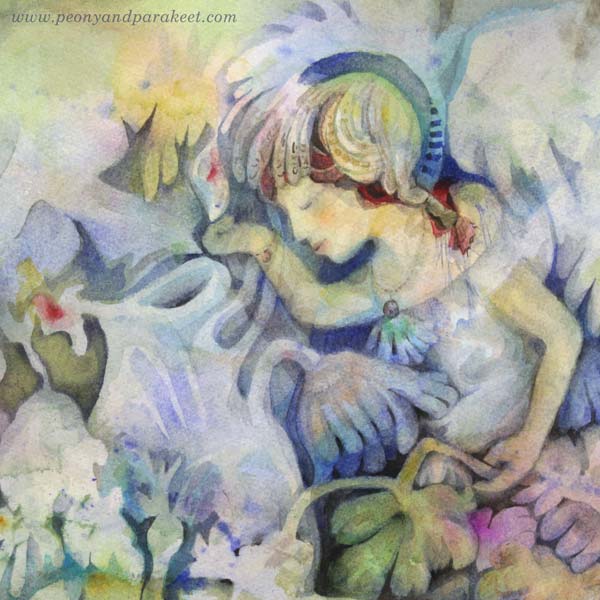
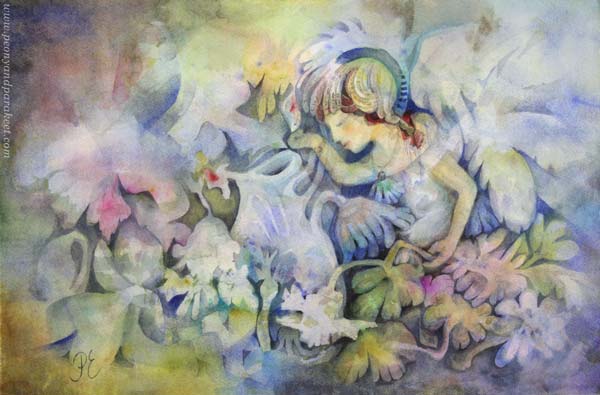
In this watercolor painting called “Mirimer“, the fairy is the focal point, but her soul is spread all over the paper.
Imaginary People Exist in Shapes and Colors As Well
The painting doesn’t even need to have a face. Your imaginary people can be abstract, like in this small acrylic painting that I recently painted on a sketchbook.
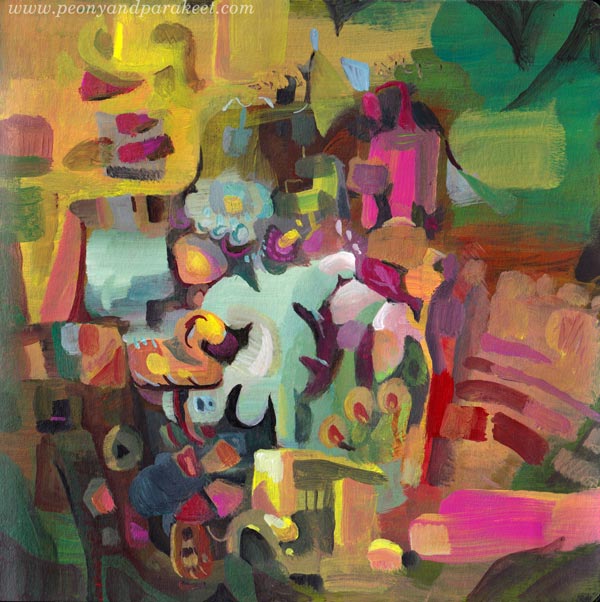
Shapes and colors have soul.
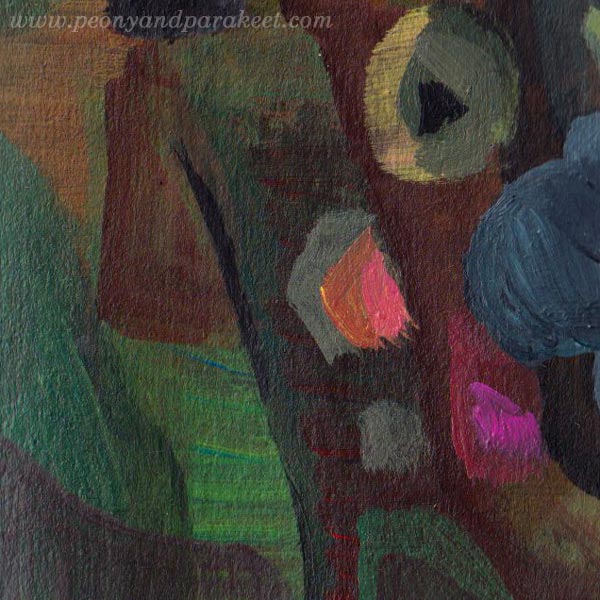
Imaginary People – First or Last?
The idea for this post came from the question that I received a couple of days ago:
“I like your little people peeking out from within your art. I would like to learn more about that. Do you draw them first and paint around them or paint and then save a spot for them?”
I have many approaches.
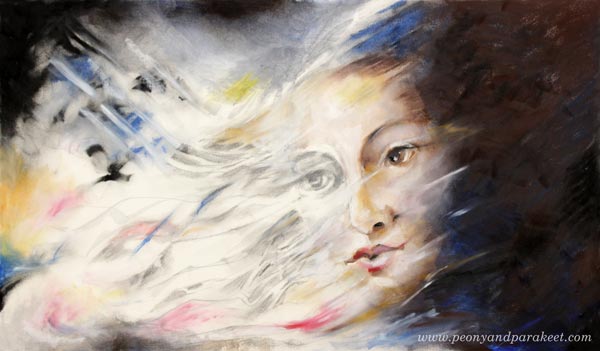
In Innovative Portraits, we use references and make a sketch. The soul begins with the plan.
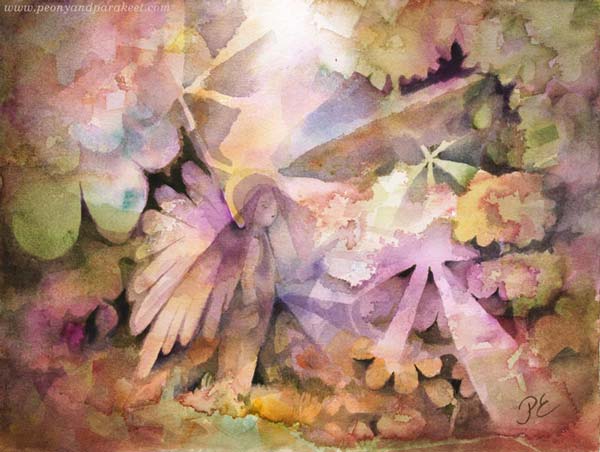
In Magical Forest, we lure fairies to appear intuitively from the watercolor background. The soul begins with the feeling.
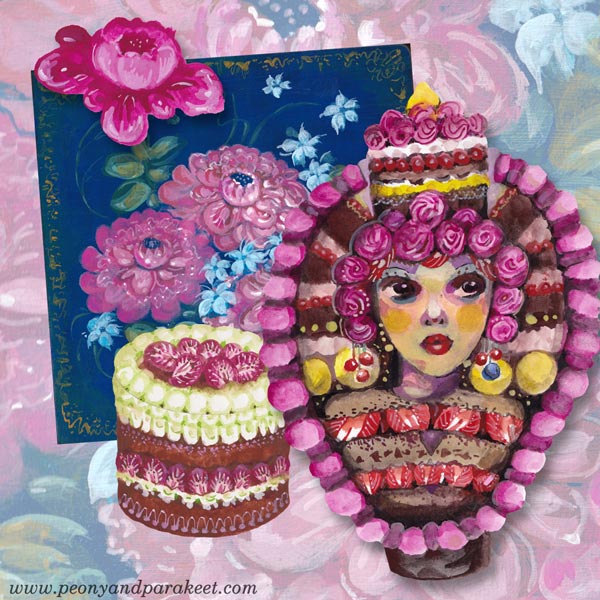
In the new class, Decodashery, we start by building a visual world and then make the dollies to fit with it. So the soul is first just a small flower, then it expands to floral paintings, cakes, lace, and finally, the imaginary people are born. By gradually setting the style and the spirit is the best intentional way to add soul to your work.
Decodashery will begin on June 29, 2020. >> Sign up now!
Why I Paint White Flowers – How Your Artistic Voice is Influenced by Others
There’s a lot of talk about finding your artistic voice, but very little about how other people affect it. So this week, I share a story about my mother and her influence on my art.
Painting the Same Thing Again and Again
A couple of days ago, I was on a morning walk near my home in Southern Finland. The air was fresh as well as the view, dominated by the blue sky and white clouds. My beagles’ busy noses and a glimmering brook followed a sown field that had already started to green. Both birds and earphones fed entertaining listening. But all I could think of was my painting. Was it finished? Should I add more color to the flowers? What else did I need to adjust to make most of the tens of hours? I was alone with my dogs, but the inner critic kept me company: what kind of artist doesn’t even know the meaning of her images?
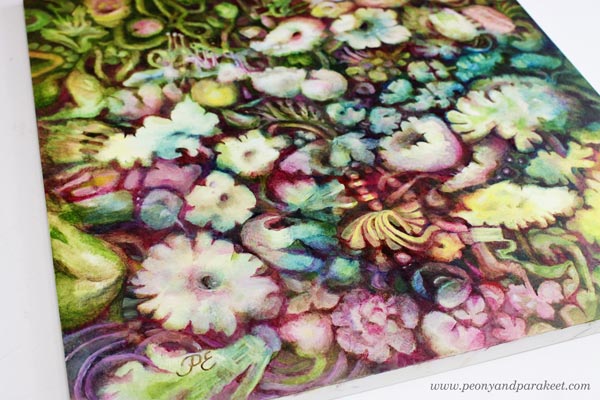
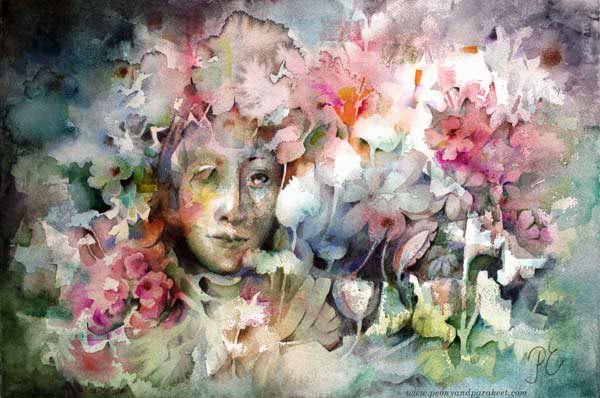
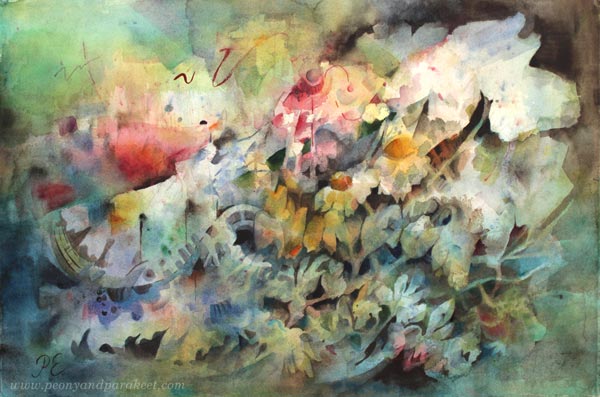
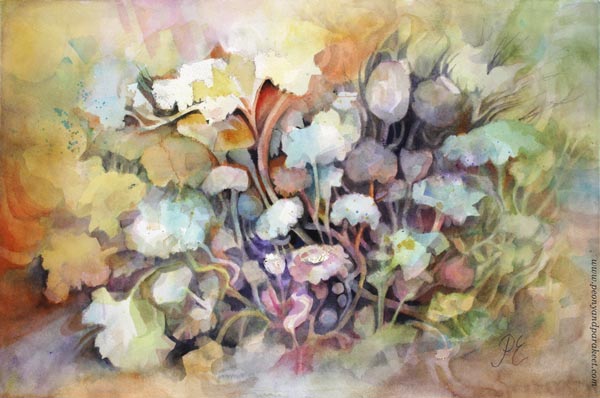
Yes, I am no artist at all. I paint white flowers, the easiest anyone can imagine, and the worst that my mother knew. “No white flowers,” she repeated to my father when her wedding anniversary came close, and he was about to buy a bouquet. “White flowers mean death.” And now, long after she has passed away, all I want to paint is white flowers.
Commenters are Your Art Coaches
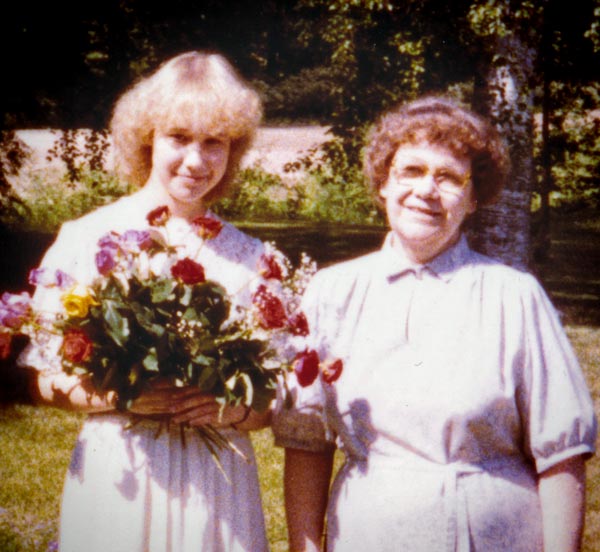
Rebelling had no place in my upbringing during the 1970s and 1980s. As a teenager, I tried to respond to my mother’s corrections and criticism with an ignorant smile. Not for long. She didn’t hesitate to tell that it wasn’t a proper reaction. She was both a direct and shy person. Her presence was almost invisible in public gatherings, but at home, in her empire, she was the master of rights and wrongs. So when I showed drawings to her, she either approved or disapproved. She didn’t talk to me as directly as to my father – what to do or what not – but her words and facial expressions told everything.
My mother was like a strict gymnastic coach with high expectations, but she lacked one essential skill – the ability to show how the tricks could be done. She was as honest to herself as to anyone in this matter and put her energy for finding time, supplies, and art education for me. Time to create was the easiest part. My mother was a housewife. She had left her job at a young age right after she got married. She didn’t want her daughters to have the same destiny, so she did her best to keep me out of the kitchen and constantly reminded me how children would prohibit me from doing what I love.
We lived in a small town near the Russian border, and our family wasn’t wealthy. The only income came from my father’s pension. In the evenings, my mother wrote all the expenses on a small black book. But purchasing pens and paper was mandatory. To her, it was the lowest level of civilization, more important than books. Our town had one bookshop that sold some supplies, but after we got more knowledge from local art groups and competitions, it became evident that I needed a better and broader selection. So every month, when my parents drove to a bigger town, I was often with them, selecting paper, paint boards, crayons, and acrylic paints from a real art supply store.
A Praised Piece Sticks into Your Mind
When I was some years over ten, in one spring morning, I decided to try out a new set of crayons. It was just a warm-up, a quick landscape without using any reference. “Look, mother, what do you think,” I said like so many times before. She looked at the image, tightened her lips, but unlike her, she didn’t say much. Later, when I opened a narrow kitchen closet to pick an iron, I stopped. The landscape was taped inside the wooden door. “I like to look at it,” she said after seeing my puzzled face.
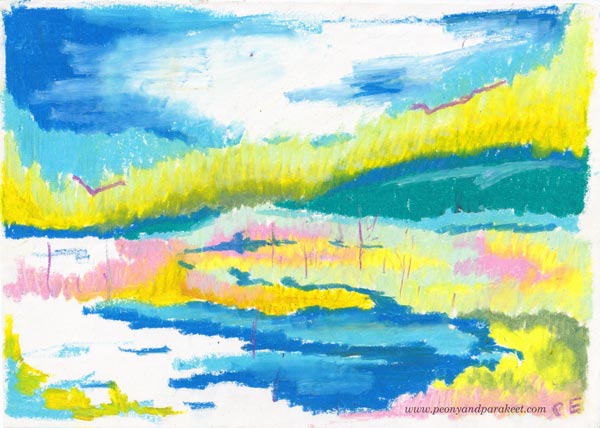
I was devastated. That little landscape didn’t deserve the place. So many times I had poured my heart out on paper and soon found out that it wasn’t to her liking. And now – I didn’t even color all the paper!
Finding the Why Behind Your Artistic Voice – Connecting the Appraisals and Repetitions
Fortunately, my mother was not the only one commenting on my art. My two big sisters had different opinions, and my teachers and friends as well. One piece didn’t satisfy them all, but there were always kind words from someone. It encouraged me to keep painting and drawing, as everyone, especially my mother, expected.
After my mother’s death, one stormy weekend, I traveled to the childhood home to pick things that I wanted to keep before we would sell it. The house was cold, but I knew it was the last time when I would see it like it used to be. Everything was clean and tidy. Performing tasks effectively with high quality had always fascinated my mother. “If I could choose what my profession was, it would be a researcher of work – if such a profession existed.”
When I got up the stairs to an attic, the sight would surprise anyone but me. The attic had always been nearly empty. In one corner, under a sloped sealing, my father had built a small closet for safe storage. I opened its little door, and there they were, neatly in a big cardboard box – my paintings and drawings. Not all, but a collection that my mother had curated over the years, the little crayon drawing included.
So a few days ago, when I was walking by the field and looking up in the sky, my mother came to me in the form of the freshly colored landscape. I now knew that my urge to paint white flowers hadn’t been an act against my mother, but a yearn for her acceptance that blank white blobs had once given to me. Now my question is: can I let go of them, or do I want to keep her in my art forever.
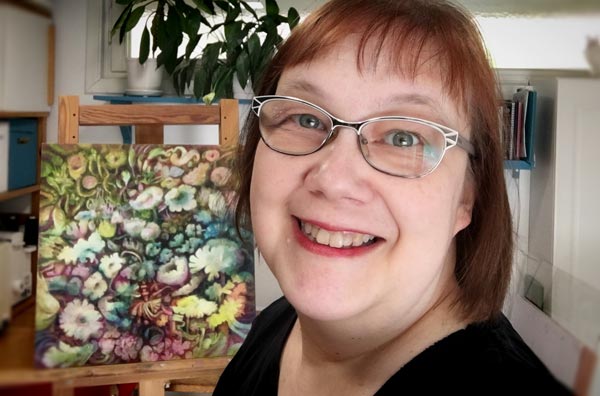
Who has influenced your art? Can you recognize how?
P.S. I also teach drawing and painting flowers in the class Floral Fantasies.