
Emotional Catharsis Through Intuitive Art
This post about catharsis and spirituality in art is enabled by the grant that I got from Arts Promotion Centre Finland. This is the fifth blog post of the project, see the first one here, the second one here, the third one here, and the fourth one here!
Recently I have thought about Wassily Kandinsky so much that he has become an imaginary character in my mind. He seems to enjoy this life after death, and I like him hanging around when I paint. This time it led to emotional catharsis – a very powerful experience. Here’s the story!
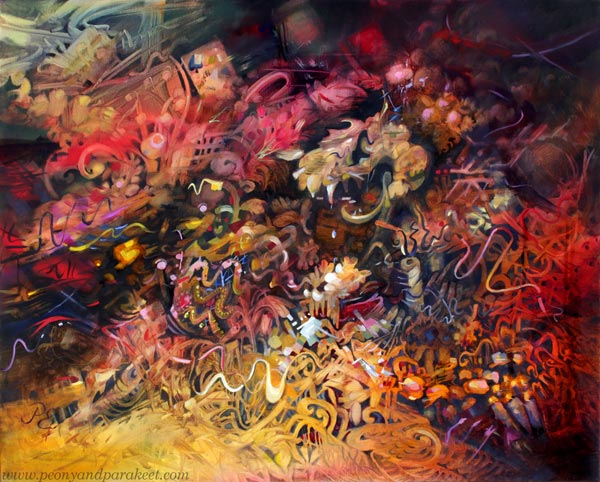
Let’s Go to The Dark Side!
One morning, before starting the painting, I read one of my recent blog posts to Wassily:
“Because expressing light is impossible without painting the darkness, I have decided to explore spirituality’s ultimate opposites as well. Like insolence, materialism, and money.”
“Let’s do it!” Wassily immediately exclaimed with his Russian accent. “Let’s paint what money looks like! Do you like money, Paivi?”
The question alone was vulgar and intrusive, and the whole subject made me shiver. “What’s the problem? Haven’t you ever painted the dark side?” Wassily asked and looked confused and a bit more gentle too.
Well, I hadn’t. Not in this scale, anyway. The idea of spending the next few weeks with blacks and bloody reds felt heavy. In my life, there have been times when I had liked money too much, for example, when I sold IT solutions to big organizations. Secretly, it felt almost as good as making art. Back then, I bought lots of art supplies, but the time for using them was much more limited. Too limited.
“Wassily,” I said, “money almost took me away from creating, so how can I create a painting about it?” But Wassily is a funny guy. He doesn’t answer questions that he wants me to answer through creating. Then he just stares at me silently like a watchdog, preventing the escape from the studio.
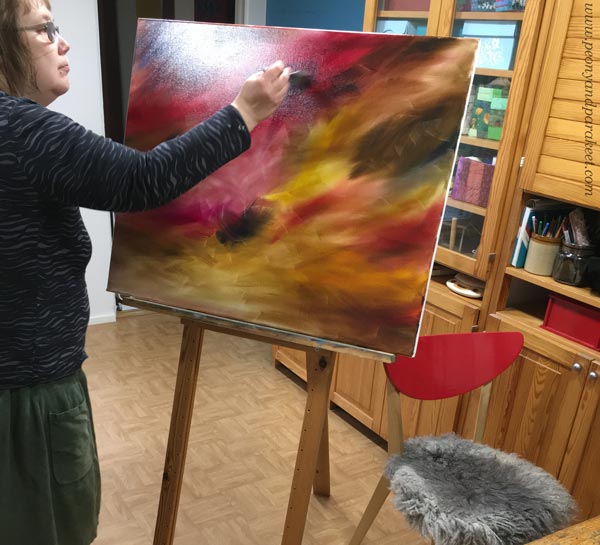
So I can do nothing but start.
From a Pet to a Beast
While filling the blank canvas, I tried to comfort myself by thinking about how money can be a good thing too, enabling grand and beautiful things.
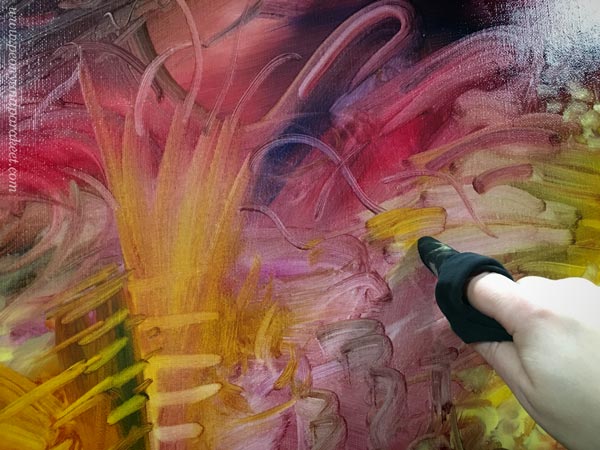
“I will paint all the luxury,” I said to Wassily and picked Indian Yellow, the color of gold.
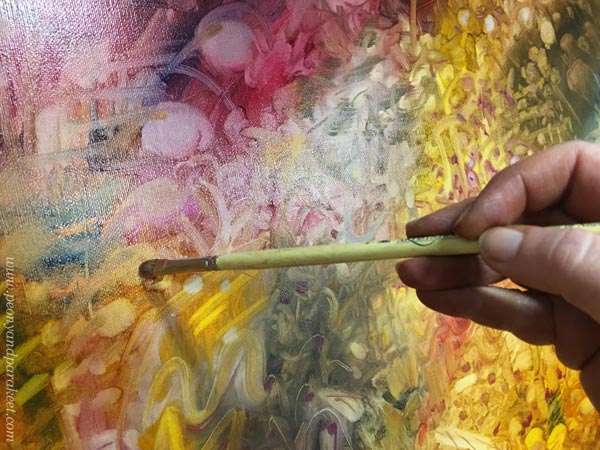
It all went fine for a long time. The painting was like a lion cub, cute and pretty at a young age, a true pet.
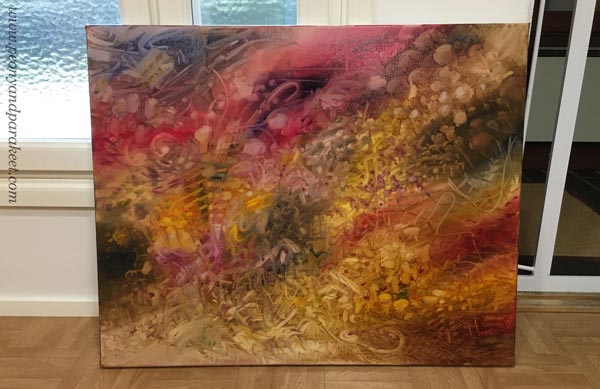
But then slowly, the colors got stronger, and shapes began to stretch in all directions.
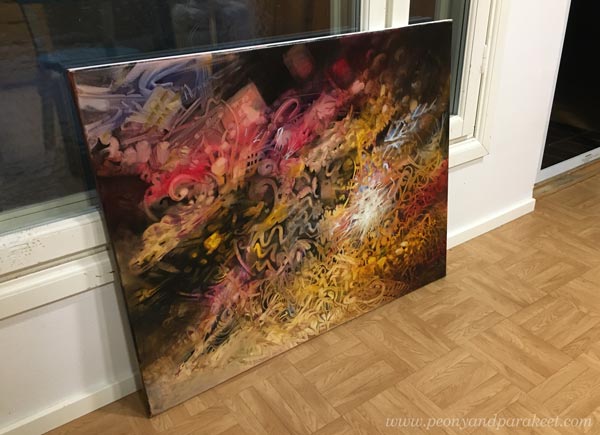
The pet had become a beast, and I couldn’t control it anymore.
Emotional Catharsis – Letting Go of Control
Just before I was about to give up the fight, Wassily stepped towards and said: “What was it like as a teenager before you chose money” He was pointing me with a brush that had Ultramarine Blue and Cadmium Red. The colors that I used so often back then.
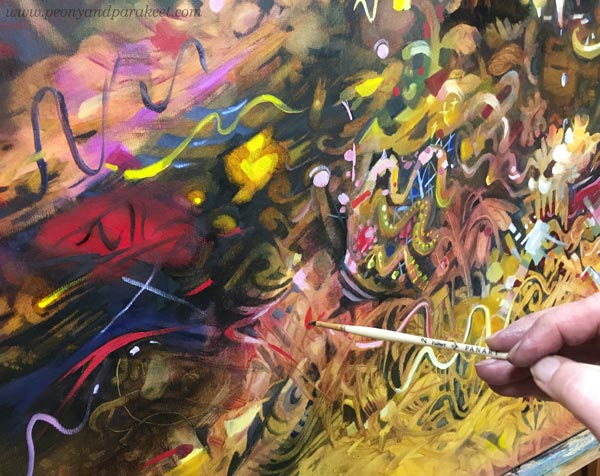
“Not now, Wassily, I can’t be weak now. I have this beast to handle”, I gulped, pointing towards the painting. But he grabbed my hand and, unlike his usual self, brutally fed it to the growing lion. The pain took over, the colors splashed uncontrollably, and for a short time, moments of my life ran through me when the lion ate me bit by bit. I was a teenager trying to find her painting style and become an artist. A young adult losing her parents and, as a result, counting pennies.
But then, just before the last ray of light burned out, I heard Wassily’s demanding voice: “You are not dead yet. Open your eyes and finish the painting.”
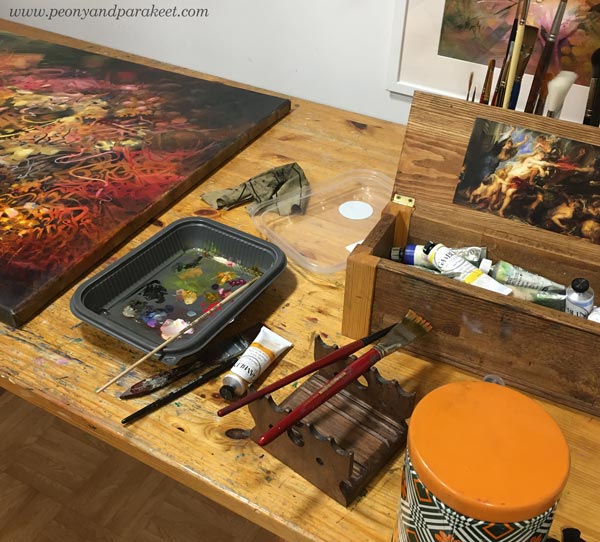
Days went by, and I visited the painting now and then like it would be a rare animal in a cage. Something had happened, but what? Wassily got frustrated: “Can’t you see it? It’s vanitas!”
Vanitas – Emotional Catharsis Explained
Vanitas paintings are still lives that express the inevitability of death in symbols. They were in fashion in the Netherlands in the early 17th century, but they have inspired artists later too.
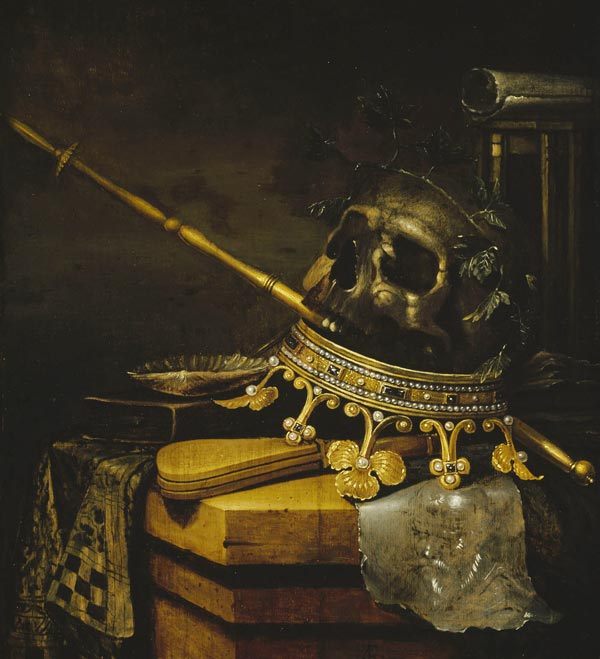
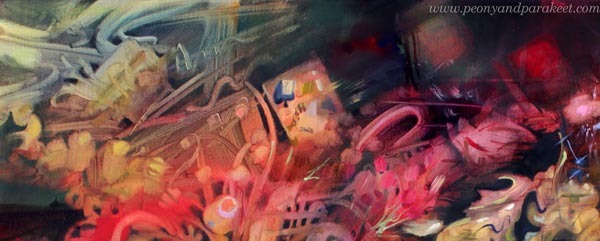
Suddenly, my lion shrank to only a skull, and there were bubbles, smoke, candles, musical instruments, playing cards, flowers, a bowl … all kinds of historical symbols for the futility of pleasure and certainty of death. Now finishing was easy. I just made the objects a little more distinct.
Here’s the closeup of the lion skull.
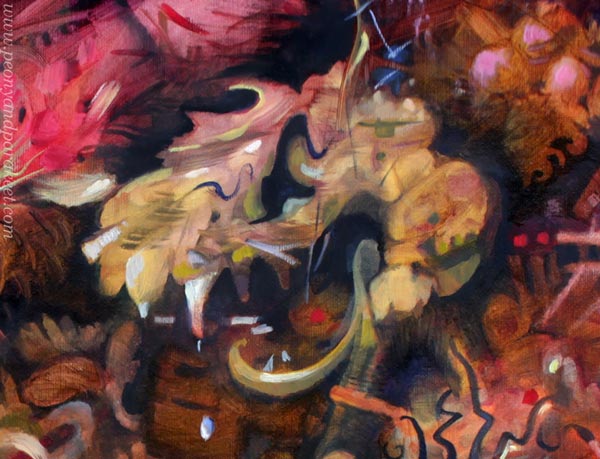
Playing cards are flying in the air.
Here’s the crown, thrown in the mud.
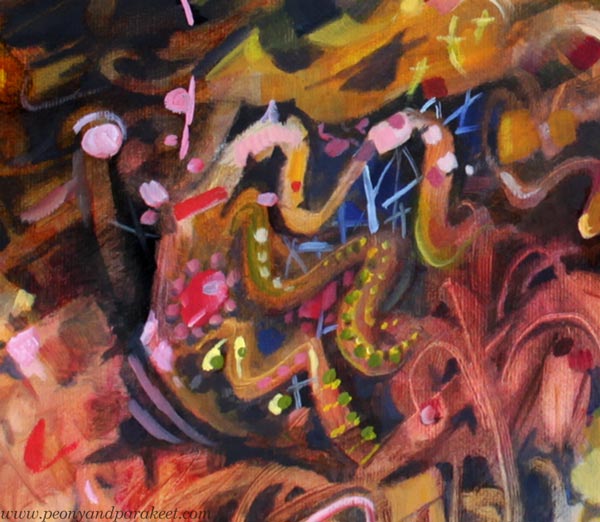
If you look carefully, you can also find lots of other symbols too. For example, a red bowl in the middle broken by icy water. And the yellow bottom expresses musical instruments and their sounds.
My favorite part is what the imaginary Wassily painted:
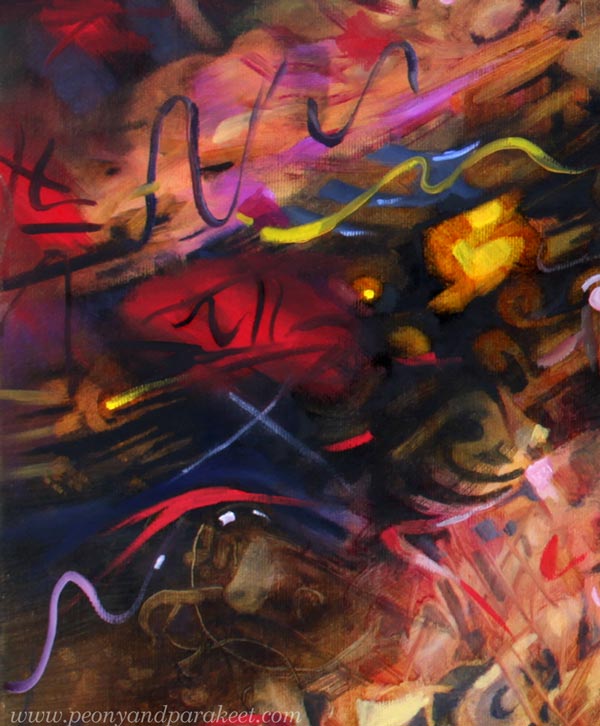
“This is how money looks like,” said Wassily in his teaching voice. “Don’t feel pity or fear about it anymore. Now you are free to paint whatever you want.”
– “I want to paint a couple of big floral still lives inspired by the 17th-century Dutch masters!” The relief and enthusiasm filled my mind.
– “Whatever,” yawned Wassily. Clearly, it would not have been his choice, but I hope he’ll keep sticking around anyway.
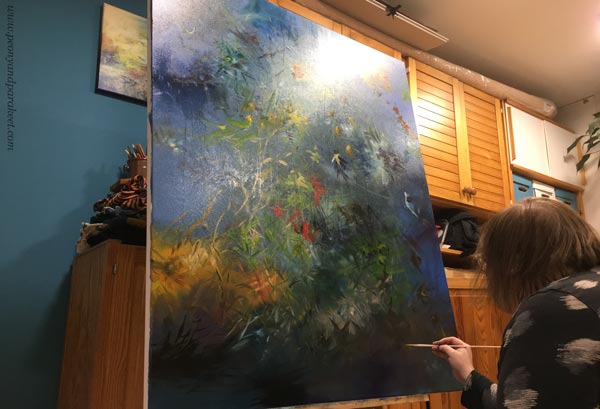
Have you ever experienced emotional catharsis through art-making? So, feeling purified after going through the climax of negative emotions? Do you always create for beauty or do you like to step to the other side too?
Art Inspiration from Lucas Cranach the Elder
This week, I gather inspiration for the next painting of a series, enabled by the grant that I got from Arts Promotion Centre Finland. This is the third blog post of this project, see the first one here and the second one here!
German Renaissance Portraits by Lucas Cranach
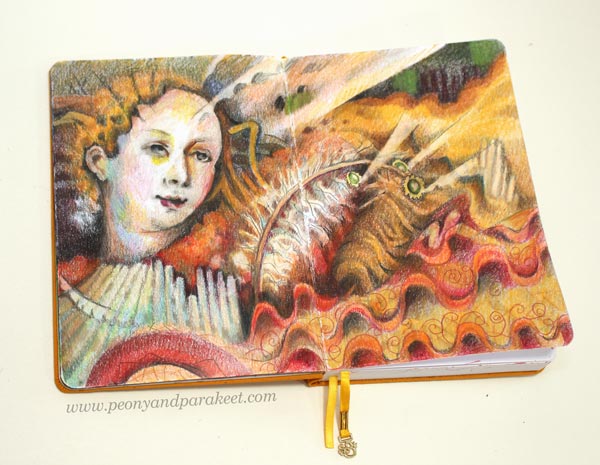
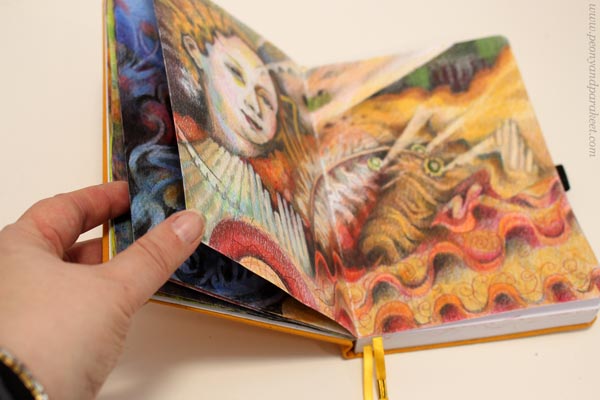
The first painting of my series (The Empire of Light) was inspired by Sandro Botticelli, Italy. Now I move further up in time and on a map and go to Germany to meet Lucas Cranach the Elder (1472-1553). Here’s a spread in my colored pencil journal inspired by Cranach’s style.
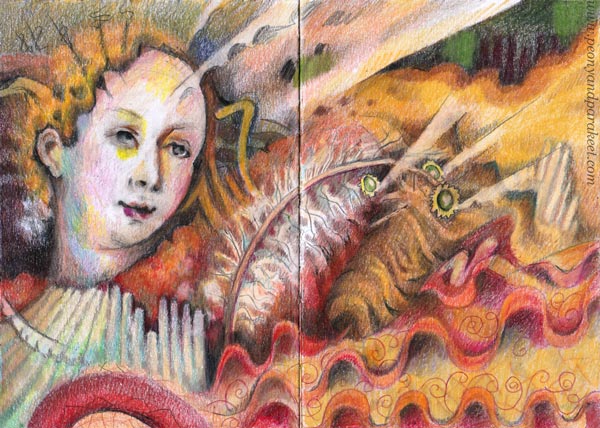
She is a weird-looking little woman but so are Lucas’s portraits too.
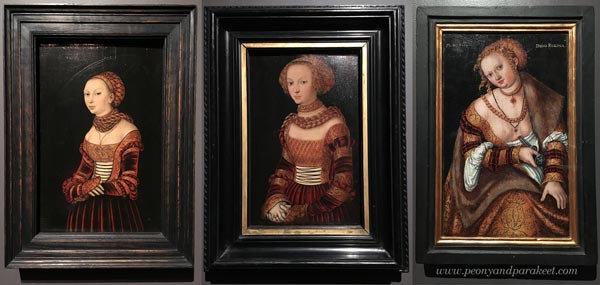
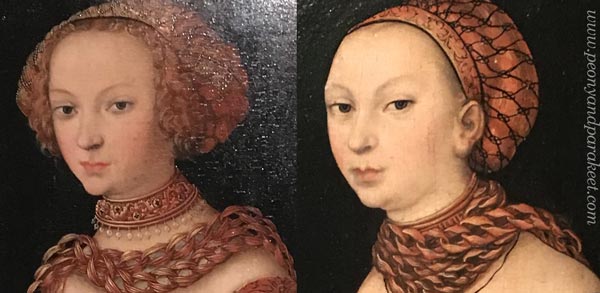
Their faces are small and not so pretty at all, at least according to today’s standards. Are these two even smiling at all? Is that boredom or irony?
Cranach’s women seem so arrogantly materialistic that it doesn’t feel suitable for a series about spirituality at all. But because expressing light is impossible without painting the darkness, I have decided to explore spirituality’s ultimate opposites as well. Like insolence, materialism, and money.
Lucas Cranach’s Super Production
Lucas Cranach the Elder wasn’t just a painter. He was a businessman who ran a workshop and a pharmacy too. His unusually large workshop wasn’t just for fine art. Printing presses produced religious images for people who had less money.
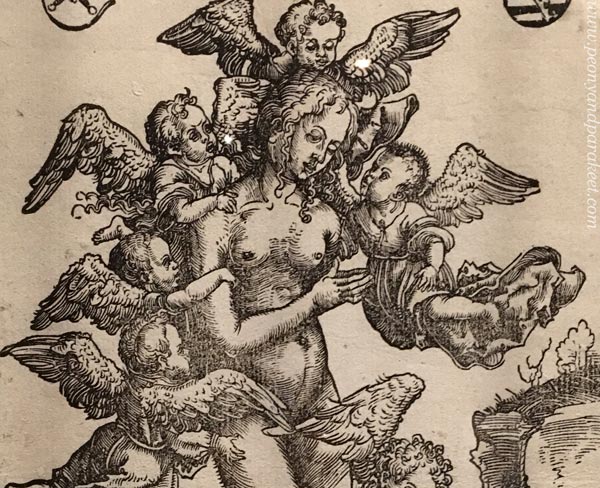
Lucas Cranach surely knew how to run a business. When he needed pigments, he decided to found a pharmacy at the same go. He got friends with prestigious people like Martin Luther. I can imagine Lucas whispering to Martin at a dinner: “What kind of images does your religious movement need? I can produce thousands of them!”
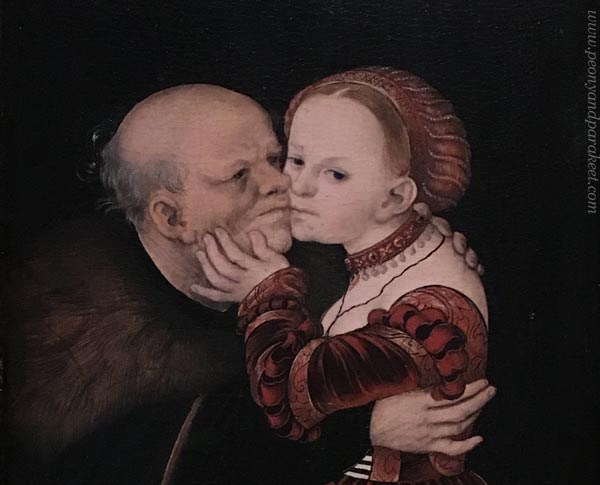
He must have had a sense of humor too. And yet, his figures and the way he painted the clothing, are a bit stiff and clumsy.
From Cranach’s Bluntness To Sharp Pencils
When Botticelli made an elegant curve, Cranach added a straight like like saying: “That’ll do. They won’t notice it anyway.” So my Cranach imitation was built around similar angular lines and weird proportions.
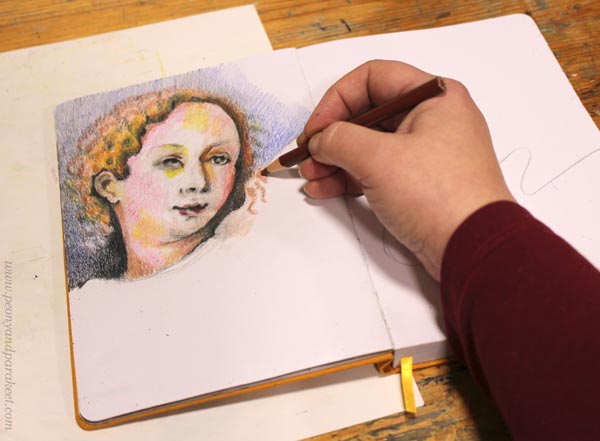
But the more I worked with the face, the more real it felt. The woman wasn’t just an angel but had vices as well. She felt so relatable and maybe because I was glancing at my new sharpener. In the middle of the spirituality project, I had become very materialistic and spent almost 150 EUR on it.
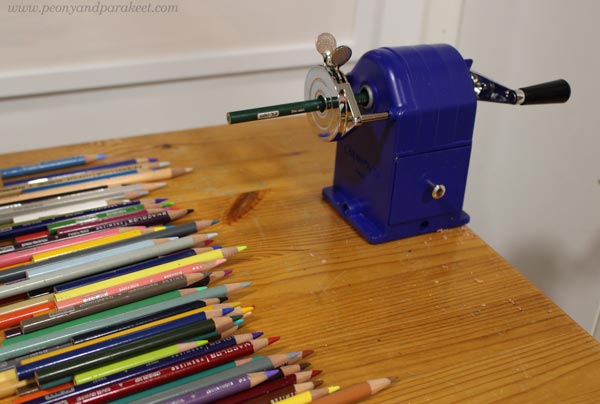
Botticelli’s goddesses wouldn’t be even willing to touch it. But Cranach’s women would grab the handle without hindrance. They would crank fast and smile quietly, and it would all look a little immodest.
My workshop has produced a lot of pencil shavings lately.
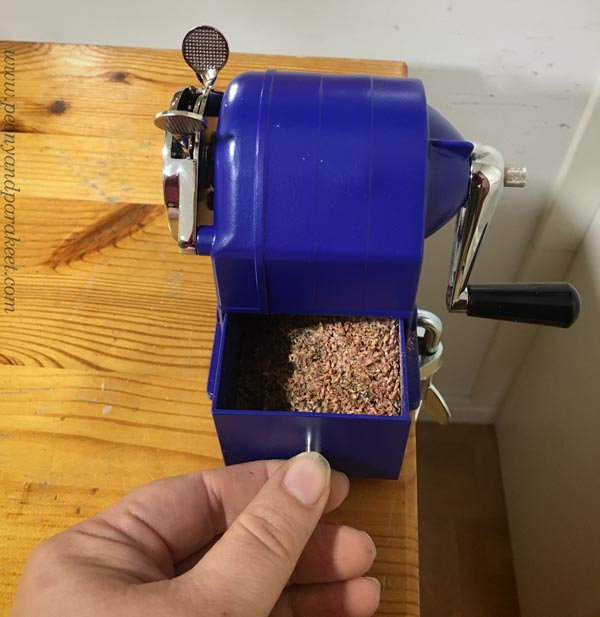
I can assure you that all my pencils are sharp!
Long Live the Spirit of Lucas Cranach!
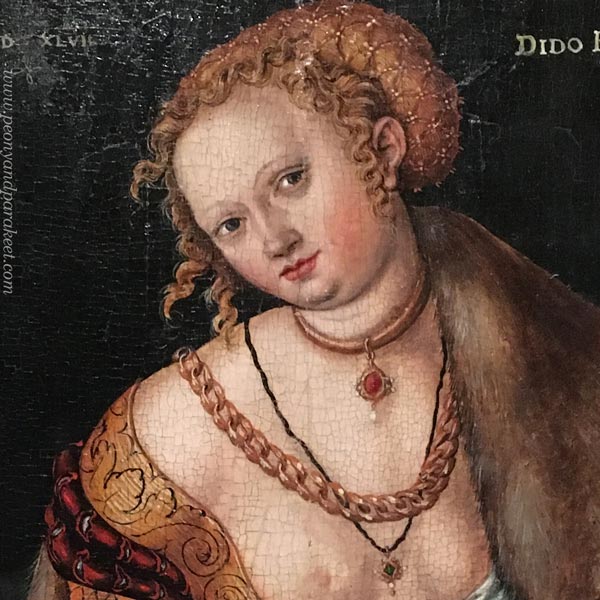
Queen Dido’s smile in Cranach’s painting is deceiving. She had made a decision to leave the materialistic world.
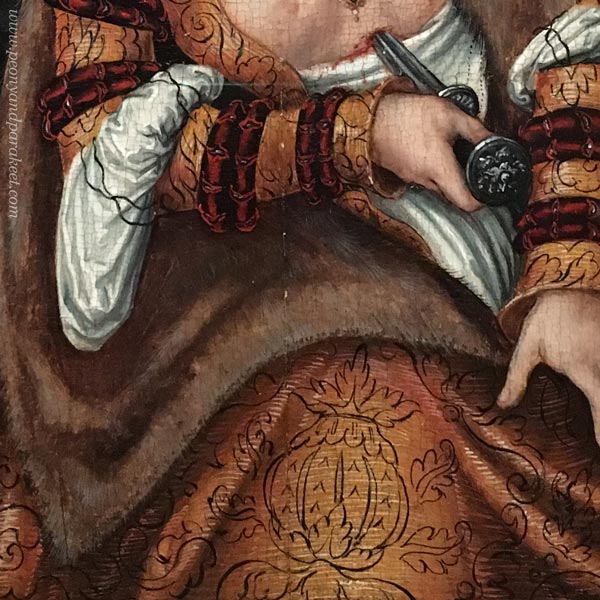
Her story goes like this: Dido founded the city of Carthago after her husband died. Then her lover, a Trojan hero Aineias was taken away and in agony, she killed herself.
Black and white always go together. Dido was not just a wealthy royal, but a sensitive woman too. Maybe Lucas Cranach and Martin Luther had deep discussions over dinner. Perhaps my sharpener will live longer than I do and serve many enthusiastic colorers after me.

The most inspiring detail in Dido’s clothing is this carelessly painted ornament on the hem. It just floats there! It doesn’t follow the folds of the fabric at all. But its living line documents Cranach’s spirit.
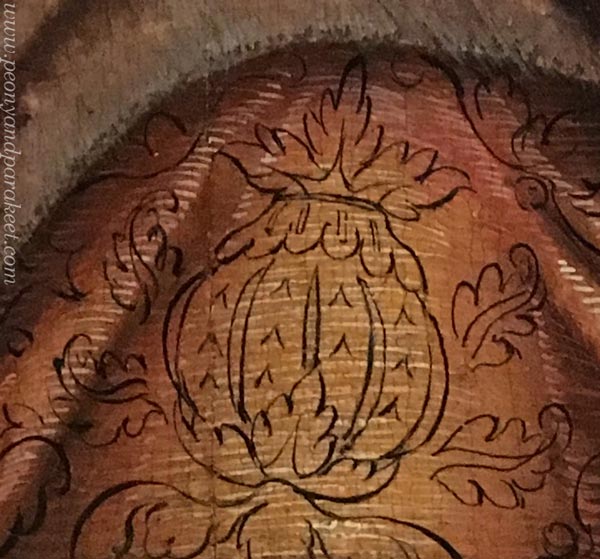
No matter what the subject is, art always carries a spirit with the way we draw lines.
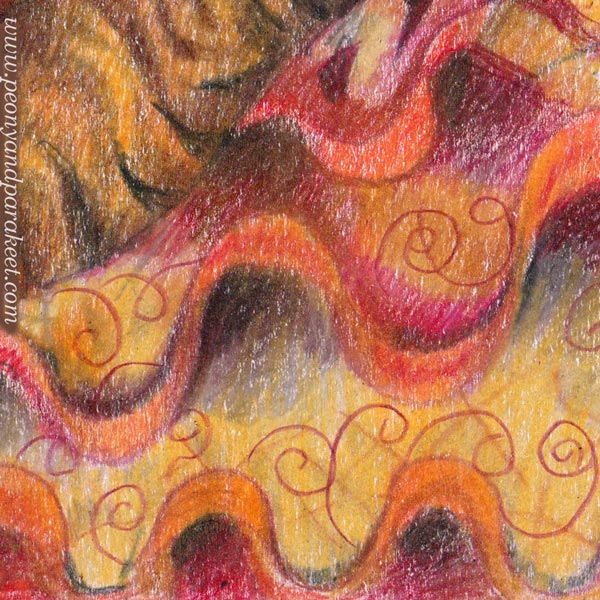
Like Cranach, I made two layers of lines, first x-shapes, then swirls.
Colored Pencil Journal
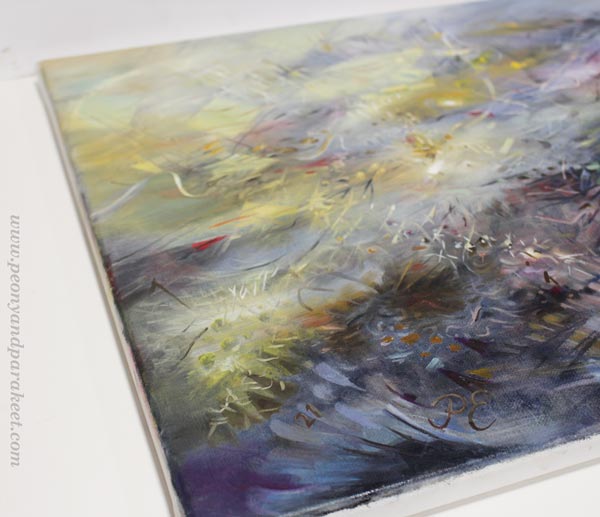
This journal spread will be my inspiration for a new abstract oil painting.
My little journal has quite many drawings already. I browse it often and it brings me joy.
Do you also have an art journal, a visual diary, or a sketchbook that you like to browse and fill? Can you find your living line there?
P.S. My photos of Lucas Cranach the Elder’s paintings are from an exhibition in 2019, see this blog post for more pics!
Getting Inspired by Removing the Obvious
This week, I have finished the first painting of the new series, enabled by the grant that I got from Arts Promotion Centre Finland. This is the second blog post of this project, see the first one here!
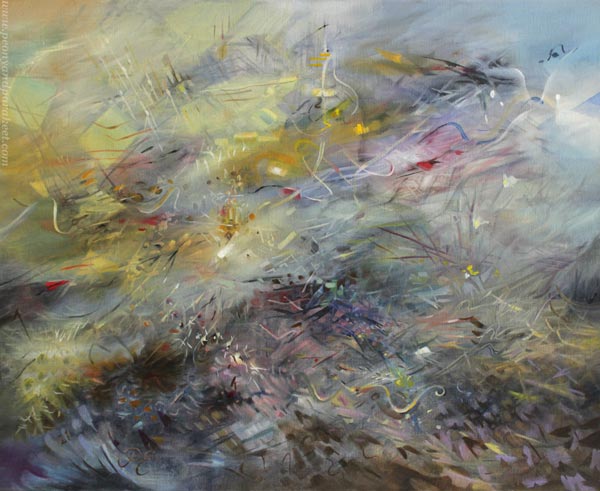
I wanted to combine two different styles for the painting.
Struggling with Differences
First, I wanted to honor Sandro Botticelli, a masterful painter from the Italian Renaissance, and include some of his colors and ornaments. I especially like the pastel colors in his paintings. Yellow ochre and ultramarine blue look beautiful in the mixtures. Botticelli’s painting The Madonna of the Pomegranate was my main inspiration for the color scheme. I also listened to Renaissance choir music and imagined how he felt when he painted and analyzed his work.
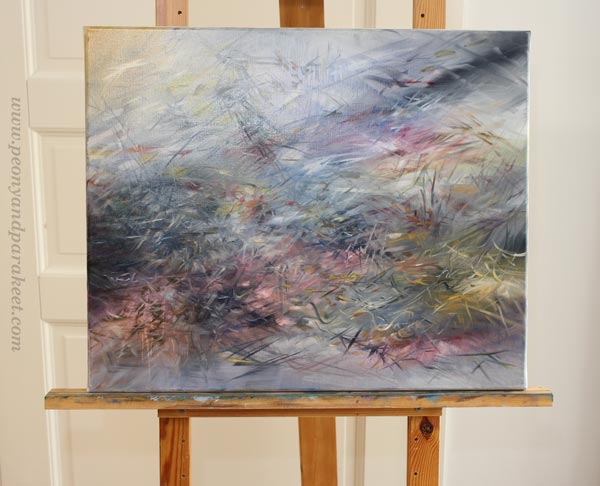
I also had another tutor, Wassili Kandinsky, from the 20th century. I reread his books On the Spiritual in Art and Point and Line to Plane and imagined him talking about releasing the inner sound of a shape.
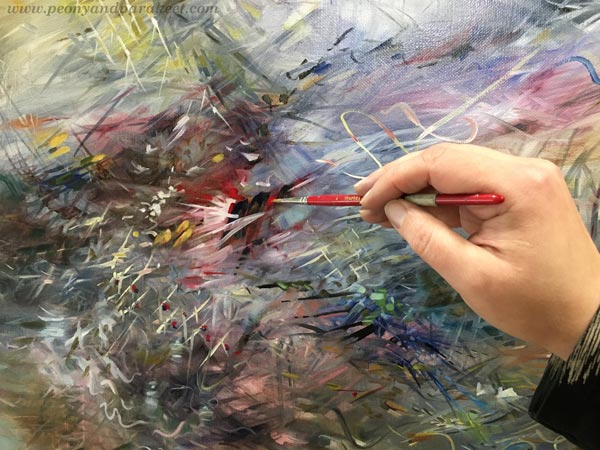
But knowledge and advice and all the left brain stuff can only help to a certain point. When focusing on facts and words, I lost not only Botticelli’s and Kandinsky’s voices but my own too. I ended up making too bold moves and the spirit of the painting was lost.
Indoors – Outdoors
Fortunately, I had to take many sittings because dogs require pauses. It feels that I am constantly moving from indoors to outdoors nowadays!

Then it hit me, that painting, life, and spirituality are not about defining two states like outdoors and indoors. I can bring indoor elements like lamps with outdoor elements like trees. Botticelli broke the division by painting decorative flowers that continued from the grass to clothes.
Removing the Obvious Limitations
And if indoors and outdoors can be one, why not break other obvious limitations too – for example, combine science and beliefs in the same painting.
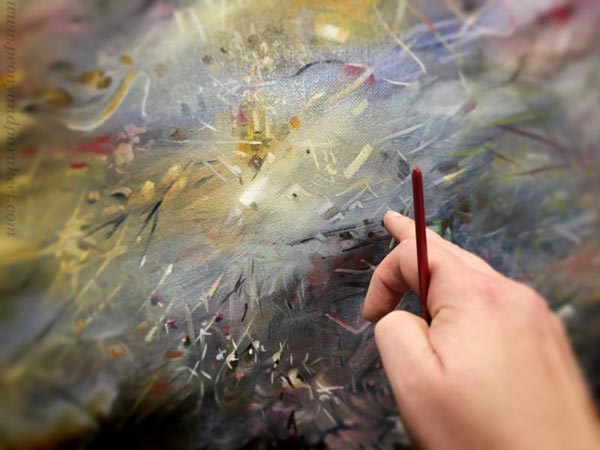
So I painted a chandelier, Botticelli’s divine rays, a light bulb to honor Thomas Edison, a tiny cross to represent spiritual beliefs. I allowed one association to freely lead to another. My mind was exploding when I thought about light and its all interpretations.
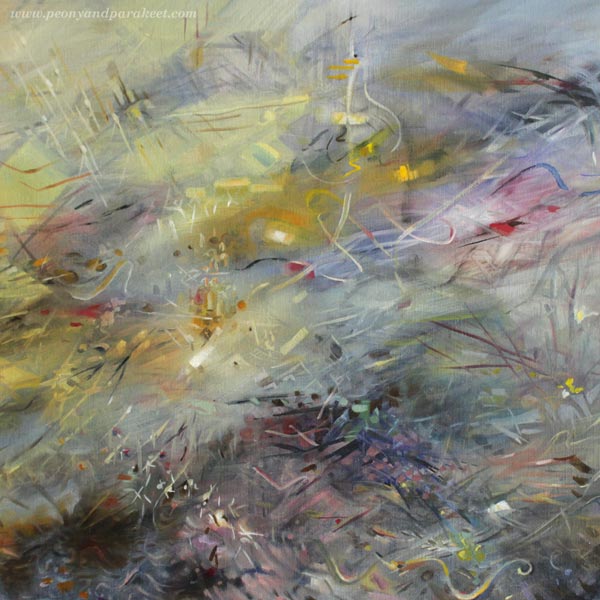
Some people collect chandeliers, others search for a proper lightbulb in a supermarket. Sometimes we believe in science, other times we have different beliefs. Some see angels instead of flowers. Sometimes we need darkness to see light, and other times we may need more light to the lightness. Light can be glitter that saves the day or a more permanent feeling of hope. Art and spirituality don’t have to be separate from the rational and mundane, but they can be the glue between the inner and outer world. We can remove the obvious, and express the diverse experience instead of a single thing.
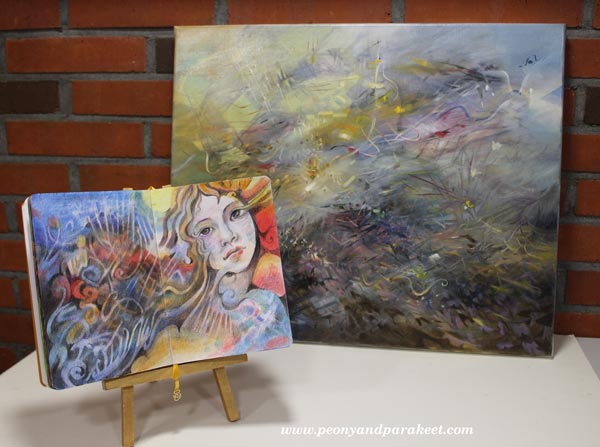
Releasing the Inner Sound
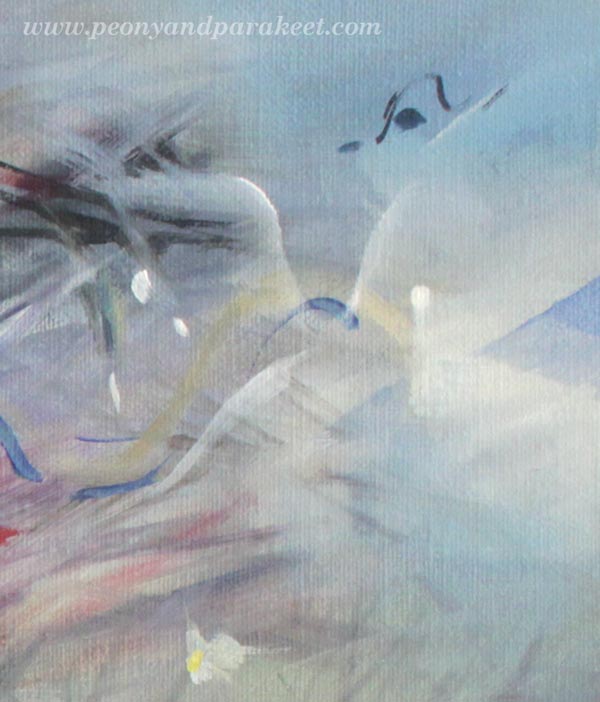
In the light of removing the obvious, Kandinsky’s idea of releasing the inner sound can simply mean this:
Make subtle changes to an element
so that the obvious interpretation becomes vaguer
and a variety of new ideas are raised.
What could “removing the obvious” mean to you? Tell me what you think!
Your Rembrandt – Thoughts from the Documentary My Rembrandt
This week, I have a short story for you. I hope it inspires you to cherish your creations.

I saw a fascinating documentary called “My Rembrandt.” It was about collectors and dealers of Rembrandt paintings. Rembrandt’s masterpieces were lovingly touched and carried from one place to another. Carefully but still confidently, they moved through castles and galleries.
While I watched men taking Rembrandt’s painting out of its elegant frame, I thought about a sight I saw as a child. In a supermarket, a woman was picking groceries from the cart to the checkout. She handled every item graciously like a simple can was a newly-found treasure that she claimed to own. This woman from a small distant town was my history teacher. Maybe her profession gave her a different perspective on things.
My teacher’s behavior taught me that the way we look and handle art matters. My creation can be my rembrandt. You can even have a postcard that has rembrandt-quality in it if you treat it with similar respect.

This is one way for me to bring up the spiritual side of life and maintain artistic inspiration.
I also made a little video to accompany this blog post.
What do you think?
Do you also have rembrandts in your collection? Have you seen the documentary?