
The Beauty of Science – Illustrating a Children’s Book
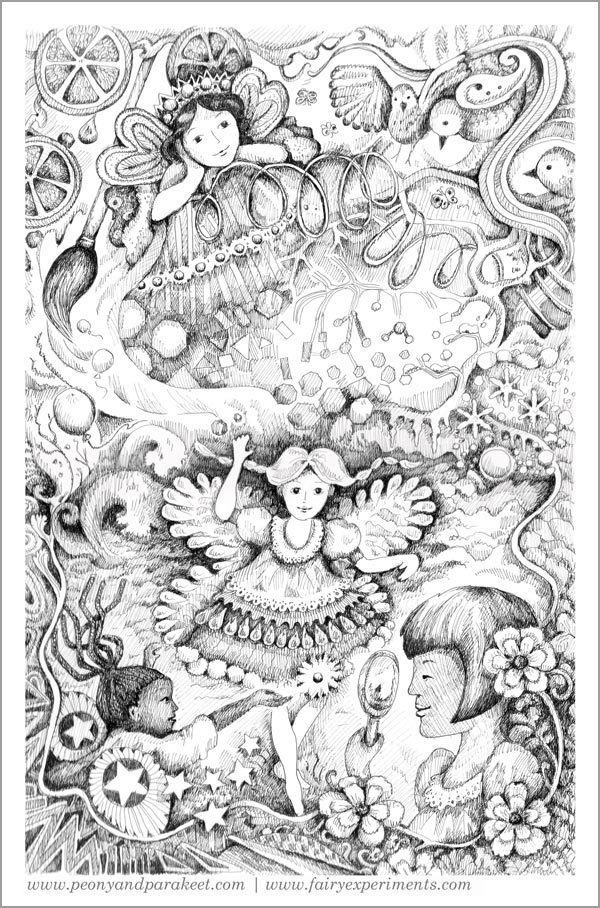
This week, I want to show an example of how we can use art to change the world. My example is about illustrating science so that it also appeals to those who love beauty and fantasy. When we talk about inclusiveness, we often talk about what words to use and how but rarely talk about the style of images. My questions for you this week are:
How could your art invite people to try new things or to think in a new way? How could your art make new people feel included right away?
Fairy Experiments for Thinkers and Tinkerers
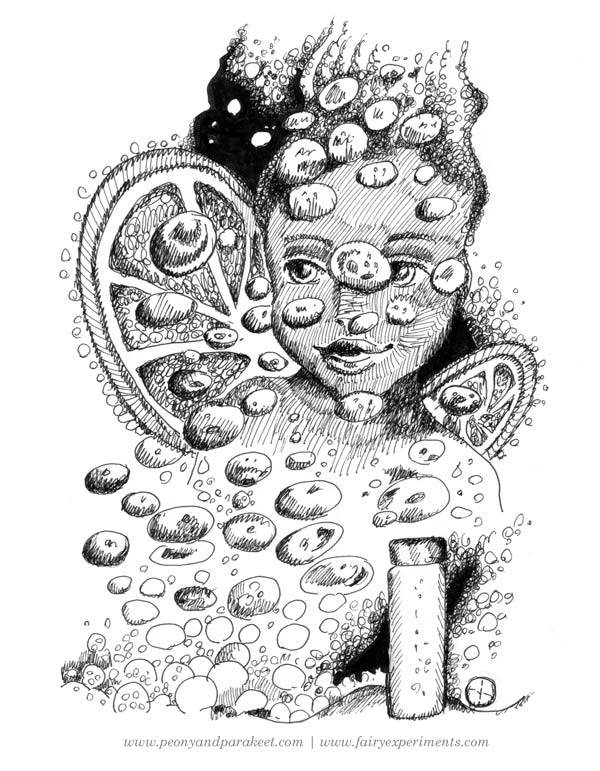
Last fall, I was hired to illustrate a children’s book. It was a big project – well over 60 images and ornaments, including the illustration for the cover, shown above. The book is called “Fairy Experiments For Thinkers and Tinkerers” and its goal is to inspire young girls to explore science through fun experiments. The book hasn’t been published yet, but my client C.L. Hunt has an email list where you can sign up to get notified when the book goes on sale: www.fairyexperiments.com
Black-and-White Drawings in Victorian Style
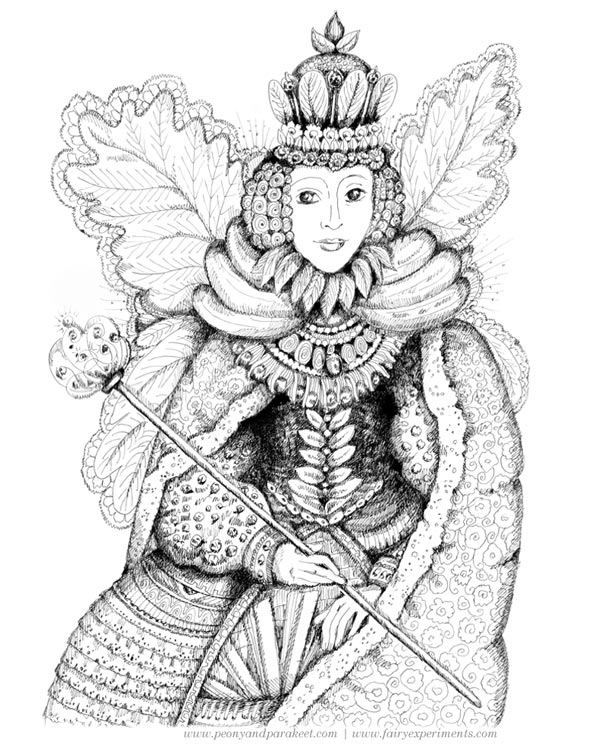
The book combines fantasy and science in a fascinating way. My client wanted to have black-and-white hand-drawings with a Victorian feel.
Illustrating the Feminine Beauty of Science
This project soon became close to my heart. As a child, I fell in love with science at school and then later, studied software engineering at The Helsinki University of Technology. Natural science, especially physics and mathematics have always interested me. As a young girl, I bought copper sulfate from a pharmacy because I thought it was so beautiful. I warmed it to make bigger crystals from the powder and loved the glow.
I have had a few women, teachers and mentors, who have supported me during my career in technology. But I have also always known, even as a young girl, that I was in a masculine world. The assignments and the culture often felt strange and yes – let’s say it aloud: not beautiful at all.
Science is not just bolts and levers, it’s also a world of glitter, shimmer, and sunsets. Nature’s transformations, the structure of the universe, and the fascinating microcosmos are full of aesthetics. And still, most science books don’t show that beauty, at least not in a feminine way.
In this book, my goal was to combine intelligence and beauty so that the feel of the images is inviting and light-hearted too.
I was excited when my client wanted to combine fairy fantasies and practical science experiments. We were on the same page from the very beginning. In the end, she summarized the project:
“Paivi understood and appreciated my project, and her enthusiasm has kept me motivated to keep working on it. The images are very well suited to my book, and their style is exactly what I was looking for. Paivi kept to her schedule, communicated well when I had questions, and I was really happy creating a shared vision with Paivi. I recommend her warmly.”
– C.L. Hunt, the author of Fairy Experiments For Thinkers & Tinkerers”
Illustrating Girl Power – Stepping away from a Passive Role
Even if we wanted to show the beauty of science, the fairies needed to be more than pretty faces and poses. In the illustrations, fairies take an active role and make the most of nature’s forces. I drew plain and classic dresses for the fairies so that action gets the attention.
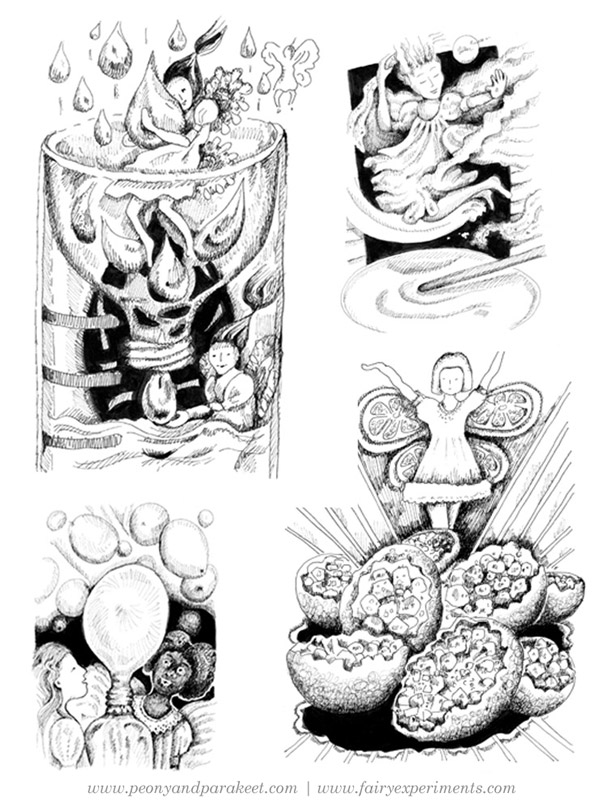
My client also wanted to have a variety of ethnic groups so that every girl can feel that the book is for her.
Illustrating Science with a Flair of Fantasy
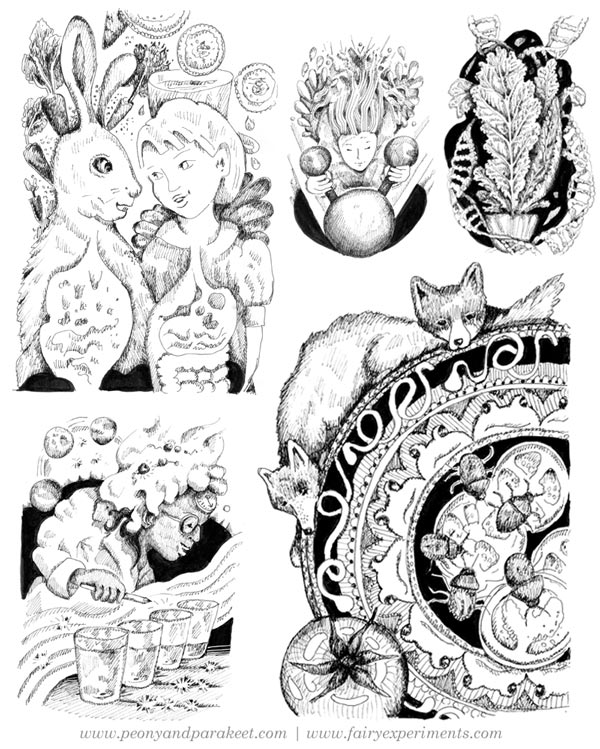
In the manuscript, there were wonderful descriptions that built bridges between reality and fantasy. My job was not only to demonstrate the essentials of the experiment but also tie them with imagination.
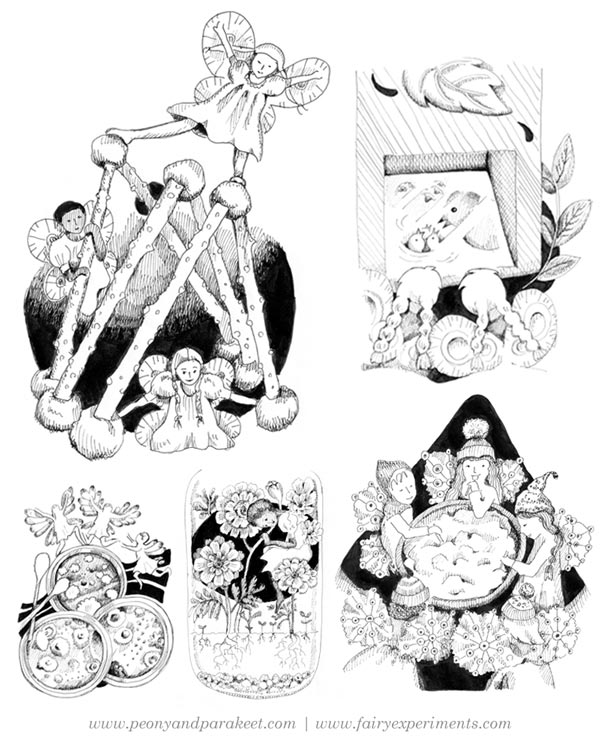
In these illustrations, fairies rule and take care of the world but also have fun. The book is all about exploring life’s miracles like the circle of life with step-by-step instructions.
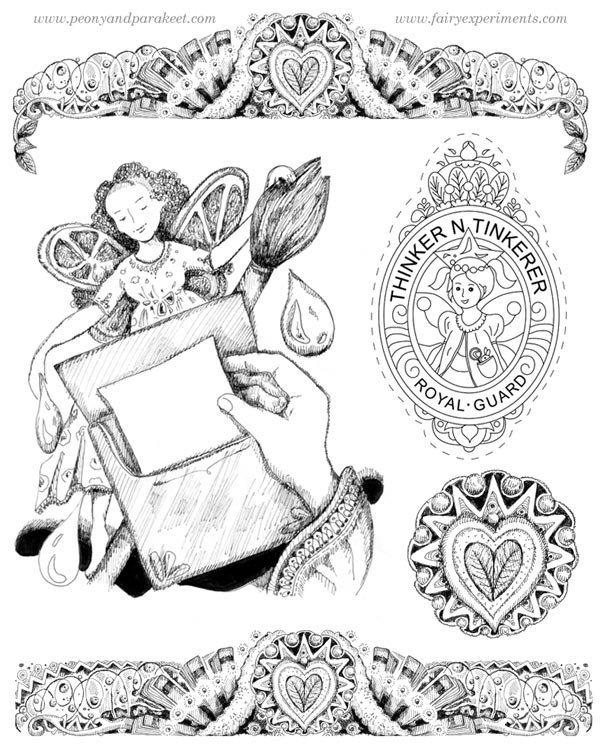
With the book, the child becomes part of the royal guard of fairies, so my job was also to design a badge that could be colored. Here’s the badge with the rest of the visual world.
Expressing Natural Science as Ornaments
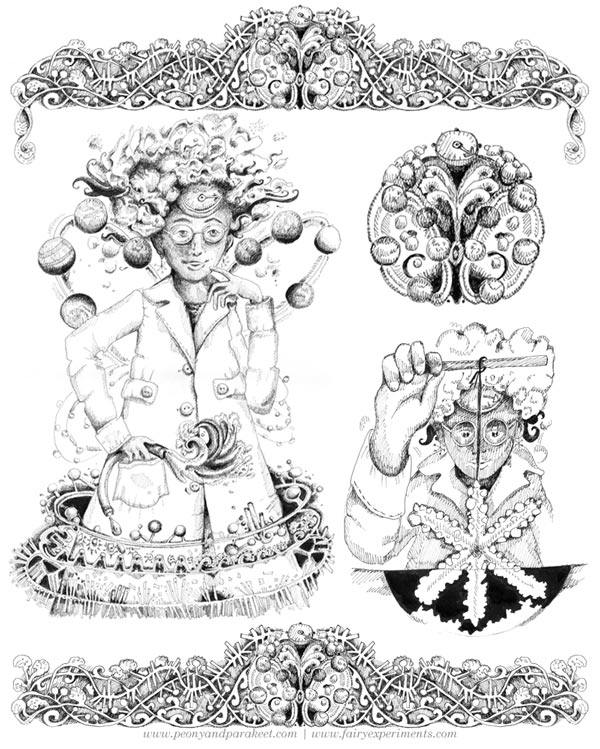
My favorite part of the projects was to design ornaments for fairy families. I hand-drew them all and used a computer only to make them symmetric.
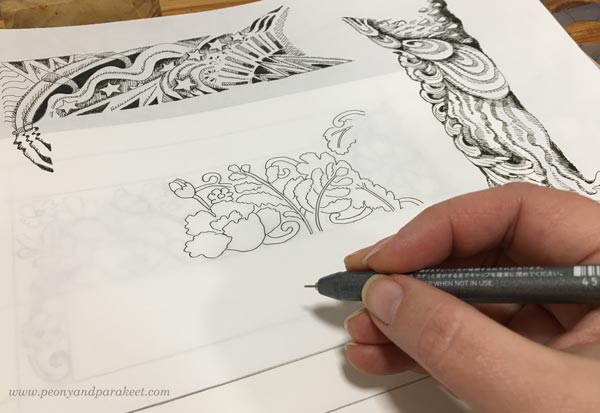
These ornaments take ideas from the illustrations and express the major chapters in a decorative way. They mark the chapters and make the book look more Victorian.
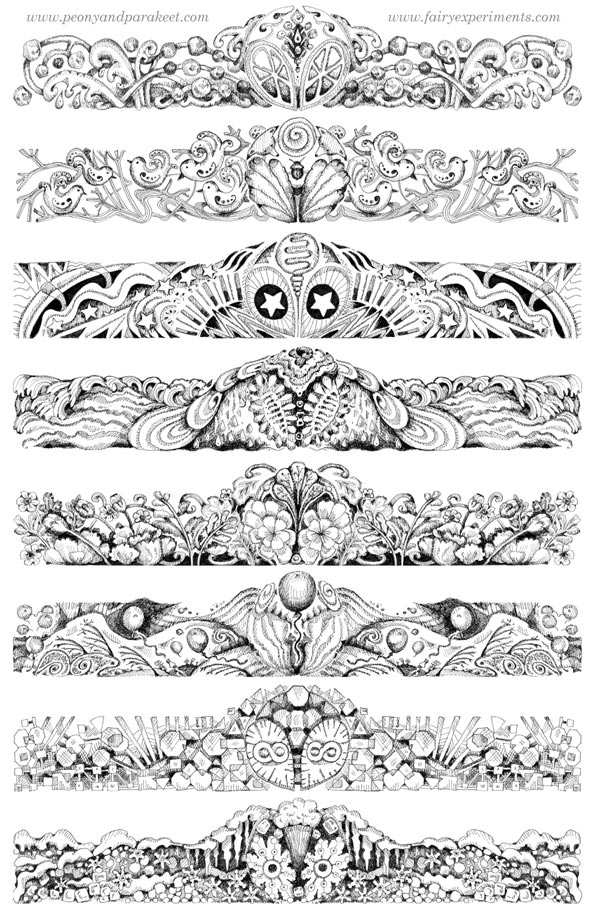
I hope you enjoyed this sneak peek to the upcoming book Fairy Experiments for Thinkers and Tinkerers by C.L. Hunt!
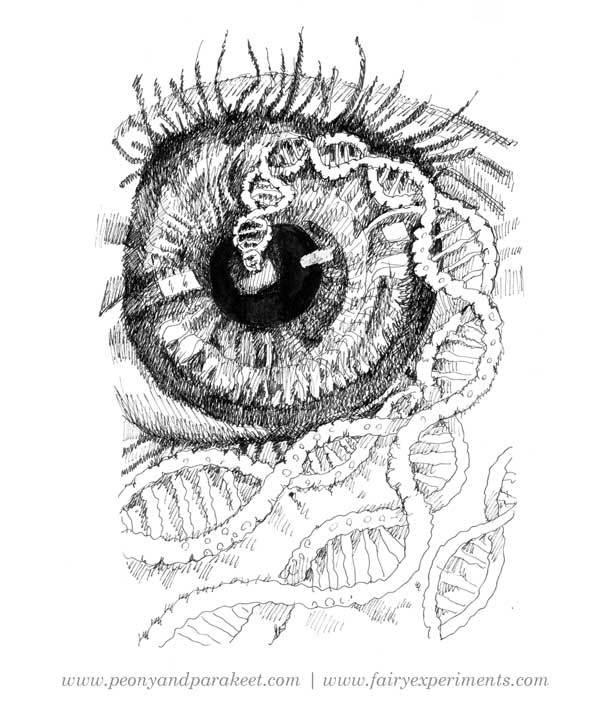
Learn to Draw with Me! I teach line-drawing techniques (+ using your imagination) in my classes Animal Inkdom and Magical Inkdom!
Hire Me as an Illustrator! See my portfolio in Hire an Illustrator!
Happy New Year from Paivi’s Art Studio – Greetings in a Video!
On this last day of the decade, I share some moments from my art studio in Finland. Watch the 1-minute video!
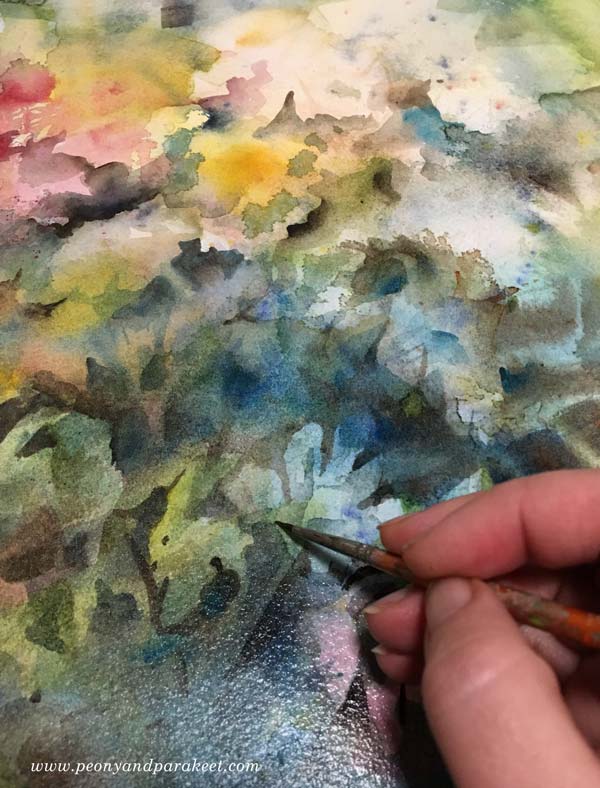
Many times when people look at art, they say admiringly: “How did the artist do that?” They assume that the artist intentionally painted every spot. But often, art is more about seeing what accidental spots to preserve rather than how to intentionally paint them. It’s the nature of art to explore the wild and uncontrollable side of life, and it’s the job of an artist to make it serve the expression.
During the past years, I have tried many art techniques, many approaches, but this the journey that’s for me – to produce and teach art that goes out of control at times, and that has unrealistic and abstract elements as well.
Start the New Year by Painting the Magic
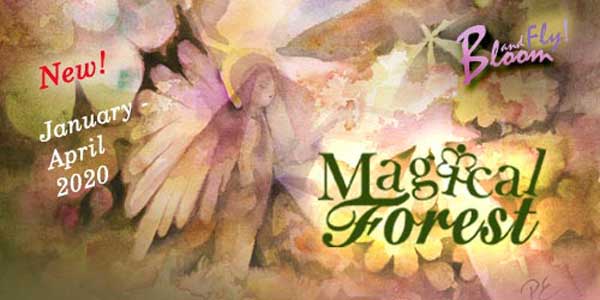
Magical Forest begins on January 1st, 2020! >> Sign up Now!
Your Art in 2020 – How to Set Creative Goals?
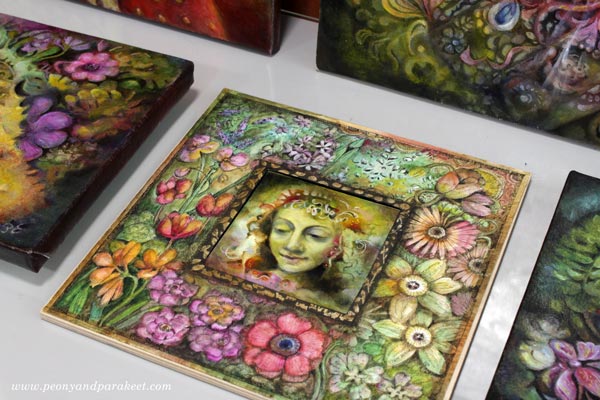
Here’s the problem with creative goals:
When forcing yourself to focus on a few things only, you will get bored and feel restricted. Rather than gaining more meaning for your art, you drift further away from what you are. You are then also less likely to fascinate and serve other people as well.
But let’s think this way:
The core of your creativity needs space for expanding. Don’t set a single technique, skill, project, or source of inspiration as your primary goal. Instead, ask:
“What kind of fantasy world do I want to build?”
Look Further Rather than Narrow the Goal
Don’t just say: “I want to paint flowers,” but imagine a place where your flowers grow. For example, is it a palace with huge vases, or a meadow full of light? Continue to travel further: what’s around them, where do they lead, what kind of patterns, colors, and atmosphere are there? When searching for inspiration, select things that fit with your imaginary world.
When you think about the world instead of a style, you allow things to get mixed and merged. You will see the many things you do as one big world-building factory. Your art-making is then more focused on how to integrate than how to minimize, and you become many steps closer to your true self.
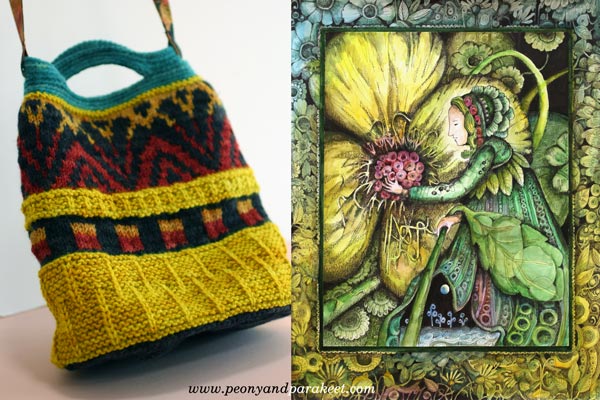
Creative Goals – Frequently Asked Questions
“I want to become an abstract painter, how does this world-building fit with that?”
Abstract art also sets an atmosphere and takes ideas from representational things. If you try to avoid that, you won’t have any ideas for abstract art. The inspiration for the world-building also includes all the senses. You can curate what sounds and music belong to your world, for example. It’s also a mental thing: think what kind of philosophy and experiences you want to express, and see them as events in your world. You can go as far as you want, but start simple and expand as you create and integrate.
“I just want to create like my idol X.X. does.”
What kind of world is she or he building? What is missing if you think about your origin and your childhood? Two people never have similar worlds. But that’s also where the exciting part begins: our worlds can cross and enrich each other.
Come to Draw and Paint with Us!
Come to expand your visual world lesson by lesson! Forest is a place where nature meets both abstract and representational, intuitive and intentional.
>> Sign up for Magical Forest!
The class begins on January 1st, 2020! >> Sign up Now!
From Portraits to Stories – How to Dive Deeper in Visual Expression
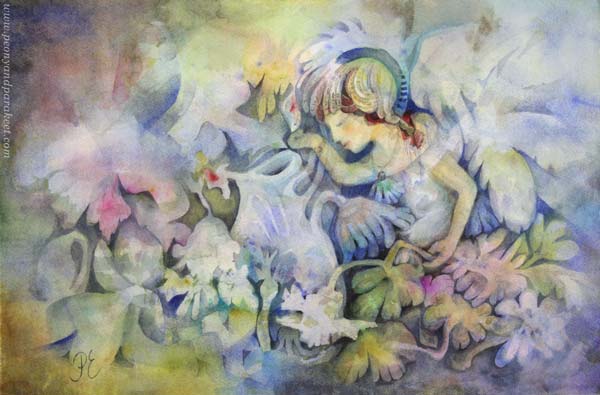
Here’s my latest watercolor painting called “Mirimer”. The name is a combination of “Miracles” and “Meri” (sea in Finnish). I love to invent these names that mix the two languages!
When I started this piece, I had two things in mind: I wanted to use Cobalt Blue Spectral (see the previous blog post about this gorgeous color), and I also wanted to continue my series of watercolor fairies.
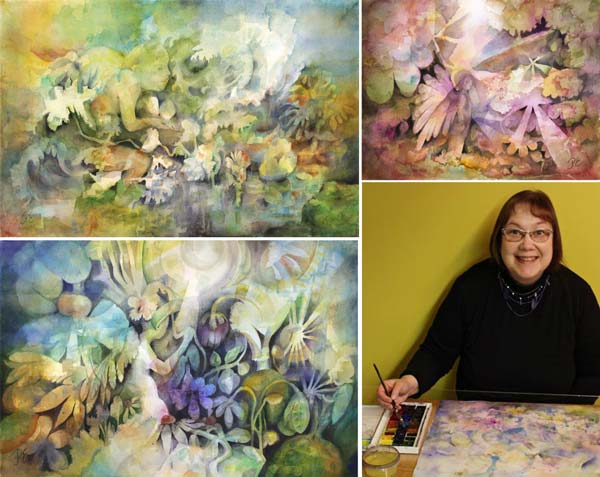
These fairies really speak to me. I feel that I should have started making these story scenes a long time ago and not wasted my time for stiff self-portraits, for example.
Life in Self-Portraits
As a teenager, I stared myself at the mirror and made self-portraits all the time. Any cardboard or piece of paper had my face!
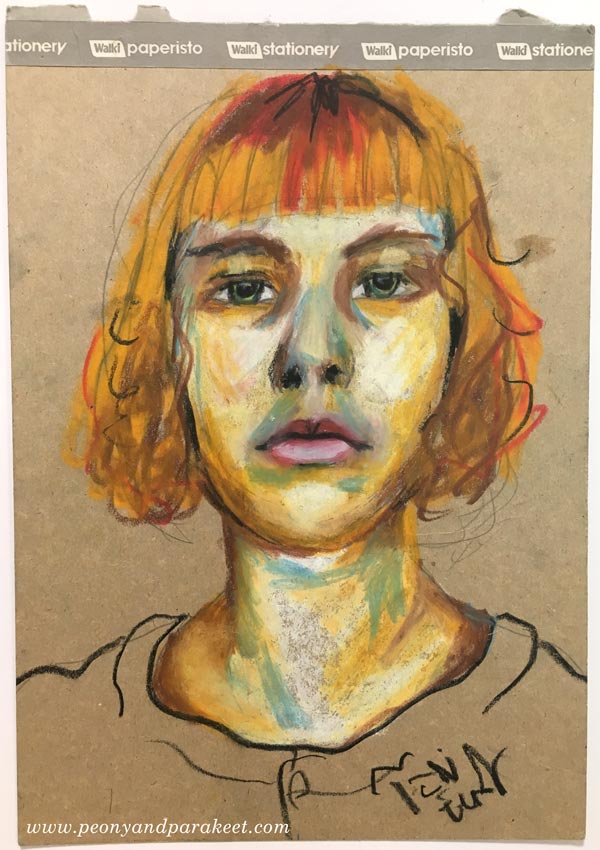
Every time I wondered if this would be a portrait of an artist: “Would my dream come true? Is this piece good or not?”
It has taken tens of years to move from literal self-reflection to expressing my emotions and my inner world. If I could turn back the time, I would peg myself to move from technique back to childish imagination, because there’s always enough time to learn the techniques, and never enough time to deepen the expression.
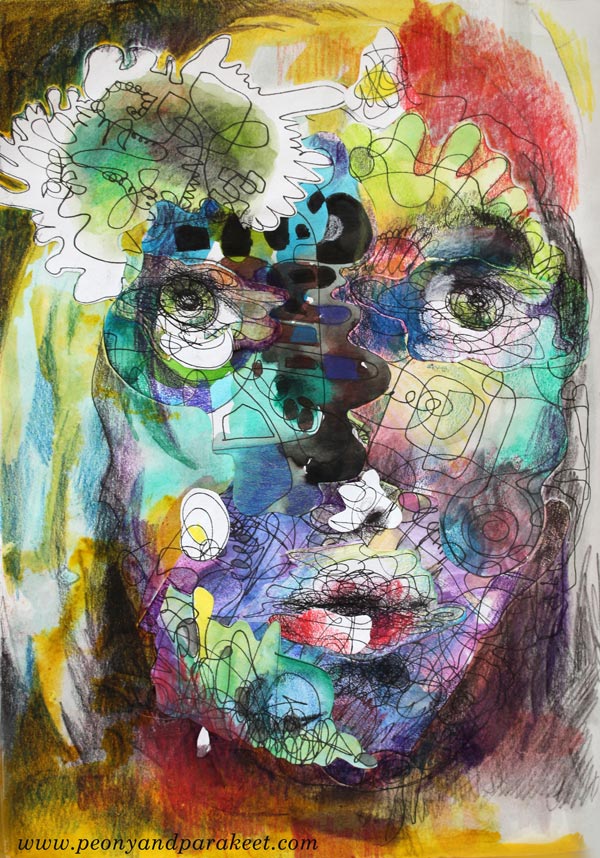
This is a self-portrait from a couple of years ago, and I like that the inner world finally begins to show.
However, for me, the greatest satisfaction of art is not in self-portraits or portraits in general. I want my art to move from portraits to stories, be more dynamic than just staring faces, tell about my experiences, and how I can see them in a new light. I believe that our inner world is full of stories that connect us to other people on a deep level. When I have thought about my artistic style or whether my art is “good” or “bad,” I have often neglected this story-telling aspect.
Mirimer – From a Portrait to a Story
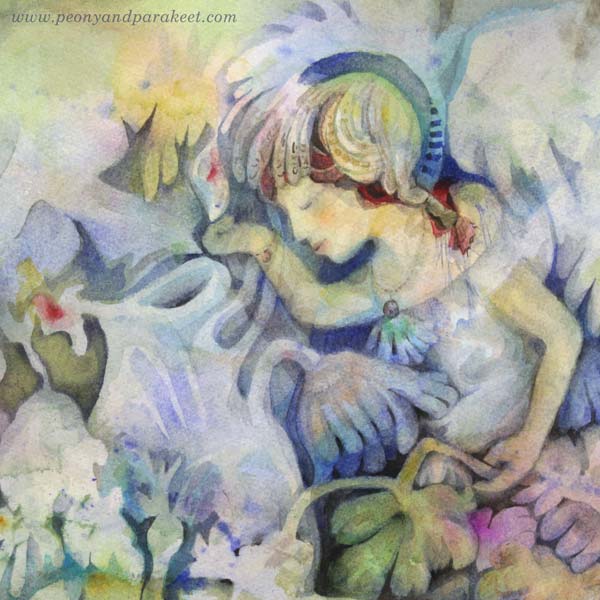
When painting “Mirimer”, there was a magical moment when I heard my mother calling my name. She passed away tens of years ago, and I thought I had forgotten the exact tone in her voice, but the painting brought back the memory. It must have been because of the blue color, her favorite. I realized that I wasn’t painting a portrait of a fairy anymore. I was painting the story of accepting loss as a part of life.
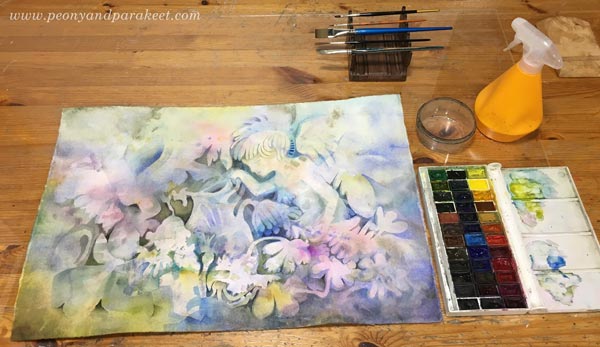
Mirimer became a blue-hooded angel, and the drops of water got some red to indicate that life carries pain that we can’t get to choose.
Illustrating Stories by Lucas Cranach
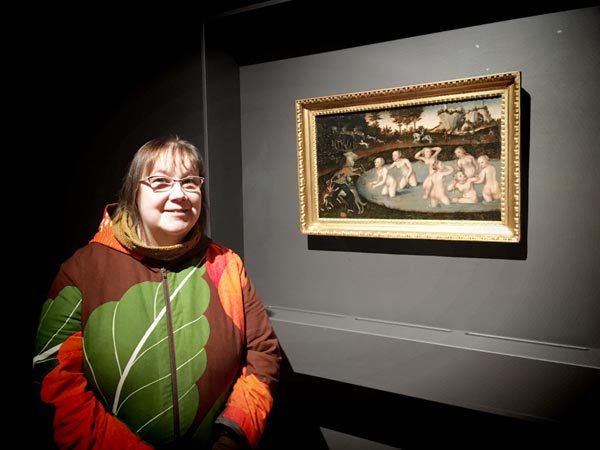
Stories also came to my mind when I went to see Lucas Cranach’s exhibition in the Sinebrychoff Art Museum. Lucas Cranach (The Elder) and her son, Lucan Cranach (The Younger), were not only German master painters in the 16th century, but they also knew how to run an art business. They had a workshop, an illustration studio, which had many employees, a logo, a style that everyone had to follow, and they produced prints too. So even if they lived in the Renaissance, they did what most artists today dream about. They built a visual world around stories that people yearned for.
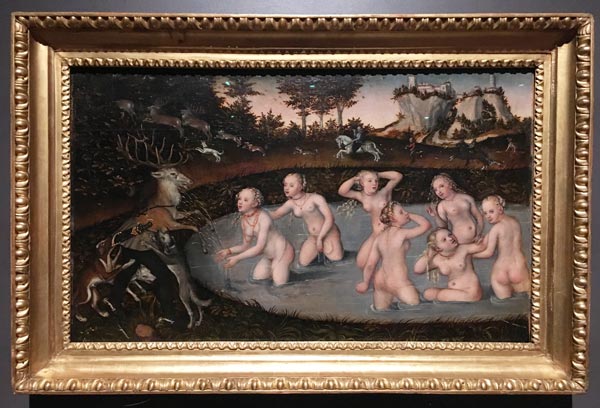
Many of the Caranachs’ stories were from Greek mythology. This painting, my favorite from the exhibition, tells a story about Actaeon turning into a stag when Diana and the nymphs splash water on him. They don’t like him to watch them, and his dogs begin to attack him too!
In the painting below, there’s Venus and her child, a little cupid. The cupid has been stealing honey and the bees have bitten him.
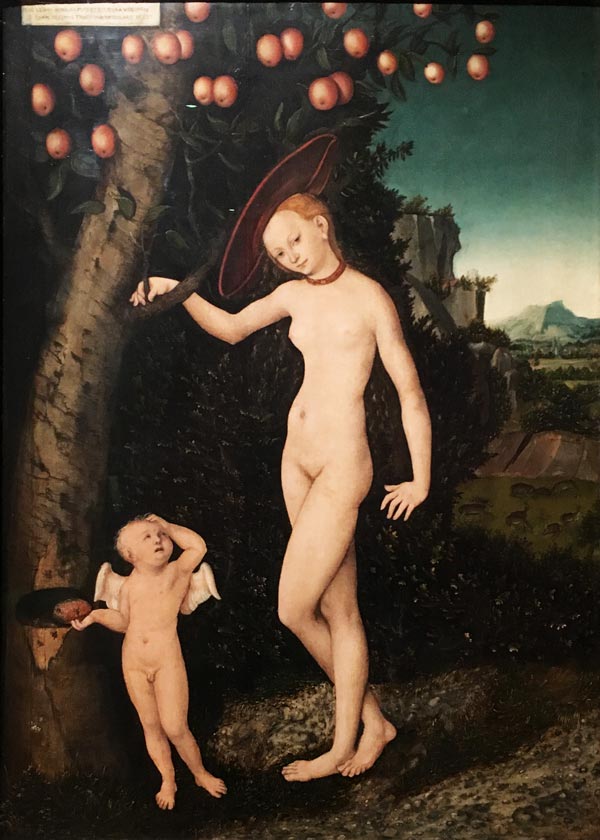
There’s also an old poem, written in Latin on the top corner of the painting too:
As Cupid was stealing honey from the hive
A bee stung the thief on the finger
And so do we seek transitory and dangerous pleasures
That are mixed with sadness and bring us pain
From Portraits to Stories – 5 Tips
- Allow more intuition and imagination into your process: Add splashes and other unexpected elements. Spend time with a color that speaks to you. Instead of actively painting something, spend time discovering and highlighting what already can be seen.
- Grow your skills from faces to body gestures. Learn to process a shape that’s on paper, in your head too so that you can find alternative ways to continue the painting.
- Play with the scale of the elements. We tend to make shapes that are all equal in sizes. But if you want to paint a tiny fairy, for example, you need huge flowers to indicate the small size.
- Let go of strict outlining, and leave room for spots of light and shadows. There’s no story without the atmosphere, and the atmosphere is created by setting the lighting.
- Take time to let the story unfold. Often, the stories have many layers, and the first associations are just the path to deeper ones.
Magical Forest – Discover Stories by Painting!
Paint watercolor fairies and nature’s spirits in their magical surroundings. Enjoy freeing up your expression while exploring flowery woods, shallow ponds, leaf chapels, and adventurous sceneries. Magical Forest begins on January 1st >> Sign up Now!