
Hand-Drawn Collage Samplers
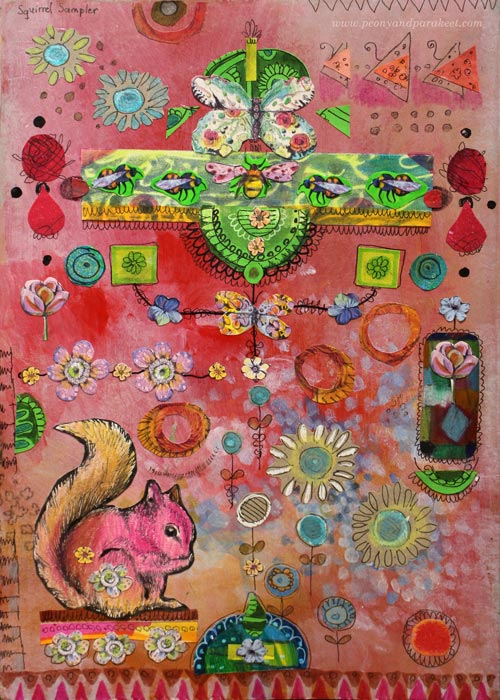
I have been browsing my art archives lately, and it has been surprisingly inspiring. I have lots of art journals and a big box of paintings and drawings from my teenage years. Even if I have experimented with many techniques and themes, it all looks very similar now. Everything fits together and gets my approval. Painting “Icebreaker” gave me a new kind of confidence, and with that confidence, I am now blogging about a playful idea that I got from cross-stitching – hand-drawn collage samplers!
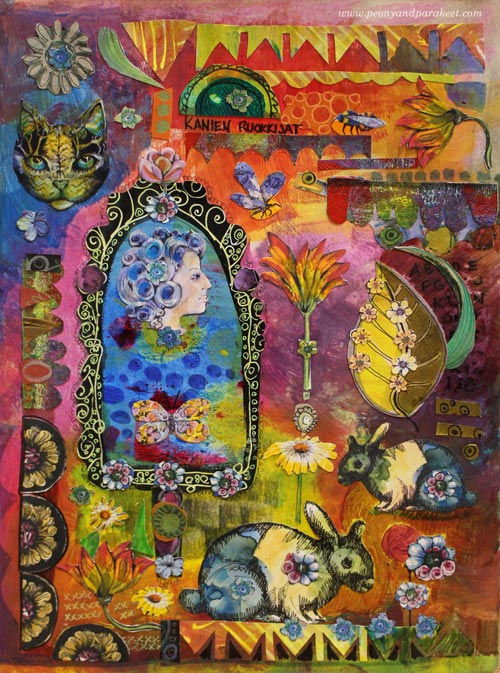
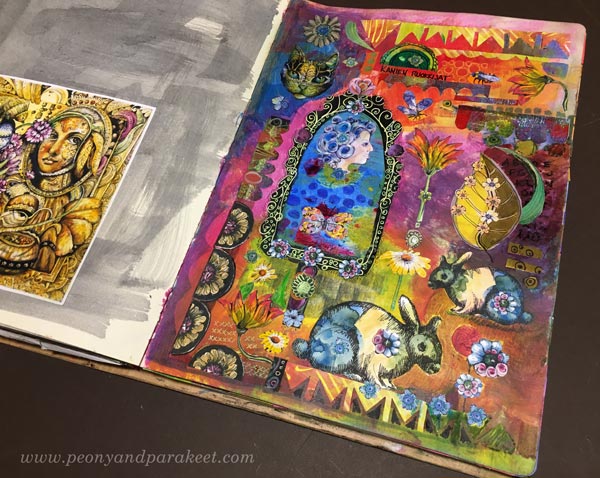
These samplers are composed of hand-drawn paper pieces so that they look like cross-stitch samplers. They have ribbons, many identical ornaments, tiny floating elements, and some symmetry. There’s also stiffness and order so that it looks like the elements are on a grid.
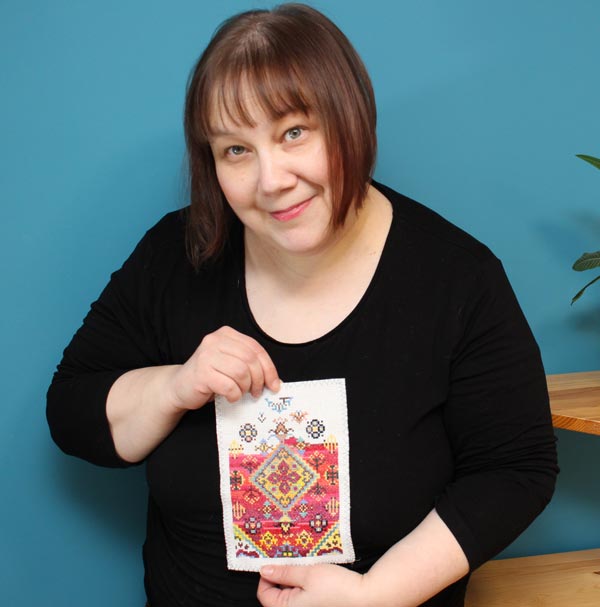
Cross-stitching is one of my hobbies, and even if I try not to think about art when stitching, I just couldn’t resist this idea! Here’s how I applied cross-stitching to collage art.
Print Tiny Scans of Hand-Drawn Collage Pieces!
It’s essential to have tiny decorations to make the collage look ornamental. I solved the problem by making collage sheets of scanned hand-drawn pieces. These collage elements were drawn for the classes Animal Inkdom and Magical Inkdom, and there are some jeweled flowers from the free mini-course for subscribers too.
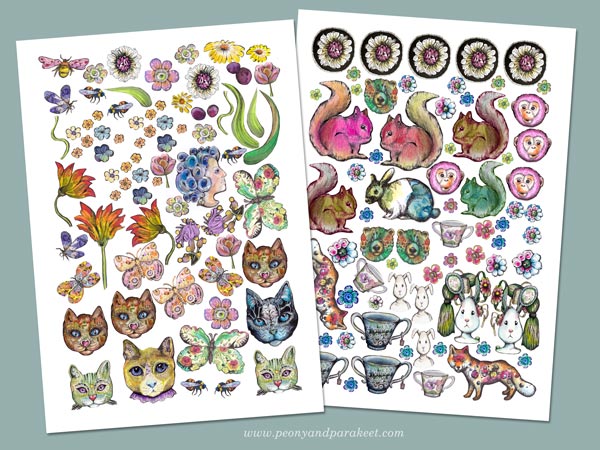
The original size of these pieces is much bigger than in the printed sheets.
Use All Kinds of Hand-Decorated Papers!
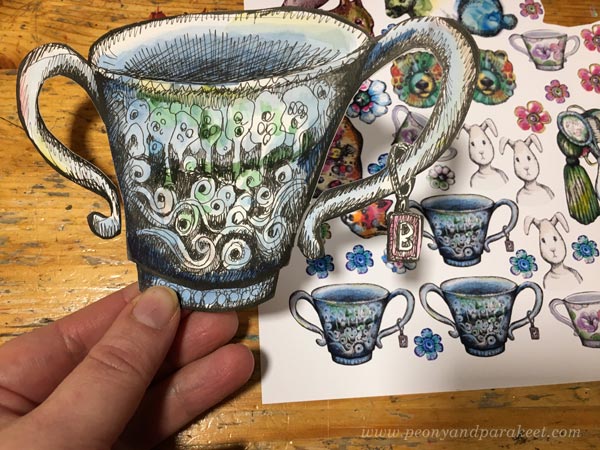
Samplers have a variety of designs, so every little doodle is a potential sampler piece. I have a box of hand-decorated and painted papers (mostly leftovers from Collageland) and two boxes of hand-drawn collage elements. I have also cut some old art created in the 1980s. All these are a good addition to small printed pieces.
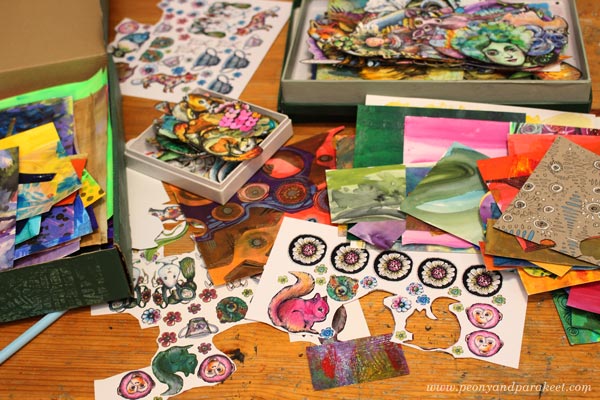
Of course, you can also use store-bought die-cuts, pictures from magazines, etc. but if all the elements are handmade, they will all fit together much better because they are all YOU!
Perfect Project for Hand-Painted Background Pages
If you are an art journaler, I bet your journal has a lot of pages that are more like backgrounds rather than finished pages. You can use them for collage samplers!
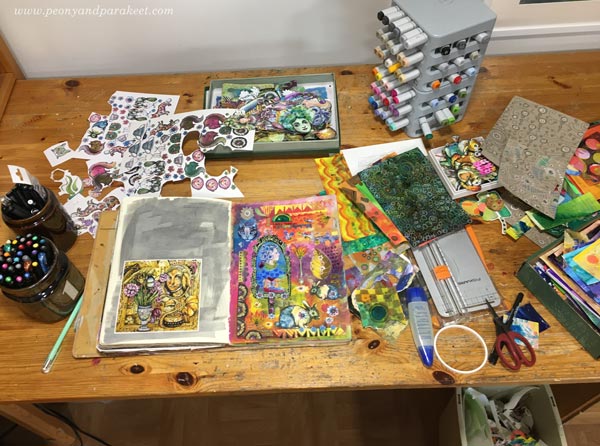
The background of this sampler was busy and bright, but I just added brown over some of the areas and let the colors speak, or should I say shout!
I attached the pieces with paper glue and some larger elements with double-sided tape. I usually use gel medium, but it’s messier, and it’s too difficult to cut all those tiny pieces with sticky fingers.
Self-Expression with Hand-drawn Collage Samplers
Sticking paper pieces can be just a relaxing hobby, like cross-stitching. But samplers can also tell stories!
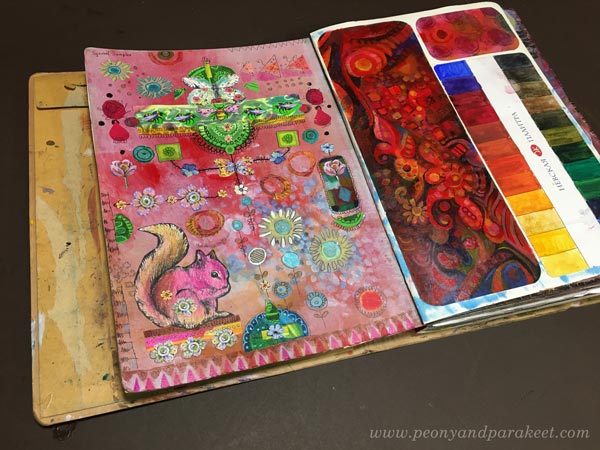
My first page is called Squirrel Sampler, and it has all kinds of little treasures that Paivi the Squirrel has collected.
The second page is called Rabbit Feeders. It refers to women’s status and importance in Virginia Woolf’s novel The Voyage Out. An isolated woman looks at herself from the mirror and questions her importance for the world. I read Voyage Out as a teenager, and this allegory, even if it’s just a few rows in the book, touched me deeply.
It often happens that creative play evokes feelings and stories that are too big to express in any other way. I hope you’ll enjoy making these samplers!
Start drawing your sampler pieces – Subscribe to my weekly emails and get a free mini-course!
Expressive Watercolor Card – Free Video Tutorial

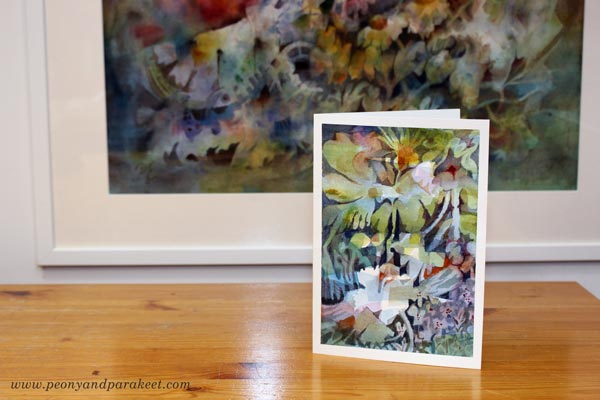
This week I have a video tutorial for you. We’ll paint an expressive watercolor card that connects several artistic approaches together.
Fine Art, Illustration, or Design?
Visual art is often divided into categories like fine art, illustration, and design. I am not a one-category artist, but interested in all of them. I need to do fine art to let go and feel free. Illustrating connects me with the outside world and other people. And I have started creating surface designs again because simplifying is a game that keeps fascinating me, and I love to develop products.
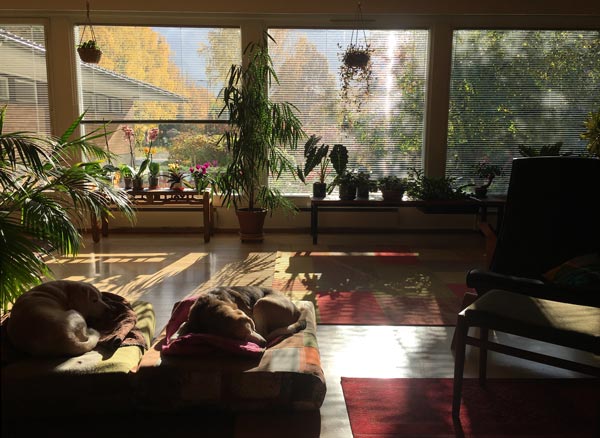
This week, let’s create a card – you could also say “a product.” It has a clear structure, so “a design,” but it can also be an illustration with a message. My card is about a house filled with plants, and I think I am illustrating my home. Visitors sometimes comment: “Wow, you have a lot of houseplants!” Almost every room in our house has plants, and their welfare constantly worries us, especially during winter when there’s less daylight.
But this card is not an illustration at all when thinking about how it started. The way it’s created makes it fine art. I painted freely and didn’t have any pre-defined images or ideas for it. However, I had a method that can produce many kinds of images. So, the method gives practical guidelines for painting, but the result can be different each time.
Expressive Watercolor Card – Paint With Me!
Watch the video and start painting!
In the video, I use the negative painting technique a lot. Even if you can use any technique that suits you, negative painting is the best technique when you want to make lines and shapes more elegant and the painting more finished. Dive deeper into this wonderful painting technique in the class Magical Forest.
Magical Forest – Dive Deeper into Expressive Watercolor Painting

Learn essential watercolor techniques like negative painting and layering, and express with light! In Magical Forest, we paint magical nature sceneries with flowers, trees, water, and fantasy.
Hop along! The class ends as late as at the end of April, and you will get the published lessons right after the registration. >> Sign up here!
The Power of Boredom
When I was a child, my most prevalent feeling was boredom. It felt like childhood was a long wait for things to happen, life to start. I was at the mercy of others and dreamed of the time when I could do it all by myself.
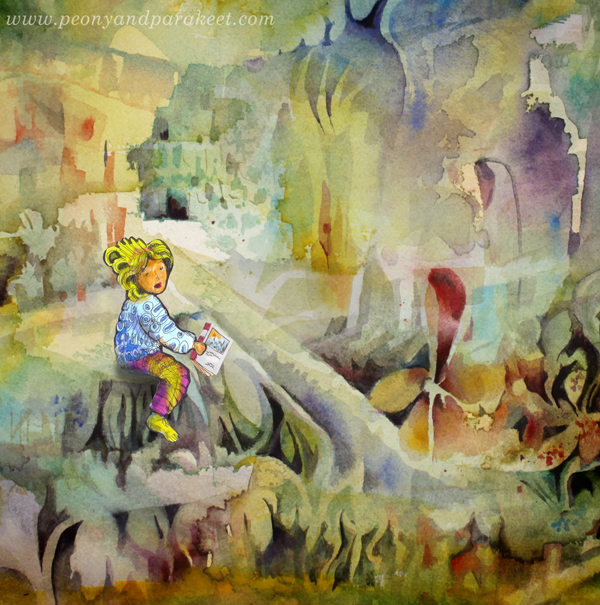
At that time, in the 1970s, there was no iPad to keep me company. Instead, I often grabbed the only picture book from the shelf where my parents kept their books. It was a softcover book about old paintings. I was staring at Monet and Manet while my mother cooked us dinner. The book wasn’t big, and the images were small. But this way, culture was introduced to me at a young age. Having this one book on the shelf, my parents unknowingly affected my life’s journey.
I was browsing the book in a colorful living room.
It had yellow, orange and red textiles and a grey sofa. Later, the colors were changed to warm green, and brown. It was all fine before my mother bought greyish mint green curtains. She was exhilarated about the color and kept talking about how well mint green fitted with the rest of the decoration. I, in turn, was in shock – cool green doesn’t fit with the warm tones! Every time I was in that room, the curtains made me feel uncomfortable. I waited for the day to pick my own palette!
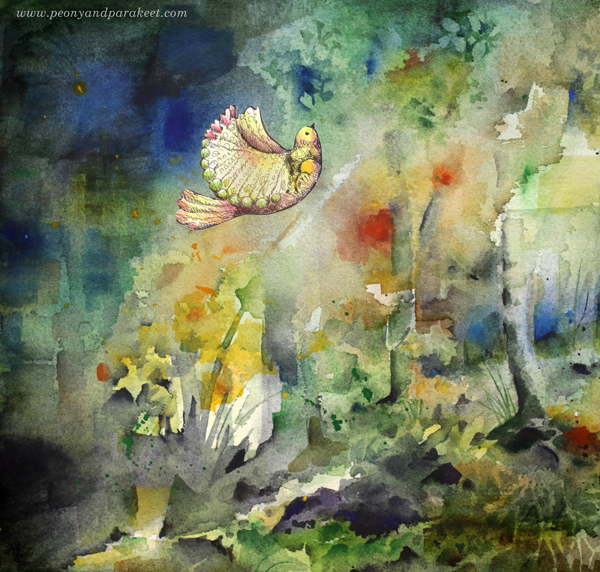
My sisters were living in a red room. It also had white, so it was quite cheery, but I didn’t like the colors. Even the table had a red frame, and it bothered me quite a bit. When my sisters moved away, and the room became mine, my parents traveled to the nearest big town Joensuu to buy new wallpaper. And when they came back, surprisingly, my father, who never had anything to say about the colors, had chosen little yellow roses! “Aww … everything has to be changed to yellow now!” I cried. My mother agreed. They bought curtains that had yellow flowers, a yellow clock, a carpet that had yellow and brown, and sunny yellow bedcovers for the two beds that the room still had.
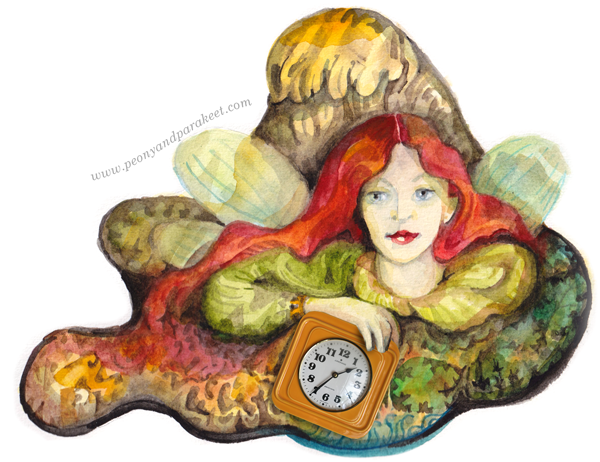
I was thinking about these colors all the time.
Did everything match? What I liked and what I didn’t like? I assumed that all people were similar, contemplating their color choices, walking around their homes, thinking about the tint of the curtains.
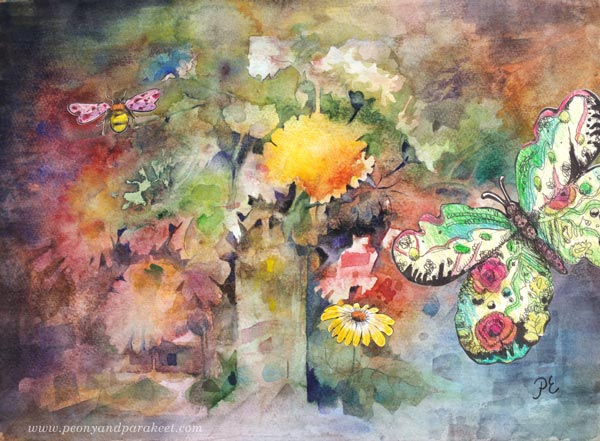
My first art book got abandoned when I started using the local library. It had huge books filled with master paintings. For years, I sat in the library and waited for my life to begin. I admired the colors, and Picasso and Matisse became my favorites.
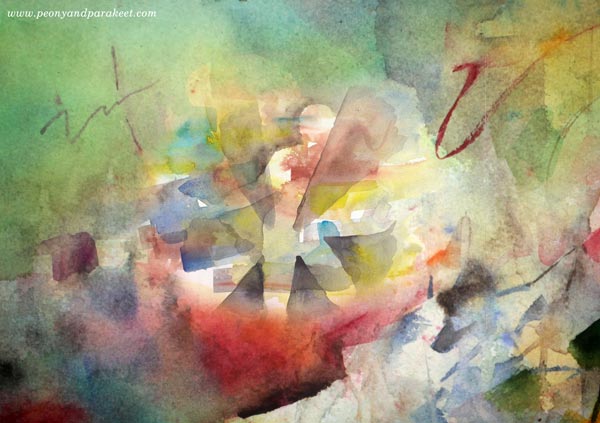
At a young age, I knew that green is not only green. It could be muddy green or mint green or something between. And when I was accepted in the local icon-painting group, I also learned that there can be a strictly defined range of tones. It was so satisfying when my teacher told me that I had produced not only an acceptable but beautiful blue for the background. We all used the same amount of the same pigments, and still, every one of us had a slightly different blue. Amazing!
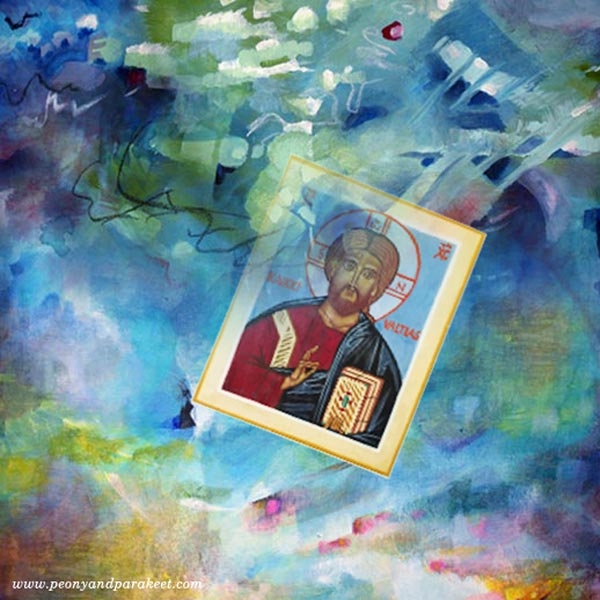
When walking to my home from a group session held at the cellar of the nearest church, I looked at the dark starry sky and admired its deep shade against the white snow. The number of colors that I was able to see was growing all the time.
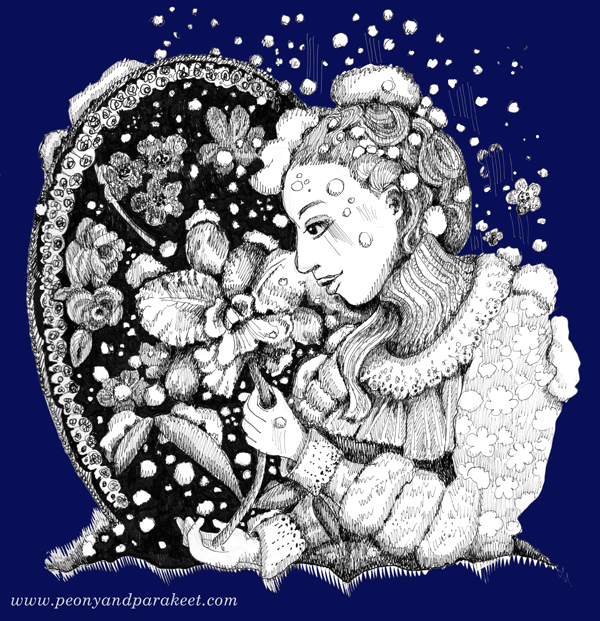
All this seemed insignificant back then.
I was just filling the moments of boredom while waiting for my life to begin. And then, finally, I grew up, moved away, went to study, met my future husband, got a dog and a good job, built a career, bought a house.
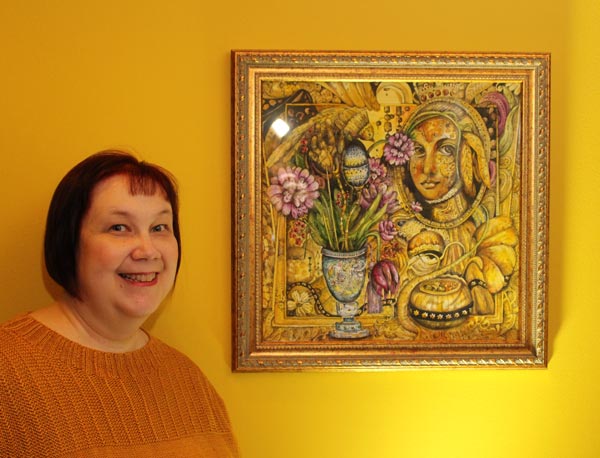
But when I am creating, these events feel less important. Instead, I want to get back to those childhood years trying to remember every single dull moment and detail, including the tone of my yellow bedroom. I am dependable on that boredom. It defines me as an artist. Everything genuine and sincere in my art can be connected with my childhood, with the age of boredom.
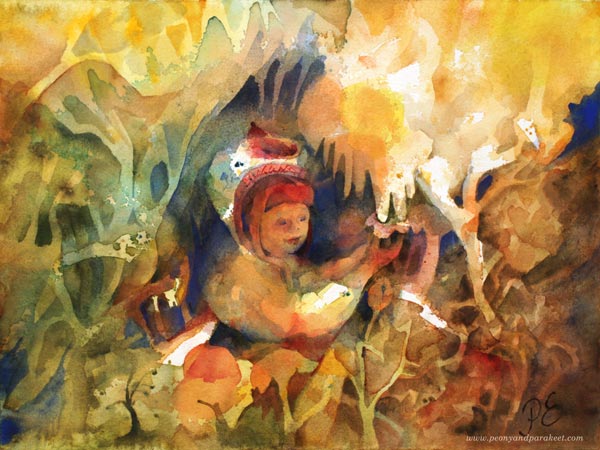
Does your childhood show in your art? Do you aim for the images that you see other people create, or are you geared to finding your own? This is one of the carrying themes in Lesson 2 of Magical Forest, starting on February 1st.
Hop along! The class ends at the end of April, and you will get Lesson 1 right after the registration. >> Sign up here!
5 Ways to Love Yourself When Painting
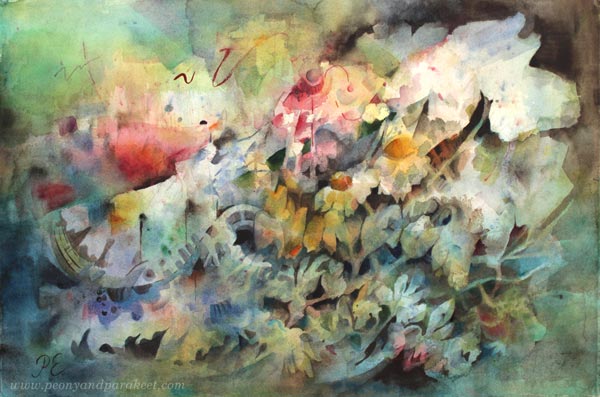
Here’s my recent watercolor painting. It’s called Icebreaker, and can I publicly say that I love it? Love, love, love. So this week, I daringly blog about how to selfishly love yourself when painting.
This is not my typical post. I would normally post things like “11 Ways to Make Your Painting More Abstract” or “7 Reasons Why Negative Painting is the Best Technique” or “3 Tips for Getting Closer to Your Style”. But after painting Icebreaker, I kind of melted. It became more true to me than ever before that we paint because we want this special kind of acceptance – the acceptance from ourselves.
When I whole-heartedly accepted what I had created, I didn’t just receive love from myself. I saw a long row of people congratulating me. All deceased, unfortunately, but still! There was my mother, saying that she knew I could do it. There was my father, looking away so that he could hide his smile. I saw my grandfather, a creative person I never met, congratulating me generously. And my dear aunt Rauha (which means Peace in English) was waving, looking just as lively and restlessly happy as she used to be. Now, this kind of love is what I want more and also spread more!
So this post is about turning your inner critic to your best fan. It’s not easy, and it may take like a lifetime, but it’s worth trying, so let’s begin!
1) Love Rises from the Mess
As a former engineer, I feel drawn to two-state things. Zero or one, yes or no, black or white, thick or thin, geometric or organic, the list is endless. But when painting, I like to be in the grey area, especially in the beginning. After the horrifying view of blank paper, my watercolors are sighing with relief: “She sprays and splashes so she must be having a good time.” And yes, I usually am.
But this mess is not just any mess to me. It’s a sign of hope. I hope to figure out what to do with it …
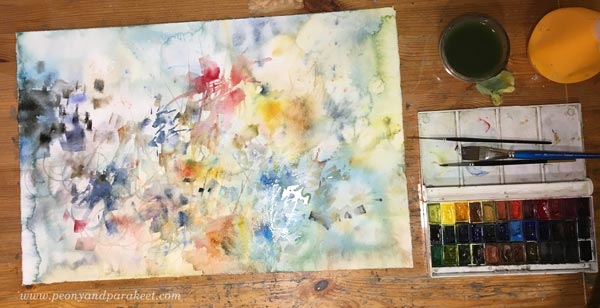
Let’s love this hopefulness in us! It’s a superpower that keeps us not only dreaming but creating too.
Yes, this superpower can look like a bad thing. It can keep us awake too late at night. It can make us buy too many brushes and focus on insignificant details like wallpaper when watching a movie. But our life is never boring or lonely when we get hopeful just by making a mess.
So, make a mess, accept the mess, fall in love with the mess! The more time you spend with the mess, the more likely you will figure it out.
2) Love What Is Secondary
Ideally, I would always know what to do next. Practically, I often have moments when I have no clue. Hope seems lost. I feel fake.
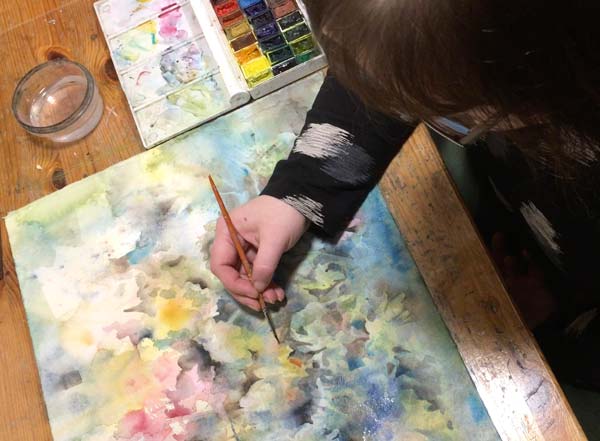
The best cure that I have found is to seek secondary things. They can be tiny spots or pretty accidental shapes, or sometimes I only admire how wet paint glows. It’s like filtering out 95 percent of the mess and seeing a few single things that look fascinating. Lovable.
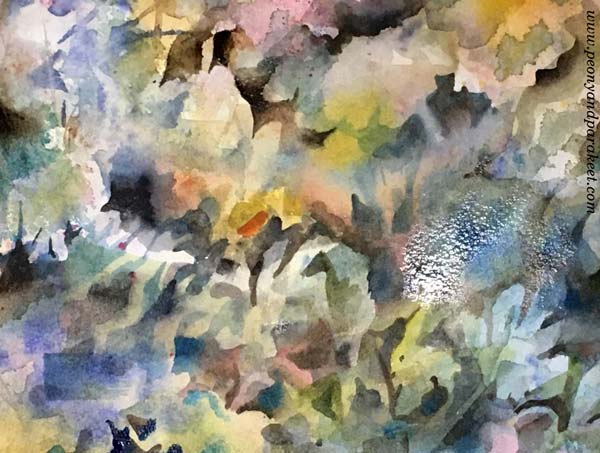
I call these elements secondary because often they are just parts of the background. But by toning down the obvious and bringing up the less apparent, I can change the direction of the painting. What anyone can see is no longer my norm. I have moved on to what only I can see.
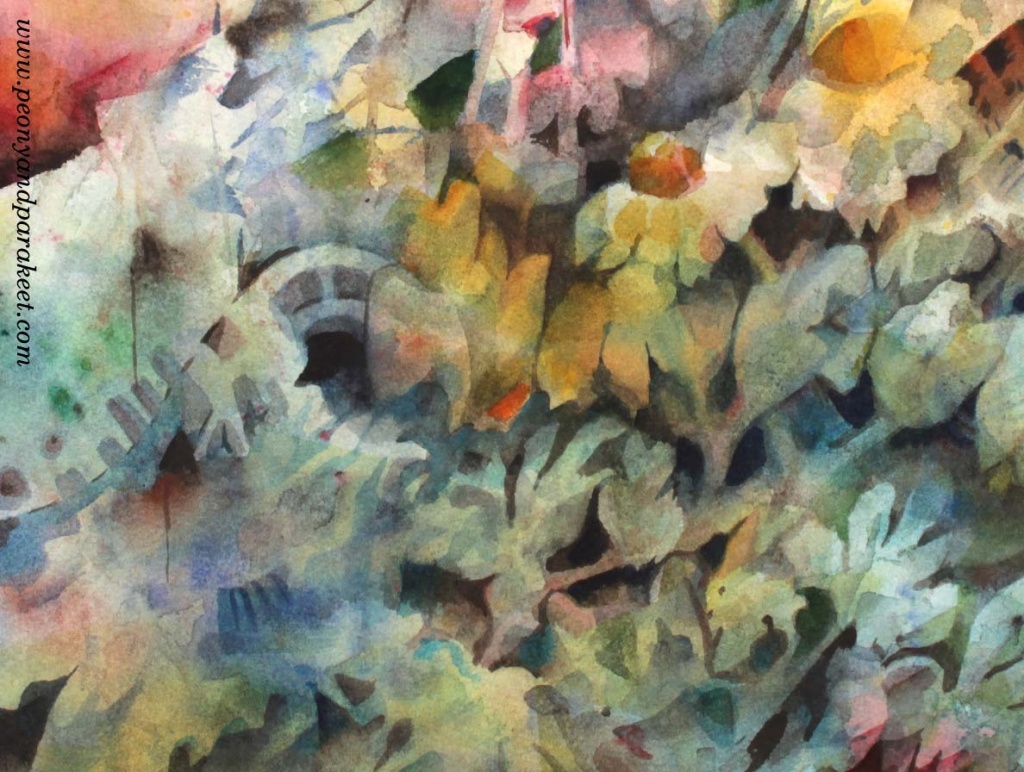
There’s so much more in us than what other people can see. Some skills and characteristics may seem secondary to others, but every one of us is allowed to love and grow them whole-heartedly.
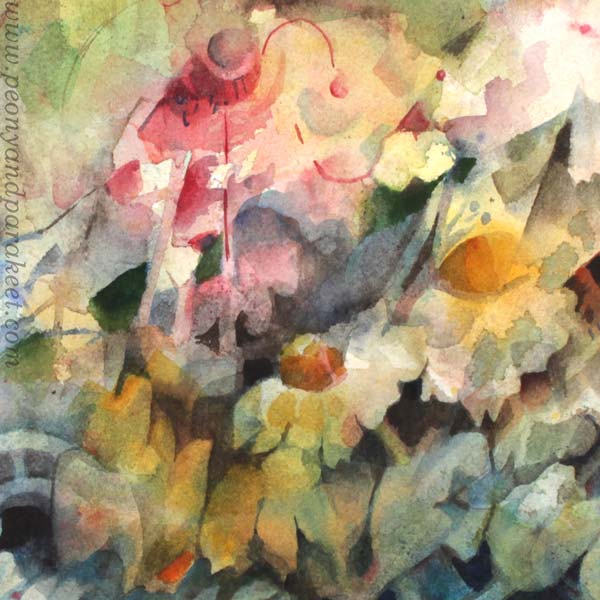
The hierarchy of the outer world doesn’t exist when you are in your inner world. You are free to appreciate discoveries that look secondary to others.
3) No Words, Just Color
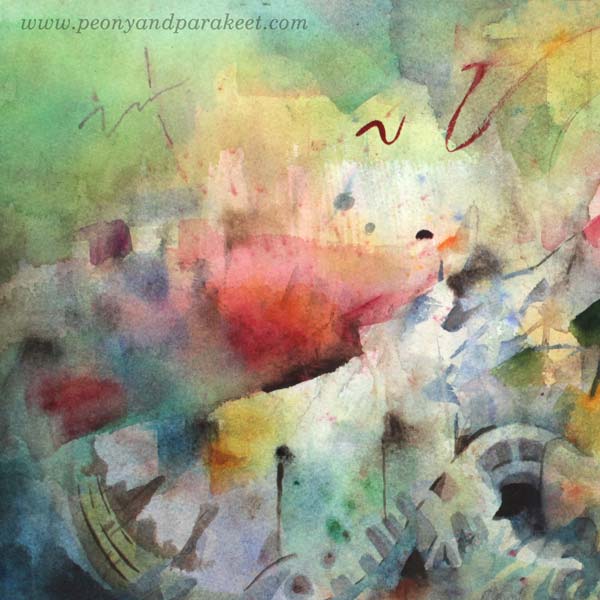
It’s not easy to write about love. Love feels more like a combination of changing colors than a sentence with specific words. So when painting, let’s feel the love through color. When dipping your brush first to the paint and then to paper, exhale color. Next, put your face close to the paper and look at the spot so that it fills your view. Inhale. It’s your color. No one can take it from you. Love, love, love.
4) Love the Vagueness
Yes, we want to find our style, our visual voice, our true self. But our boat is moving. We are changing, our life is changing, the world is changing. Everything is unsure and insecure. That also makes everything possible.
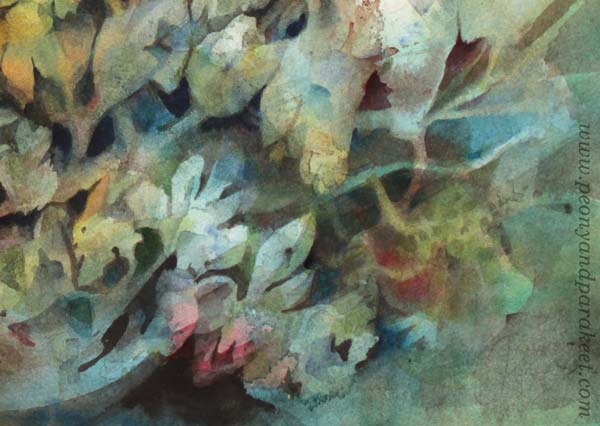
I like to build my paintings so that I leave this vagueness/possibility alive. Maybe there’s a flower, maybe not. Someone sees some triangles only, while others see a rosebud. There can be plenty of interpretations. I am vague, and everything is all right. My painting is a living organism, partly defined by the vague me, partly by the vague you.
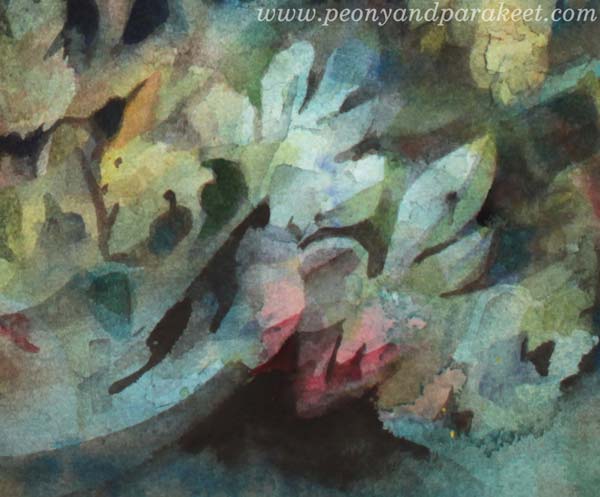
Today we might love the current painting less than tomorrow. And our art may tell a different story after a couple of years. That’s ok.
No, that’s not ok. That’s fabulous!
5) Break It!
I admire brave people. I adore Tracy Chapman singing without a band. Her voice is not faultless, and many of her stories are not relatable to me. But I feel her honesty being present right there when I am listening to her through the headphones.
But for me, it’s often the fear that’s speaking. I hear myself shouting, “NO!” and that’s when I know that the answer should be “YES.” I know I am not alone here. We are often afraid to touch the painting even if we know it lacks something. The risk is real, but worth taking.
In this painting, it would have been so much easier not to paint that dark brown around the white area. But the ice wouldn’t start breaking otherwise.
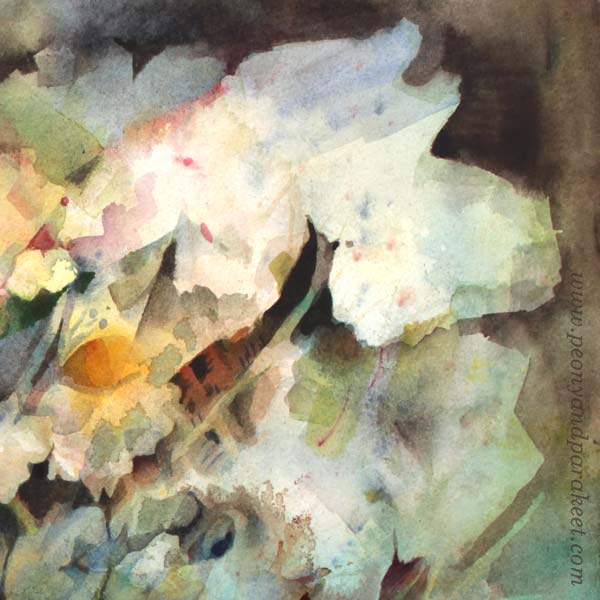
Let’s love this creativity that wants to break what’s almost working. Let’s cherish this wild force that we have in us.
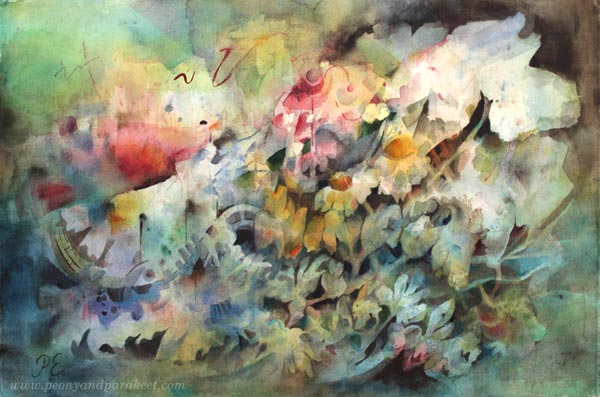
Let’s love who we are when we paint, and when we are surrounded by our paintings!
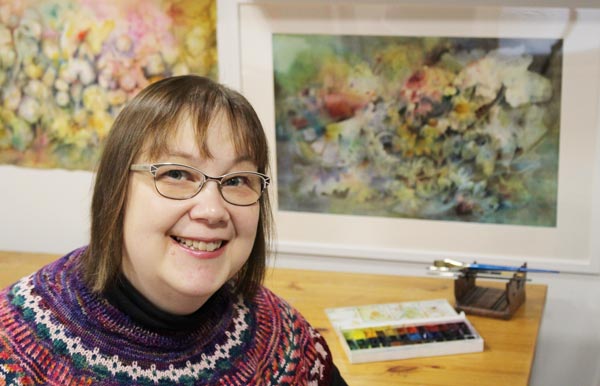
Icebreaker and other watercolor paintings are for sale at paivieerola.com
I currently teach an online watercolor class Magical Forest with themes hope, spirituality, flow, and curiosity. You can still hop along! The class ends at the end of April, so there’s lots of time to catch up! >> Sign up here!