
How to Discover Yourself as an Artist
This week I share deep thoughts about how to discover yourself as an artist and how to get discovered. I have a video for you and also, some photos of making a recent large oil painting called “Atlantis”.
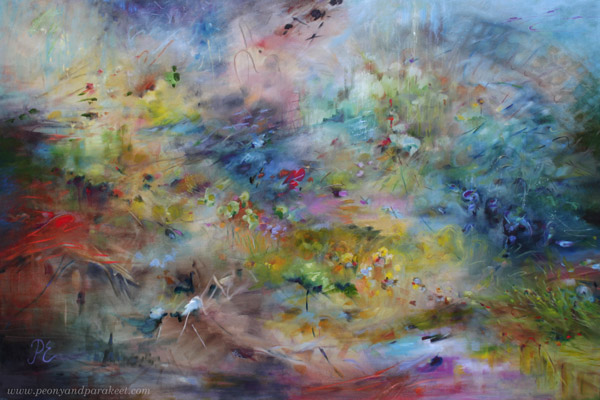
When I paint, I am an introvert, but after the session, I want to connect with the world.

When the painting is not finished, I may look at it with a very critical eye.

Then I think: Only if you knew what I think, how I feel, and how I have made myself to always reach higher.
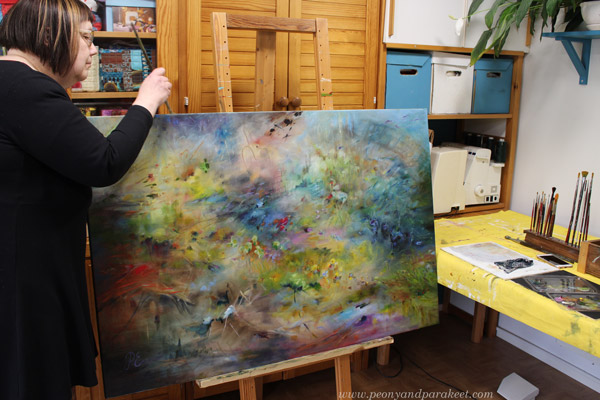
This week, I want to tell you. I want to share some things I have found helpful in my artistic career. How I have discovered my artistry and more: how I have got discovered as an artist.
How to Discover Yourself as an Artist and How to Get Discovered – Watch the Video!
I hope this was helpful. Tell us what you think!
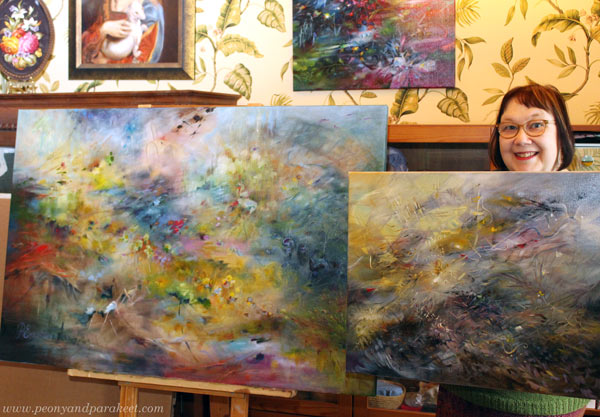
I am always waiting for your comments!
Intuitive Flowers with Colored Pencils
This week, we take an intuitive approach to flowers and color them freely with colored pencils. This method can also be easily adapted to watercolors.

Everyone’s flowers are different, but we can all start with the same steps. I will show you how to start and how to bring intuition into the process, and then you can finish the piece in your own style.

Let’s get the colored pencils and start intuitive flowers step-by-step!
Step 1 – Background
Start by intuitively picking one main color. I choose a color that I feel strangely drawn to, or a pencil that looks a bit sad and needs some quality time with me. I may sharpen or re-arrange the pencils before I start, so that I feel more connection with them.
With the chosen pencil, color the paper lightly and softly. Leave a part of the center blank so that you will also have white in your work.

When you feel bored, add other colors for an energy boost and spiciness, but always get back to your main color. The main color sets the mood and makes sure that every flower will breathe the same air.
I use soft-tipped colored pencils, such as Prismacolor Premier and Caran d’Ache Luminance. Thin layers are a joy to color and the strokes are soft. My paper is Fabriano Accademia Drawing Paper (200 gsm/94 lbs).
Step 2 – Circles
Color a new background layer so that you leave round areas uncolored. These are like ghosts that will be turned to flowers in the next step.

Make sure you have big, small, and medium circles, not just one size. Let some circles overlap and some disappear partly near the edges. This step is simple, but not very intuitive, because we tend to create circles of one size and separate from each other.
What does intuitive mean to you?
For me, it’s an emotional connection to colors and bringing out the spirit rather than the material. If you think intuitive is what feels easy, you’re holding back your development in making art.
Step 3 – Notches
Turn circles to flowers by coloring notches with the background colors. Make all kinds of shapes this way. I try to avoid symmetry, because flowers are rarely perfectly symmetrical. The more imaginative the shapes are, the more spirit I see in them.

You can also add some color to the flowers if it helps you to form a tighter connection, but do it only lightly in this step.
Step 4 – Colors
Add more colors – and not only to the flowers but also to the background. I like to think that the spirit of the flower is larger than its outline. The flower radiates the spirit, and the color of the flower is more in its surroundings than in the flower itself. This makes the background as fun to color as the flowers.

Make stems thin and curvy when you want the flowers to look delicate.
Step 5 – Repeat!
Add more details with the techniques of steps 1-4: more background color, more circles, more notches, more colors.

The more experienced you are, the more patience you have. Intuition is a rusty vehicle. The connection improves with time, and your piece will begin to speak to you.

Grow Your Skills at Fun Botanicum!
Fun Botanicum is a great course for all who want to grow their skills in drawing plants and learning more techniques for florals.
Intuitive Flowers and Colored Pencils
For me, being intuitive also means being flexible. I cherish every little flower, but also accept that not every flower can remain in the final piece.

A flower can bloom and give her soul to you, and then become a background spirit only. In this piece that happened a lot.

My drawing took about four hours to make.

What does intuitive mean to you? Do you aim for intuition when you are creating art?
Let’s Paint like Emily Wrote – Emotional Connection with Childhood Novels
This week, we are reminiscing about childhood novels while painting naturally with watercolors. Do you have this kind of emotional connection with the books from your childhood?

See more pics at Taiko Finnish Online Art Store
Now that spring has arrived in Finland and the plants have started to grow, two words have risen above others: “warm” and “natural.”
In January, I decided that my word of the year would be “Release.” This word takes my thoughts to childhood. Again, I want to be a person who is expressive, but also warm and natural.
Can Art Be Natural?

I think art can be abstract and original, but still natural. In this introductory video for the course Freely Grown, I open up about this way of creating.
Watercolors are perhaps the most natural art supplies. When a color meets water, it blooms, and as Henri Matisse said, “There are always flowers for those who want to see them.”

When painting naturally, seeing and creating alternate. A hazy spot that looks like a mistake can be the seed for something bigger.


Natural vs. What You Expect from Yourself
With the word “Release”, I have been thinking about how difficult it is to let go of conventional interpretations and expectations. Can you paint dandelions – doesn’t everyone want roses?
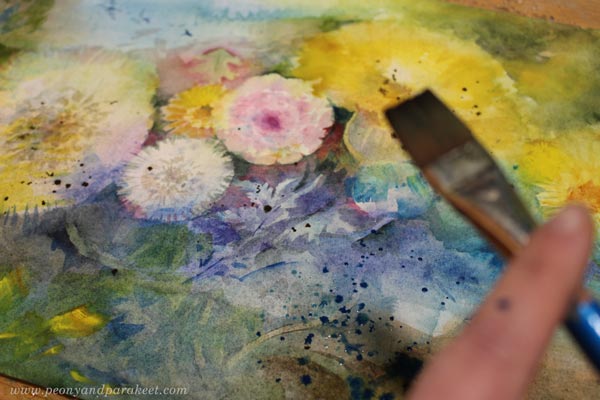
To some extent, I identify more with the dandelion: persistent, sometimes pushy and overwhelming, often stepping over the borders.

The more I think about my shortcomings, the more I think about L.M. Montgomery’s Emily of New Moon, a brave orphan girl who wanted to be a poet. She felt like a real person to me. Her story was also a growth story of an artist that had a big impact on my life. I recognize this kind of emotional connection with other childhood novels, too.
The Brave Girls of Childhood Novels

In Finland, we had a popular children’s book series written by Anni Polva. The main character there is Tiina, a pretty wild young girl. Tiina isn’t an artist, but an adventurer. Isn’t it so that to release is also to go for an adventure?

What about Enid Blyton’s The Famous Five books? You could also go on an adventure in those, and in good company.

I also read L.M. Montgomery’s Anne of Green Gables series and Louisa M. Alcott’s Little Women books. Memories of these girls’ books and the word “Release” strongly resonate with me right now. We are living turbulent times, and need to be brave and adventurous – but still in a warm and natural way.
Do you too have an emotional connection to childhood novels?
P.S. I also wrote about children’s books in these blog posts:
In 2023: Watercolor Flowers in Louisa M. Alcott Style
and in 2022: Turning Memories into Paintings
Poetry Girl and Bosom Friends – Start Drawing Again!
Let’s get you out of the creative rut and have quality time with your inner child – the poetry girl in you! Join us for a course that will get you excited about making art again! >> Sign up here!
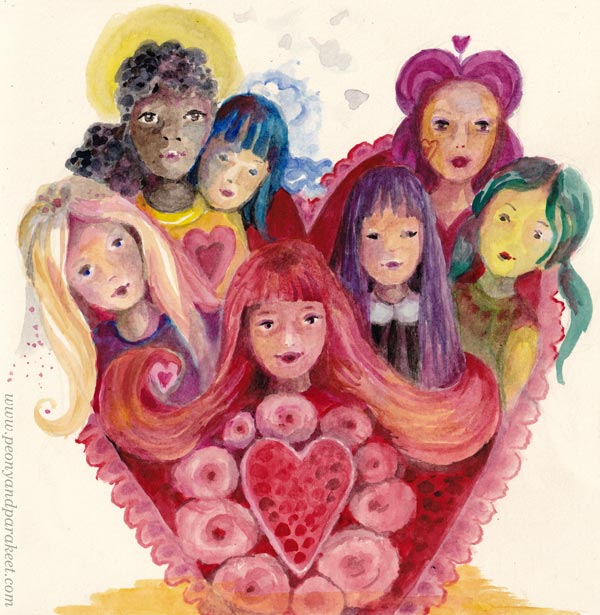
Poetry Girl and Bosom Friends
In Finland we have two lovely words: “runotyttö” and “sydänystävä” – “poem girl” and “heart friend”. Runotyttö means a dreamy young person – poetry girl – and sydänystävä means a close friend – a bosom friend. I think the best courses are like the bosom friends that bring out the poetry girl in you.
They make you see new possibilities, but they do it in a gentle and fun way.
>> Sign up for Hearts and Stories!
Here’s how we get out of the creative rut in the course Hearts and Stories.
Out of the Creative Rut – Step 1
First, we will restore the joy of drawing simple shapes.
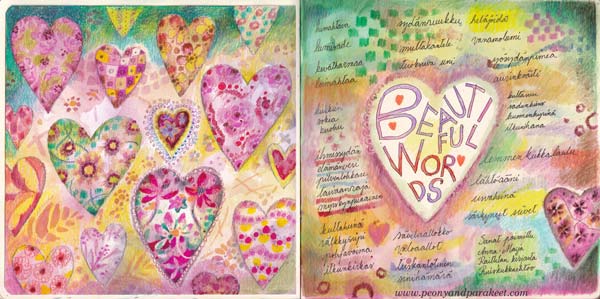
Out of the Creative Rut – Step 2
Second, we will go for an adventure that travels from one small picture to another.
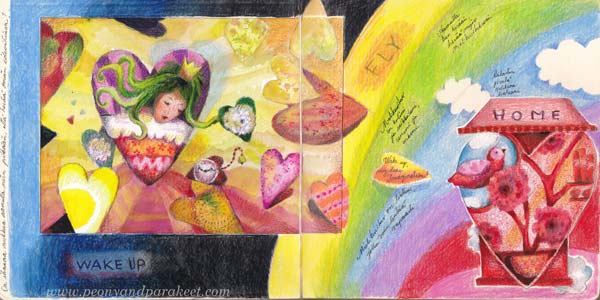
Out of the Creative Rut – Step 3
Third, we will find a connection to fantasy through characters.
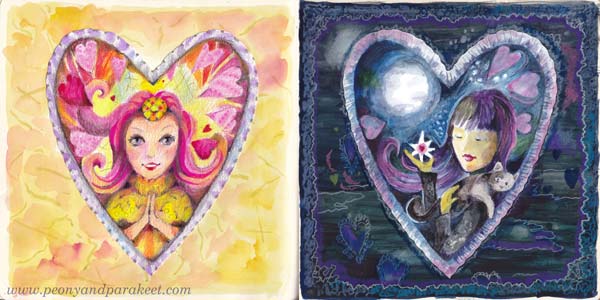
Out of the Creative Rut – Step 4
Finally, we put everything together so that we are excited to continue creating.
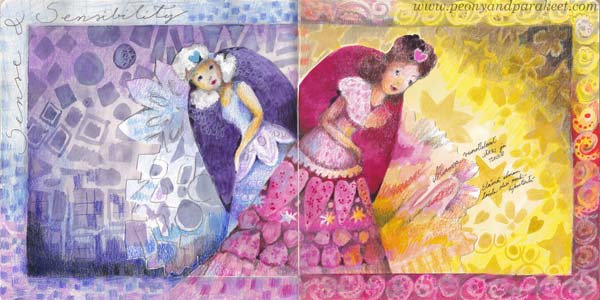
Art is a mood and a direction. It shows where you are, and suggests where you want to go.
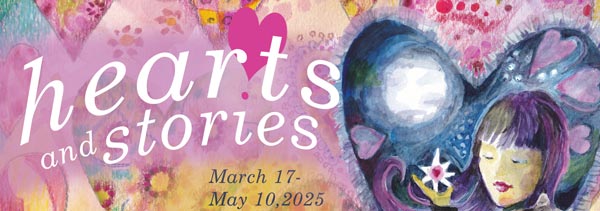
Join us for a course that will get you excited about making art again!
>> Sign up for Hearts and Stories!