
Visual Vocabulary First, Style Second
This week is about visual vocabulary and how to widen it.
I often hear the worry about finding the style, but more rarely about widening the vocabulary. Style is a quality word, but vocabulary is more about quantity. Still, it’s as important, and you can’t find the style without growing the vocabulary!
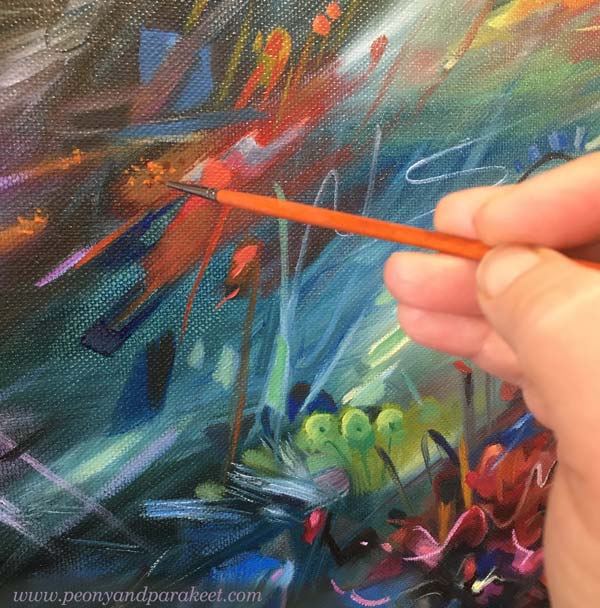
Often when we create art, we use a limited variety of shapes and lines and often the most ordinary ones. For example, your strokes may be quite straight and have very little variety in thickness. Or your shapes can be mostly basic geometric shapes. When I started, I mainly drew circles and my pieces were very symmetrical in general.
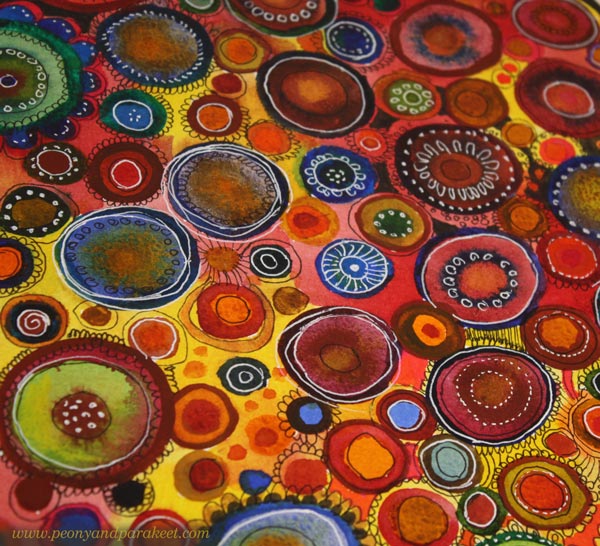
Forget the Style, Grow the Visual Vocabulary!
When you want to widen your visual vocabulary, look at the details of your work. There are seeds that can grow into great things. For example, could you repeat a random spot that almost disappears into the background and build a subtle texture from it?
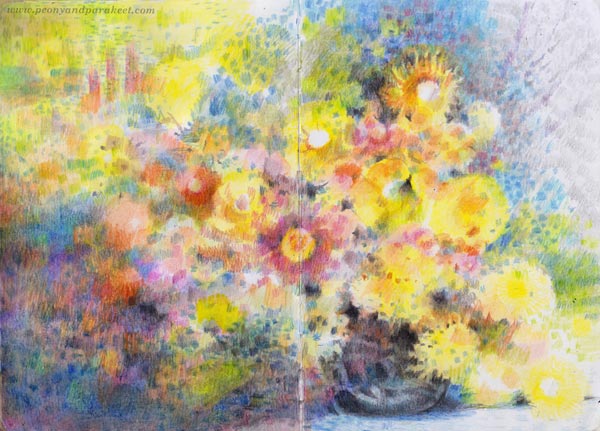
Look at your drawing line and think about whether it could deviate slightly from its path. Could you make a notch somewhere and thus make the shape more interesting?

Imagine you are a child who knows only a few words. Then it’s not important to question what the topic should be, but to find more words to tell any. Stop worrying whether you should create faces or landscapes and make a wide range of art to grow the visual vocabulary.
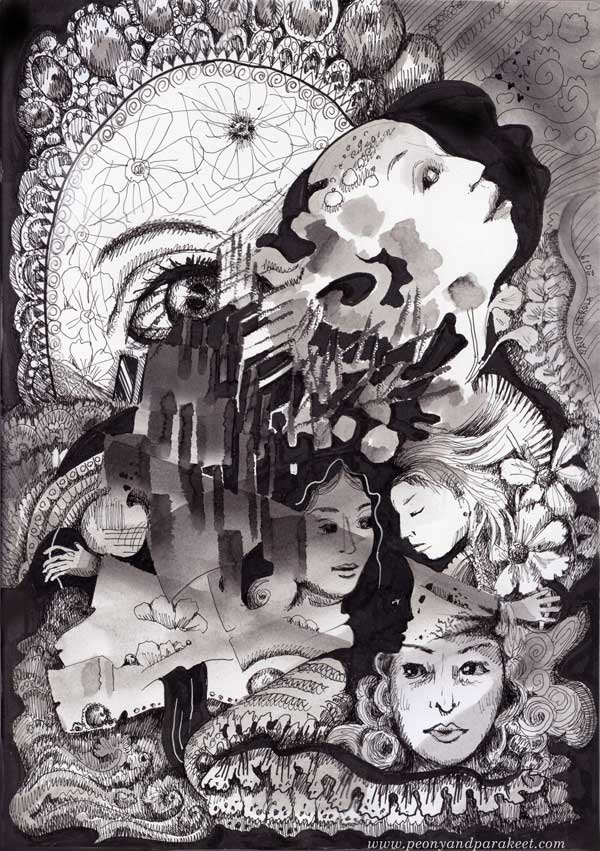
When you can draw a wide range of shapes, curves, lines and have many ways to color, repeat, break up and assemble them, you can produce visual stimuli on the paper that makes your imagination work. From this collaboration, art is born.
Outer Inspiration – Borrowing “Words” from Others
By looking at art, you can find words, i.e. shapes, that you want to incorporate into your own vocabulary, i.e. style.
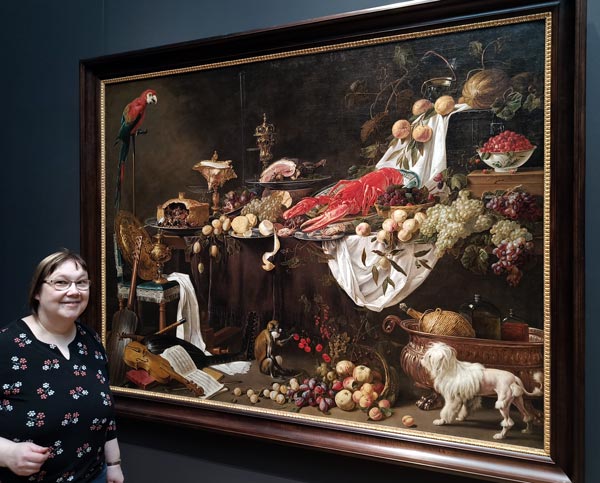
Art history is like an encyclopedia where we can pick what we like. Any art can be seen as abstract – just focus on finding a variety of shapes and colors.


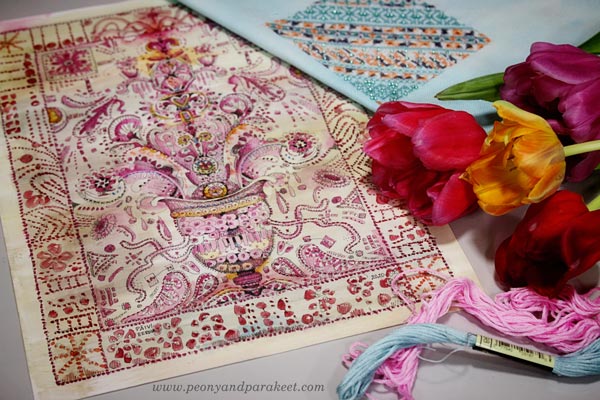
Your vocabulary can be inspired of not only fine art, but crafts as well.
Imagination Sets Who You Are
Too much outer inspiration causes copying, so don’t leave your imagination out of the equation! Imagine you are a singer who takes a popular song into your repertoire. Then you enter a singing competition and are told: “You sound a lot like the original singer of the song, but we want to hear who you are.”
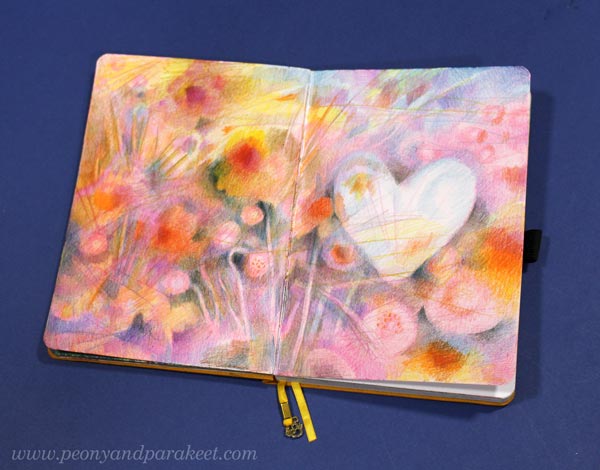
So we need not only to expand our expressive language, but also to develop our imagination. Visual vocabulary and imagination are a pair, and art needs both.
For example, you can draw a circle and give it a meaning, but can others see it? With imagination alone, the expression remains hidden. With a rich expressive language, we can make art enjoyable for others as well.
Welcome to My Courses + What I Want to Teach
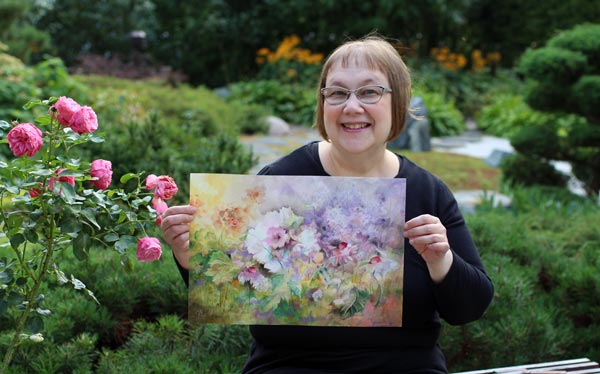
The goal of my courses is to develop both your visual vocabulary and imagination.
First, I want to get you to draw something a little differently than you have done before and thus enrich your visual vocabulary. Second, I want to make a crack in your everyday thinking and plant imagination in it. I want you to ask: “What if?” and to respond with something completely crazy – something that makes you feel free to tell completely new kinds of stories.
When art emerges from this starting point, richly and vividly expressing itself, you will find your style.
Inspiring Art Journals
This week is dedicated to inspiring art journals that hopefully make you start creating right away.
Towards the end of last year, I started to really miss drawing. When I want to come up with ideas, I need a pen and paper! Or maybe I should say that I need my art journals because that’s where the ideas stay in good order.
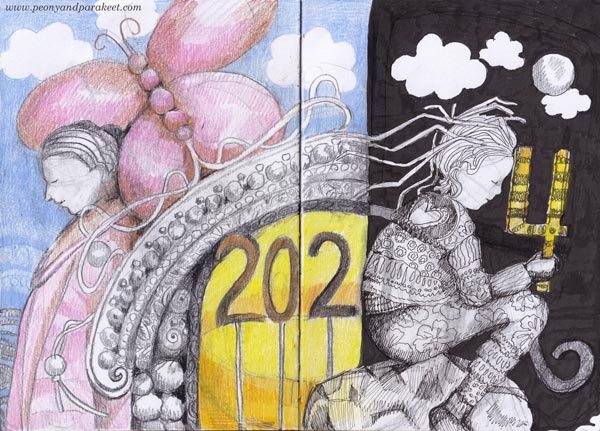
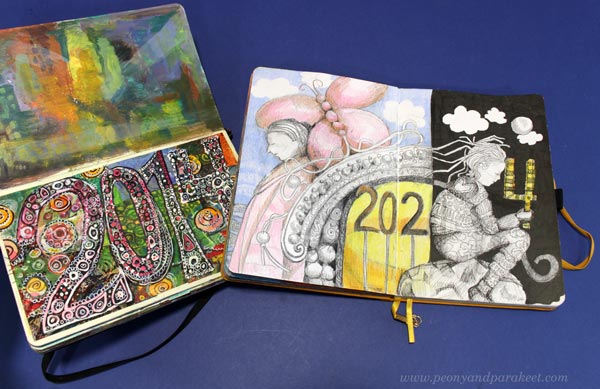
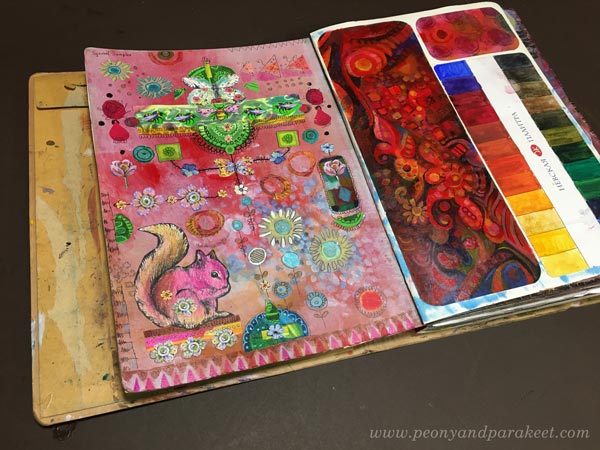
I made this spread in my colored pencil journal. 2023 is an old romantic woman that is going away and a young girl who is ready for adventure will take her place.
There are only a few pages after the previous year’s spread.

I hope to make more pages in this colored pencil journal this year.
Inspiring Art Journals
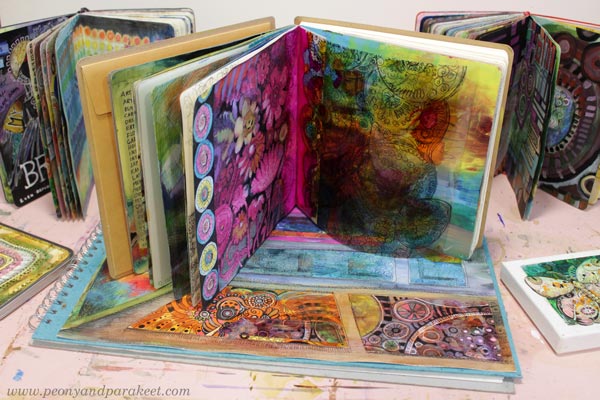
This week, I picked up random art journal books and browsed them. I especially love the one in the upper left corner with the black and white drawings the most.
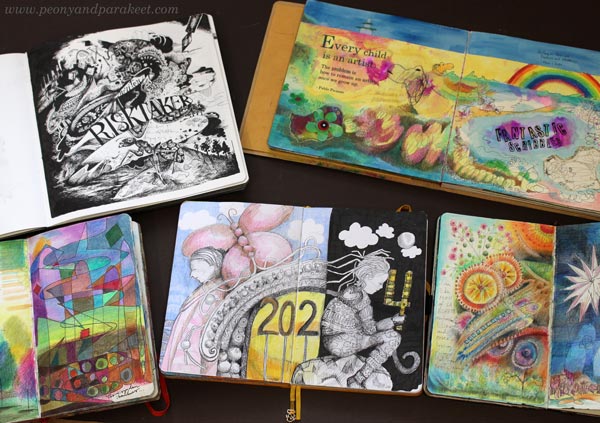
The drawings have no color but they are all full of ideas that still inspire me.
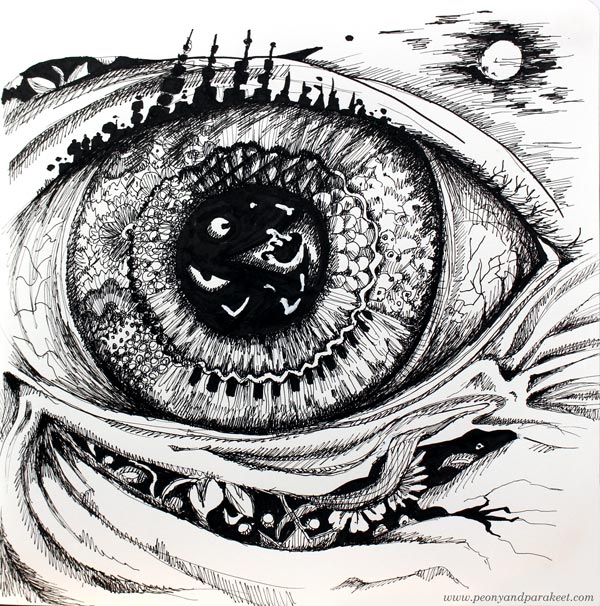
I now want to add ink drawings to my colored pencil journal as well.
Tiny Pages
Last year I bought a very small art journal. This is a pretty cute page!
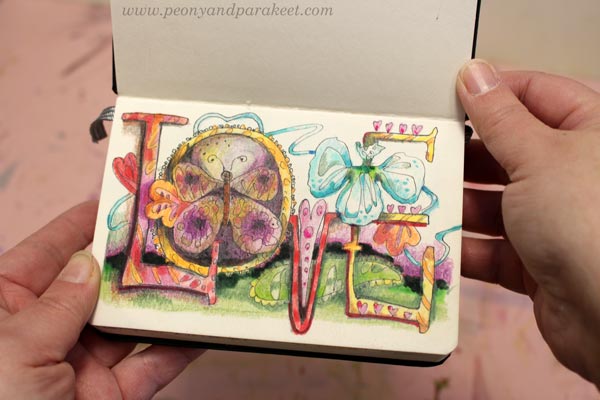
All the reds and pinks looked very nice together.
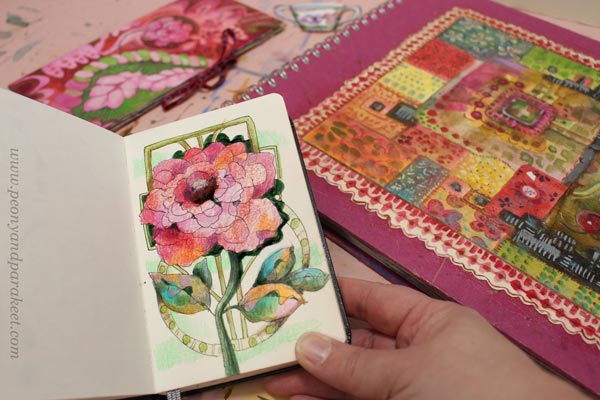
Years go by and my skills grow, but even the clumsiest covers still seem to fit with the new creations.
Doodler’s Resort
While browsing the journals, I found a spread with a transparent film in the middle. I had printed doodles on it and I still quite like the effect. This idea is from 2020, when the world stopped and I couldn’t do anything but mindless doodling.
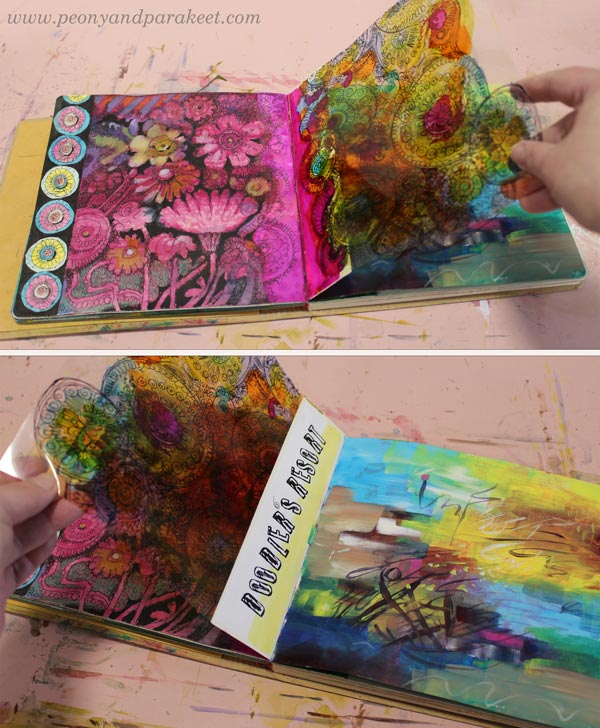
This art journal also has a lovely inside cover.
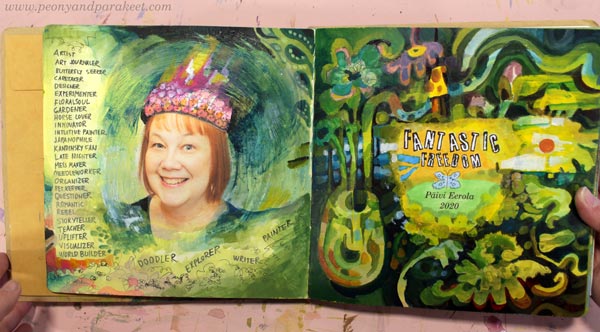
Divide the Content!
I don’t understand why it took so long before I realized that I could add annual pages, inside covers, chapters, and other pages telling about the content of the book in art journals.
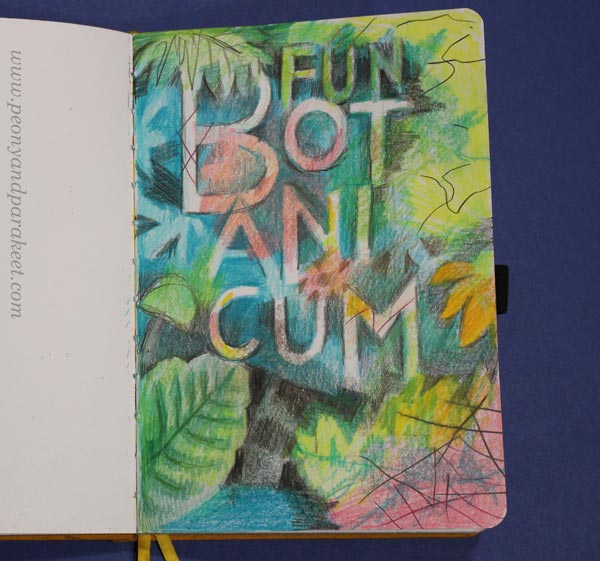
Nowadays, I have a course called Fun Botanicum, where you make a chapter cover, themed pages, and an end page in the middle of an art journal.
Inspiring Art Journals Tell About Time
It was fun to look at old art journals and wonder how these are connected to everything that is going on now.
Time is a mysterious place. It is like an illuminated palace that blinds us. We can only walk away from it to the darkness. But as long as we are alive, we can start the adventure and get creative. “It takes a long time to become young,” said Pablo Picasso.
In my opinion, only by drawing can we know what we really think. The more you draw, the more your skills grow, and the more you will find out!
Do you agree?
Get Creative in Drawing Ornaments!
This month, the focus is on art history. Art history is often talked about in a very serious tone, but let’s examine it through imagination and start by drawing ornaments!
Ornament Tells a Story from Childhood
It’s fascinating that even if the ornaments are stiff and organized compositions, one can express a whole story.
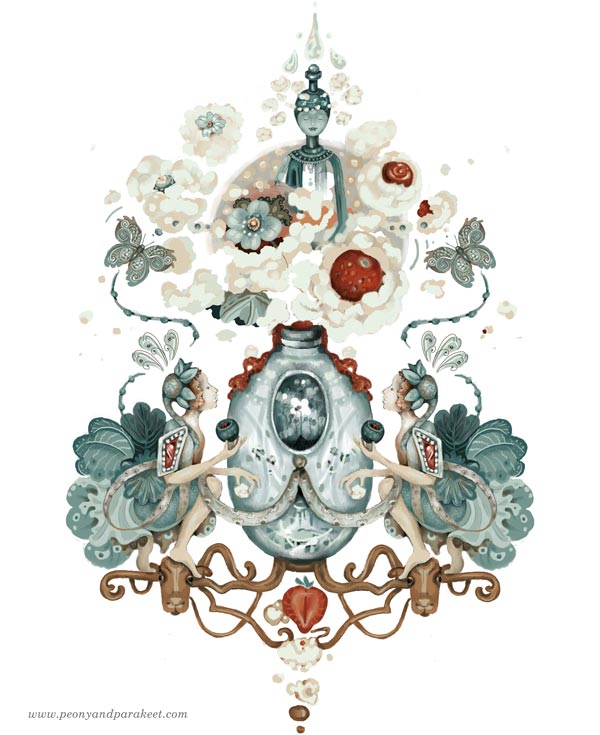
The background of this drawing is a funny story from my childhood. When the school asked each student’s favorite food, I answered “Mansikoita ja kermavaahtoa!” – Strawberries and whipped cream” while the others listed macaroni dishes or meatballs. Both the teacher and the students were quite shocked by the answer, but I wondered how anyone would prefer to eat something so modest and usual.
This story tells a lot about how I’ve always wanted to get away from the mundane. I still want to draw things so that they look like a luxurious celebration rather than a gray everyday life. I like drawing jewels, lace, floral motifs, and swirls, and you can have a lot of those on the ornaments.
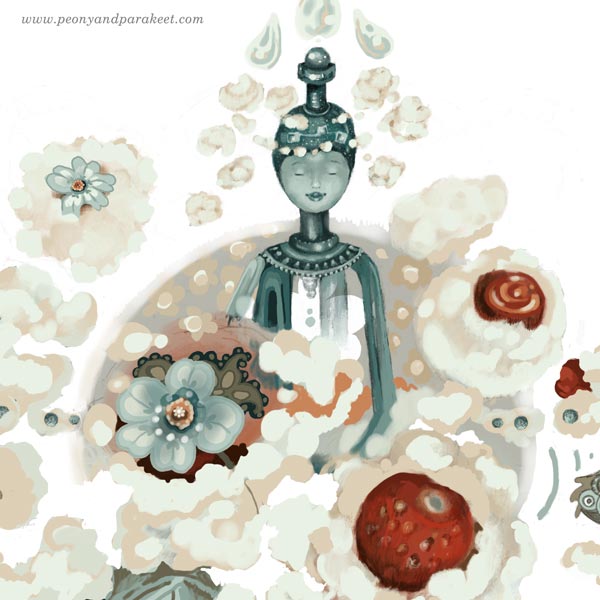
I often want to include people or animals too. For example here, I wanted to make the whisk half-human, and draw two fairies that enjoy the dessert.
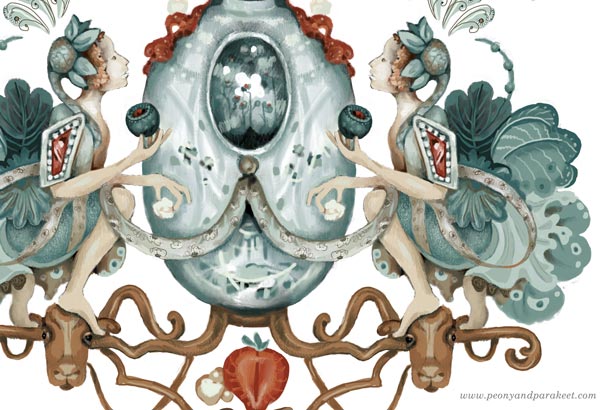
The method that I teach for human poses in the course Doll World was very helpful here.
Inspiration from Antiques, Old Buildings, and Paintings
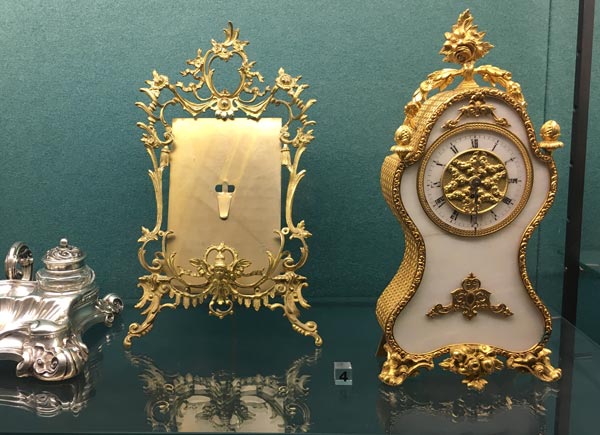
There are plenty of ornaments in my photo archive. When I visit old buildings, I go through doors, ceilings, wall panels, and floors, looking for nice ornaments.
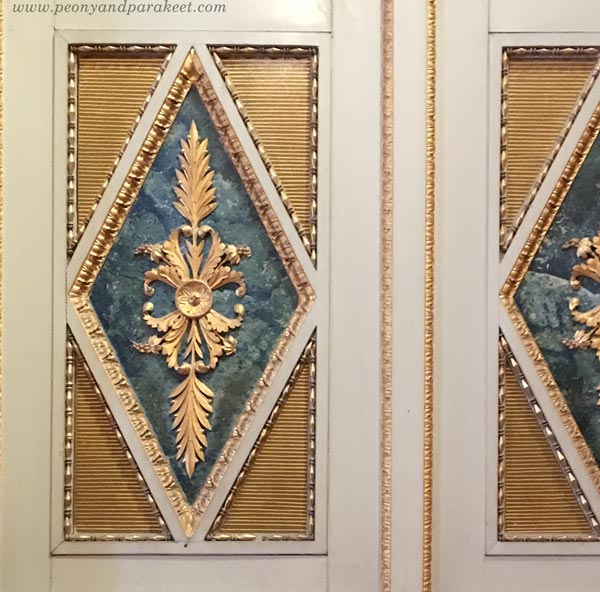
I also love to examine antiques closely.
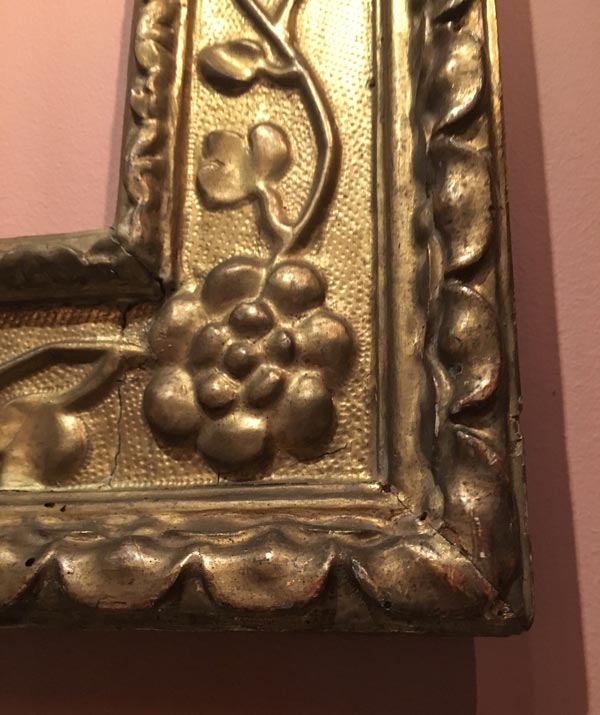
Old paintings often have lovely frames. Whenever I photograph one, I always try to include the frame in the picture.
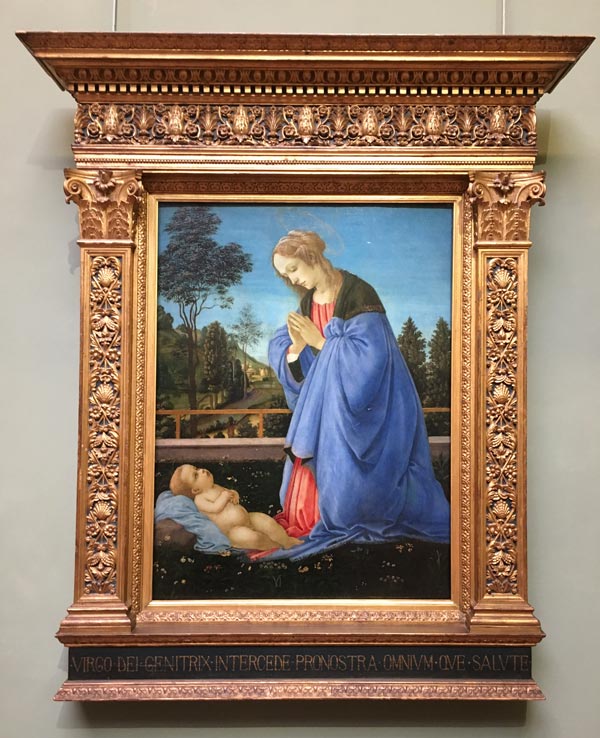
This frame is like an ornament representing a palace!
Lots of Simple Shapes
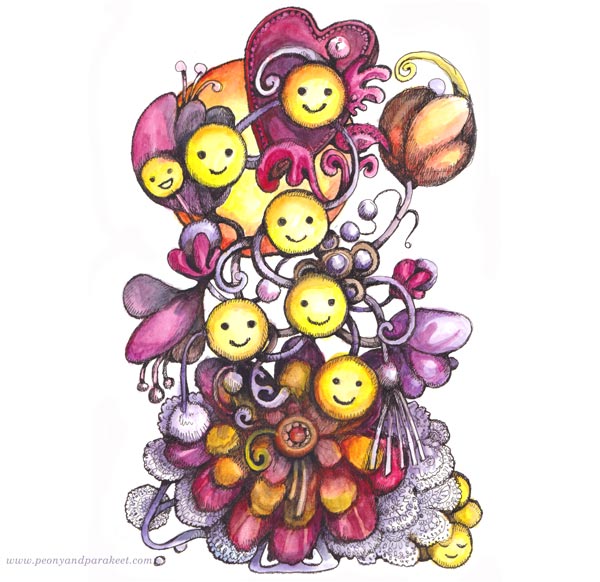
The decorative appearance of the ornaments can mislead you into overestimating their complexity. When an ornament is taken apart, the shapes can be quite simple.
I love this kind of sophistication based on quantity and repetition, with which you can express anything – humorous subjects …
… or more serious.
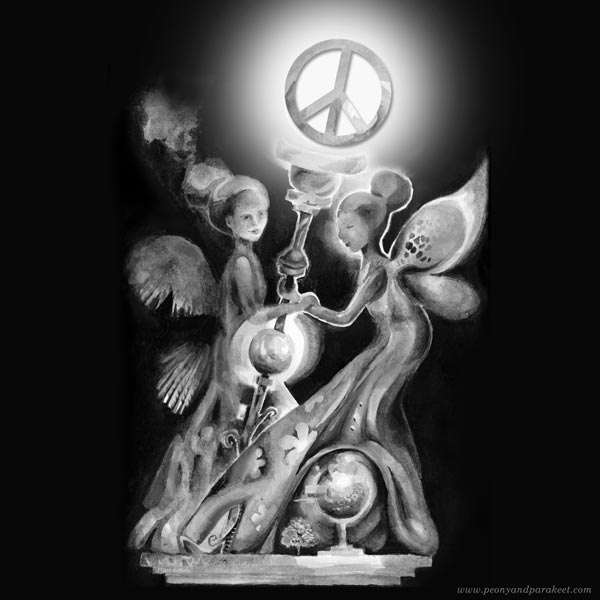
This example shows well that you can also express light when drawing ornaments.
Ornaments Can Both Hide and Reveal
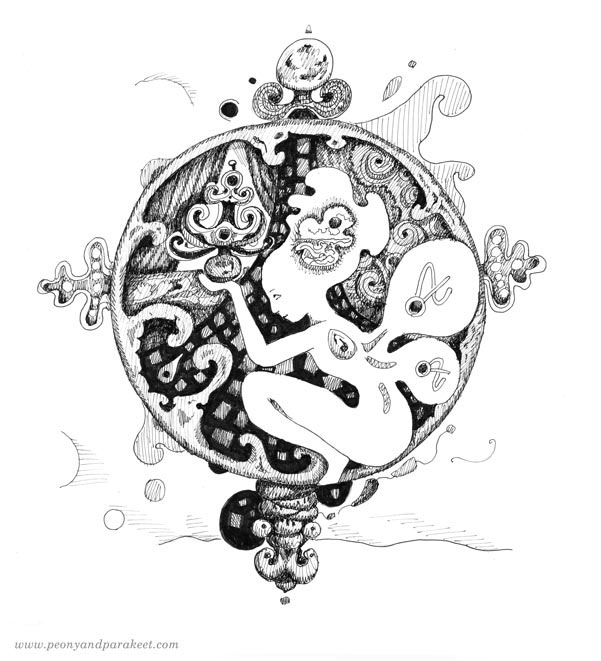
I am fascinated by the fact that although the subject can be drowned in decorative forms, it can also be brought out more directly and more concisely than in a regular drawing. Time travel to the past can become surreal when the horizon disappears and the items are arranged as part of a floating structure.
Ornaments as Collage Art
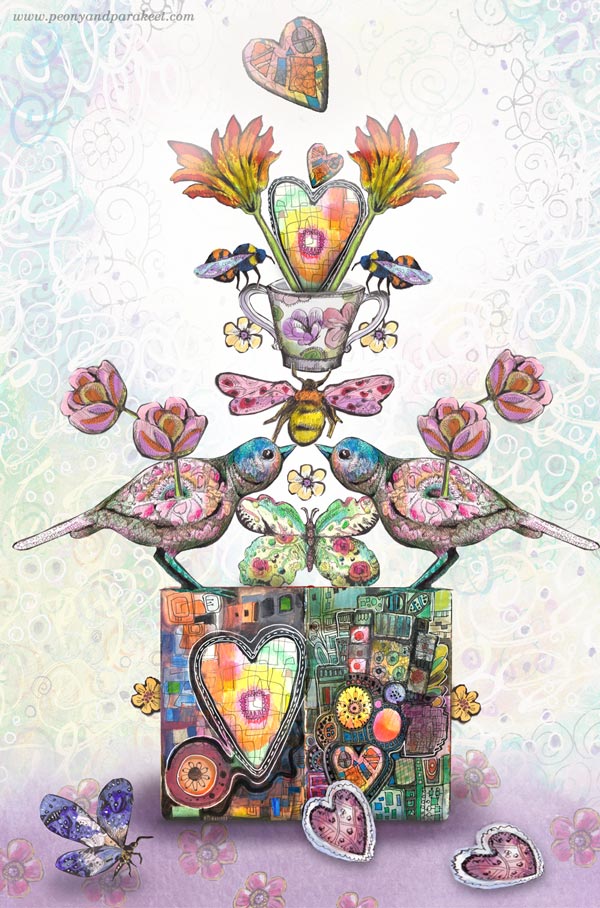
If drawing the whole ornament in one go feels too demanding, remember that the ornaments can also be collage art. You can glue individual elements so that they form a decorative tree or medallion. I have put together many kinds of ornaments from hand-drawn animals and hand-decorated papers.
You can also scan or photograph the drawings and assemble the ornament digitally with an image processing program. Here are animal figures and flowers from the course Animal Inkdom and a teacup from the course Magical Inkdom.
Drawing Ornaments is Expressing the World
After working with ornaments for a while, you begin to realize that the world is largely based on them. Surface patterns are everywhere. The beauty of organic forms can be found in all living things.
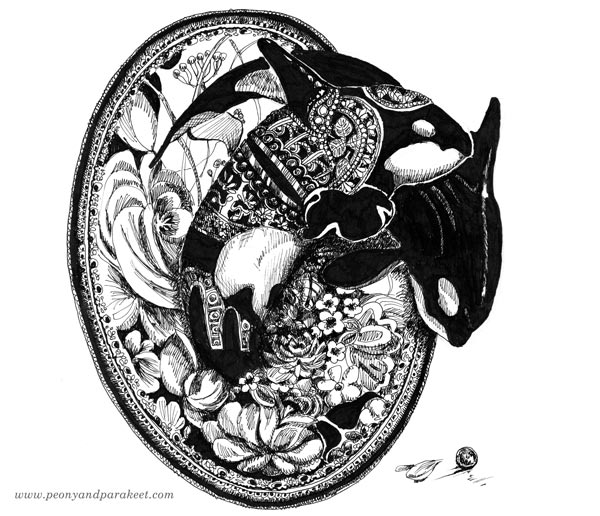
Ornaments build a bridge between the living and the non-living. They make the living an object and the object alive.
Hidden Love for Ornaments and How it Shows
I think that many of us have an innate need to design ornaments. Maybe you dream about designing fabrics or have a huge stash of them. Maybe you collect jewelry or save photos of them. Maybe you feel that something is lacking if you only draw or paint complete images and are not able to rearrange the composition so that it’s something more stylish and less representational.
I only realized this tendency of mine when I made ornaments as part of the illustration for a children’s book. Back then, I used transparent marker paper to design the symmetry, and my desk was full of different versions.
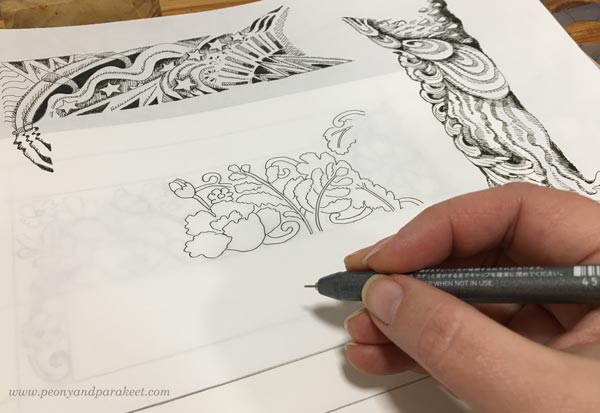
One day when picking the pen, I suddenly felt happy and meaningful: “I should do this more!” Since then, I have not underestimated even the smallest encounters with ornaments.
Drawing Ornaments Inspired by Embroidery
I relax from my work as an artist by doing cross-stitch and those projects also inspired me to draw ornaments.
See here how to draw and color an embroidery-inspired ornament – Doodler’s Sampler Step by Step!
Drawing Ornaments without Perfect Symmetry
I drew the last ornament with the ProCreate app. The good things about it are that the background can be kept separate so that the background colors can be varied and it is easy to create symmetry. However, I think completely symmetrical ornaments are a bit too stiff and boring, so I also made quite a lot of asymmetry for this ornament.
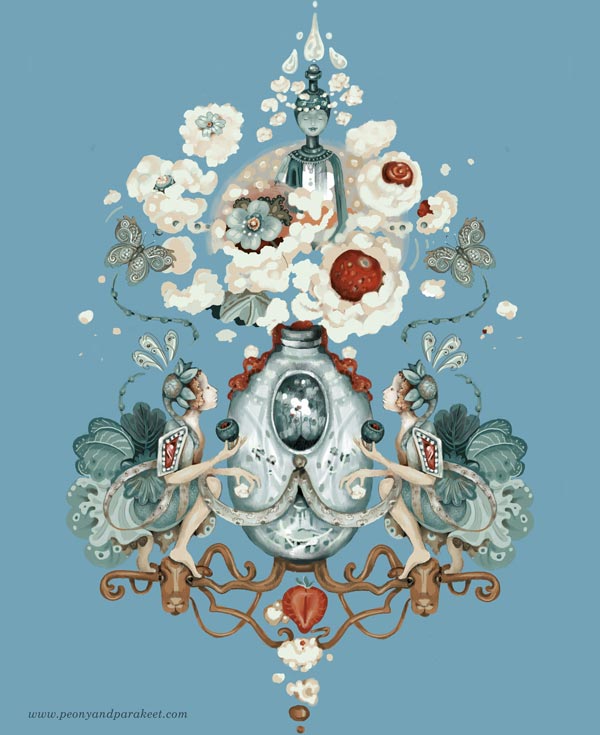
I hope you will start drawing ornaments right away whatever technique you choose!
Related Courses
- Doll World – drawing human poses – Buy here!
- Animal Inkdom – drawing animals – Buy here!
- Magical Inkdom – drawing fantasy – Buy here!
- Collageland – inspired by embroidery – Buy here!
Why Draw in Black and White?
I have often asked myself: “Why draw when you can paint?” And as someone who loves colors, it hasn’t always felt appealing to omit them. Still, one of the biggest things in my artistic development has been to find a connection to my childhood through black-and-white drawings.
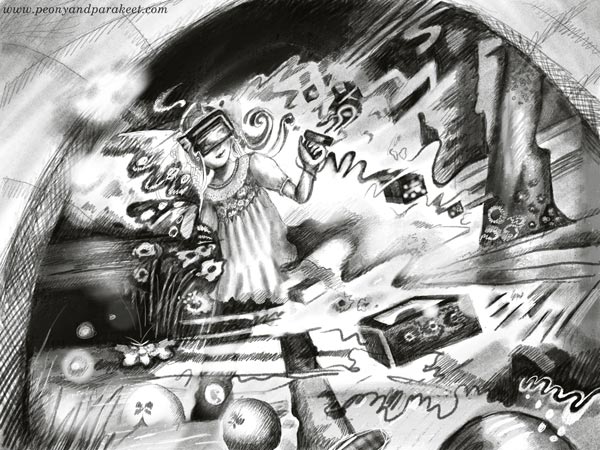
In this week’s blog post, I want to inspire you to draw things you love in black and white. If you want to practice ink drawing with me, see these courses: Animal Inkdom and Magical Inkdom!
My Way to Drawing in Black and White
It’s been over thirty years since my father’s death. He was quite distant, but I still vividly remember when he drew horses when I was a child. The horses were not noble and streamlined like in the picture books, but furry sympathetic characters. It was as if my dad really knew these animals.
So it was no wonder that when I participated in the Inktober drawing challenge in 2018, my drawing style borrowed a short hair-like line from my father. You can say that at that time, I fell in love with drawing. Nowadays, I still draw in black and white every time I want to visualize something through my thoughts. I now have an Apple Pen and Procreate, but I sometimes draw on paper as well.
See a quick 4-minute flip-through video about one of my sketchbooks!
See more pictures of the children’s book illustrations: The Beauty of Science – Illustrating a Children’s Book
Why Draw? – Move from One Idea to Many!
Drawing visualizes the invisible and makes us think deeper. First, the idea is wavering and could take any direction. But as the details increase, the big picture also grows. Therefore, it’s important for me to let the pen linger in small areas. I find pleasure in putting tiny pieces in place so that they are part of a bigger story.
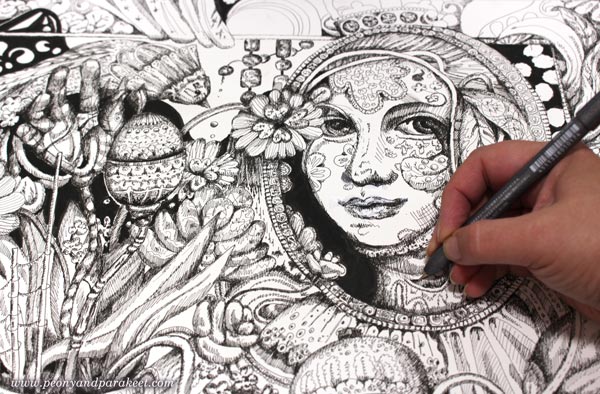
There are two good things about drawing with a thin black marker pen. First of all, the pen mark cannot be erased. You have to figure out how to make the wrong stroke a part of the drawing. It has often happened to me that the core of the picture was created while correcting a mistake. Another advantage is that when you don’t have to worry about colors, you can focus on shapes and patterns in peace. And of course, you can always color the drawing afterward, for example with colored pencils or watercolors.
Why Draw? – Connect Your Art with Your Origin!
I believe that anyone who has drawn for a while will develop an understanding of why they draw. I have a feeling that I was created to express things through ornaments. For me, an ornament is not just a picture, but a whole language. When drawing ornaments, I’m on the border between writing and illustrating, and feel that I am doing something important. As if I belong to those authors to whom poetry appears as pictures.
It’s confusing, but this connection between drawing and writing seems to have arisen in me when my father drew a horse. Of course, I didn’t know how to break it down like that as a child, but I now think of my father’s horses as ornaments that summarized the origin of our family. It wasn’t the most elegant possible, but I still wanted to give it wings. Nowadays, every time I draw, I feel close to where I am coming from. I hope that by drawing you too will find wings for your origin!
What would you like to draw? Leave a comment!