
Expressing Inspiration Through Art
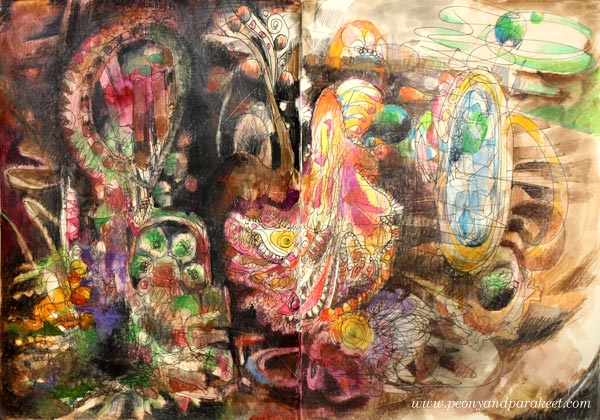
I made this mixed media drawing “Storyteller’s Power” for the class Inspirational Drawing 2.0. I have created it from a collection of inspiration images. One of them is Luca Mombello’s Renaissance painting “The Immaculate and God the Father” which I saw at the recent renaissance art exhibition of The National Museum of Finland. Seeing the artwork, and how it reminded me of modern fantasy novels, caused a huge spark of inspiration. But when I heard that the frame was handmade by the painter, it felt mind-blowing. What an artist!
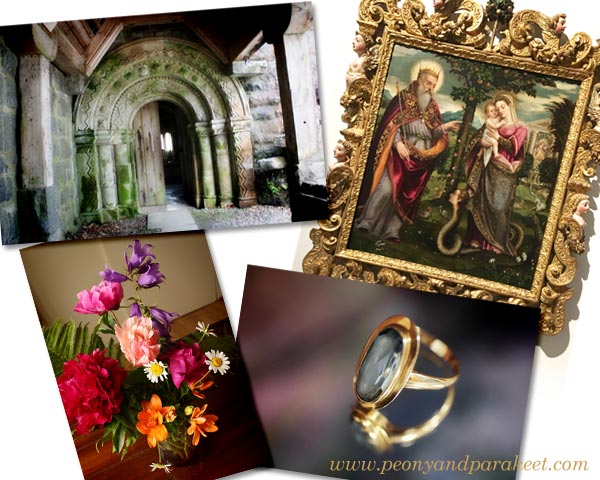
Inspiration is Often Visual
It doesn’t have to be an art exhibition to make me inspired. I see ideas everywhere. Because of that, I am a useless listener without doodling or knitting. If I listen to a long lecture without nothing to do with my hands, I find visual ideas and inspiration everywhere. I look at the pipes attached to the ceiling or count the colors of the clothes. Soon, I have discovered a new idea that has nothing to do with what I came to listen! I believe that especially for visual people, inspiration is often visual too. We get excited by what we see and can’t help being drawn to colors and details.
Only You Can Express Your Inspiration!
Over three years ago I started to find a solution for expressing inspiration by drawing and painting. The world was full of images that embarked my excitement, but it seemed impossible to express it genuinely through art. I was either too intentional which brought stiffness, or too intuitive, which took me just further away from my original inspiration.
I already had some experience of using mood boards when studying design so I was certain that there was a solution to the problem. But rather than creating a new design, I wanted to use the images for enriching artistic expression. The idea was not to copy but boost imagination in a meaningful and intentional way. After all, inspiration is a personal feeling, and it should be interpreted in a personal way. Even if it’s evoked by something or someone, there’s always something unique in the way each one of us experiences it. Only you can express your inspiration!
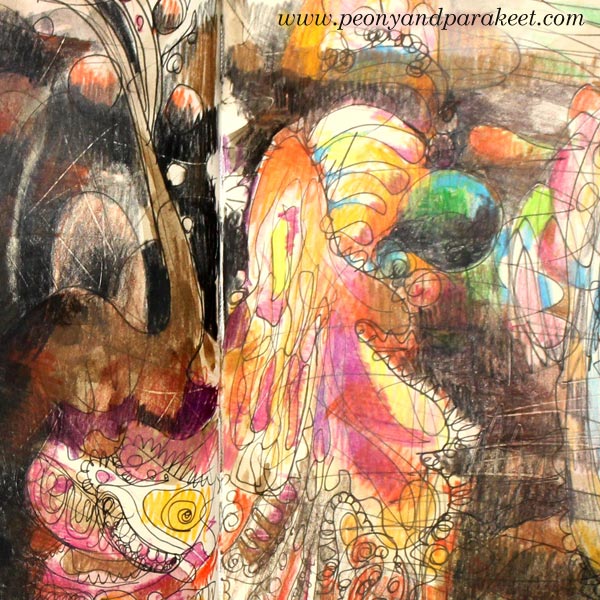
Expressing Inspiration Through Art
An inspirational image can quickly touch hearts but drawing and painting is a slower process. We can use images for picking visual ideas but we also need to process the inspiration so that we know why we got inspired in the first place. I believe that the images are like icons that bring up personal memories, points of view and aspirations. If we don’t connect with those, we don’t fully put the inspiration into use for art making.
At the first version of Inspirational Drawing, I showed a method for using an inspirational image as the source of ideas for a new drawing. At Inspirational Drawing 2.0, I introduce an improved process. It helps you to use one or more images as an inspiration source, connect with the thoughts and feelings that they evoke and create unique art from there. First, I show samples and walk you through a simplified process. Then I help you to create a bigger project that uses many kinds of inspiration along creating.
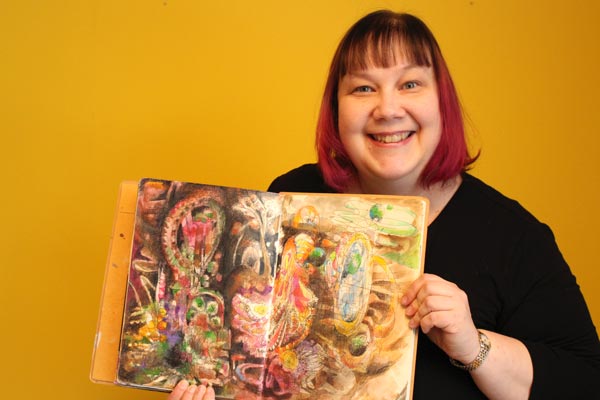
Claudia Watkins, one of the students says: “Paivi is a very profound lady. Her insights are amazing. Although having a technical background, Paivi sees beauty, philosophy, and art in everything. Paivi has helped me a lot in my art journey.”
Express Your Inspiration: Sign up for Inspirational Drawing 2.0!
Mixed Media Seascapes – 5 Tips for Expressive Art
Notice the new, useful categories for the blog posts, see the sidebar “Posts by Theme” or if you are in mobile, see the end of the page!
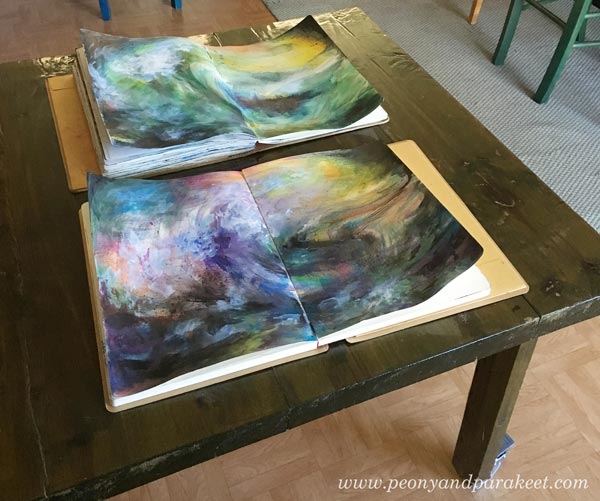
Sometimes I regret creating my art on the journals. When I created these mixed media seascapes for the mini-course Stormy Scenery, I wanted to keep the journals open and visible for days just to get back with the process and look at all the colors. And when I saw what my students had created, I secretly wished the same – that not so many weren’t in journals but frames. I want to share some art made from the mini-course and share some tips for expressive seascapes.
1) Play with Colors!
When creating the waves, show how the water reflects the colors of its surroundings. When there’s a storm, there will be a lot that’s moving, and it will affect the colors too. You can show your current state of mind as the sea and bring out the variety of thoughts and feelings. See how Claudia Watkins has made a row of waves with various colors.
2) Create a Connection Between The Sky and The Sea!
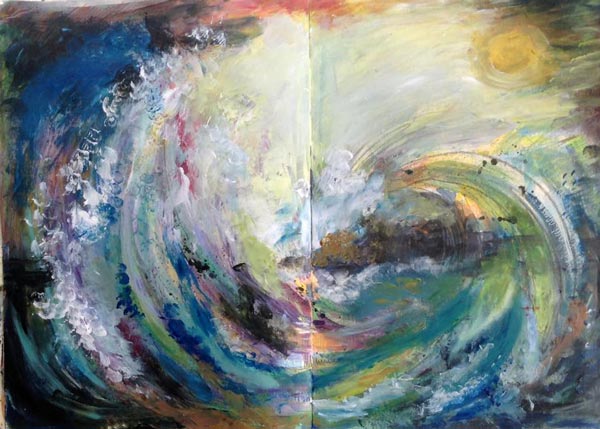
If the sea represents you and the sky represents the outside world, how do they interact? Susan Rajkumar has expressed the connection in a brilliant way. It looks like the sea is willing to hug the sun and the overall feeling of the piece is warm and happy.
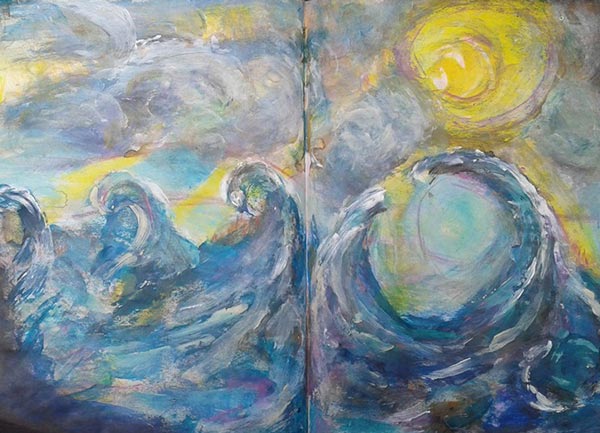
Sheila McGruer’s sun has left the sea, and it has caused an explosion of energy.
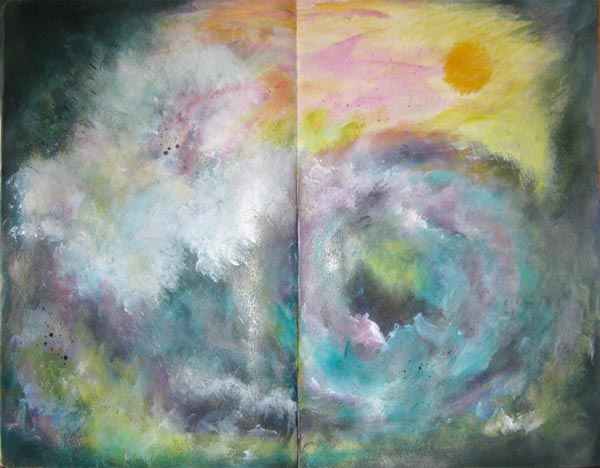
Sheila’s piece also has the softness which takes us to the next tip …
3) Express the Softness of Water
Cheryl Rayner shows the softness with both long strokes and splashes of water. With softness, you can practice gentleness towards yourself and others.
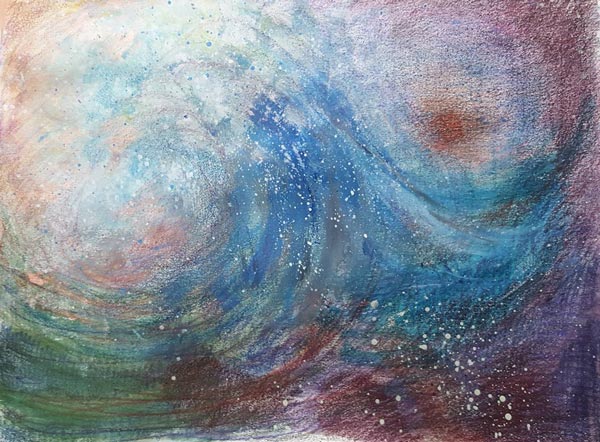
4) Show The Movement of The Waves
Enjoy the transformation that happens when you focus on creating art! Strokes and lines express the movement. Lorraine Cline’s green sea is captivating because it’s wonderfully dynamic!
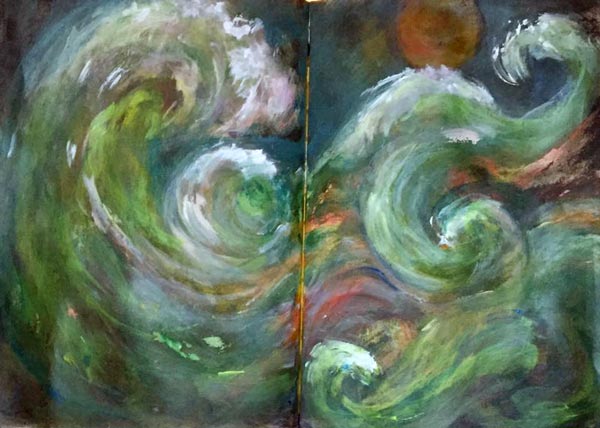
Terttu Laitinen has the great eye of the storm.
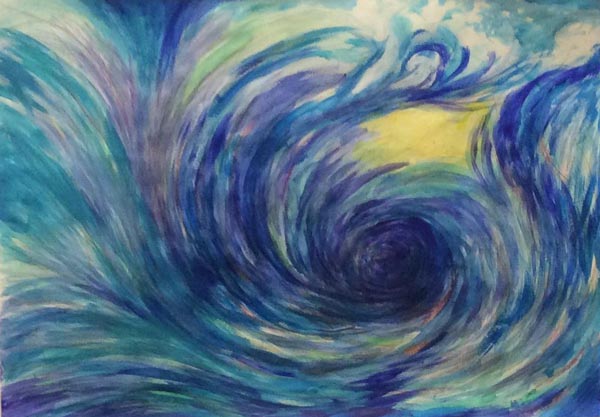
5) Make The Scene Look 3-Dimensional!
In any scene and any mind, some things are closer, and some things are further away. Add more 3-dimensional look to make some elements more blurry and some sharper than others. Satu Kontuvuori has a striking focal point where sharp white waves are on the top of the blurry black eye of the storm.
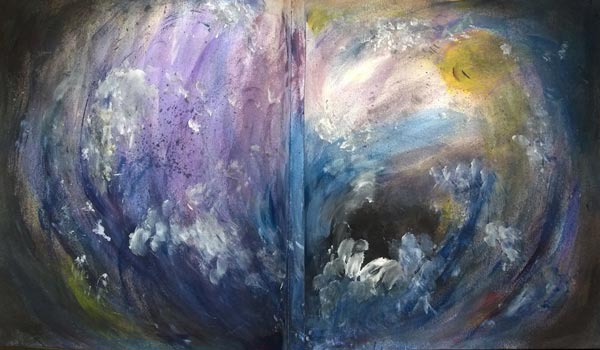
Mackie d’Arge also has a clear focal point and lots of less defined splashes around it.
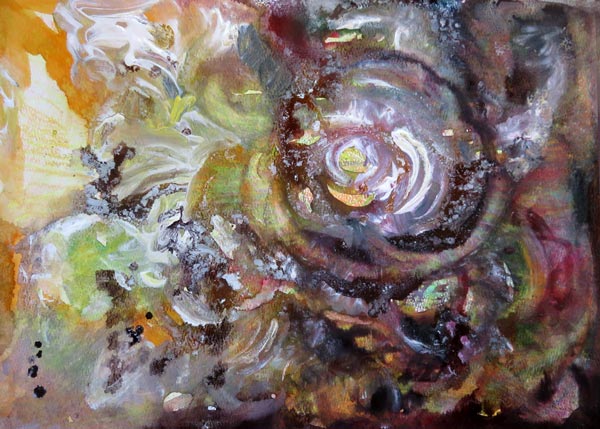
Internal Seascapes – Connect with Your Internal Energy!
The mixed media seascapes shown in this blog posts are made from the mini-course Stormy Scenery which was part of my Imagine Monthly Spring series last year. You can now purchase it individually too. When creating Stormy Scenery, I was inspired by the long chain of seascape painters, especially by J.M.W. Turner and Ivan Aivazovski. I also have a Pinterest board called Internal Seascapes where I have collected inspirational sea paintings.
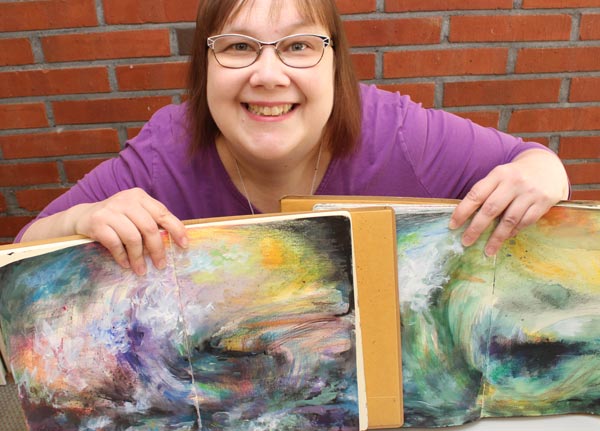
But in Stormy Scenery, more than just to paint the sea, I coach you through the process of opening up and bringing out your expression. With the mini-course, you are not so much mimicking the sea outside but expressing the power inside. I believe that every artist has a unique power as well as every day has a unique energy.
Create Mixed Media Seascapes!
Use colored pencils, watercolors, and acrylic paints to create expressive mixed media art!
>> Click here to buy Stormy Scenery!

Mixed Media Drawing Tutorial – Create Step by Step!
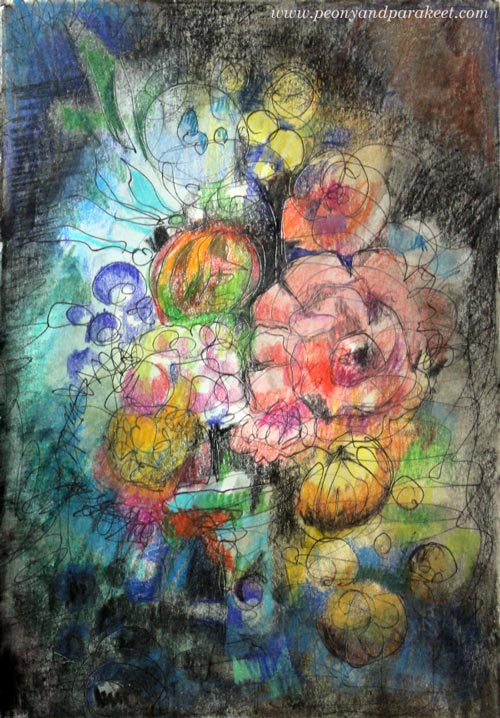
With this blog post, I want to encourage you to
… draw from imagination
… fall in love with the combination of water-soluble media and colored pencils
… find inspiration from art that has been created hundreds of years ago
Inspiration from Old Still Lives
A few weeks ago, I visited a small art museum called Sinebrychoff Art Museum in Helsinki. I have visited it many times because it’s a cozy old building and small art exhibitions are refreshing more than overwhelming. One more reason is that in Finland you can buy a museum card for about 65 EUR and it gives you free access to most of the Finnish museums for a year. It became available in 2015, and since then I have visited museums more than ever before in a year.
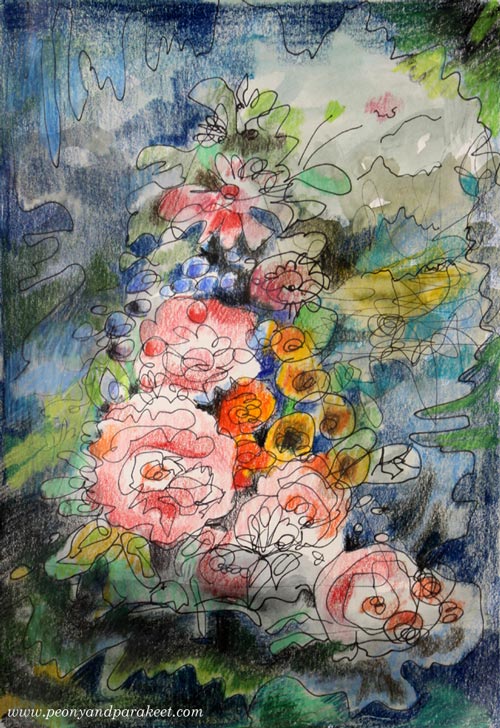
The exhibition at Sinebrychoff Art Museum was about old still lives, painted in the 16th to 18th centuries. I have admired those old, elegant paintings with beautiful flowers and fruits of all sorts for a long time. I have a Pinterest board dedicated to the most luxurious still lives, and I often bring up little things that I have learned from watching them in my classes. So no wonder, I was very inspired after seeing the exhibition, and I had to create a small drawing just to let my imagination play with the memories of beautiful paintings.
Mixed Media Drawing with Imaginative Fruits and Flowers
I picked one of my art journals, a Daler-Rowney’s Graduate Sketchbook, and a black thin-tipped drawing pen that has permanent ink. I prefer sketching with a permanent pen rather than with a pencil. Not being able to erase anything makes me more creative. Using permanent ink allows me to play with wet media as well.
First, I started doodling from the edges towards the center. Then I added some watercolors on the top of the doodling leaving the center blank.
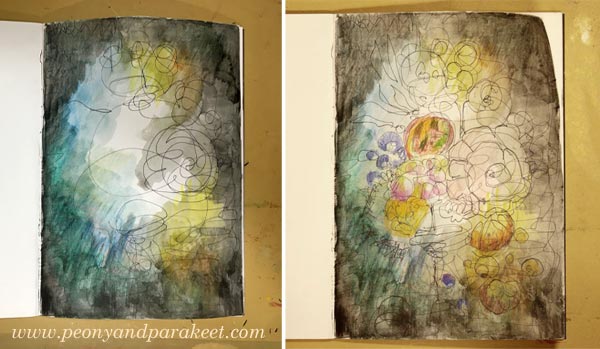
Once the watercolor was dry, I added more doodling in the center and finished the page with colored pencils. The dark background makes the colorful flowers and fruit stand out.
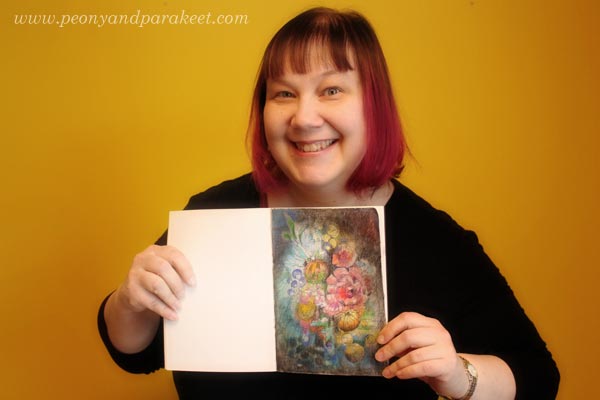
This process was so simple that I wanted to make a small tutorial for another page inspired by old still lives. So here it comes!
Mixed Media Drawing – A Tutorial
1) Set the composition with simple shapes. Draw a big shape and then a smaller one. The shapes can intersect.
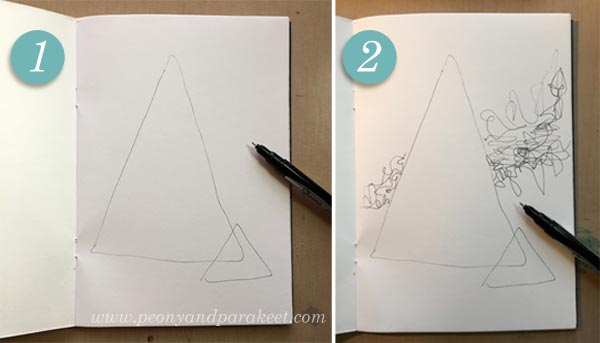
2) Add the horizon by doodling. I wanted to make the drawing dynamic by giving the horizon a diagonal direction.
3) Paint the background leaving most of the shapes blank. I used watercolors, but you can use any water-soluble media like inks or watercolor pens. Just make sure that your lines will show through because it’s part of the visual appeal. Use more than just one color so that your painting inspires you in the next step. Let dry.
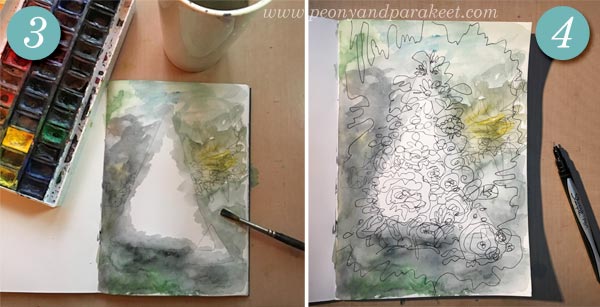
4) Doodle your heart out! Without raising your pen from the paper, doodle over the painted background and on the center too.
5) Color the drawing with bright colors and dark shadows. I used colored pencils, but you can use almost any media for coloring. For example, felt-tipped pens work great. You can also continue to use water-soluble media for coloring. Add dark colors between the flowers and the leaves. Leave some of the painting made in Step 3 visible so that your drawing breathes.
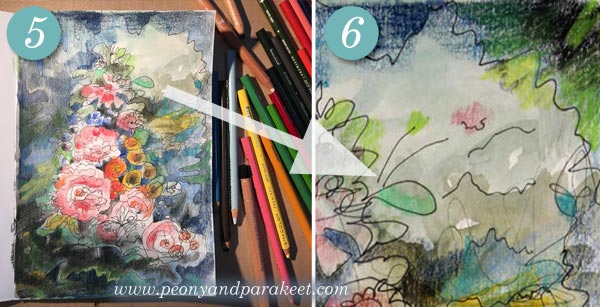
6) Add the final touches to balance the drawing. I added some lines to make the elements in the background more explanatory and a tiny flower that looks like it’s reaching them. I also made the top right corner look similar to the bottom right corner to highlight the diagonal composition in the background.
Mixed Media Drawing – Say You Want to Explore More!

1) Enjoy Drawing from Imagination!
At Inspirational Drawing 2.0, you will quickly get in touch with you living line and lively imagination. You will also get personal help to finish your pieces so that they are meaningful and appealing to other people too.
>> Sign up for Inspirational Drawing 2.0!

2) Practice Merging Painting with Drawing!
Learn to merge drawn areas with painted areas and play with shadows! Flowing Greenery is a self-study class with two projects, a small still life, and a bigger landscape.
>> Buy Flowing Greenery!

3) Get Creative with Colored Pencils!
Coloring doesn’t have to be stiff or boring. Learn to color freely whether it’s coloring a drawing or creating intuitive art directly on a blank page!
>> Buy Coloring Freely!
Traveler’s Notebook as Art Journal
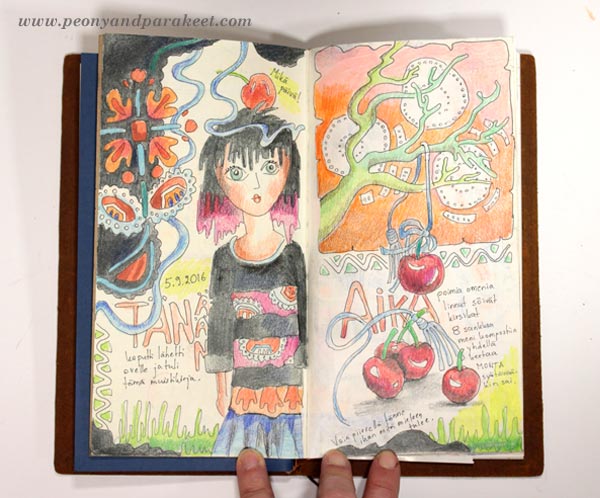
I ordered a Midori Traveler’s Notebook last year, in August. I couldn’t help myself because based on Instagram, it seemed to me that everybody had one! I was curious to know what’s so special about it. Midori Traveler’s Notebook is practically a piece of leather with a binding system for small notebooks, often referred as “inserts.” I also ordered a few blank inserts. When I received the set at the beginning of September, I wasn’t so impressed. I didn’t like the smell of the leather, and the paper in the small notebooks was so thin that writing showed through. But I knew many of those who make planner pages had changed to a Traveller’s Notebook, so had many scrapbookers and art journalers. I had to try it!
Traveler’s Notebook as a Visual Diary
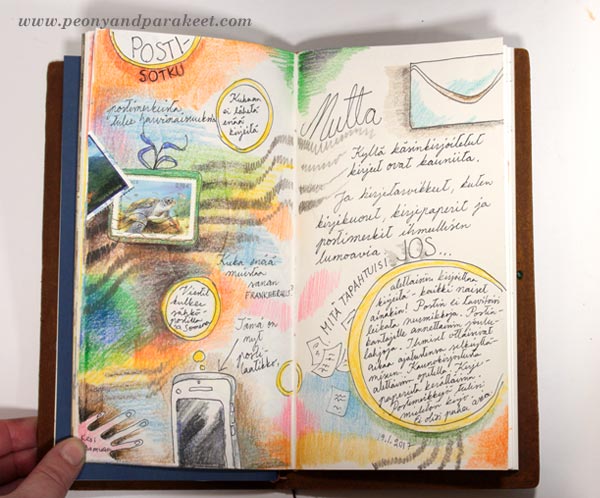
I decided to start a notebook where I combine journaling and drawing. It would be a kind of visual diary where I would add random thoughts and illustrate them. I began with daily events, but once I got the hang of it, I wrote more openly about anything that came to my mind. Like in the spread below, I write about how Finnish Post is in trouble when people don’t send letters anymore and when the postbox is on the phone rather than anywhere else. I also speculate what would happen if people suddenly started writing letters again.
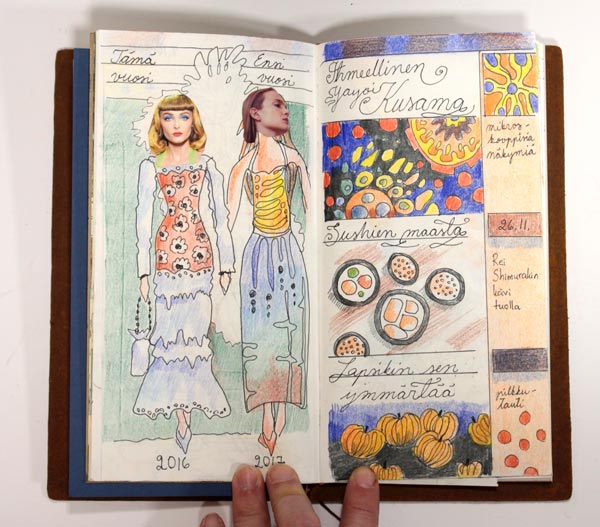
In the next spread, I show the current year and the next year walking side by side on the left page. The right page is inspired by a Japanese artist Yayoi Kusama and her inspiring exhibition in Helsinki Art Museum.
Supplies for Traveler’s Notebook
I mostly use a thin-tipped black drawing pen and colored pencils. I sometimes add a little bit watercolor or water with watercolor pencils. Random collage pieces are also used, but I mainly use thin paper so that the bulkiness doesn’t affect my drawing in the next pages.
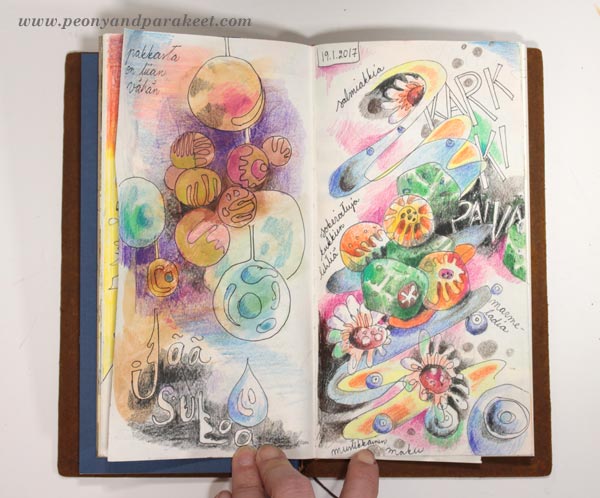
Alternating between Words and Images – Watch the Video!
I don’t sketch but just start by drawing a small motif or writing a couple of words. While creating a page, I like to maintain a dialog between drawing and writing. A written thought leads to a visual element and vice versa. To show this technique I have created a short video where you can see me writing and drawing, and at the same time, I show some ideas about what you can put in your notebooks.
Because the video is quite small in size, here’s a close-up of the page that I am creating in the video.
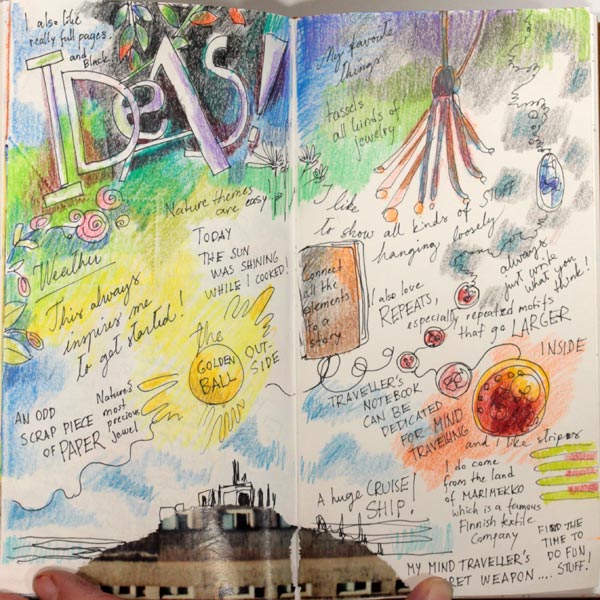
And here’s the video which shows a few more pages too.
Get more ideas and enjoyment by drawing!
>> Sign up for Inspirational Drawing 2.0