
Selling Watercolor Paintings as Gifts
This week, I talk about making and selling watercolor paintings as gifts. At the same time, we celebrate the playfulness of watercolors.

See more and bigger pics at Taiko (online art store)
I love gift shops. My dream for a long time has been that, in addition to large oil paintings, I could sell smaller pieces as gifts. Recently, this has come true. I have sold many of my watercolor paintings not only directly but also via the Taiko online art store and the Gumbostrand Konst & Form gallery.
Art as Gifts vs. Art for Homes
An art buyer never buys art just for need. The work must appeal to the buyer on a deep level. Still, large paintings are chosen more according to the interior, and smaller ones are purchased as gifts. Sometimes a small painting is a gift to the buyer himself, often to someone else.

As a professional artist, I am more known for oil paintings, but I have dreamt that also my watercolor pieces would be in demand. I love to paint them and the idea of a perfect gift inspires me. However, it has taken time to grow my vision of how they should look.
Because I have grown many of my general painting skills with watercolors, my watercolor paintings have quite a similar style to my oil paintings. But with watercolors, I step in a slightly more illustrative direction. I want my watercolor art not to be too abstract, but approachable and atmospheric. See a collection of my recent watercolor paintings here!
Flower Art But With a Playful Attitude
My watercolor pieces usually have flowers. However, I don’t paint just static and spiritless flower arrangements. I see flowers as adventurous human or animal figures and get playful with them. On the one hand, the flowers are like dolls and teddy bears, and on the other hand, they are imperfectly perfect, feeling natural and real.
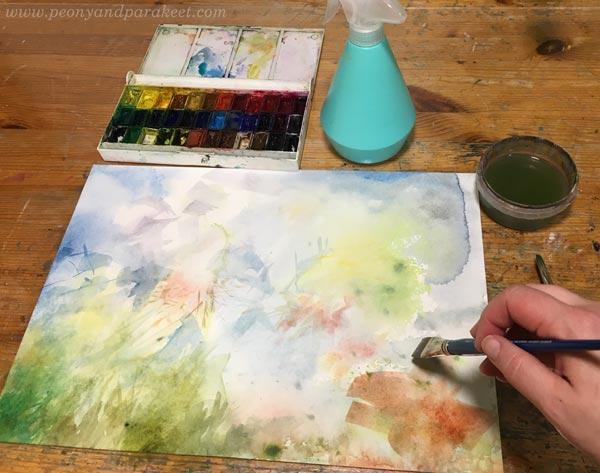
When the playfulness really kicks in, painting is fun.
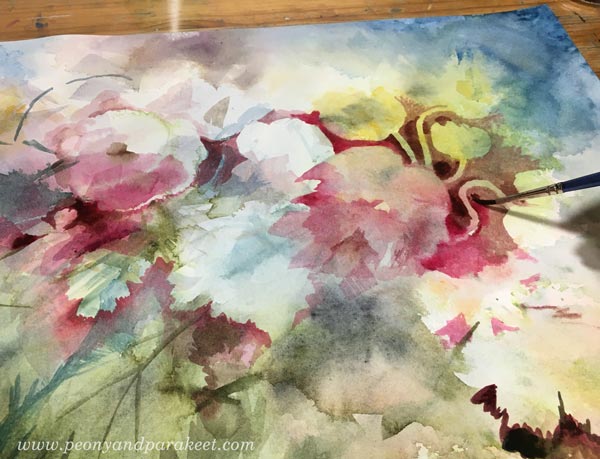
I love to discover plants in the middle of random watercolor spots. I have also a course called Freely Grown about this kind of process.
Taking Several Sessions to Grow the Idea
Usually, the first layers of the painting are fast and only take an hour or two. But that’s when the painting is just a regular flower painting, not a special piece that has a special appeal. Within a couple of hours, there’s not much time to grow the idea further or adjust the details.

I usually paint in several sessions where the first one or two lay the foundation and produce the basic painting, and where the next sessions (usually 2 to 4) grow the story and produce the finished look.

For example, for this painting, I took walks to see flowers and to add some more to the painting. But after a while, that felt too traditional and then decided on the gold mining theme.

The further I go, the smaller the brush strokes become.
Working with a Progress Photo
I find it helpful to take a photo of the unfinished piece, and then use it as a reference. The small-sized picture makes it easier for me to spot the areas that still need adjusting.

Looking at the photo also helps with distancing myself from the actual piece. I can ask: Do I love this? Would I buy this? When selling watercolor paintings as gifts, never underestimate the quality, always try a little higher.
Color over Color
Pigments are very different from each other. Some colors require many layers, and others can be used very thickly. Most artist-quality yellows have good coverage and work well for the finishing touches.

I have recently used smooth (hot press) watercolor paper because it’s best for tiny details.
Gentle Breakthroughs
I want to break boundaries with all my art, but in watercolor, I try to do it more gently than usual. In this painting, the flowers have caught Hokusai’s great wave from Japan and taken it to Lapland to pan for gold. And so it happened that the gold and the flowers started a decorative baroque party and everything small became surprisingly big and grand. Despite all this, this is a flower painting where the viewer can relax and enjoy the joyful atmosphere.

But whatever the story is, I try to express it so that it can evoke different memories and associations in different people. Somehow, the painting must make a gentle breakthrough in the eyes of the viewer – find a soft spot where the immersion can begin.
See more pics of “Kultaa huuhtoneet – Gold Panners” at the Taiko art store!
Freely Grown – Paint Watercolor Flowers with Me!
In the course Freely Grown, I walk you through my watercolor painting process. Because the finishing touches with a small brush are the most challenging, we take the easier route and do them with colored pencils. In Freely Grown, you paint flowers freely without reference photos and create a unique painting from the given techniques and guidelines. >> Buy here!
Colored Pencils – Ornamental Approach
This week, we take an ornamental approach to colored pencils! We will color freely, but so that we don’t start with a blank paper.

This is the piece I am creating in the video. The process is fun and the result is ornamental.
Ornamental Approach – Watch the Video!
To get started, you will need drawing paper, pencil, eraser, ruler, and round templates, for example, plates or lids will do.
I hope this kind of ornamental coloring inspires you to start and keep going!
Joy of Nature in Colored Pencil
This week, we learn from nature and bring its joy to our colored pencil art.

It makes me sad how colored pencils are used only for replicating photos, and how little there is room for free expression. Nature grows freely, so why not give our art the same opportunity? I hope this post inspires you to do more intuitive coloring!
Joy of Nature: Patchwork
Think about nature sceneries as crazy quilts that have fabrics and seams! The fabrics are larger areas and the seams are lines. Patchwork has short seams, so keep your lines quite short too.

When you walk in nature, stop, and see the quilt by searching for the mesh of trees and bushes. Observe how twigs cross over each other and form nature’s patchwork.
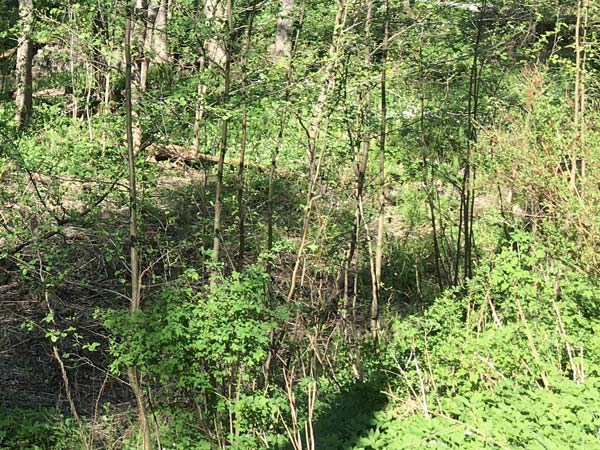
Then when you start coloring a blank paper, focus on building the asymmetric and abstract style quilt, rather than thinking about trees and such.

I find this kind of “patchwork coloring” a lot of fun. Many call this mark-making, but I like to think about creating a patchwork instead. Marks are a more abstract term but textiles connect me to the creative world that is full of ideas.
Joy of Nature: Harmony
Despite its patchy structure, nature sceneries have harmony that our art often lacks. When you walk in nature, step back to admire the big picture and point out the areas by their dominating colors. You could think that the sky and earth both have a few quilts: patchwork areas that mostly have similar colors.
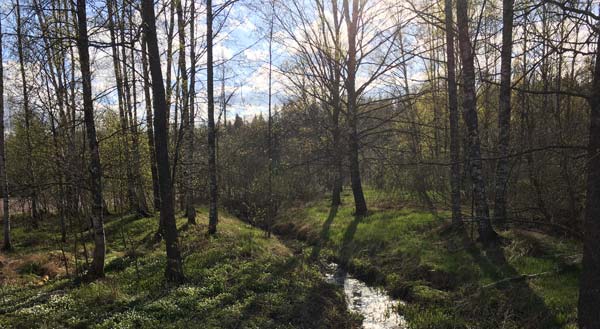
So, when your paper has all kinds of patchwork, compose larger areas by coloring over them so that they get a stronger identity in color. For example, you can have a couple of green areas, a dark area, a more neutral brown area, and one with very light colors.

So, first, you start coloring gently with a wider color scheme and then add larger unified layers over the colorful patchwork.
Joy of Nature: Spirit
I like to think that light is nature’s spirit. When you walk in nature, seek for this spirit. You miss the spirit, if you only point out the big concrete things in the scenery like bushes, trees, water, and sky. To see the spirit, you have to step into the abstract world and look for the light: odd shapes on the trunks of the trees, pattern play on the leaves, and in general, all kinds of small reflections.
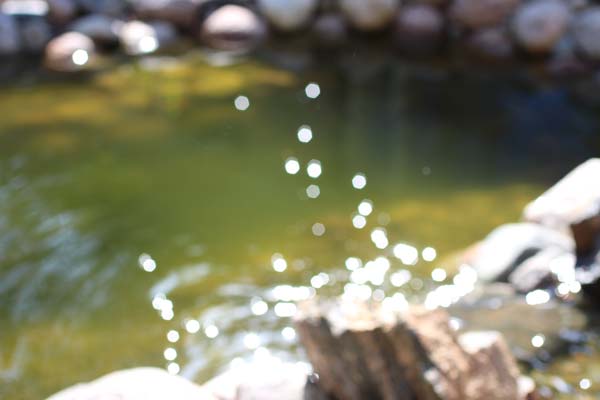
For me, it’s helpful to think that the spirit has twins. One is the light and the other is the shadow. When you want more light, you will also get stronger shadows.
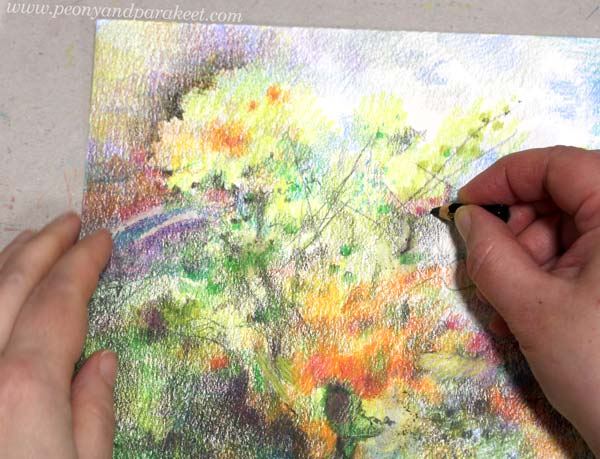
Light and shadows add contrast and scatter. When you add them to your piece, it becomes less harmonic, but also less boring.
Joy of Coloring Small
Recently, my colored pencil pieces have been quite small, and the paper has been divided into smaller pieces.
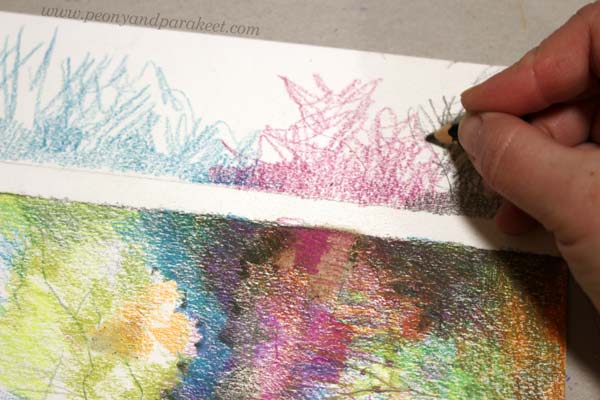
Coloring can be a bit like weeding: you can do it little by little.
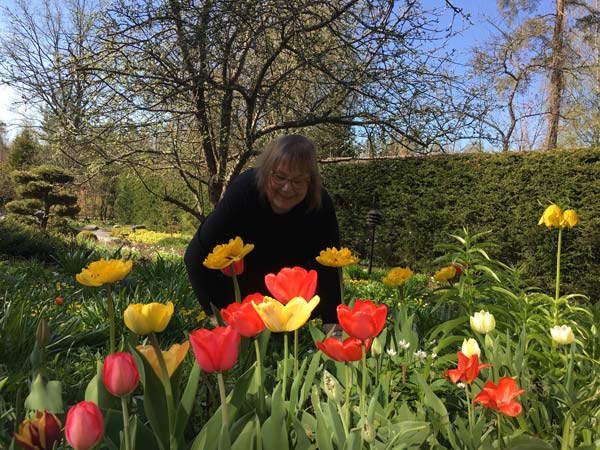
First, the result is nothing, but it will bloom over time.

Colored pencils beat other supplies when we are creating this kind of small joyful art.
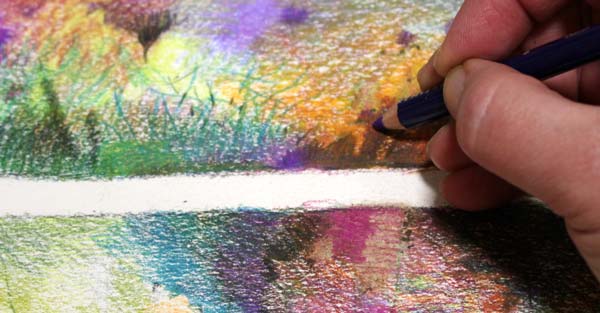
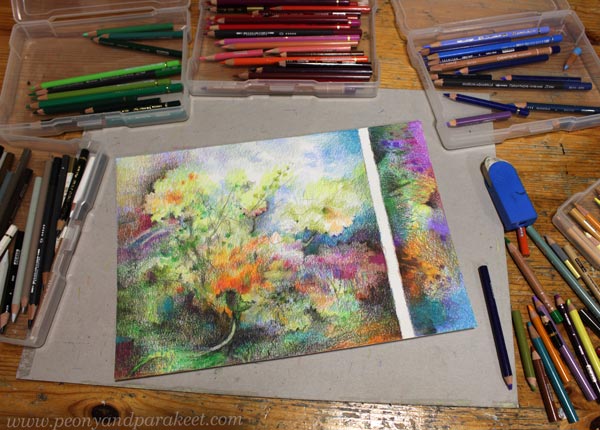
Here one A4-sized paper has two pieces of colored pencil art. So, you can take short walks or long walks to express the joy of nature in colored pencil.
Mother Nature is the best art teacher. That’s why most of my classes are about what I have learned from her.
Coloring Without Limits
This week, I want to talk about colored pencils and coloring without limits. You can color without a preconceived idea, without outlines, and without sketching.

You only need to feel drawn to one color first. Recently, purple-blue has called me.
What to Draw?
Have you ever been thinking about what to draw when everything in the world seems to be drawn already? Maybe you too have wondered whether you draw a face, a bird, or a flower, and if so why. But there is always a secret path in art – the possibility to deviate from the traditional path at the very beginning and see what appears on paper freely.
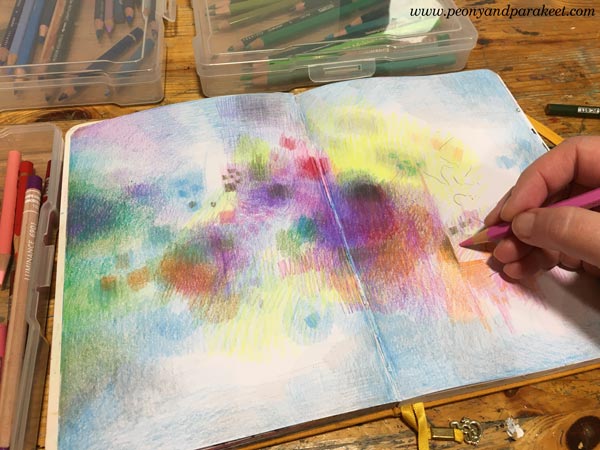
I have a small colored pencil journal where it’s easy to make a spread now and then.

This was a quick and fun little project.
Choosing Paper with Colors
The smoothness of the paper affects the coloring experience. Single strokes are better visible on smooth paper.

My colored pencil journal has very smooth paper, and I find it less effortless to color than a rougher one.

But when I want the colors to shine more and achieve a little blurrier and thus a softer result, the paper is better when it has some tooth.

I currently have a pad of Fabriano Accademia drawing paper and it’s very nice with colored pencils.

I keep my pencils organized by color. All brands are mixed in one box. Some are watercolor pencils, some are regular, and all of them are in the same mix.
Just Start! – Two Tips
Bring the pencils to a place where you can see them often. And then …”Just start!”
Sometimes it’s easier said than done. When getting started feels like a chore, I have two tips for you.
First, let the color do the talking. Pick a pencil and examine it’s tone. Color lightly first, and then bring in more layers. Every color has a spirit. Connect with it like it’s your pet or an angel. You don’t need to rationalize why you feel drawn to this or that color. Find the pencil that resonates the best with your current self.
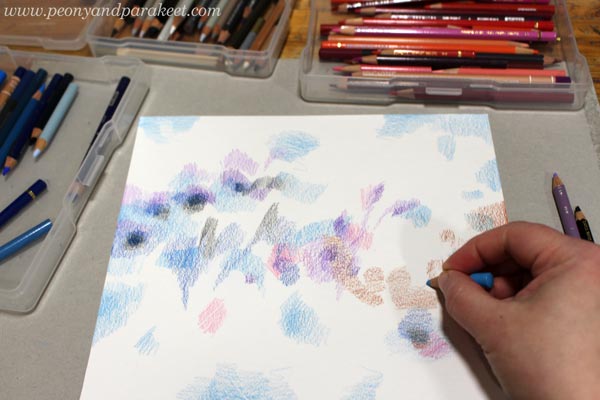
Second, give the color at least two other colors as friends. Often one color is very little, but when it’s side by side with two other colors, art will appear. A shape that has only one color is flat but with two other colors, it becomes much more lively.
Colored Pencils Say This All The Time
I know many colored pencils complain that they always have to create something figurative and realistic. They envy paints who can roam freely on paper and how people only smile at their tricks. Colored pencils are too often squeezed tightly and pressed hard against paper at the very beginning. They have to follow strict discipline and are under pressure to produce something that looks real. And when they try to do exactly as they are told, the result is stiff. “Nothing like what can be achieved with paints,” their owners say which makes the pencils sad. If they could choose they would be coloring without limits.
I believe in free education when it comes to colored pencils: “Make what you want and enjoy!” I often say to them. “Imagine that you are something more than just pencils!”
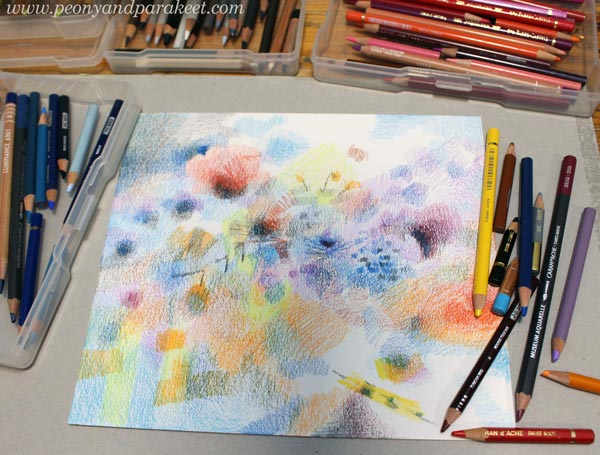
My pencils jump out of their boxes and do all kinds of silly marks. They are like paints.
Without Limits – Imagine You Are More!
In art, it is terribly important that we imagine to be more than what we are. Be more skillful, more innovative, more unique, and more important. Then, at that very moment, the pencils, life, and fantasy cannot be separated. The colors speak inside us and the art steps in.

Love of Coloring Without Limits
When I was a child, colored pencils often kept me company. They still bring me joy and I want to keep staying their advocate.

Get 20 % OFF from the classes Intuitive Coloring and Fun Botanicum!
The sale ends on Sunday, May 5, 2024, at midnight PDT.