
Design Principles Translated to Intuitive Painting
This week, I talk about design principles for intuitive painters. This is for you who paint because it’s a spiritual act!
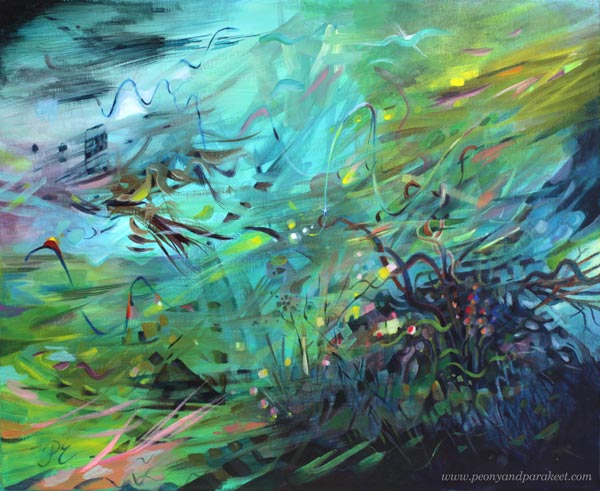
While making this acrylic painting, I thought about how intuitive painters often feel a disconnection with general art advice like “make sure you have a focal point.” Even if I teach online classes, I often find advice that solely focuses on the technical part misleading because it talks so little about artistic expression and the experience of making art. Design principles can be like a bible for technically oriented people and a blank book for those who want to approach the subject more emotionally. But it doesn’t have to be like that!
Design Principles and Intuitive Painting
Intuitive painting differs from following a predefined idea, a reference photo, or a sketch. Let’s take the focal point as an example. Intentionally, you should start what matters the most and make it noticeable. This way, you have a clear focal point, and your painting delivers a clear message. But when you paint intuitively, there’s no message when you begin. The painting process is about connecting with your spirit and being open to what wants to come out. Here’s what my painting looked like after the first layers. Yes, there’s some resemblance with the finished piece, but not so much that the advice would make sense.
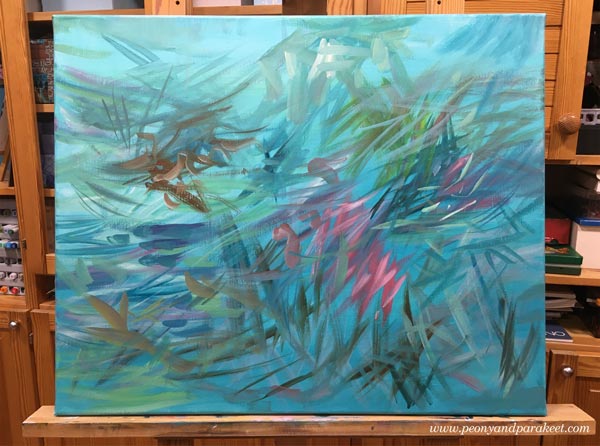
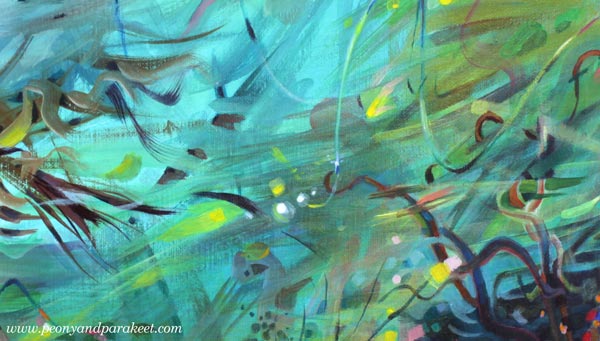
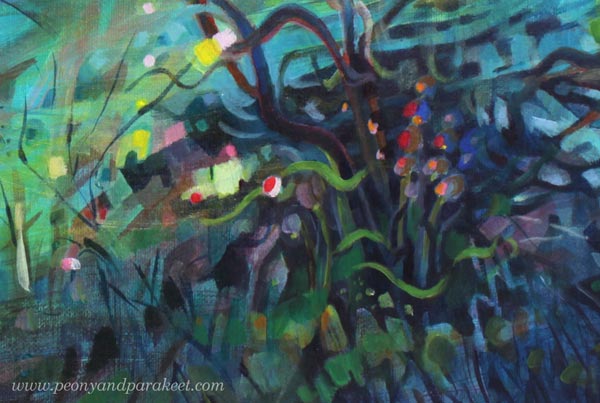
The focal point (the small pale yellow rectangle in the dark area) and its supporting element, the row of white dew drops, were added much later. Here are the dewdrops and the many layers more closely.
On the other hand, I don’t agree with those who say that lighting candles and taking a spiritual mindset should be enough. There are also those who believe in natural talent – that you either can or can’t paint – which I most strongly oppose.
For me, intuition is about bringing knowledge and creativity work together and listening to what they have to say. When I want to move forward, sometimes it’s about growing my knowledge, sometimes increasing my creativity, but often it’s also getting better at listening – quietly observing what the painting wants to become.
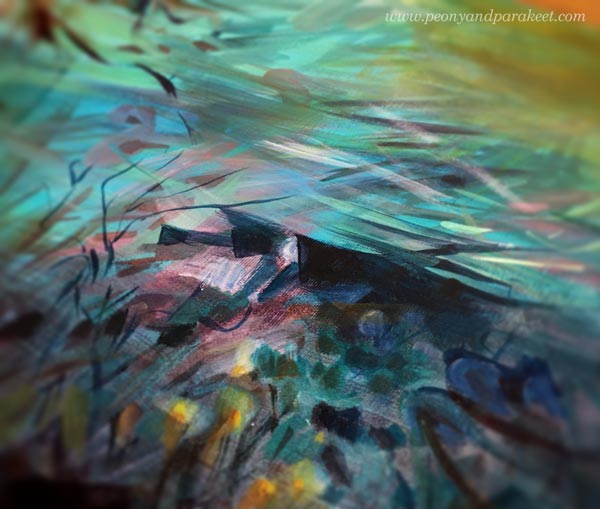
When I notice a shape that looks like it’s whispering to me, I want to strengthen it. And sometimes, these shapes later disappear under new ones, but they still showed me the way.
Let’s go through 7 design principles and translate them from intentional to intuitive painting.
#1 Emphasis
In intuitive painting, aiming for emphasis is often about finding a suitable title and adjusting the painting to express the title. For me, painting is quite far before the first ideas about the title come up. However, the first ideas are usually the most conventional ones, so I keep painting and diving deeper.
I thought this piece was finished, when it looked like this. The title that I had in mind was “Windy Tales” or “Wind Blows in a Fairytale.” But it was still too generic, so I kept asking: What fairytale?
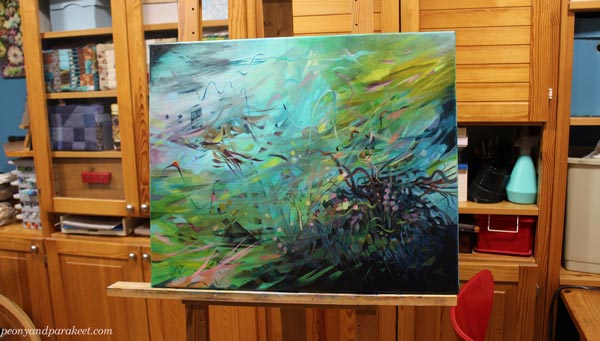
After the painting session, knitting late at night, I got the answer: Snowwhite! So next morning, I added some more white and other colors of Disney’s Snowwhite.
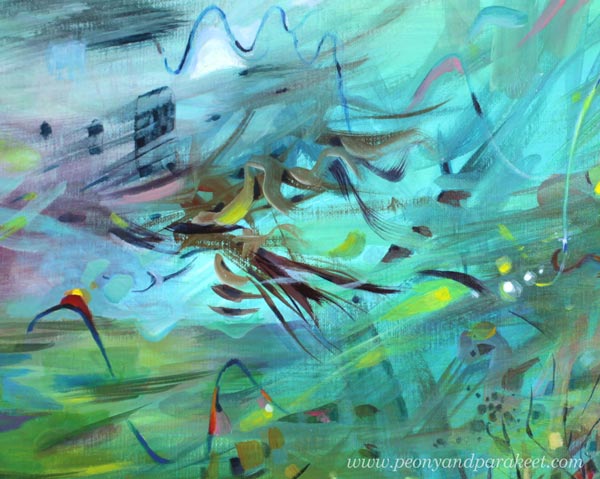
I feel that these small adjustments released the spirit of the painting.
Intuitive doesn’t have to mean fast. We can take breaks and let our intuition and connection grow between the sessions.
#2 Balance and Alignment
The emphasis needs extra effort, but balancing is what we do naturally and so much that it suffocates expression. Be aware that “intuitive” often become “balanced” and nothing else.
The easiest way to balance a painting is to make it symmetrical. So taking an asymmetrical approach – even just for a couple of layers – makes you more expressive than any meditation! Imagine a horizontal and a vertical line in the center of your work and force yourself away from constant balancing strokes.
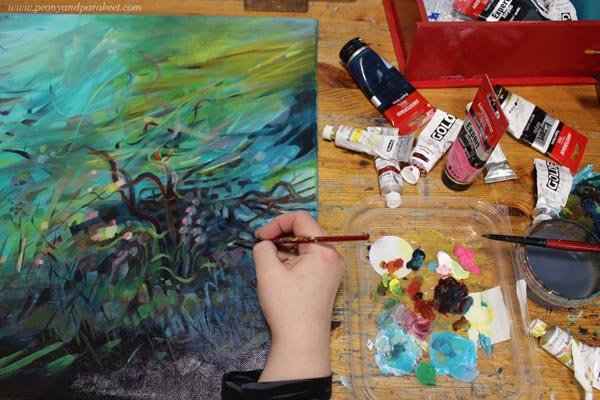
So for intuitive painters, getting off-balance is more important than creating a balance right from the beginning. In the end, you can balance the image with a few strokes if needed.
#3 Contrast
Intuitive painters have a strong connection to colors. I often begin with a specific color combination in mind, and colors feed my ideas. Yes, I like pinks, turquoises, bright yellows, bright greens … but I also have to remind myself that like a spring flower, a spirit of the painting rises slowly from mud.
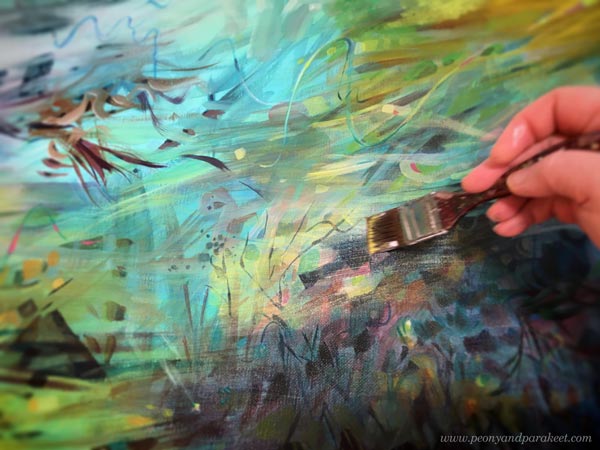
This design principle is not so much having different colors, but having differences in lightness and darkness. For intuitive painters, it means that we have to process colors that we lay on the painting. So not just squeeze tubes, but to create our own color mixes so that the spirit is not only on the paper or canvas but also on our palette.
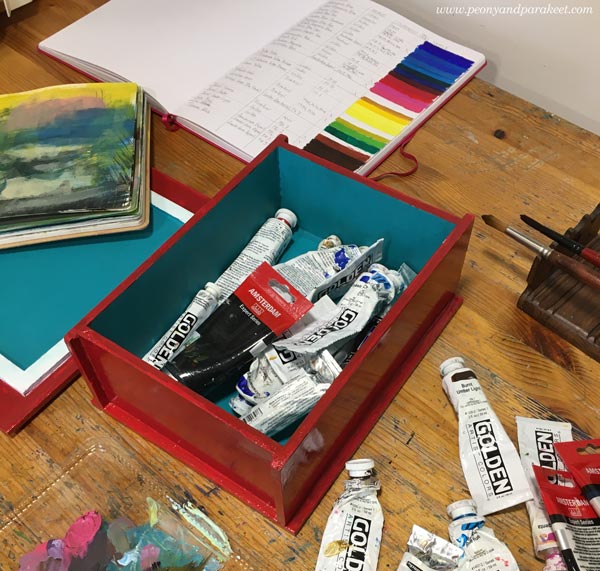
When we slowly create the color mixes, we have time to connect with the tone, adjust its darkness, seek for the genuine response that has a longer-term effect than what has been industrially produced.
#4 Repetition
The best way to think about repetition is to express echo. Instead of constantly balancing your painting by looking at the big picture, focus on one shape that you have just painted and imagine its spirit. How would the shape echo itself?
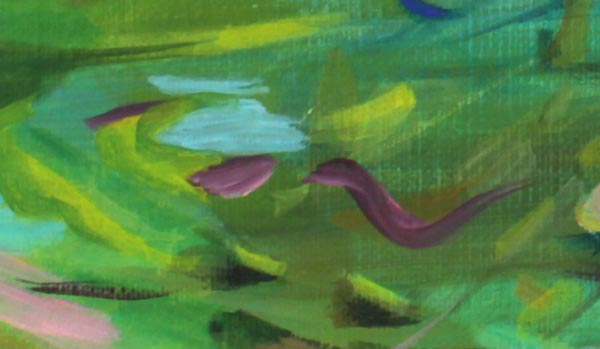
The echo is never identical to the original spirit. The echo is weaker, and there’s never just one sound, but a few.
#5 Proportion
In intuitive painting, we paint energy. Energy gathers to form cells, then clusters that get bigger and bigger. It’s easiest to see these clusters by looking at the painting from a distance or by taking a photo and reducing it.

If your painting is full of clusters, all the energy is static, and you need more openness in shapes and lines. If all the clusters are similar in size, then the overall energy is impermanent and less powerful.
#6 Movement
Intuitive painting connects us with the tradition of storytelling. We don’t just deliver a spirit but a story about its power. In visuals, we can build paths from one element to another so that the eye can effortlessly move around the painting like it’s listening to an impactful story.
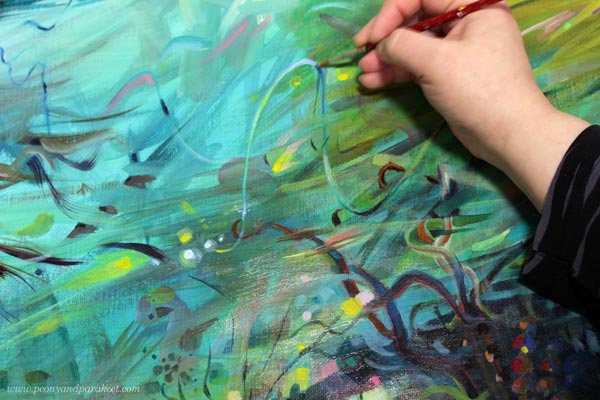
Rather than painting separate elements, connect them with lines or layering one slightly over another. Make sure that all your elements are not round and stop the eye, but pointed that move the eye forward and build flow and movement. So, when you feel the connection with the painting, create connections visually too.
#7 White Space
Intuitive painting is less about arranging space and more about filling space, but white space is still relevant if you think about it as breathing. A painting doesn’t only need a spirit – it needs to breathe. If you paint boldly, everything bland will help with breathing. Adding muted yellows around a bright yellow spot makes the yellow spot breathe.
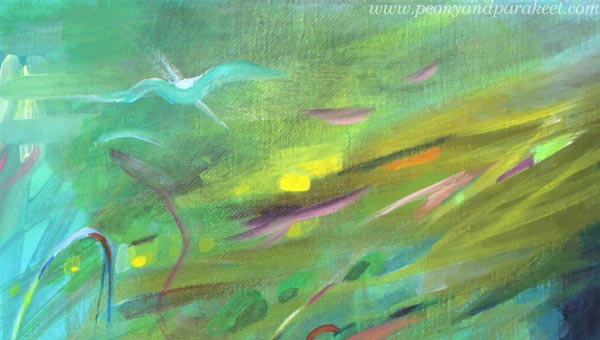
Design Principles Apply To All Art
So, you see, intentional and intuitive painting are not so different after all. The process and the values are a bit different. Still, it’s like humans – we come from different countries and cultures, speak different languages, but with some translation, we can feel togetherness across the borders.
If you like this article, you will love my class Floral Freedom! There I translate Paul Klee’s technical and Wassily Kandinsky’s spiritual teachings so that you can paint abstract florals freely. >> Buy Here!
Expressing Inner Storms by Painting
This post is dedicated to all who have lost their creative inspiration during these challenging times when outer storms cause inner storms too.
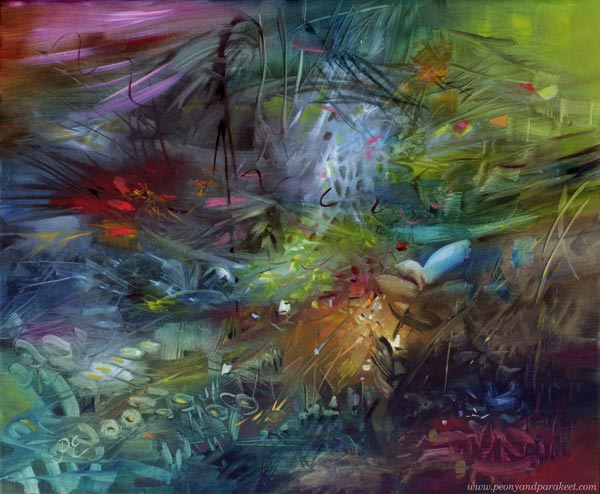
I have always loved art that uplifts and is more on the bright side of fantasy than in the darkness. I have defined myself as an artist who does not express agony or suffering or bring out what’s wrong in society. My art has based on the possibilities of imagination. It’s about the richness of the inner world. “Spiritual freedom” has been my word.
But the longer I have painted, the more courageous I have become. How flowery do my paintings have to be? To free up my art and to free up my thinking as well, I have begun to accept all kinds of shapes, colors, and emotions. The same flowers that bloom in my watercolor pieces become little monsters when I paint more freely in oil. It’s like there’s a new world under the inner world I only used to know.
Painting Inner Storms
At the end of January, I started a new big painting. It had dark colors, but I intended to brighten it. “When the time is right, I will make it more cheerful,” I promised to myself. Weeks went by, and it always felt like I had something more important to do. I didn’t have the energy, or I had too much energy. The more I postponed the finishing, the moody I became. “This pandemic gets to my nerves,” I said to my husband.
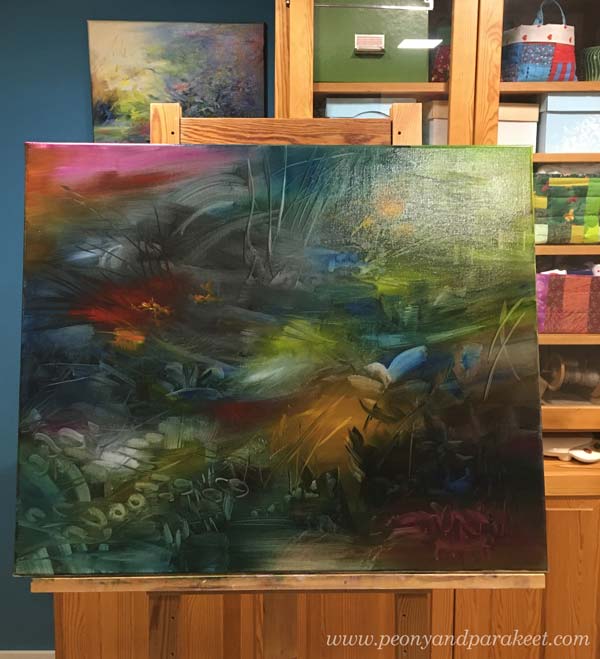
But when my spirit got more and more low, I had to do something. One night I picked paints and brushes, abandoned all the happy stuff I was creating and continued the painting. The brushes felt heavy at first. The paint tubes were like stones. But then I remembered the magic words: “Päivi, you can paint!” This confidence, even if it always feels false first, energizes my strokes and thoughts. The painting begins to speak to me, and my responses become more and more natural.
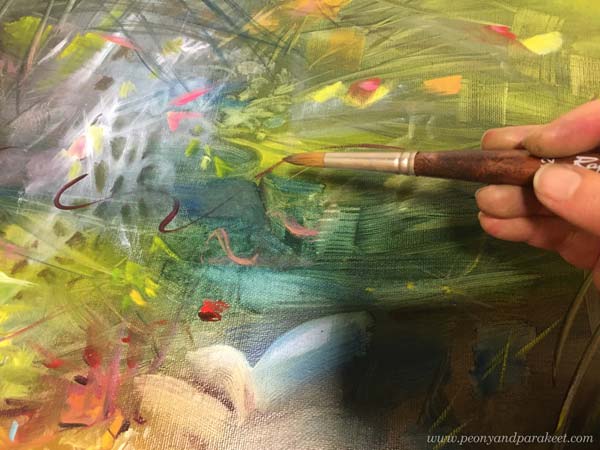
This Too Shall Pass
“What are you painting, Päivi,” I heard my inner critic saying after a while. “The piece is still very dark.” My immediate answer was: “Yes, it’s dark, but this too shall pass.” At that moment, I knew the name of the painting and why it should not be forced to look more cheerful. Inner storms can be as beautiful as the happy moments and little monsters as clever as any flower.
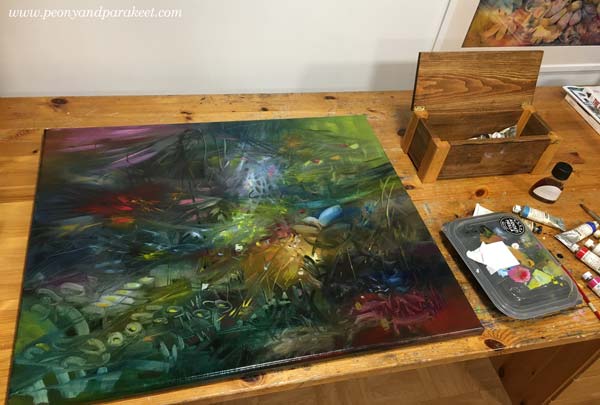
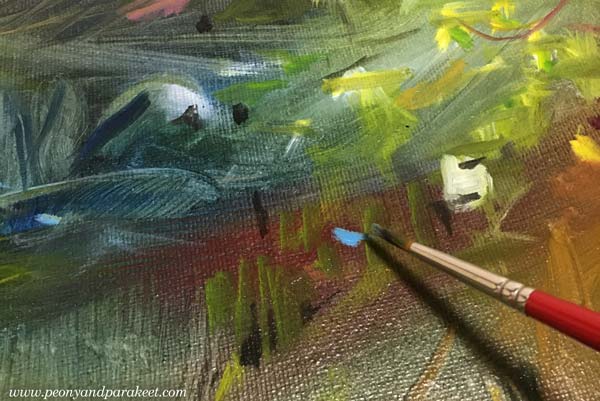
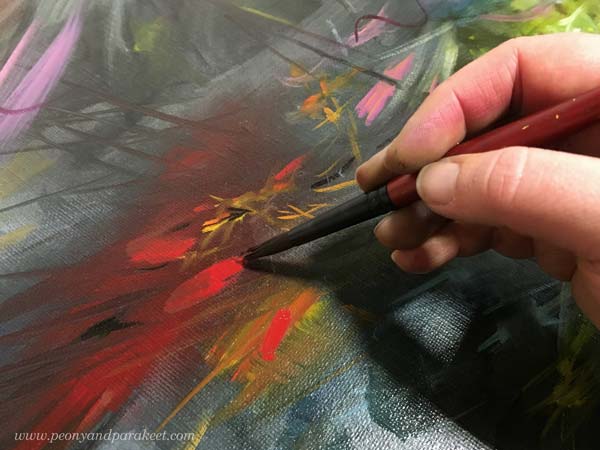
When I woke up the following morning, my mind was calm and still. And when I look at the painting, it gives me hope no matter how stormy and gloomy it seems.
Here are some detail pics.
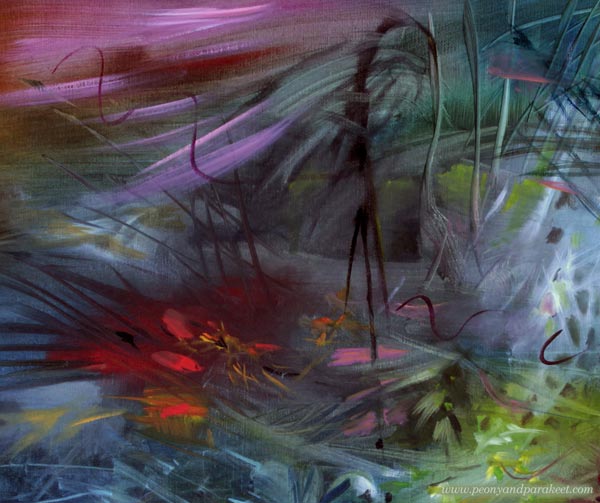
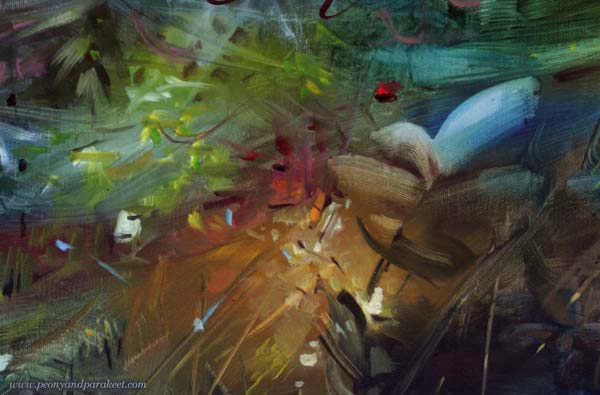
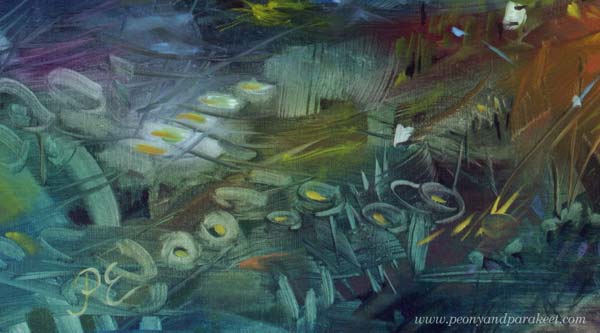
Here’s the whole painting again.
Sometimes the lack of inspiration is a sign of not letting out what needs do so.
Have a creative Easter!
P.S. My abstract painting class Floral Freedom is now available as a self-study. Watch the video below!
My free painting style is based on Paul Klee’s and Wassily Kandinsky’s timeless teachings presented in this class. >> Buy here!
Create for the Inner Child – Painting and Drawing on Scraps of Paper
This week I have a new free video for you! It’s about using small paper scraps for playing and dreaming, but it also goes deeper. I hope you’ll enjoy it!
Whether you want to play, be “on the bridge” or paint freely, welcome to my online classes!
Building and Breaking – Revealing Artistic Potential
This week, I talk about the hidden potential behind artworks and how we can reveal that by not only building but also breaking.
Modern Maximalist
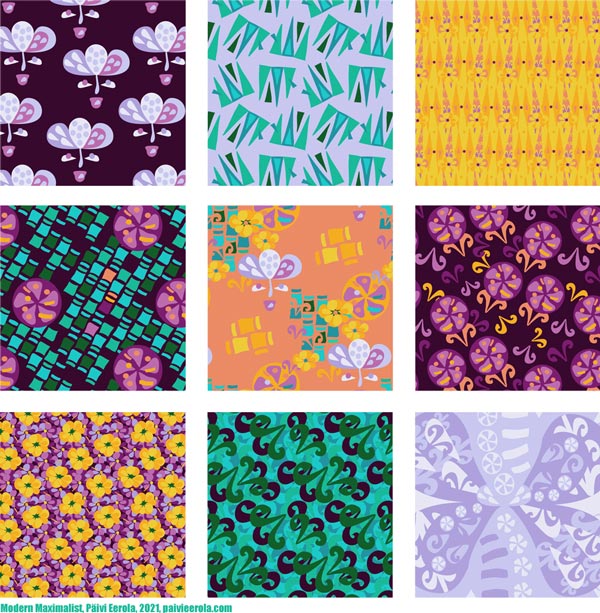
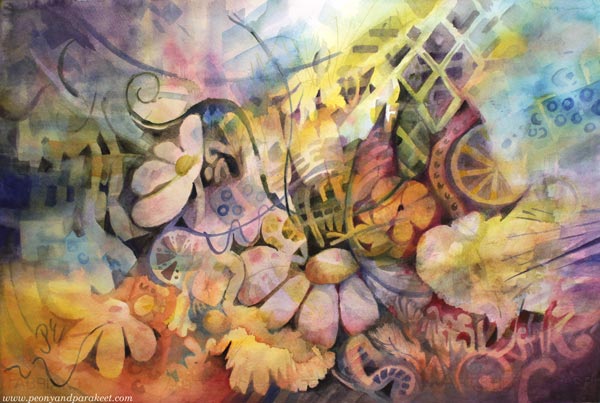
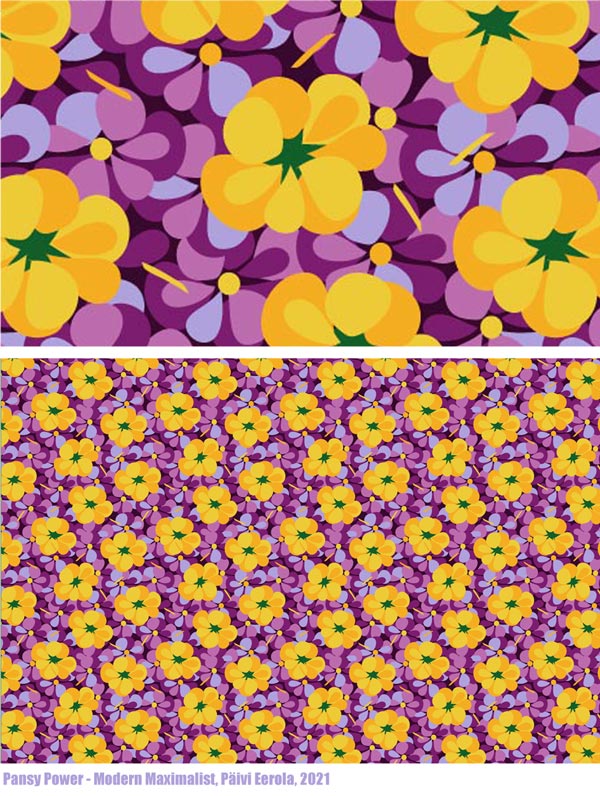
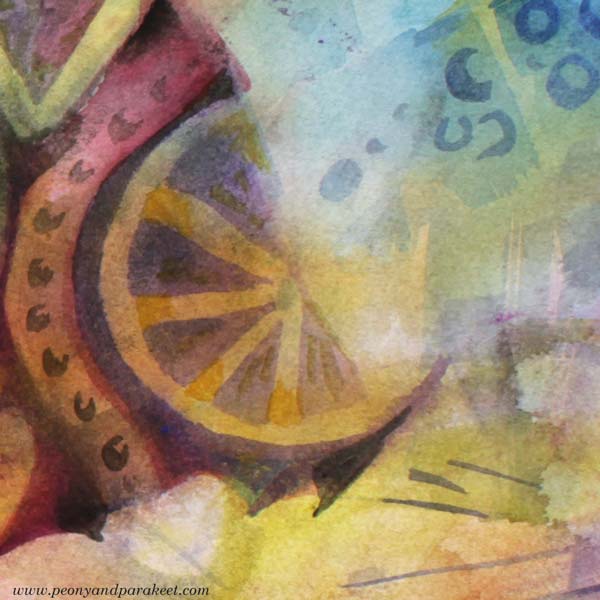
I have just designed a collection of surface patterns called Modern Maximalist. It’s drawn digitally in Adobe Illustrator and more modern than my work usually is. However, I love modern, especially the 1960s and 1970s styles. I was born at the end of the 1960s, live in a house built in the same era, and my love for retro has been too hidden in my art. But still, I didn’t want to design the collection based only on the images of others, but to build a bridge from my art to design. So, most of the motifs were based on this watercolor painting that I made a couple of weeks ago!
More Artistic Potential by Building and Breaking
Often when we create art, we build. We communicate the big picture and compose bits and pieces so that they work together. We get happy accidents (and sometimes some not-so-happy ones) and aim to make an image where the overall atmosphere takes over the details.
But to reveal more, we also need to break. Then the romantic flower that was painted to represent a dreamer, becomes a more stylish and symbolic figure.
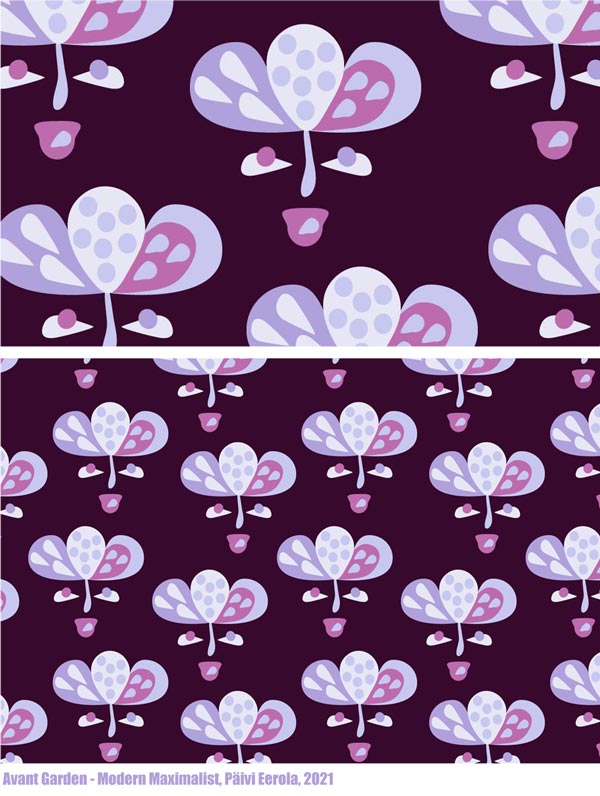
Yellow flowers and all the yellow washes can be more geometric when they are away from the big picture.

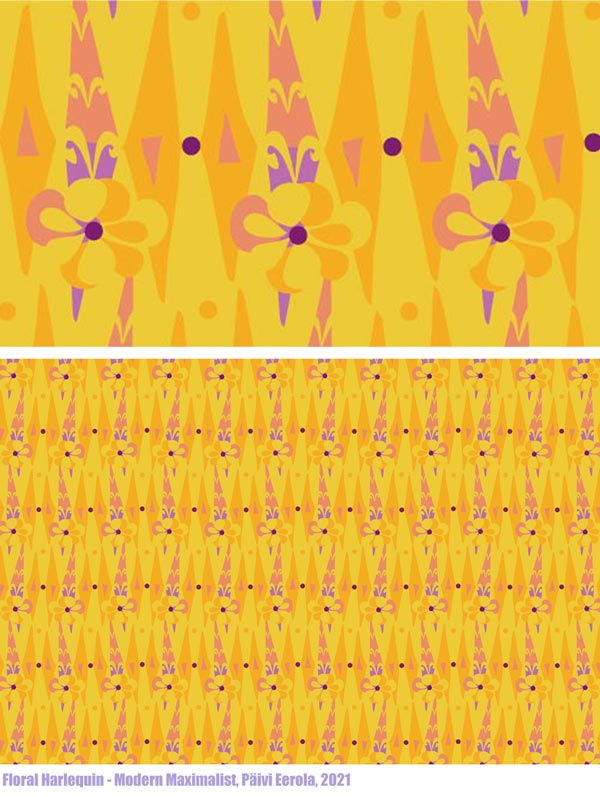
The juicyness of the fruits and other decorative details can be reorganized.
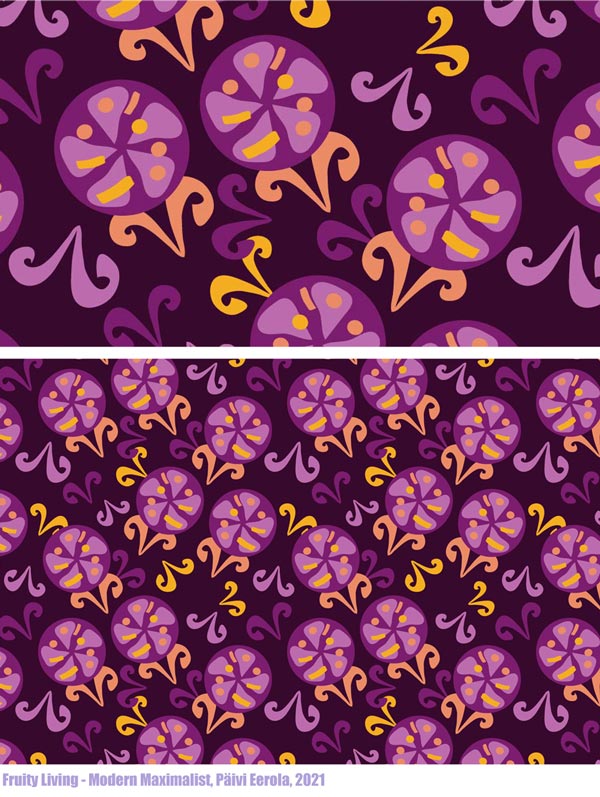
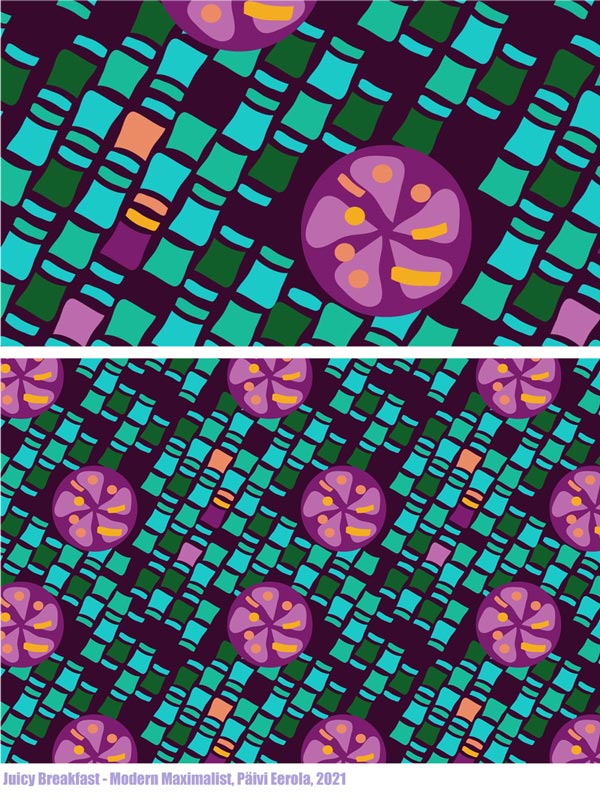
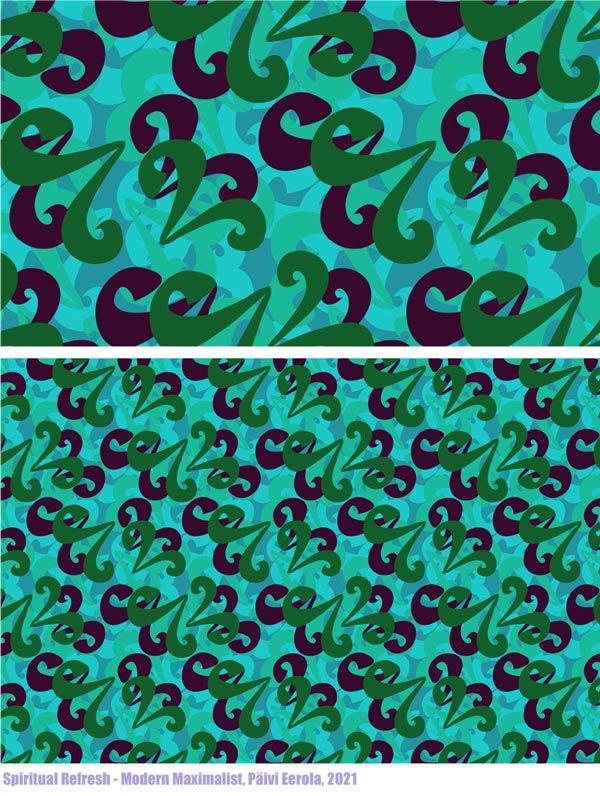
Picking Ideas from Other Images
We can also add more fuel, and break and pick from other images. This design called “List Maxima” uses motifs from the painting, but also the idea of a list that came from playing with the name of the collection, and fashion pictures that showed puffy and full dresses of the maximalist style.
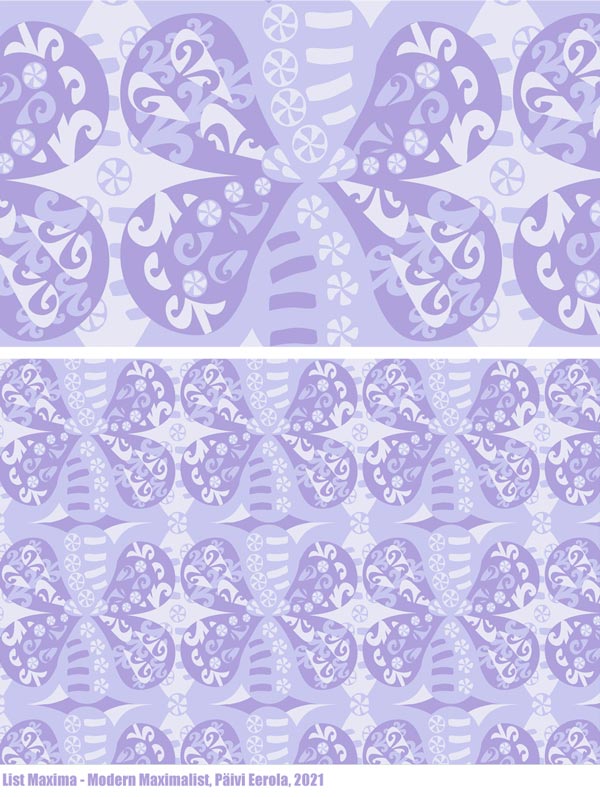
By breaking and picking, we also develop our ability to curate – to see which inspiration suits what we have already done. It’s an essential part of a style-development and and growing artistic vision.
I saw a pleated skirt on Prince Charles’s wife Camilla Parker-Bowles, not a maximalist style at all, but wonderfully modern so I broke and picked the image and got creative from that.
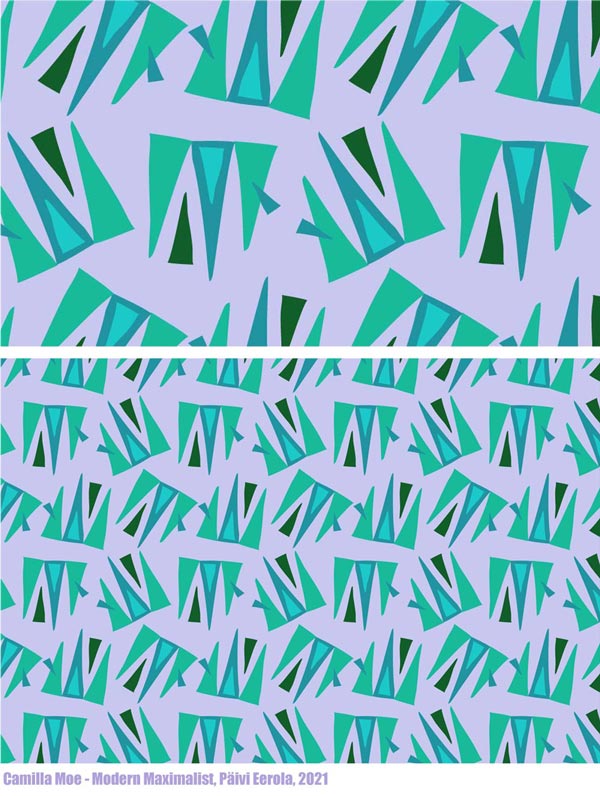
Artists often say to me: “I need to focus!” But by focusing on narrowing, we non-creatively force ourselves to do one thing. By breaking and picking, we can curate all kinds of inspiration and be creative so that it grows our artistic vision.
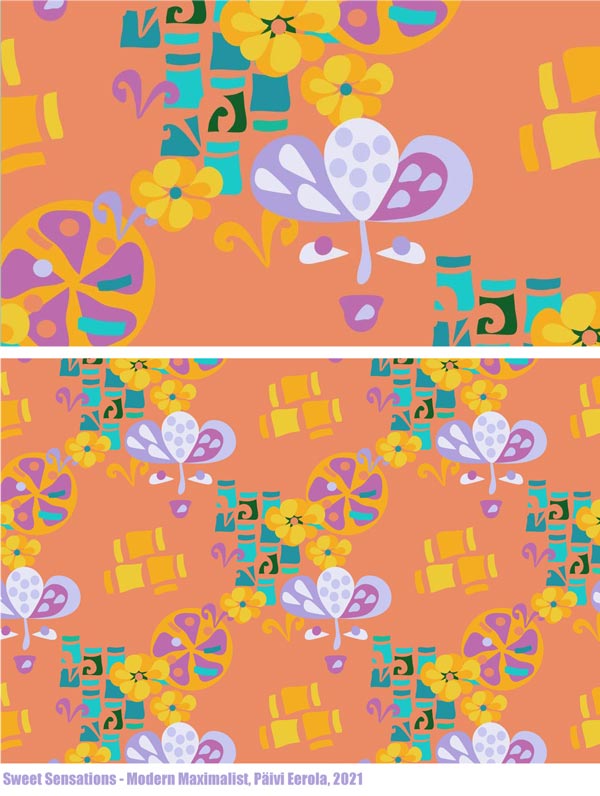
Revealing the Artistic Potential
No matter where you are in your artistic journey, your art benefits from the idea of building and breaking. Build to go deeper into the experience and break to reveal more ideas and potential! In practice, building often means painting, and breaking is often connected to drawing – even if, of course, you can use any techniques that suit you.
What was first a watercolor painting, could now be a quilt!
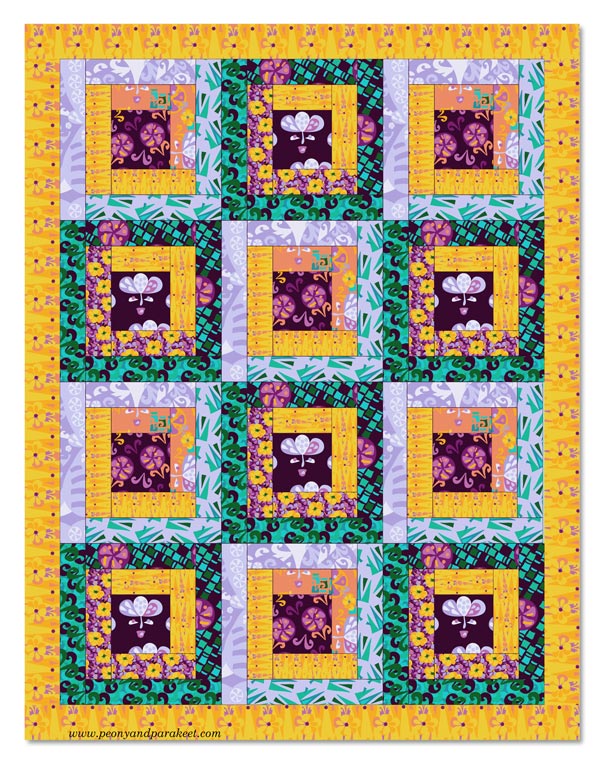
Building and breaking can alternate endlessly when we combine new ideas and results with old ones.
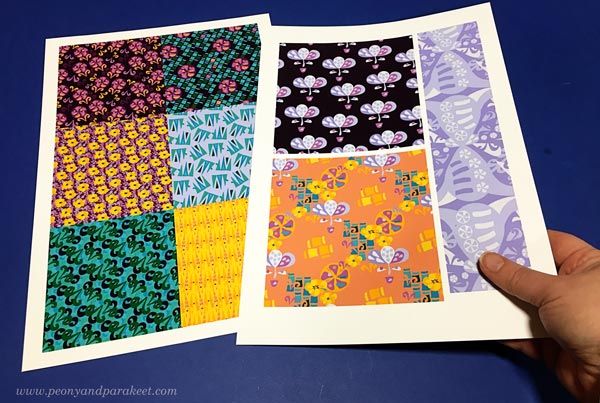
Here I am breaking and picking to create something new into my art journal.
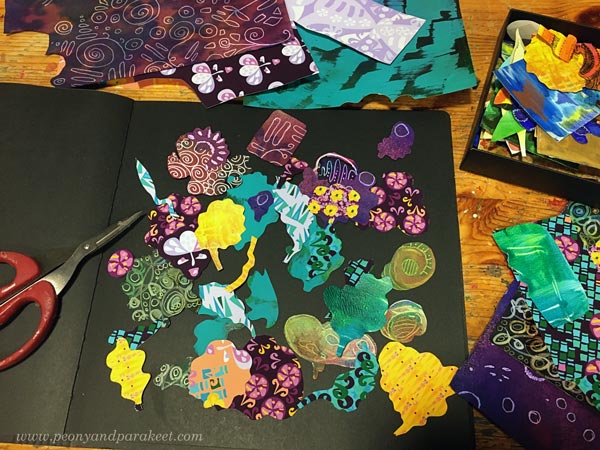
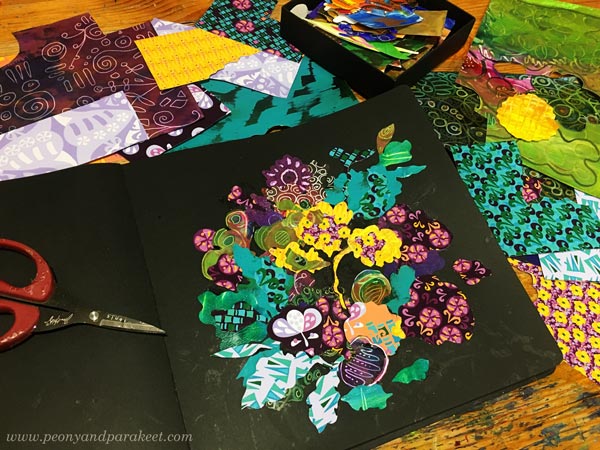
Here’s what I built by cutting and glueing new prints and old hand-decorated papers.
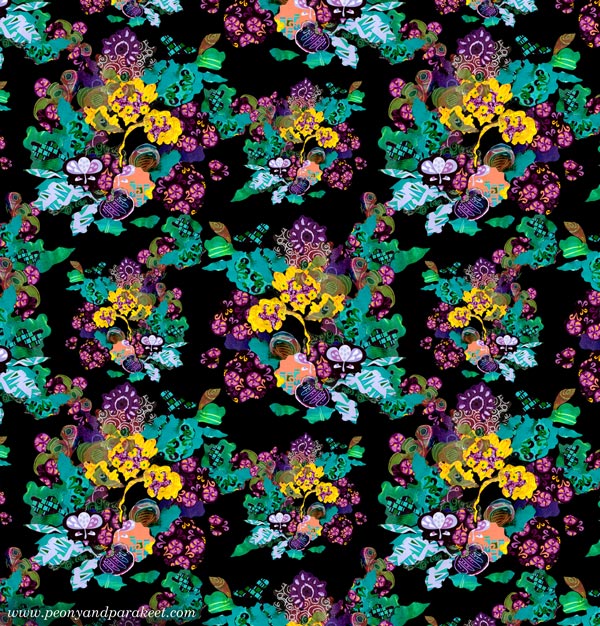
And I couldn’t resist checking if this could work as a repeat too!
I hope you found this post about building and breaking inspiring!
Need help for finding your artistic potential and building artistic vision? Sign up for my coaching program called Artistic Vision!