
Joyful Flowers and Exploring Joy with Colored Pencils
Let’s draw joyful flowers together, step by step! This post is enabled by the grant that I got from Arts Promotion Centre Finland. This is the fourth blog post of the project, see the first one here, the second one here, and the third one here!
Here’s what we will create: flowers that have joyfully gathered together and reach towards the light. No references, imagination only!
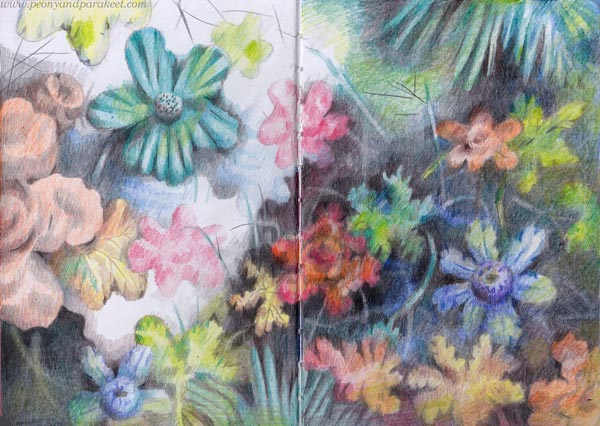
I made the drawing in my colored pencil journal and used colored pencils only. But these instructions can be easily applied to other mediums too.
Step 1 – Flowery Blobs
Pick a pencil of any color and draw blobs.
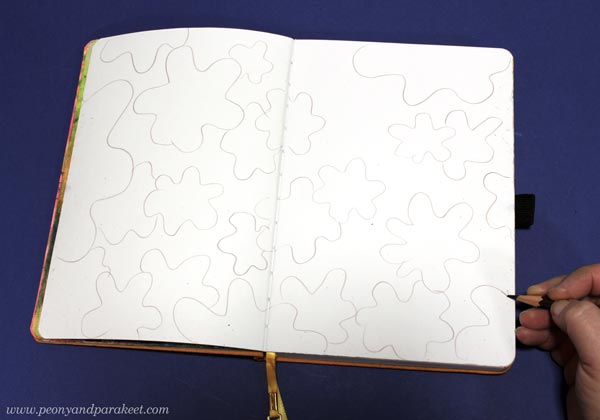
More than perfecting each flowery blob, make sure that the blobs are:
a) not similar in size – draw small, medium, and big blobs!
b) not separate – draw some only partly so that they go on the back of others!
c) not fully on the paper – draw some near the edges so that they are only partly visible!
d) not spread too evenly – leave some space too, but don’t place it in the middle!
This way, you set the foundation for joyful flowers so that you express diversity (a), togetherness (b), continuity (c), and freedom (d).
Step 2 – From a Blob to a Flower or a Leaf
Pick flowery colors and a black pencil for the background. Focus on the area in the low middle and work towards either side of the paper.
With black, color notches on the blobs so that they begin to look like flowers.
With bright and flowery colors, color some random shapes on the blobs.
Color a center for the blob to make it look more like a flower.
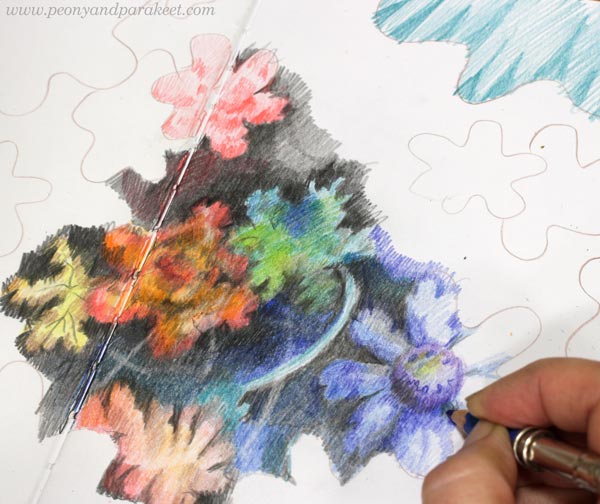
All the blobs don’t need the center; they can be leaves. You can also draw veins on them.
Add many colors so that the leaves and flowers look lively. Layer colors to get a variety of tones.
Step 3 – Background
Start with the black background, but gradually change to lighter tones. Leave a pitch-black area small, and add layers of other colors, like blue, on the top of the black, then gradually let the different colors take over. Leave a blank area too. Color softly and gently so that every layer adds intensity to the drawing.
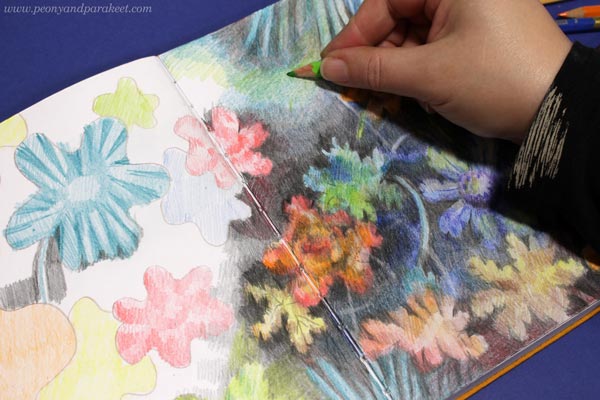
One of the joys of coloring is to relax and not rush at all. Stay in a small area and work with a few flowers only (Step 1) before feeling confident enough to expand the working area and focus more on the background.
Step 3 – Setting the Colors for Joyful Flowers
You can mark the colors for each flower and leaf by coloring them carelessly first.
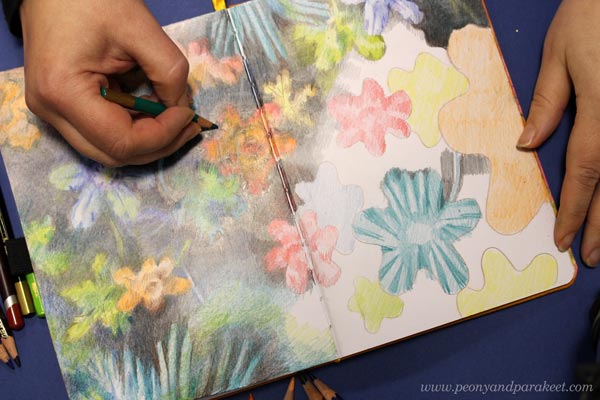
When some parts are more finished than others, there’s both joy of looking and joy of coloring!
Step 4 – Changing Most Whites to Pastels
I assume that you now have white everywhere: between the strokes, near the edges, in the flowers, and in many places on the background. But let’s change that! Leave only one area in the background that’s pure white and color over other blank parts.
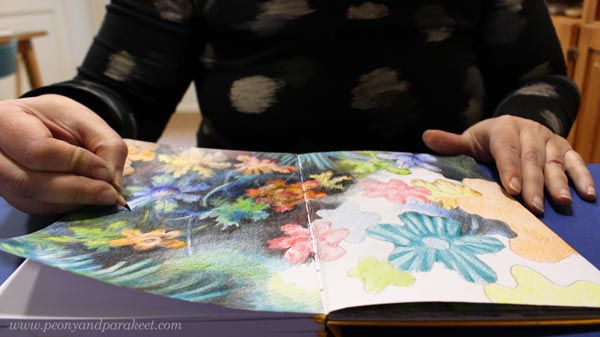
Add more color on the areas where careless coloring has left white stripes, and change the larger white areas to pastel colors. All this makes the image more joyful because the joy is in the nuances, not in the big changes.
Step 5 – The Joy of Cohesion
One of the greatest joys in art-making is to feel togetherness. So more than trying to achieve a particular style, I make changes to the image so that it feels like a place where I belong. I also want my flowers and leaves to look happy, but not so that I force them to smile by throwing “happy colors” but imagining that everyone has a friend in the scenery: someone to trust and lean on.
I also make some flowers look like me: who need to feel free to bloom. So they are less defined and almost disappear into the light, but their spirit still looks strong. So, the less realistic a flower is, the more room there’s for the expression.
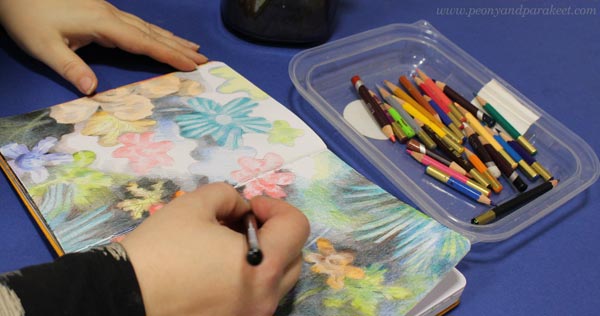
At some point in art-making, I begin to question if other people will like the image. It’s comforting to know that if we manage to create the feeling of effortless belonging, the image will naturally resonate more widely. The joy of cohesion also allows something to go wrong and become different than we expected. If we make every element feel accepted and welcomed, joy will naturally appear.
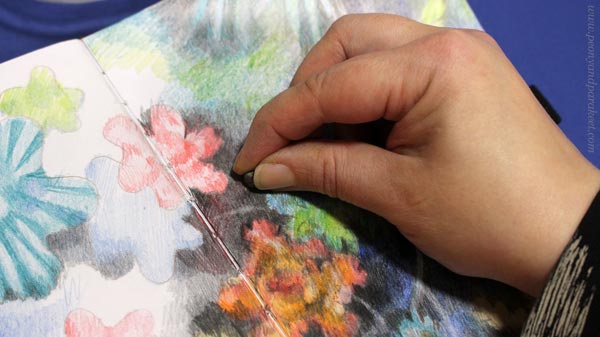
I a flower or a leaf looks lonely, add a stem that connects it with others. Long lines can look commanding and stiffen the image, so erase a glimpse of a stem only. Stems also look more natural if they don’t start right from the flower but appear and disappear as softly as possible. Stems can also go across each other and form a connecting mesh.
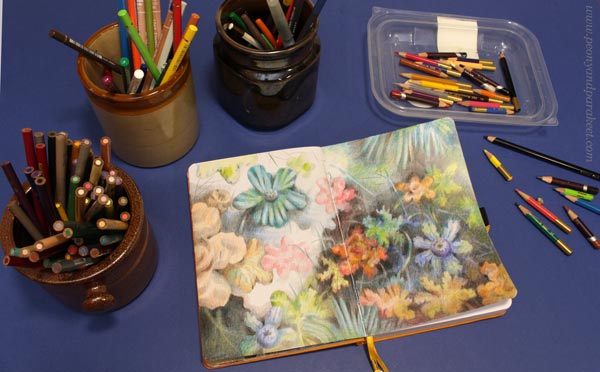
When one flower leads to another, and the eye always finds a clue about where to look next, cohesion is present.
More Inspiration for Joyful Flowers
I have got so many ideas from flowers that even when I don’t create them, my visual language is very flowery.
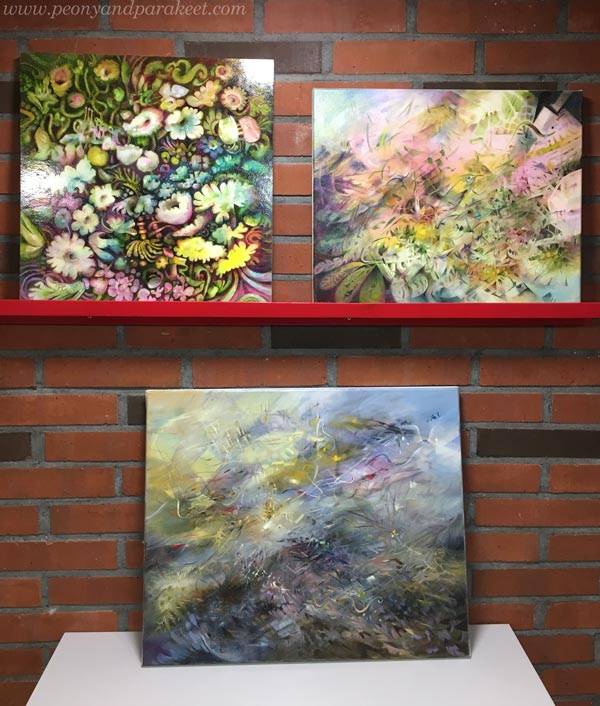
This week, I started two big oil paintings. These are 120 x 100 cm – it’s the biggest size that I have ever painted!
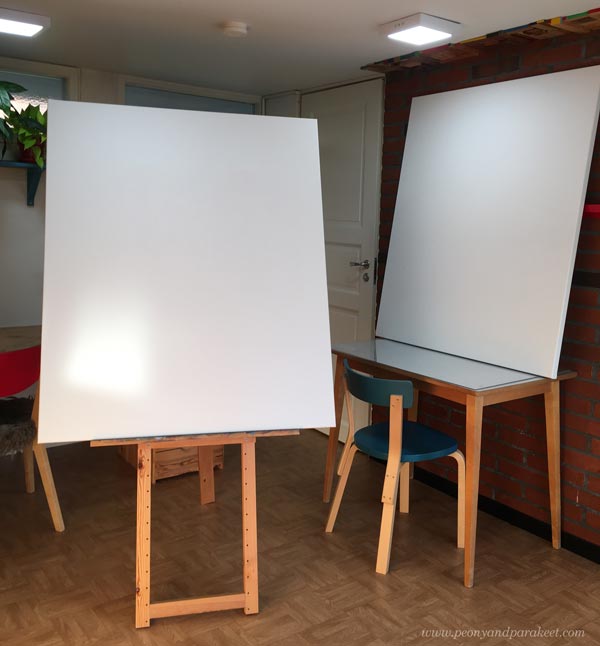
My first inspiration source for these is floral still lives from the 17th century. But these are just beginnings, and let’s see how they will progress in the upcoming weeks.
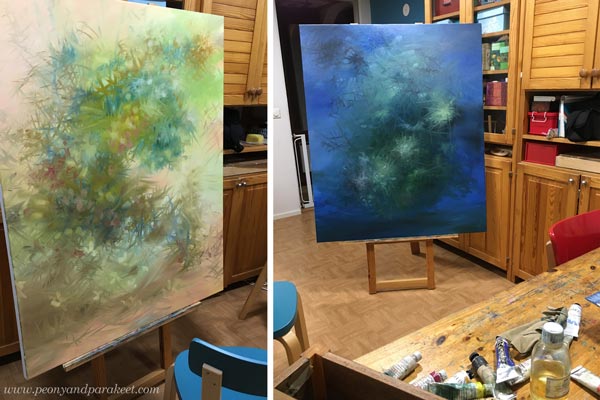
My little studio has been full of projects this week and will continue to be so!
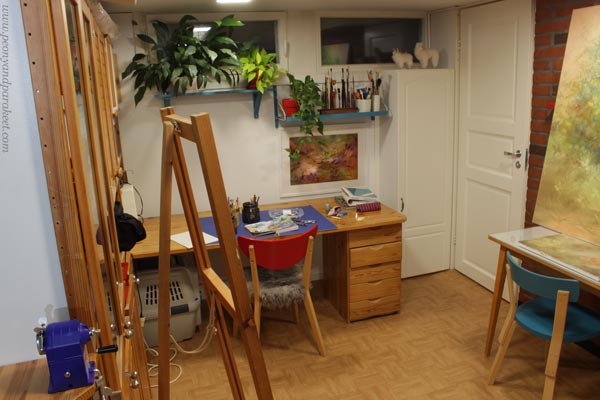
I hope this blog post inspires you to create joyful flowers – big or small, pencils or paints!
Free Like a Bird – Creating Free from Expectations
This week, I write about my personality type based on Thomas Erikson’s book Surrounded by Idiots and how to paint free from expectations.
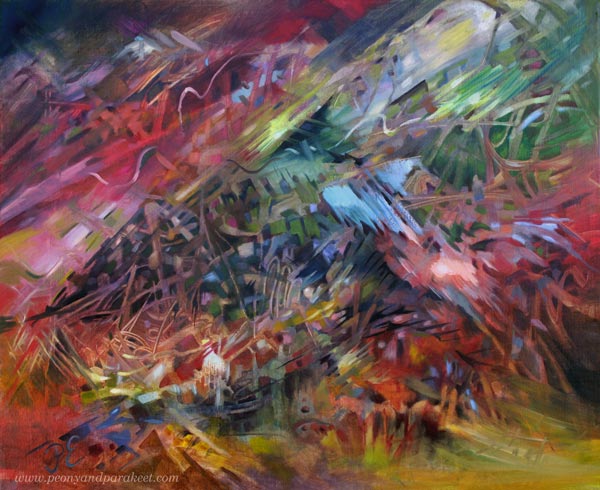
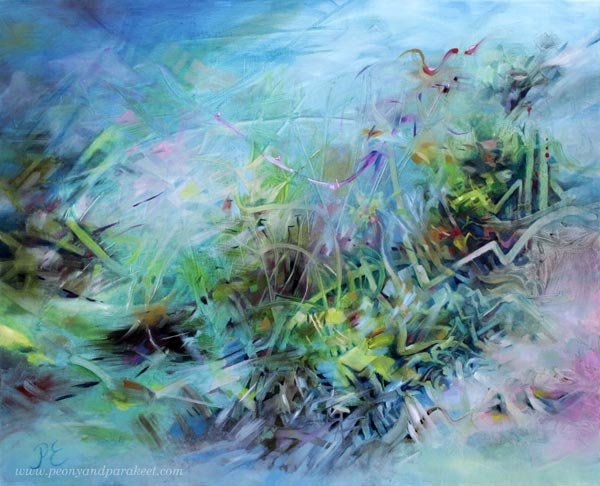
Here’s my newest painting. When finishing it, I became surprised gladly when “Blackbird” got a little sister “Finch.” Here’s Blackbird again:
Book: Surrounded by Idiots – The Four Types of Human Behaviour
All my life, I have had strong opinions about how and what I should paint. And yes, these opinions have not been something like “powerful dreams” but more like pushy commands. I didn’t even realize how pushy they have been until I read Thomas Erikson’s book “Surrounded by Idiots.” It made me think about my personality from a new perspective.
Even if the idea of the book – dividing personalities into four categories and naming them by colors – could be taken as nonsense, after reading it, I can’t help thinking about how “red” I am. An ambitious fact-oriented person who has pushed herself to the utmost limit with this art-making obsession.
If you are “yellow,” you probably think that I should either have fun or move on. “Greens” might recommend taking a rest and stopping working too hard. And “Blues” claim that the book is not scientifically proved and there’s no reason to quit.
But I have discovered a new solution. It’s been a joy to use my red energy only to make sure that I keep painting. When I open the tubes, my redness is gone. I am open to painting anything. Every ugly start feels like an invitation to the jungle: Let’s see what’s going on in the inner world.
Breaking the Glass – Growing Compassion Towards Inanimate Things
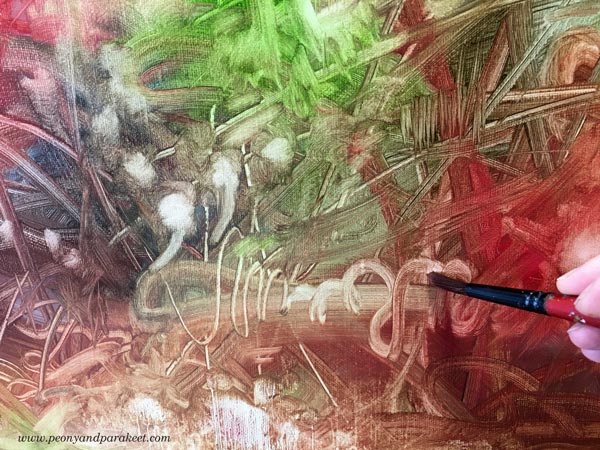
In the class Floral Freedom, you dive deep into Wassily Kandinsky’s ideas about abstract art. Among other things, he talks about breaking the glass – stopping being the observer and starting to be the one that experiences things. Now when I have been pushing myself for almost seven years, the glass has become thin. I feel joy about how easily it breaks right after squeezing the paint on the palette.
For a red person, it has been difficult to break through. I have been giving orders and tightened the control from time to time. But now, the only goal for the spring is to paint all the canvases that I purchased earlier this year. Not questioning what I paint, but just do it.
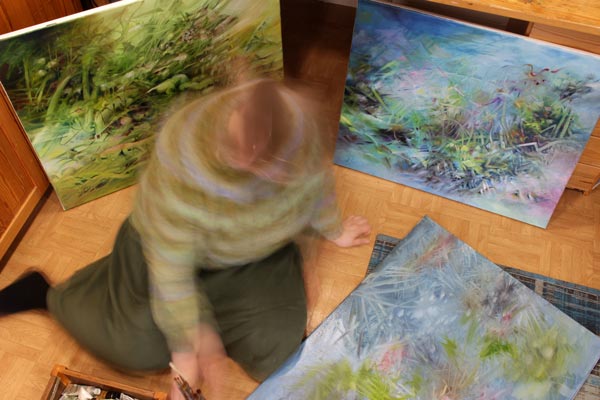
“Do it!” the red in me commands matter-of-factly and then leaves me working. After breaking the glass, I arrive at a lobby that’s filled with all kinds of stuff. For example, there are tulips that my husband removed from the bench where they were not supposed to grow.
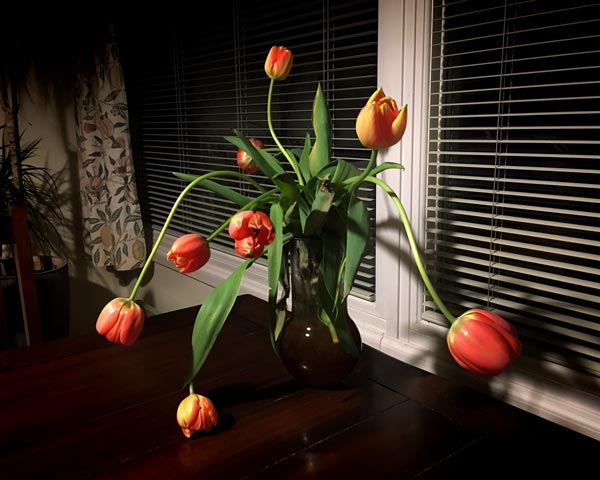
They twisted and turned in the vase, like wild animals in a cage, trying to break free. And when they withered, they became angry and devastated beasts, desperate to continue their lives. They didn’t want to face the fact that they wouldn’t reproduce like they were born to do.
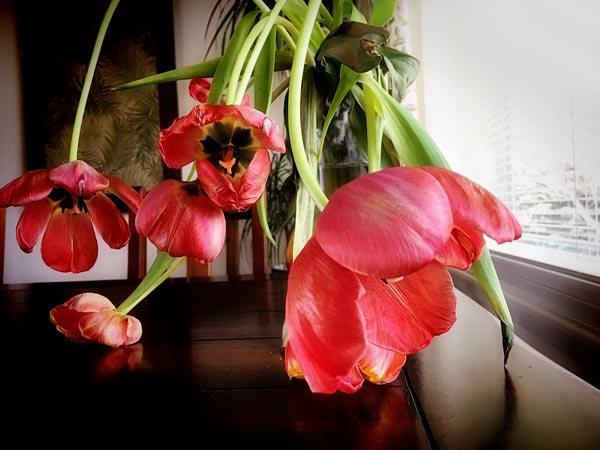
When painting, we can see similar things or just glide on the glass and bypass them. Shapes that don’t get the place in the spotlight. Lines that disappear before they reach high enough.
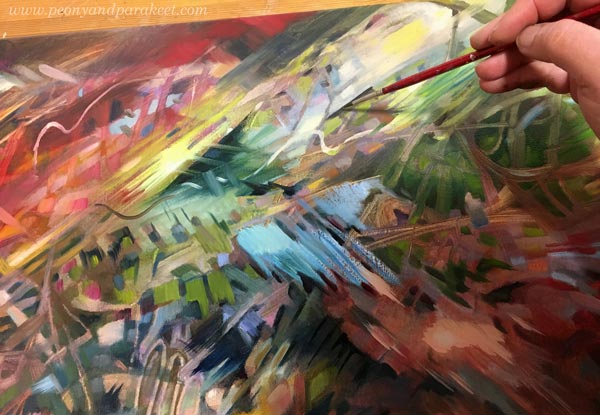
But if we put our mind into noticing them, we can make these inanimate splotches of paint breath and fly, even save some ugly spots. Not because we would hasten and thus compromise the quality, but because we feel sudden compassion towards their character.
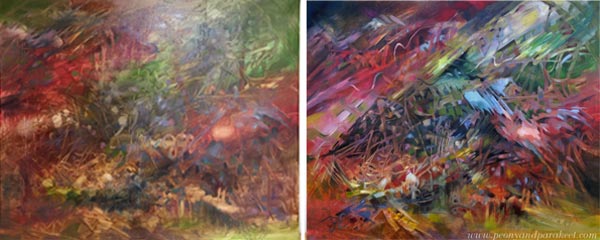
Then a picture is not forced but appears naturally. However, the result is not static or exact like the observer would want. Instead, it describes the inner experience of being.
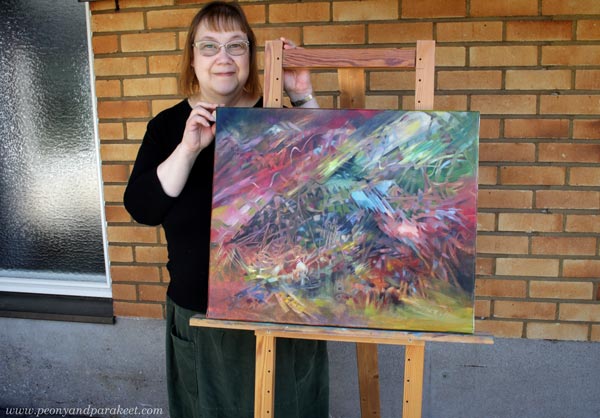
The Experience of Being a Finch
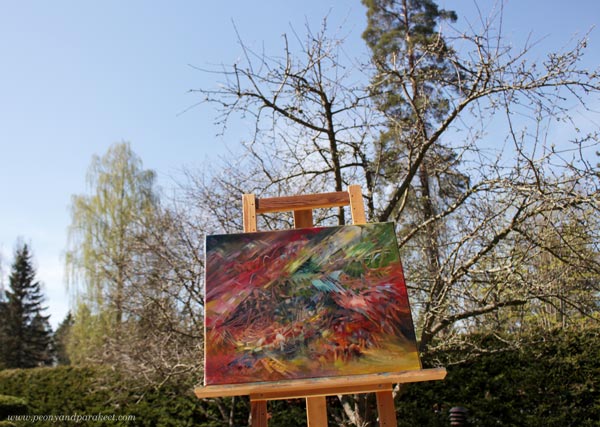
In this painting, the being is a little bird, facing danger, trying to take care of its nest, flying and falling, still living the summer of her life.
Have you read Thomas Erikson’s book Surrounded by Idiots? Do you see a connection between your personality and art-making?
Expressing Inner Storms by Painting
This post is dedicated to all who have lost their creative inspiration during these challenging times when outer storms cause inner storms too.
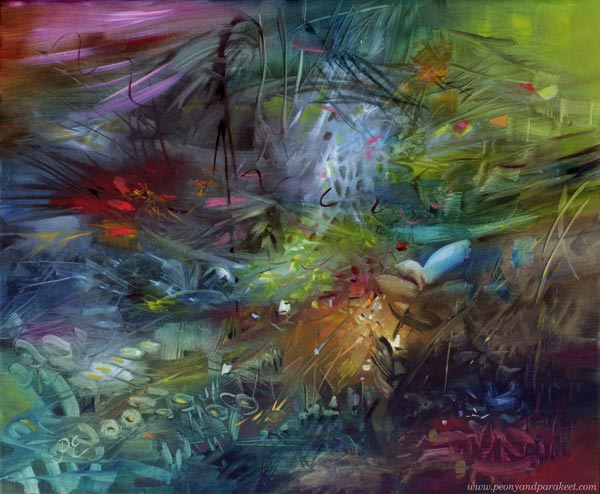
I have always loved art that uplifts and is more on the bright side of fantasy than in the darkness. I have defined myself as an artist who does not express agony or suffering or bring out what’s wrong in society. My art has based on the possibilities of imagination. It’s about the richness of the inner world. “Spiritual freedom” has been my word.
But the longer I have painted, the more courageous I have become. How flowery do my paintings have to be? To free up my art and to free up my thinking as well, I have begun to accept all kinds of shapes, colors, and emotions. The same flowers that bloom in my watercolor pieces become little monsters when I paint more freely in oil. It’s like there’s a new world under the inner world I only used to know.
Painting Inner Storms
At the end of January, I started a new big painting. It had dark colors, but I intended to brighten it. “When the time is right, I will make it more cheerful,” I promised to myself. Weeks went by, and it always felt like I had something more important to do. I didn’t have the energy, or I had too much energy. The more I postponed the finishing, the moody I became. “This pandemic gets to my nerves,” I said to my husband.
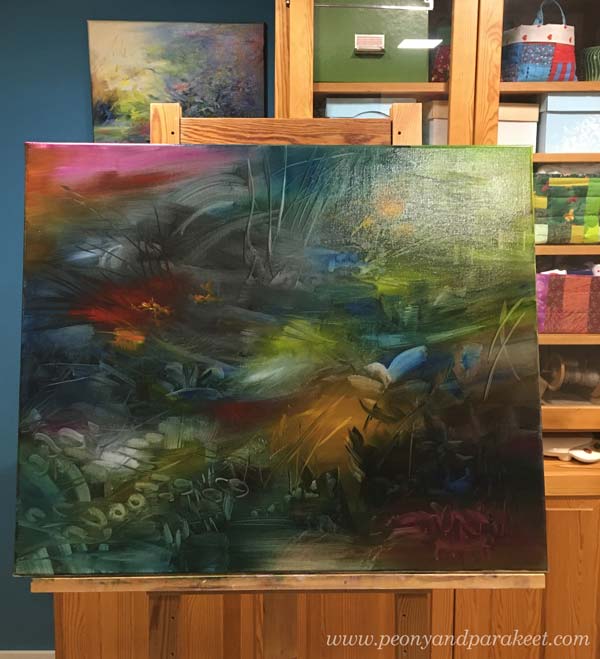
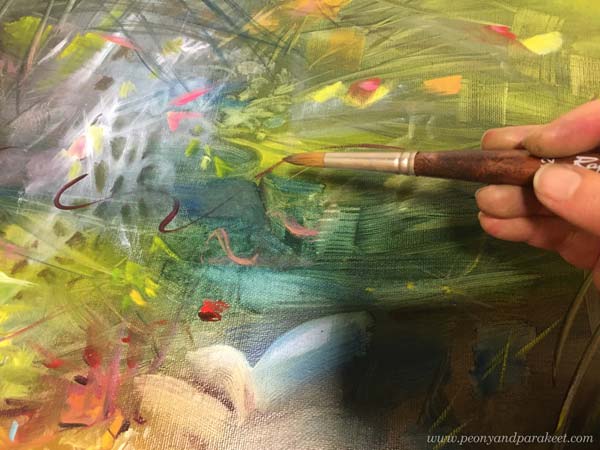
But when my spirit got more and more low, I had to do something. One night I picked paints and brushes, abandoned all the happy stuff I was creating and continued the painting. The brushes felt heavy at first. The paint tubes were like stones. But then I remembered the magic words: “Päivi, you can paint!” This confidence, even if it always feels false first, energizes my strokes and thoughts. The painting begins to speak to me, and my responses become more and more natural.
This Too Shall Pass
“What are you painting, Päivi,” I heard my inner critic saying after a while. “The piece is still very dark.” My immediate answer was: “Yes, it’s dark, but this too shall pass.” At that moment, I knew the name of the painting and why it should not be forced to look more cheerful. Inner storms can be as beautiful as the happy moments and little monsters as clever as any flower.
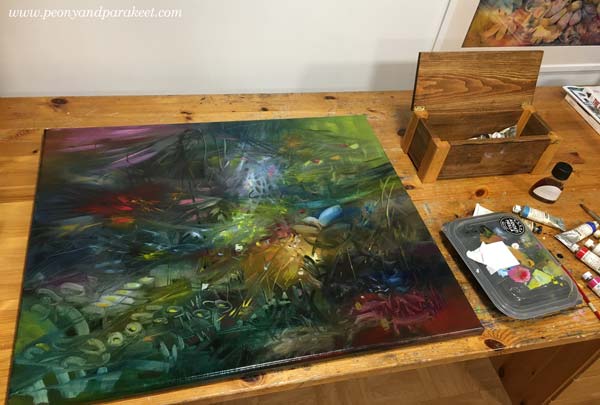
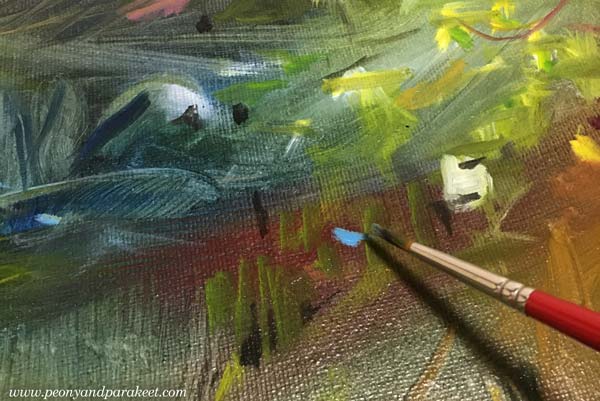
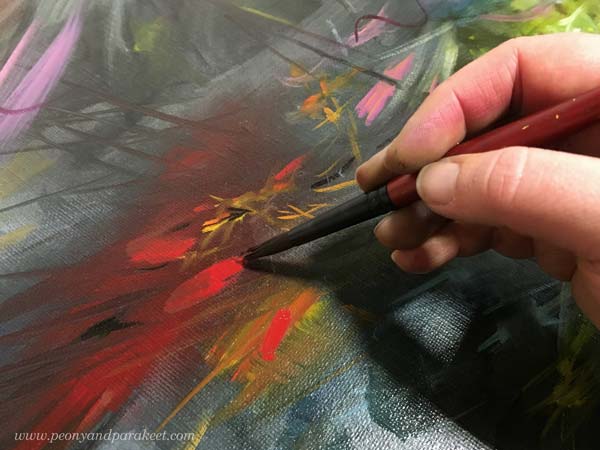
When I woke up the following morning, my mind was calm and still. And when I look at the painting, it gives me hope no matter how stormy and gloomy it seems.
Here are some detail pics.
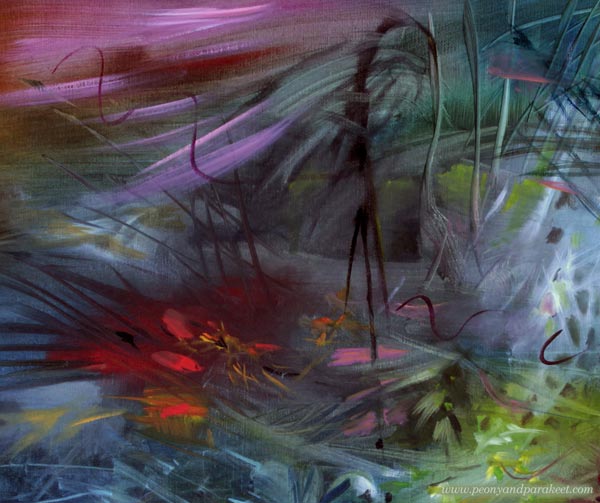
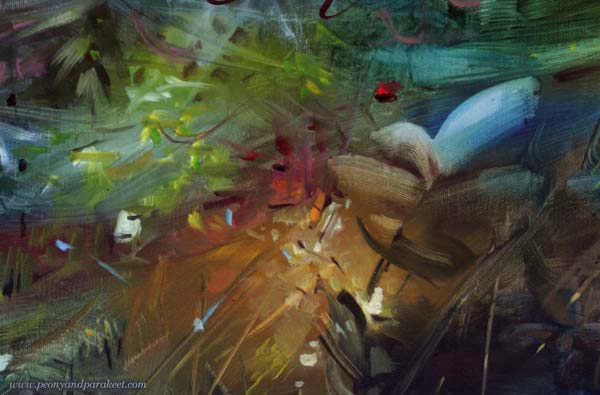
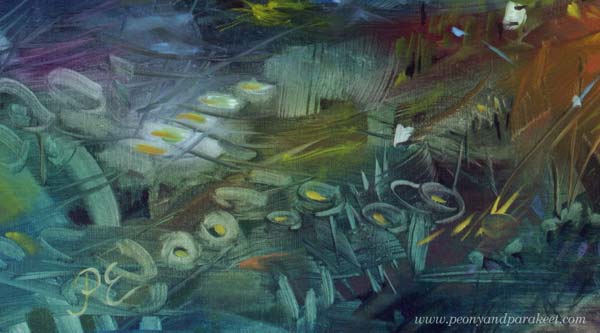
Here’s the whole painting again.
Sometimes the lack of inspiration is a sign of not letting out what needs do so.
Have a creative Easter!
P.S. My abstract painting class Floral Freedom is now available as a self-study. Watch the video below!
My free painting style is based on Paul Klee’s and Wassily Kandinsky’s timeless teachings presented in this class. >> Buy here!
Create for the Inner Child – Painting and Drawing on Scraps of Paper
This week I have a new free video for you! It’s about using small paper scraps for playing and dreaming, but it also goes deeper. I hope you’ll enjoy it!
Whether you want to play, be “on the bridge” or paint freely, welcome to my online classes!