
Discovering a Character by Drawing
This week is about illustrating characters and discovering those that feel personal.
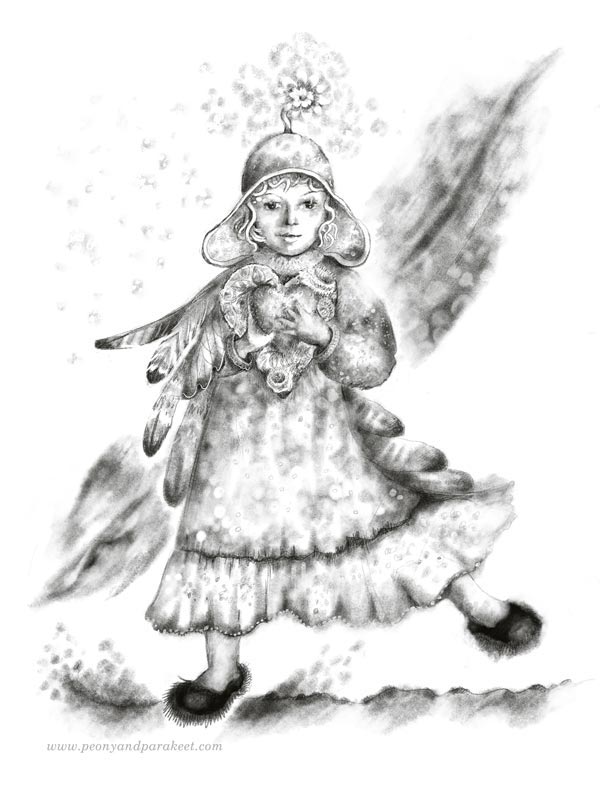
Have you ever wanted to draw a face or a figure that would really touch your heart? I don’t only mean something that looks pretty on paper but someone that begins to speak to you when your eyes meet.
Starting from an Animal Figure
In the class Magical Inkdom, I mention the word “kissanukke” when we are drawing cats. Kissanukke is “cat doll” in English, but somehow I think it’s much funnier in Finnish. Say: kissanukke! The word is just hilarious.
Last week, I wondered why I think about that word so often. Maybe it’s a hint I should draw cats again. So, I picked a big smooth watercolor paper and a pencil to sketch a huge cat. I wanted to go big because I wanted the cat’s face to be large enough for working on facial features. I adjusted them for a long time with a pencil, and then with colored pencils. I wanted this kissanukke to be more than a doll – a living thing that speaks to me.
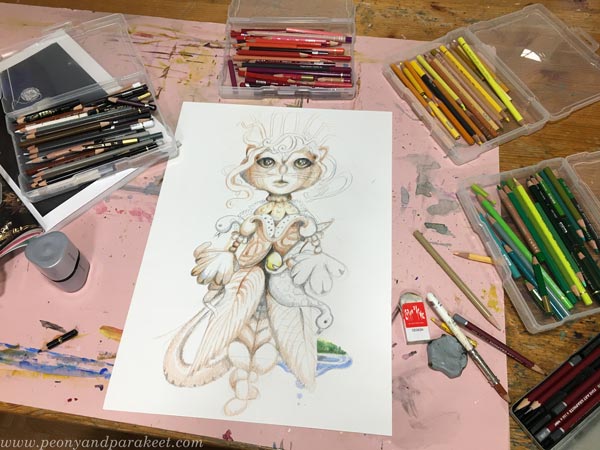
I love to use thick and smooth watercolor paper with colored pencils even when I don’t use water for the drawing.
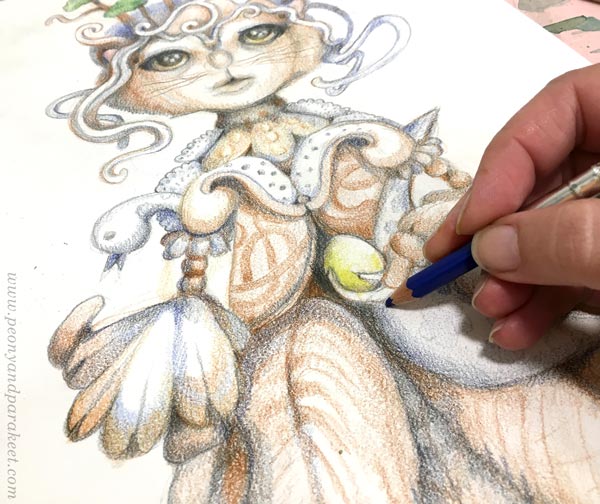
When the paper is big, it’s easy to dive deep into details and let them make the drawing more whimsical than the original sketch.
What’s Behind the Animal?
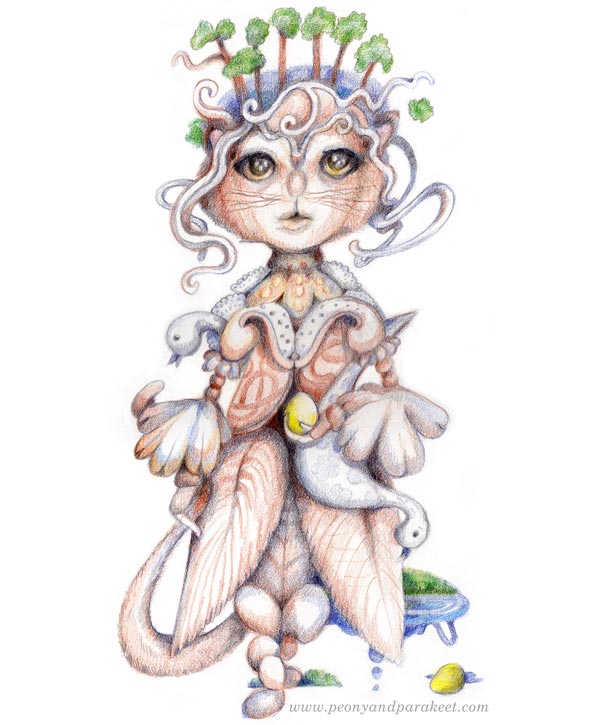
When Kissanukke was born, I asked her: “Who are you?” She said: “I am a hunter, and I can bring you anything you want!” I smiled at her: “What a magical cat you are, with the golden egg and all!” “I had two,” she said, “but the other one got missing when I tried to catch the geese. And I am no cat but a lion!”
Of course, she is a lion – how did I not see that before! I used to be a big fan of Joy Adamson and her lion Elsa as a child. No wonder my inner child has kept asking for cats!
Discovering Through a Different Pose
So, I thought, let’s draw another leijonanukke – lion doll – for the child. This time, I changed the pose so that the character would only need to glance sideways and wished that a shyer creature would appear.
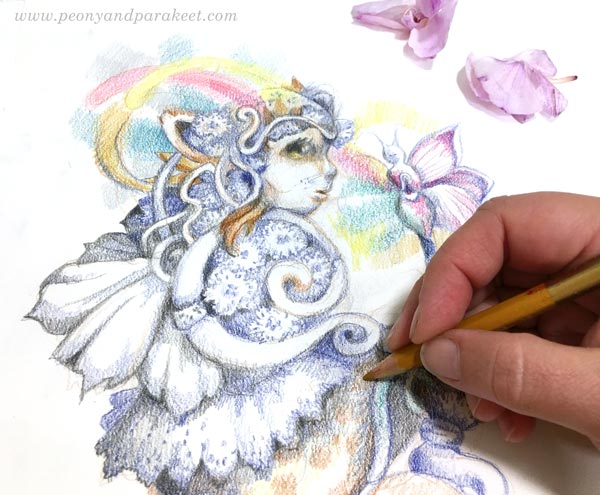
“Are you a hunter too?” I asked when discovering the new character. “No, I am an orchid whisperer! Shhh!”
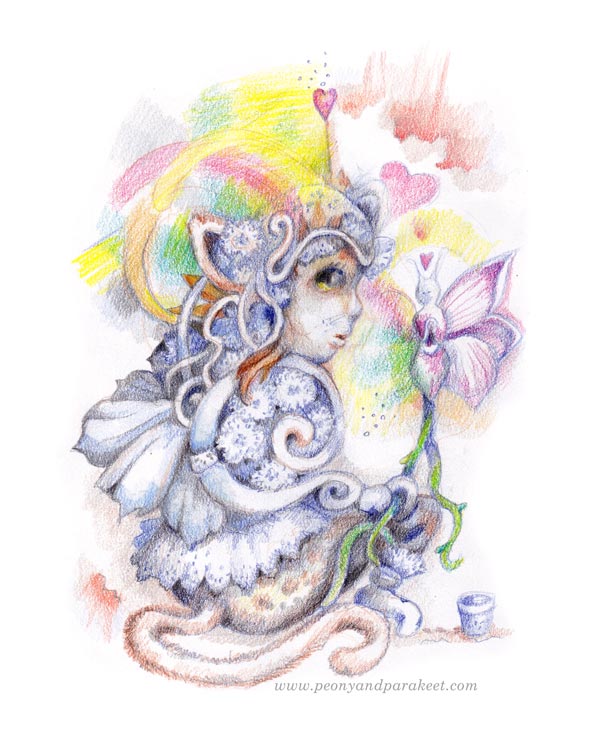
One of my orchids just stopped blooming, and I am eagerly waiting another to bloom. So, there’s a need for her too!
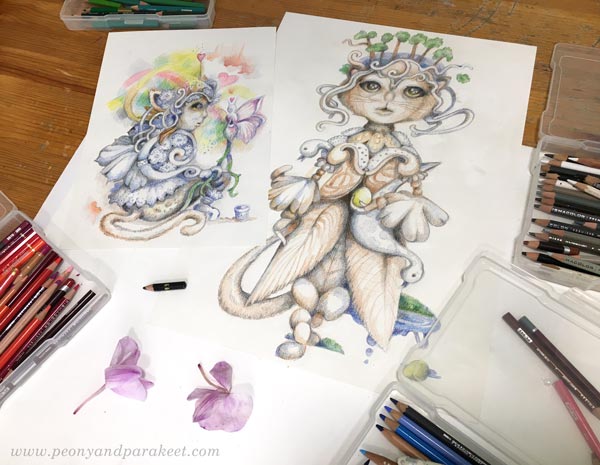
Whisperer is smaller than Hunter. The small size also makes her look less finished in the pics. If you need to provide a hand drawing in a digital form, always draw larger than the asked size. The result looks neater that way.
Discovering a Human Character
This week, I went to the studio and gathered all the courage I got. “Hunter,” I said, “could you bring me a human that really touches my heart.”
And that’s how this little country girl came out – a true nature child!
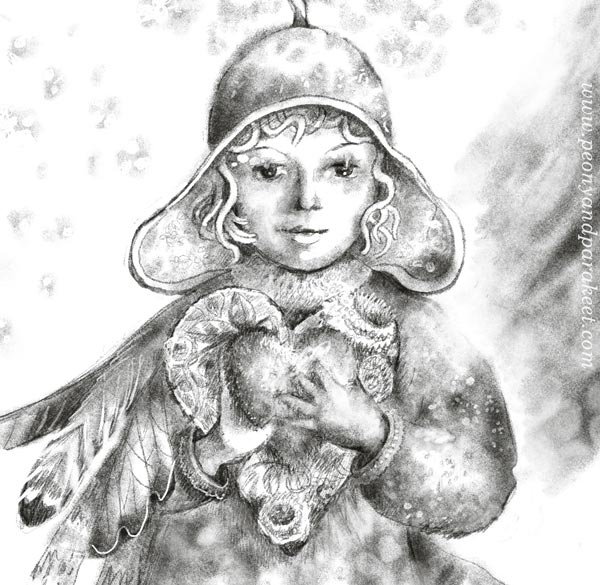
I didn’t use any references when drawing the girl and the cats. A reference can help us draw what’s expected but not what comes out naturally. References are great practice, and during the years, I have been practicing with them too. For example, in the class Innovative Portraits, we draw faces and use references creatively. But when discovering a character that feels like a soul mate, references become disturbing. Then it’s all about the connection with your inner self, traveling back in time for inspiration and forward in imagination.
Digital Pencil Work
I drew the girl on my iPad with Apple Pencil and the program called Procreate. I got these fancy tools as a birthday gift from my husband in February but have been waiting for the right moment to get to know them.
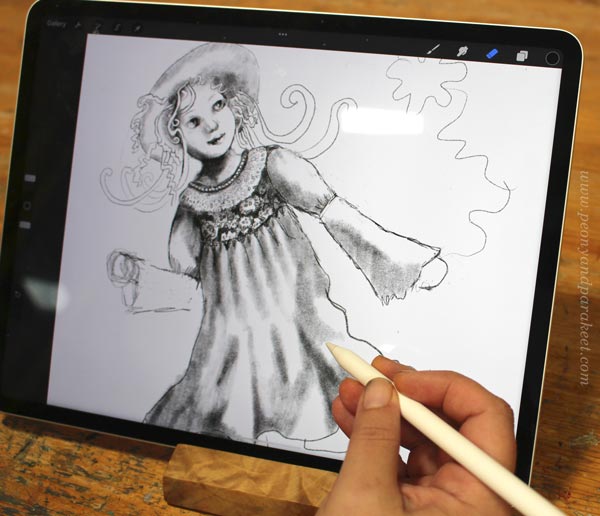
So far, I have mostly been using a simple digital brush called “Peppermint” that imitates a graphite pencil.
I will blog more about Procreate later, so it would be interesting to hear if you have used it. Also, if you have any questions, please let me know! However, if you are not into digital tools, don’t worry, I will keep on drawing with real pencils too!
Is Your Painting Introvert or Extrovert?
This week, I talk about the personality of paintings. Some are extroverts, some introverts!
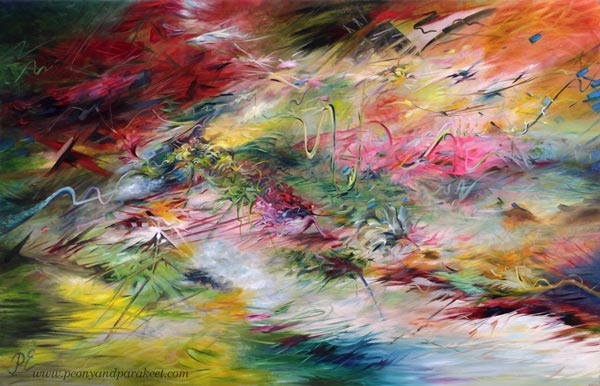
This oil painting, “Kotona Plutossa – At Home in Pluto,” is a part of my series Linnunrata – Milky Way, where I explore planets and outer space. (See previous work: the Earth here, Venus here, and the Sun here!)
Many Inspiration Sources
Earlier this year, I saw a documentary about Pluto, and it felt more familiar than many other planets that I have only read about. In the series, I imagine how the Milky Way could bloom and only take a small dose of the facts about the Planet.
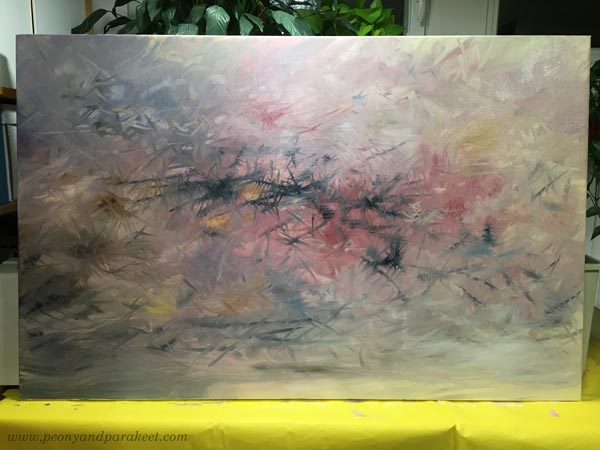
Pluto’s ice volcanoes started the painting, but then I brought in more ideas. The central idea for this painting was home decor. I love mid-century modern houses and furniture, and many of the shapes have a similar feel.
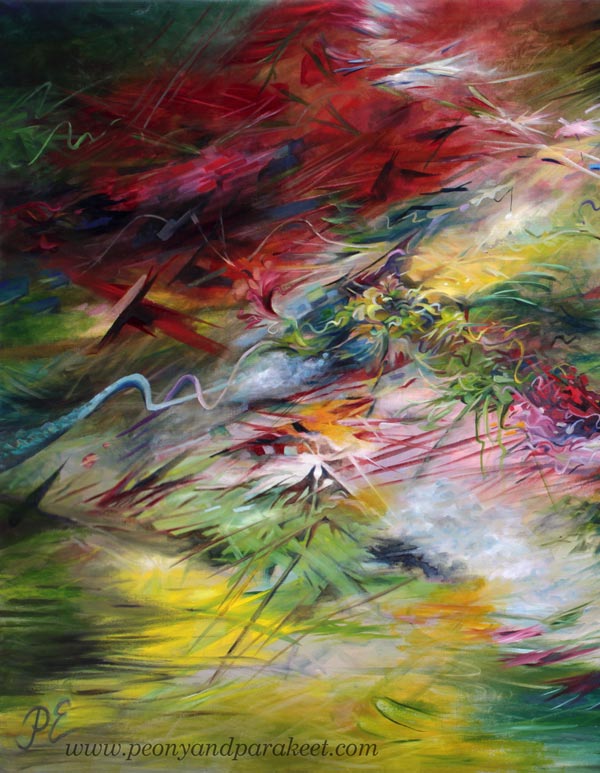
Tricia Guild’s fabrics were another inspiration source. I have been her fan for decades and don’t even have to look at her photos to know what kind of florals she would like to bring to the painting.
Introvert or Extrovert? – Changing the Approach
Even if Pluto is a dwarf planet, this is my biggest painting so far. My style is detailed, and there’s a lot of space in 90 x 140 cm (about 35,5 x 55 inches). There were moments when I felt very unsure about how to proceed because when I asked the painting, it stayed quiet. “Can you hear me, Pluto?” I whispered several times. No response.
This painting clearly was an introvert. I felt like I wanted to quit.
I recognize this syndrome – what I call Big Picture Syndrome – by its signs:
- You feel the need to look at the piece only from the big picture perspective, as a quick stroke here and another there would magically make everything work. In truth, you don’t yet have a clue what the carrying theme for the piece is, and should discover it by making the details more inspiring.
- You feel negative about your potential as an artist but try to convince yourself that the piece is good enough. That someone will like it. And at the same time, you know it’s only an excuse for quitting. The truth is that some pieces are harder than others. Some paintings are extroverts that begin to speak to you right away. And some are introverts that need more time to open up. No need to blame yourself for that. Just keep working and trying to figure out what the piece wants!
“Can you hear me, Pluto?” I asked after bringing in new ideas and adjusting colors and shapes. I was relieved when she answered shyly “Pluto hears.” And when I finished the painting, it felt like coming home.
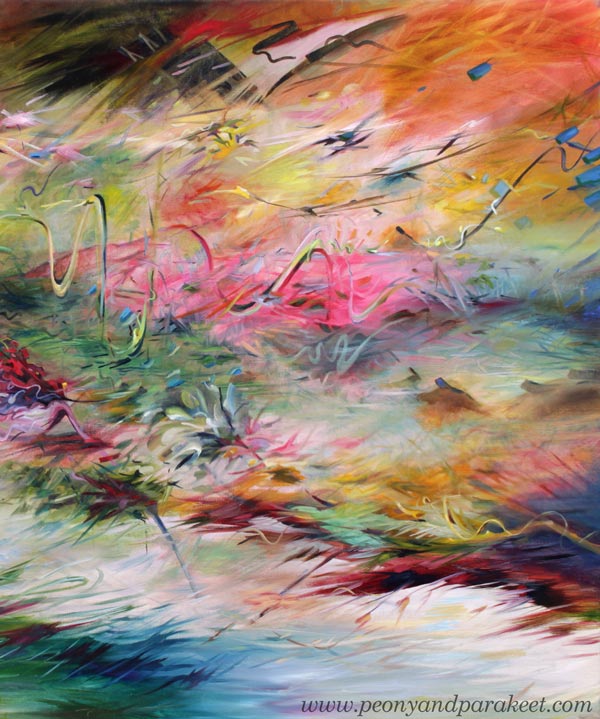
Listening to an introvert painting is always helpful for learning new things about yourself. I became more aware of how much textiles and fabrics inspire me and I want to show that more later too. If you only accept extrovert art, moving forward is more difficult.
Childhood of an Introvert
Another thing that came to my mind was this small crayon piece from about 40 years ago. ( Read more about this one here!)
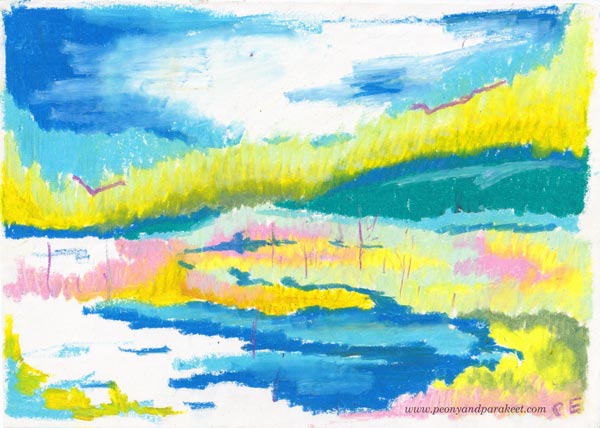
When I put it here, I am astonished at how similar these two pieces look. No wonder she was so shy, there are a lot of years between us!
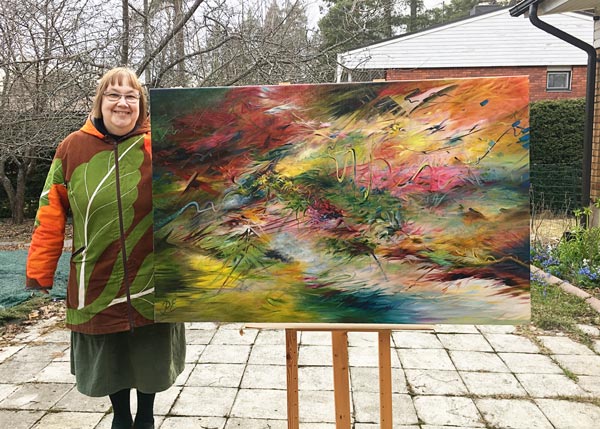
Everything has changed, and nothing has changed over the years, isn’t that so? Introvert or extrovert – try it!
Preparing For the Solo Show
My first solo show Linnunrata will be in June, and it’s keeping me super busy! I still have a couple of paintings that are not finished, and there are lots of edges to paint, hanging wires to attach, and varnishing to do. My current plan is to show 18 paintings, and every single one still has something that I need to do before the show. And there are posters to design, marketing to do, a lot of work!
Linnunrata will be at Gallery K, Tikkurila, Vantaa in June 3-19, 2022.
5 Reasons Why I Love Colored Pencils
This week’s post is an affectionate thank you to my colored pencils.

Here’s why I love them so much!
#1 Colored Pencils Add Magic to Everyday Moments
Colored pencils are quick and easy for everyday use. Whenever I write, I can quickly pick a few pencils and color a part of the text or make a small illustration.
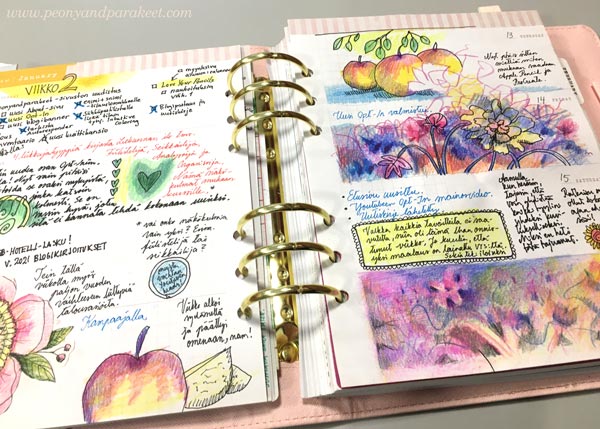
Planners, shopping lists, and any notes become more cheerful when I add some colored pencils to them.
#2 Colored Pencils Change a Journal to a Treasure
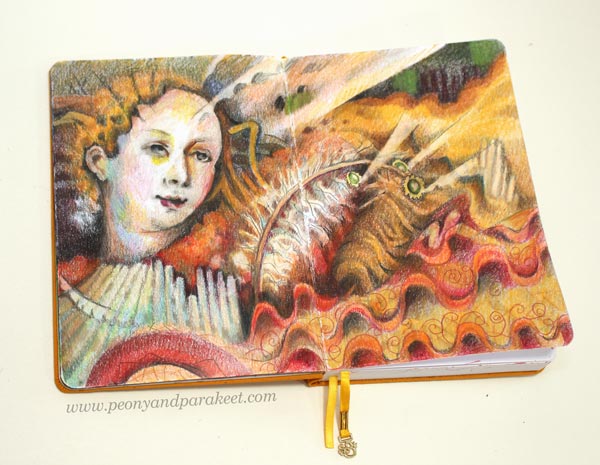
Colored pencils are perfect for small journals. When I started my colored pencil diary last year, I wasn’t sure how long the inspiration would last. But the small size felt so easy that the pages kept coming, and I love to browse the journal often. It’s my inspiration book and one way I do “research” – search for ideas that reappear more freely in my paintings.
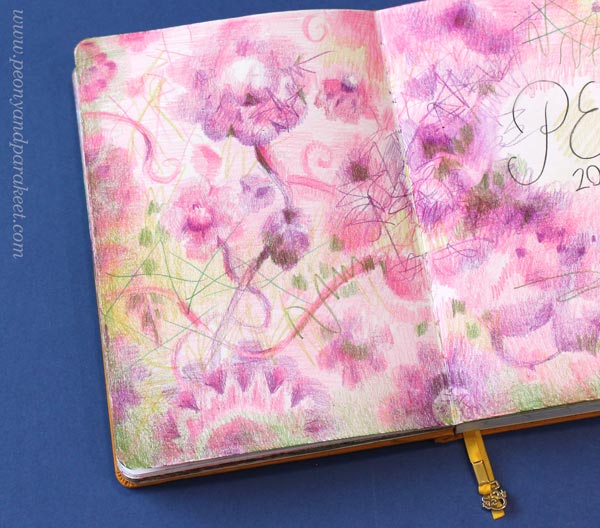
This spread is a part of a new class, Fun Botanicum, where we make a set of plant-inspired pages. The idea of making chapters and different types of pages in a journal is so inspiring. One small journal can be like a library that has many collections!
#3 It’s Enjoyable to Paint with Colored Pencils
After painting a series of oil paintings, I am usually exhausted. Then my pencils feel a refreshing approach to painting. When I “paint” with colored pencils, I press only lightly like holding a brush, make soft and blurry shapes, and create color mixes by layering. This way, I fly to my imagination without making a mess or worrying over things like drying time or fluency.
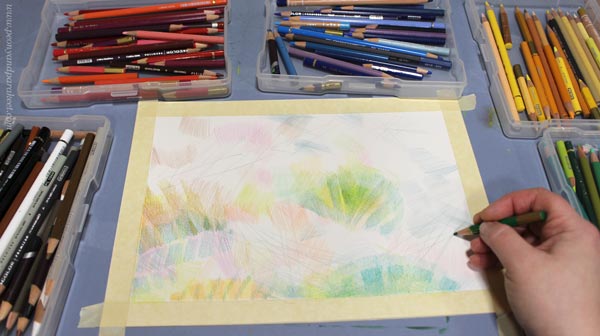
I feel a similar softness to using a brush when smooth hot press watercolor paper meets a wax-based pencil. Gentle strokes don’t hurt but nurture the hand, and the overall experience speaks self-love: “Be gentle, focus on the good in the world.”
#4 Colored Pencils Love Lines
I love drawing lines, and fortunately, my colored pencils love them too. I can draw straight lines, curves, continuous mesh, outline – all my pencils require is sharpening now and then!
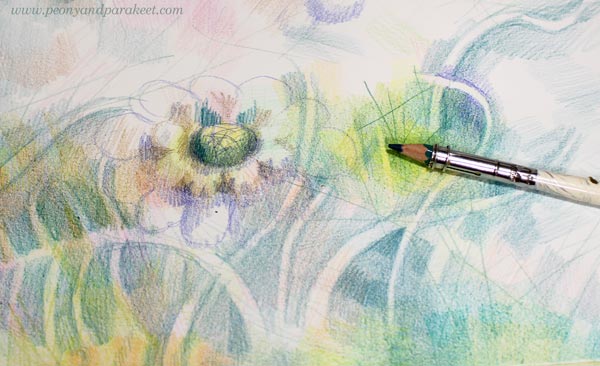
I love the willingness of my pencils to work until they are too short for the extender. I try to treat them as well as I can, no matter how short they are and what brand they represent. Old pencils can do lines too!
#5 Colored Pencils Can Take a Break
My oil paints are like afghan hounds. They require a lot of care and attention, and they always look appalled if I stop too soon. But colored pencils are like little parakeets. They sing when I am with them but are happy to fall asleep when nothing is happening. So I can color just a bit and then leave the project to wait for the next free moment. My pencils are ok with that – Every Single Time!
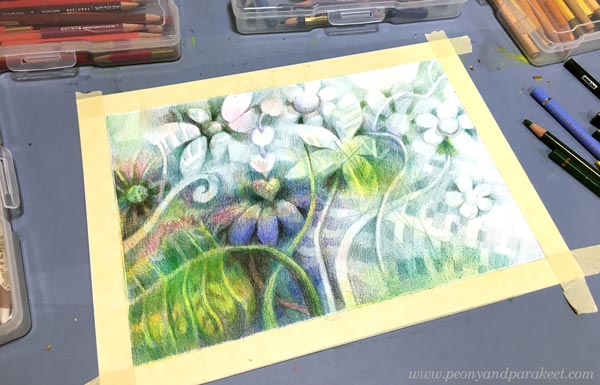
For example, this week’s work was made in several sessions. Watched the news and colored some. Listened to an audiobook, and colored some. Walked by and decided to color some. Unlike my oil paints, colored pencils never complain about what I listen, and they don’t get jealous if I watch tv at the same time.
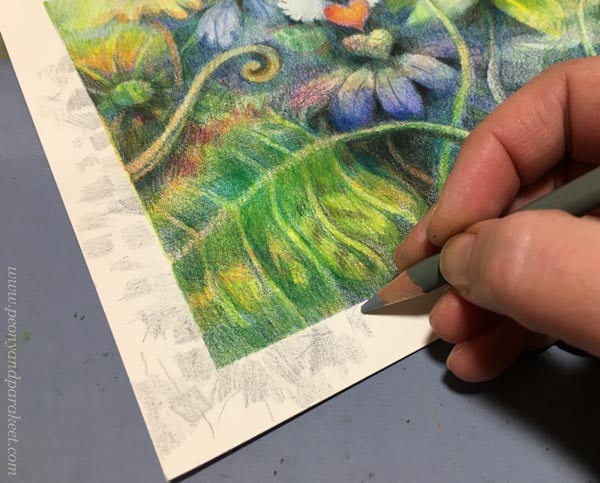
First, I didn’t intend to color the border, but then I couldn’t help myself to spend a little more time with the pencils.
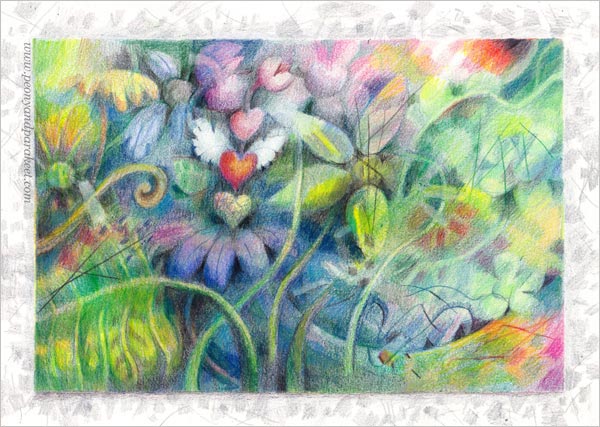
Hearts make this piece a bit cutesy, but colored pencils always make me more playful than paints.

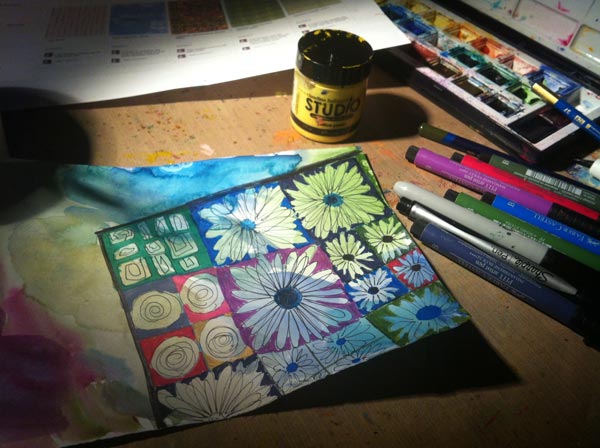
I love this system of color-coordinated boxes!
Having Good Time with Fun Botanicum
Let’s gather colored pencils and get inspired by plants, crazy lines, delicious colors, and the freedom of imagination.
Fun Botanicum begins on March 15. Sign up now!
Emotional Catharsis Through Intuitive Art
This post about catharsis and spirituality in art is enabled by the grant that I got from Arts Promotion Centre Finland. This is the fifth blog post of the project, see the first one here, the second one here, the third one here, and the fourth one here!
Recently I have thought about Wassily Kandinsky so much that he has become an imaginary character in my mind. He seems to enjoy this life after death, and I like him hanging around when I paint. This time it led to emotional catharsis – a very powerful experience. Here’s the story!
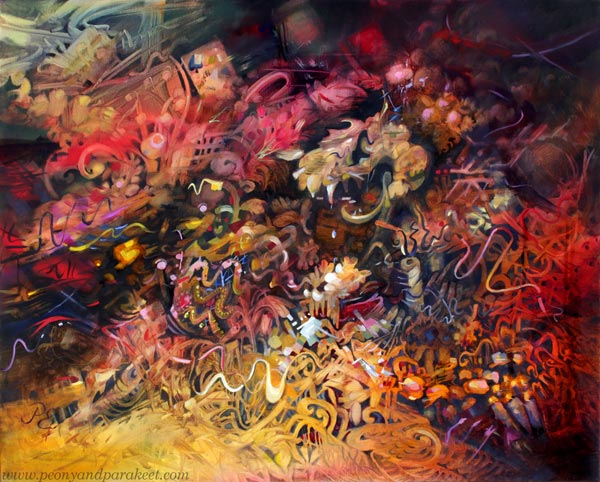
Let’s Go to The Dark Side!
One morning, before starting the painting, I read one of my recent blog posts to Wassily:
“Because expressing light is impossible without painting the darkness, I have decided to explore spirituality’s ultimate opposites as well. Like insolence, materialism, and money.”
“Let’s do it!” Wassily immediately exclaimed with his Russian accent. “Let’s paint what money looks like! Do you like money, Paivi?”
The question alone was vulgar and intrusive, and the whole subject made me shiver. “What’s the problem? Haven’t you ever painted the dark side?” Wassily asked and looked confused and a bit more gentle too.
Well, I hadn’t. Not in this scale, anyway. The idea of spending the next few weeks with blacks and bloody reds felt heavy. In my life, there have been times when I had liked money too much, for example, when I sold IT solutions to big organizations. Secretly, it felt almost as good as making art. Back then, I bought lots of art supplies, but the time for using them was much more limited. Too limited.
“Wassily,” I said, “money almost took me away from creating, so how can I create a painting about it?” But Wassily is a funny guy. He doesn’t answer questions that he wants me to answer through creating. Then he just stares at me silently like a watchdog, preventing the escape from the studio.
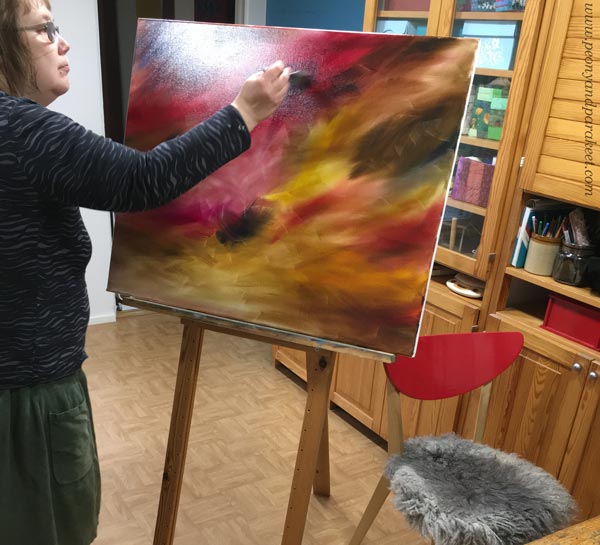
So I can do nothing but start.
From a Pet to a Beast
While filling the blank canvas, I tried to comfort myself by thinking about how money can be a good thing too, enabling grand and beautiful things.
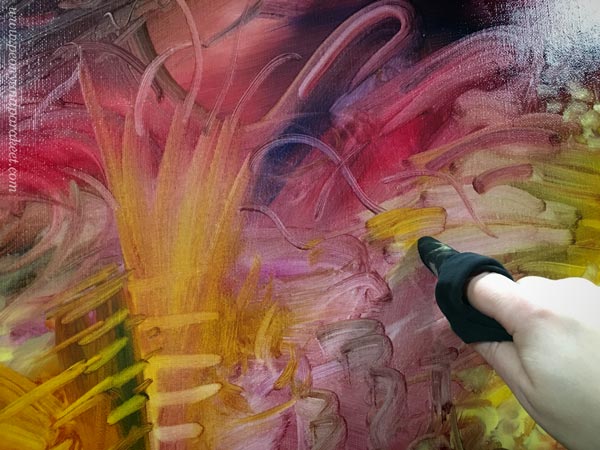
“I will paint all the luxury,” I said to Wassily and picked Indian Yellow, the color of gold.
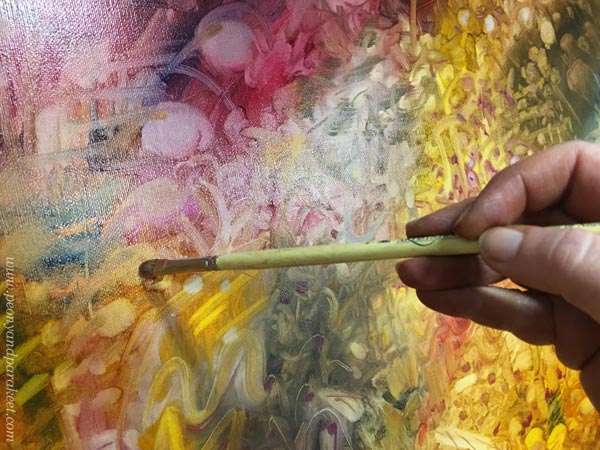
It all went fine for a long time. The painting was like a lion cub, cute and pretty at a young age, a true pet.
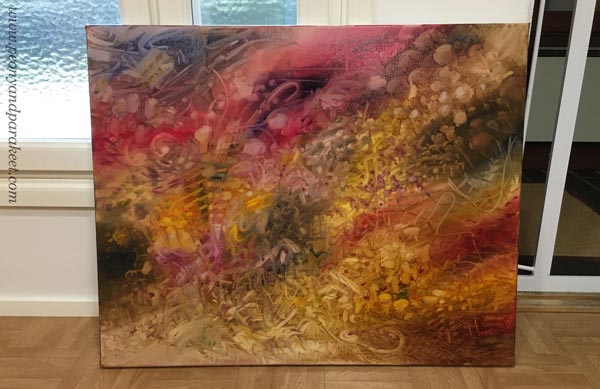
But then slowly, the colors got stronger, and shapes began to stretch in all directions.
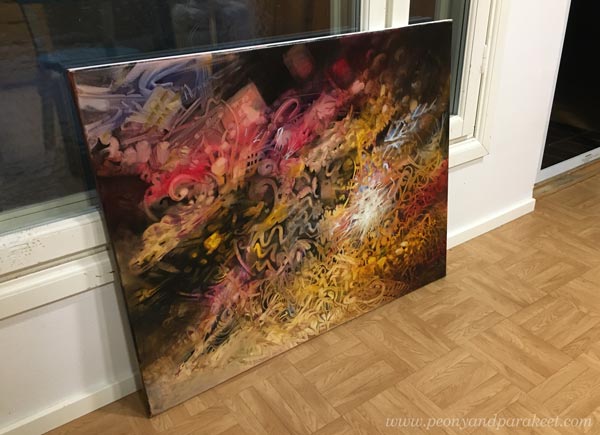
The pet had become a beast, and I couldn’t control it anymore.
Emotional Catharsis – Letting Go of Control
Just before I was about to give up the fight, Wassily stepped towards and said: “What was it like as a teenager before you chose money” He was pointing me with a brush that had Ultramarine Blue and Cadmium Red. The colors that I used so often back then.
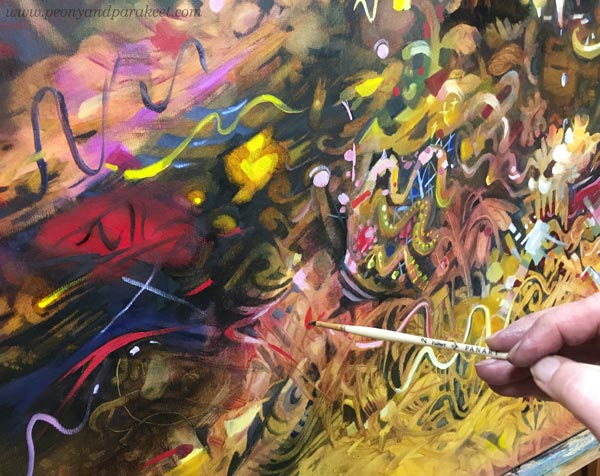
“Not now, Wassily, I can’t be weak now. I have this beast to handle”, I gulped, pointing towards the painting. But he grabbed my hand and, unlike his usual self, brutally fed it to the growing lion. The pain took over, the colors splashed uncontrollably, and for a short time, moments of my life ran through me when the lion ate me bit by bit. I was a teenager trying to find her painting style and become an artist. A young adult losing her parents and, as a result, counting pennies.
But then, just before the last ray of light burned out, I heard Wassily’s demanding voice: “You are not dead yet. Open your eyes and finish the painting.”
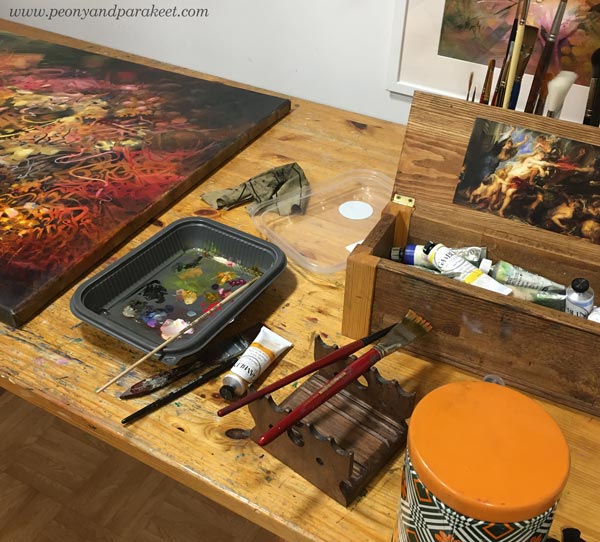
Days went by, and I visited the painting now and then like it would be a rare animal in a cage. Something had happened, but what? Wassily got frustrated: “Can’t you see it? It’s vanitas!”
Vanitas – Emotional Catharsis Explained
Vanitas paintings are still lives that express the inevitability of death in symbols. They were in fashion in the Netherlands in the early 17th century, but they have inspired artists later too.
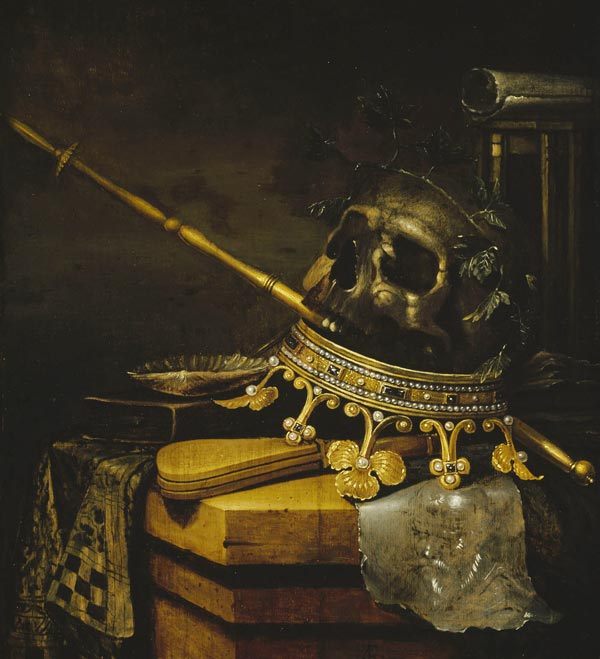
Suddenly, my lion shrank to only a skull, and there were bubbles, smoke, candles, musical instruments, playing cards, flowers, a bowl … all kinds of historical symbols for the futility of pleasure and certainty of death. Now finishing was easy. I just made the objects a little more distinct.
Here’s the closeup of the lion skull.
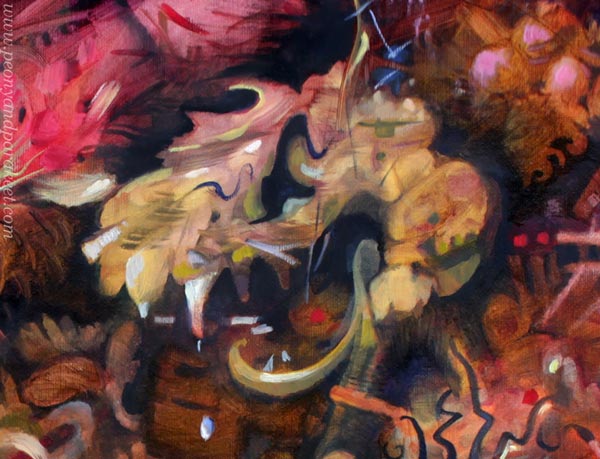
Playing cards are flying in the air.
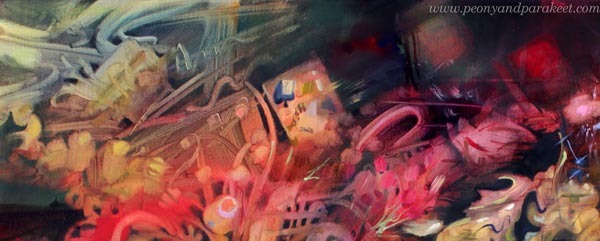
Here’s the crown, thrown in the mud.
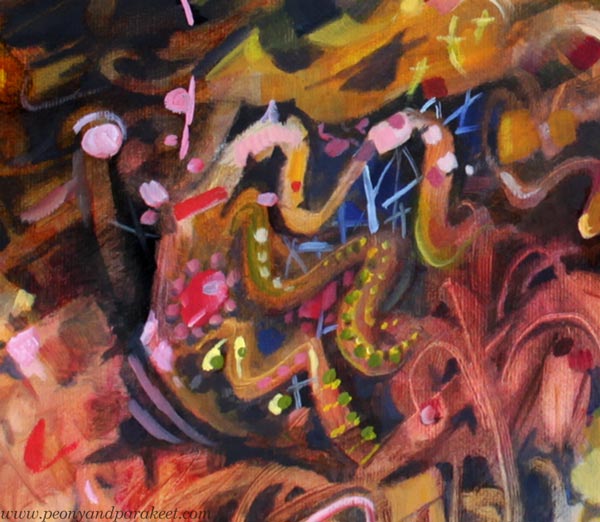
If you look carefully, you can also find lots of other symbols too. For example, a red bowl in the middle broken by icy water. And the yellow bottom expresses musical instruments and their sounds.
My favorite part is what the imaginary Wassily painted:
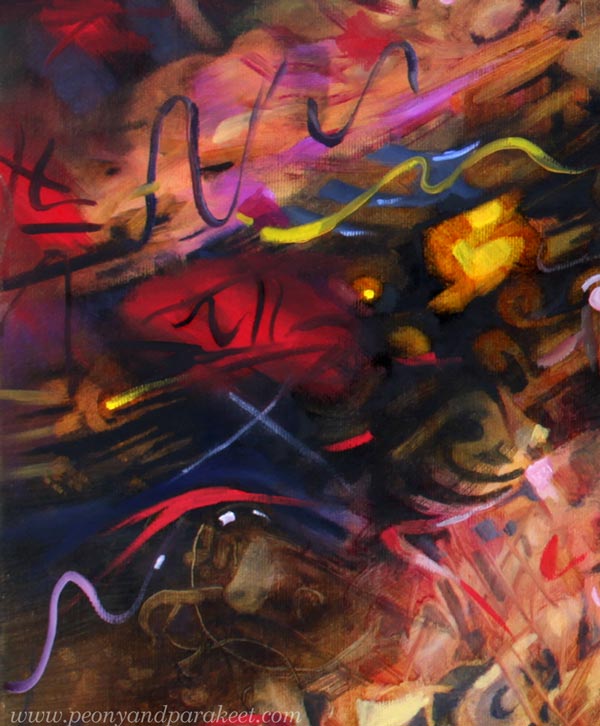
“This is how money looks like,” said Wassily in his teaching voice. “Don’t feel pity or fear about it anymore. Now you are free to paint whatever you want.”
– “I want to paint a couple of big floral still lives inspired by the 17th-century Dutch masters!” The relief and enthusiasm filled my mind.
– “Whatever,” yawned Wassily. Clearly, it would not have been his choice, but I hope he’ll keep sticking around anyway.
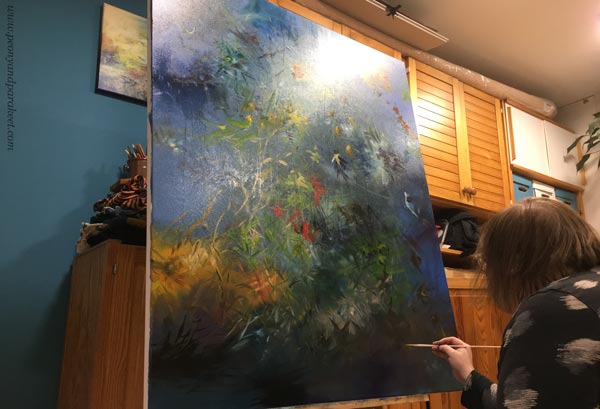
Have you ever experienced emotional catharsis through art-making? So, feeling purified after going through the climax of negative emotions? Do you always create for beauty or do you like to step to the other side too?