
Response from the Universe
This week, I have exciting news and talk about life’s big decisions.
In the spring, I will only paint canvas, but later this year, in addition to that, I will also paint the virtual world! Namely, I have received a part-time 1-year grant from the Finnish Cultural Foundation to produce a digital, three-dimensional artwork called Unknown Land.
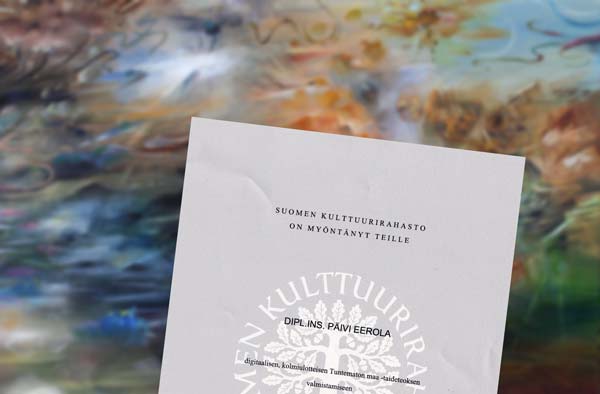
This is an excerpt of the application that I sent last fall to the foundation.
In my works, I search for a solution to the problems of the external world through the root causes, so strengthening the inner power of a person. By inner power, I refer to imagination and intuition – the human ability to imagine and sense the future. The future is an unknown land.
We can think of this unknown land as a new untouched continent. When we arrive there, everything seems like a newly born fantasy at first, but soon, we will see that this is not the case – only the emphasis has changed. Things emerge from the past, the meaning of which we have previously underestimated. In an unknown land, we are in a state where we no longer want to return to the past, but on the other hand, we cannot escape it. Then it is possible to see the old shadows in a new light and make an effort from that to the new one. Like my paintings, we, therefore, travel between the future and the past – the abstract and representational.
In the project, I will create an interactive virtual reality artwork based on my oil paintings. The project has many kinds of computer work – digital painting, 3D modeling, programming, testing, etc. So, things that feel more like my past self than the current one.
Past’s Big Decisions
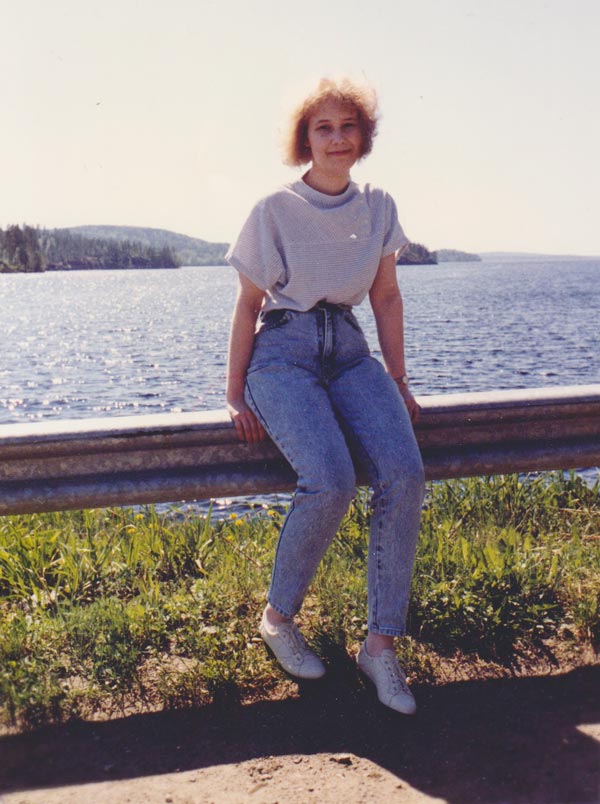
Let’s rewind to the 1980s when I was making big decisions in my life. My father had just died. I was engaged but not in love. I sent applications to universities and got accepted by them all. Although I tried not to think about it in the picture below, I knew this would happen: I would move far away to the south to study technology, I would not marry the guy I was engaged to, and I would leave art – at least for a while.
I had wanted to be an artist but didn’t think the art schools would be as accepting as the universities. I had self-evaluated my skills and talent, which weren’t where they should have been. When I said no to art, I got yes to many good things: intelligent ideas, challenging jobs, better income, etc. I was fascinated by computers, and I believed that the universe wanted me to study software engineering.
But later, it dawned on me that the universe is not quite that simple.
Worlds Are Fighting Over You
Even if I am not a big believer in destiny, I believe that there are worlds that fight over you. No matter how depressed on unpopular you feel at times, remember that some worlds would always do anything to win your heart. And even if you shout to the universe and it remains silent, the worlds are still there for you, waiting for the right moment.
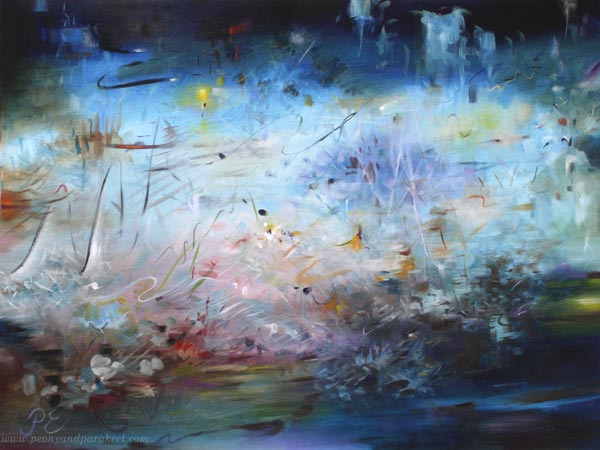
Art didn’t give up on me even if Technology won the battle in the 1980s. There have been big fights since. Last fall, just when Art thought that Technology had been beaten for good, I got excited about VR – virtual reality. Art and Technology have their own ways of capturing my attention. Art is like the beast of my inner world, demanding attention and energy. Technology always attacks outside – sends a few inspiring lines to read about innovations, an abbreviation to figure out, or an invitation to a special event for nerds.
“I will let the universe decide,” I told myself when I wrote the application. But so it happened that the two worlds that had been fighting over me for all my life finally agreed to come together. My life’s big decisions make sense now.
Changes Will Come
I will start the exciting new project in the fall. It will take a lot of my time, and changes will come, but I don’t want to think about them yet. I am painting for the next exhibitions and leading the class Doll World this spring. Then it’s time for Art and Technology to collide.
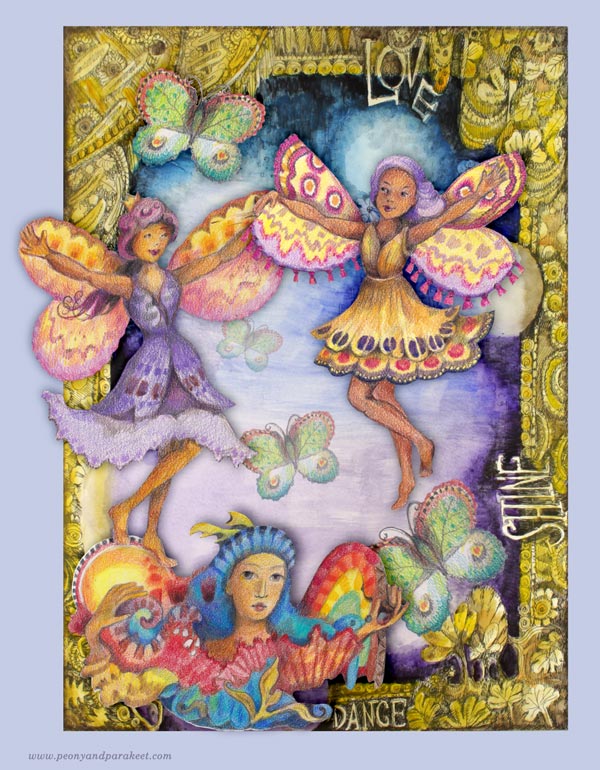
What are the worlds that are fighting over you? Tell us – leave a comment!
Birth of the Attic Paintings
What stories define you as an artist, and how could they inspire you to move forward?
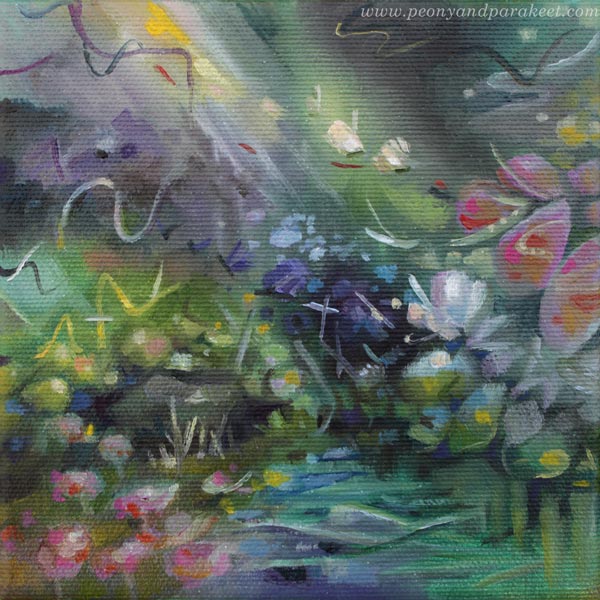
“Satumaa” is a Finnish word that’s something like “fairytale land.” This painting is only 15 x 15 cm!
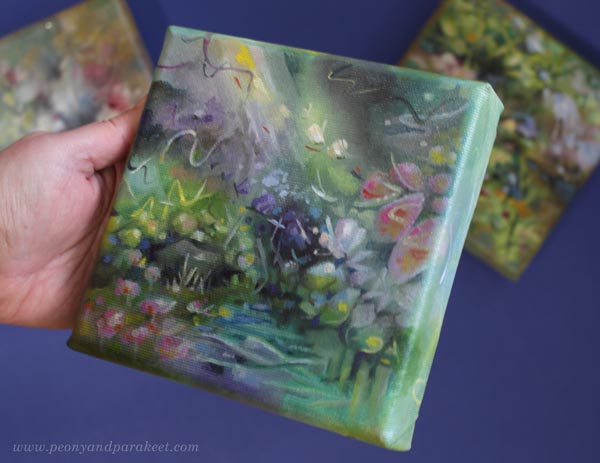
I call these miniature pieces attic paintings. Here’s the story behind them.
Päivi’s Attic
When I was a child, I dreamed about running a shop. My main interest there was in product development. I wanted to design things and offer an attractive selection. We lived in a wooden house with a big attic, and I established my shop there. It was called “Päivin puikko” – Päivi’s Needle and had a modest selection of hand-crocheted things.
I remember the joyful sound of footsteps on the staircase when my two sisters came to visit. They were a lot older than me and had coins with them too. When they admired the little handmade items on the table, the feeling of acceptance ran through me. One sister grabbed a long chain and asked how much it was. “Twenty pennies,” I said. “But this is so long,” said the sister, ” you worked hard for it, I give you fifty.” Sold!
Stories That Define Us
The stories where we experience big feelings define us. I realized that when I tried to figure out how much I have to raise the prices of my paintings. It was necessary as I have grown as an artist, and the general prices have come up too. But a little child in me said: “Don’t!”
“Why,” I asked.
“Because your paintings are already too expensive for my shop in the attic,” she whispered.
And yes, I couldn’t imagine selling my big paintings in that little corner. Yet, I wanted to have something for her too.
“Here’s what we do,” I said to the child. “I will raise the prices, but I will paint some small studies for you, only 150 EUR each.”
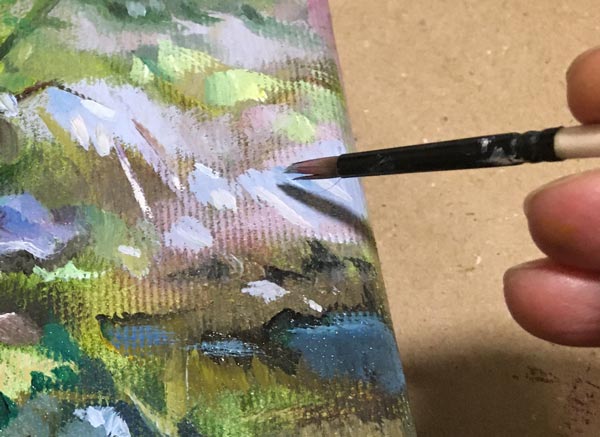
And that’s how these miniature paintings were born.
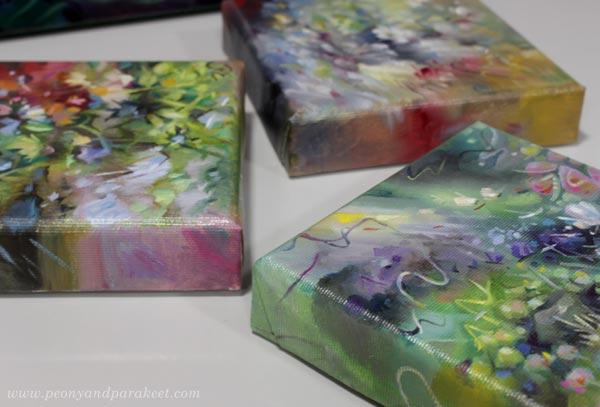
I call these attic paintings. The size is only 15 x 15 cm, and they are born from left-over paints. They are the same high-quality oil paints that I use for bigger pieces, but I often have leftovers on the palette after a painting session.
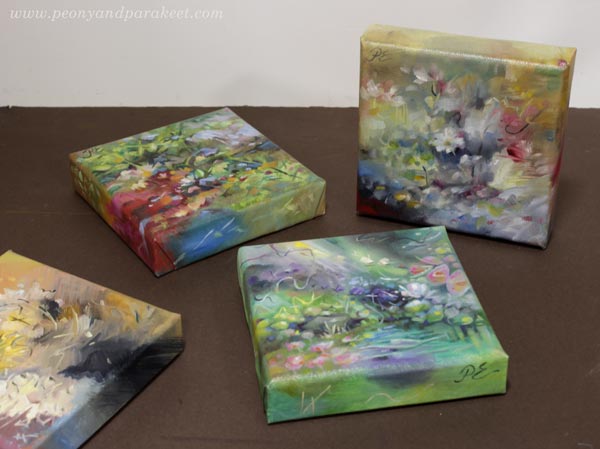
I am now much more comfortable with the higher prices when I have something for the attic – and for gift shops too!
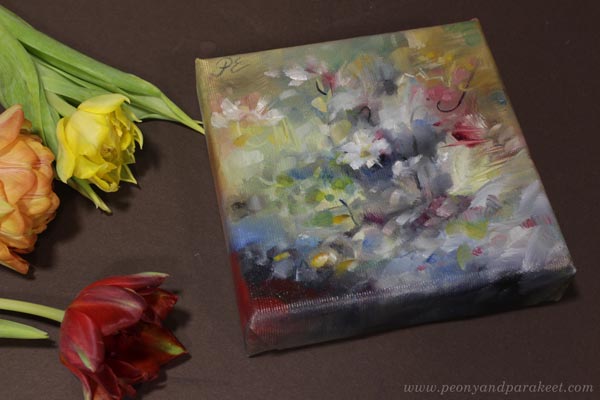
Valkovuokko
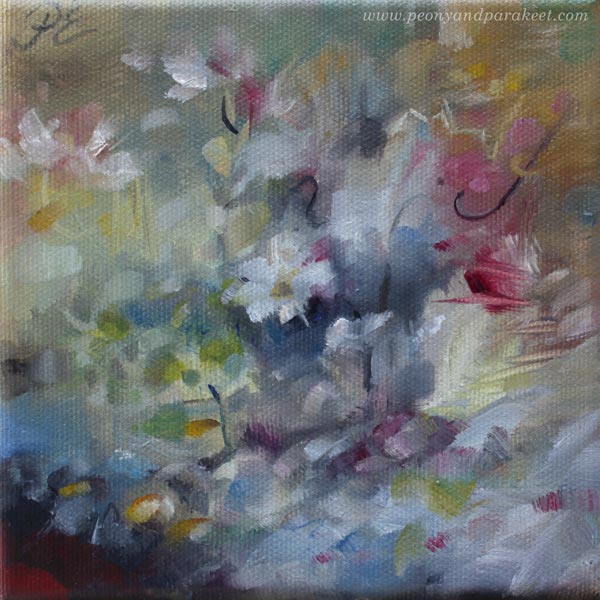
The English word for “Valkovuokko” is “wood anemone.”
Mansikkapaikka
“Mansikkapaikka” is “a strawberry place” in English. I was thinking about wild strawberries here.
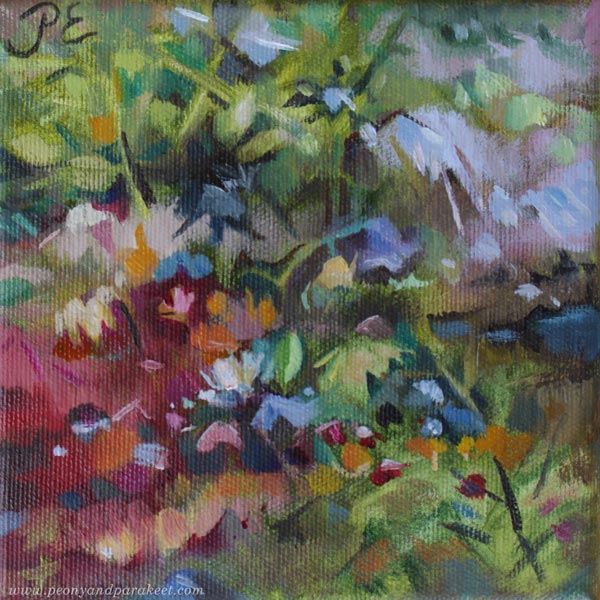
These small canvases work well for studies. It’s good now when I am practicing Albert Edelfelt‘s painting style for my upcoming exhibition in Villa Albert.
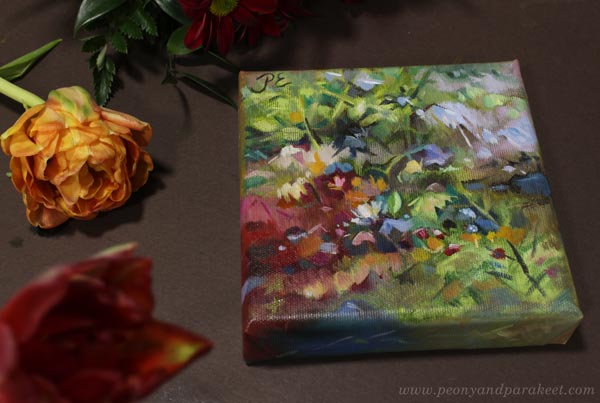
Mansikkapaikka is inspired by Edelfelt’s painting Ahomansikoita.

Satumaa
I like to paint sceneries that are overly romantic and full of fantasy.
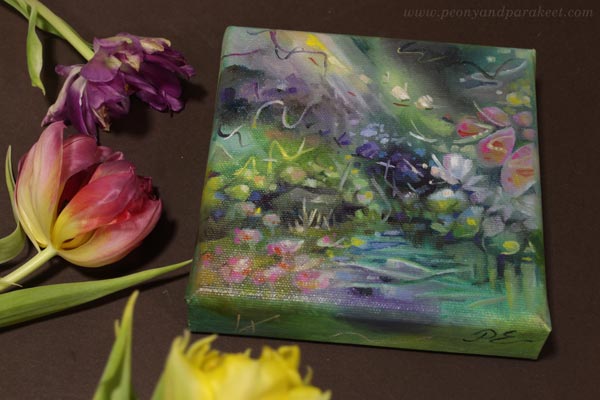
Satumaa was inspired by an older painting called “Luvattu maa – Promised Land.”
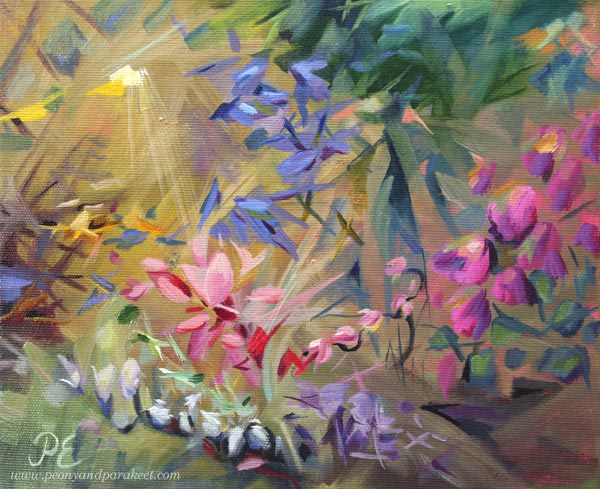
Promised Land was so much fun to paint that I wanted to repeat the idea of using a limited selection of shapes and expressing plants traveling toward the light.
Attic Paintings – Expansion of Style and Love for Plants
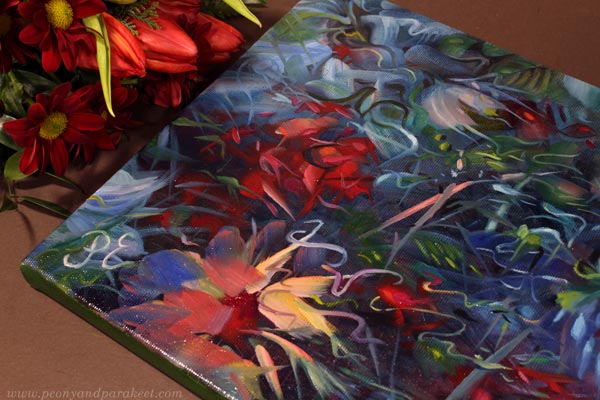
I placed “Mercury Temperatures” with the attic paintings to see how the small ones go with the bigger ones.
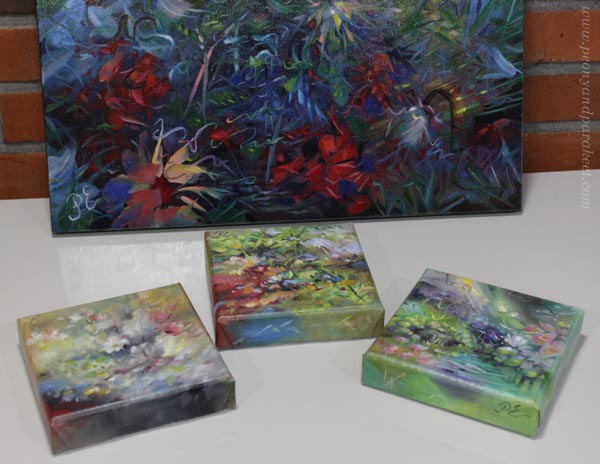
My love for plants and yearning for nostalgia and fantasy are well presented in both, I think!
My husband and I are enthusiastic about plants, especially decorative ones. Our home is like a flower shop now when I have got some bouquets for my birthday and when orchids are blooming.
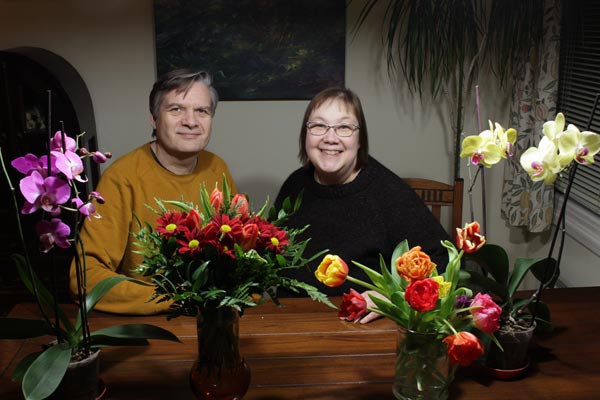
When I think about the shop in the attic, I wonder how I could not see its influence earlier. The stories that define us can prevent us from growing. But the stories can also be the key to solutions that enable growth and change.
What do you think?
Art and Sacrifice – Must an Artist Drop Other Interests?
This week, I respond to a question about creative focus: when we want to move forward, should we focus on doing one thing and abandon other creative activities, like crafting?
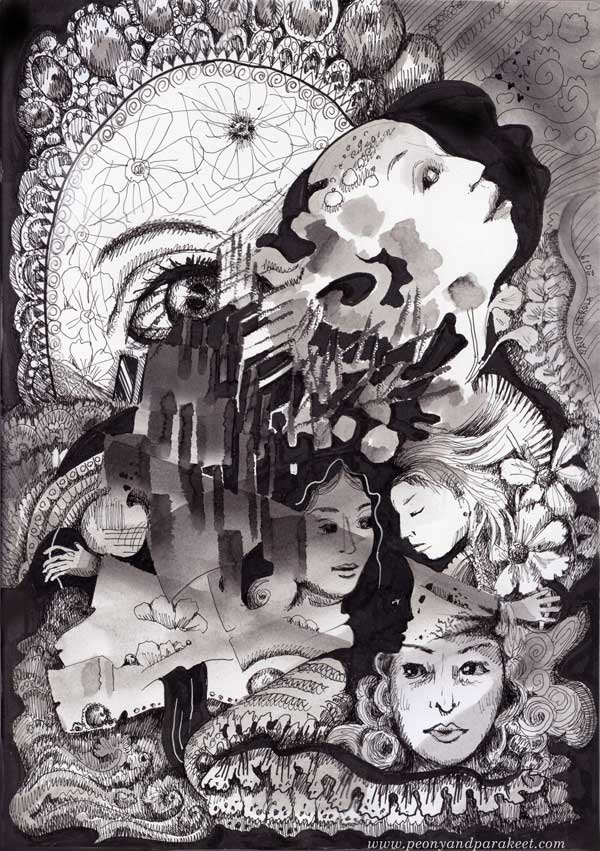
I got the idea for this blog post from an interesting discussion that is running in my community Bloom and Fly.
The discussion started when a member wrote:
“I find that I have an interest in, perhaps, too many creative pursuits. I enjoy sketching, making journals, watercolors, acrylics, crafting, etc. I have observed that artists with a specific focus and dedication seem to be more successful and just plain good at what they do.
Of course, if one focuses on one ability, the hope is a gain in creative skills. Practice for purpose. So, should we know that in order to be very good at something, we must sacrifice other interests? Any thoughts?
I find that I have an interest in, perhaps, too many creative pursuits. I enjoy sketching, making journals, watercolors, acrylics, crafting, etc. I have observed that artists with a specific focus and dedication seem to be more successful and just plain good at what they do. Of course, if one focuses on one ability, the hope is a gain in creative skills. Practice for purpose. So, should we know that in order to be very good at something, we must sacrifice other interests? Any thoughts?“
Here’s my answer!
Sacrificing a Hobby? What’s Your Priority?
When you want to move forward, the essential question about every activity is: “Is this activity for relaxation or for moving forward” so, “Is this hobby or work?”
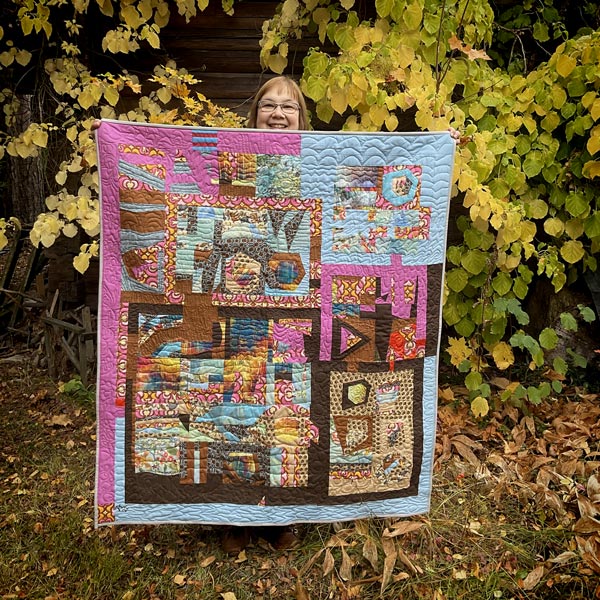
Having many hobbies is a good thing. I am a professional artist, and I love my many hobbies. For example, I quilt, scrapbook, make cards, spin yarn, knit, and cross stitch. I don’t do everything every week, but I do these regularly in my spare time, mainly in the late evenings and weekends. If I learn new things in my hobbies, it’s nice, but it’s not why I do them. I do them for relaxation, to keep the balance in life, and to stay healthy.
My official Instagram account is @peonyandparakeet, and there, I only share art-related stuff.
Separating your hobbies from your work is essential when you want to see your artistry more clearer.
I also have two beagles that need quite a lot of exercise and lots of house plants that need care. Like my other hobbies, they have never been things that I would sacrifice to become a better artist. I would find it very difficult to lead a happy life focused on art-making only.
But when you want to move forward in visual art, you need to redefine creativity and art.
For many people, a simple quilt is a work of art, a sign of creativity. I get that. But when you want to move forward in art, you need to raise the bar and stop treating every activity as if it would require creativity.
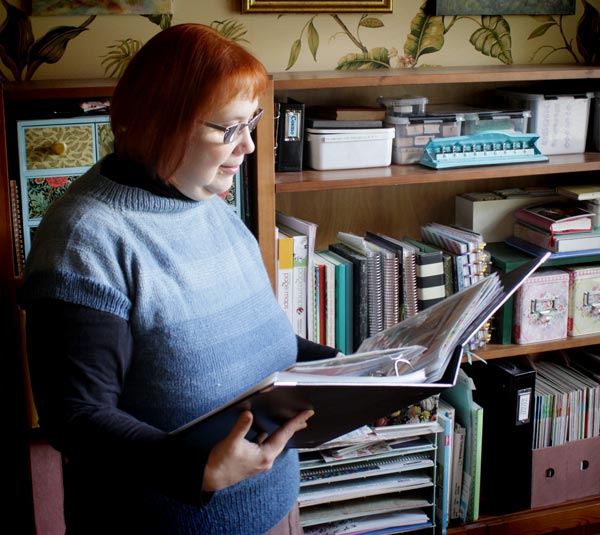
For example, if you don’t want to become a professional scrapbooker, decide that scrapbooking is not a creative activity for you. Yes, you learn self-expression and design from it, but treat it as a side bonus and define the meaning of the hobby differently. For example, I scrapbook because I want to get reminded of the good things that happen in real life – that everything is not about my imagination, but real life matters too. I want to take photos and get an outside view of my life. My paper crafting happens in a different space than art-making and with a different set of tools.
I don’t publish my paper crafting projects alongside my art. Sharing my art is work, and paper crafting is a hobby that’s reserved just for me. When I shop for crafting products, I am a consumer who enjoys buying pretty stuff. When I shop for art supplies, it’s much more serious. I check the pigments and the other quality factors and don’t feel like a shopper at all.
The results of my hobbies are not brilliant, but I reserve my critical eye for my art. If I someday do not enjoy the hobby, I just stop and do something else. That’s ok because it’s not my work.
Where Does Your Best Energy Go?
I save my best energy for creating art. It’s my priority and my work.
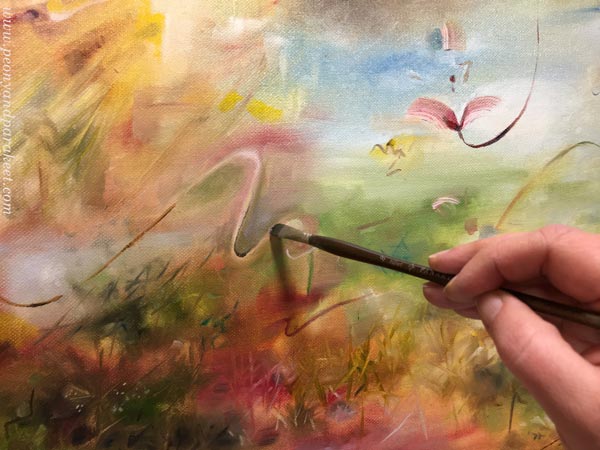
Many days are difficult, but that’s ok. I don’t expect to enjoy every moment. Even if I sometimes fiercely hate what I do, I will continue because, in the long run, it enables things that I want to accomplish in life.
Of course, like in every job, changes are needed if every single day is agony. But in general, I don’t expect things to go easily and effortlessly. I show up every weekday and create productions, not just single projects. Productions are, for example, a series of paintings that I will be exhibiting or a course that I will be launching. I try to think about my work as a series of things, not just single things that I throw to the world. I commit from three months to one year and don’t expect results immediately.
Series is always a big risk. Many classes have not sold as I expected them to, but some have been surprisingly successful. The same has happened with paintings. But the more I think of my work as a continuum or a curated collection, the more potential impact there is.
That’s also why I want to encourage you to make art journals, make a series of drawings to fill boxes of joy, and even take classes to commit to several projects.
Sacrificing Techniques: Drawing or Painting, Watercolors or Acrylics?
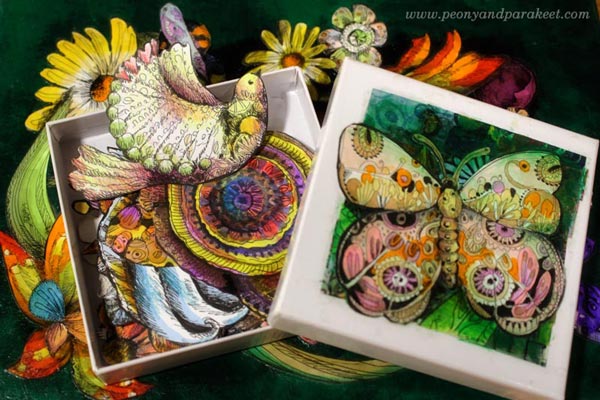
When you want to move forward in art, the most important question is not about the technique. It’s more important to consider what things you want to offer the world. If you think about this blog, would you really want me to focus on one technique, one theme, or one subject? And still, I have a clear focus that defines my offerings: I want people to get connected with their imagination.
Thus, when I fill my journals, it doesn’t make me feel less artist than if I make big oil paintings. My intention is the same – to inspire you to reach that inner child and use your imagination. Journal pages get published in my blog or classes and encourage you to create and imagine, and when someone buys a painting, it takes his or her mind from the wall to a different world.
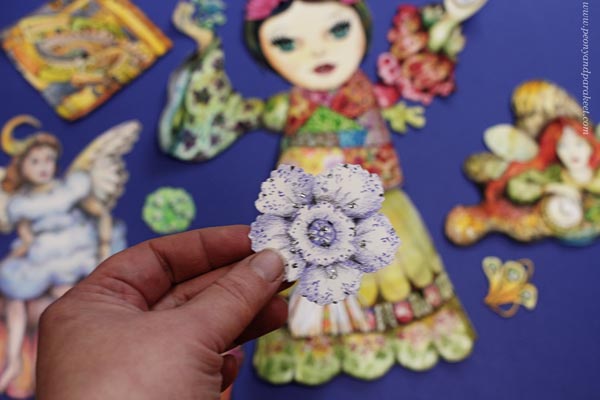
In the work-oriented mindset, you don’t just create for yourself but build a path to serve others. This path can, of course, begin from your own enjoyment, but the longer you want to go, the more it will also involve others.
When you see artists focusing on what they do, remember that they are mindful of how they serve you. Their life can include all kinds of things and activities; they just don’t show that to you. You don’t need to sacrifice your other hobbies; you only need to stop thinking of art as something that you do only for yourself.
This, however, doesn’t mean that you would do art only for the sake of pleasing others. When you are at the beginning of an artist’s journey, you are not conscious of how you can serve people the best way yet. You need to create more art, grow your skills, listen to yourself, and regularly show up to the world. I have found my path by updating this blog, which is now over 10 years old. So I thank you for helping me find my mission as an artist!
“Great, But I Don’t Want Art to Be Work for Me!”
Of course, we can have goals in our hobbies too, and many times the development begins as a hobby. But isn’t it so that when we set goals, they include secret dreams? Being aware of these hidden thoughts and facing how much work it will require is a part of the artist’s journey. And yes, some sacrifice is then needed.
If I think about myself, becoming an artist has required more passion and work than I thought. For example, getting over rejections has been hard but necessary. When everyone said “no,” it was difficult to see the potential “yes” in my work.
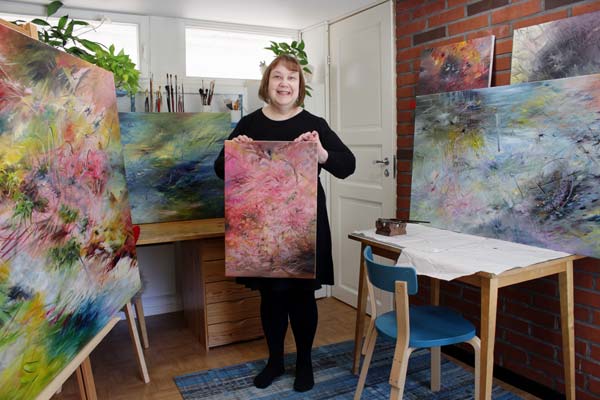
But life is short, and this is what I have ever wanted to accomplish in this life. And now, I even see a new horizon and want to accomplish more. Again, it feels overwhelming, but I know that if I treat it as work – as my priority, I will have a chance. I will write more about that in the near future!
Art and Sacrifice – What Do You Hope to Accomplish?
This is my counter question to the original one. What does being successful in art mean to you?
I also like this question: “How does success appear in your environment?” It’s like a mini question that leads to the big one. For example, imagine how your home looks when you have accomplished what you hope to do. How have you organized the supplies? What’s on your walls? What is the overall style and atmosphere? Even – where do you live then?
Any thoughts? Please leave a comment!
Learning from Artistic Influences – Answering a Question
This week, I have a letter for you who want more from your art. Success looks different in different stages, but wherever you are in the artist’s journey, intuition says that moving forward will be tedious. So, it’s tempting to find a shortcut.
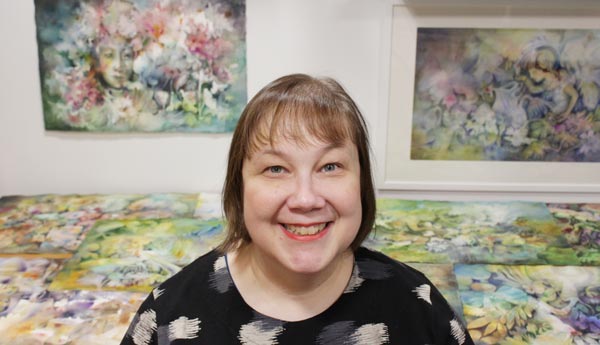
Last week, I got a message from a reader asking if I could recommend one or two artists that have influenced your work. “Who, in your opinion, is someone a new artist must learn about?” she wrote.
Here’s my answer to the message with some additional explanations and images.
Listing Artistic Influences
There are a lot of things that have influenced my work, starting from the slow and long summer days as a child in Nothern Karelia, browsing art history books in a local library, studying computer engineering and learning conceptual thinking, studying industrial design and learning the basics of visual communication through shapes, reading Paul Klee’s Pedagogical Sketchbook, learning old master techniques first in a couple of courses, then on my own, etc.
Two artists that I have admired in the past few years have been Peter Paul Rubens, a Baroque painter, and Wassily Kandinsky, an abstract art pioneer.
(These artists have inspired me to teach as well. In the last section of Floral Fantasies, you learn old master’s techniques, and in Floral Freedom, you learn abstract art through Kandinsky’s and Klee’s ideas.)
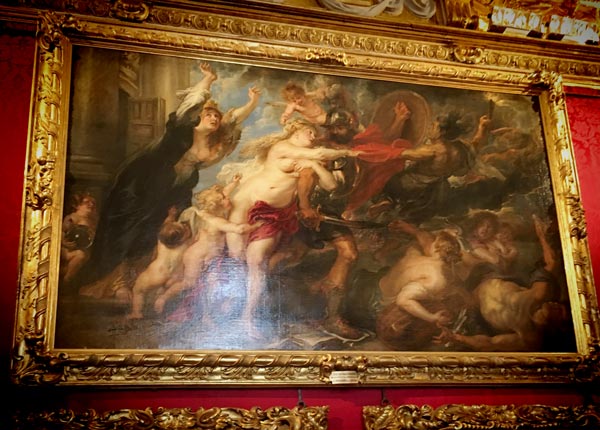
Read more about my visit to Palazzo Pitti in 2017!
However, these may not be the answers you want to hear. The answer that is most beneficial for you is to ask yourself what’s the root reason for the question.
Questioning Your Direction
When I was searching for an answer to that question about ten years ago, I wanted to find a direction that would take me to the art world. I knew my skills weren’t spectacular, so I wanted to find someone successful who creates art that is simple enough. But then I realized that my taste was a way further, and the only admiration I had for those artists was in their courage to come up and the success as far as I was then able to define it.
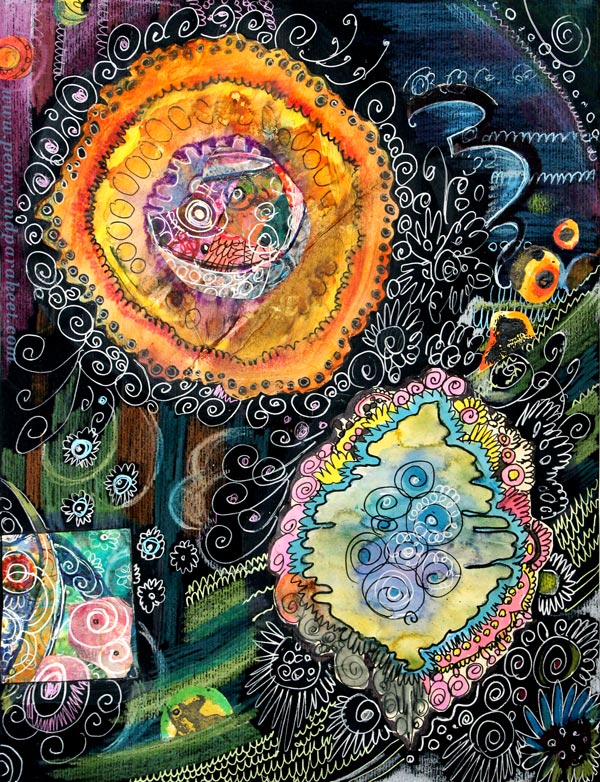
I believe in intuition, and based on that, I assume that you are at the intersection, wondering whether to start going further forward: becoming braver to share your work, build stronger technical skills, and move to the next level in what influences your art and how.
In the next level, the answers become more complicated and multi-faceted. You should learn more about art history and all kinds of contemporary art, go to art museums and galleries, and stop to think not only on the level of “I like that red” but on a more conceptual level: “what does that red represent and how could that effect be created in other ways too?”
Expanding Knowledge and Inspiration for Art
As an artist, you belong to the chain of creative generations, and your roots are long and broad.
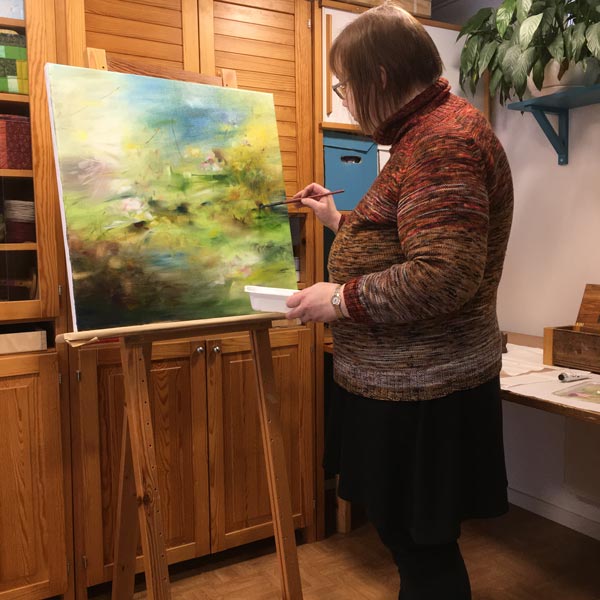
You might also be in a spot where you need to start looking for inspiration outside art, expand into designing, illustration, architecture, and further: nature, culture, and whatever fields are close to you. Art happens when things collide. The nature of art is to expand, not narrow down.
My letter ends here, but how would you have answered the question? Leave a comment!