
Preparing for Sales Events
This week’s post is about something that I have been doing lately: preparing for sales events!
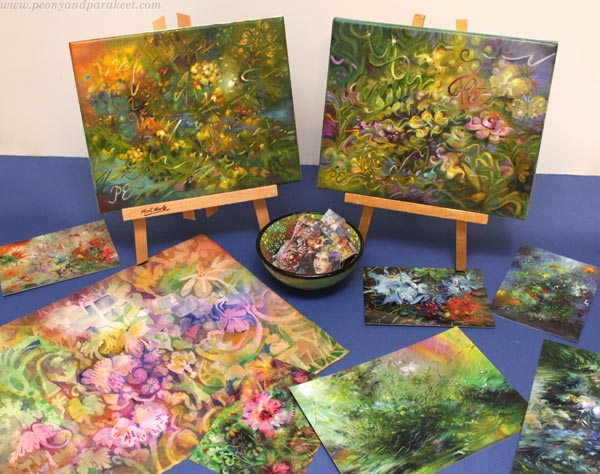
I participate in four events:
- A curated group show organized by the big gallery Gumbostrand Konst & Form
- A winter-themed group show organized by the local artist association where I am presenting Talviyön runoelma – Winter Night’s Poem
- 2-day Christmas sales event organized by the local artist association Vantaan taiteilijaseura
- Black Friday course sales event organized by me on this website!
For me, this is a lot! Fortunately, I have had time to prepare. For example, I got the deadline for the suggestions for the curated group show on Sept 1st. I was then able to apply and have new work specifically painted for the gallery.
Of these four, I am most anxious about the 2-day Christmas sales event even if it’s the smallest one! I have a sales table there, and I haven’t been preparing one for ages. I enjoy selling face-to-face, so it’s also something that I look forward to. It’s also great to see all kinds of sales items on one table and make a nice selection.
Selecting Sales Items – Delivering the Experience of an Original
Even the smallest sales table is a chance to strengthen your artistic voice and communicate your art brand. Most customers may buy postcards and other affordable items only, but still – we want to give them the whole experience. People have come back to me saying: “I remember you. I bought one card from you a couple of years ago, and I look at it every day.” I like to think that with the card, they also buy a piece of the world I am presenting to them. That’s why I always try to include original art as well.
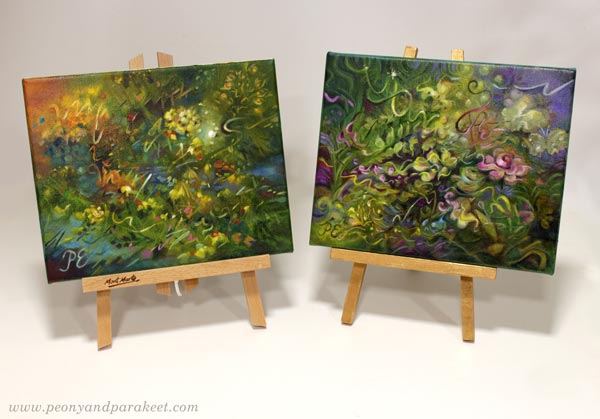
Here’s one of the small paintings that I just finished. It’s called Samettikukan sointi – The Sound of the Marigold.
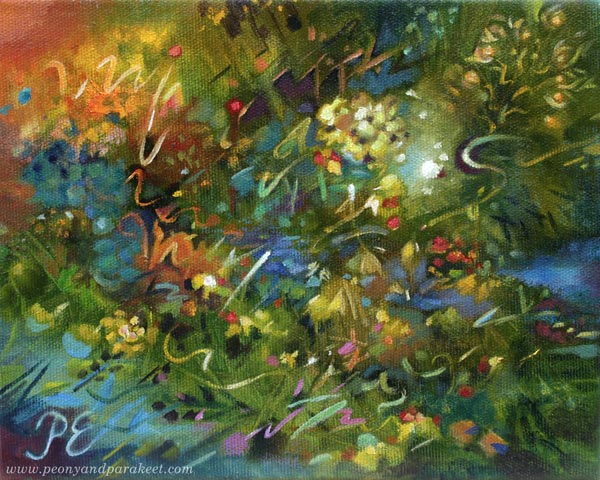
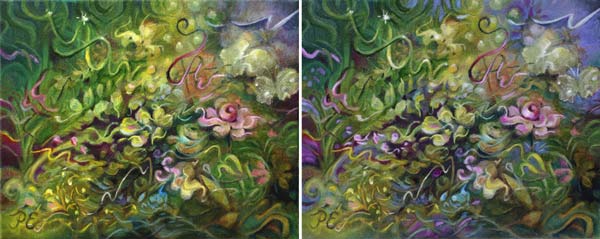
The Sound of the Marigold is a sister to a piece that I showed you earlier called Ruusun henki – The Spirit of the Rose. But when I placed the paintings side by side, I wanted to make adjustments to the rose painting so that its’ color scheme is less similar. So here’s the new version of The Spirit of the Rose:
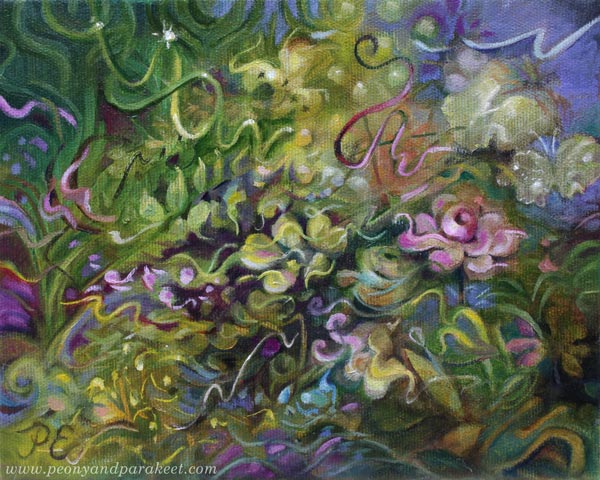
Here are the two versions together so that you can compare the changes.
I am going to have small stands for them so that they will stand out from the rest of the selection.
There are also a couple more small oil paintings. They are still in progress, but I hope to finish them soon so that they have time to dry.
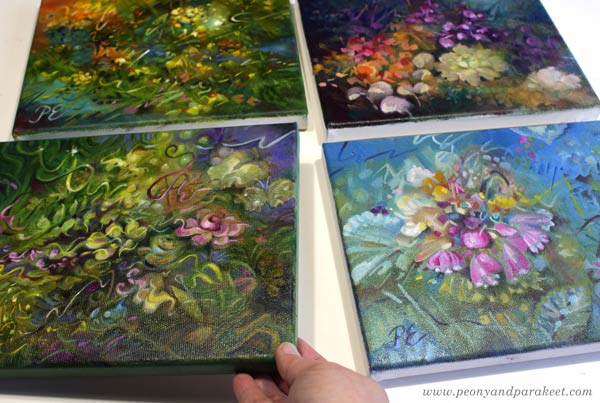
I have noticed that people who don’t regularly go to art events forget the difference between a photo and an actual painting. – like it would be the same browsing the feed or picking a postcard as watching an original.
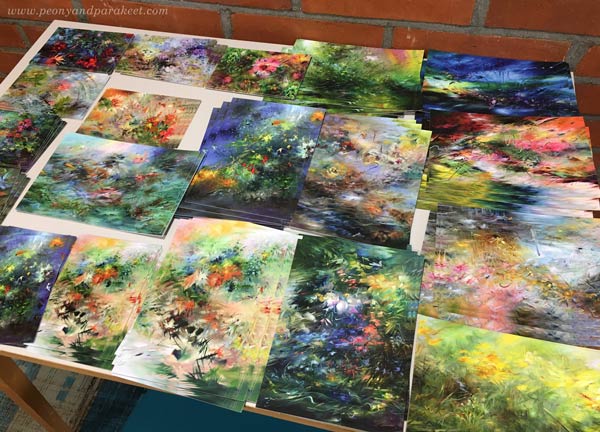
On my sales table, prints will dominate in quantity. And because most of them are pictures of oil paintings, I also want to deliver the experience of an original oil painting. With the four small ones, I can hopefully present one medium-sized original, maybe Forest of Wishes.
What A Part of Your Audience Expects to See
In my experience, some people are interested in a specific art technique. Previously, when I had the sales table at a similar event, there were some who wanted to talk about watercolor painting and were disappointed that I only had one example or so. These are people who are art hobbyists themselves and who are potential customers for my classes.
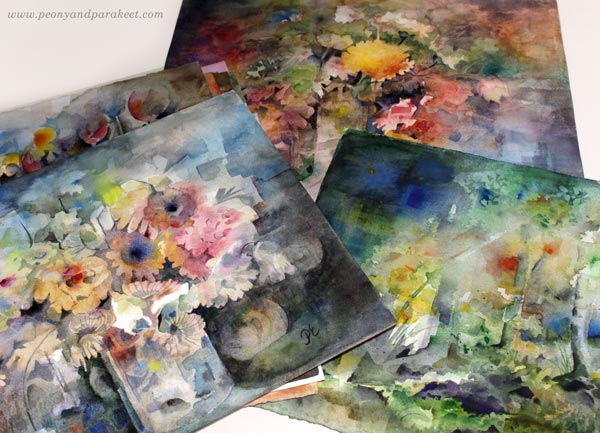
I used to paint a lot in watercolor, but lately, not so much because they don’t sell as well as oil paintings and have a low price point. Because I need to make a living and because I enjoy creating big paintings, I have focused on oils. But this time, I thought I would take a bunch of watercolor paintings with me and set the price lower than expected. If I still actively sold watercolor paintings, I wouldn’t do that, but now I see the chance to reach this part of the audience and show my watercolor work.
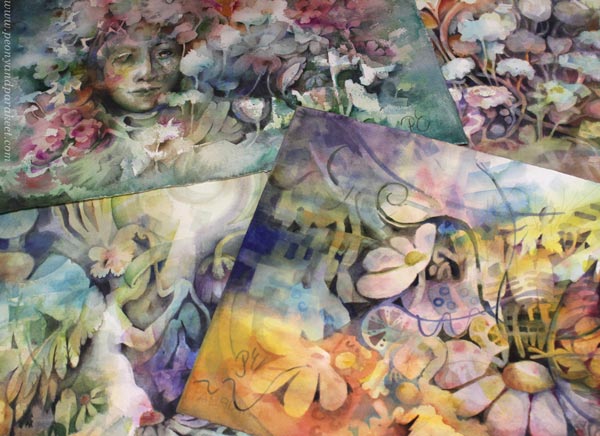
Because most elements of my style were developed in watercolor first, these pieces fit well with cards that have oil paintings.
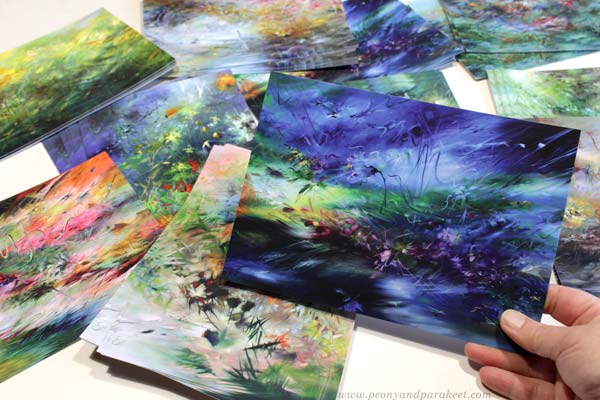
These cards came out gorgeous! They have a satin finish and are bigger and thicker than standard postcards. I ordered them as well as the cards from Moo.com (affiliate link, but I would recommend them without one too!)
What to Leave Out
Many times, I have put everything I have on the sales table, and that’s never been a good thing. You might have potential best sellers, but bringing items that don’t make sense to them will ruin the sales. For example, I brought fabrics with my designs and some craft items to an event focused on fine art. And vice versa, I took some original art to a craft show. Yes, you might get some sales from the odd items, but confuse most of the audience.
Price can be a reason to exclude some too. For example, if the organizer takes a percentage of the sales or if the price of the sales table is high, selling the most affordable items doesn’t necessarily make sense. And vice versa: when people come for good finds on their way to the shopping center, selling the biggest and most expensive pieces can be hard.
This painting – Tiger’s Eye – has been waiting to get to a curated exhibition that interests art collectors. Now I am happy to pack it and two other paintings for a big gallery show.
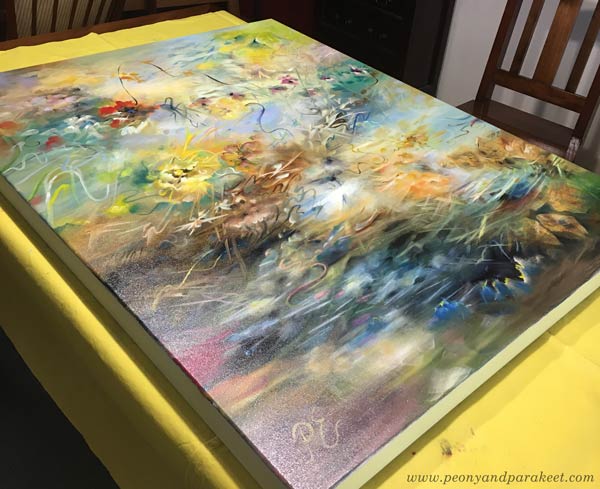
My oil paintings always get a varnish and a hanging wire so that they are ready for hanging on the wall.
In my experience, original art that is ready to hang is more tempting to buy than pieces that require, for example, framing. However, if the price point is very low, it doesn’t always make sense to frame the pieces. Whatever the case, it’s always good to present a unified collection and leave out some that are too different in size, style, or frame than others.
When selecting work for the small postcards, I left out many paintings I like and value. For example, many of my big paintings are not so great for postcards. Their details get lost in the tiny size, and their subject is more suitable for decorating interiors than sending wishes.
And then some paintings are quicker but more suitable; for example, Kukkiva maa – Flowering Earth that I painted in acrylics for the class Floral Freedom.
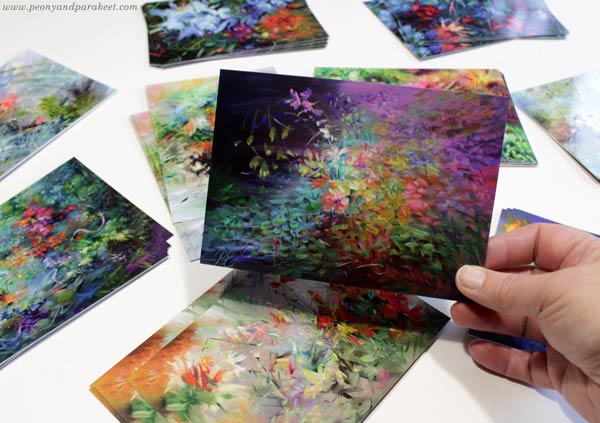
I think it’s perfect for a postcard – full of colors and flowers!
How You Will Be Remembered
Many times when I have been preparing for the events, my behavior has been on my mind: Am I able to show my enthusiasm? How could I not only make sales but be remembered afterward too?
But the best answer here is quite technical. You should have something to give that has your contact information on it. And all your products should have your name and website – or at least an email – on them. I use the same tactics, the same generosity that is, that I have used with selling online courses. I give something for free and invite people to see if I am suitable for them. On the sales events, I have small cards that have different pictures – details of my art – and I invite people to pick one that they like.
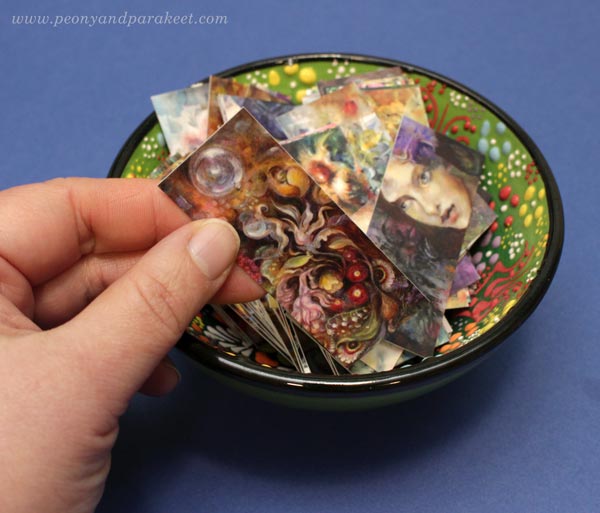
This begins a conversation about their likings about them, and when they have the mini card, I can serve them better and be remembered too.
The postcards also have contact information printed on the back.
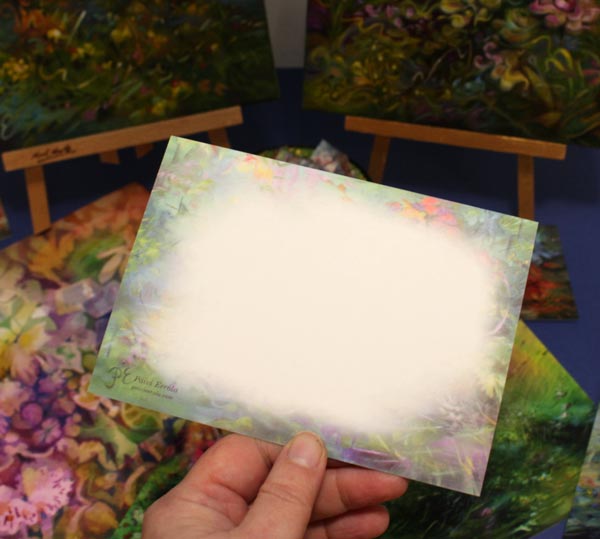
There’s also another artwork as a frame.
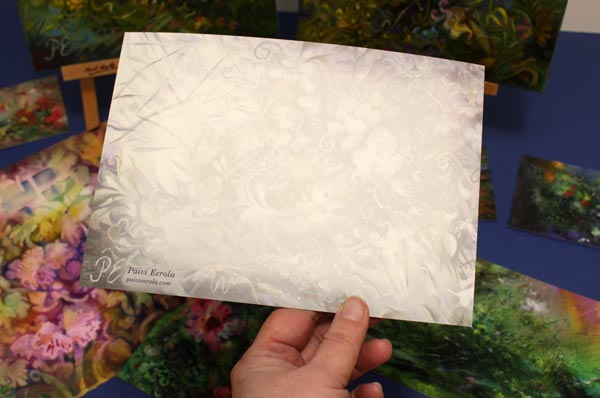
I think about these features as generosity as well. I have taken the time to design the back to make the cards even more valuable.
Sales Events Are the Opportunity to Test
Even if it’s good to have a unified style and selection, the sales event is also an opportunity to test new ideas and approaches. I like to do tests that are not big new things but hidden in the small stuff. This time, I made a postcard of my colored pencil work to see how many people can recognize the medium and how many are interested in this style of drawing.
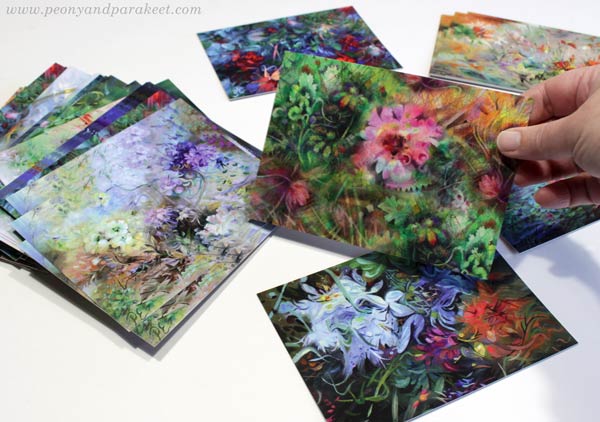
This postcard is composed digitally of many colored pencil pieces.

As you know, I am not just an oil painter, but also love colored pencils. It would be fun to talk about them too.
This leads us to my course sales event on Black Friday weekend. All classes will be on sale and registration for the new class Doll World will open. Doll World will begin at the beginning of January.
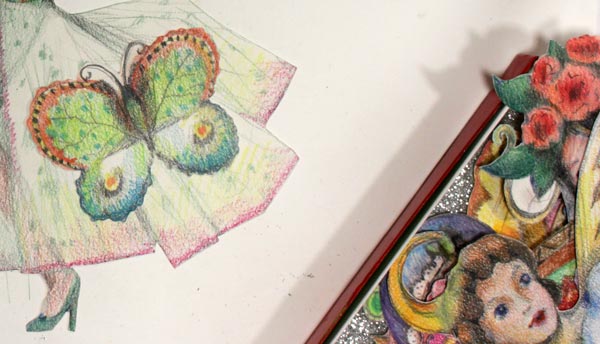
During the years, I have learned that if I love the class, there’s a possibility that you will love it too. The same goes for all art really. We have to pamper it and give attention to its needs. And when the course or the painting asks: “Will there be anyone for me?” we must say: “Yes, my dear – kyllä kultaseni – sometimes it will just take a little bit of time.” We both feel vulnerable about this.
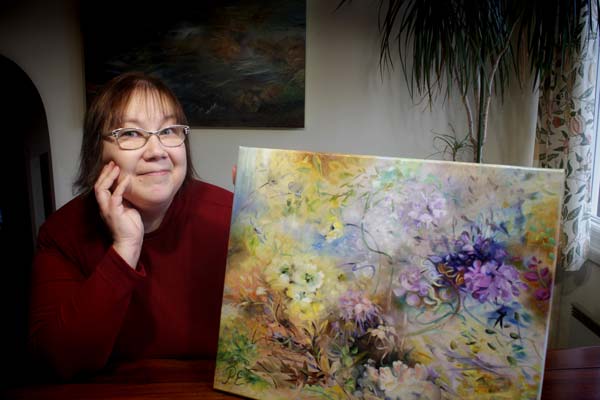
P.S. The engineer in me says that this is not a comprehensive article about setting a sales table. But I intend to share some pics when I set the actual table on December 3-4 at Galleria K, Vantaa, Finland. So stay tuned for Black Friday sales and future blog posts!
Painting Roses and Their Spirit
This week, we get inspiration from roses – their spirit, resilience, and decorative beauty.
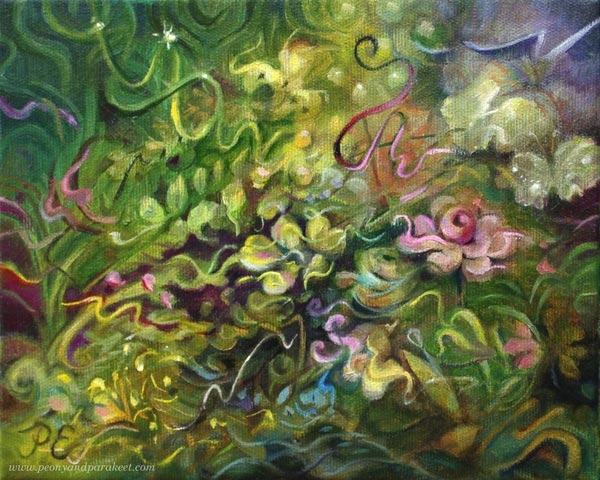
With this post, I want to encourage you to expand the use of decorative art. You can add decorative elements to any art style! See another example in the older blog post: From Decorative to Expressive Art
The Spirit of the Rose Stays Alive in The Fall
Roses surprise me every fall. When other flowers have given up weeks ago, roses still make buds and continue to bloom. Not as galore as in summer, but they try their best on cold nights and cloudy days. The spirit of the rose is born from warmth and light, but once it’s up, it doesn’t quench easily.
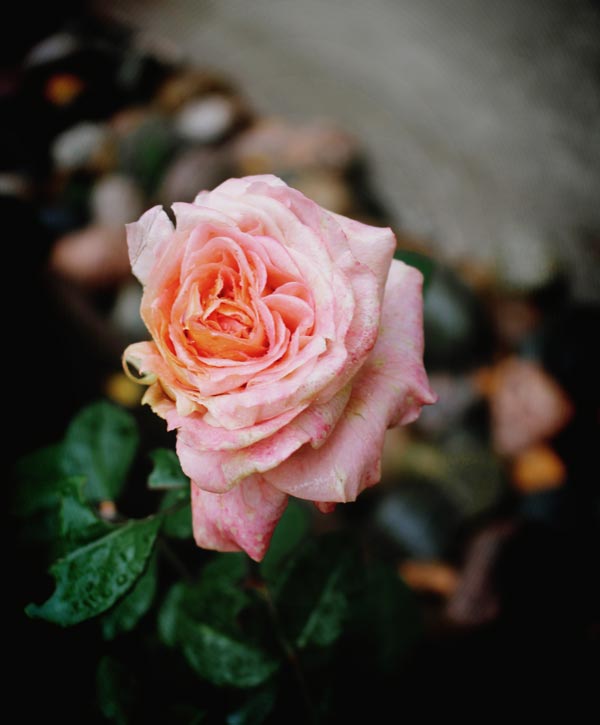
In our garden, roses are more my husband’s thing – I collect peonies! But in the fall, I have to admit how superior roses are, queens of the garden, one could say. When the colorful leaves take over the scenery, even the most modest rose flowers stand out simply because they are different in colors and shapes.
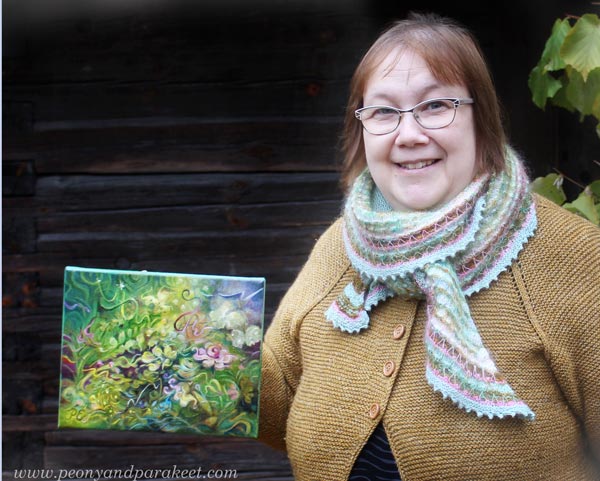
It reminds me of how resilience and beauty are connected. So mere persistence in creating makes your art beautiful.
Expressing with Small and Decorative
This painting is a small one, only 20 x 25 cm (approximately 8 x 10 inches). When I was a beginner in painting, the small size felt easier. But nowadays, I prefer big canvases, and if I want to create something small, I usually grab my colored pencils, not brushes. But on the other hand, I like the challenge that the small size gives.
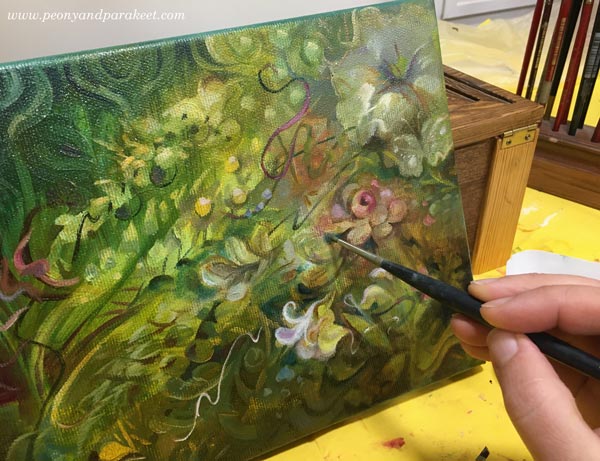
When painting roses in a small size, I need to have an extra focus on the quality of brushwork. Even the tiniest strokes should be elegant, especially if the painting is called ”The Spirit of the Rose.”
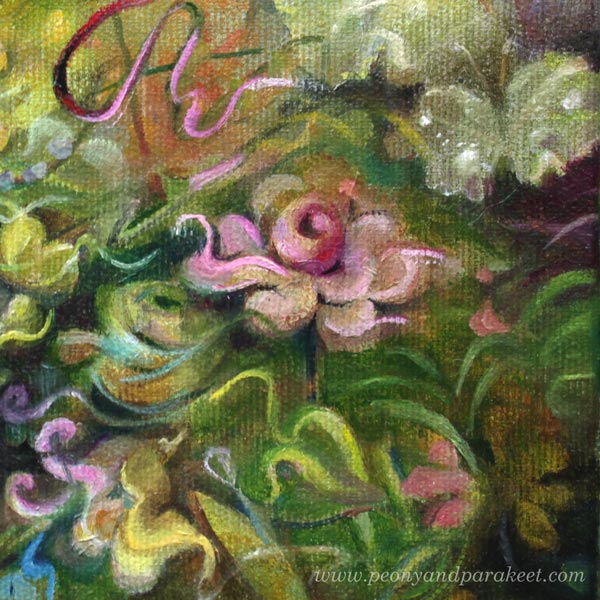
Decorative paintings often look very static, but I like to add movement with lines. At best, my small paintings are like short classical musical pieces with a clear melody, lots of short violin strokes, and clever piano tunes in major. It often helps me if I define the desired outcome by other art forms like music or movies.
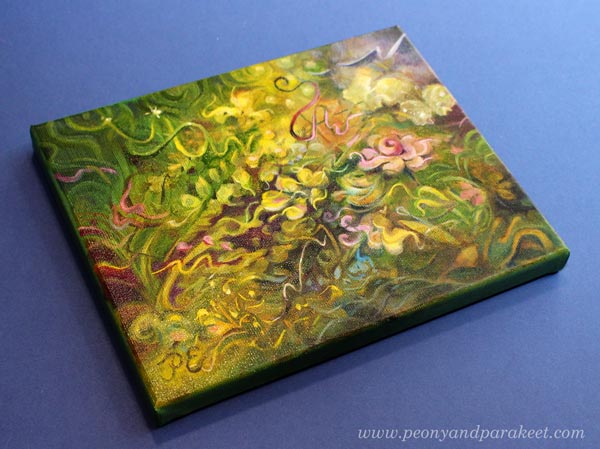
But decorative art has its limitations. The spirit of a rose is not visible if you only paint one kind of rose and if all that you paint is roses. Add flower variations, how the flowers affect their surroundings, and how the surroundings gather around the flowers. Add elements that resemble the living spirit, and let colors interact too so that the roses are not separate but part of the living scenery. So, painting roses is never just about roses, it also expresses how you see the world.
Painting Roses – Decorative Flowers of Decodashery
Even if single floral motifs are often not so expressive, I am fascinated by the techniques of decorative art, especially folk art. A couple of years ago, I noticed that I need practice with the brushstrokes. I wanted to learn to paint in a decorative style and then combine that with a looser and more abstract approach that I already had in my style toolbox. I think that style should not be a matter of narrowing down but expanding, and I felt that more experience in decorative painting was something that I could benefit from. So I made a course called Decodashery and painted flowers after flowers to improve my strokes.
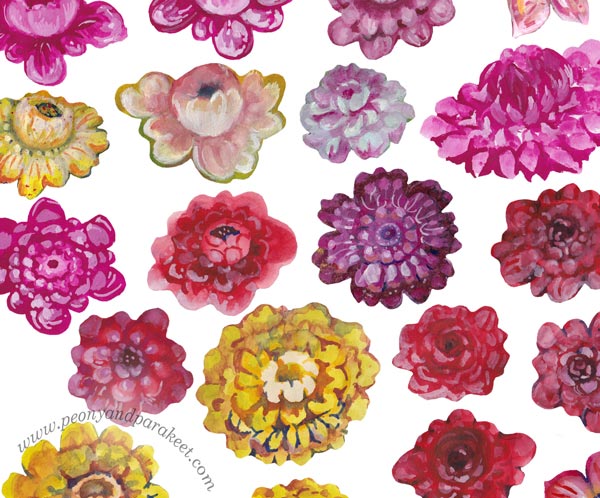
You see, preparing for the course requires deep understanding. A teacher isn’t only someone who masters the technique but one who can also break it into pieces and explain it. And by doing that, the skill becomes more stable and versatile. So, you can create quicker when knowing how things are constructed, and it’s easier to adapt the technique to your own liking. In the classes, whether you are a student or a teacher, the resilience grows, and the spirit of the rose becomes stronger: ”There’s still time to bloom, and I will do it!”
Drawing Roses and Flower Girls – New Course Is in the Making
This fall, I have not only been painting a new series but also developing a new course.
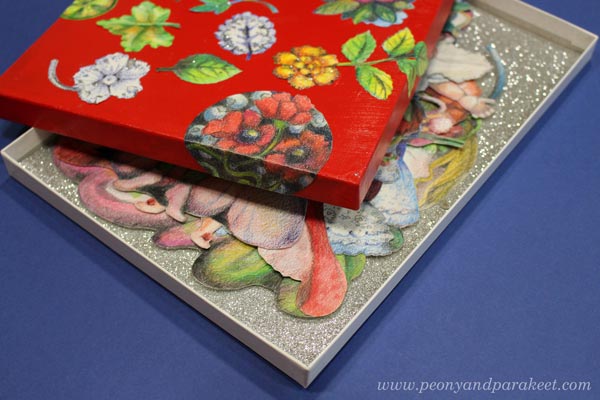
Its working title is ”Doll World,” and it’s about drawing human figures. I think it’s a skill that enables us to do illustrations that captivate the viewer and something that we all would like to do for fun too. We will draw flowers as warmups and decorate the dresses with colored pencils. I plan to run the class next year and open the registration next month. So stay tuned!
The Electrical Life of Any Artist
This week I have a consolation post for any artist!
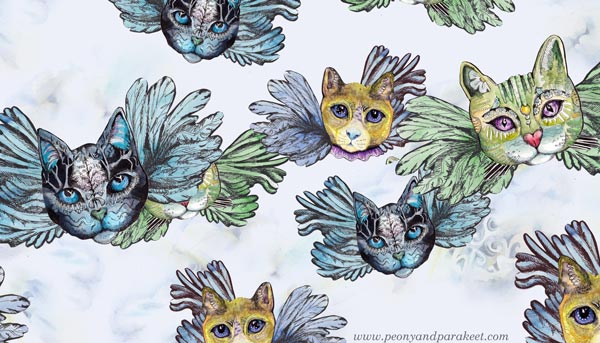
We start from a movie and then let thoughts fly from top to bottom and come back up.
The Movie – The Electrical Life of Louis Wain
Just a couple of days ago, I watched an inspiring movie called The Electrical Life of Louis Wain. It’s a story about the illustrator Louis Wain (1860-1939) who got famous for his cat drawings. Louis Wain’s life was full of misery, he was poor, responsible for five unmarried sisters, lost her wife to breast cancer soon after the marriage, made bad business decisions, and suffered grief and mental illness.
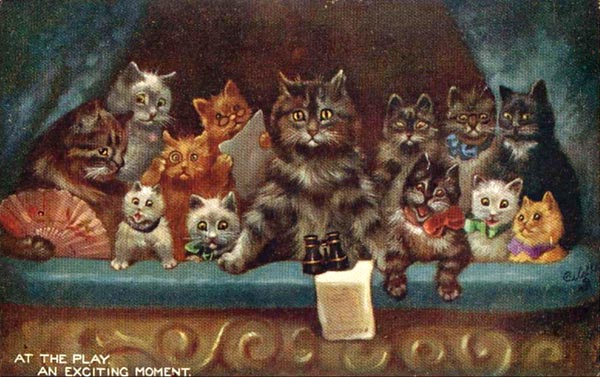
And yet, Louis’s cat drawings were fun illustrations full of liveliness and details.
The Two Undertones of Any Day
The movie felt strangely therapeutic. Maybe partly because it expressed so well what I had been thinking lately: how life has both melancholic and uplifting undertones and how important it is to recognize and make room for both of them.
For Louis, life had two separate sides – the harsh reality and the wonderous world of imagination. I think that many of us can relate to that even if in our lives, the melancholic and uplifting undertones would spread more evenly. If I think about my artist life, there have been so many rejections that where I am now is a small miracle. And if I think about the future, more small miracles are needed to move forward.
Here’s a short video about my journey so far.
This video was published on my Instagram account first, so the proportions were optimized for that.
Those Who Believe in You
In the end, you only need to have one person who believes in you as an artist. Many times you can be that person for yourself. Like Louis, the world of imagination has the power to keep the uplifting undertone going.
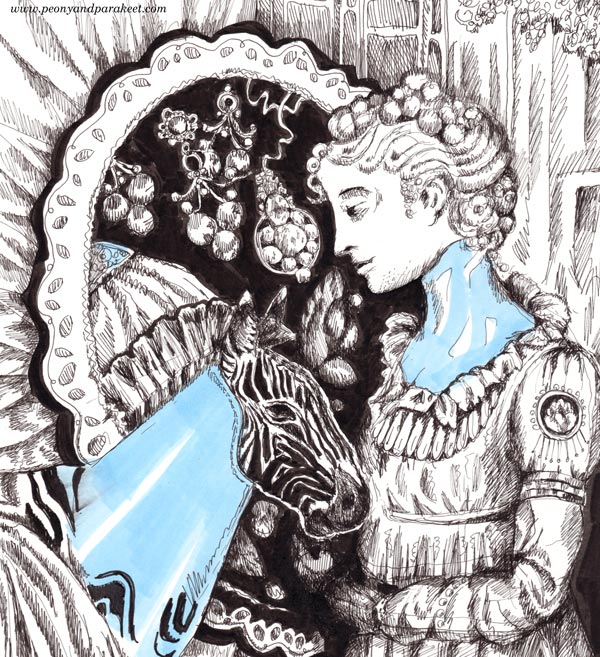
But for me, there have been times when a small miracle has been needed – that someone else brings me up. When Louis found supporters in the movie, I thought of mine. They are a part of my electrical life story. Who could be yours?
It wasn’t easy to contact any of them – ask, apply, and reach out just after losing the belief and energy, but doing that has pushed me forward. Sometimes they have been friends, but many times strangers who have given me a chance to connect with their audience. In the art world, and especially in the fine art world, people are hesitant to accept outsiders. But once you get one door open, some others will open up too. The number of your supporters will grow step by step.
Opening Up for Small Miracles
In the beginning, art was something I did in secret. If I didn’t believe in my art, I simply stopped creating for a while. But the more I created, the more I wanted to find connections with other people. First with others who create, and then more publicly. After going public, stopping is much harder because you start to see wider: There must be someone who says yes.
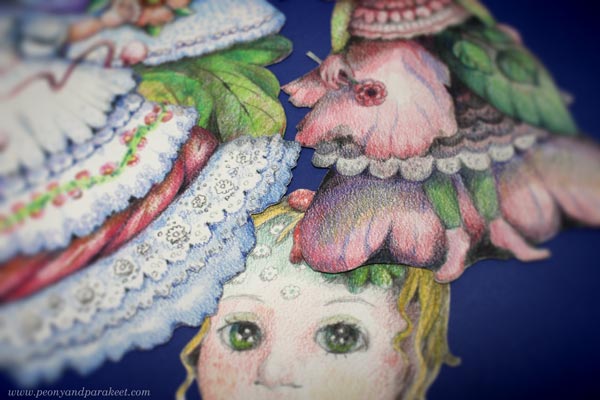
I see that the melancholic and uplifting undertones are wrapped around each other like two plies in a yarn. By expressing both of them, not only a person but also her art becomes stronger – more touching and captivating. It’s then easier to make small miracles happen – have positive electricity as Louis Wain would put it.
What do you think? Have you seen the movie?
P.S. If you want to turn back the clock and learn from 6-years-younger Paivi, here’s your chance! Planet Color, is retiring on Sept 30, at midnight PDT.
If you are a beginner in painting and want to use acrylic paints more, for example, in your art journals, check this class! Planet Color is now more than 50% OFF before it goes away! >> Buy here!
How Your Personal Story is Related to Your Art
This week, I share how my newest painting was born. At the same time, I talk about how the artist’s personal story affects the outcome.
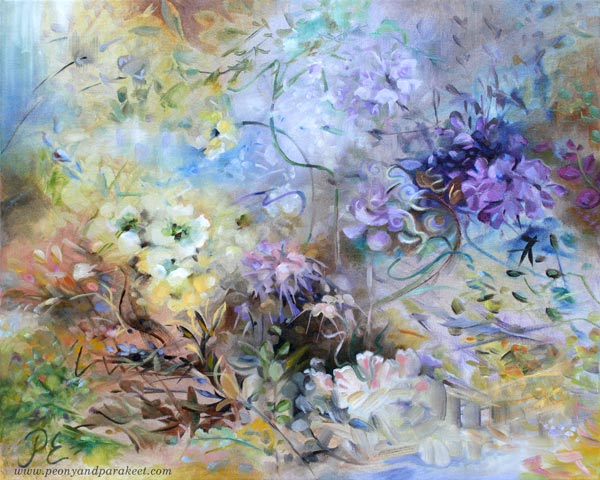
My paintings usually reflect the current season. But now, when there’s a fall in Finland, something springy appeared on my canvas. I call this one “The Spring of Dreams.”
Observing a Flower – Engineer’s and Romantic’s Approaches
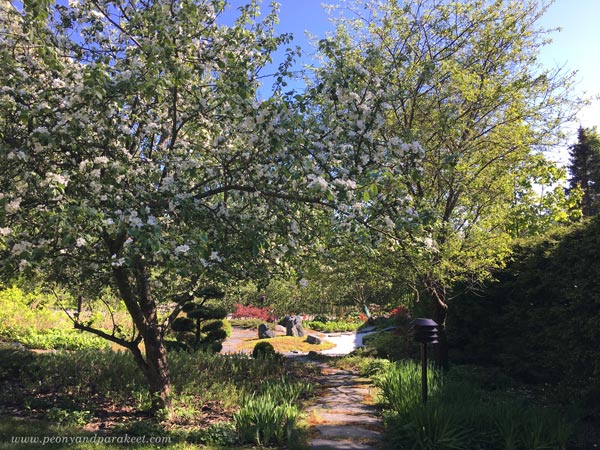
Last spring was beautiful. The apple and cherry trees were blossoming.
And with the early summer came wonderful irises.
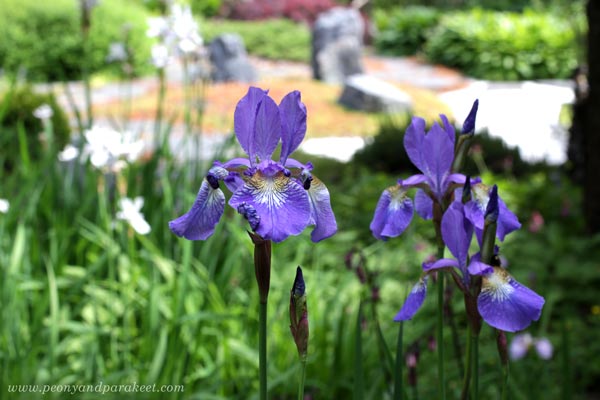
I often take photos in the garden and examine the plants. As a former engineer, I try to see how they are constructed. Not how the petals are attached and such, but how the light constructs the flower, adding its own brushmark to it. As a romantic, I try to see a face of a flower. I look at it like it would be an animal or a human – like it has a name and a history. I am not searching for its eyes but trying to sense its needs and dreams.
This way, I don’t need to copy photos but can paint freely and intuitively. Then when random shapes begin to look like a lighted plant, I try to give it what it wants, even if it’s often a species that doesn’t even exist.
The Fight Between Too Stiff and Too Messy
However, the painting process is not always as straightforward as it sounds. Often the engineer adds something stiff, and the romantic wipes it off. Then the romantic makes a mess, and the engineer tries to clean it.
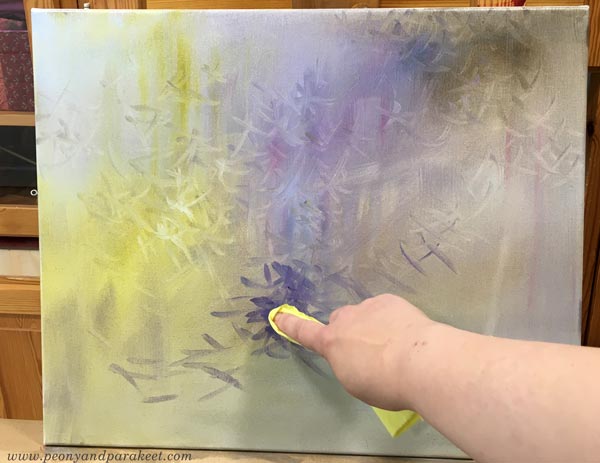
The engineer in me likes to build things with a brush: “There’s a chair, look!”
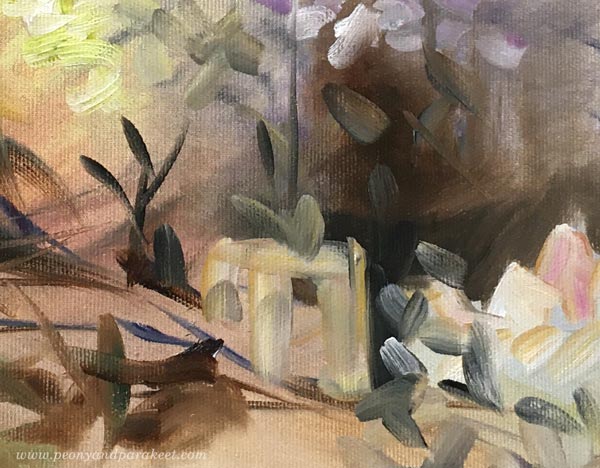
The romantic in me likes leaves and swirls more.
Artistic Direction and Setting Guidelines
To stop the fights, I gave an artistic direction that set challenges for both of them: “We will be making a dreamy floral that has purple. The painting should fit a modern, feminine home that has some rustic elements as well.” Both the engineer and the romantic understand had a common understanding of style when picturing a space where the painting should fit. When I use this method, I choose a location in my home or a picture in an interior design book, or a photo found on Instagram.
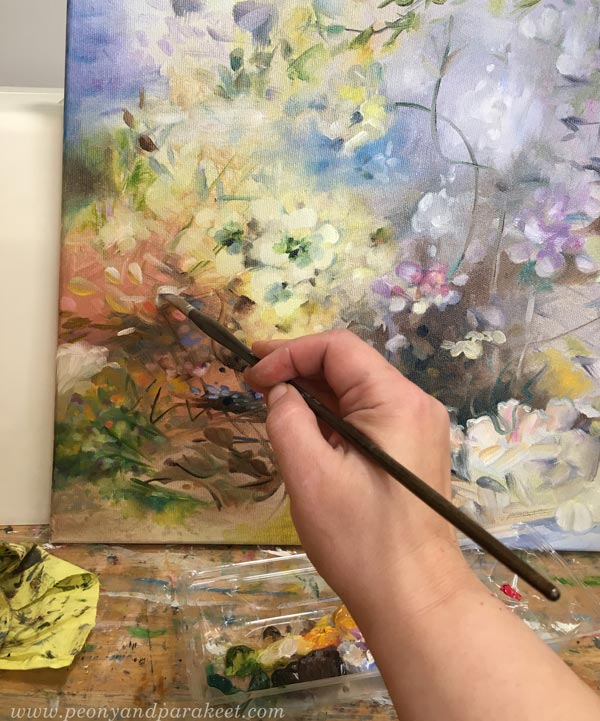
When I was studying industrial design, these kinds of simple and concrete guidelines were called design drivers. Design drivers are different from design principles. Design principles are general guidelines to make your image more expressive and aesthetic. Design drivers are project-based and loosely define the outcome.
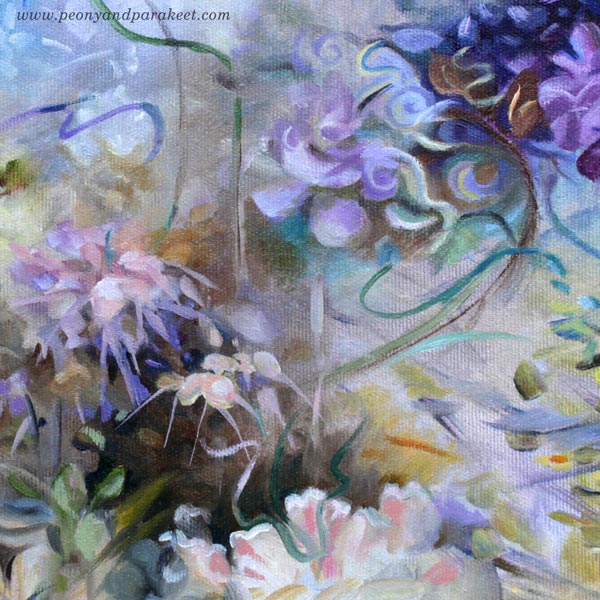
Design drivers prevent me from painting this and that, but I try to make them so general that I can get creative and freely express myself. For example, the requirement to use purple in a painting is not a big limitation.
Personal Story and Art Projects
Behind design drivers, there’s a more general foundation, an artistic vision. My paintings always lean toward the past and have a historical feel. As an artist, I want to combine the past and the present in an uplifting way, creating a fantasy of immortality for the interior space. Because I lost both of my parents at a young age, I never thought I would live old. This way, my artistic vision, and personal story are connected.

I claim that art-making has many layers. It’s not only about the process, techniques, or assignment. The artistic vision and the personal story matter as well. You always have a chance to bring them in, whether you are painting or drawing. For example, if a course sets the starting point, the creative challenge is how to include your artistic vision and story in the projects. This time, rather than listing things you love, go deeper and think about your struggles. How do they define what you want to achieve in art?