
The Electrical Life of Any Artist
This week I have a consolation post for any artist!
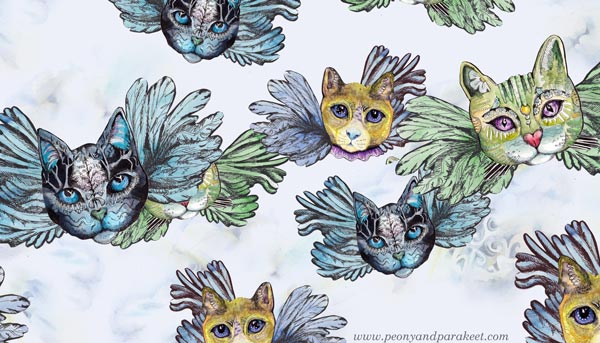
We start from a movie and then let thoughts fly from top to bottom and come back up.
The Movie – The Electrical Life of Louis Wain
Just a couple of days ago, I watched an inspiring movie called The Electrical Life of Louis Wain. It’s a story about the illustrator Louis Wain (1860-1939) who got famous for his cat drawings. Louis Wain’s life was full of misery, he was poor, responsible for five unmarried sisters, lost her wife to breast cancer soon after the marriage, made bad business decisions, and suffered grief and mental illness.
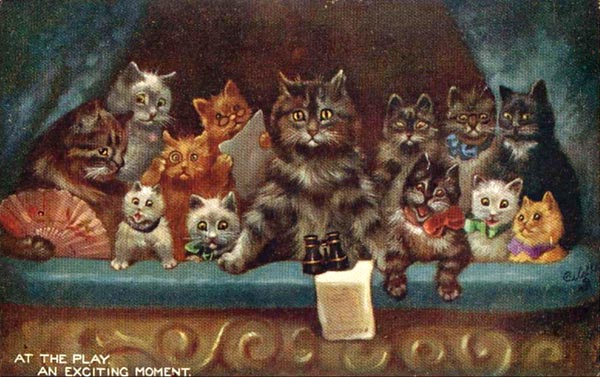
And yet, Louis’s cat drawings were fun illustrations full of liveliness and details.
The Two Undertones of Any Day
The movie felt strangely therapeutic. Maybe partly because it expressed so well what I had been thinking lately: how life has both melancholic and uplifting undertones and how important it is to recognize and make room for both of them.
For Louis, life had two separate sides – the harsh reality and the wonderous world of imagination. I think that many of us can relate to that even if in our lives, the melancholic and uplifting undertones would spread more evenly. If I think about my artist life, there have been so many rejections that where I am now is a small miracle. And if I think about the future, more small miracles are needed to move forward.
Here’s a short video about my journey so far.
This video was published on my Instagram account first, so the proportions were optimized for that.
Those Who Believe in You
In the end, you only need to have one person who believes in you as an artist. Many times you can be that person for yourself. Like Louis, the world of imagination has the power to keep the uplifting undertone going.
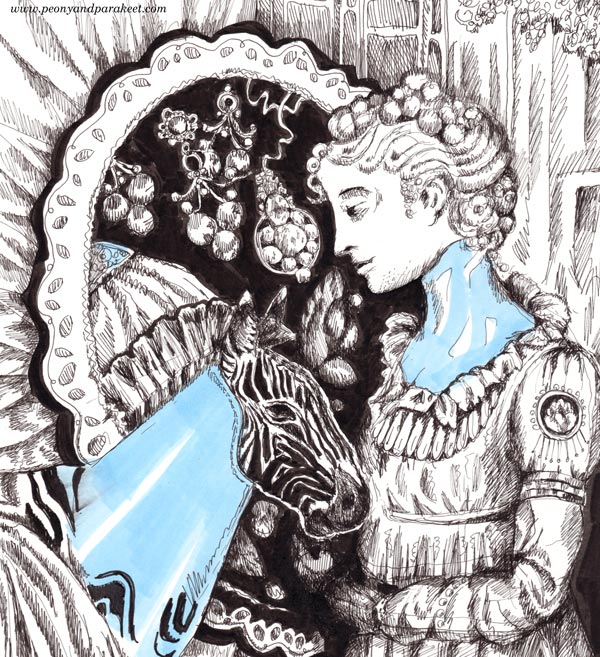
But for me, there have been times when a small miracle has been needed – that someone else brings me up. When Louis found supporters in the movie, I thought of mine. They are a part of my electrical life story. Who could be yours?
It wasn’t easy to contact any of them – ask, apply, and reach out just after losing the belief and energy, but doing that has pushed me forward. Sometimes they have been friends, but many times strangers who have given me a chance to connect with their audience. In the art world, and especially in the fine art world, people are hesitant to accept outsiders. But once you get one door open, some others will open up too. The number of your supporters will grow step by step.
Opening Up for Small Miracles
In the beginning, art was something I did in secret. If I didn’t believe in my art, I simply stopped creating for a while. But the more I created, the more I wanted to find connections with other people. First with others who create, and then more publicly. After going public, stopping is much harder because you start to see wider: There must be someone who says yes.
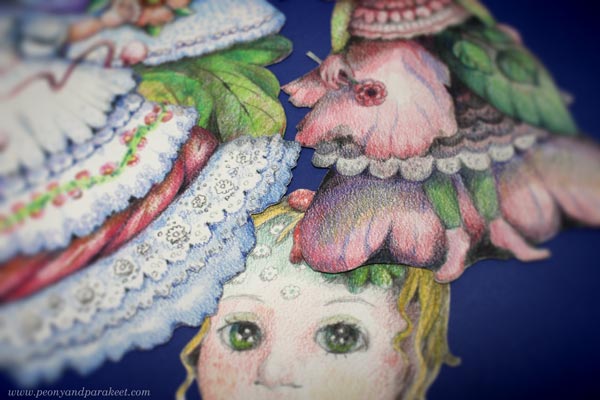
I see that the melancholic and uplifting undertones are wrapped around each other like two plies in a yarn. By expressing both of them, not only a person but also her art becomes stronger – more touching and captivating. It’s then easier to make small miracles happen – have positive electricity as Louis Wain would put it.
What do you think? Have you seen the movie?
P.S. If you want to turn back the clock and learn from 6-years-younger Paivi, here’s your chance! Planet Color, is retiring on Sept 30, at midnight PDT.
If you are a beginner in painting and want to use acrylic paints more, for example, in your art journals, check this class! Planet Color is now more than 50% OFF before it goes away! >> Buy here!
Discovering a Character by Drawing
This week is about illustrating characters and discovering those that feel personal.
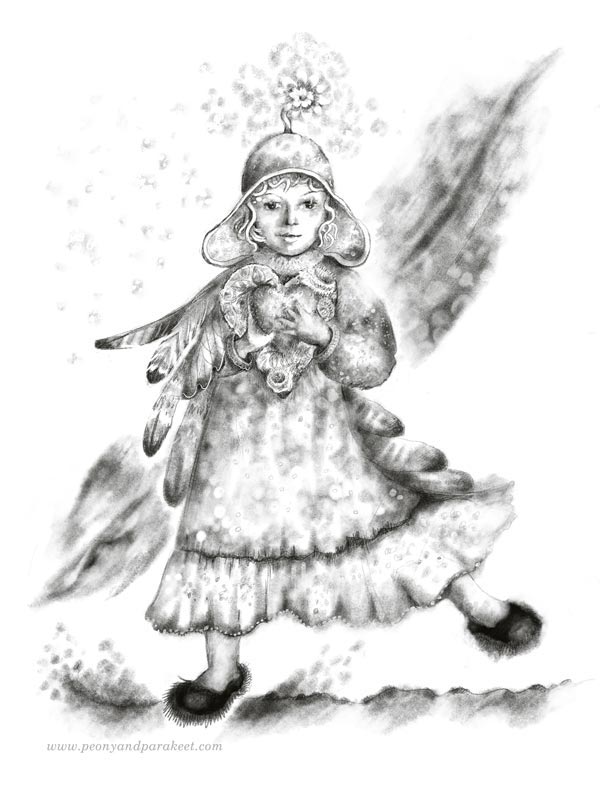
Have you ever wanted to draw a face or a figure that would really touch your heart? I don’t only mean something that looks pretty on paper but someone that begins to speak to you when your eyes meet.
Starting from an Animal Figure
In the class Magical Inkdom, I mention the word “kissanukke” when we are drawing cats. Kissanukke is “cat doll” in English, but somehow I think it’s much funnier in Finnish. Say: kissanukke! The word is just hilarious.
Last week, I wondered why I think about that word so often. Maybe it’s a hint I should draw cats again. So, I picked a big smooth watercolor paper and a pencil to sketch a huge cat. I wanted to go big because I wanted the cat’s face to be large enough for working on facial features. I adjusted them for a long time with a pencil, and then with colored pencils. I wanted this kissanukke to be more than a doll – a living thing that speaks to me.
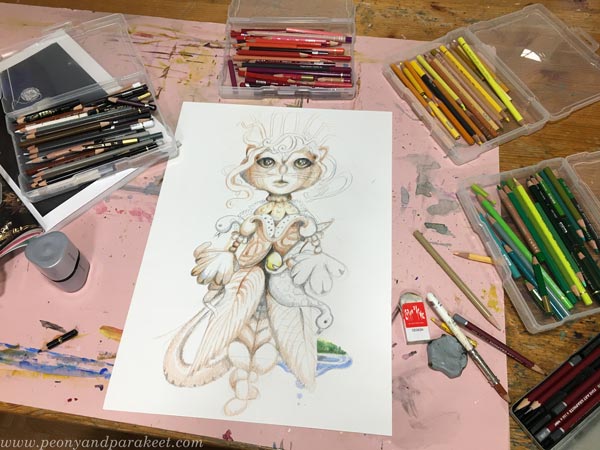
I love to use thick and smooth watercolor paper with colored pencils even when I don’t use water for the drawing.
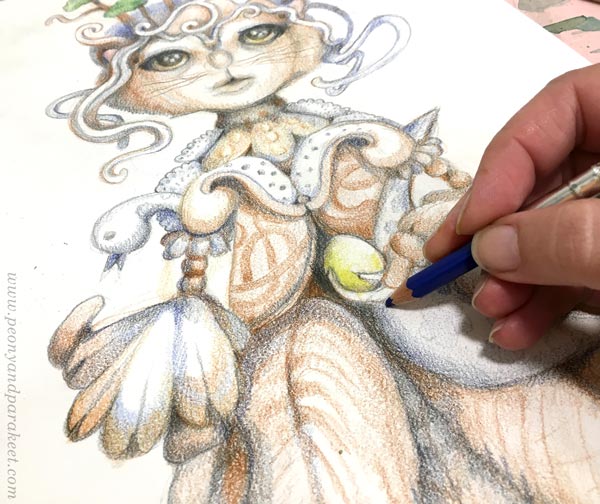
When the paper is big, it’s easy to dive deep into details and let them make the drawing more whimsical than the original sketch.
What’s Behind the Animal?
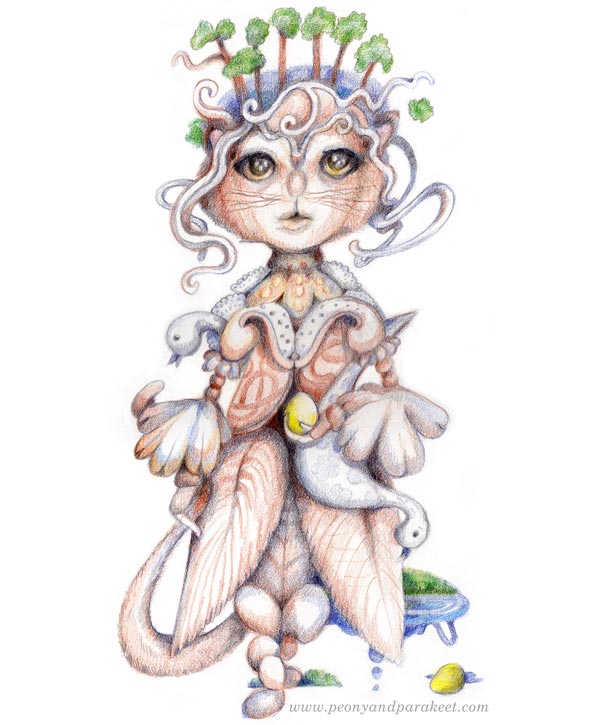
When Kissanukke was born, I asked her: “Who are you?” She said: “I am a hunter, and I can bring you anything you want!” I smiled at her: “What a magical cat you are, with the golden egg and all!” “I had two,” she said, “but the other one got missing when I tried to catch the geese. And I am no cat but a lion!”
Of course, she is a lion – how did I not see that before! I used to be a big fan of Joy Adamson and her lion Elsa as a child. No wonder my inner child has kept asking for cats!
Discovering Through a Different Pose
So, I thought, let’s draw another leijonanukke – lion doll – for the child. This time, I changed the pose so that the character would only need to glance sideways and wished that a shyer creature would appear.
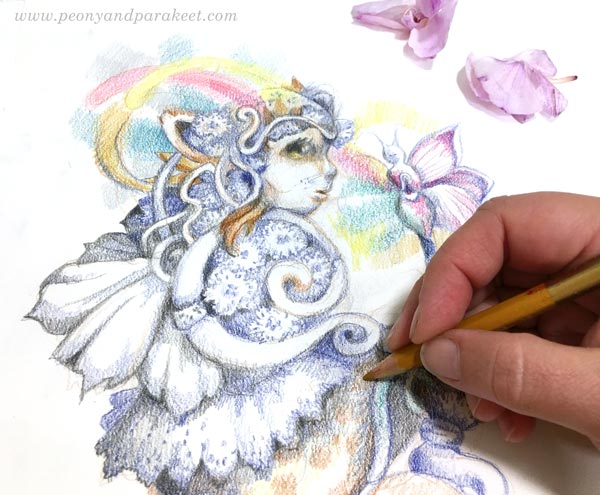
“Are you a hunter too?” I asked when discovering the new character. “No, I am an orchid whisperer! Shhh!”
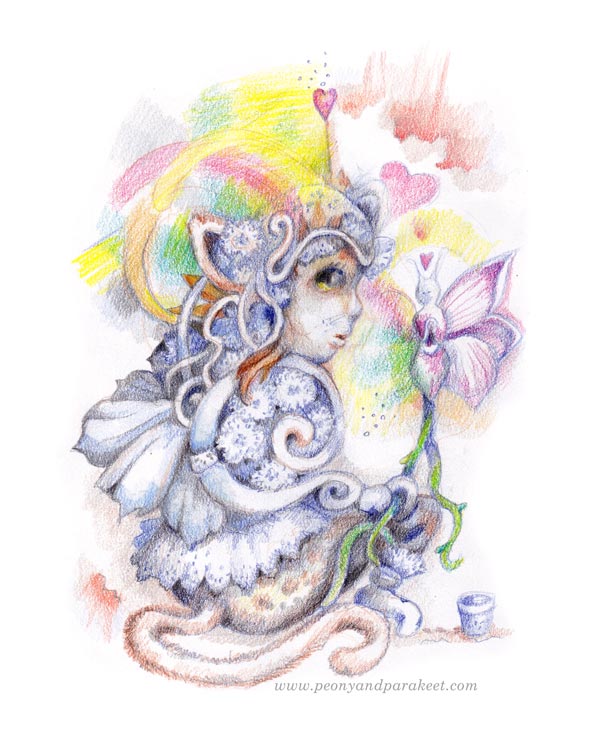
One of my orchids just stopped blooming, and I am eagerly waiting another to bloom. So, there’s a need for her too!
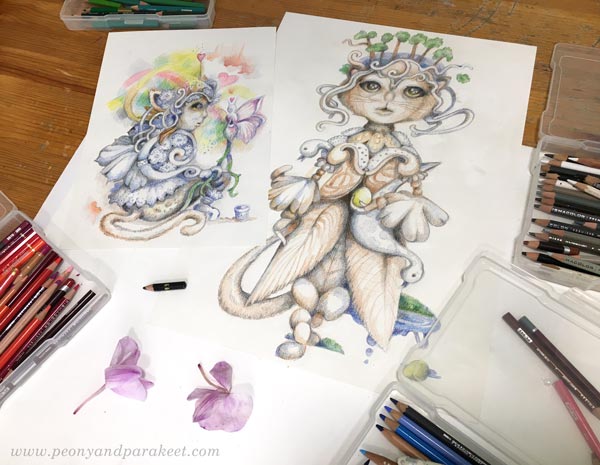
Whisperer is smaller than Hunter. The small size also makes her look less finished in the pics. If you need to provide a hand drawing in a digital form, always draw larger than the asked size. The result looks neater that way.
Discovering a Human Character
This week, I went to the studio and gathered all the courage I got. “Hunter,” I said, “could you bring me a human that really touches my heart.”
And that’s how this little country girl came out – a true nature child!
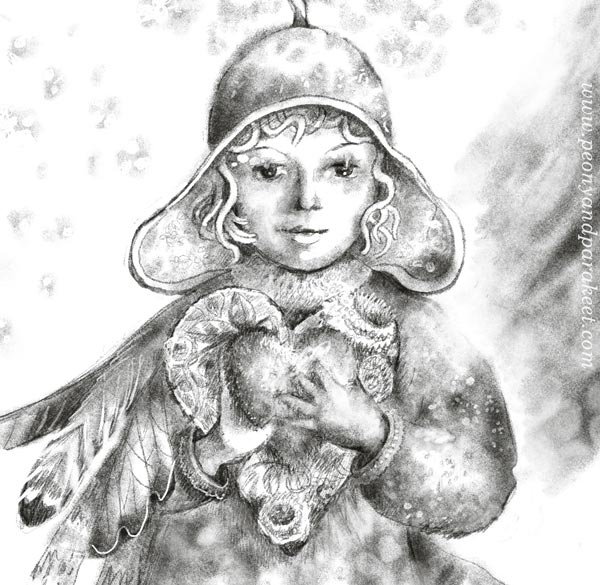
I didn’t use any references when drawing the girl and the cats. A reference can help us draw what’s expected but not what comes out naturally. References are great practice, and during the years, I have been practicing with them too. For example, in the class Innovative Portraits, we draw faces and use references creatively. But when discovering a character that feels like a soul mate, references become disturbing. Then it’s all about the connection with your inner self, traveling back in time for inspiration and forward in imagination.
Digital Pencil Work
I drew the girl on my iPad with Apple Pencil and the program called Procreate. I got these fancy tools as a birthday gift from my husband in February but have been waiting for the right moment to get to know them.
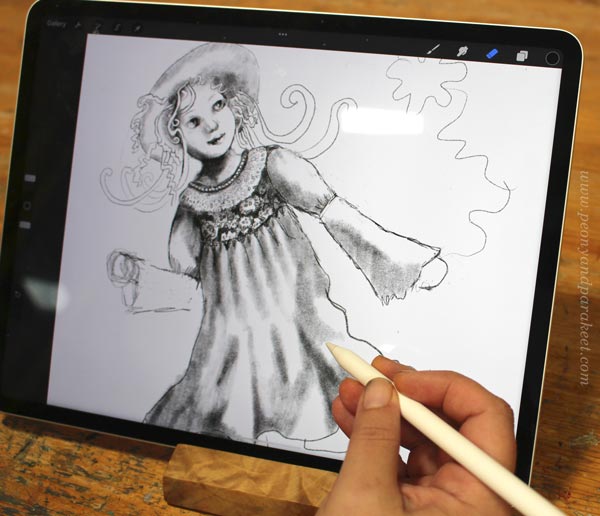
So far, I have mostly been using a simple digital brush called “Peppermint” that imitates a graphite pencil.
I will blog more about Procreate later, so it would be interesting to hear if you have used it. Also, if you have any questions, please let me know! However, if you are not into digital tools, don’t worry, I will keep on drawing with real pencils too!
Butterfly Art and Beyond
This week, I have some butterfly art, stories from the past, and plenty of inspiration for art-making.
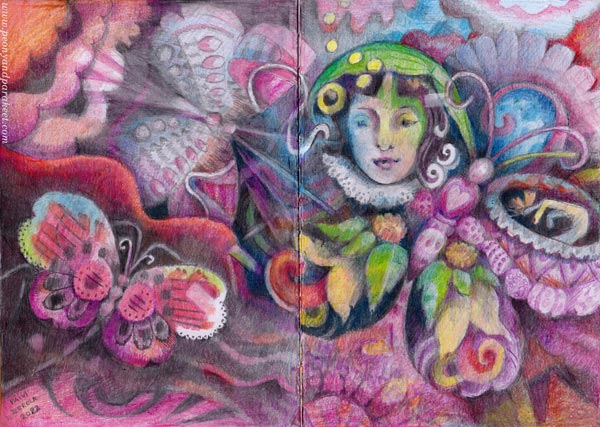
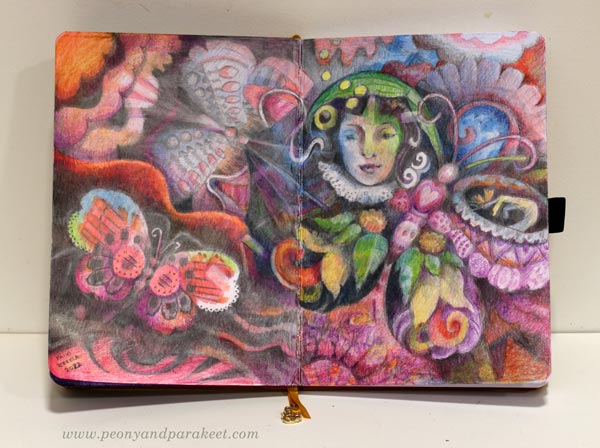
Here’s the newest spread of my colored pencil journal. I think it’s a little different than the pages so far – more detailed at least! You can see most of the previous spreads in this video; tell me what you think!
With this butterfly fantasy, I want to take you more than a hundred years back in time – to the end of the 19th century when a famous Finnish artist Helene Schjerfbeck (1862-1946) painted Violets in a Japanese Vase in 1890.
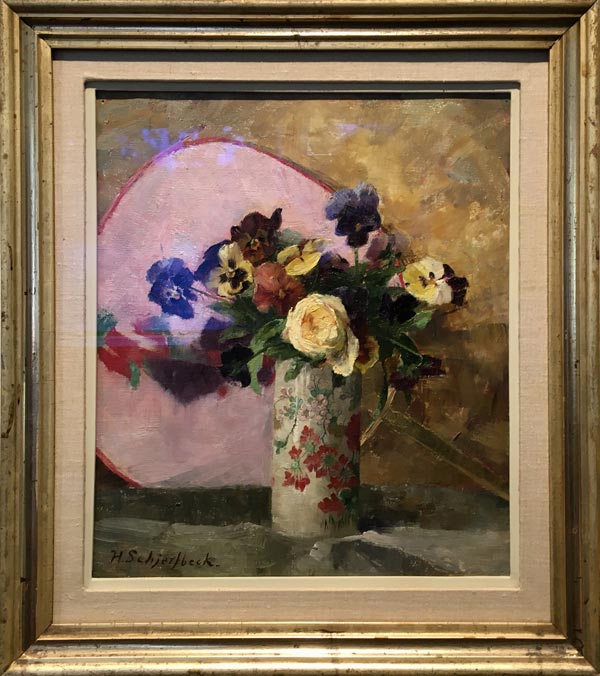
Although Helene wasn’t as famous back then, she had traveled and studied abroad. And now, she had just got back home after spending a year in Paris and England. After painting people, Helene was now drawn to make nature-themed pieces. It felt refreshing to change big and challenging portraits to small landscapes and still lives. Flowers became Helene’s consolation pieces. When she was sent to St. Petersburg to copy Russian masterpieces and thus bring educational reproductions to Finland (“here’s how the masters paint”), she painted flowers for her own joy in the evenings. (See Helene Schjerbeck’s later style and my adaptation for colored pencils in this blog post!)
I can relate to Helene. My main work is big oil paintings – abstract florals or landscapes – but I also make art that soothes and maintains rather than breaks through. While the first pieces of the new series are drying and waiting for their next layers, I feel drawn to the boxes of pencils.
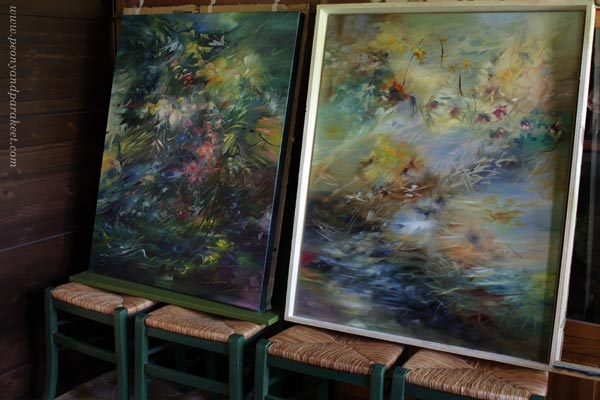
At the beginning of the week, after painting the whole Sunday, I wanted to draw something just for me. “Butterflies!” my inner child asked.
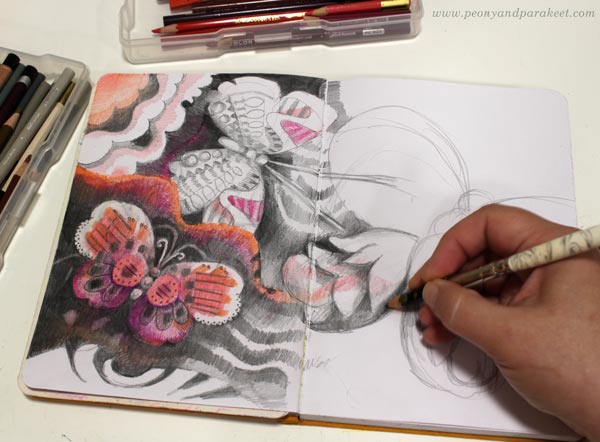
Here’s how far I got in one evening. This was before I traveled back in time to meet Helene – and another artist called Torsten Wasastjerna!
Fantasy Art in Villa Gyllenberg
In the middle of the week, my husband and I visited Villa Gyllenberg in Helsinki. It’s a museum that used to be the home of Signe and Ane Gyllenberg in the 20th century. The house was built in 1938, and it has a wonderful location near the sea.
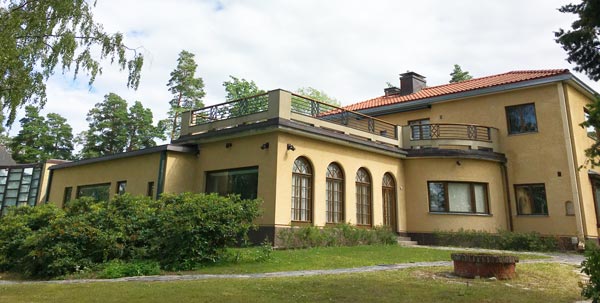
A part of the museum is a furnished old home with an extensive art collection, including Helene Schjerfbeck’s violet painting.
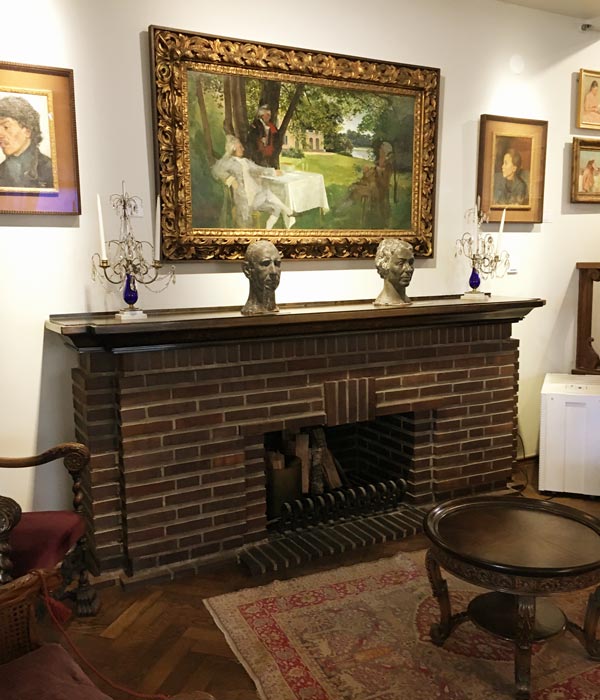
Just recently, Villa Gyllenberg got a new extension for art exhibitions. The new space has high walls and plenty of space, but still, there was something too big to fit there straight!
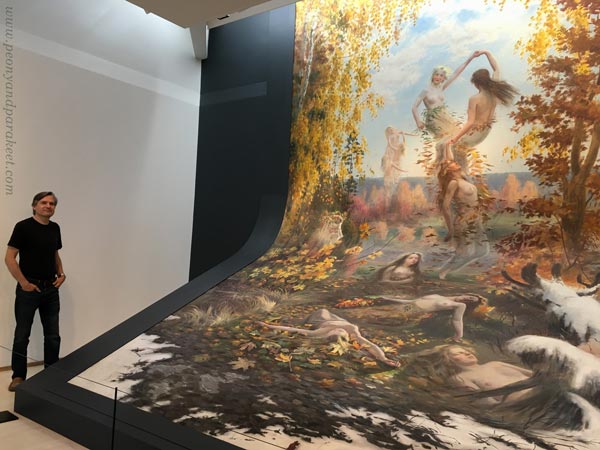
This is Torsten Wasastjerna’s oil painting Falling Leaves, made in 1897. It’s 550 cm high and 370 cm wide, one of the biggest Finnish paintings ever. My husband agreed to model beside it so that you get an idea of how big it is.
Inspired by Torsten Wasastjerna
Like Helene Schjerbeck, Torsten Wasastjerna (1863-1924) got an education in fine art and studied abroad too. But his consolation was fantasy. He did commission portraits to pay the bills but loved illustrating fairies and angels. He even wrote books. The first one was called Dröm och Värklighet – Dream and Reality.
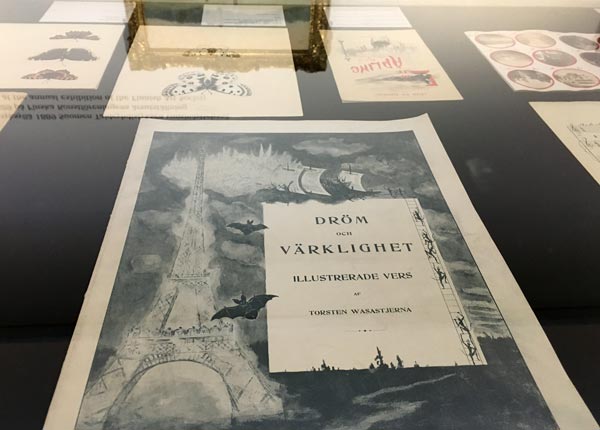
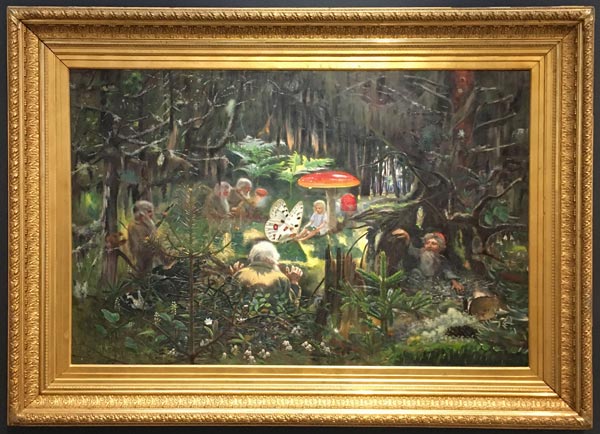
Torsten Wasastjerna’s fantasy world wasn’t as surreal as mine, but it felt close.
When I got back home, I was inspired to work on the butterfly piece with much more detail than I first had planned.
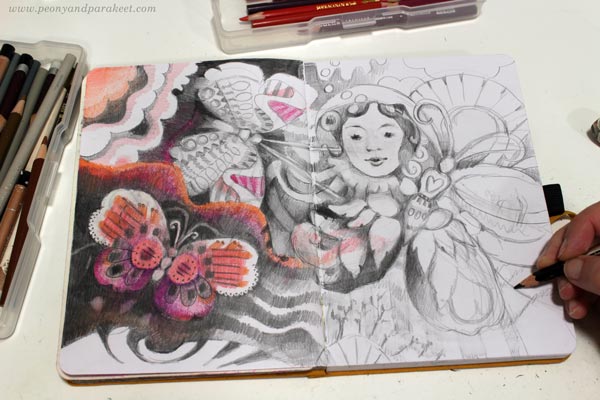
I added a person, a butterfly girl or a boy, to one of the wings.
Butterfly Art and Beyond
I am impressed by how dedicated Torsten was to his fantasy art, even if it was not valued by others.
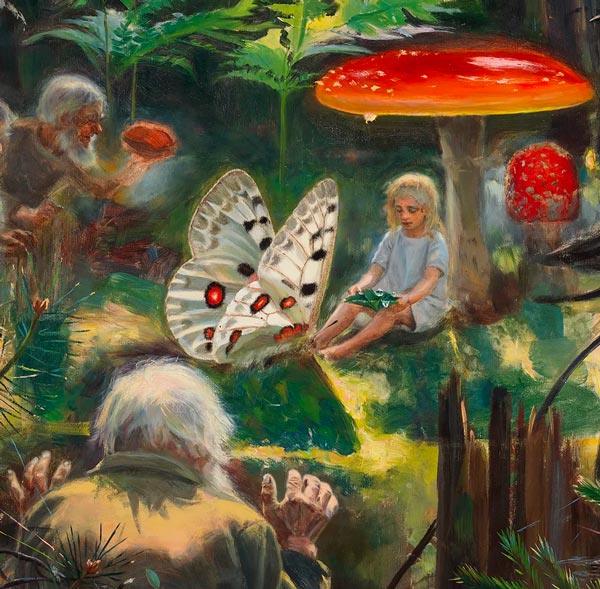
It made me think that I, too, can create “butterfly art” that goes beyond the butterflies – that challenges both my imagination and dedication.
So, I spent more hours than normally with this spread, adding details and then adjusting their shapes and colors.
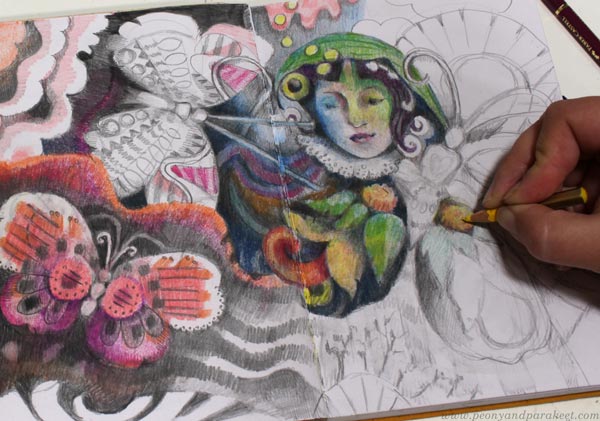
It felt like my pencils reached a new level, getting closer to my heart than before.
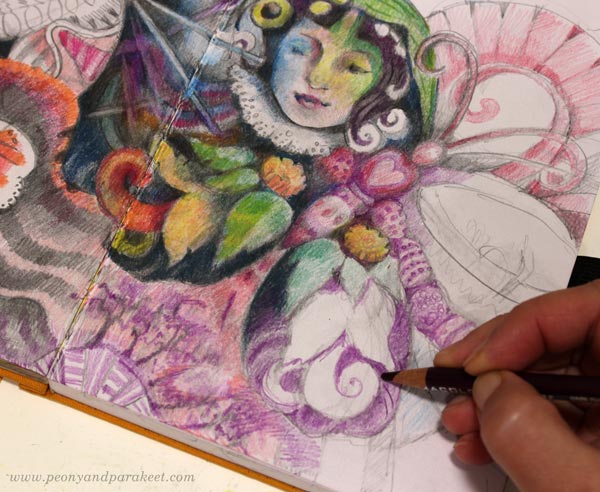
The world that is naturally and effortlessly born in my paintings fed the more illustrative work too.
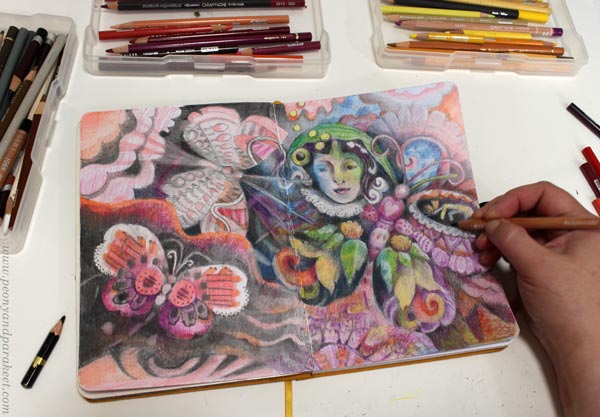
All this makes me think about how important it is to go to see art and use that for inner discussions: how am I different, what are my consolation pieces, and how do I show my dedication to art? Then butterfly art can go beyond butterflies in the same way as Helene’s violets are not just “violet art.”
What do you think?
Let’s Get Inspired by Tassels!
This week, we dive deep into the soul of tassels and get the most out of our creativity.
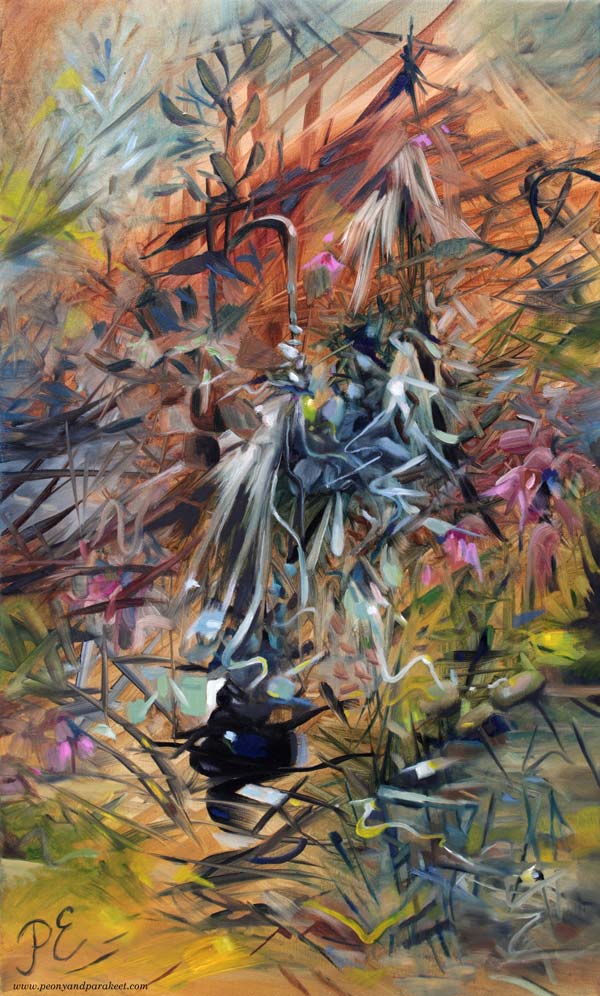
Here’s one of my newest paintings called Church of Saturn. This oil painting is a part of my series Linnunrata – Milky Way, where I explore planets and outer space. (See previous work: Jupiter here, Uranus here, the Moon here, Mercury here, Neptune here, Pluto here, the Earth here, Venus here, and the Sun here!) When I painted it, I thought about the rings of Saturn, the god of agriculture, branches and twigs, an old wooden church from my childhood, wabi-sabi, and the beauty of – tassels!
Tassel Dolls
When I was living in Eastern Karelia in the 1970s, the simplest doll we could make was a tassel doll. I painted it in watercolors so that you can check if it’s something that you had too!
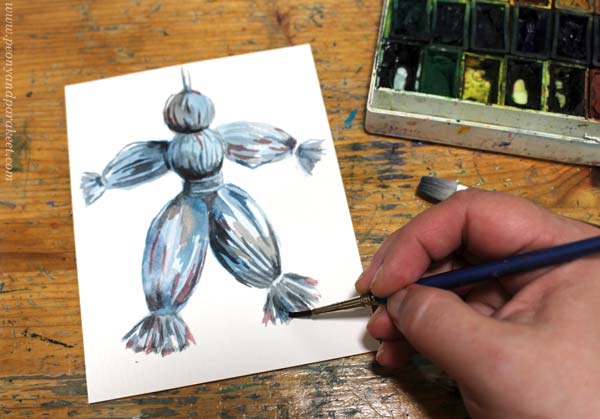
The doll was made of wool yarn and so simple that even a 5-year-old could make it. It’s a good example of a thing that is not valued by our adult self, but that brings up our inner child: “Hey, Miss Tassel, where do you want to go?”
Tassels as Extra Decorations
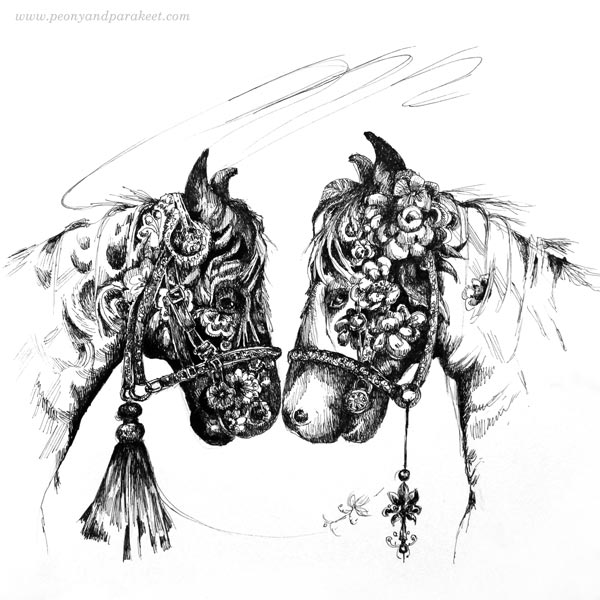
I rediscovered my love for tassels in 2018 when I participated in the Inktober challenge. Back then, I thought of tassels being a fun accessory and I have enjoyed using them as extra decorations in my drawings.
This week, I drew a new tassel for my boxes of joy and had a lot of fun making it.
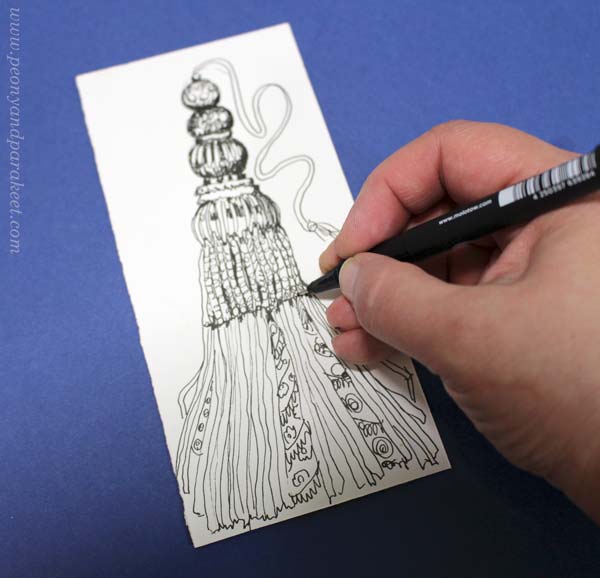
First I drew some circles and lines with a black drawing pen, then added textures and shadows in the style I each in the classes Animal Inkdom and Magical Inkdom.
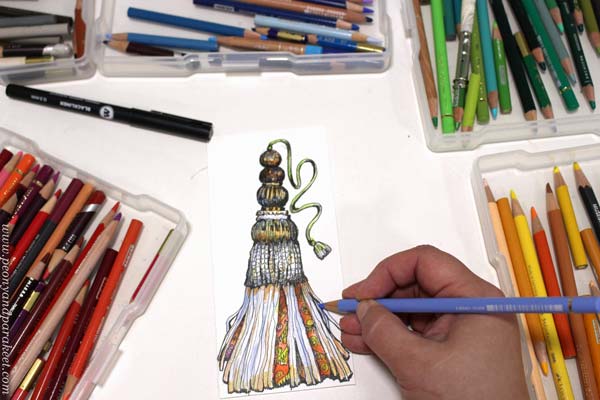
After colored pencils, I picked some other hand-drawn pieces from my boxes and admired the luxurious collection.
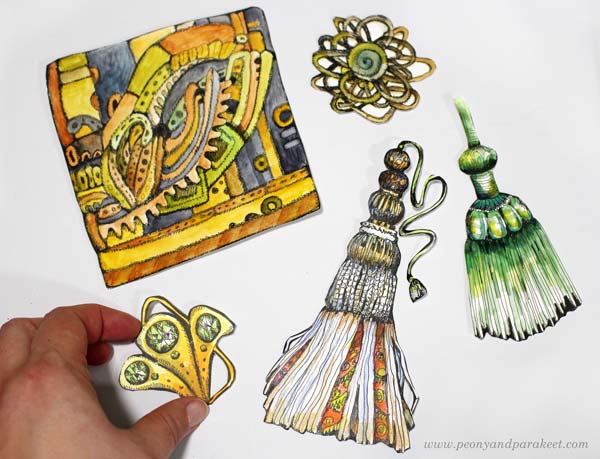
Who needs shopping when you can have your own personal store and draw all the good stuff for it!
Blowing Life to a Tassel
A tassel drawing can be more than a decoration only. You can have more fun by playing with it so that it will get a personality. Imagine a tassel as a person or an animal – a living thing. Here I see two tassel ladies on a stroll!
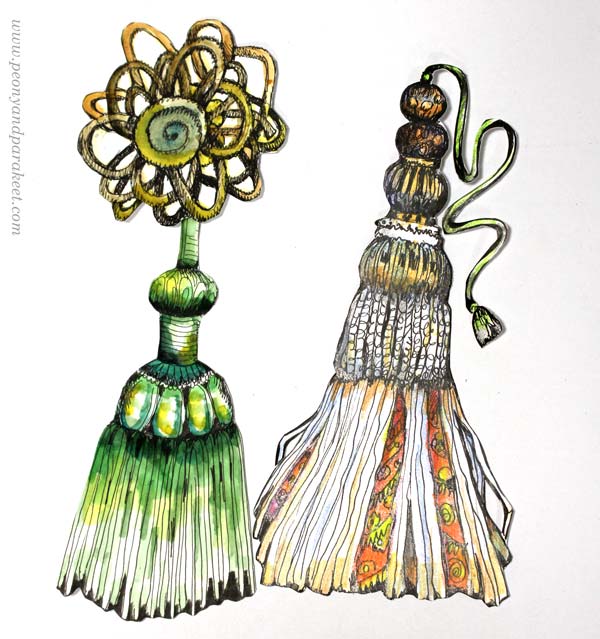
Now, the tassel has a mind of its own. An artist can see any simple object as an element of expression.
In the painting “Church of Saturn,” the tassels have a spirit that makes them an integral part of nature.
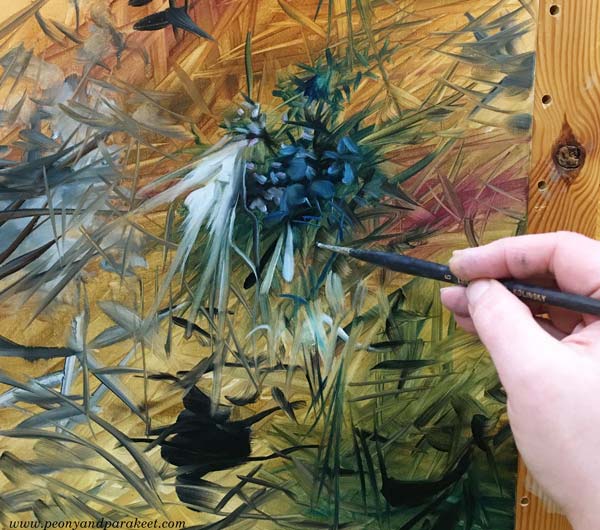
These tassels are organic, and the style is abstract rather than illustrative.
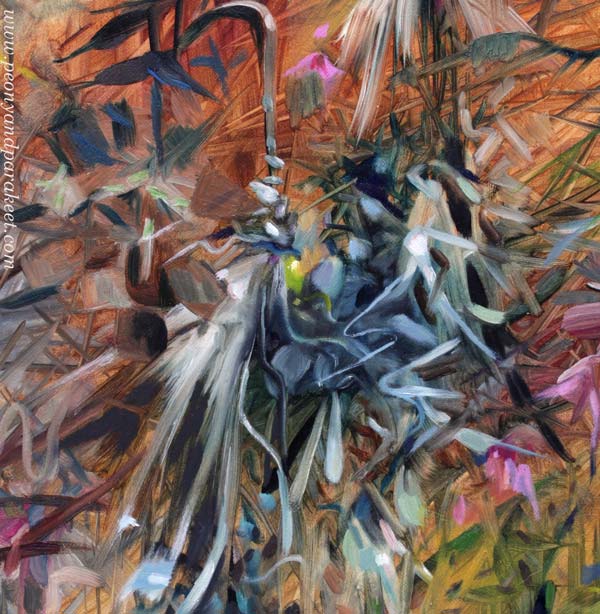
As artists we need to do this – go beyond what’s expected and commonly seen.
Ornamental Figure with Tassels
In the class Magical Inkdom, I draw a funny bunny with a tassel on her head and now I got the idea of making an ornamental figure so that the tassels form the body.
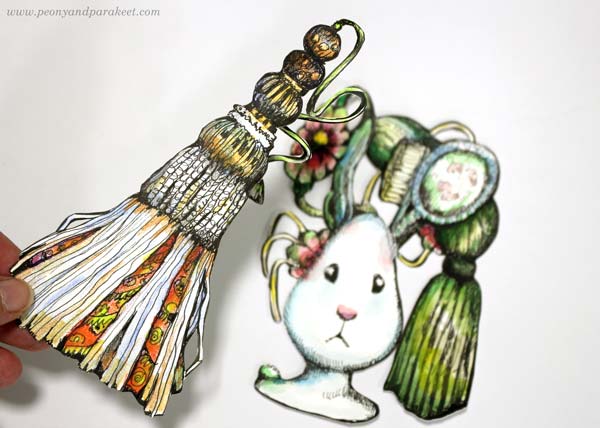
To make a symmetrical ornament, I traced the tassel three times on the right side marker paper. Marker paper is thin so it’s easy to see through it.
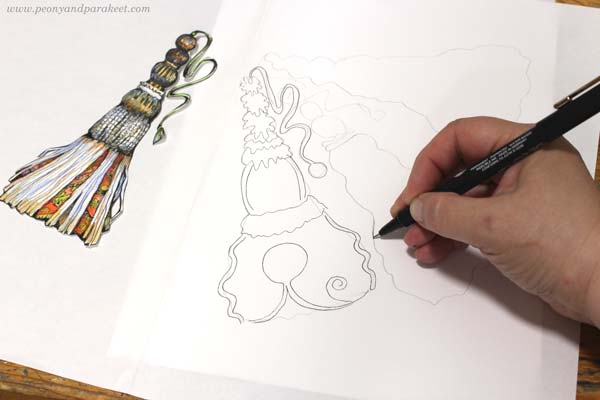
Then I taped the paper to the window and traced the three tassels on the left side of the paper. I added additional elements to the center and some facial features too. My tassel doll!
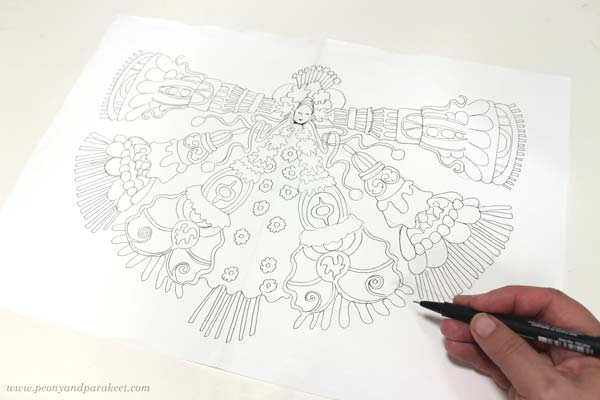
But when I continued the drawing, I got a crazy idea of a knitting hamster. Tens of years ago, I was a hamster breeder, attending shows and everything. I know those little animals well! Knitting is one of my favorite hobbies and the thought of a hamster collecting all the yarn and trying to knit it made me smile.
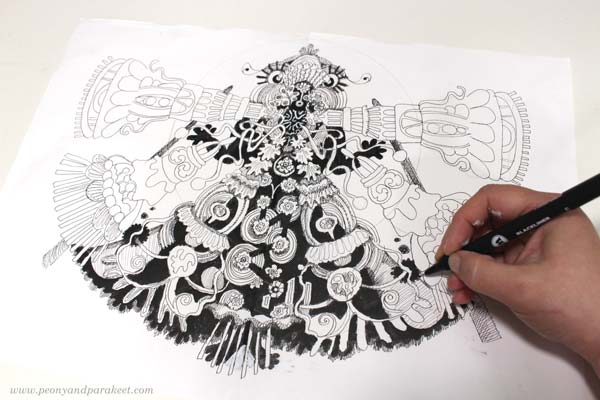
Then the word “Knitwork Orange” came to my mind, and I included the orange as well!
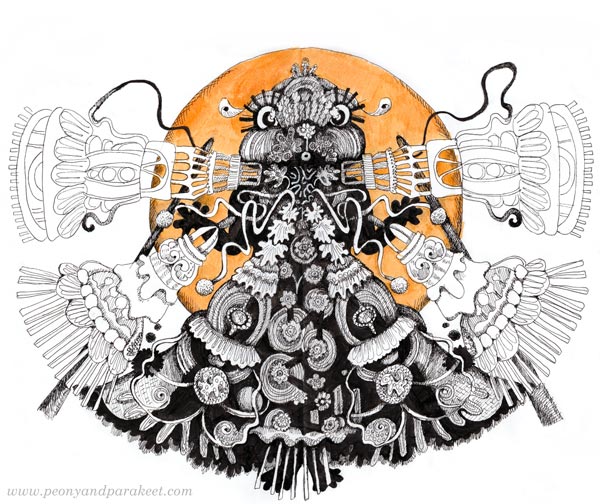
Here’s me, in the middle of the night, knitting away!
Tassel Dolls on Mars
Last spring, I had a small canvas that was first just a mess. I like to start my paintings in this intuitive way and without a plan. I had some leftover paint so nothing was wasted.
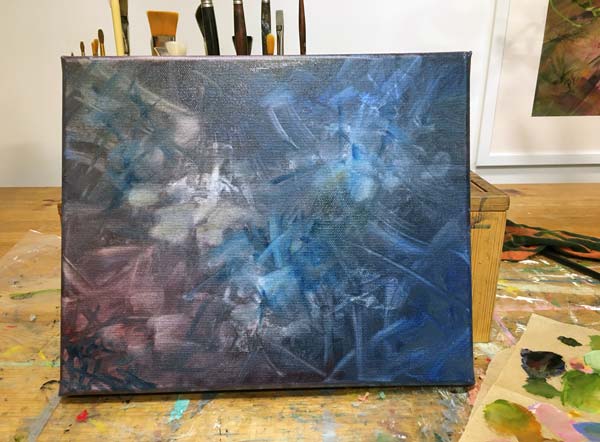
The first ideas are terribly traditional and mine was to make a vase with flowers.
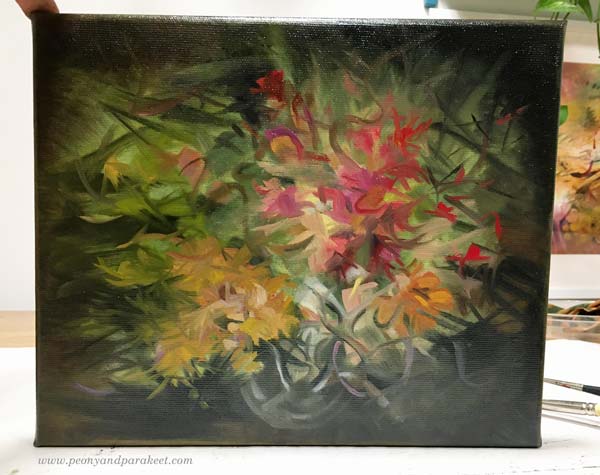
But after this, I was taken to another planet, to Mars! There, tassel dolls met art deco, and I had a lot of fun finishing the painting with all the decorative details.
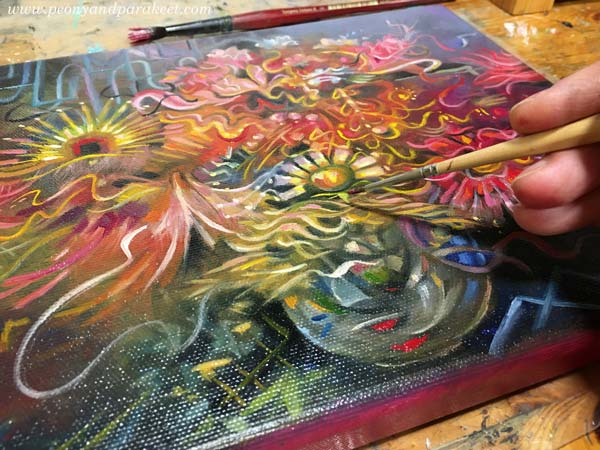
I love the Great Gatsby movie from 2013. It has the best party scenes and good music. I had a lot of fun creating a tassel doll party that took place on another planet.
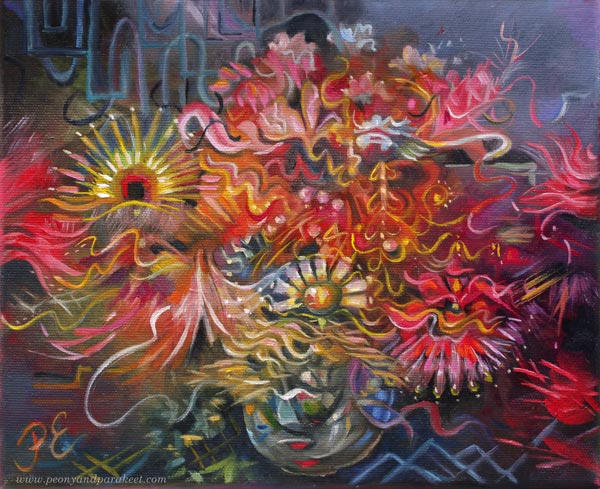
This small piece ends the Milky Way series – 11 oil paintings from March to May. I have taken a break from creating art, but feel like I am recovering now. Thanks to making the tassel drawings for this post! I hope they work for you too!