
No Creative Blocks – Painting Grief and Loss
Even if I want these blog posts to be a celebration of art-making, I also want to paint and write from the heart. This week’s post is about sadness and its’ effects on creativity.

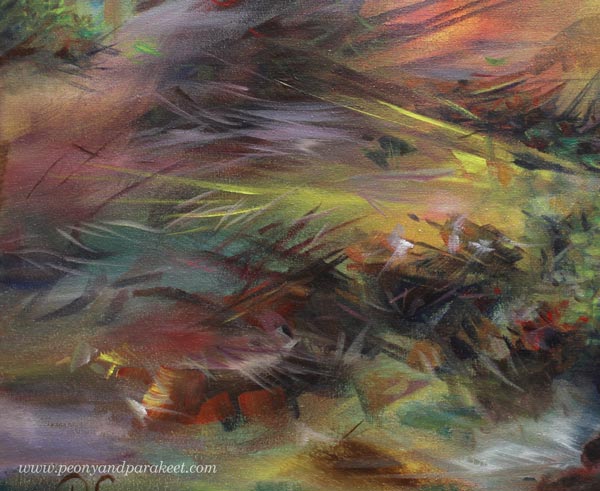
Here’s my latest acrylic painting called “If Grief Smoked.” Like many of the recent paintings, this also has a connection to a poem. The title is from Eeva-Liisa Manner’s poem “Jos suru savuaisi.” But this time, I didn’t follow the poem but used the title as a prompt only.
Missing Cosmo
I have been very melancholic this fall, and to be honest, building a new class Floral Freedom, has been my savior. It’s been a captivating escape from a life that feels emptier than before. My loyal companion Cosmo died in September, and it’s like a part of me has lost a purpose.
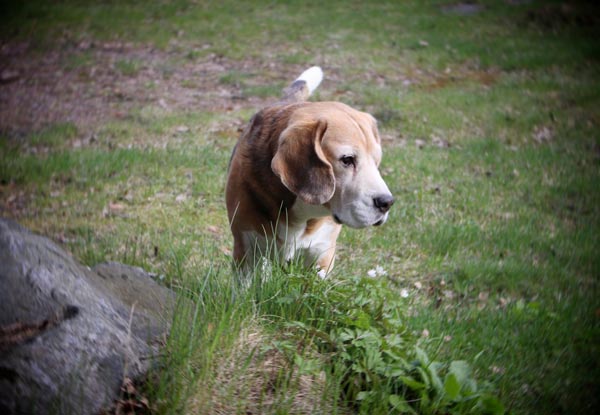
Cosmo was our family member for over 15 years, and there’s a lot I miss about him. Small things, often quite insignificant ones, like how he used to pick a sock when he wanted attention. My heart breaks when I remember how softly he did that, not leaving a single mark. In the end, he was a good dog and didn’t want to behave badly.
So yes, my grief has been smoking and burning. A wind of time has taken some away but also spread it further. When it started to feel that the grief would scorch my brushes, destroy the paints, and make the studio a smoky place, I knew it was time to paint. Not that it would take the grief away, but force me to deal with it.
Persuasion Can Replace Inspiration
Art is not always about inspiration. You know Picasso’s saying that the inspiration has to find you working. I find self-persuasion especially useful. “After this, you can paint whatever you want,” I said to myself.
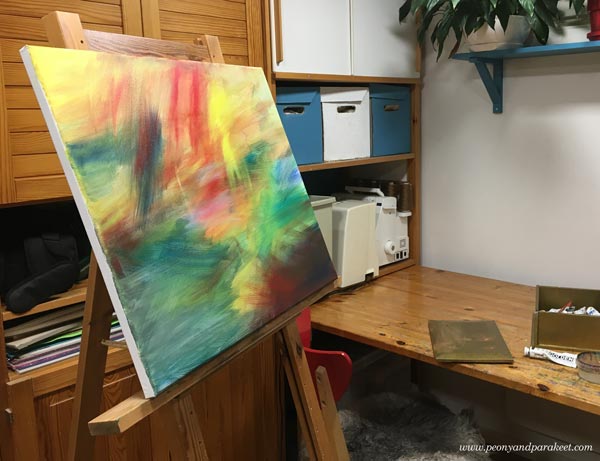
If we don’t paint these paintings that need to come out, it can cause a creative block. I have had some major ones in the past, and I didn’t want that to happen now.

“Follow the color,” I said to myself like many times before. It’s a quote of my own that boosts my confidence when I am working.
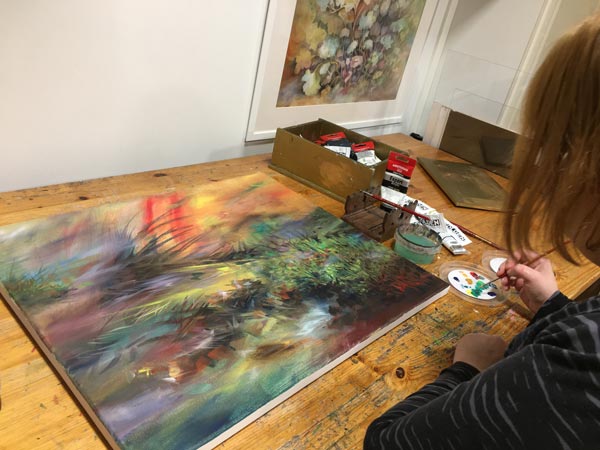
Stepping Into The Painting
This scenery had been in my mind for weeks. It was like an overdue baby, pushing through the brush.
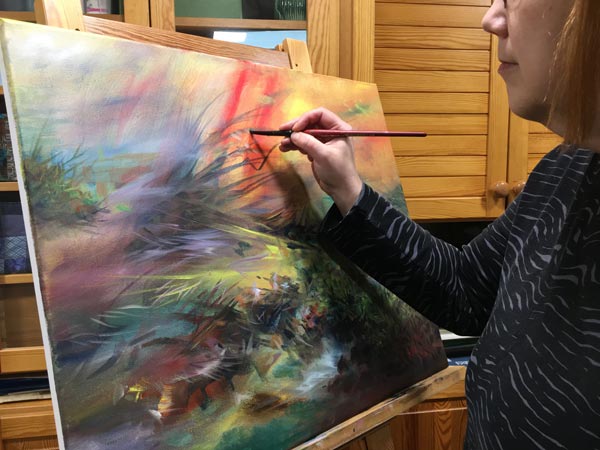
I just had to open my heart and welcome it.
Wassily Kandinsky talks about a glass between the artist and the painting, and how to remove it. It’s one of the hardest things when in grief, but also the most impactful one.

When we paint without the glass, the image becomes more personal. It doesn’t matter what other people think about it because you are living and breathing it. But oddly so, removing the glass also makes the image more general. My loss gets connected to everybody else’s losses. We are all behind the same glass, under the same blanket.
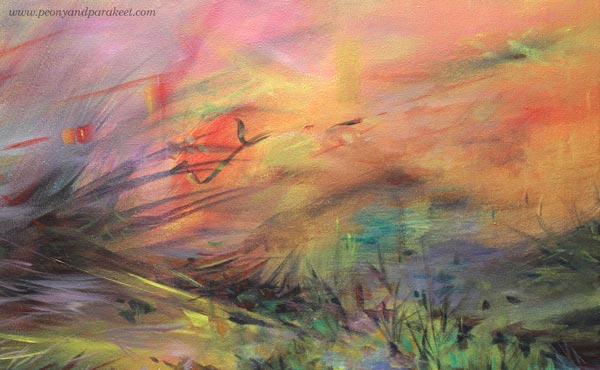
If grief smoked, we would all be covered in it. Even if it’s the saddest thing, it’s also beautiful to let go of someone or something you love. You can no longer help them, and it’s time to give them away.
Mental Queue – Images That Need to Get Painted
Art helps us with things that can’t be solved intellectually. I also think that artists have a mental queue. If we try to jump over the hard images, we don’t have the energy for the more cheerful ones that come next.
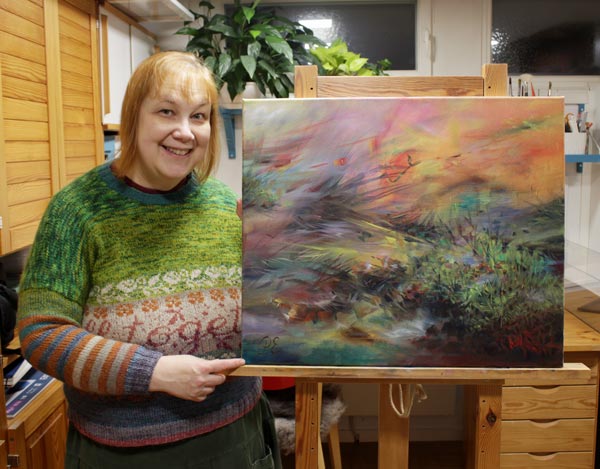
I hope this inspires you to pick the brush and paint the image that has been waiting for its turn.
Paint a Poem!
This week, we’ll talk about poems and how to turn them into paintings!

This acrylic painting is called “Terät liitävät kirsikkapuista,” and it’s my interpretation of Valter Juva’s poem from 1902.
The Finnish name is a bit difficult to translate. Terät liitävät have a double meaning: 1) blades flying in the air 2) petals falling freely. Namely, a petal – terälehti – is a compound word in Finnish. Terä is a tip or a blade. Lehti means a leaf.
This is not the only language-related thing in the poem, and I struggled with the translation. But here’s the best I could do!
English Translation of Valter Juva’s Poem
| Terät liitävät kirsikkapuista, ja virta vieno ne vie. Se tyynine suvantoineen mun onneni kymi lie. | Edges fall from cherry trees and are caught by a gentle stream. The river and its pools are the well of my serene. |
| Suviyössä, mi tuoksuu ja värjyy, veet kultahan sulautuu; se lekkuu lännessä päivä ja idässä kuultaa kuu. | In the summer night, that smells and glows, waters melt in gold; in the west, the day is stirring, and in the east, shines the moon. |
| Niin hiljaist’ on ja tyyntä! Ja koskien alla veet ne ahtaassa piirissä viipyy, mut siinä on syvenneet. | It’s so quiet and calm! And under the rapids, waters dwell in a tight round but have become deeper and deeper. |
Passion for Poetry
When I was a teenager, poems were my passion in the same way drawing and painting have been. I used to read poetry, and almost daily, wrote my own. I even entered competitions, and some poems have been published. Later, this love for poems have reappeared occasionally: I have read or written some. In 2014, I even wrote a blog post about illustrating poems in art journaling.
But now, it feels that poetry has come to stay. Every time I open a big book (Runojen kirja – Book of Poems) that I won in a poem-writing competition in 1981, I see something that I want to paint. The book has over 800 pages filled with four centuries of Finnish poetry, but it’s not just that. With the book, I remember many poets that I used to read. My mind is blowing, and my brushes are jumping! “Paint paint paint,” they cry!
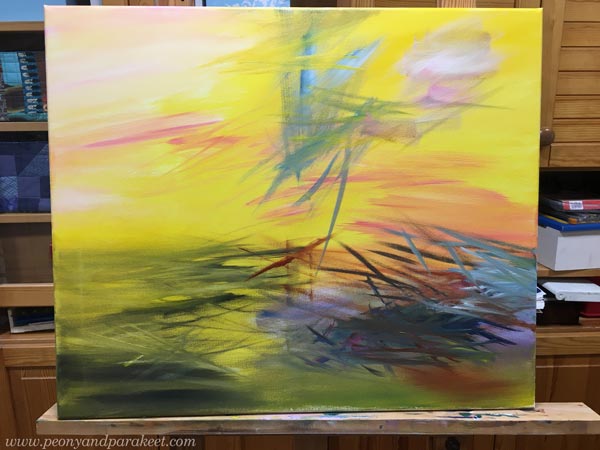
Valter Juva’s poem was new to me, but I got inspired right away. This painting has a lot of yellow in the background!
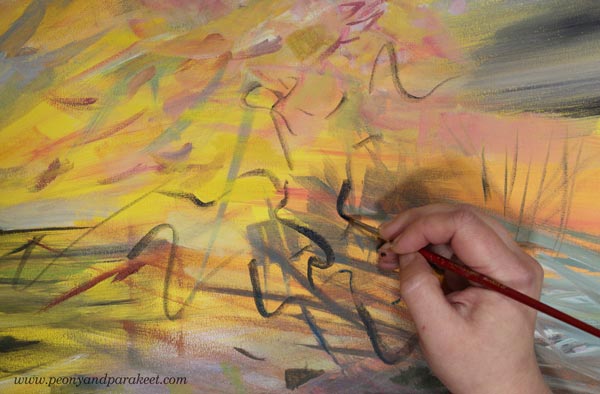
It was a joy to paint those sharp petals and curvy cherry trees that so willingly release the flowers. The size of this painting is 50 x 60 cm (about 19,5 x 23,5 inches) so I was able to paint the details more roughly and quite quickly.
Paint a Poem – Trust the Inspiration!
Painting a poem doesn’t have to be about illustrating every word. It can be more about finding a personal view – how the poem loosely explains your current life and often past experiences too.
In Valter Juva’s poem, the connection between Japan (cherry trees) and Finland (bright summer nights) blew my mind. You who have read my blog for a long time, know that both my husband and I love everything Japanese, and we also have a Japanese garden.
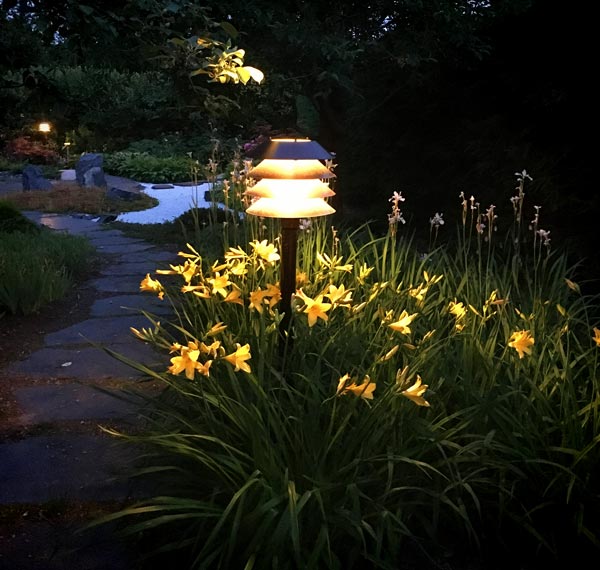
White nights were magical last summer! East and west meet like in the poem!
Paint a Poem – Color the Words!
Poems are filled with interesting words that can have a double meaning or a specific nuance. We don’t even have to know what strange words actually mean. It can still have a certain feeling to us, and we can express that with colors and shapes.

In Valter Juva’s poem, there’s a Karelian word lekkuu which means moving or stirring. To me, it has a relaxed undertone which makes me think about yellow-orange curves floating in the air, just above the water.
Paint a Poem – Break Borders!
In art, whether it’s poetry or painting, we can break borders. We don’t have to stick with one geographic location but create one that has characteristics of several places. Similarly, we are allowed to freely travel in time, from childhood to ancient history, and from the current moment to fantasy.
By changing the rules of reality, we can make representational elements symbolize more abstract things. They can be inanimate objects or nature’s elements, for example. In Valter Juva’s poem, waters have deep knowledge, In my painting, static trees take off and timid flowers jump from the plane.
Also, we can be magicians and make any material change its state. In the poem, water becomes gold, and in my painting, light is less immaterial and more touchable and concrete.
Poems are filled with metaphors, so why not let them in your paintings too!
Which poem would you like to paint?
The Child and The Adult – Finding Clarity for Your Art
This week I show a new painting “Call of the Sun” and talk about finding clarity in art. This week’s post is especially for you who feels that your art is all over the place and you have no artistic direction.

Auringon kutsu – Call of the Sun, acrylics, 50 x 70 cm. Click the image to see it bigger!
The Child and The Adult – Who Do You Serve?
I used to think there are two kinds of artists – those who like to play and dream, and those who are more ambitious and aim to express their deepest emotions. Just recently, when I started this new painting, I asked myself: “What do you want to paint, Paivi?” And the answer was: “Horses!”
– You can’t paint horses only!
– Why?
– Because there’s more that needs to come out.
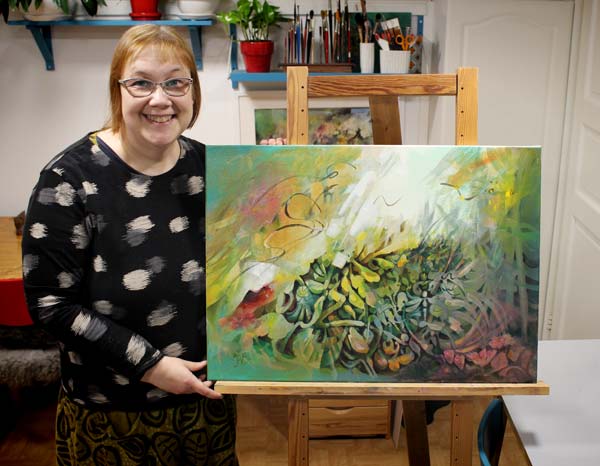
There was. There is. My inner child wants me to paint horses, but I am an adult too. If all my art is playful illustrations, I am desperately missing the adult in me.
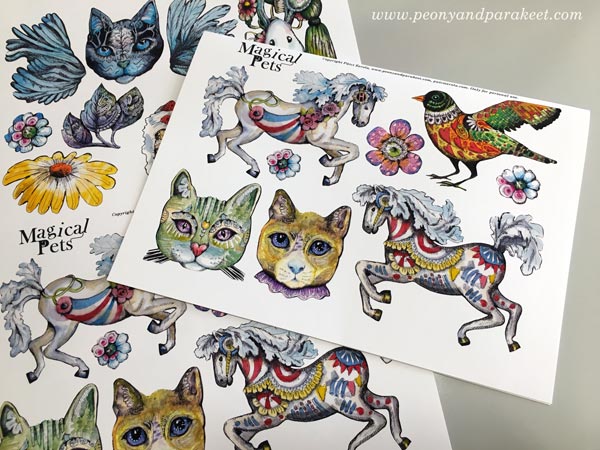
The Magical Pets image sheet is now available in my art shop. Or make your own in the classes Animal Inkdom and Magical Inkdom!
Concrete vs. Abstract
The adult in me wants to work in a way that does not appeal to the child. The expression is more intuitive and abstract and thoughts less concrete. I feel free when painting like this. It’s like life travels through me, and it heals my soul. It makes me feel that this is the best that art can offer.
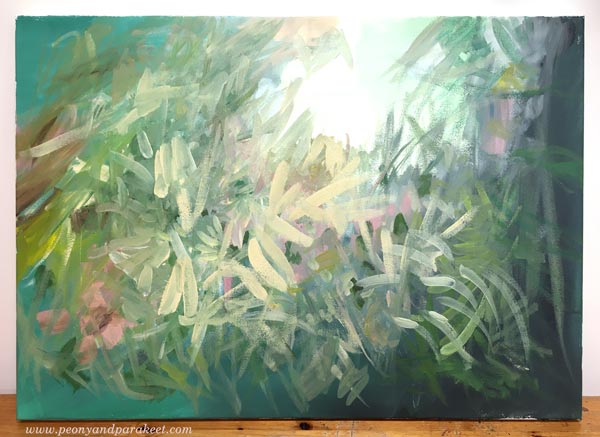
But I also feel free when I grab a more childish painting. I imagine talking to the horse and how it responses with gentleness.
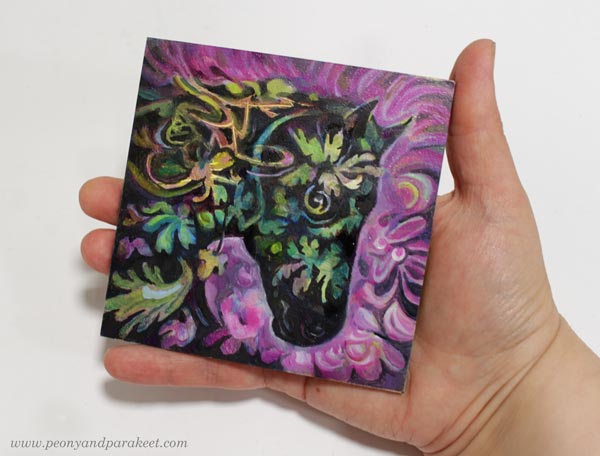
This, too, is the best that art can offer – the connection to childhood, to the person who didn’t want much more than a pet of her own.
The Child and the Adult – Don’t Lose Either One
Nowadays, my studio is both the playroom and the space for meditation. The inner adult needs to paint with the inner child and vice versa.
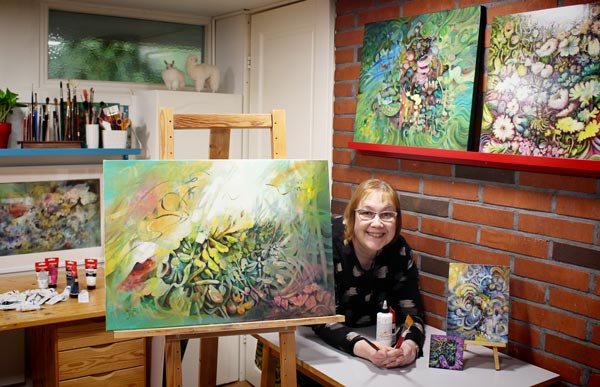
If the child gets neglected, other people’s expectations step in, and I lose myself. If the adult is away, I focus too much on the tangible things. Then the invisible side of the experience doesn’t come through. This realization has helped me in finding clarity for my art.
What are Invisible and Intangible Things?
Examples of intangible things that we can visualize in art:
- communicating the atmosphere with nature’s elements like light, air, and wind
- expressing emotions that contain mixed feelings, for example, the combination of love and melancholy
- inventing creative concepts like seeing similarities in the structure of plants and bridges
- focusing on experiences like flying instead of painting a bird
When we omit these kinds of intangible things, we are in danger of only creating shells rather than expressing a spirit.
Viewers Have Child and Adult Too
As viewers, we also have both sides: the child and the adult.
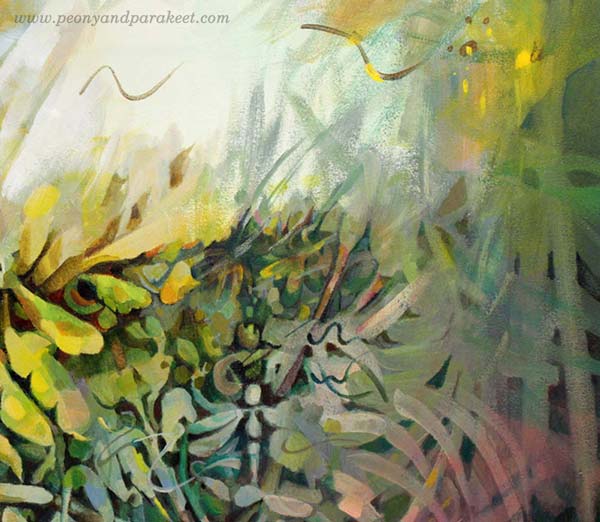
I painted a dragonfly for your inner child to play with while the adult can ponder about the more abstract strokes.
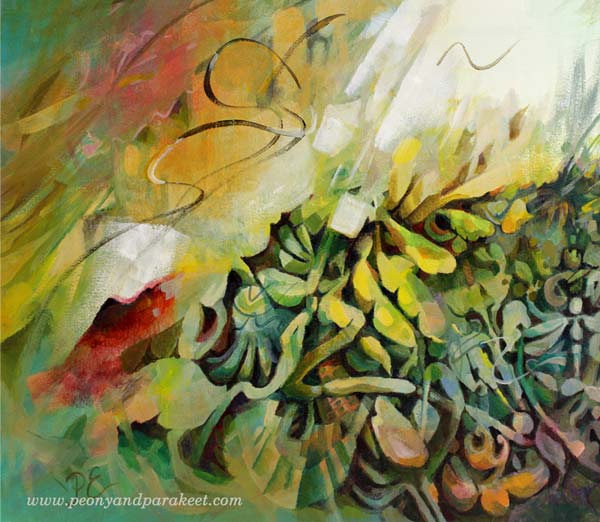
Sometimes simple lines and colors can express more than realistic objects.
Finding Clarity and Balance for Art-Making
For a long time, I haven’t been happy about my art. Especially this fall, it has changed. I have found what my child needs to be satisfied with the result, and what pleases the adult in me. Surprisingly, being able to satisfy the child has been crucial for me to getting forward in abstract painting. This one is in progress, and you will get more pics and stories about it when it’s finished.
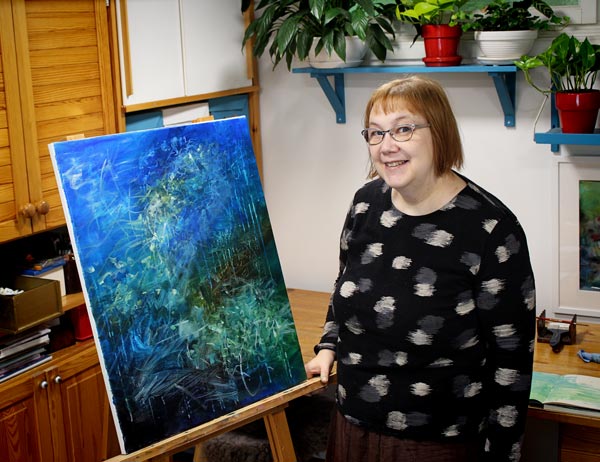
What do you think? Are you in the journey of finding clarity for your art? What would need to change in your art so that both the child and the adult are happy? Tell me, I am interested to know!
Expressive Abstract Style Tutorial – Paint a Beautiful Mess!
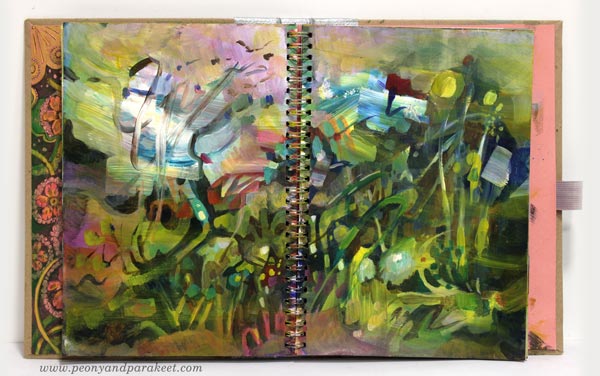
This week I have a video about painting in an expressive abstract style. It’s a very contemporary style which many artists have nowadays. It’s based on loose strokes, and I guess it’s the style that many who are not so much into art say that even a child can do it, but it’s not quite like that! Watch the video!
Are you interested in creating abstract art? Do you wish to learn more about abstract art in my blog and in my classes? Leave a comment!