
Your Art and Loosening Up
This week, I talk about being unique and loosening up in a video. You also get to see me working with a new oil painting.
Your Art and Loosening Up – From a Former Engineer
With the video below, I want to get you to think about how much you do layering. But this time, I don’t talk about the actual layers of the painting, but the layers of you and your life – the more abstract stuff. Namely, we often lead our artistic direction too literally and don’t allow contradictory or silly ideas. I hope you enjoy this video!
This is a little different than many of my videos. I would be interested to hear how you like it! Do leave a comment!
Links Relevant to the Video
- Ilun Handu Duunaa, Episode 44 (in Finnish)
- Paul Klee and Wassily Kandinsky at Wikipedia
- Paul Klee’s Pedagogical Sketchbook at Amazon.com (affiliate link)
- Wassily Kandinsky’s Point and Line to Plane at Amazon.com (affiliate link)
- Floral Freedom (the abstract floral class!)
Expressing Inner Storms by Painting
This post is dedicated to all who have lost their creative inspiration during these challenging times when outer storms cause inner storms too.
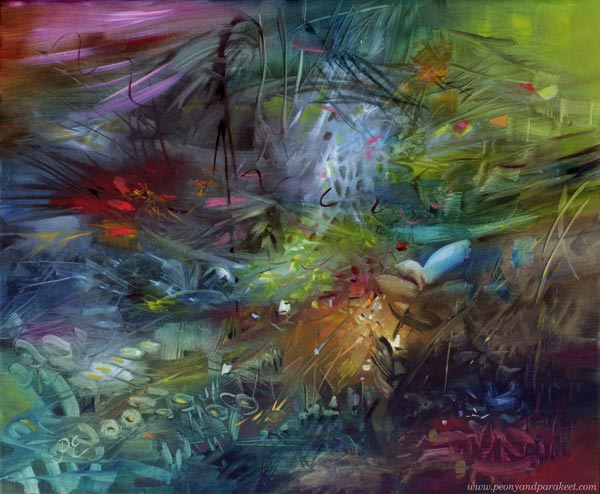
I have always loved art that uplifts and is more on the bright side of fantasy than in the darkness. I have defined myself as an artist who does not express agony or suffering or bring out what’s wrong in society. My art has based on the possibilities of imagination. It’s about the richness of the inner world. “Spiritual freedom” has been my word.
But the longer I have painted, the more courageous I have become. How flowery do my paintings have to be? To free up my art and to free up my thinking as well, I have begun to accept all kinds of shapes, colors, and emotions. The same flowers that bloom in my watercolor pieces become little monsters when I paint more freely in oil. It’s like there’s a new world under the inner world I only used to know.
Painting Inner Storms
At the end of January, I started a new big painting. It had dark colors, but I intended to brighten it. “When the time is right, I will make it more cheerful,” I promised to myself. Weeks went by, and it always felt like I had something more important to do. I didn’t have the energy, or I had too much energy. The more I postponed the finishing, the moody I became. “This pandemic gets to my nerves,” I said to my husband.
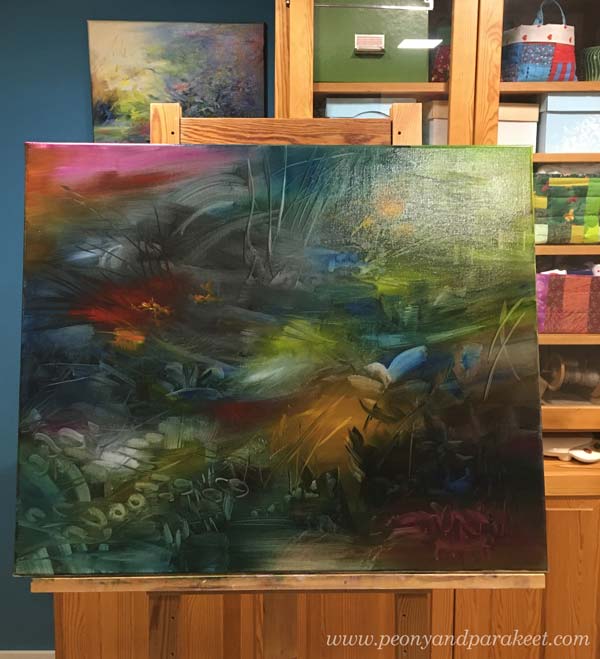
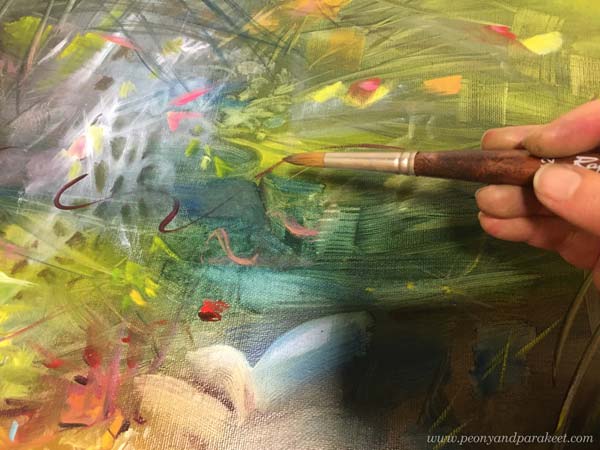
But when my spirit got more and more low, I had to do something. One night I picked paints and brushes, abandoned all the happy stuff I was creating and continued the painting. The brushes felt heavy at first. The paint tubes were like stones. But then I remembered the magic words: “Päivi, you can paint!” This confidence, even if it always feels false first, energizes my strokes and thoughts. The painting begins to speak to me, and my responses become more and more natural.
This Too Shall Pass
“What are you painting, Päivi,” I heard my inner critic saying after a while. “The piece is still very dark.” My immediate answer was: “Yes, it’s dark, but this too shall pass.” At that moment, I knew the name of the painting and why it should not be forced to look more cheerful. Inner storms can be as beautiful as the happy moments and little monsters as clever as any flower.
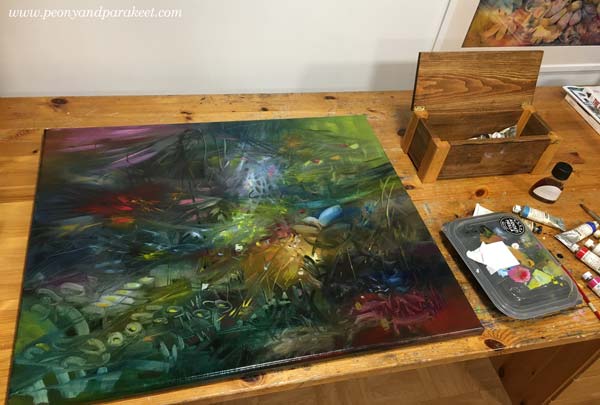
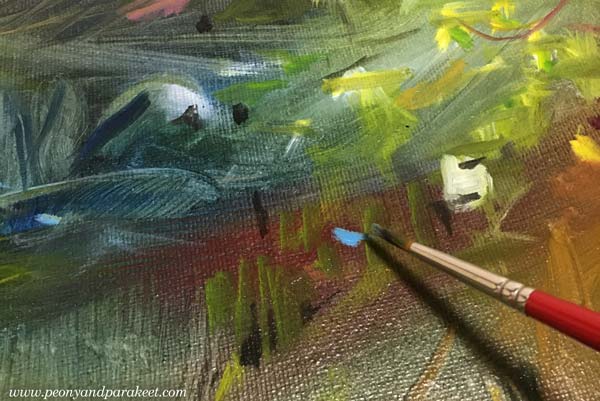
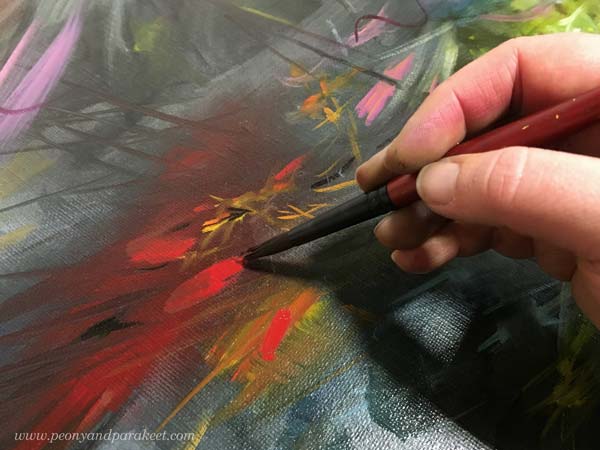
When I woke up the following morning, my mind was calm and still. And when I look at the painting, it gives me hope no matter how stormy and gloomy it seems.
Here are some detail pics.
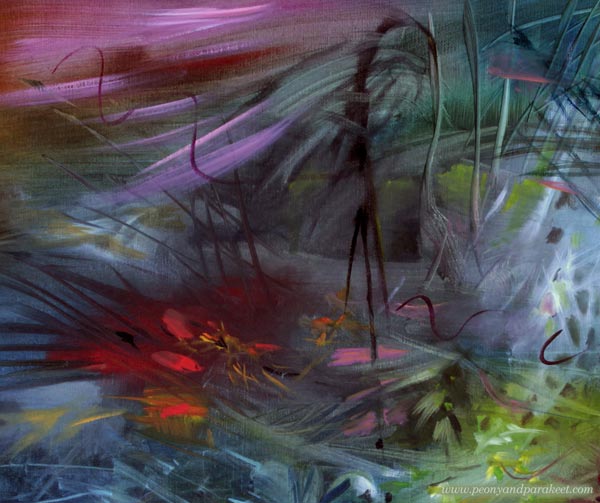
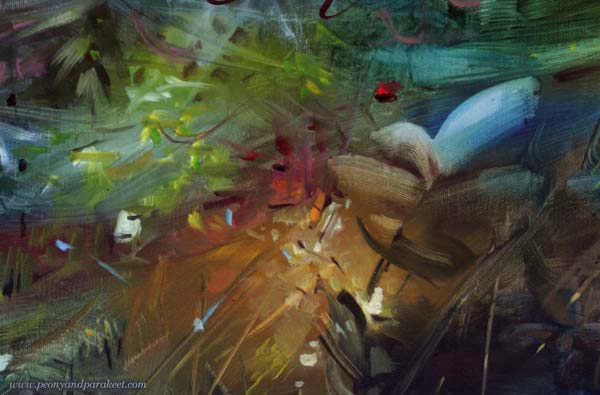
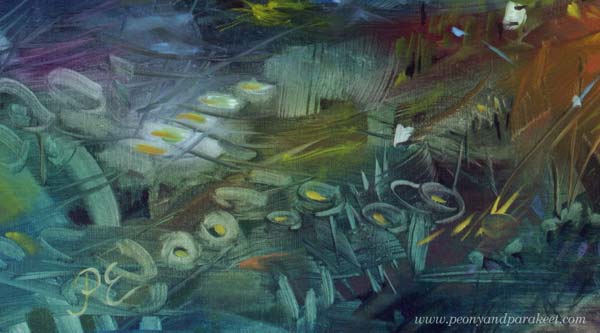
Here’s the whole painting again.
Sometimes the lack of inspiration is a sign of not letting out what needs do so.
Have a creative Easter!
P.S. My abstract painting class Floral Freedom is now available as a self-study. Watch the video below!
My free painting style is based on Paul Klee’s and Wassily Kandinsky’s timeless teachings presented in this class. >> Buy here!
Artistic Growth – From “Huh” to “Wow”
This week, we’ll talk about changing artistic direction and how the first reaction doesn’t always matter as much as the second one.
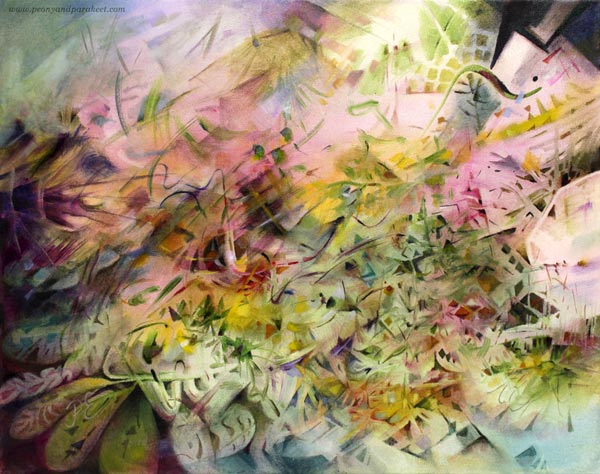
My seed idea for this painting was slightly different from usual, and I wanted to see how it would grow on canvas. It took many sessions and lots of struggles with finishing. “There’s still something wrong with this painting, Paivi,” I said to myself after correcting a couple of shapes that my husband pointed out. Last night, I had a dream that I walked an ugly dog on a thin leash. The breed was an odd choice, but the dog was still mine.
“Huh” and “Wow” – First and Second Reactions
Isn’t it so that we want to change, but as soon as we begin to see the results, we are likely to bounce back? It’s so easy to say: “No, this is not for me, I’ll try something else. I’ll try a different style, a new technique, another art class, or find other artists to follow and admire.” And this is not only a bad thing. In the long run, bouncing back is about integrating the new stuff into our natural self. But in the short run, it can prevent the growth we want and need.
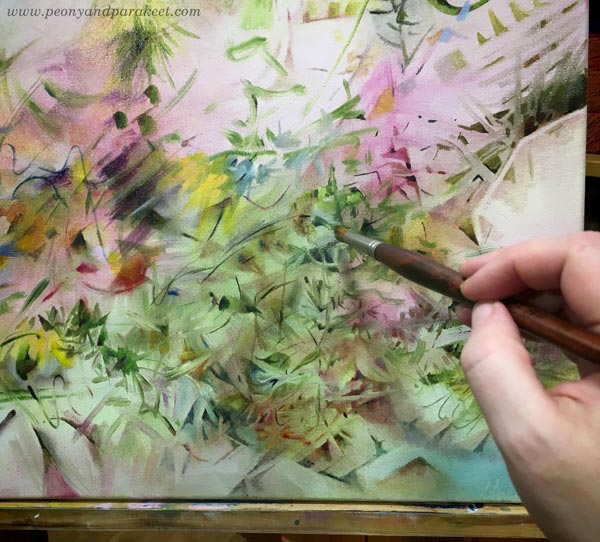
I have been reading James Victore‘s Feck Perfuction as an audiobook. It’s a book about creativity and easy listening about things that are really tough in practice. It’s more like a two-hour inspirational speech than a down-to-earth guide, but it feels current with this painting. In the book, James Victore refers to an American pop artist Edward Ruscha. He has said: “Good art should elicit a response of ‘Huh? Wow!’ as opposed to ‘Wow! Huh?'”
This week, my favorite video podcast, One Fantastic Week, talked about “Instagram art” – pictures that the Instagram algorithm likes. It’s colorful, easy to consume and comprehend, but its exposure doesn’t ensure the artistic quality.
Artistic Growth and New Truths
When a painting is not for a class or a specific exhibition, I try not to think about the audience too much. I trust that you will pick what you like, and forgive me those you don’t.
But with this painting, I realized that I have played in the “Wow! Huh?” category, and this one tries to be more “Huh? Wow!” And that change makes me uncomfortable. It’s like I have been written a revealing story but in a code language, being afraid that anyone who stops to look will see to the core of me. And at the same time, worrying about that anyone who doesn’t, only sees a mess.
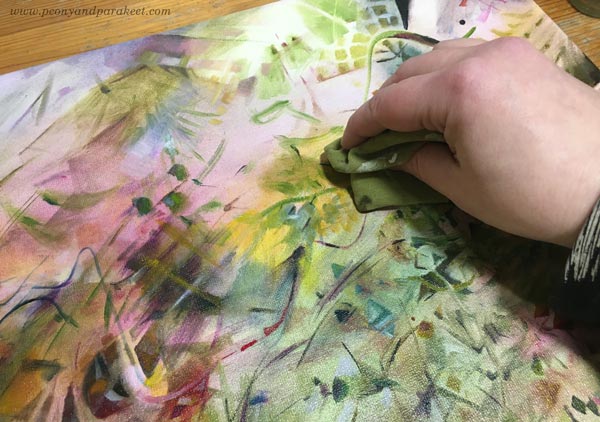
An Outside View to the Inside World
Teaching art has helped me to grow as an artist a lot. For example, when I get to see a student sharing a wonderful painting saying: “I don’t know about this one,” my gut reaction is then: “What!? This is beautiful!” But what’s “huh” for them is “wow” for me because I see the painting in a context that’s still new to them. They haven’t got used to seeing themselves like that. They are in the middle of a change, and it’s tempting to get back to the same old thing.
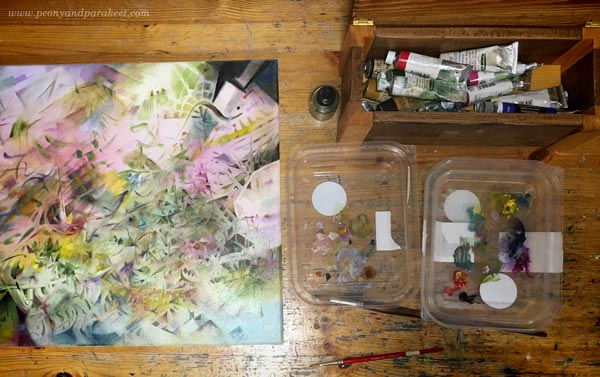
I recycle plastic lids and use them as palettes.
But when we do something regularly, it’s natural to miss the change. Floating on the surface isn’t enough anymore, and we get curious what’s deeper – “behind the glass” as we say in Floral Freedom, referring to Wassily Kandinsky‘s teachings. Then we need to learn, stretch, and redefine. Accept new truths.
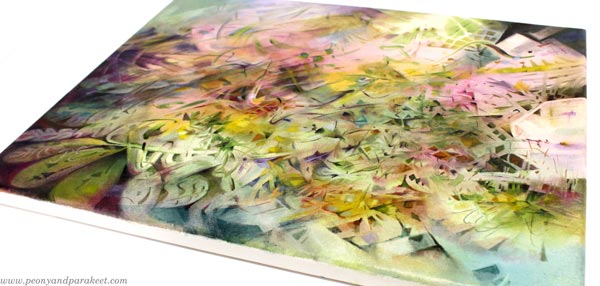
When looking at the mirror, I see more wrinkles than before. What was “huh” some years ago would be “wow” now. But with this wisdom, I hope long life for this painting. That the “huh” that it causes now will be “wow” someday. Maybe after I have fully accepted that my artistic growth is towards more and more abstract art.
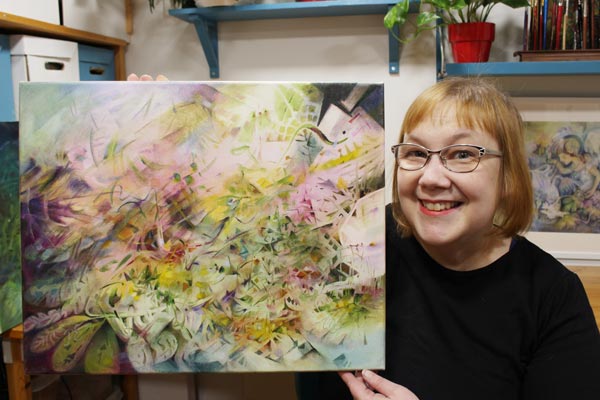
It’s also good to accept that some paintings are just “huh-huh” and a few manage to be “wow-wow,” and what’s “huh” for some is “wow” for another. What do you think?
What to Paint on Canvas?
This week, I invite you to think about what you should paint. It’s a general question and applies to any medium, but if you have purchased a canvas, the pressure is even higher. My story starts with dogs, and even if they don’t seem to match with the painting, they do. Read the story!
Childhood Without Dog of My Own
If I had to choose one thing that dominated my childhood, it would be the yearning for a dog. When my sister was pushing me in a stroller, I was pointing and screaming “hauva,” which a Finnish word for “doggie.” “How could you instantly recognize a dog from any other animal no matter how it looked,” she wondered.
My father was a policeman, and he had trained two german shepherds a long time before I was born. But a family photo album had a few photos. “Jumi,” was the name of the more handsome one, and I must have drawn him hundreds of times with a trembling hand of a toddler. I pictured the dog standing on the top of the mountain in a sunset. It was an exotic view because there weren’t any mountains in the countryside of eastern Finland. I only saw them if I kneed down, looked up, and stretched my imagination.
Walking in Nature with Imagination
My envy and admiration for all people who had dogs grew steadily, and at the age of five, I had several that were in constant observation. One of them was Kaisa, a vet whose mother lived in a big apartment building next to our house. She had a Finnish spitz and sometimes kindly invited the children of the neighborhood for a forest walk. We were a small and noisy crowd. Everyone had their turn to hold the leash, and even if it was only a few minutes, I still remember how powerful I felt.
So even as a young teenager, I imagined dogs around me whenever I went for a walk. The boring life in a small town became much more bearable when I didn’t have to look around, but only to a close distance. There they were, two brown labrador retrievers that behaved exceptionally well no matter where I took them.
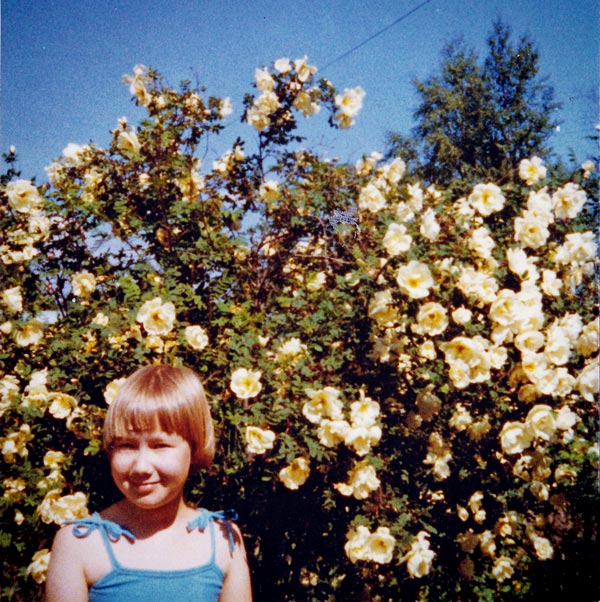
I preferred labradors because the royal family of England bred them. I had always wanted to be the queen of England, so my labradors certainly originated from Sandringham. My friend Anne had got a hold of a catalog of the Crufts dog show, and I excitedly picked the parents for mine. Every time I drew or knitted a dog, I tried to invent the best kennel name for me. “Starway’s” was one of my favorites. By then, my sister had married a man who had a spaniel, and from the spaniel club magazines, I found a new favorite breed: an American cocker spaniel.
Goodbye, Boredom!
The older I got, the more evident it became that I would leave my home town. Instead of frustratedly strolling in the fields and woods of the east, I would be happily hurrying on the busy streets of the south. And not alone, but with an American cocker spaniel of my own!
I would gladly say goodbye to lazy hot summer days when there was nothing else to do than examine the tussocks. When I once pointed them to my mother, she quietly said that our grass wasn’t proper like the apartment building had. But I found it much better. Instead of staring at individual blades, my imagination made wonders from the tussocks. They were luxurious carpets, cushions, and chairs, and when they looked up, I greeted them back. My grass tussocks were like dogs who had them – a flock that was always around and willing to join whatever I did.
When I got my first dog, I was already living in the south. It was an American cocker spaniel, of course. I lived in a flat, but between high buildings, there was a small wood. Unlike me, Anja had been born in an urban environment, and everything in nature wondered her. When she jumped back in surprise after seeing an ant, I realized that I was a country girl – no matter how much I loved palaces!
My next dogs have been beagles. With them, I am back in the world where looking down and examining closely is highly appreciated. Tussocks, hays, wildflowers, and brooks have returned.
What to Paint on Canvas?
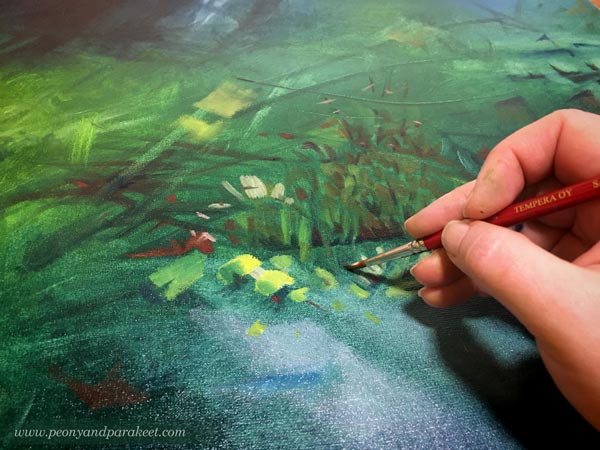
In my artistic path from childhood to this day, I have thought that I should create the luxury that I don’t have. That my creativity is at its best when it produces what I miss. But in 2020, when the world quieted down, humble tussocks saw their moment. “Stop haunting me, you don’t even have a voice,” I whispered to them. “We have – and you used to listen, remember?” they responded.
And yes, when I pick the brush, I hear them again. Instead of trying to master the visual state of what I know very little of, I am painting the sounds in the deep. All that time when I wanted to be the queen of Sandringham labradors, I was, and I still am – a herder of mixed-breed tussocks!
How about You – What Should You Paint?
What you need to paint is not what you want to get and be, but what you have always got and been. The solution is not to find and paint what you love but to look in the opposite direction, find what’s been the most ordinary for you, even if it wouldn’t be that for others. The solution is not to paint how things look, but how they sound, smell, taste, and feel. In the book Point and Line to Plane, Wassily Kandinsky talks about releasing the inner sound of a shape.
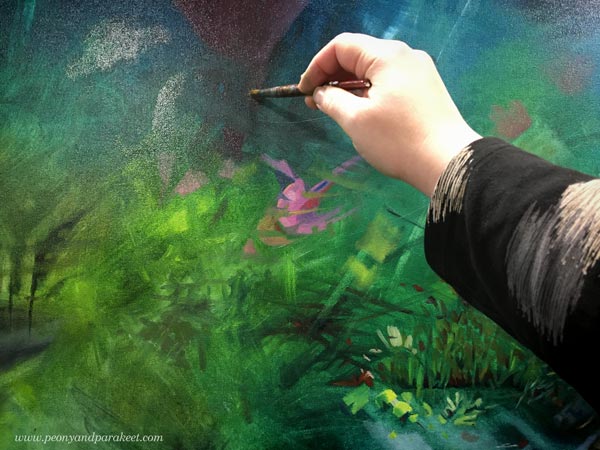
With the tussocks, the teachings of the abstract masters Paul Klee and Wassily Kandinsky have been groundbreaking to me. They have enabled me to paint more freely than ever and I have also built a class Floral Freedom from these teachings. Floral Freedom is especially for you, who wants the painting to look loose and naturally abstract, but who hasn’t find satisfactory results from “just making a mess.”
Good Accidents – When to Improvise
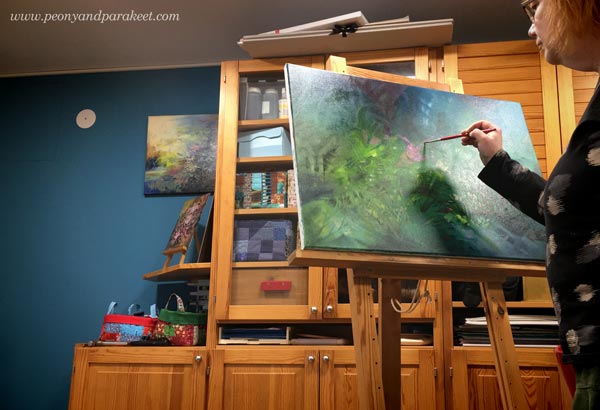
Art is never about just making a mess. Artists who say so are just unable to put it into words. Wassily Kandinsky and Paul Klee were not only exceptional painters but also exceptional teachers. They defined abstract art in methods and diagrams. In Floral Freedom, you get their theories in an easily understandable form and use them to paint flowers.
In this video (after the first two minutes), Helen Mirren talks about Wassily Kandinsky’s art. She first assumed Kandinsky’s work was just improvisation – “instinctive and improvisational and wild and of the moment,” but later learned that his work is constructed with care and thought.
Here’s how she says this:
I can also relate to what Helen Mirren says about acting – that you have to give the impression of the improvisation and naturalness and learn what’s a good accident. But I also have the definition of a good accident in visual art: it’s what you have used to see and know.
I feel that I know everything about the soul of grass tussocks. When I paint them, I don’t have to worry about people not liking them, not even if someone can paint them better. This grass is not any grass but how a 5-year old Paivi saw it, walked on it, and what she imagined from it.
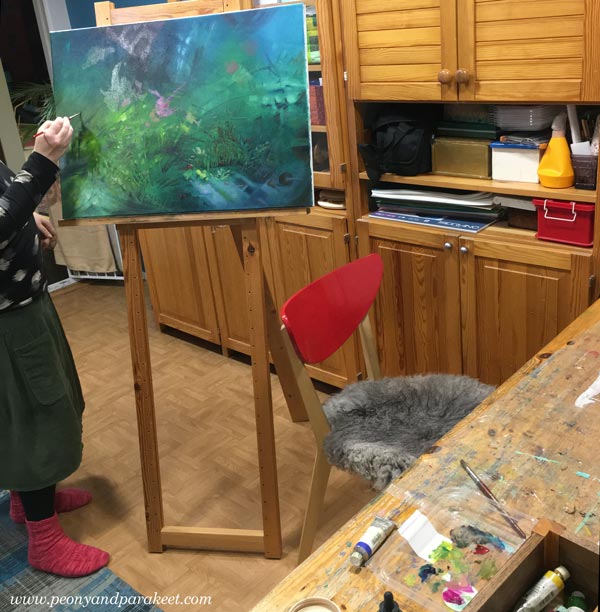
I paint sounds of plants as I hear them, freely and without references. I don’t plan what to paint on a canvas, and I don’t follow any image of my mind. It feels like improvisation, but the process is technical and systematic. One shape follows another and I dive deep into the painting, creating and releasing tensions.
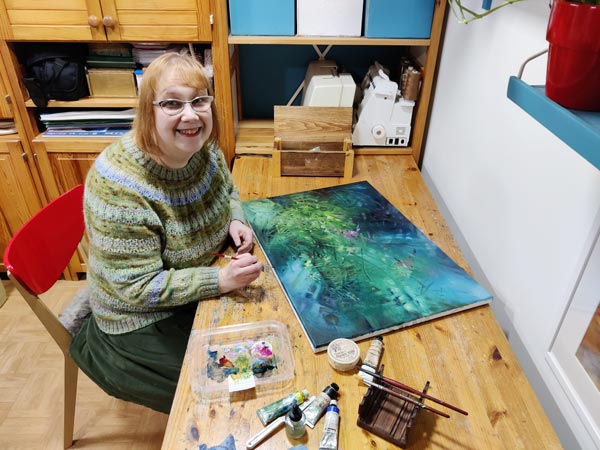
I am filled with excitement and emotion, but work systematically and intentionally, translating from spiritual to visual.
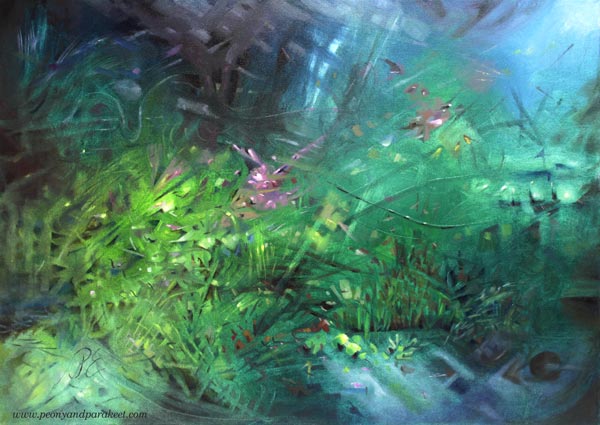
I really enjoyed painting this one – the first one of the new year! It’s called “Syvällä soi” which is a bit difficult to translate in English but it means that some are playing instruments or singing in the deep so the translation could be “Sounds in the Deep.”
Floral Freedom – Paint Dreamy Florals to Free Your Spirit
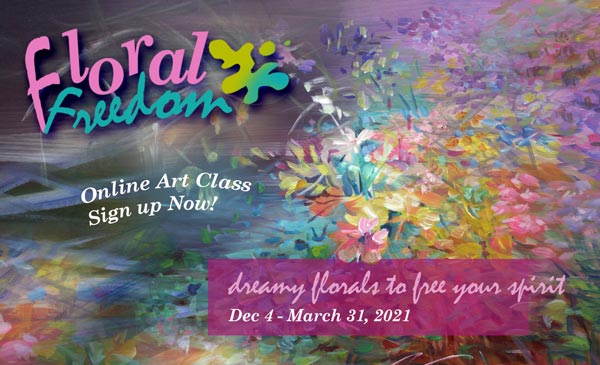
Come to learn the theories behind abstract art, and paint flowers with me – Sign up for Floral Freedom! We use acrylic paints for the projects. The class has already started, but you can still hop in. You will get the published lessons right away, and you have plenty of time to catch up and connect with me and the community. This class is comprehensive, and suitable for self-study too. Sign up now!