
Coloring with the Inner Child
This week, let’s get excited about colored pencils and embrace the inner child!

I used to play with colored pencils as a child. Not just use them for drawing and coloring, but also treat them as dolls. A brand was their surname. I had Caran d’Aches, Derwents, Lyras, … My sister was coloring while I played with the pencils. So, it often happened that someone precious got blunt and tired in my sister’s hands and needed some loving care after coming back to my play.
Colored Pencils – Do Yours Need Some TLC?
Some weeks ago, when taking the jars of colored pencils out of the cabinet, I sighed: “I want a new set; these are getting quite short.” But if I look at my diverse selection of pencils in child’s eyes, all they needed was some sharpening and close observation – what is the family name, who could this little pencil be?

I picked a tray for a smaller selection so that I can get to know them again: “Hello, Cretacolor! Let’s work together!” And then, I made some mixed selections and drew more, and it felt as much fun as a brand new set. I also found some small sheets of paper, and it felt as satisfying to fill them as it is to knit with leftover yarns.

Coloring with the Inner Child
The same difference in attitude goes for drawing and coloring. As adults, we may color some random shapes, feel disappointed in their composition, and try forcing the image out. Or we can change the rational to irrational. Then, like a child sees a person in a pencil, we see life in a simple shape. What could be its counterpart, and where could be its reflection? And could it remain blurry – breathe better without outlines?

Instead of controlling the big picture, we can reveal the personality behind each shape. The image will then grow slowly but naturally, and we get to release our inner child.
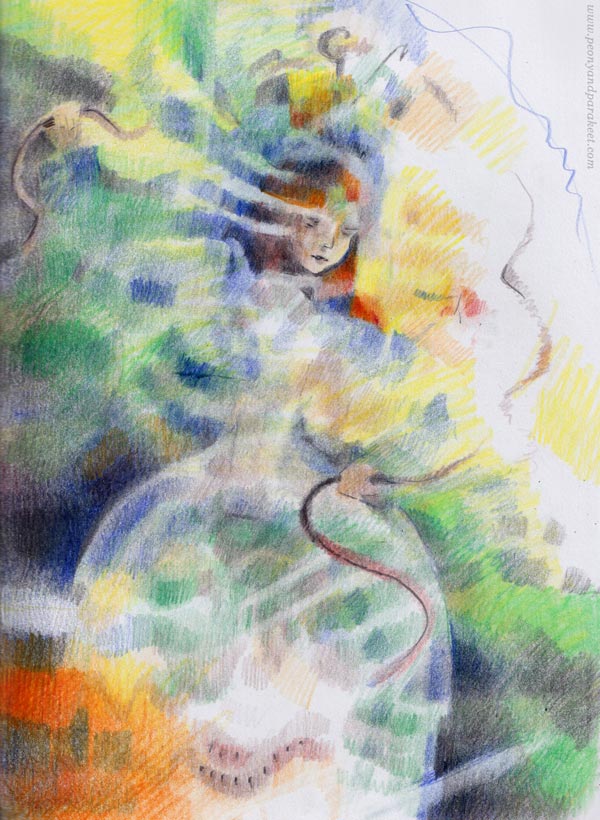
This post includes sneak peeks of my upcoming class Intuitive Coloring – Stay tuned!
For Animal Lovers – News, Art, and a Flash Sale!
This week, I share exciting personal news and celebrate with a flash sale. The animal drawing class Animal Inkdom is 40 % off this weekend! The sale ends on Sunday, July 18, 2021, at midnight PDT. >> Buy here!
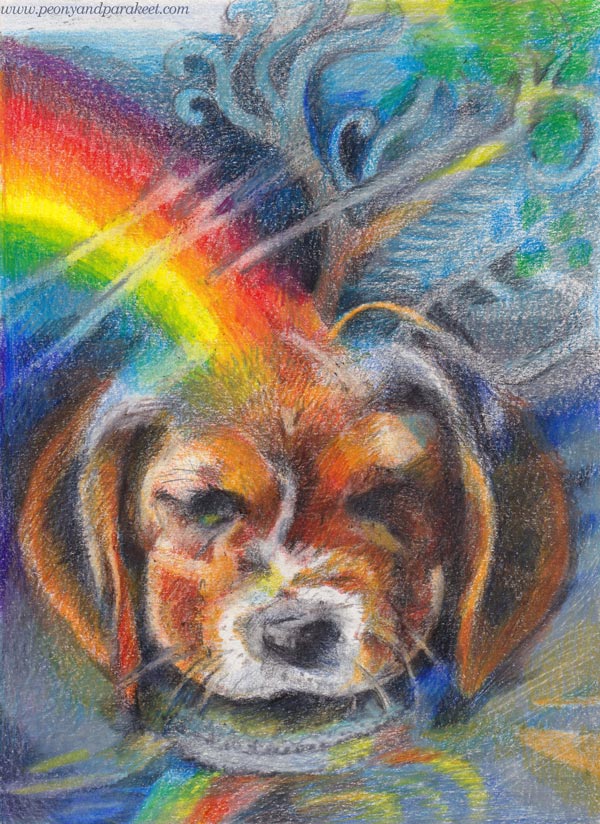
This week, my husband and I had a small vacation. We went for a two-day trip to see the Finnish countryside and some towns, but first and foremost: to choose a new family member! We have been waiting for this since our beloved beagle Cosmo passed away, but beagles are very popular, and cold winter seemed to postpone the litter.
But here she is!
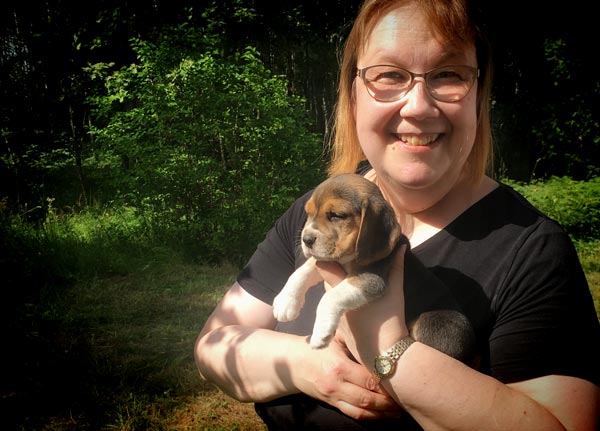
She is only 5 weeks in the photo and we will get her after a few weeks. We have named her Saima. It’s a Finnish girl’s name and also very similar to Saimaa, the largest lake, where we went to see her. Saima also has a grey spot on her other leg. Grey is harmaa in Finnish, and a famous Finnish poet was Saima Harmaja. So there really was only one option for the name! We are eagerly waiting for her and hope that our beagle Stella will love her too.
Celebrating Saima – Animal Inkdom 40% OFF
Last spring, when waiting impatiently for her to be born, I decided that after I get to hold a new puppy in my arms, there will also be a sale for Animal Inkdom. So now’s the time!
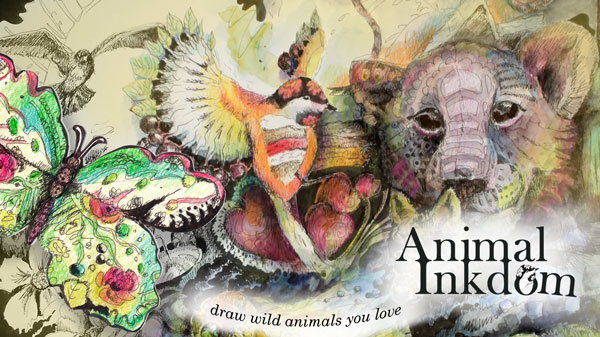
Animal Inkdom has been my most popular class during the past couple of years. When I recorded it, I had so much fun that I had to edit out some laughs. I think that the love for animals and the easy flow of ideas have made the class inspiring for everyone.
And because choosing a puppy isn’t something that happens often, I wanted the sale to be exceptional too. Animal Inkdom is 40% OFF, but only for this weekend! The sale ends on Sunday night, July 18, 2021, at midnight PDT. >> Buy Here!
Intuitive Coloring – Examples and Thoughts
This week, I show sneak peeks and process pics of simple intuitive colorings and talk about intuitive art.
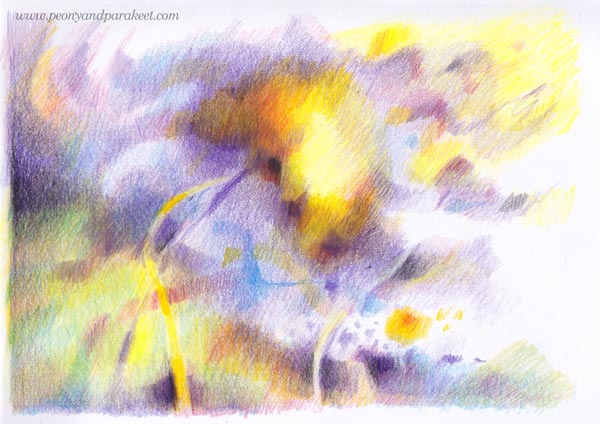
Since I made the last free video “Colored Pencils – Intuitive Approach,” I have been thinking about free coloring. First, it felt like I have explored it thoroughly in the e-book Coloring Freely and in the class Inspirational Drawing. But as soon as I began to make some notes about intuitive coloring, I realized that there are things that I haven’t shared in these blog posts or in my classes so far. Many of them are things that seemed complicated and heavy at first, but the more I have experimented with them, they appear to be very simple and light.
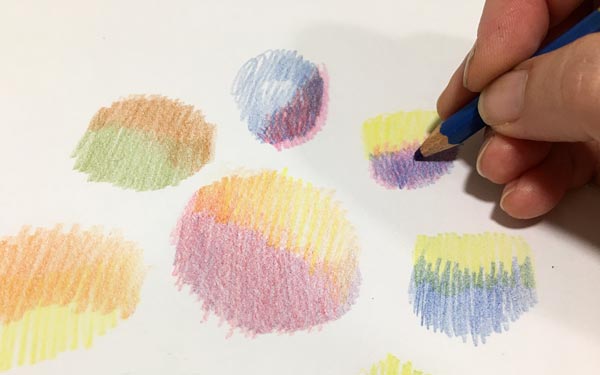
And it feels fun to color freely on a blank paper, and there’s a sense of playfulness too right from the beginning.
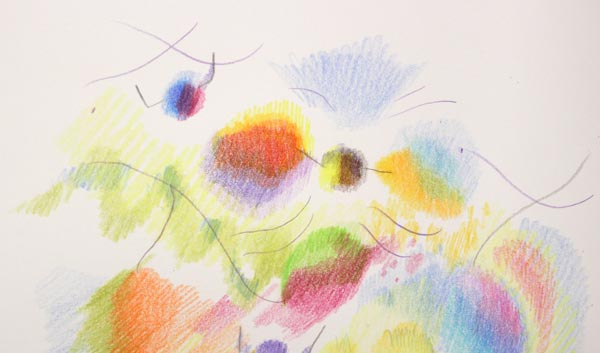
I am a more-is-more kind of a person, but after making a series of large oil paintings, I wrote a mental note that says “less is enough” in capital letters.
Can Intuitive Coloring Be Taught and Learned?
I have also been thinking about the term “intuition” a lot. Why does it feel so intuitively correct to say that my art is intuitive? And not only that. Why do I want to teach intuitive art? Because isn’t intuitive just about letting go and emptying the mind on paper? Doing what you want, doing what feels right?
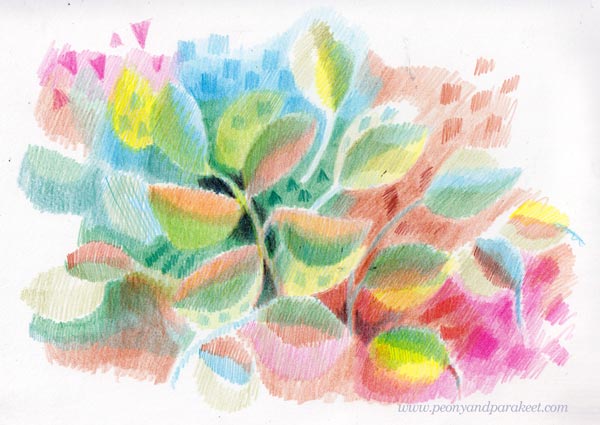
But as a former engineer, it’s always been hard for me to trust intuition when I am trying something new or reaching for a new level. Then the intuition is confused with the comfortable “same-old-same-old” routine. That old dog always stays close, but intuition and imagination are timid puppies. To find the puppies – that’s where I feel I can help.
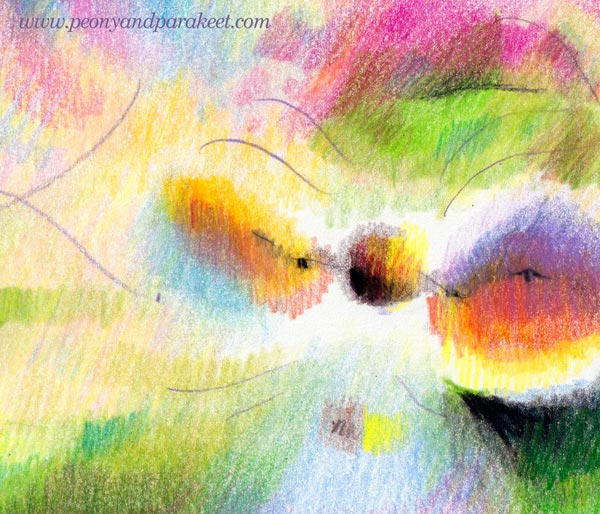
Would you be interested in this upcoming class?
All In – Finding Uncommon Inspiration
This week, I share my biggest painting so far, and talk about computer games and all the things that should not inspire but that do!
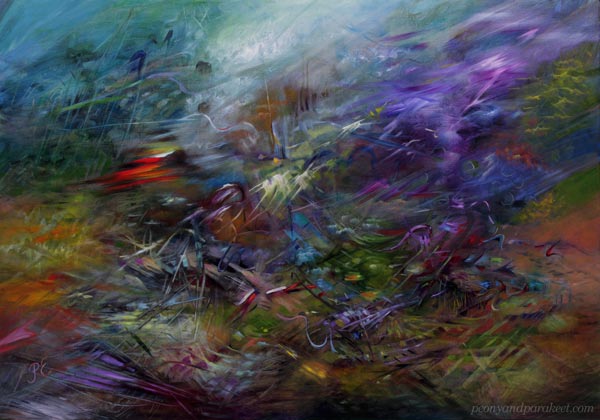
Here’s the last painting of the series that I have been working on this year. It’s called “All In.” The Finnish translation “Kaikki peliin” is perhaps even more suitable because there’s the word “peli” – the game. In this painting, I made every element look like it moves – like in a computer game!
I Am Not a Gamer
No, I am not! Actually, I am the last person who should be talking about computer games because I don’t play them at all. But I have seen some commercials on television and Youtube, and they make my heart beat faster – that’s the tribe where I belong! Despite I hate seeing violence, and don’t usually even watch action movies. Action upsets me. In general, I prefer everything cute and pretty.
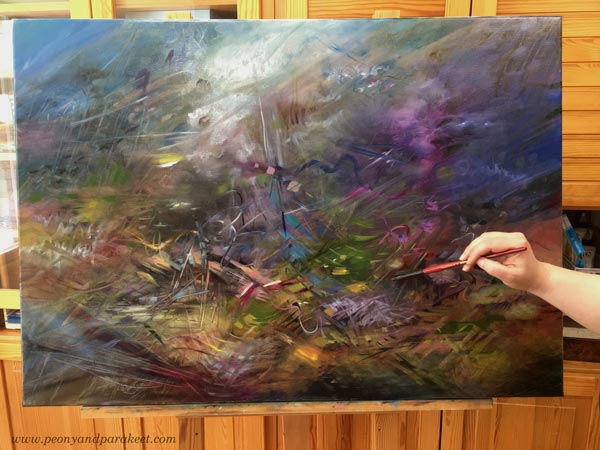
My Imagination Loves Games
But when I paint, I am not just an artist with all kinds of brushes and tubes. I become a nerd who tries to find the fastest processor and the best graphics driver for rendering 3D from her brain. It no longer matters what kind of art I should create and how art should be created. I change to a guy who moves from one level to the next, always seeking more monsters, more excitement, more points.
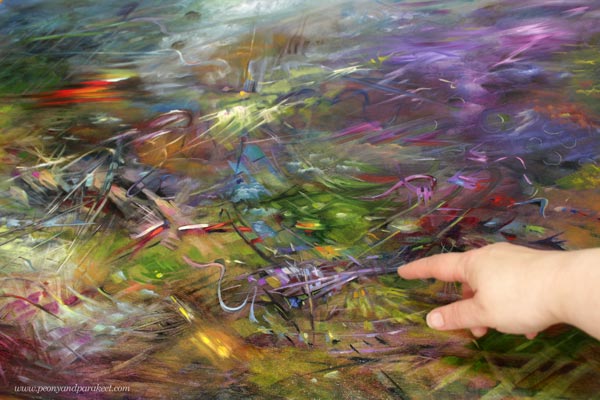
Because I don’t play the games, I should not even know how it is like. Yet, I feel I do. Namely, in my twenties, I chose computers over art. I felt I belonged to the world of introverts who built systems – worlds of their own. And now, when I paint, my paintings bring me back to the same setting – how to build a world that operates like a fast-moving game, with many layers and levels.
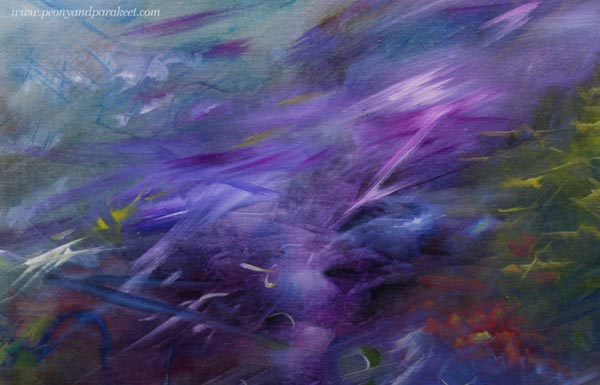
This is not what I would have expected. If someone said to me: “Hey Paivi, you should paint game sceneries. Make your own games!” I am pretty certain that a couple of years ago my answer would have been: “You must be kidding. I am a feminine romantic who hates that stuff!”
The Adventure for Uncommon Inspiration
But art is an adventure. It’s not only a journey to a variety of techniques and skills but also an exploration that includes the darkest corners of your mind.
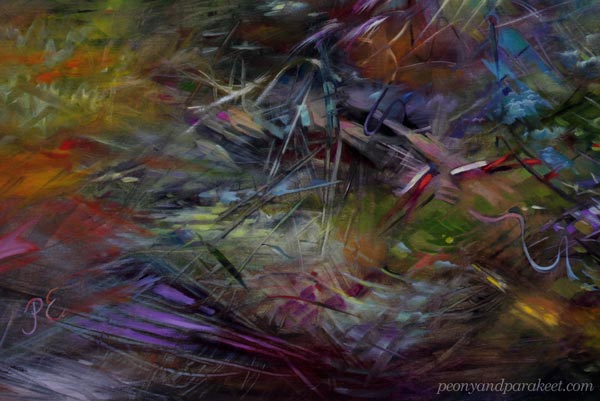
In 1980s, I was a girl who sat in a local library on hot summer days, browsing big books of old art. My dream was to become an artist, but knowing that it would not be safe or easy, I said I wanted to be an English teacher. Between the art books of the library, I saw young boys browsing computer magazines. I went to the shelf after them and knew that I also belonged there – to that group of nerds. And when I saw a computer for the first time, my heart beat fast like for the best painting of a museum.
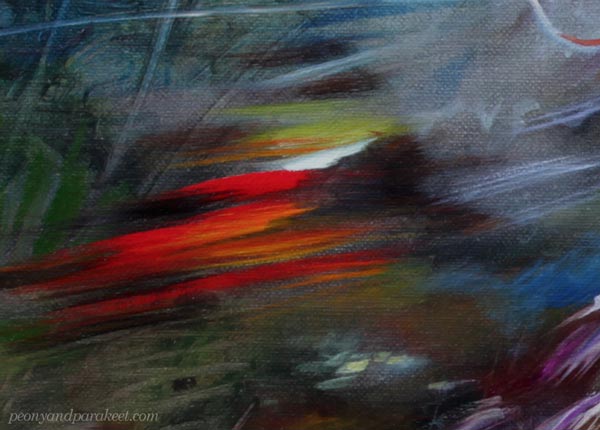
Making a series of paintings has been quiet and hard work. I have had lots of self-doubts and melancholic moments between the sessions. But when I paint, it’s all good. My paintings say: “Tell me what you want and we will give it to you!” And often, I don’t know what to reply, but they seem to know anyway. Like I never told them how nerd I am, but they shamelessly reveal everything and apologize for nothing.
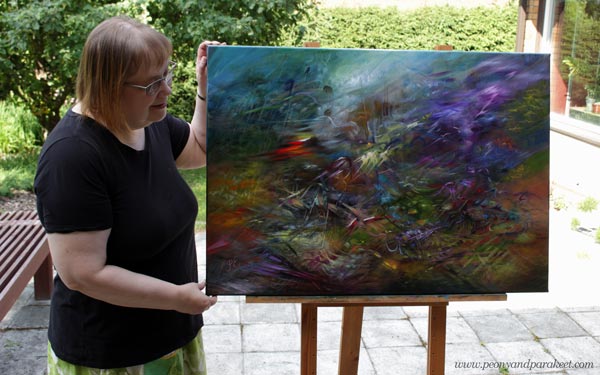
We talk a lot about being unique as artists, but what about if a part of the solution is just to find inspiration that feels uncommon to us. It could be something that we try to get rid of but never seem to manage to do. Or something that we find appalling but still strangely captivating.
What could be your uncommon inspiration? Could the art that you create be a little different from the art that you like to consume? What do you think?