
Develop Your Art Style Without Forcing
When you want to develop your art style, you don’t have to force it. Stop feeling frustrated, not being focused enough, and start building your visual vocabulary. Learn how to create a variety of shapes and lines and find different ways to use color. Whether you want to paint abstract art or fill your art journal with fun drawings, this week’s video is for you.
Develop Your Art Style – Grow Your Visual Vocabulary
This week I want to bring back the topic I wrote about at the end of May: Visual Vocabulary First, Style Second. I felt that the importance of this topic could not be expressed well enough in the written text. This is also a very important issue for me in my own development as an artist. It is like a big onion with a lot to peel.

Not Everything But Essential Stuff
When I was making the video, I kept thinking that it didn’t express everything. That I should also talk about deeper levels of imagination and expression. And it also bothered me a bit to say in the video that the subject is not important and ask you to just focus on growing your visual vocabulary. But I don’t mean that what you express wouldn’t be important. I mean that when the content is taken to a generic level, for example, whether you should be painting landscapes or portraits, it’s superficial.
So I dare to publish a video that doesn’t express everything about making art, because it’s probably more useful when it offers a more limited view. The video dives into visual vocabulary, because in my opinion, it is the solution to more issues than anything else related to making art. Here, too, I emphasize the “in my opinion,” because there are, of course, many different ways to approach art making.
Develop Your Art Style Without Forcing – Watch the Video!
I personally believe that in art, being a creator makes a person visionary. Although art is also a work of the mind, the mind expands by creating, just as language skills grow through speaking. I am a pretty fast speaker by nature. So, it has been quite a task for me to get my English to a level where I can speak at a reasonably natural speed and fluently. When I notice grammatical errors while editing videos, I remind myself of the same importance of doing.
Even though we are not perfect, let’s keep creating and always moving forward!
Visual Vocabulary First, Style Second
This week is about visual vocabulary and how to widen it.
I often hear the worry about finding the style, but more rarely about widening the vocabulary. Style is a quality word, but vocabulary is more about quantity. Still, it’s as important, and you can’t find the style without growing the vocabulary!
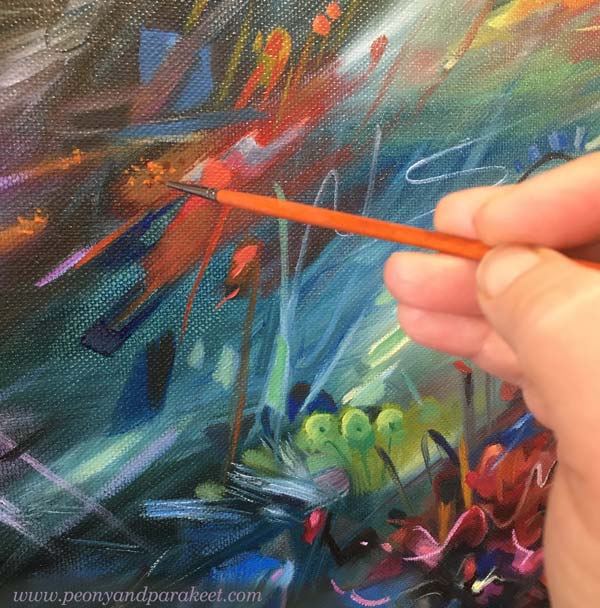
Often when we create art, we use a limited variety of shapes and lines and often the most ordinary ones. For example, your strokes may be quite straight and have very little variety in thickness. Or your shapes can be mostly basic geometric shapes. When I started, I mainly drew circles and my pieces were very symmetrical in general.
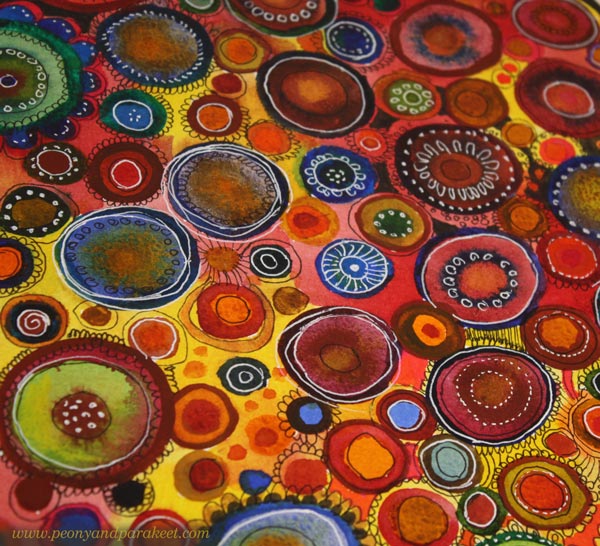
Forget the Style, Grow the Visual Vocabulary!
When you want to widen your visual vocabulary, look at the details of your work. There are seeds that can grow into great things. For example, could you repeat a random spot that almost disappears into the background and build a subtle texture from it?
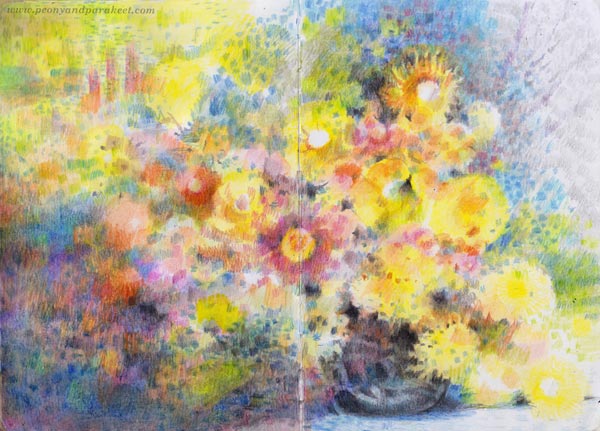
Look at your drawing line and think about whether it could deviate slightly from its path. Could you make a notch somewhere and thus make the shape more interesting?

Imagine you are a child who knows only a few words. Then it’s not important to question what the topic should be, but to find more words to tell any. Stop worrying whether you should create faces or landscapes and make a wide range of art to grow the visual vocabulary.
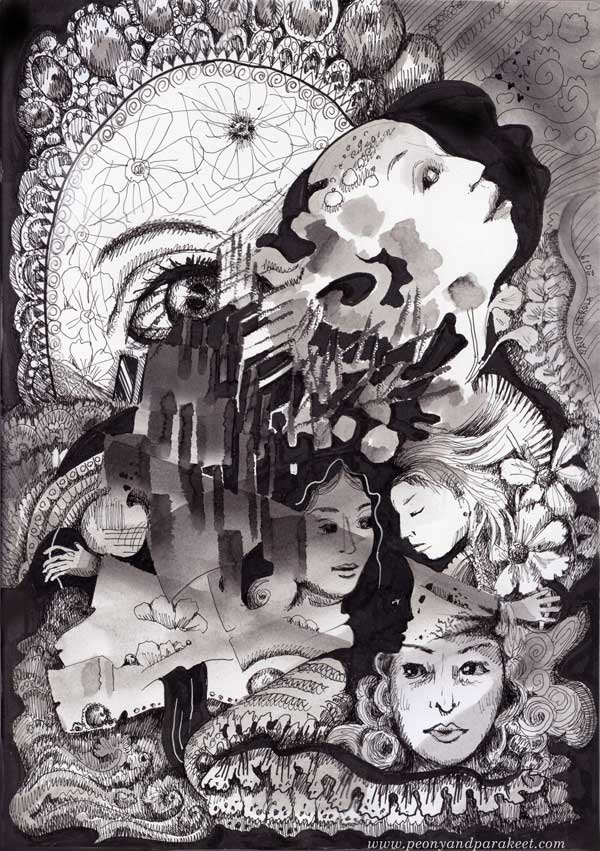
When you can draw a wide range of shapes, curves, lines and have many ways to color, repeat, break up and assemble them, you can produce visual stimuli on the paper that makes your imagination work. From this collaboration, art is born.
Outer Inspiration – Borrowing “Words” from Others
By looking at art, you can find words, i.e. shapes, that you want to incorporate into your own vocabulary, i.e. style.
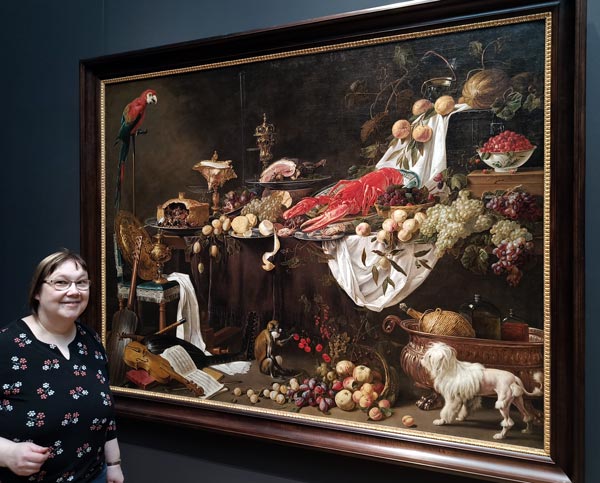
Art history is like an encyclopedia where we can pick what we like. Any art can be seen as abstract – just focus on finding a variety of shapes and colors.


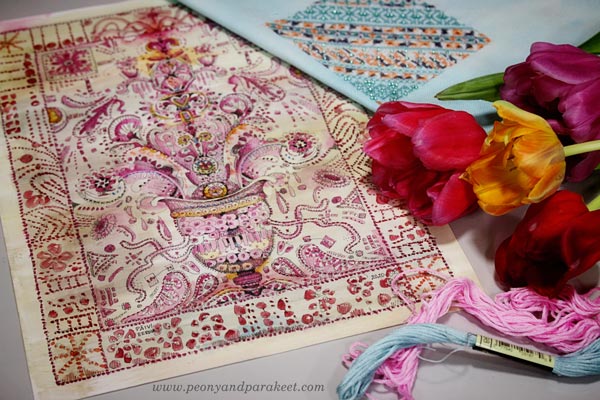
Your vocabulary can be inspired of not only fine art, but crafts as well.
Imagination Sets Who You Are
Too much outer inspiration causes copying, so don’t leave your imagination out of the equation! Imagine you are a singer who takes a popular song into your repertoire. Then you enter a singing competition and are told: “You sound a lot like the original singer of the song, but we want to hear who you are.”
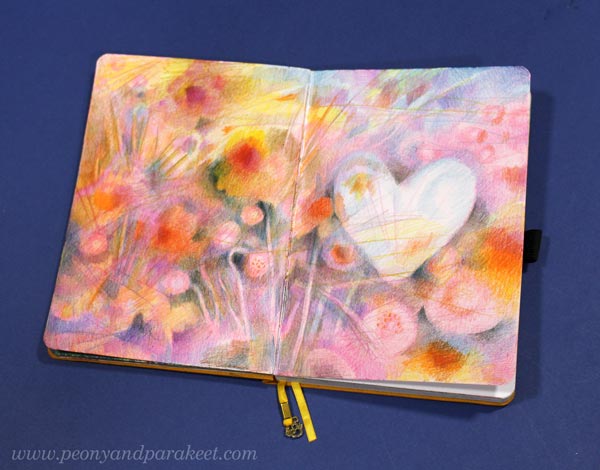
So we need not only to expand our expressive language, but also to develop our imagination. Visual vocabulary and imagination are a pair, and art needs both.
For example, you can draw a circle and give it a meaning, but can others see it? With imagination alone, the expression remains hidden. With a rich expressive language, we can make art enjoyable for others as well.
Welcome to My Courses + What I Want to Teach
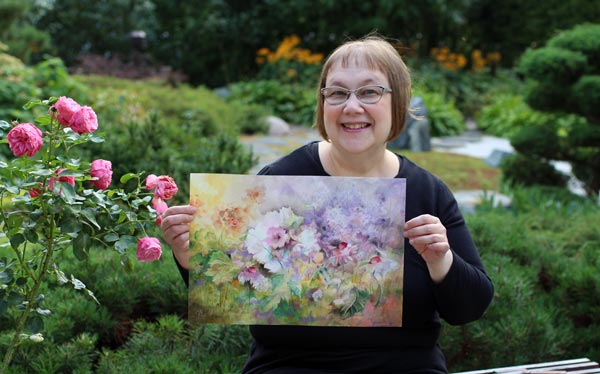
The goal of my courses is to develop both your visual vocabulary and imagination.
First, I want to get you to draw something a little differently than you have done before and thus enrich your visual vocabulary. Second, I want to make a crack in your everyday thinking and plant imagination in it. I want you to ask: “What if?” and to respond with something completely crazy – something that makes you feel free to tell completely new kinds of stories.
When art emerges from this starting point, richly and vividly expressing itself, you will find your style.
How to Discover Yourself as an Artist
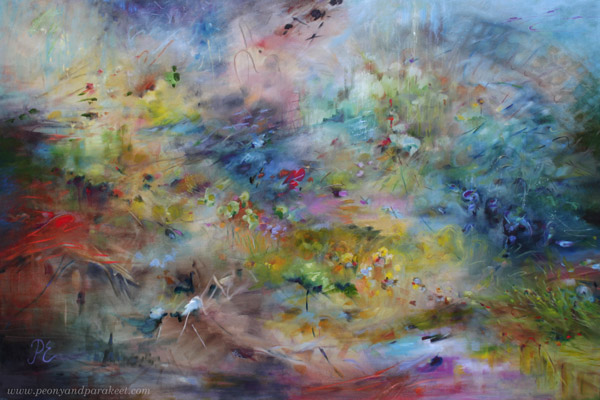
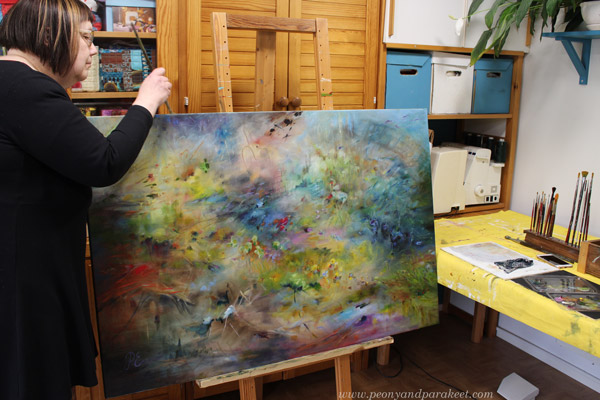
This week I share deep thoughts about how to discover yourself as an artist and how to get discovered. I have a video for you and also, some photos of making a recent large oil painting called “Atlantis”.
When I paint, I am an introvert, but after the session, I want to connect with the world.

When the painting is not finished, I may look at it with a very critical eye.

Then I think: Only if you knew what I think, how I feel, and how I have made myself to always reach higher.
This week, I want to tell you. I want to share some things I have found helpful in my artistic career. How I have discovered my artistry and more: how I have got discovered as an artist.
How to Discover Yourself as an Artist and How to Get Discovered – Watch the Video!
I hope this was helpful. Tell us what you think!
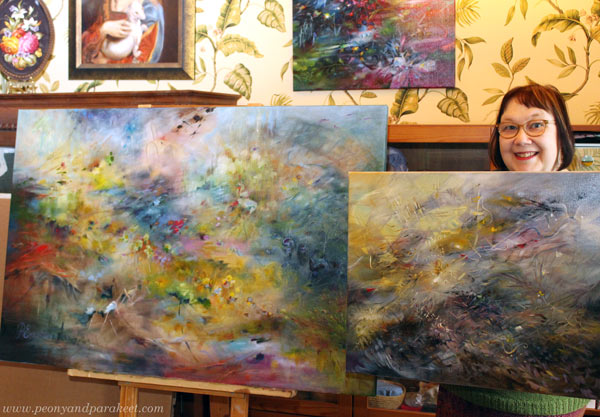
I am always waiting for your comments!
Inspirational Drawing Changed My Life
This week, I share a story about how drawing changed my life – how art can start from discovering your living line and then drawing it over and over again.

Now is also the last chance to buy my course Inspirational Drawing!
The course will go away on April 21st at midnight PDT. >> Buy Now!
Are You Waiting for Your Moment in Art?
10 years ago, I definitely was waiting for my moment. I had dreamed about art all my life. I wanted to find what kind of artist I am and wanted to do it in practice, by creating. So, not be the one who only dreams about art or who only buys art supplies and says: “one day”.
I didn’t want to be remembered as a creative stamper or any other kind of crafter. I wanted to find my way in art-making and art world – not by questioning if I could do it, but simply by drawing and painting so much that I would get my moment.
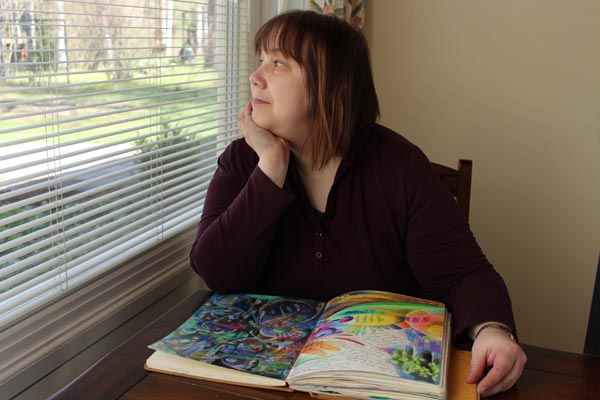
And I did find my way, and many moments have come. But when things happen for the first time, you don’t quite know it right away. You will recognize the moment that changed your life later. For me, it was when I got the idea of the course Inspirational Drawing.
Over time, the course has had three versions:
- A pilot in Finnish (2015)
- The first version in English (2015)
- The second and the current version in English (2017)
Inspirational Drawing has been my most popular course when counting all the versions together. You could say that my story as an artist started with this course. Now when it’s time to expire the last version, I want to celebrate it by telling its story, which also is a big part of how I found my artistic style and became a professional visual artist.
From Art Journaling To Drawing Freely
Before the deep dive into drawing, art journaling had been my hobby for many years. Here’s a spread from 2013 where I reflect on who I am. The title says: “Kehitä ja sä saat sen” – “Develop and you will get it!

Since my background was in design and IT, I didn’t think I would ever be accepted into art circles. But because I had previous experience in teaching adults, I knew that there are always people who are on your path, but little further behind. And I had many who read my blog. So I started creating online courses in 2014.
I had left my day job, and practiced drawing full-time. The more I drew, the more I noticed how I mostly created circles only.

After making a couple of short courses, I knew I wanted to teach myself to draw and others too. But how to break that habit of drawing closed lines?
I got the idea of long lines that wandered freely on the paper. Some call this method contour drawing, I learned later. But I don’t think contour drawing is quite the same thing, because my method breaks many of its principles. And most importantly, in my method you explore the inner world instead of the outer.

Glimpse into the Past – Watch the 2-minute Video!
In 2015, I held a pilot course on drawing for Finns. It was called “Inspiroidu piirtämisestä” – get inspired of drawing. Here’s some samples from that course in a 2-minute video. This was me 10 years ago – A glimpse into the past!
The Finnish pilot went well and there were also enthusiasm on my blog, so it was clear that I should make the next course in English and make available for art journalers around the world.
Develop and You Will Get It!
I started calling my method “inspirational drawing” because once you get started the drawing itself offers inspiration to draw more.

Even before the first English course was born, an American publishing company offered me a deal to write a book about my method with the title “Drawing Freely.” I declined. I don’t know if it was a wise decision, but I was extremely excited to teach courses and see how the method worked with the course participants.
The first Inspirational Drawing course was published at the end of 2015. Many people got excited about drawing – especially those who wanted to draw freely without models.
>> See this blog post of student work from 2015!
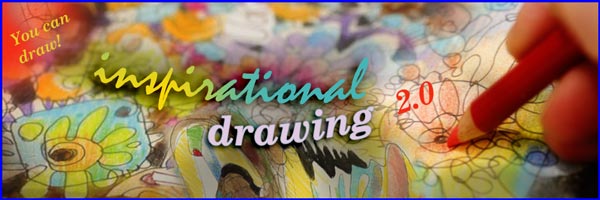
In the first version, I included decorative drawing, but in the second version, I wanted to go even more in an expressive direction. So, in 2017 the first version was archived and the second version, Inspirational Drawing 2.0, was introduced. The core idea of the free-flowing line remains the same, but all the projects were new.
The method of Inspirational Drawing also includes how to collect inspiration from pictures. Choosing images and being inspired by them is part of loving art, and I wanted to build a connection from drawing to it. In Inspirational Drawing, photos and other images are not used as direct references, but as a source of individual ideas such as colors, details, and concepts.
Drawing Changed My Life
You could say that although my current style is best visible in my paintings, it’s largely based on what I have found in the Inspirational Drawing method: the ornamentation of lines, dynamic expression, the freedom to break reality and build a new one.

And today I have been accepted into art circles. I belong to professional artist organizations, collaborate with galleries, and make a part of my living by selling my paintings. I have received grants and don’t feel like an outsider anymore. Drawing truly changed my life.

This change started with the urge to free my pen from drawing just closed circles. When my line opened up, so did my inner world, and finally, the outer world as well. The idea of Inspirational Drawing is summed up in the phrase “You can draw!” With this mindset and enthusiasm for drawing, you can break your mental boundaries. You can question the old answers about how and what to draw.
You Can Draw!
Since 2017, technology has developed, and I have grown as a teacher and artist. Every now and then I remove old courses, and now it’s time to archive Inspirational Drawing.
Inspirational Drawing will go away on April 21st at midnight PDT, but before that, you can purchase it at a sale price. The original price was 109 EUR, but now you can buy the course for only 49 EUR! >> Buy Now!