
Getting Inspired by Removing the Obvious
This week, I have finished the first painting of the new series, enabled by the grant that I got from Arts Promotion Centre Finland. This is the second blog post of this project, see the first one here!
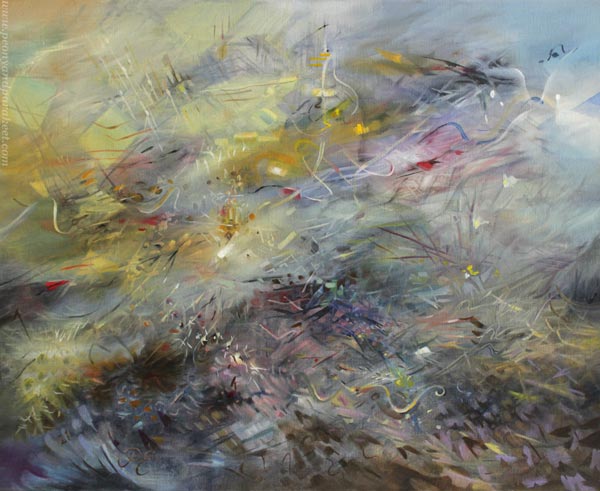
I wanted to combine two different styles for the painting.
Struggling with Differences
First, I wanted to honor Sandro Botticelli, a masterful painter from the Italian Renaissance, and include some of his colors and ornaments. I especially like the pastel colors in his paintings. Yellow ochre and ultramarine blue look beautiful in the mixtures. Botticelli’s painting The Madonna of the Pomegranate was my main inspiration for the color scheme. I also listened to Renaissance choir music and imagined how he felt when he painted and analyzed his work.
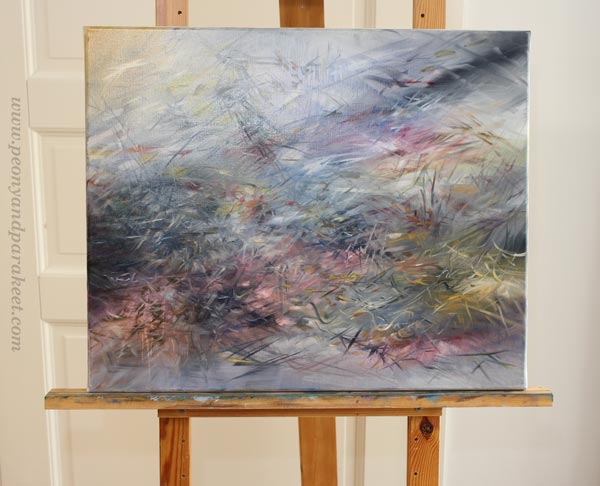
I also had another tutor, Wassili Kandinsky, from the 20th century. I reread his books On the Spiritual in Art and Point and Line to Plane and imagined him talking about releasing the inner sound of a shape.
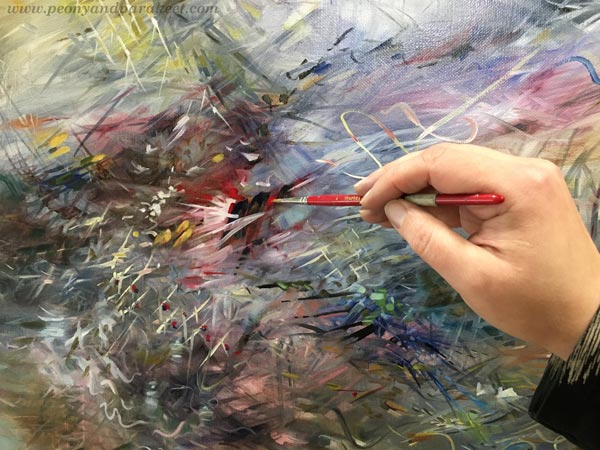
But knowledge and advice and all the left brain stuff can only help to a certain point. When focusing on facts and words, I lost not only Botticelli’s and Kandinsky’s voices but my own too. I ended up making too bold moves and the spirit of the painting was lost.
Indoors – Outdoors
Fortunately, I had to take many sittings because dogs require pauses. It feels that I am constantly moving from indoors to outdoors nowadays!

Then it hit me, that painting, life, and spirituality are not about defining two states like outdoors and indoors. I can bring indoor elements like lamps with outdoor elements like trees. Botticelli broke the division by painting decorative flowers that continued from the grass to clothes.
Removing the Obvious Limitations
And if indoors and outdoors can be one, why not break other obvious limitations too – for example, combine science and beliefs in the same painting.
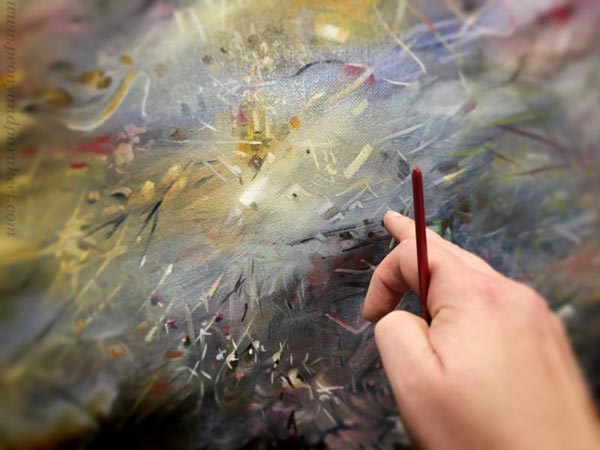
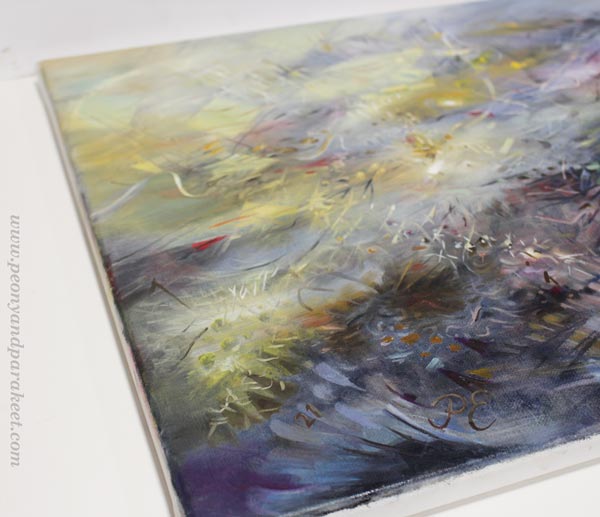
So I painted a chandelier, Botticelli’s divine rays, a light bulb to honor Thomas Edison, a tiny cross to represent spiritual beliefs. I allowed one association to freely lead to another. My mind was exploding when I thought about light and its all interpretations.
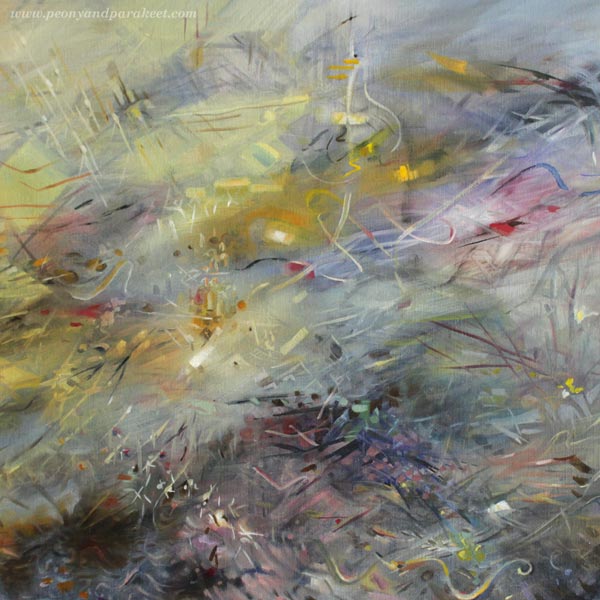
Some people collect chandeliers, others search for a proper lightbulb in a supermarket. Sometimes we believe in science, other times we have different beliefs. Some see angels instead of flowers. Sometimes we need darkness to see light, and other times we may need more light to the lightness. Light can be glitter that saves the day or a more permanent feeling of hope. Art and spirituality don’t have to be separate from the rational and mundane, but they can be the glue between the inner and outer world. We can remove the obvious, and express the diverse experience instead of a single thing.
Releasing the Inner Sound
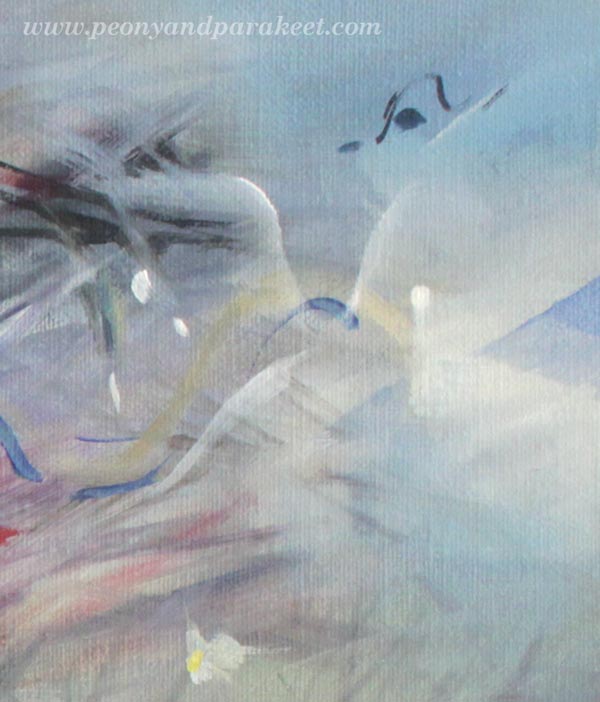
In the light of removing the obvious, Kandinsky’s idea of releasing the inner sound can simply mean this:
Make subtle changes to an element
so that the obvious interpretation becomes vaguer
and a variety of new ideas are raised.
What could “removing the obvious” mean to you? Tell me what you think!
Art is a Lemon Tree – How’s Your Lemonade?
This week, I talk about art and lemonade and share some news about the rest of the year!
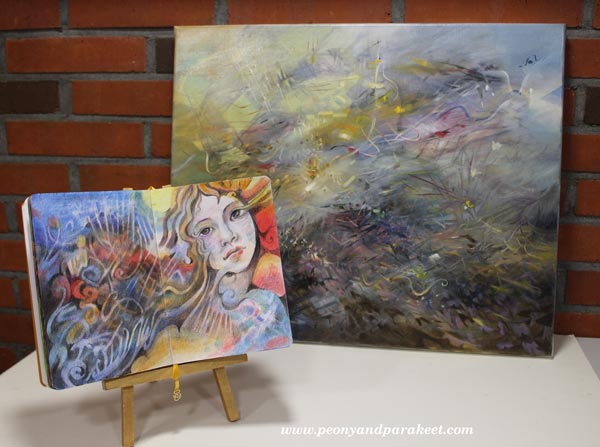
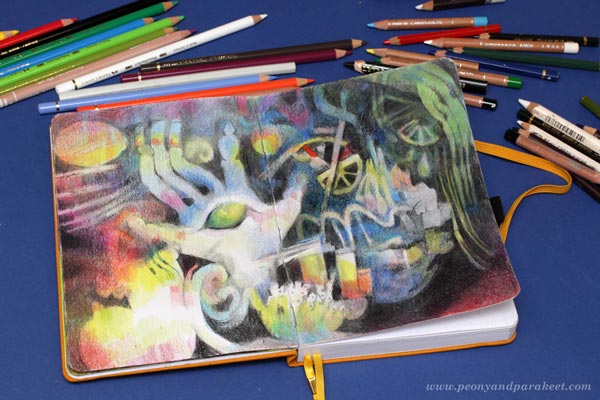
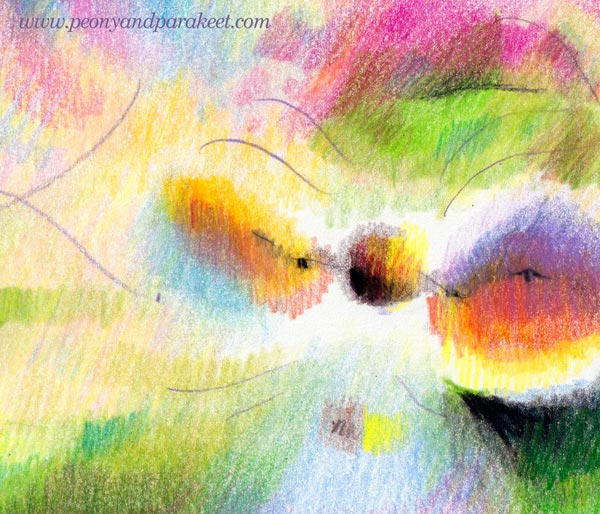
I was going to make a cheerful spread on my colored pencil diary, celebrating a beginning of a period that I have never experienced so far in my life. But I started the drawing intuitively, and here’s what came up: a murky image with a bittersweet impression!
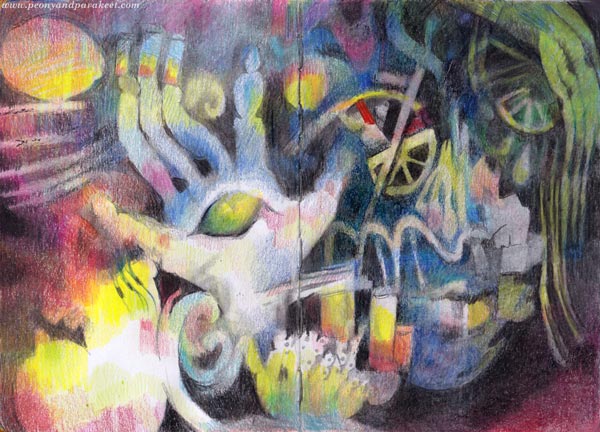
“When life gives you lemons, make lemonade,” they say.
I have never been fond of that kind of forced optimism, but I guess there’s also a seed of truth. In art, you have to make most of what you have.
What Kinds of Lemons Does the Tree Produce?
In 2014, when I became a full-time artist, I thought about growing my skills and how that would naturally lead to something good. But nowadays, my leap has felt more like changing a long CV in technology and service design to a very short, almost non-existent, CV in art.
Art is like a lemon tree. You can nurture it, but you can’t change its variety. Over the years, I have learned not only to teach but also to illustrate, make surface designs, and even draw ornaments and logos. But my heart has always been in fine art, and especially in intuitive abstracts.
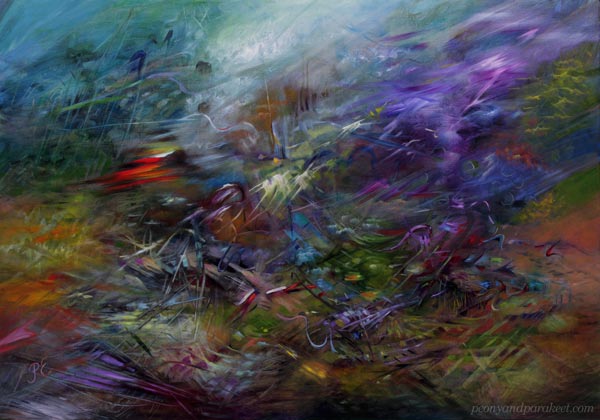
In my opinion, fine art makes the best lemons. But the weather is harsh, and the harvest becomes too small to be enough for the lemonade. So my passion for teaching has often been the lemonade maker, not the actual paintings.
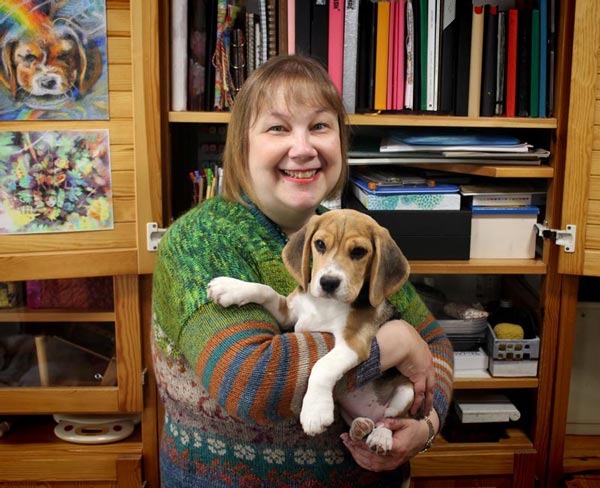
But now, things change for a few months. I have got a grant from The Arts Promotion Centre Finland to create a series of paintings and write about the process. I will publish the art and most of the writings here in my blog, so you will also get to drink this lemonade!
The project has a set theme that also includes a background study. I will also continue the colored pencil diary and document a part of the process in colored pencils. Later posts will reveal more.
I hope that my project will also inspire you to create – grow more lemons and make your kind of lemonade!
P.S. You can still sign up for Intuitive Coloring! You will get the published lessons immediately after signing up, and can start having fun right away. >> Sign Up Now!
Intuitive Coloring – Examples and Thoughts
This week, I show sneak peeks and process pics of simple intuitive colorings and talk about intuitive art.
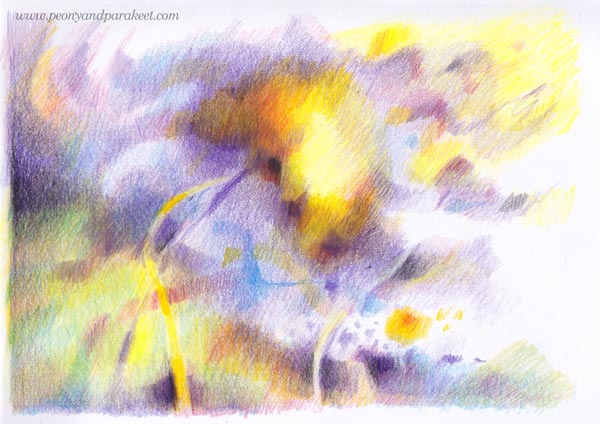
Since I made the last free video “Colored Pencils – Intuitive Approach,” I have been thinking about free coloring. First, it felt like I have explored it thoroughly in the e-book Coloring Freely and in the class Inspirational Drawing. But as soon as I began to make some notes about intuitive coloring, I realized that there are things that I haven’t shared in these blog posts or in my classes so far. Many of them are things that seemed complicated and heavy at first, but the more I have experimented with them, they appear to be very simple and light.
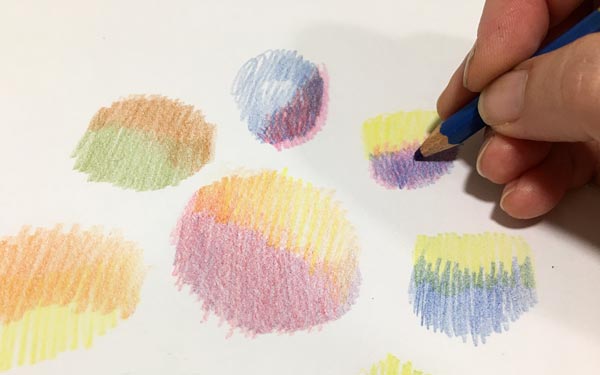
And it feels fun to color freely on a blank paper, and there’s a sense of playfulness too right from the beginning.
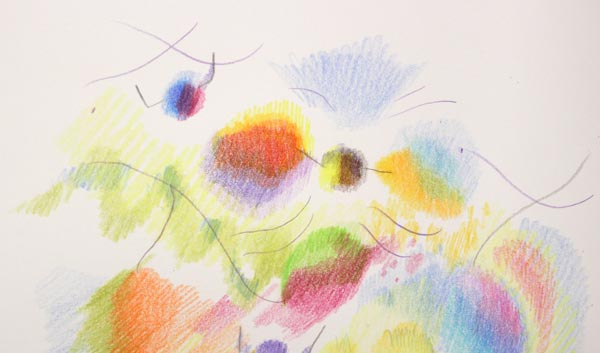
I am a more-is-more kind of a person, but after making a series of large oil paintings, I wrote a mental note that says “less is enough” in capital letters.
Can Intuitive Coloring Be Taught and Learned?
I have also been thinking about the term “intuition” a lot. Why does it feel so intuitively correct to say that my art is intuitive? And not only that. Why do I want to teach intuitive art? Because isn’t intuitive just about letting go and emptying the mind on paper? Doing what you want, doing what feels right?
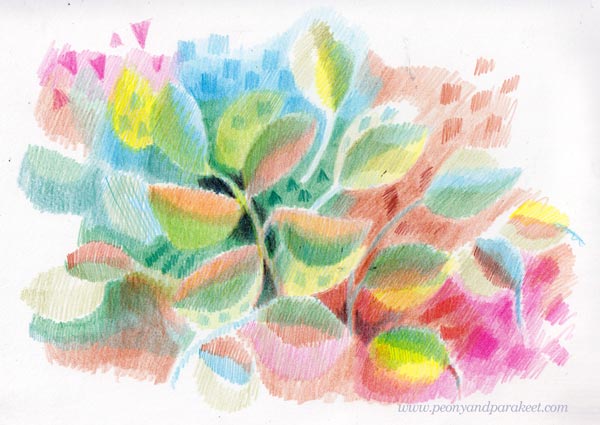
But as a former engineer, it’s always been hard for me to trust intuition when I am trying something new or reaching for a new level. Then the intuition is confused with the comfortable “same-old-same-old” routine. That old dog always stays close, but intuition and imagination are timid puppies. To find the puppies – that’s where I feel I can help.
Would you be interested in this upcoming class?
All In – Finding Uncommon Inspiration
This week, I share my biggest painting so far, and talk about computer games and all the things that should not inspire but that do!
Here’s the last painting of the series that I have been working on this year. It’s called “All In.” The Finnish translation “Kaikki peliin” is perhaps even more suitable because there’s the word “peli” – the game. In this painting, I made every element look like it moves – like in a computer game!
I Am Not a Gamer
No, I am not! Actually, I am the last person who should be talking about computer games because I don’t play them at all. But I have seen some commercials on television and Youtube, and they make my heart beat faster – that’s the tribe where I belong! Despite I hate seeing violence, and don’t usually even watch action movies. Action upsets me. In general, I prefer everything cute and pretty.
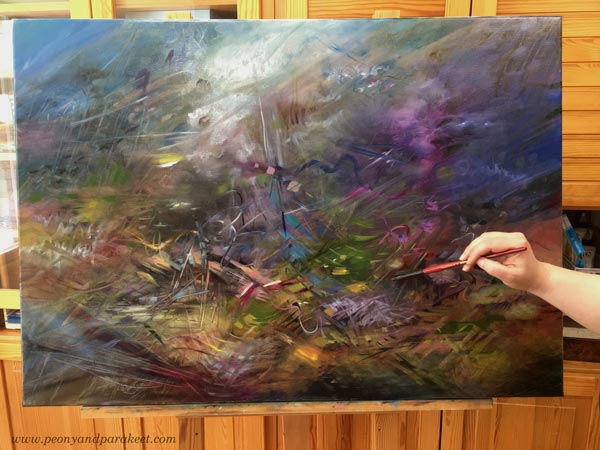
My Imagination Loves Games
But when I paint, I am not just an artist with all kinds of brushes and tubes. I become a nerd who tries to find the fastest processor and the best graphics driver for rendering 3D from her brain. It no longer matters what kind of art I should create and how art should be created. I change to a guy who moves from one level to the next, always seeking more monsters, more excitement, more points.
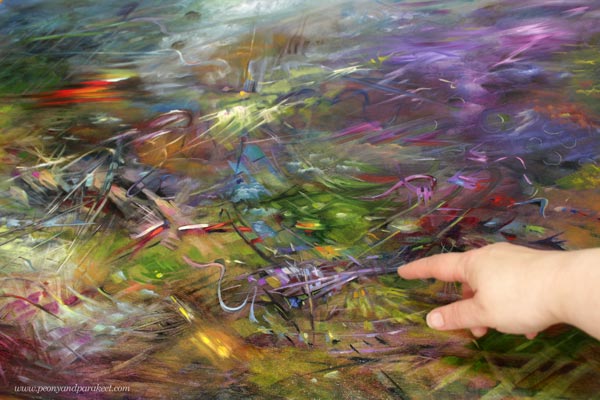
Because I don’t play the games, I should not even know how it is like. Yet, I feel I do. Namely, in my twenties, I chose computers over art. I felt I belonged to the world of introverts who built systems – worlds of their own. And now, when I paint, my paintings bring me back to the same setting – how to build a world that operates like a fast-moving game, with many layers and levels.
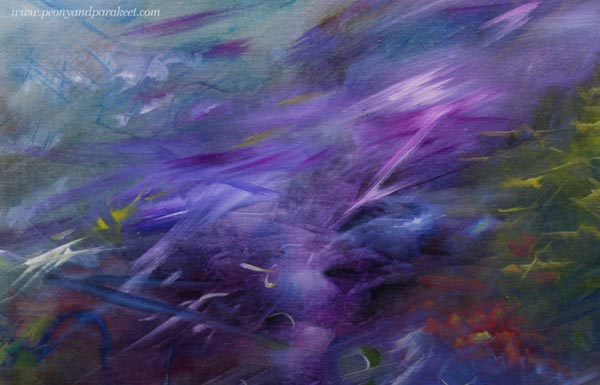
This is not what I would have expected. If someone said to me: “Hey Paivi, you should paint game sceneries. Make your own games!” I am pretty certain that a couple of years ago my answer would have been: “You must be kidding. I am a feminine romantic who hates that stuff!”
The Adventure for Uncommon Inspiration
But art is an adventure. It’s not only a journey to a variety of techniques and skills but also an exploration that includes the darkest corners of your mind.
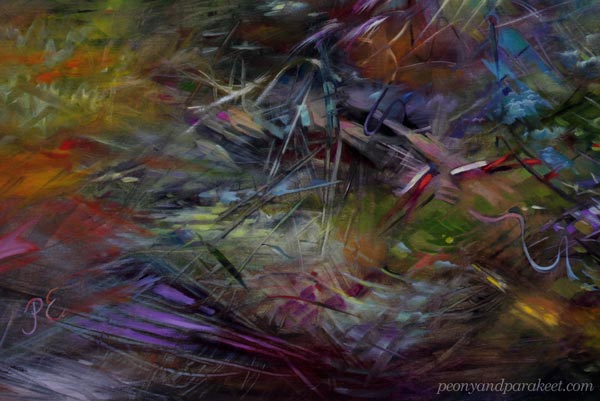
In 1980s, I was a girl who sat in a local library on hot summer days, browsing big books of old art. My dream was to become an artist, but knowing that it would not be safe or easy, I said I wanted to be an English teacher. Between the art books of the library, I saw young boys browsing computer magazines. I went to the shelf after them and knew that I also belonged there – to that group of nerds. And when I saw a computer for the first time, my heart beat fast like for the best painting of a museum.
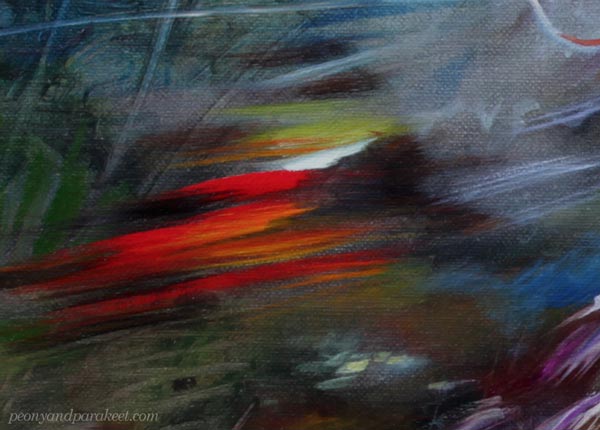
Making a series of paintings has been quiet and hard work. I have had lots of self-doubts and melancholic moments between the sessions. But when I paint, it’s all good. My paintings say: “Tell me what you want and we will give it to you!” And often, I don’t know what to reply, but they seem to know anyway. Like I never told them how nerd I am, but they shamelessly reveal everything and apologize for nothing.
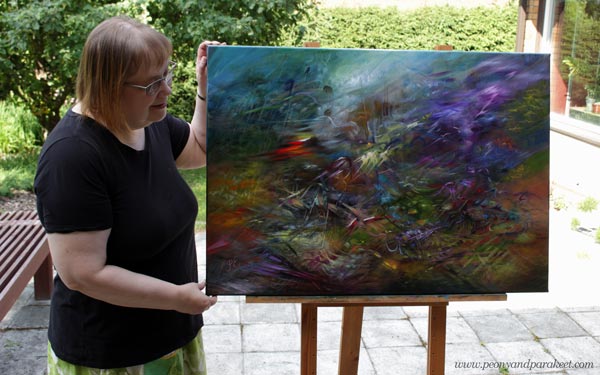
We talk a lot about being unique as artists, but what about if a part of the solution is just to find inspiration that feels uncommon to us. It could be something that we try to get rid of but never seem to manage to do. Or something that we find appalling but still strangely captivating.
What could be your uncommon inspiration? Could the art that you create be a little different from the art that you like to consume? What do you think?