
Drawing Swirls with Colored Pencils
This week, let’s make a summery drawing by coloring ornamental swirls!
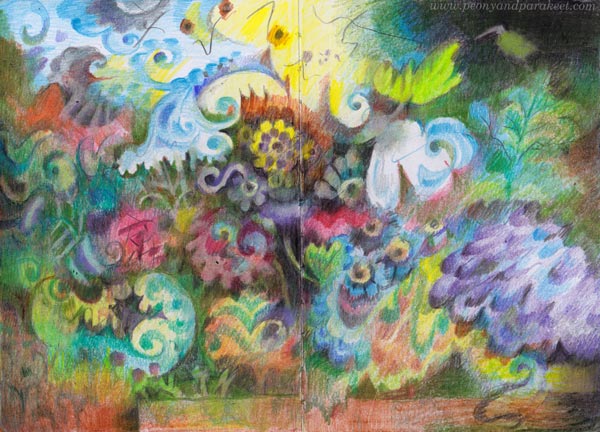
Here’s the latest spread in my colored pencil journal. I have been recovering from painting a big series of oil paintings, so I wanted to create something small and experiment with the idea that I got in mind while cleaning the studio for the next paintings. Because I like to create freely and intuitively, my colored pencil journal is not a direct sketchbook for paintings, but more like a study book of ideas – a place to ponder and practice at the same time. This time, I wanted to focus on ornamental swirls so that they flow freely on the page. The elements themselves have stiffness but the overall impression is dynamic when the ornaments are layered on top of each other.
Drawing Swirls is a Good Art Practice
Practicing swirls makes all your drawings more beautiful because it develops both the hand and the eye. Try to make a perfect curve that ends with a perfect little circle, then widen parts of the curves so that they grow broader gradually. Observe not only the swirl itself but also the shape that it creates besides it.
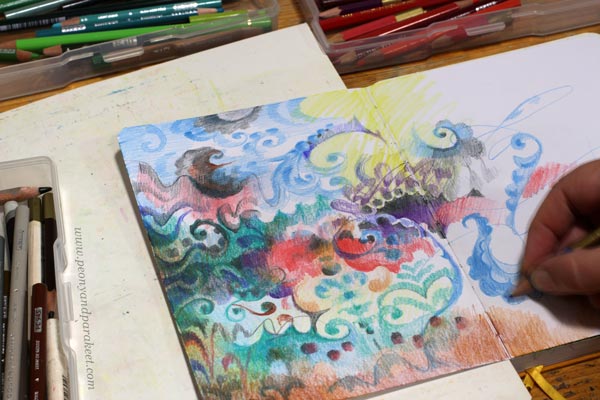
If you tend to place the swirls stiffly row by row, draw some free lines as guides for their placement. You can also turn the page in different directions and color ornaments that are directed differently from each other.
Shadows Can Be Swirls Too
I like to color many layers and make some swirls disappear into the background. When layering, you can make everything ornamental: the background, the shadows, and the actual elements.

There are lots of swirls in my drawing but I also included some simple scallop shapes and circles to make the visual language more diverse.
Darkening a Little More Than You Would Normally Dare
If you want to make your drawing atmospheric, cover most of the white spots.

Darken the drawing gradually by coloring thin layers over most of the elements.
Add Something Angular to Go With Swirls
When my drawing progressed, it started to remind me of old still live paintings, for example, those that Riks Museum in the Netherlands has. There the vase was often placed on a tabletop. The rectangle on the bottom works as a contrast to the organic flowery shapes.
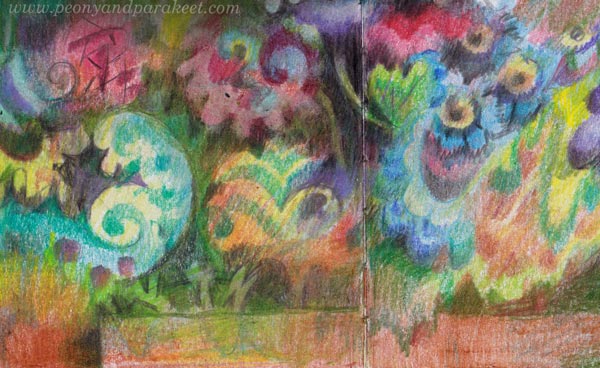
Add some shapes that break the rectangle, like the leaf-like one in my drawing. This way the result looks less strict and more layered.
Summer Coloring – A Little Bit Now and Then
I like and need this easiness of colored pencils when I slowly rebuild and restrengthen my creative core. Colored pencils are easy to grab for short sessions and you can color outside too. It’s now summer in Finland, and the weather has been fantastic. I think it shows in my drawing.
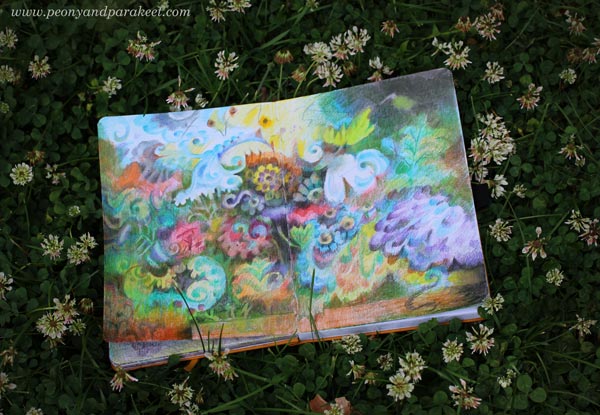
This journal has quite many colored pages already. It brings me joy to browse them. I am dreaming of the day when the journal is full even if it may be far away.
P.S. Check the class Fun Botanicum for more journal inspiration!
Expressing Happiness in Art
This week, we look under ice and talk about expressing happiness!
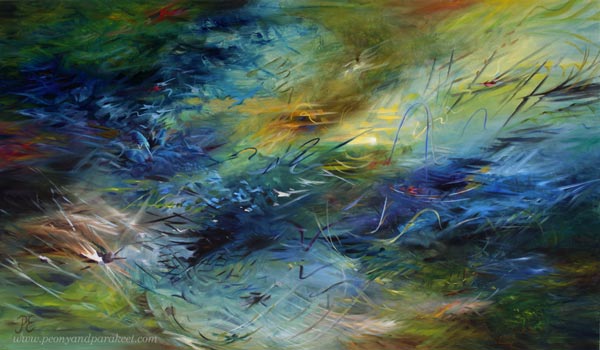
What’s in the Name?
Here’s one of my latest paintings called Onnellisten maa. Like so many times before, I had difficulties translating it, but I came to a conclusion that the English name can be a bit different “Happy Earth” instead of “The Land of Happy Ones.” Maa is both earth and land in Finnish.
This painting is a part of my series Linnunrata – Milky Way, where I explore planets and outer space. The painting represents the planet Earth and Finland, my home country. (See previous paintings: Venus here and the Sun here!)
The name Linnunrata also has a double meaning in Finnish. It’s not only the name of our galaxy but also means bird’s route or track. My paintings often have bird-like shapes and flying objects, so it’s a perfect name for the series and for the upcoming exhibition that will also have some older pieces.
Inspired by Ice
Here’s how the painting started – lots of wild strokes in icy greens.
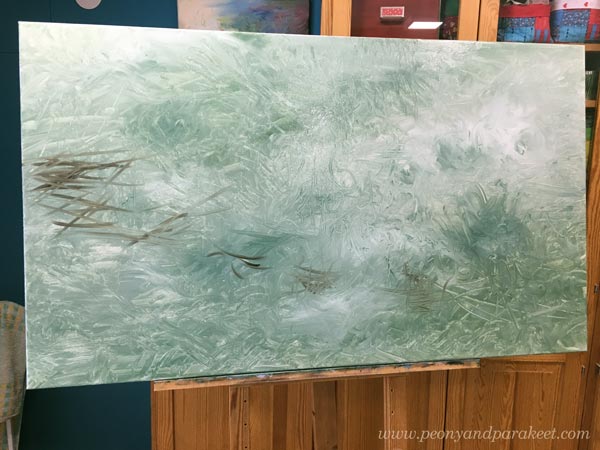
These greens are composed of Titanium White, Raw Umber, and Nicosia Green Earth. The green is a new color that I purchased recently. It’s earthy, not bright at all, but wonderfully suitable for an intuitive painting inspired by our globe.
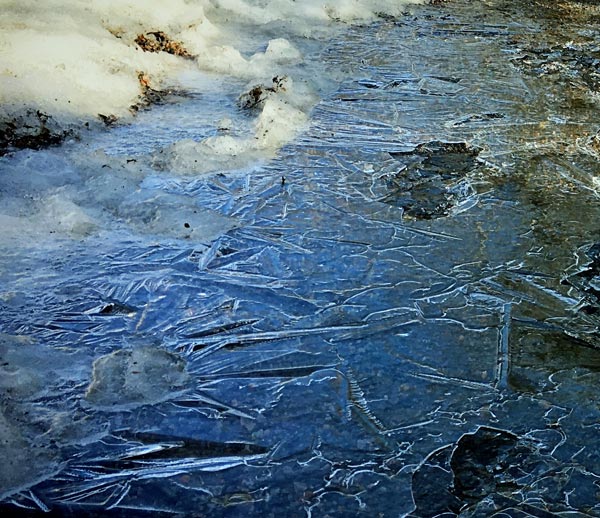
I also wanted to throw in some blue. At the beginning of April, thin ice covered all the puddles and reflected the sky.
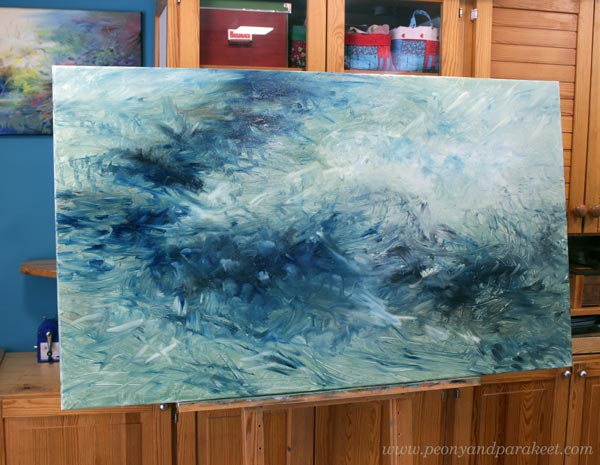
Here’s how the painting looked after adding some Prussian Blue over the greens.
My puppy Saima found ice interesting too!
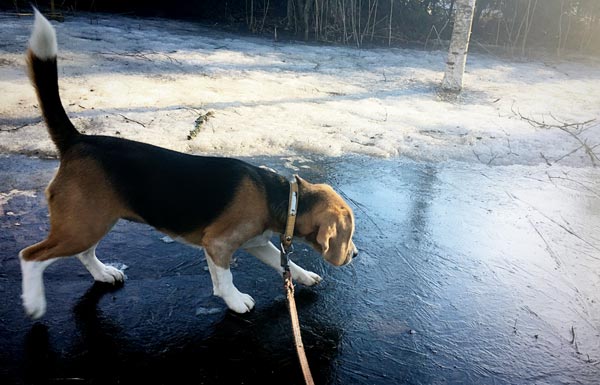
We in Finland are known for icy surfaces, not only in nature but in people too. Our most known celebrity must be a winning formula driver Kimi Räikkönen, also known as The Iceman. “Shut up, let me drive” was his regular message to the team when he was in the middle of the race.
But ice is never only ice. It makes us think about what’s under it. How does Räikkönen feel when he turns the wheel and pushes the pedals – pressure, joy, passion? What is the storm inside an icy person?
Expressing Happiness
Despite all the ice, Finland has been selected as the happiest country in the world again. It’s the fifth time in a row! With the painting, I wanted to tell what makes Finland the happiest. At the same time, I wanted to express what makes the planet Earth so special.
So, it was time to break the ice and bring in more colors.
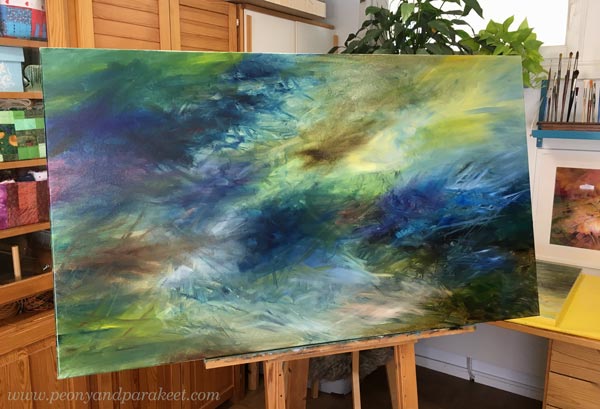
The best feeling when creating art is freedom. We are free to express and discover.
When expressing happiness, seek signs of life. For example:
- Could that spot move if I poke it with a line?
- Could those two lines be connected and thus get wings?
And when a creature is born, let him live in peace! Don’t force him to look like a certain species, but let him be unique in his world. I often aim for the impression of an uncharted area where a human, the viewer, enters for the first time.

I also try to express impact so that the painting makes sense. So, make the movement in one corner cause something else to change. And when you introduce a new color, do it gradually so that it doesn’t only flourish. There should be a beginning and an end to its path.

These two needs are not only what a painting or a drawing hopes to have. They are also important for humans. We want to feel independent and free and still impactful and connected so that life moves forward. I think Finland has been successful in both.
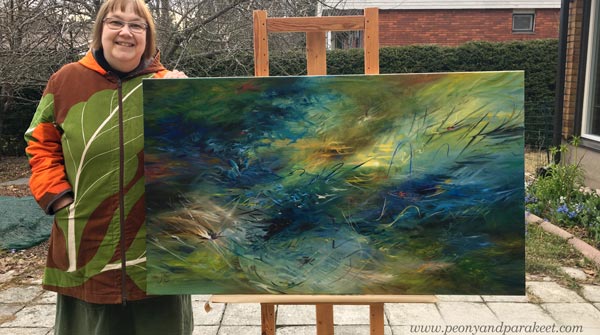
Now, most ice has melted, and our spring has started. Some say that Finnish people change when the summer comes. They see us stop to look at the sun and even smile sometimes!
Painting and teaching are my ways to express happiness.
How have you spread happiness through art?
Bringing Old-World Feel to Abstract Floral Painting
This week, let’s dive into the old-world feel and get inspired by the opera singer Edita Gruberová!
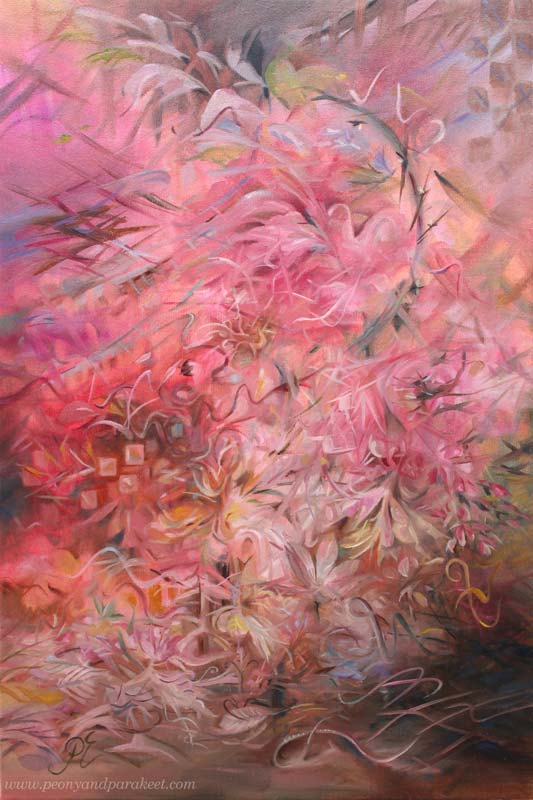
Ideas Behind the Painting
I listened to the opera singer Edita Gruberová (1946-2021) while working on this painting. Her version of the famous aria Queen of the Night from the opera Magic Flute is exquisite. Gruberová’s voice is partly like a bird’s not a human’s voice at all, and the aria brings that up well. The music editor Outi Paananen calls her a nightingale of Slovakia.
The transformation from a human to a bird felt inspiring. Maybe I could do a transformation of a painting so that my free and careless strokes would turn into decorative swirls, adding an old-world feel to an abstract floral painting. I had done something similar just recently but in a much smaller piece. See this blog post where I revamped a flower painting! From that experiment, I knew that it would take both time and patience. In a bigger piece, I could also get lost in the details so that the painting becomes confusing.
Before listening to Edita Gruberová, I already had a lot of ideas, collected in the blog post called Pink Inspiration. And now I wanted to add her and her birds to the painting too. I heard Edita’s story from Outi Paananen’s excellent radio program “Narrin aamulaulu” (in Finnish) on the Finnish Broadcasting Company. She had a clear artistic vision and strong willpower, and she demanded a lot of herself. It inspired me to challenge myself too.
Bringing Old-World Feel – 2 Tips!
In the past, painters often started with sketches and made detailed underpaintings with two or three colors. But a looser approach is not an enemy to the old-world feel.
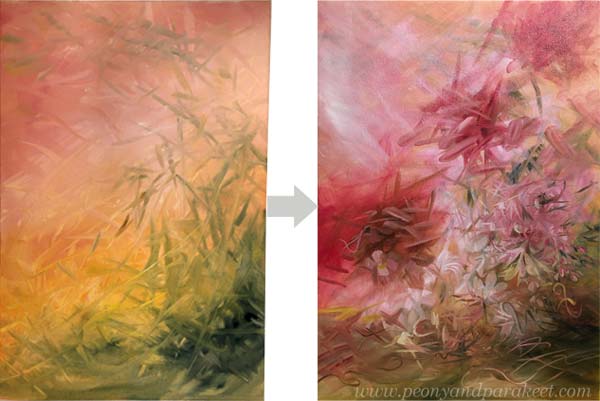
When you want to bring an old-world feel to an abstract painting, two things are the most important:
- Blurry on the bottom! Start from the background with soft transitions from light to dark, add blurry shapes, and paint like you would see the scenery from a far distance.
- Sharp on the top! Add sharp shapes and lines on the top of blurry ones. You can sharpen some blurry shapes but do it only partly, leaving some parts more undefined. But most importantly, let sharp lines and shapes sing the melody of their own. If the background is the orchestra, the top layer is the singer that has a melody of her own.
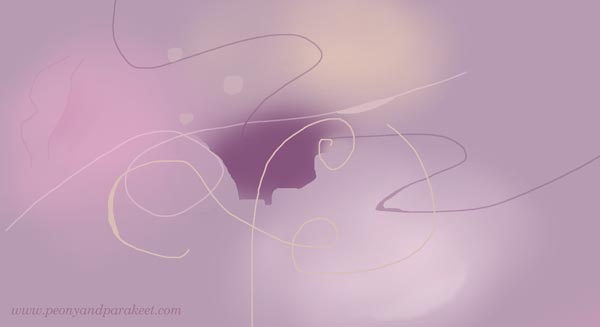
The thickness of the lines can change in places and there can be decorative dots too.
Timelessness Takes Time
It’s always tempting to get the piece finished quickly, but to get the sense of timelessness, the time has to stop while painting. So, I focused on tiny details and immersed myself in building a wondrous world with curves and swirls.
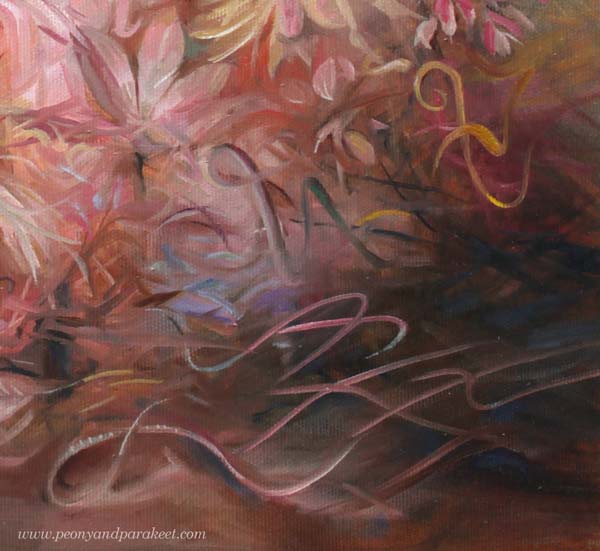
My lines are like old-fashioned handwriting in places. I have practiced them by drawing for a few years. Any note or waste paper can be used for practicing! I often doodled on planner pages.
Intuition and the Ability to (Not to!) See
As usual, I didn’t use any direct reference photos for the painting but worked intuitively. However, I tried to reduce the human ability to see ordinary concrete objects like flowers, faces, or such in simple forms. For a long time, I have thought that the ability to see is a part of creativity. But the more I create, the less I need the ability, at least in the first place. Seeing too soon makes me hurry and my art much less unique. So I try to let the shapes fly free and the big picture appear without too much forcing and seeing.

During the process, a little bird-like mesh appeared on the right. When I was making the final touches, and intentionally made him a partner in the center.

Sadly, Edita died last year, just before I discovered her, so I can’t send her a photo. But I want to honor her with this blog post and ask you to listen to her singing on Youtube. Isn’t that inspiring!
A Series in Progress
I have been painting like mad this month because I have to get everything finished for my solo show in June very soon. So, there are lots of paintings in progress in the studio!
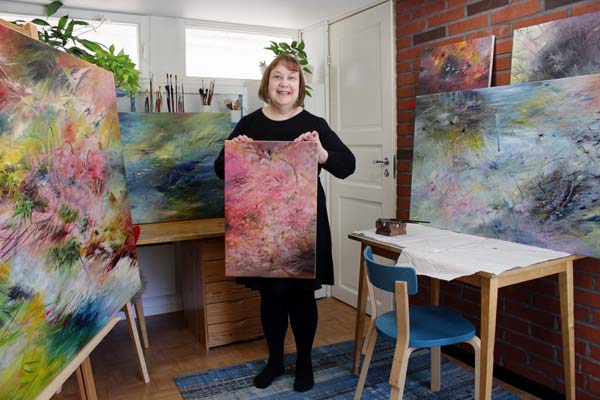
Easter was mostly spent with brushes, and if this wasn’t my ultimate passion, I would be quite exhausted already! Also, seeing the flow of wonderful creations from the students in my community Bloom and Fly energizes me a lot.
Let’s keep creating and inspiring each other!
What to Do When You Admire an Artist
This post is about art, admiration, and spirituality and enabled by Arts Promotion Centre Finland. This is the ninth blog post of the project; see the first one here, the second one here, the third one here, the fourth one here, the fifth one here, the sixth one here, the seventh one here, and the eighth one here!
This week, I finished the last oil painting of the new series. It’s pretty large – about 27.5 x 35.5 inches – and I think it completes the series well because it’s the most dynamic of the seven.

My goal in the series was to express spirituality through abstract art. The plan was to explore Wassily Kandinsky’s idea about releasing the inner sound of the shapes and get inspired by art from the 16th to 18th centuries. This last painting is a salute to my favorite artist: Peter Paul Rubens (1577-1640).
Going Deeper – The Experience of Working with a Grant
Sadly, my three-month period of working with the grant is now coming to an end. During that, I painted a series of seven oil paintings, wrote several blog posts and weekly emails, plus a fictive essay in Finnish that that will hopefully get published somewhere. I still have the summarizing report to write and several paintings to varnish, but all the main work is done.
During the past months, my little studio has been filled with paintings. Every morning, before anything, I have gone there to both worry about the project and to enjoy the kind of excitement that only uncompleted work can give.

Despite the theme of spirituality, I haven’t lit any candles, meditated, or prayed. But I have slowed things down and taken time to question without forcing out the answer. At the same time, a clear schedule and content plan have brought structure to my days. I am grateful for the opportunity of doing this kind of deep work.

Many times when we create art, we hurry. A part of it is that we want to see the piece finished, but there’s more too. Art can make us feel uncomfortable and bring up memories we would rather want to leave behind. But making art can also point out stiffness, clumsiness, and differences between who we are and the artist we admire.
When You Admire an Artist – Rubens for Example!
Dear Peter Paul Rubens, I want to paint like you. I want to master the curvy lines, the soft transitions from one shade to another, the effortless flow in the composition, and something that I can’t name but that makes my heart beat faster every time I see one of your masterpieces.
With masterpieces, I mean paintings like “Four Continents” or “Four Rivers of Paradise” – this artwork has two alternative titles.

Experts used to think that the painting had four continents and four rivers. Europe is the woman on the left, and her partner is the river Danube. Africa is the black woman, and her man is the Nile. The woman in the center back represents America, and her man is Rio de la Plata. The woman on the right is Asia, and her man is the Ganges. However, there’s a competing interpretation of the river figures. They may represent the four great rivers of the ancient East/paradise: the Euphrates, the Tigris, the Gihon, and the Pishon.
Rubens was born in an era where a shape could not be freed in the way we now can. He had to build a representation layer that people could explain and understand in a specific way. We humans have a strong need to label things. For example, when people see my work, they immediately begin to describe what they see.
But my paintings can produce many interpretations because I try to make shapes so that they raise several different kinds of associations. When painting, I focus more on how the shapes and colors interact with each other, not on one interpretation of what they represent.
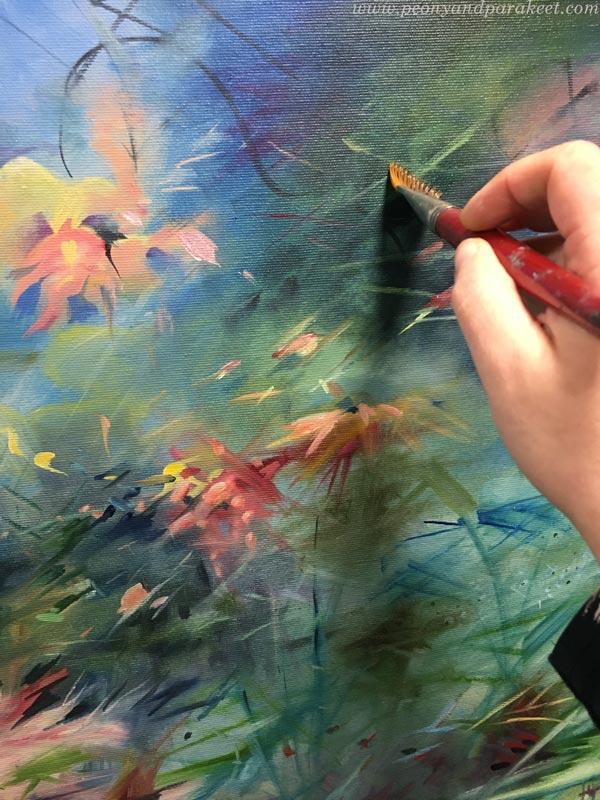
Rubens didn’t have the luxury to leave the shapes abstract – it would not be treated as a completed painting in the 17th century.
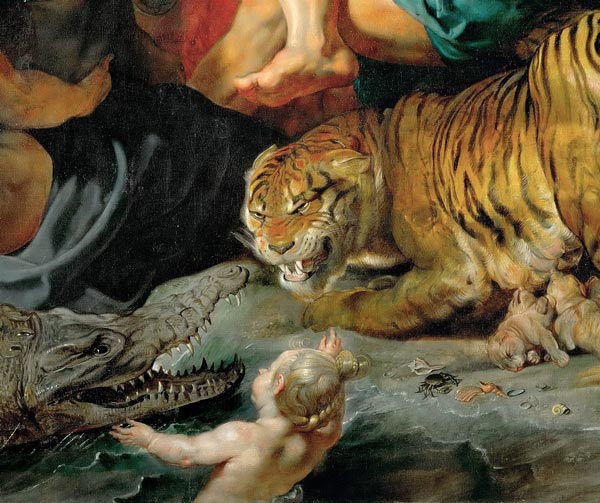
And still, his expression has such a sense of mystery that it draws me in and forms a spiritual connection with humankind.
Creating with Hurry vs. Taking Time to Imagine
Recently, I have started to feel that it’s ok that I am not Rubens, Kandinsky, or any other admirable artist. By taking time for imagination, I still can feel a connection with them.

Rather than trying to reproduce what my favorite artists have created, I imagine that my little studio is a time capsule where they hang around. My sensitivity for them can get mixed with the rest of my imagination, and produce my kind of work, still supported by them.

The core of art is that we are free to imagine. We are allowed to break the limits of time, explore the inner world, and go beyond literal ideas and explanations.

This journey has taught me that it is possible to live with wild thoughts no matter what direction they take. Like a rare animal, a thought can be shy and fast, and thus, require sitting before the trust is formed.
I started the project with the definition of spirituality, but now the greatest lesson seems to be to let go of any single definition and find more, no matter what the subject is.
I’d love to hear your thoughts on this post. Who do you admire, for example, if not anything else!