
Colored Pencil Fantasy Art – From Sunnyland to Starryverse
This week, we go from happy and light to adventurous and dark. This is how adventurous colored pencil fantasy art is born!
Imagine walking in a sunnyland through sunshine meadows, seeing pinks, fresh greens, smiling yellows, and trotting happily along a path that feels pleasantly warm and soft. And then, suddenly, something dark hits you, and you no longer feel the ground. Should you fight back to the sunnyland? Or try to figure out what this new place is that feels like a deepwater or a starryverse? That’s what happened to me with colored pencils.
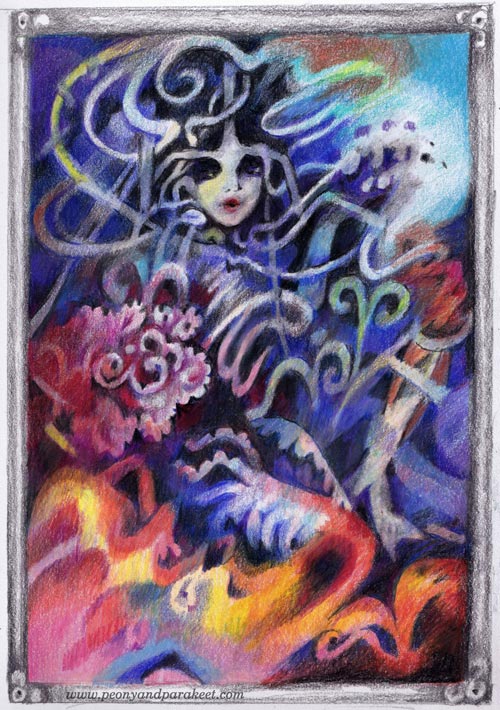
I have made drawings for the upcoming class Intuitive Coloring, and it’s been fun. Happy pictures have filled my studio, and bright colors have got shorter.
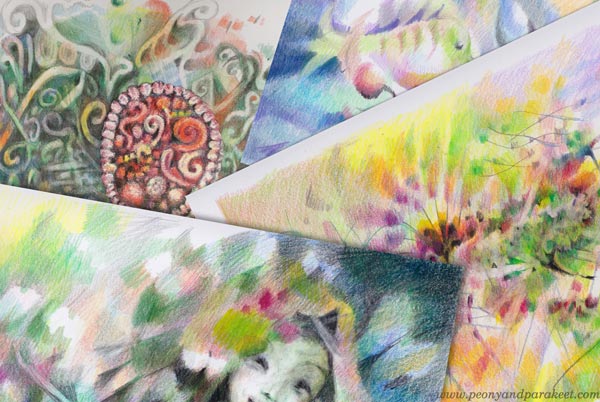
But then, boom! Somebody wanted to come out, and she was not a smiley face.
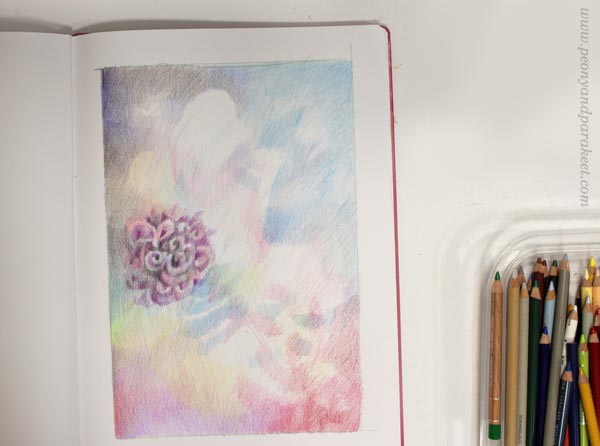
“Let’s make you smile,” I told her. “Let’s take away the darkness, and you will fit better with others. So, here’s a rose that will guide our path back to the sunnyland.” But she didn’t stay behind the flower, and her eyes refused to smile.
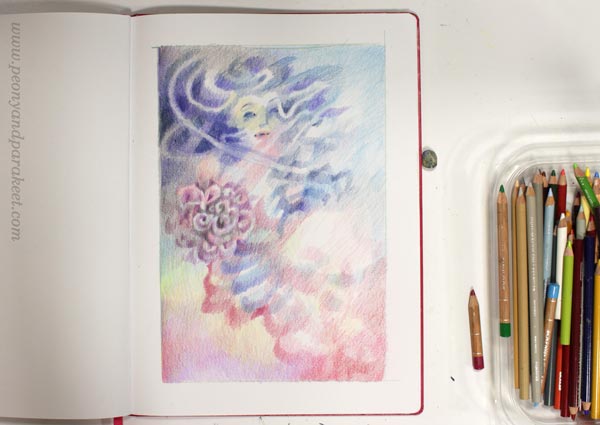
It’s easy to follow intuition when she plays with the butterflies promising good things and much harder when she takes you to a less defined zone. For example, can I let go of not drawing an arm or a leg? Not that I would specifically enjoy drawing them, but because humans do usually have hands and feet.
Colored Pencil Fantasy Art
I didn’t know what was what, but I let her appear anyway.
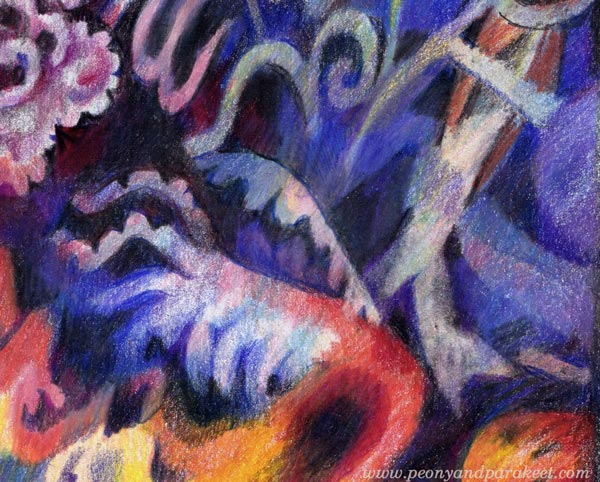
While spending time in this strange place, it started to feel exciting and inviting.
I found myself thinking: why do I give restrictions to my imagination when pens and paper don’t set them? When imagination hits our intuition – or is it vice versa – why not just let go and see who’s the little monster that wants to come out.
I want to fit and belong, and yet, it’s not always so.
My art and my expectations don’t always meet. But the dark starryverse feeds the bright sunnyland, and I need both to keep the sun shining and fairies moving forward.
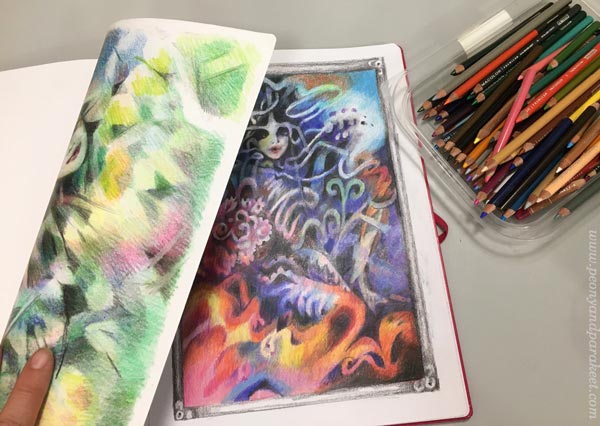
How’s this with your art?
Coloring with the Inner Child
This week, let’s get excited about colored pencils and embrace the inner child!

I used to play with colored pencils as a child. Not just use them for drawing and coloring, but also treat them as dolls. A brand was their surname. I had Caran d’Aches, Derwents, Lyras, … My sister was coloring while I played with the pencils. So, it often happened that someone precious got blunt and tired in my sister’s hands and needed some loving care after coming back to my play.
Colored Pencils – Do Yours Need Some TLC?
Some weeks ago, when taking the jars of colored pencils out of the cabinet, I sighed: “I want a new set; these are getting quite short.” But if I look at my diverse selection of pencils in child’s eyes, all they needed was some sharpening and close observation – what is the family name, who could this little pencil be?

I picked a tray for a smaller selection so that I can get to know them again: “Hello, Cretacolor! Let’s work together!” And then, I made some mixed selections and drew more, and it felt as much fun as a brand new set. I also found some small sheets of paper, and it felt as satisfying to fill them as it is to knit with leftover yarns.

Coloring with the Inner Child
The same difference in attitude goes for drawing and coloring. As adults, we may color some random shapes, feel disappointed in their composition, and try forcing the image out. Or we can change the rational to irrational. Then, like a child sees a person in a pencil, we see life in a simple shape. What could be its counterpart, and where could be its reflection? And could it remain blurry – breathe better without outlines?

Instead of controlling the big picture, we can reveal the personality behind each shape. The image will then grow slowly but naturally, and we get to release our inner child.
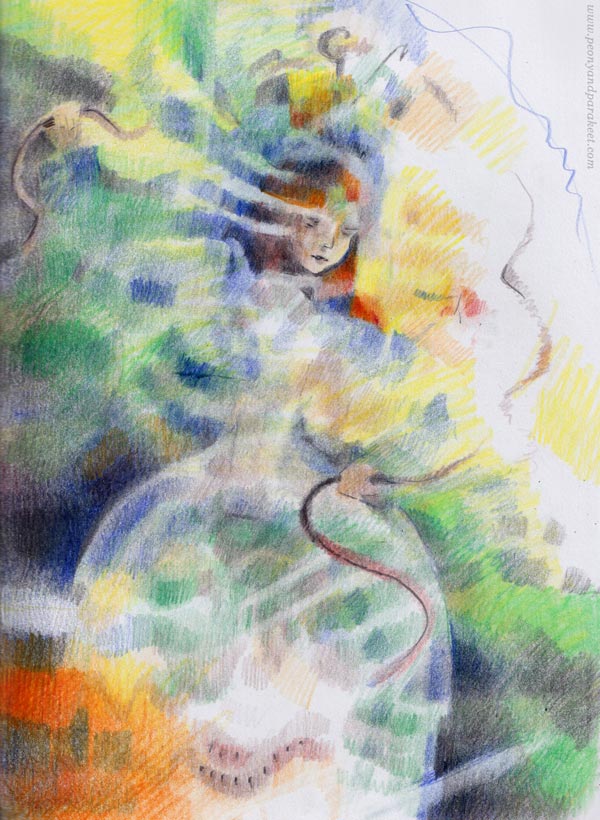
This post includes sneak peeks of my upcoming class Intuitive Coloring – Stay tuned!
For Animal Lovers – News, Art, and a Flash Sale!
This week, I share exciting personal news and celebrate with a flash sale. The animal drawing class Animal Inkdom is 40 % off this weekend! The sale ends on Sunday, July 18, 2021, at midnight PDT. >> Buy here!
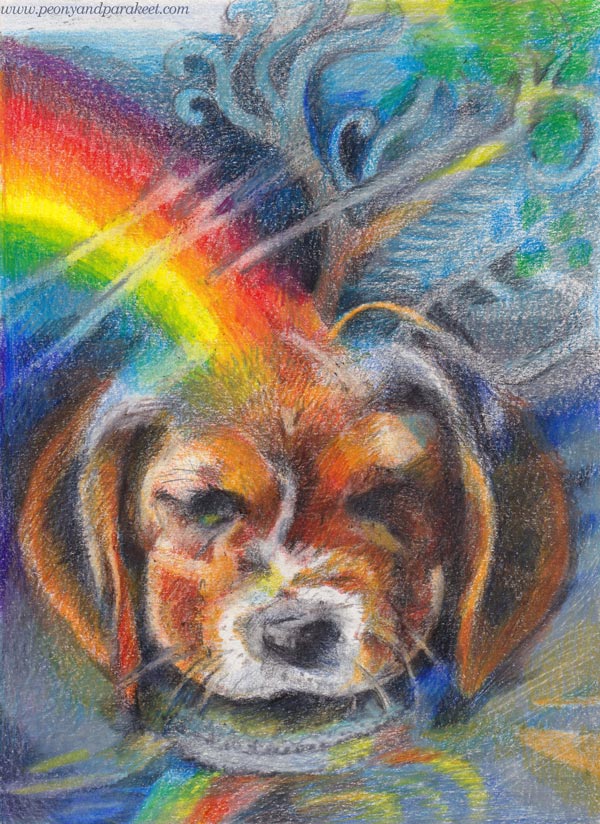
This week, my husband and I had a small vacation. We went for a two-day trip to see the Finnish countryside and some towns, but first and foremost: to choose a new family member! We have been waiting for this since our beloved beagle Cosmo passed away, but beagles are very popular, and cold winter seemed to postpone the litter.
But here she is!

She is only 5 weeks in the photo and we will get her after a few weeks. We have named her Saima. It’s a Finnish girl’s name and also very similar to Saimaa, the largest lake, where we went to see her. Saima also has a grey spot on her other leg. Grey is harmaa in Finnish, and a famous Finnish poet was Saima Harmaja. So there really was only one option for the name! We are eagerly waiting for her and hope that our beagle Stella will love her too.
Celebrating Saima – Animal Inkdom 40% OFF
Last spring, when waiting impatiently for her to be born, I decided that after I get to hold a new puppy in my arms, there will also be a sale for Animal Inkdom. So now’s the time!
Animal Inkdom has been my most popular class during the past couple of years. When I recorded it, I had so much fun that I had to edit out some laughs. I think that the love for animals and the easy flow of ideas have made the class inspiring for everyone.
And because choosing a puppy isn’t something that happens often, I wanted the sale to be exceptional too. Animal Inkdom is 40% OFF, but only for this weekend! The sale ends on Sunday night, July 18, 2021, at midnight PDT. >> Buy Here!
Intuitive Coloring – Examples and Thoughts
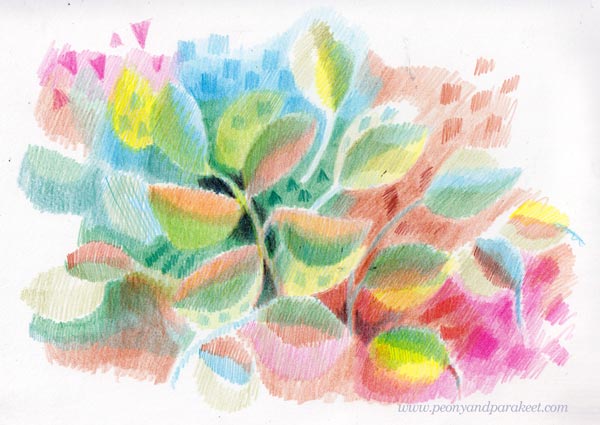
This week, I show sneak peeks and process pics of simple intuitive colorings and talk about intuitive art.
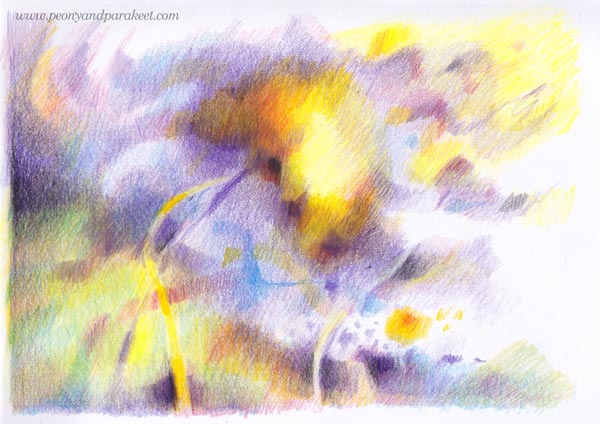
Since I made the last free video “Colored Pencils – Intuitive Approach,” I have been thinking about free coloring. First, it felt like I have explored it thoroughly in the e-book Coloring Freely and in the class Inspirational Drawing. But as soon as I began to make some notes about intuitive coloring, I realized that there are things that I haven’t shared in these blog posts or in my classes so far. Many of them are things that seemed complicated and heavy at first, but the more I have experimented with them, they appear to be very simple and light.
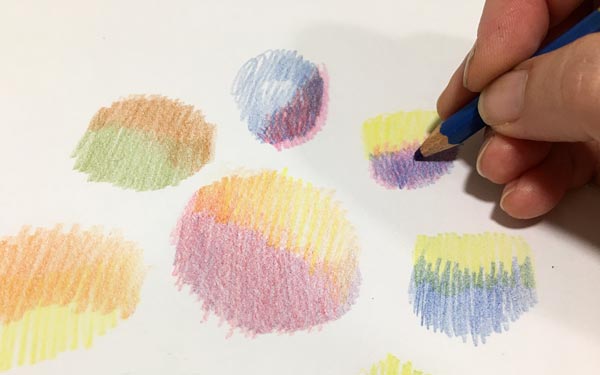
And it feels fun to color freely on a blank paper, and there’s a sense of playfulness too right from the beginning.
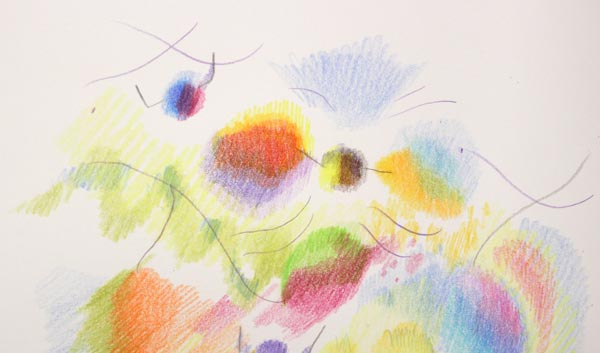
I am a more-is-more kind of a person, but after making a series of large oil paintings, I wrote a mental note that says “less is enough” in capital letters.
Can Intuitive Coloring Be Taught and Learned?
I have also been thinking about the term “intuition” a lot. Why does it feel so intuitively correct to say that my art is intuitive? And not only that. Why do I want to teach intuitive art? Because isn’t intuitive just about letting go and emptying the mind on paper? Doing what you want, doing what feels right?
But as a former engineer, it’s always been hard for me to trust intuition when I am trying something new or reaching for a new level. Then the intuition is confused with the comfortable “same-old-same-old” routine. That old dog always stays close, but intuition and imagination are timid puppies. To find the puppies – that’s where I feel I can help.
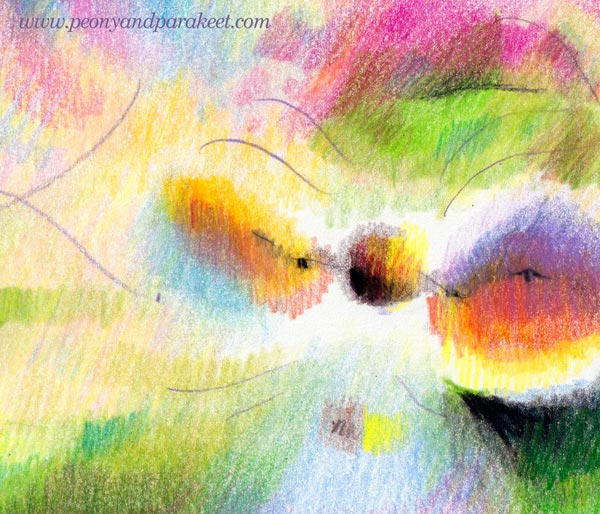
Would you be interested in this upcoming class?