
Layering Colored Pencils – Magical Effects Step by Step
This week, I have a new spread for my colored pencil journal, and it’s based on layering colored pencils. I share detailed photos so that you can try this too!
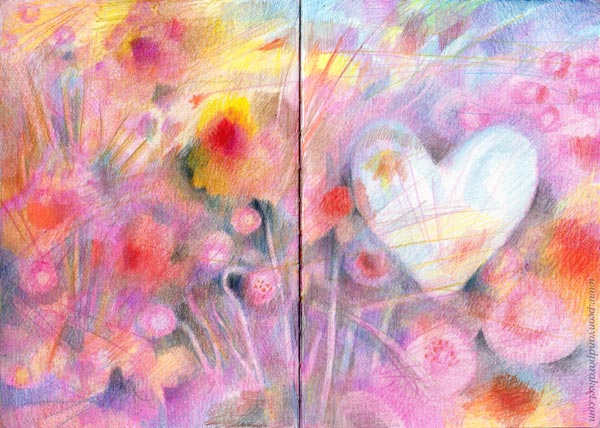
This coloring technique creates magical looseness, even if it begins with very stiff shapes. Because layering the colored pencils is the key here, it’s important to keep the layers light because paper can’t hold color endlessly.
Step 1 – Set Atmosphere
Choose a color that sets the mood for the image. My choice was pink.
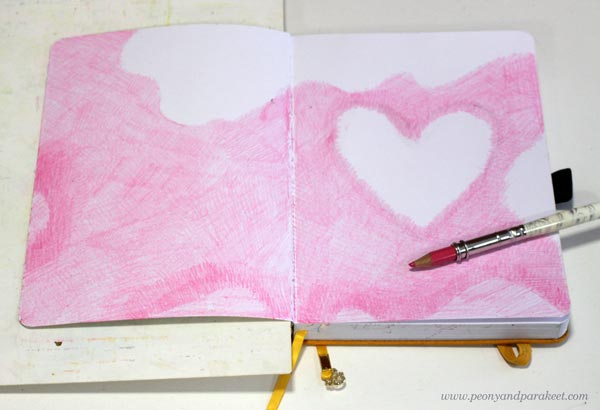
Color the background lightly, but leave some blank areas near the edges and where you want the focal point to be. The heart is my focal point.
The blank parts will allow you to include lovely color variations in the last layers. Color softly and avoid outlines so that the overall feel is magical from the first layer.
Step 2 – Add Pattern
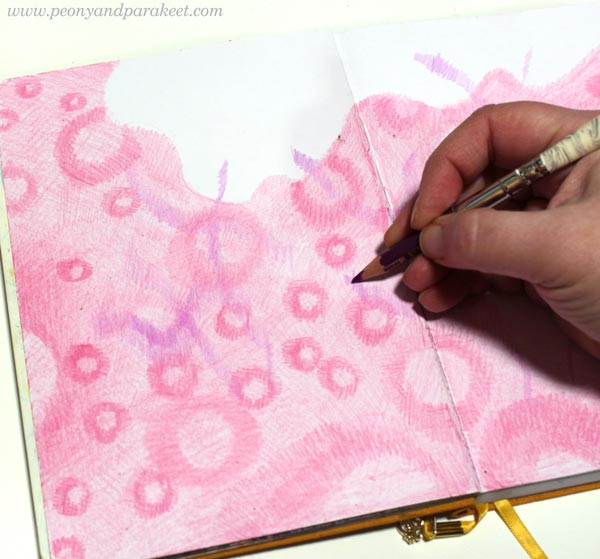
Stick with the same pencil and continue the monotone look by coloring rings on the colored area.
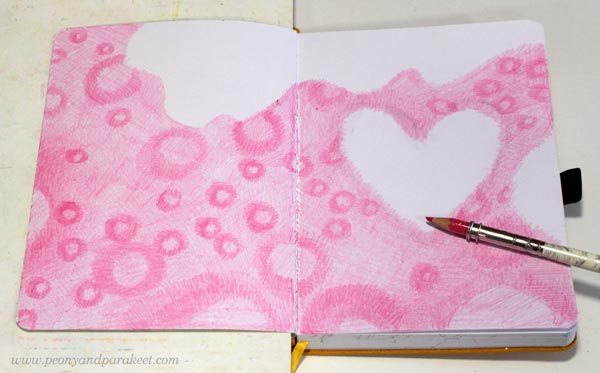
Make sure that the rings are different in size and spread a little unevenly so that the result looks natural and interesting. Think about fabrics but not the easiest polka dots, but a bit more intricate design.
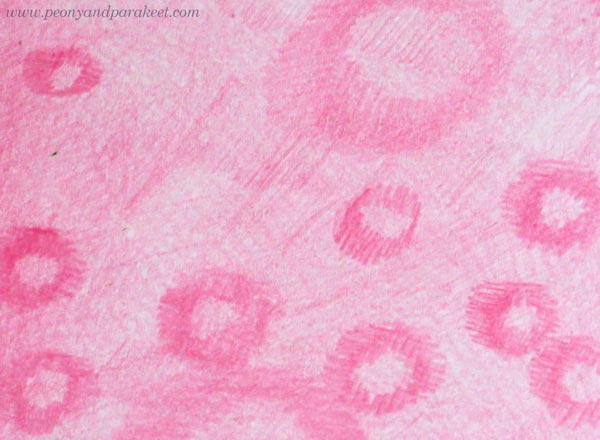
Here’s a closeup of my rings. Again, I don’t use outlines but color them with short strokes that go in many directions.
Step 3 – Destroy
This step could be called “destruction” because now we color random shapes that don’t follow the previous layers at all. Bring in new bright colors. Color stripes, rectangles, random shapes, and lines freely.
You can go over the blank parts too but keep the focal point a little less untouched.
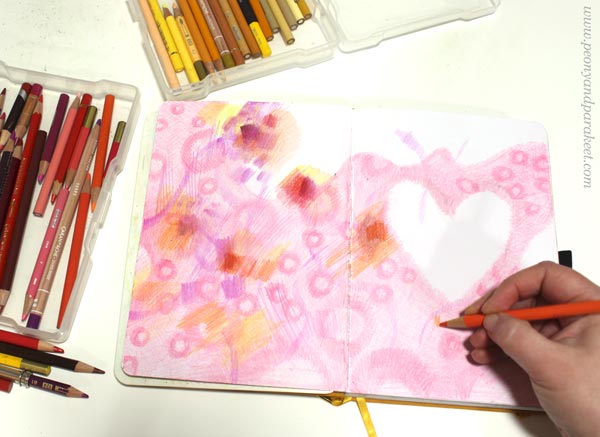
The idea is not to cover previous layers fully but to destroy their rhythm.
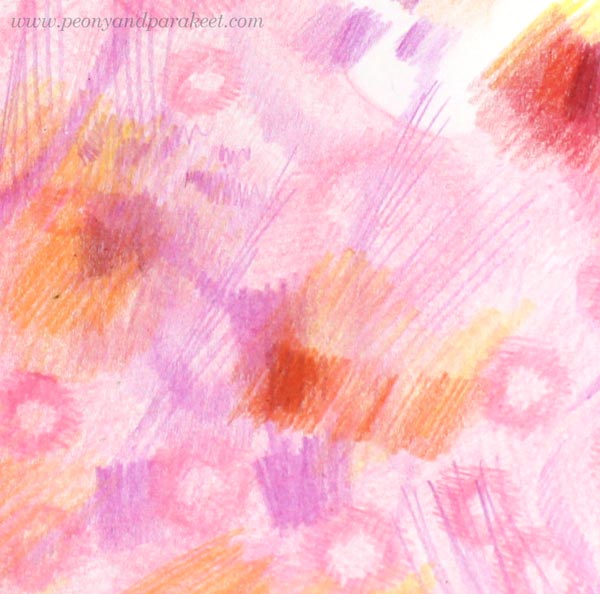
Here’s a closeup of my work. The new shapes and lines have taken over, and the rings are not so well visible anymore.
Step 4 – Discover
Keep coloring, but now bring in darker tones too. Keep the layers light and shapes soft, but when you discover something that you like, highlight its edges with a darker color.
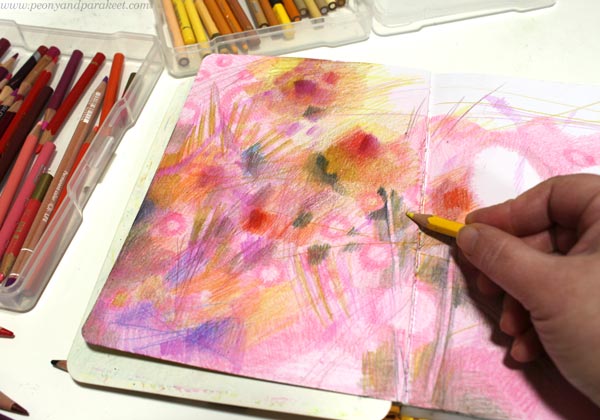
I didn’t use any green pencils in my spread, but it does have some green shades. Mixing black and yellow makes lovely olive green.
Now it’s also the time to bring some rings back to the foreground!
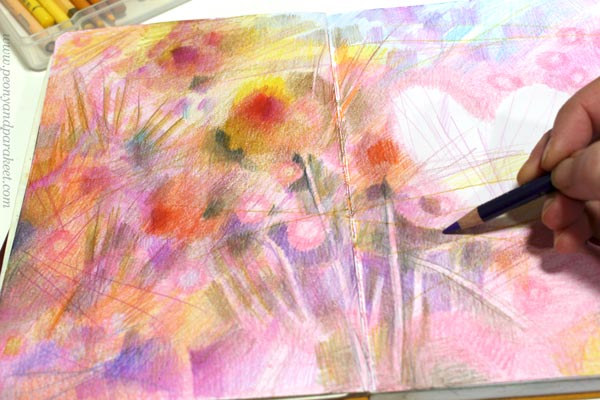
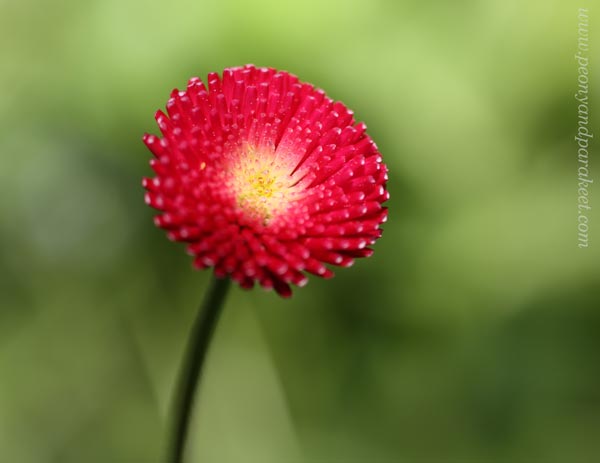
These rings remind me of perennial Bellis flowers!
Here’s a closeup of digging out the rings – now flowers – with dark colors.
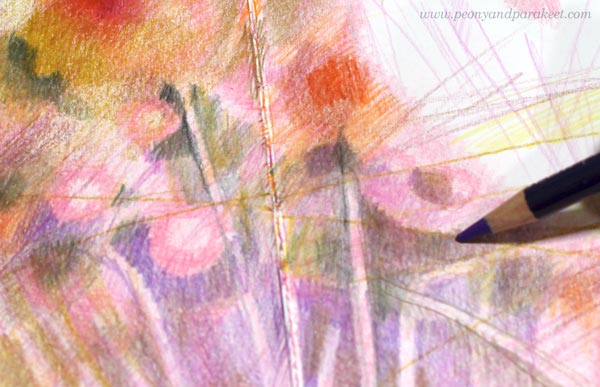
I don’t bring up all the rings, just some! This makes the layered look: some elements are covered and located further in the background, some come up to the foreground. The stiffness of the background pattern looks attractive when it’s combined with looser coloring.
Step 5 – Finish with Message
Your work will be finished when it delivers a message. The focal point, the heart in my case, is essential for achieving this. I like to work intuitively so that I don’t try to define the message right from the beginning but let the insight grow with the coloring. Here, I left the heart light and made it look icy and magical.
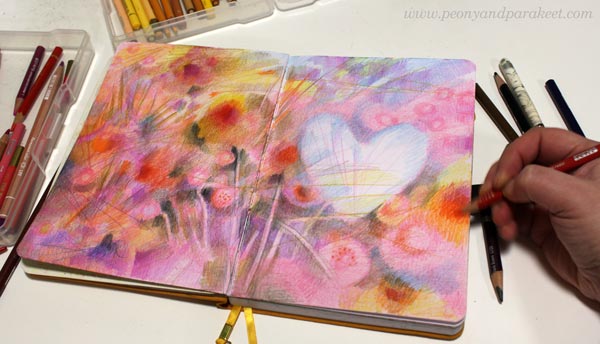
First, I thought about this winter, how tough it has been to walk the dogs on icy roads, and how much I want spring to come. And then it hit me how ice must mourn when its life is coming to an ending. How between the first flowers, there’s a little block of ice, looking around, feeling isolated.
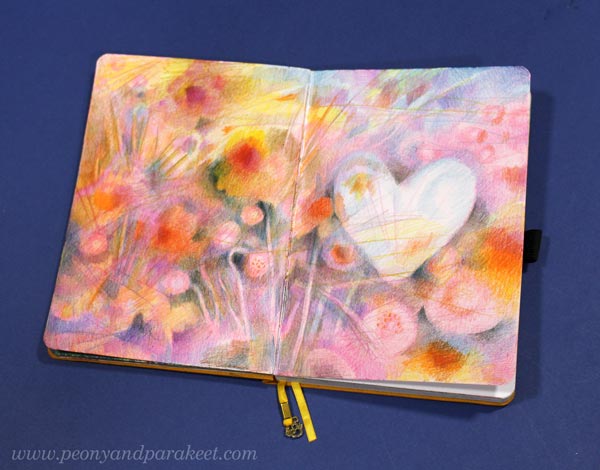
This little frozen heart is like a rare unicorn – reflecting the surroundings, introvertedly, like we all do when we are creating.
I find this kind of pondering an important part of art-making. That’s why I always try to end with a message even if viewers can freely find their explanations as well.
Fun Botanicum – Sign up Now!
From March 15 to May 15, 2022, I run an online class for us who are inspired by nature and fantasy and love plants. The class is called Fun Botanicum and we will draw fantasy plants by scribbling, doodling, and layering with colored pencils. Join us!
The early-bird sale ends soon! Early-bird price: 59 EUR, now 49 EUR. >> Sign Up Now!
The sale ends on Feb 20, 2022, at midnight PST.
Creative Take on Damask Motifs
This week, we look at damask motifs from a new perspective. I challenge you to make this traditional motif your own and use it in your art!
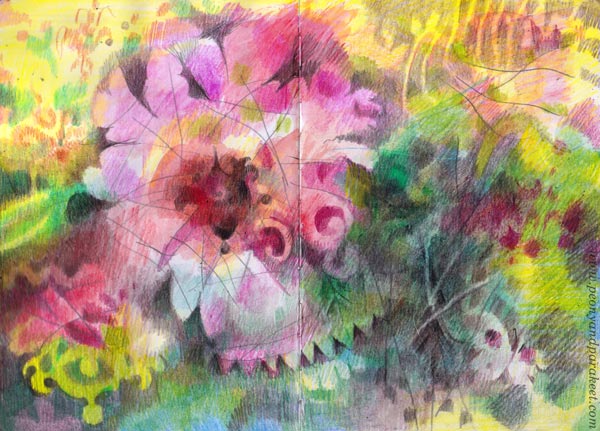
It all started from a dream I saw a few days ago. “You should wear more decorative clothes, Paivi,” I was telling myself. “Like the old historical dress that you had at a ball as a teenager.”
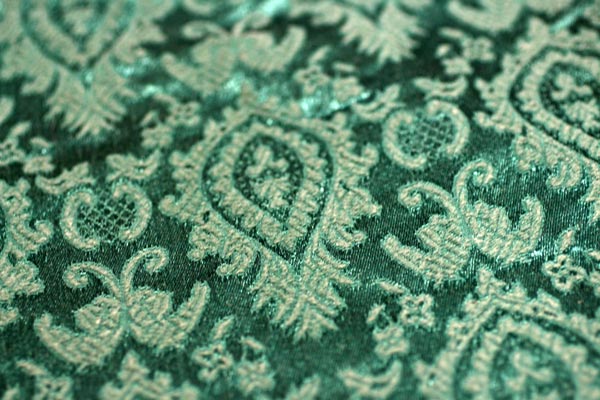
I still have the dress. It has damask motifs – woven ornamental patterns that seem to never go out of date (more about their history). The idea of perfecting not only the actual swirls but also the shapes between is a good drawing practice that doesn’t have to be boring at all!
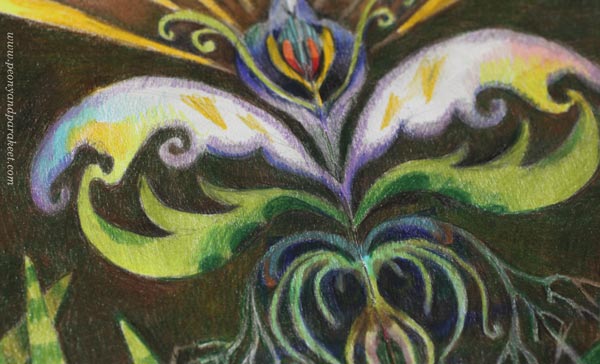
This week, I played with colored pencils mostly, but in 2015, I made a mixed media piece called Rococo. So check out this post too!
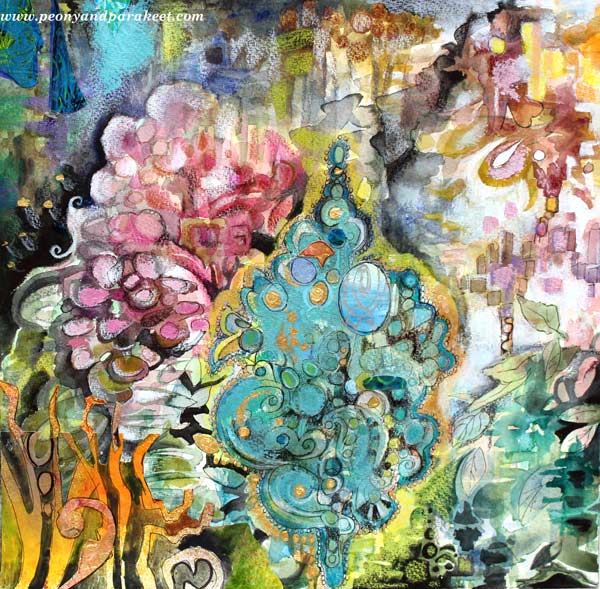
Damask Lady
The reason for my dream was an unfinished page in my colored pencil journal. I had started it at the end of last year but found it terribly uninspiring. I didn’t feel any connection with the figure, and she looked like someone had forced her to be there. In a way, that had happened. After a series of big paintings, I was knackered, as readers from the UK and Australia would describe. I had no motivation to take a brush and only a little to do something with colored pencils.
First, I added a bit of watercolor to cover white and then colored intuitively without any predefined ideas or models.
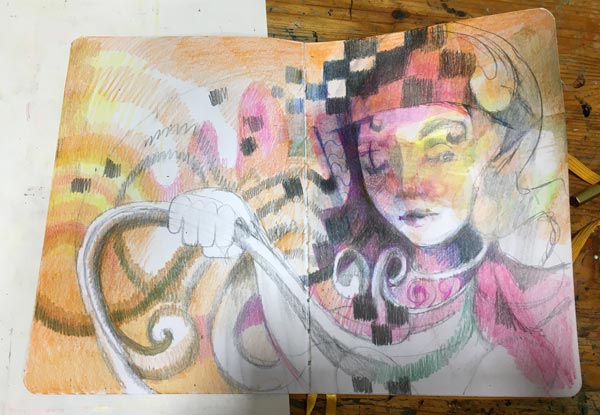
Sometimes it’s just that when you are tired, it’s best to leave the piece and come back later, even if it would be a tiny spread in a small journal. After the dream, I knew what to do: play with damask motifs!

I feel drawn to this damask lady. She looks both curious and self-confident – everything I would like to be in this new year!
Looser Damask Motifs – Nature
I got so inspired by coloring the swirly lady that the next spread was born quickly. Again, first some watercolor splashes, and then details with colored pencils.
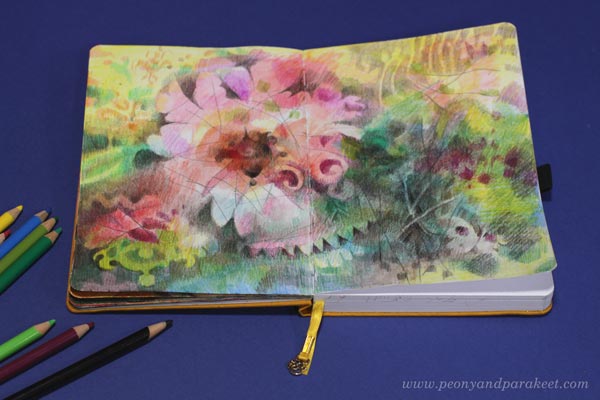
If you compare the flowery spread above with the portrait below, you see the change in looseness. The flower is much freer than the lady, but I like both. I like how damask motifs can be seen as a part of nature – snow on trees, water drops, butterfly wings and their spots. But I also like how they can be more architecture- and design-related and a part of human fantasies and mysteries.
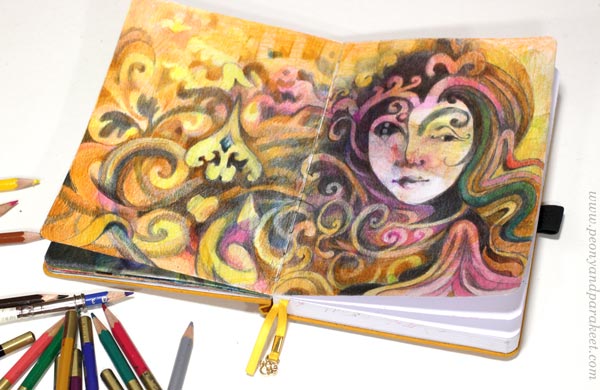
Which take do YOU like more?
Sketching a Damask Motif
Next, I wanted to go even further in stiffening the expression. I would design a damask-inspired motif so that there would be no looseness at all.
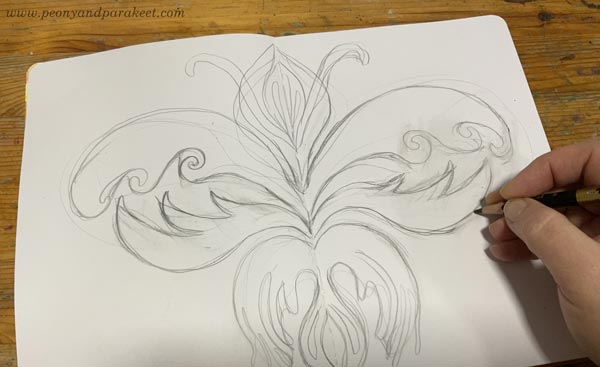
I started by sketching the motif in the middle of the spread, using the fold as a guide to achieving the required symmetry. In damask motifs, the negative – the shape of the background – is as important as the positive is. So after the careless sketch, I then went through the surrounding area and adjusted its swirls.
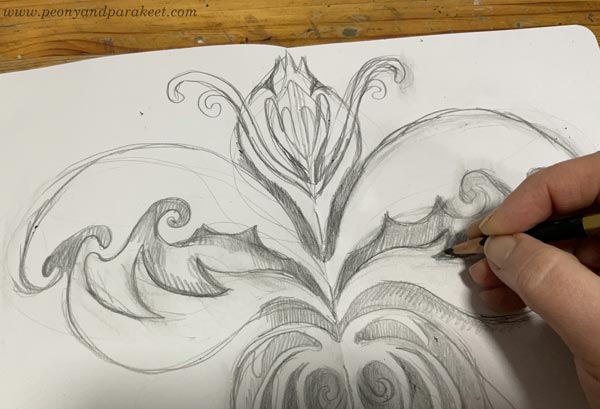
This motif felt like a forbidden fruit. I was surprised to hear myself saying: “You have crossed the line now, Paivi. Even if you always paint the inside, now it will be reverse – illustrating the outside world.” I didn’t get this first at all – I thought I was just drawing was a simple flowery ornament inspired by damask motifs!
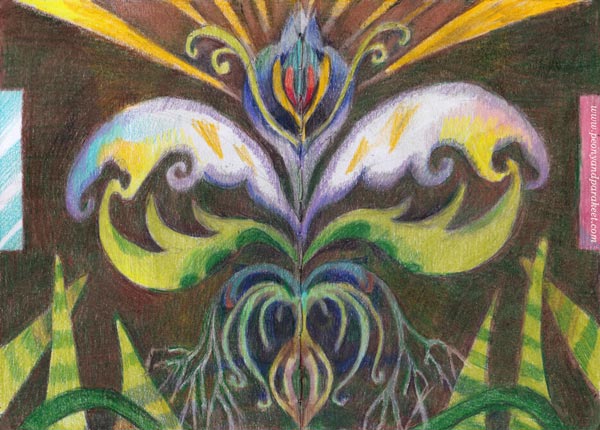
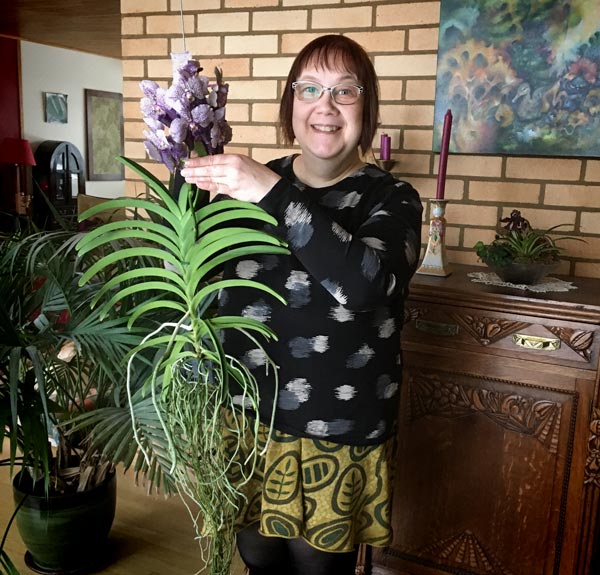
But when I was making the finishing touches, I realized that my drawing did illustrate the outside world – our living room: a wooden ceiling, windows on the left, a wall rug on the right, a vanda orchid hanging without a pot, and the snake plants growing lower.
Here’s a picture of my vanda when it was blooming in 2020!
This spread is not loosely made at all, and yet I find that the looseness is how I unconsciously picked and interpreted the subject.
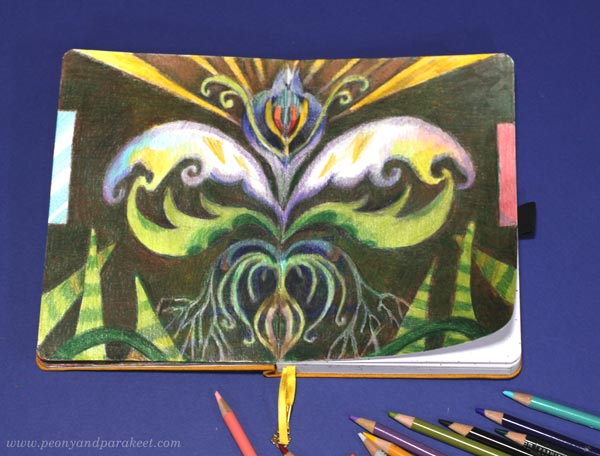
Which of the pieces of this post inspire you the most?
Are you inspired by the stiffness or looseness?
How do you want your damasks to look?
Please leave a comment! It would be so interesting to know!
Joyful Flowers and Exploring Joy with Colored Pencils
Let’s draw joyful flowers together, step by step! This post is enabled by the grant that I got from Arts Promotion Centre Finland. This is the fourth blog post of the project, see the first one here, the second one here, and the third one here!
Here’s what we will create: flowers that have joyfully gathered together and reach towards the light. No references, imagination only!
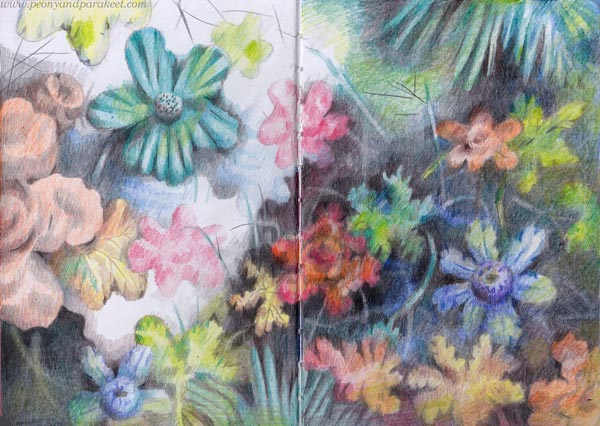
I made the drawing in my colored pencil journal and used colored pencils only. But these instructions can be easily applied to other mediums too.
Step 1 – Flowery Blobs
Pick a pencil of any color and draw blobs.
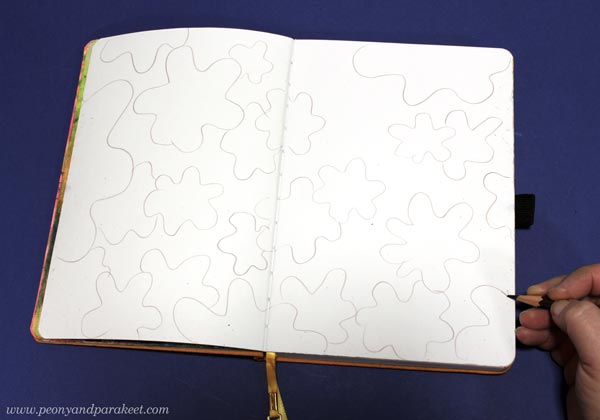
More than perfecting each flowery blob, make sure that the blobs are:
a) not similar in size – draw small, medium, and big blobs!
b) not separate – draw some only partly so that they go on the back of others!
c) not fully on the paper – draw some near the edges so that they are only partly visible!
d) not spread too evenly – leave some space too, but don’t place it in the middle!
This way, you set the foundation for joyful flowers so that you express diversity (a), togetherness (b), continuity (c), and freedom (d).
Step 2 – From a Blob to a Flower or a Leaf
Pick flowery colors and a black pencil for the background. Focus on the area in the low middle and work towards either side of the paper.
With black, color notches on the blobs so that they begin to look like flowers.
With bright and flowery colors, color some random shapes on the blobs.
Color a center for the blob to make it look more like a flower.
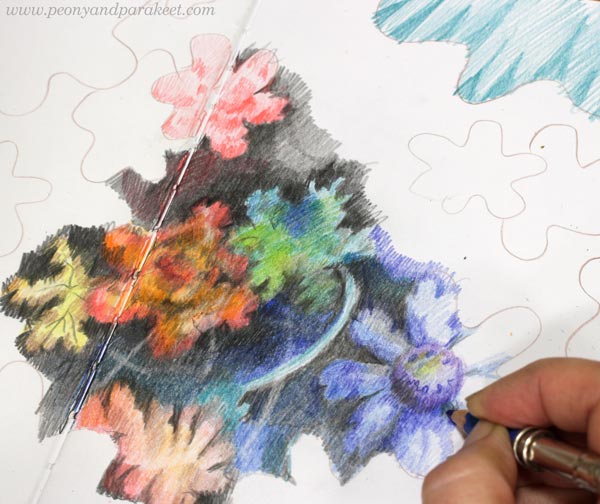
All the blobs don’t need the center; they can be leaves. You can also draw veins on them.
Add many colors so that the leaves and flowers look lively. Layer colors to get a variety of tones.
Step 3 – Background
Start with the black background, but gradually change to lighter tones. Leave a pitch-black area small, and add layers of other colors, like blue, on the top of the black, then gradually let the different colors take over. Leave a blank area too. Color softly and gently so that every layer adds intensity to the drawing.
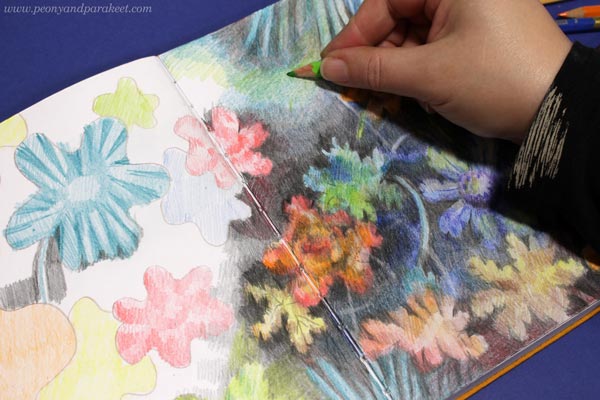
One of the joys of coloring is to relax and not rush at all. Stay in a small area and work with a few flowers only (Step 1) before feeling confident enough to expand the working area and focus more on the background.
Step 3 – Setting the Colors for Joyful Flowers
You can mark the colors for each flower and leaf by coloring them carelessly first.
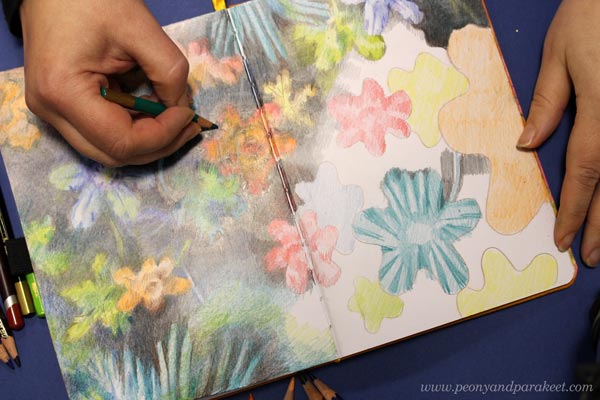
When some parts are more finished than others, there’s both joy of looking and joy of coloring!
Step 4 – Changing Most Whites to Pastels
I assume that you now have white everywhere: between the strokes, near the edges, in the flowers, and in many places on the background. But let’s change that! Leave only one area in the background that’s pure white and color over other blank parts.
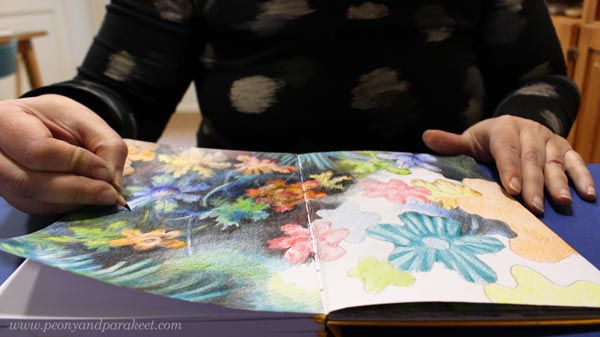
Add more color on the areas where careless coloring has left white stripes, and change the larger white areas to pastel colors. All this makes the image more joyful because the joy is in the nuances, not in the big changes.
Step 5 – The Joy of Cohesion
One of the greatest joys in art-making is to feel togetherness. So more than trying to achieve a particular style, I make changes to the image so that it feels like a place where I belong. I also want my flowers and leaves to look happy, but not so that I force them to smile by throwing “happy colors” but imagining that everyone has a friend in the scenery: someone to trust and lean on.
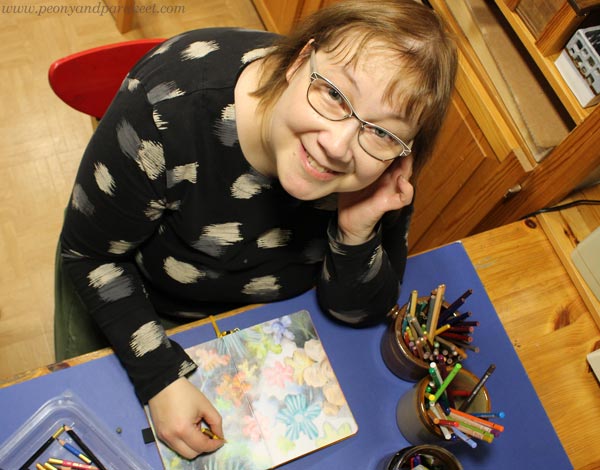
I also make some flowers look like me: who need to feel free to bloom. So they are less defined and almost disappear into the light, but their spirit still looks strong. So, the less realistic a flower is, the more room there’s for the expression.
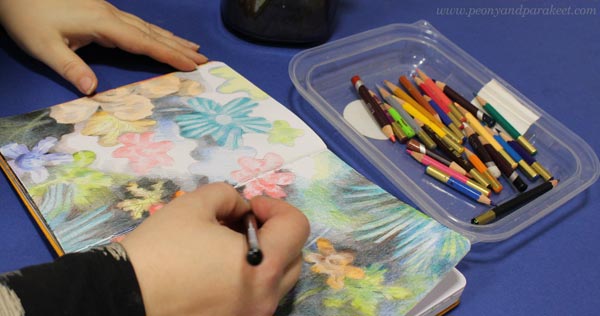
At some point in art-making, I begin to question if other people will like the image. It’s comforting to know that if we manage to create the feeling of effortless belonging, the image will naturally resonate more widely. The joy of cohesion also allows something to go wrong and become different than we expected. If we make every element feel accepted and welcomed, joy will naturally appear.
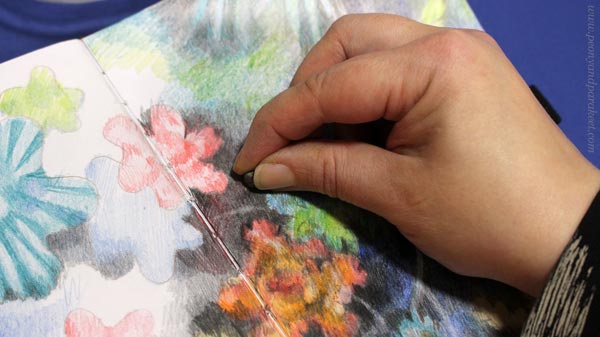
I a flower or a leaf looks lonely, add a stem that connects it with others. Long lines can look commanding and stiffen the image, so erase a glimpse of a stem only. Stems also look more natural if they don’t start right from the flower but appear and disappear as softly as possible. Stems can also go across each other and form a connecting mesh.
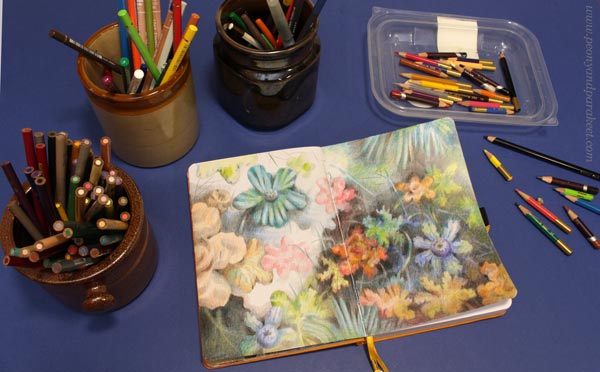
When one flower leads to another, and the eye always finds a clue about where to look next, cohesion is present.
More Inspiration for Joyful Flowers
I have got so many ideas from flowers that even when I don’t create them, my visual language is very flowery.
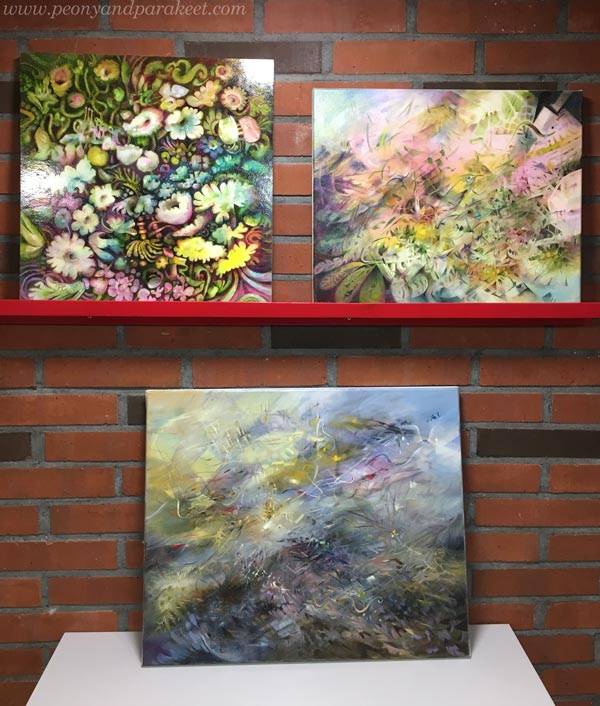
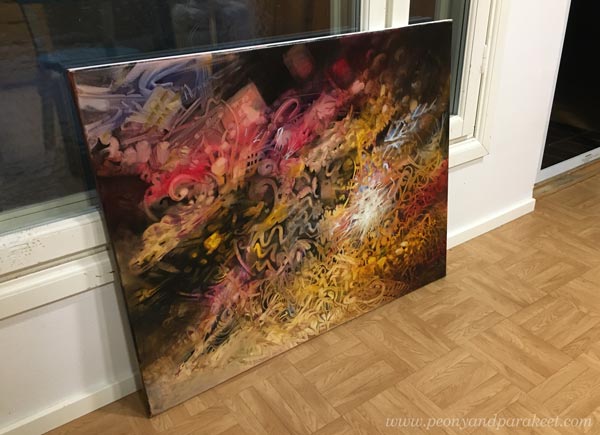
This week, I started two big oil paintings. These are 120 x 100 cm – it’s the biggest size that I have ever painted!
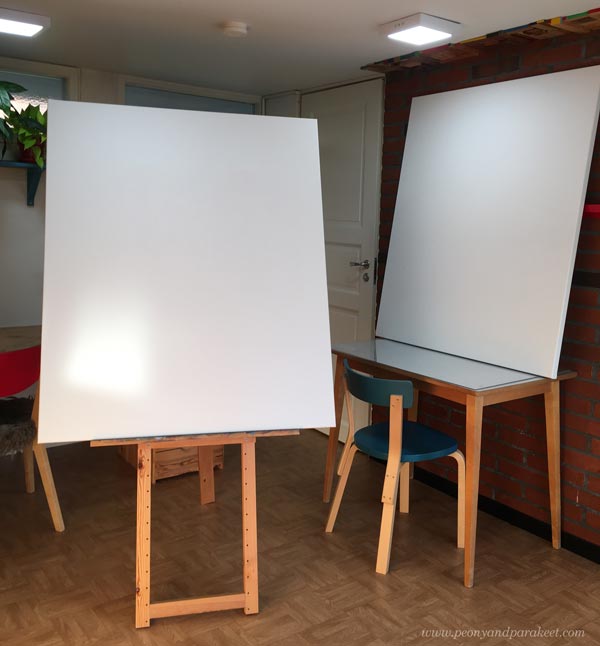
My first inspiration source for these is floral still lives from the 17th century. But these are just beginnings, and let’s see how they will progress in the upcoming weeks.
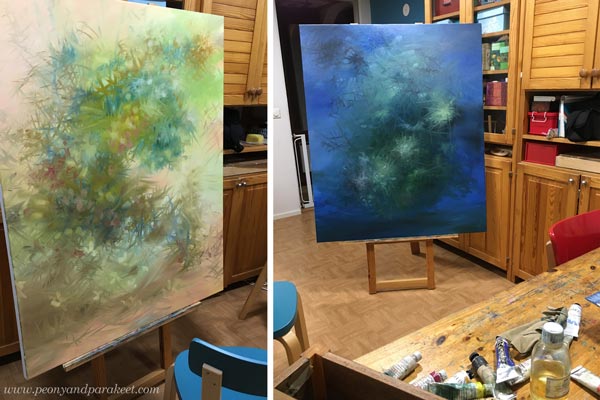
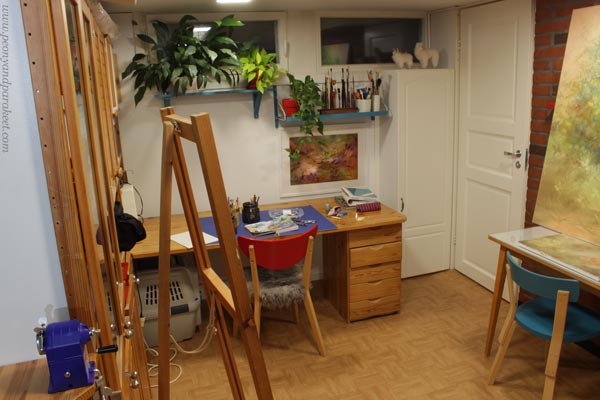
My little studio has been full of projects this week and will continue to be so!
I hope this blog post inspires you to create joyful flowers – big or small, pencils or paints!
Messy Art Journal Style with Colored Pencils
This week, we go deep into the messy art journal style. See how to mimic messy mixed media pages in colored pencils!
I wanted to add some happy freedom to my colored pencil diary. So here are the most recent spreads!
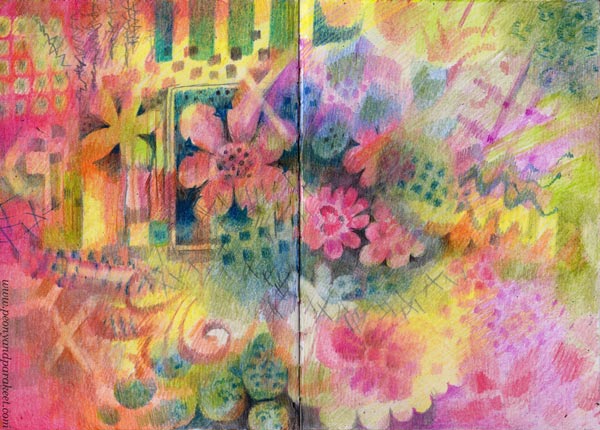
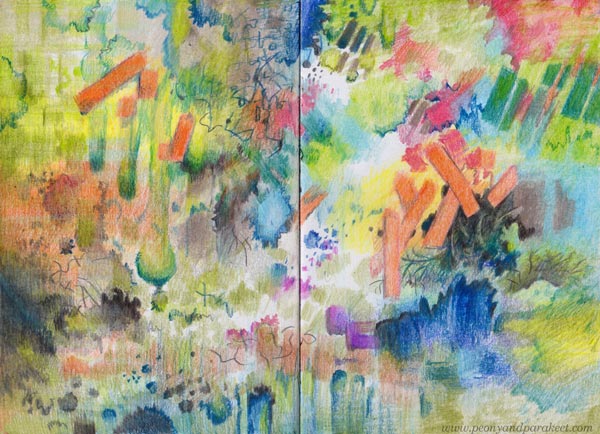
These spreads have an impression of a messy mixed media look – collage, paints, and all – but they have been made with colored pencils only.
Confessions from a Former Art Journal Book Junkie
Let’s first turn back time over ten years when my best hobby was art journaling. My day job took a lot of time, so buying became a part of self-expression. I bought almost every possible book about art journaling and dreamed about becoming a mixed media artist.
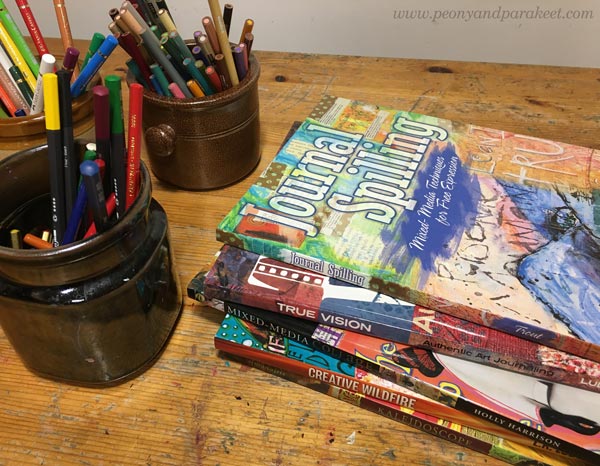
Now when I look at these books, their examples look clumsy, sometimes even ugly. But I still get attracted by the easiness that made me buy the books: “Messy is ok, you can do it!” And so did I: mixed paints, pens, collage, and all the possible media into one spread. “Mixed media techniques” was the word that I was looking for when browsing a book store or Youtube.
Art Journals Started a Journey
These journals were all the art that I created for a long time. Like the books stated, I assumed that the messy pages would be enough to define me as an artist. In some ways, I was right. A messy art journal style was a ticket to the world of art-making, blogging, even teaching. For example, in Collageland, I use paints, pens, and scissors to create fun and messy pages.
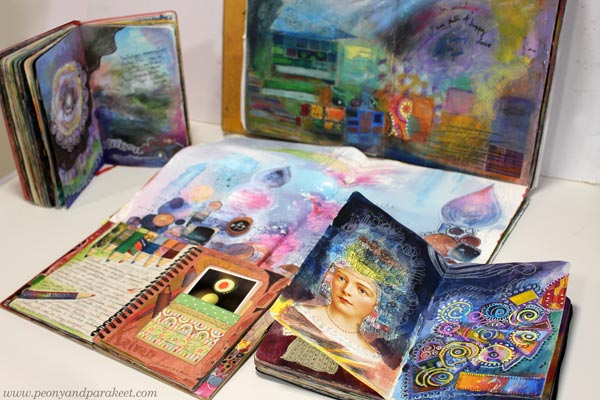
But in 2013, when I was in a local art supply store and proudly presented one of the journals to the owner, his fake smile told me that I hadn’t even started yet. In the traditional side of art-making, that is!
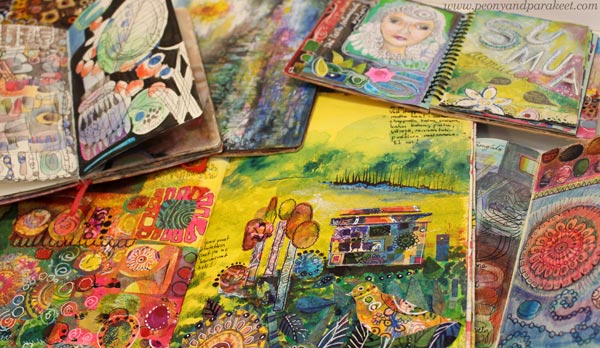
Nowadays, I think of myself being a traditional artist rather than a mixed media crafter. I prefer to stick with one medium at a time and my main artworks are more on the traditional side. And I wince every time when someone calls me a mixed media artist!
But art journaling has led me to so many happy places that I don’t ever want to get too far from it. Often, I have just replaced images from magazines with my own hand drawings.
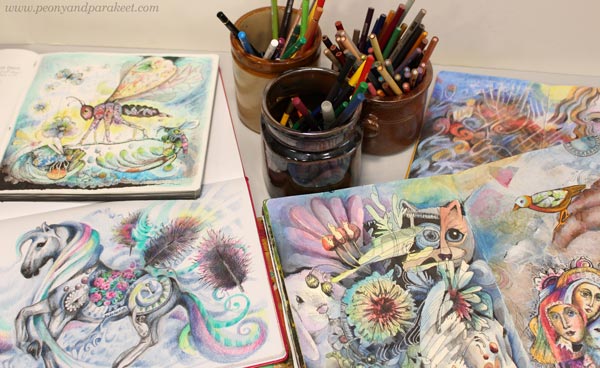
So, instead of collecting products, I can be the product. My most popular classes like Animal Inkdom and Magical Inkdom have started on that idea.
Choosing the Shortest Pencils
The best thing that I have learned from art journaling is to not over-think and just start creating. It often feels like my hand knows more than my brain. So, when I want to think further and forward, I say to my shortest pencils: “Let’s create something messy, like in the old times!”. And these little pensioners are always willing to get back to work and do what’s expected.
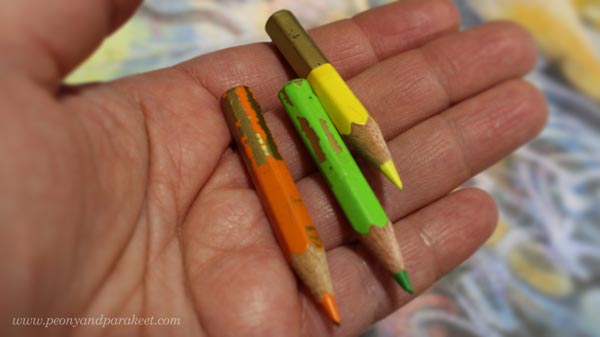
Using old and much-used pencils also takes off the pressure of pursuing brilliancy right from the beginning. For example, before I started building the class Intuitive Coloring, preliminary pieces were made with the shorties, and then for the actual recordings, I picked longer and more prestigious pencils.
So, when coloring a mess, do it with a small and diverse set of retired pencils that no longer care if you are a true artist or not!
Collage Imitation in Messy Art Journal Style
On the first spread, I mimicked what we used to include in our messy art journals: paper scraps, geometric stencils, scribbling, simple marks like x’s and o’s, flowers, and curves.

Just keep layering until the paper is covered, and don’t forget to mimic the glue too! Make the elements go on top of each other, or erase a part of them to make everything look integrated.
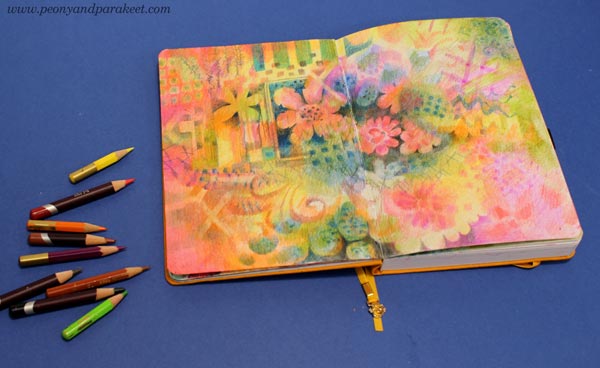
Look at my little pencils! Aren’t they endearing? I have started to carry them in a pencil case so that they are always with me, ready to be pampered.
Paint Imitation in Messy Art Journal Style
Then let’s change the mindset a bit and move from mimicking products to imitating paints. Start with stripes and small splotches and slowly grow them so that they cover more of the blank page.
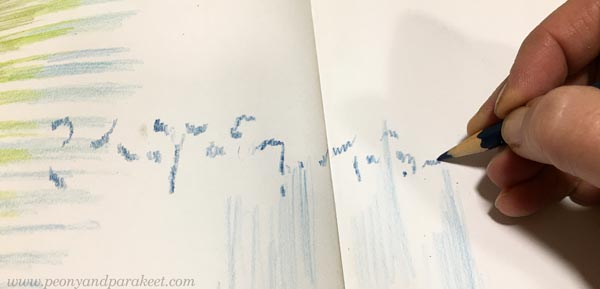
When we make a mess with paints, the edges are jagged, so color freely and intentionally make errors on the shapes.
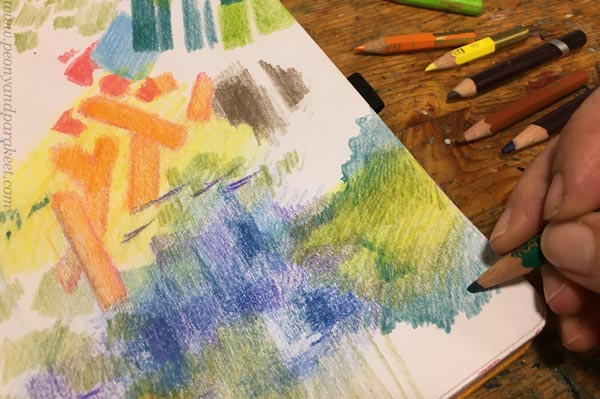
My orange rectangles represent a product, a stencil maybe, but most of the elements are more like watercolor, acrylics, or inks.
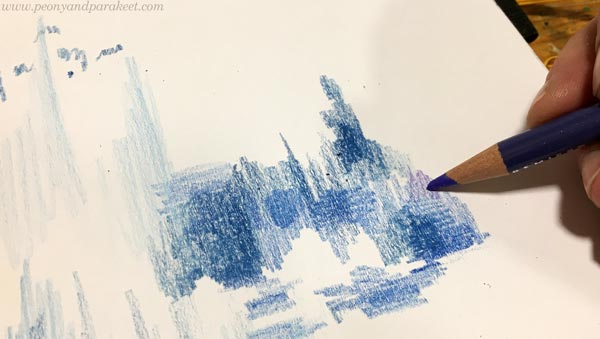
Watercolor spots have dark edges that softly fade away. By adding more colors, you can make the spots look translucent.
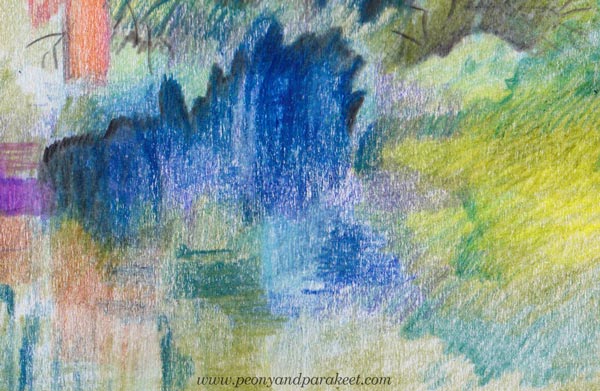
Acrylic paint has wider shadows, reflections of light (stripes and spots), and less transparency.
Add tiny spots too and make sure that their patterning is irregular.
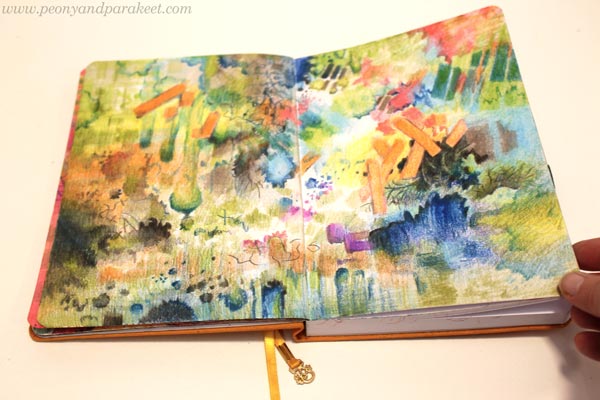
Drawing all kinds of splashes and drops was so much fun that I am now thinking: could I imitate watercolor in oils. Doesn’t this prove that mess-making and traditional fine art are not so far away from each other after all?
I hope this inspired you to pick your pencils and start faux mixed media with them!