
Coming Up with Ideas that Make You an Artist
This week’s blog post is about working with ideas that bring more of you together and make you an artist.
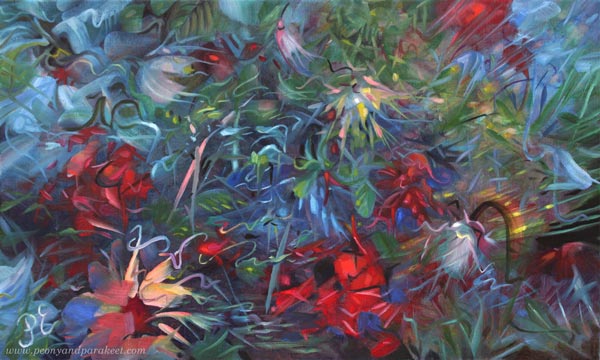
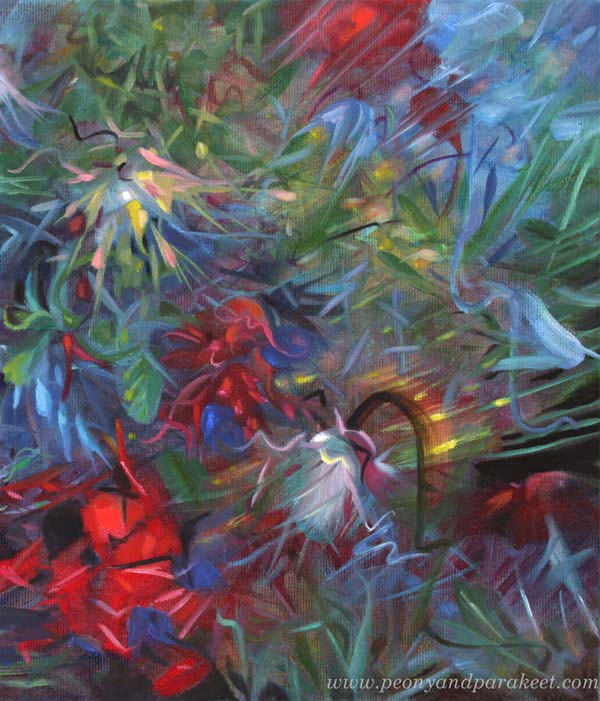
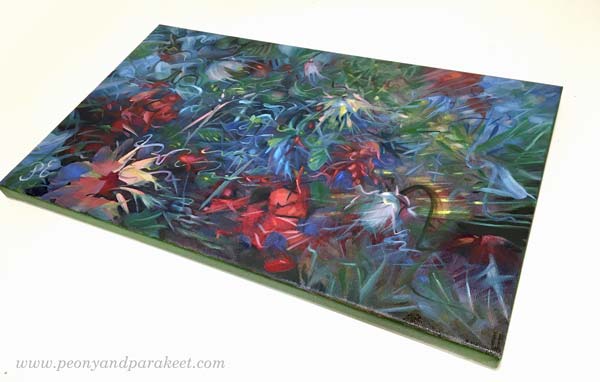
Here’s one of my newest paintings called Merkuriuksen lämpötilat – Mercury Temperatures. This oil painting is a part of my series Linnunrata – Milky Way, where I explore planets and outer space. (See previous work: Neptune here, Pluto here, the Earth here, Venus here, and the Sun here!)
My first intention was to create Mars, not Mercury, so I started with sharp strokes and fiery colors.
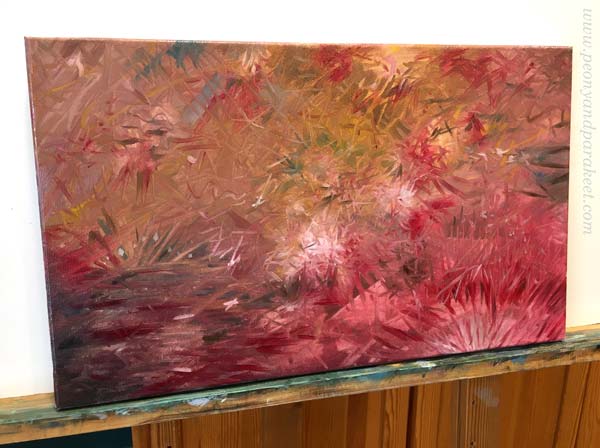
But it happened that Mars appeared in another painting, so I changed the subject after the first layer. This wasn’t hard. All I needed was to get back to left-brain thinking, which I call my inner engineer.
Fact-Finding for Artistic Inspiration
It has been fun to find out facts about the planets. I have also had great discussions about them with my husband. We both love science and are interested in the bits of information about outer space. The mind-blowing fact about the planet Mercury is that its temperature varies about 650 degrees! Night and day in the same location can have very different temperatures.
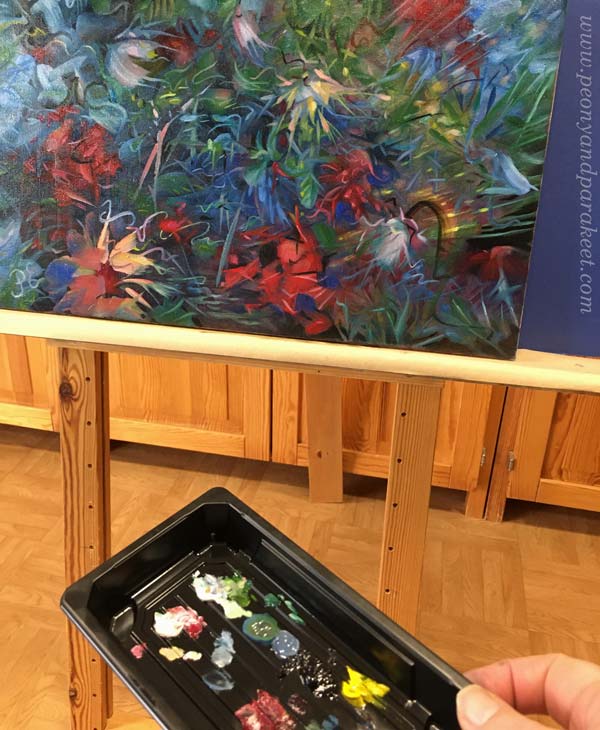
I try to keep the fact-finding separate from the painting process as possible. I want the facts to be just one of the many inspiration sources and be intuitive and inventive during actual art-making. For example, in this painting, I also thought about pattern designs, interior decorating, wallpapers of William Morris and Designers Guild, fantasy stories with unicorns, gardening … all kinds of inspiration got mixed into one piece.
Hidden Love for Natural Science
Over a couple of years, natural science has got more and more impact on my art. However, I have been pretty quiet about it because it feels weird to talk about science and then show flower paintings. But now, my inner engineer said that Mercury Temperatures is the only appropriate name for the piece, and I noticed how happy she looked, being involved and accepted more than many times before.
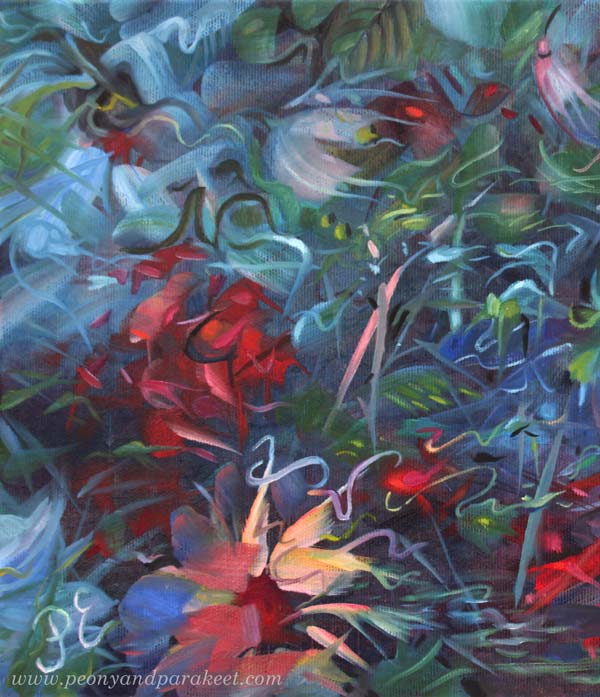
This spring, I have learned a lot about leading myself artistically. I have noticed that if my inner engineer can provide concepts like “temperature changes” rather than direct images, my inner artist can then tie them freely with visual ideas. Together they form an effective pair. My inner engineer can provide exciting ideas based on her background studies, and my inner artist can still get all the creative freedom she needs.
Digging Deeper into the Professional Identity
It has started to feel that there’s a reason why I first studied engineering, then moved to design, and only finally to art. I play with the question that if my career had started as an artist, would I be studying technology now? It feels that my ideas are on several levels, and if I omit the science level, something is missing.
For years and years, I have been trying to manage what my inner engineer can do and how she should not disturb the inner artist. But now, when I have given the inner engineer a significant role, the inner artist hasn’t complained at all. On the contrary, it feels like the artist praises the engineer and vice versa.
This understanding has also closed the gap between design and art. Some of my work can now be openly more design-oriented than others. My inner designer had a lot of fun participating in this painting.
I feel happy about being able to use my curiosity about natural science in the artistic process. I have even started to think that my background in technology and science can be one factor that makes my art unique, even if it doesn’t get the leading role when marketing my work.
Coming Up With Genuine Ideas
We often think about using the skills from one profession to another very literally. But the identity in one can be used for another when we get to the level of ideas and inspiration. Every field has pieces of information that are super inspiring, especially if you already have the foundational knowledge of the area. With the knowledge, your imagination can build bridges between what is and what could be.
Ideas that make you an artist are not about art.
The artistic identity is more like an umbrella rather than an individual thing. An artist is a connector rather than a lonely one on a closed island.
What do you think?
Is Your Painting Introvert or Extrovert?
This week, I talk about the personality of paintings. Some are extroverts, some introverts!
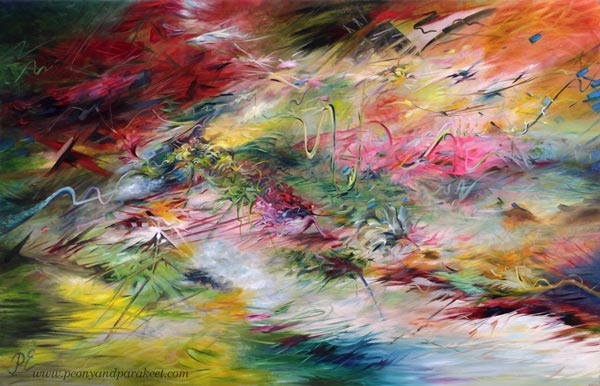
This oil painting, “Kotona Plutossa – At Home in Pluto,” is a part of my series Linnunrata – Milky Way, where I explore planets and outer space. (See previous work: the Earth here, Venus here, and the Sun here!)
Many Inspiration Sources
Earlier this year, I saw a documentary about Pluto, and it felt more familiar than many other planets that I have only read about. In the series, I imagine how the Milky Way could bloom and only take a small dose of the facts about the Planet.
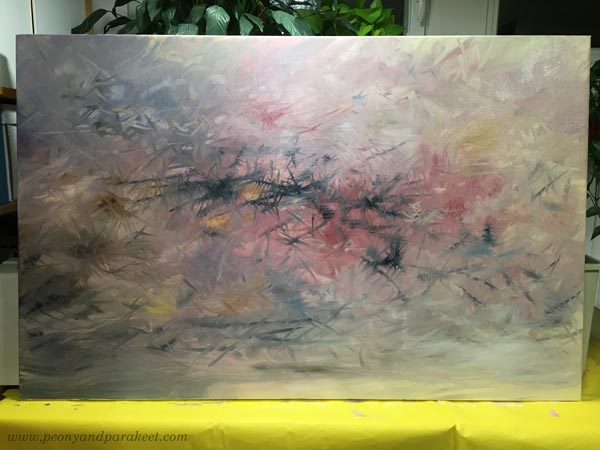
Pluto’s ice volcanoes started the painting, but then I brought in more ideas. The central idea for this painting was home decor. I love mid-century modern houses and furniture, and many of the shapes have a similar feel.
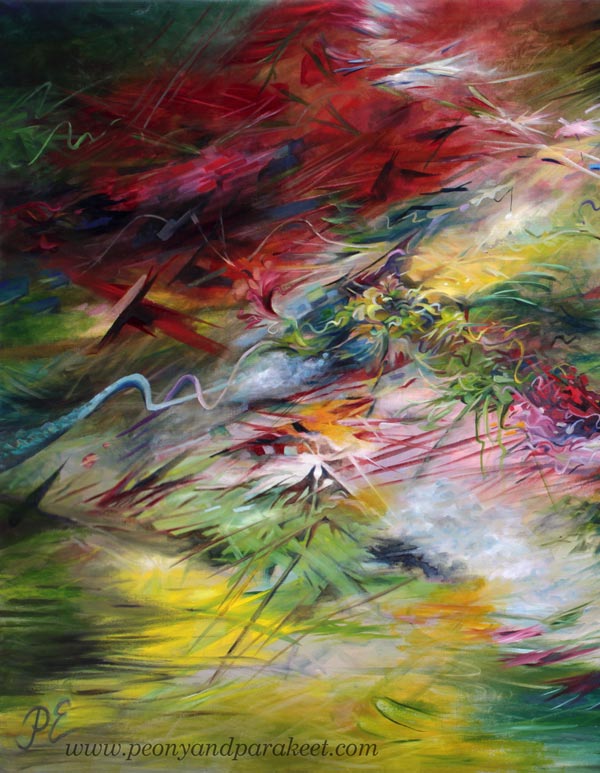
Tricia Guild’s fabrics were another inspiration source. I have been her fan for decades and don’t even have to look at her photos to know what kind of florals she would like to bring to the painting.
Introvert or Extrovert? – Changing the Approach
Even if Pluto is a dwarf planet, this is my biggest painting so far. My style is detailed, and there’s a lot of space in 90 x 140 cm (about 35,5 x 55 inches). There were moments when I felt very unsure about how to proceed because when I asked the painting, it stayed quiet. “Can you hear me, Pluto?” I whispered several times. No response.
This painting clearly was an introvert. I felt like I wanted to quit.
I recognize this syndrome – what I call Big Picture Syndrome – by its signs:
- You feel the need to look at the piece only from the big picture perspective, as a quick stroke here and another there would magically make everything work. In truth, you don’t yet have a clue what the carrying theme for the piece is, and should discover it by making the details more inspiring.
- You feel negative about your potential as an artist but try to convince yourself that the piece is good enough. That someone will like it. And at the same time, you know it’s only an excuse for quitting. The truth is that some pieces are harder than others. Some paintings are extroverts that begin to speak to you right away. And some are introverts that need more time to open up. No need to blame yourself for that. Just keep working and trying to figure out what the piece wants!
“Can you hear me, Pluto?” I asked after bringing in new ideas and adjusting colors and shapes. I was relieved when she answered shyly “Pluto hears.” And when I finished the painting, it felt like coming home.
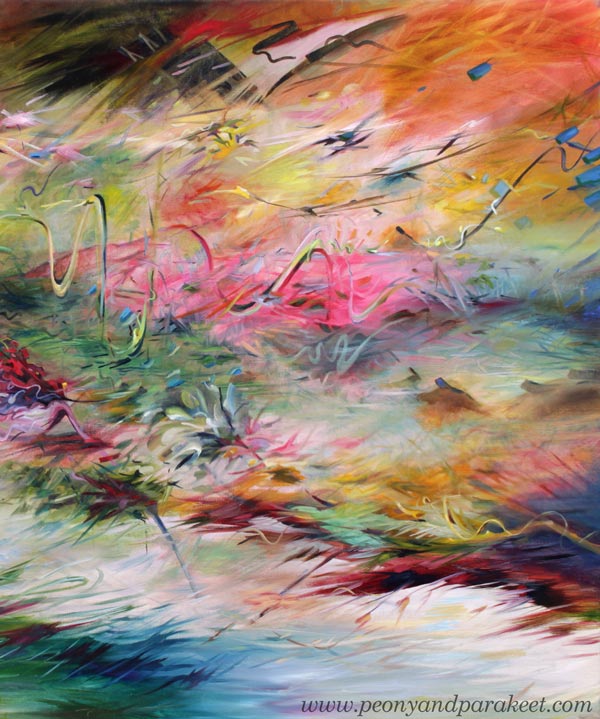
Listening to an introvert painting is always helpful for learning new things about yourself. I became more aware of how much textiles and fabrics inspire me and I want to show that more later too. If you only accept extrovert art, moving forward is more difficult.
Childhood of an Introvert
Another thing that came to my mind was this small crayon piece from about 40 years ago. ( Read more about this one here!)
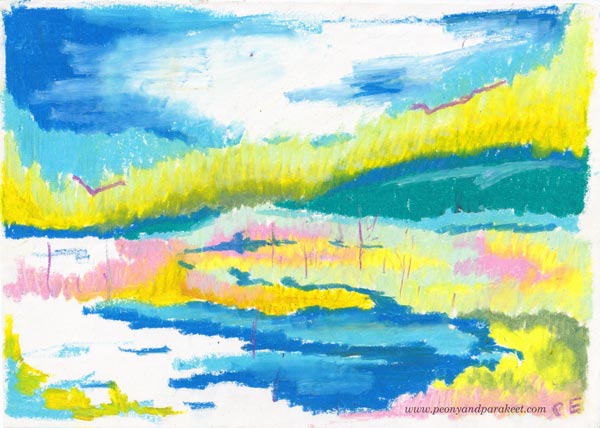
When I put it here, I am astonished at how similar these two pieces look. No wonder she was so shy, there are a lot of years between us!
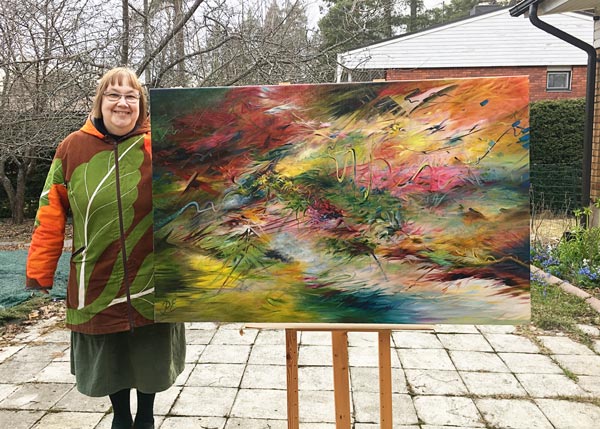
Everything has changed, and nothing has changed over the years, isn’t that so? Introvert or extrovert – try it!
Preparing For the Solo Show
My first solo show Linnunrata will be in June, and it’s keeping me super busy! I still have a couple of paintings that are not finished, and there are lots of edges to paint, hanging wires to attach, and varnishing to do. My current plan is to show 18 paintings, and every single one still has something that I need to do before the show. And there are posters to design, marketing to do, a lot of work!
Linnunrata will be at Gallery K, Tikkurila, Vantaa in June 3-19, 2022.
Expressing Happiness in Art
This week, we look under ice and talk about expressing happiness!
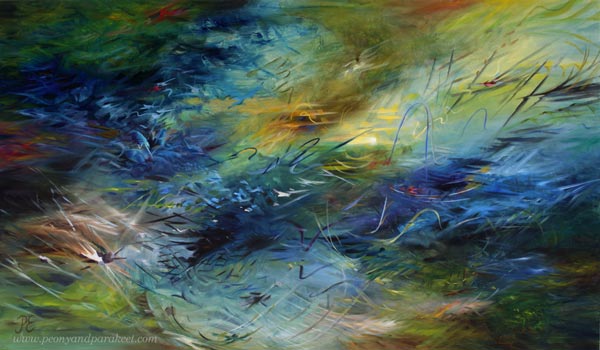
What’s in the Name?
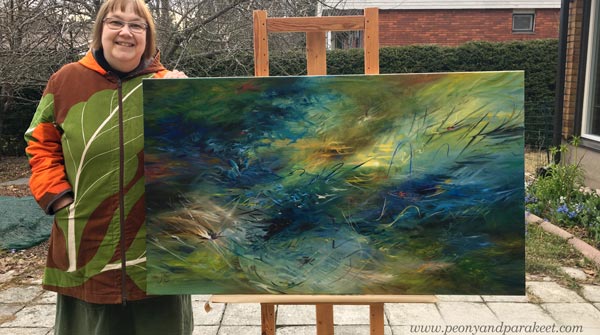
Here’s one of my latest paintings called Onnellisten maa. Like so many times before, I had difficulties translating it, but I came to a conclusion that the English name can be a bit different “Happy Earth” instead of “The Land of Happy Ones.” Maa is both earth and land in Finnish.
This painting is a part of my series Linnunrata – Milky Way, where I explore planets and outer space. The painting represents the planet Earth and Finland, my home country. (See previous paintings: Venus here and the Sun here!)
The name Linnunrata also has a double meaning in Finnish. It’s not only the name of our galaxy but also means bird’s route or track. My paintings often have bird-like shapes and flying objects, so it’s a perfect name for the series and for the upcoming exhibition that will also have some older pieces.
Inspired by Ice
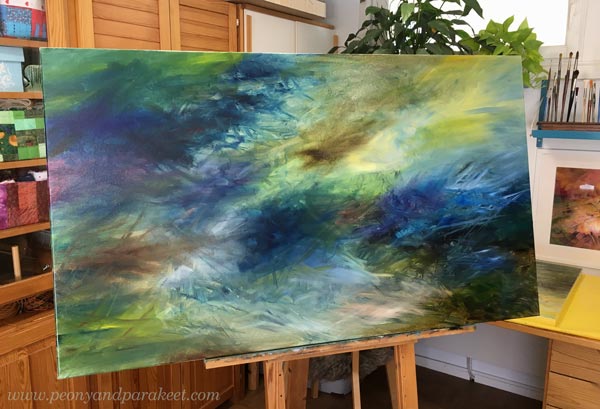
Here’s how the painting started – lots of wild strokes in icy greens.
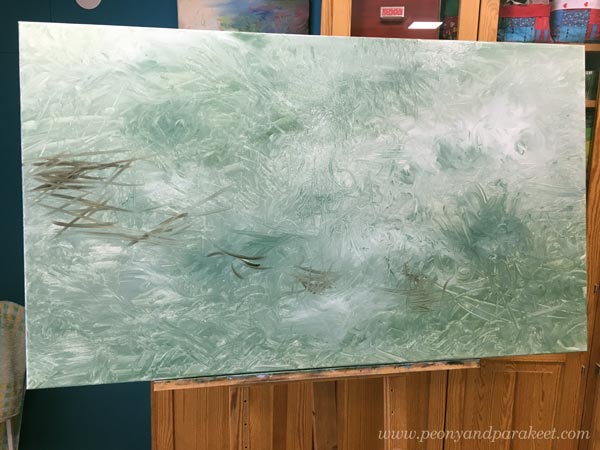
These greens are composed of Titanium White, Raw Umber, and Nicosia Green Earth. The green is a new color that I purchased recently. It’s earthy, not bright at all, but wonderfully suitable for an intuitive painting inspired by our globe.
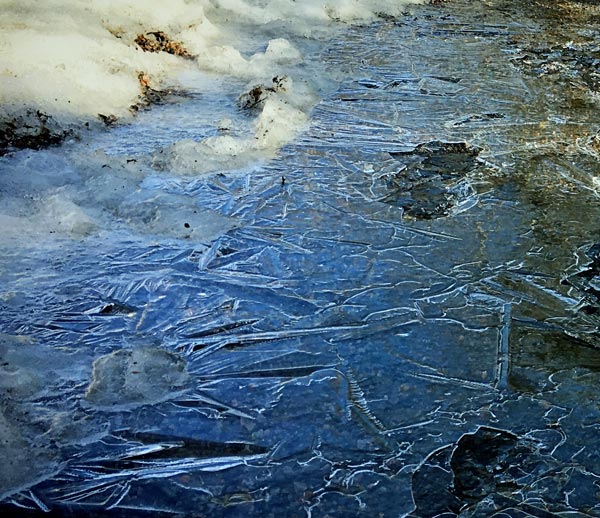
I also wanted to throw in some blue. At the beginning of April, thin ice covered all the puddles and reflected the sky.
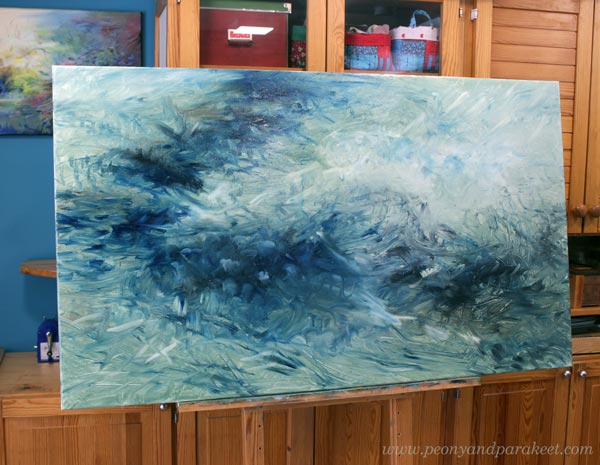
Here’s how the painting looked after adding some Prussian Blue over the greens.
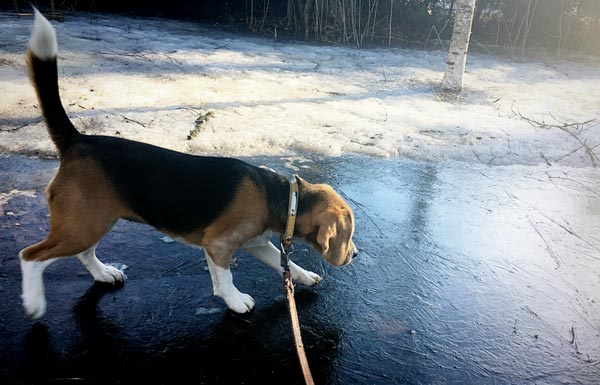
My puppy Saima found ice interesting too!
We in Finland are known for icy surfaces, not only in nature but in people too. Our most known celebrity must be a winning formula driver Kimi Räikkönen, also known as The Iceman. “Shut up, let me drive” was his regular message to the team when he was in the middle of the race.
But ice is never only ice. It makes us think about what’s under it. How does Räikkönen feel when he turns the wheel and pushes the pedals – pressure, joy, passion? What is the storm inside an icy person?
Expressing Happiness
Despite all the ice, Finland has been selected as the happiest country in the world again. It’s the fifth time in a row! With the painting, I wanted to tell what makes Finland the happiest. At the same time, I wanted to express what makes the planet Earth so special.
So, it was time to break the ice and bring in more colors.
The best feeling when creating art is freedom. We are free to express and discover.
When expressing happiness, seek signs of life. For example:
- Could that spot move if I poke it with a line?
- Could those two lines be connected and thus get wings?
And when a creature is born, let him live in peace! Don’t force him to look like a certain species, but let him be unique in his world. I often aim for the impression of an uncharted area where a human, the viewer, enters for the first time.

I also try to express impact so that the painting makes sense. So, make the movement in one corner cause something else to change. And when you introduce a new color, do it gradually so that it doesn’t only flourish. There should be a beginning and an end to its path.

These two needs are not only what a painting or a drawing hopes to have. They are also important for humans. We want to feel independent and free and still impactful and connected so that life moves forward. I think Finland has been successful in both.
Now, most ice has melted, and our spring has started. Some say that Finnish people change when the summer comes. They see us stop to look at the sun and even smile sometimes!
Painting and teaching are my ways to express happiness.
How have you spread happiness through art?
Bringing Old-World Feel to Abstract Floral Painting
This week, let’s dive into the old-world feel and get inspired by the opera singer Edita Gruberová!
Ideas Behind the Painting
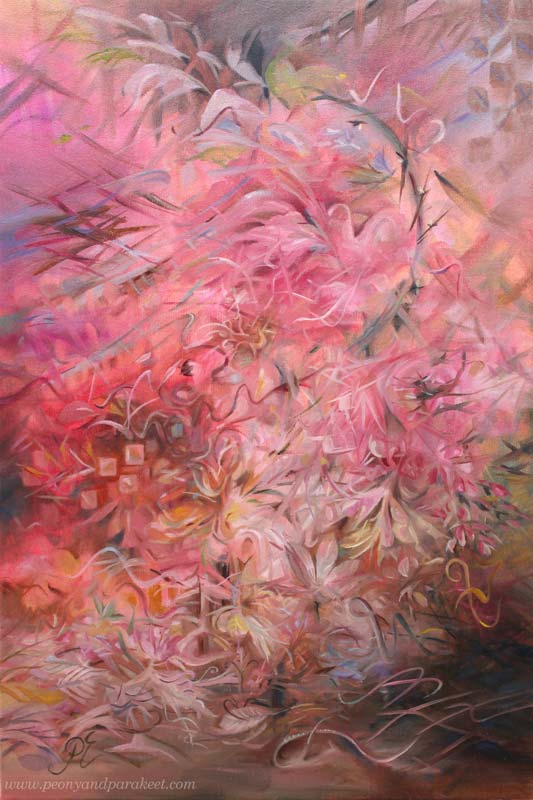
I listened to the opera singer Edita Gruberová (1946-2021) while working on this painting. Her version of the famous aria Queen of the Night from the opera Magic Flute is exquisite. Gruberová’s voice is partly like a bird’s not a human’s voice at all, and the aria brings that up well. The music editor Outi Paananen calls her a nightingale of Slovakia.
The transformation from a human to a bird felt inspiring. Maybe I could do a transformation of a painting so that my free and careless strokes would turn into decorative swirls, adding an old-world feel to an abstract floral painting. I had done something similar just recently but in a much smaller piece. See this blog post where I revamped a flower painting! From that experiment, I knew that it would take both time and patience. In a bigger piece, I could also get lost in the details so that the painting becomes confusing.
Before listening to Edita Gruberová, I already had a lot of ideas, collected in the blog post called Pink Inspiration. And now I wanted to add her and her birds to the painting too. I heard Edita’s story from Outi Paananen’s excellent radio program “Narrin aamulaulu” (in Finnish) on the Finnish Broadcasting Company. She had a clear artistic vision and strong willpower, and she demanded a lot of herself. It inspired me to challenge myself too.
Bringing Old-World Feel – 2 Tips!
In the past, painters often started with sketches and made detailed underpaintings with two or three colors. But a looser approach is not an enemy to the old-world feel.
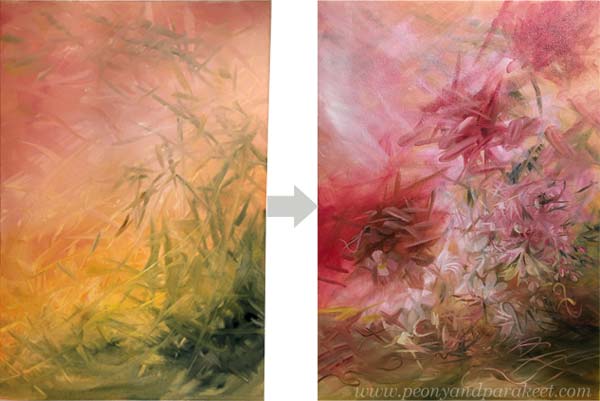
When you want to bring an old-world feel to an abstract painting, two things are the most important:
- Blurry on the bottom! Start from the background with soft transitions from light to dark, add blurry shapes, and paint like you would see the scenery from a far distance.
- Sharp on the top! Add sharp shapes and lines on the top of blurry ones. You can sharpen some blurry shapes but do it only partly, leaving some parts more undefined. But most importantly, let sharp lines and shapes sing the melody of their own. If the background is the orchestra, the top layer is the singer that has a melody of her own.
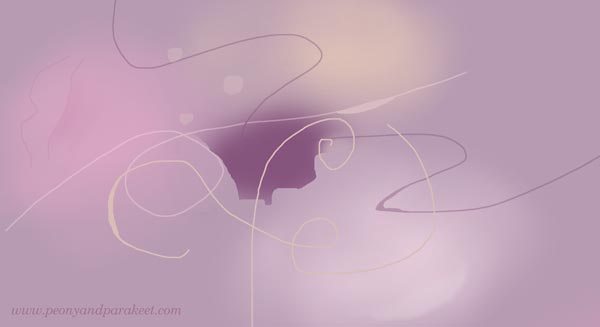
The thickness of the lines can change in places and there can be decorative dots too.
Timelessness Takes Time
It’s always tempting to get the piece finished quickly, but to get the sense of timelessness, the time has to stop while painting. So, I focused on tiny details and immersed myself in building a wondrous world with curves and swirls.
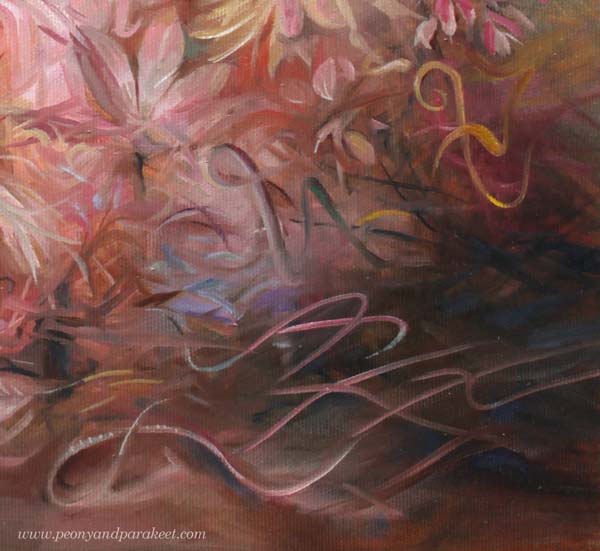
My lines are like old-fashioned handwriting in places. I have practiced them by drawing for a few years. Any note or waste paper can be used for practicing! I often doodled on planner pages.
Intuition and the Ability to (Not to!) See
As usual, I didn’t use any direct reference photos for the painting but worked intuitively. However, I tried to reduce the human ability to see ordinary concrete objects like flowers, faces, or such in simple forms. For a long time, I have thought that the ability to see is a part of creativity. But the more I create, the less I need the ability, at least in the first place. Seeing too soon makes me hurry and my art much less unique. So I try to let the shapes fly free and the big picture appear without too much forcing and seeing.

During the process, a little bird-like mesh appeared on the right. When I was making the final touches, and intentionally made him a partner in the center.

Sadly, Edita died last year, just before I discovered her, so I can’t send her a photo. But I want to honor her with this blog post and ask you to listen to her singing on Youtube. Isn’t that inspiring!
A Series in Progress
I have been painting like mad this month because I have to get everything finished for my solo show in June very soon. So, there are lots of paintings in progress in the studio!
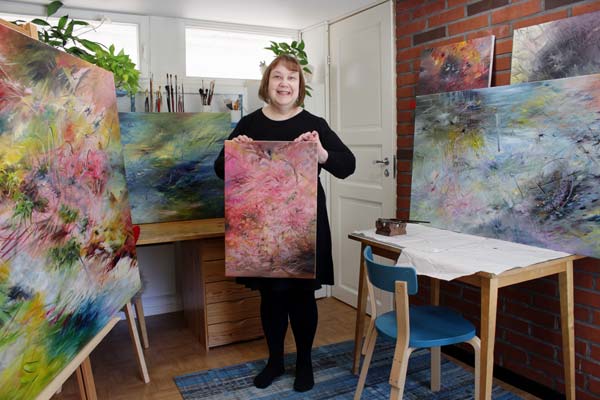
Easter was mostly spent with brushes, and if this wasn’t my ultimate passion, I would be quite exhausted already! Also, seeing the flow of wonderful creations from the students in my community Bloom and Fly energizes me a lot.
Let’s keep creating and inspiring each other!